Question 1:
In what ways does your media product use, develop,
challenge forms and conventions of real media texts?
FRONT COVER
For my magazine front cover I used a large mid shot image because
this type of shot was very common in hip hop magazines. Also this is
good because you can see the artist’s clothes which shows what hip
hop artists wear and how they look. Also on my front cover I used the
left hand third because this shows how I can put the information
about what's inside the magazine. Also in hip hop magazines the sub-
headings for the articles are commonly on the left side which I have
done as well. Also on my front cover I have added cover lines to it
which gives the customer short detail to what is inside and will intrigue
them to buying and reading it. Also commonly in music magazines
there is a date, prices and a barcode.
For my magazine I have added a barcode and have put a QR code on
my front cover. I decided to add a QR code because it challenges the
conventions of a real magazine which stands out. Also on magazines
there is promotions which advertise certain events like music festivals,
however I have decided ton advertise a boxing match. This links in well
with the theme because the event is between hip hop artists and the
music magazine is based on hip hop. I researched different magazines
and the front cover for most of them had three main colours. I also
did this because it made the magazine look professional and the red,
black and white colours I used all linked well with each other.
CONTENTS PAGE
When I decided to make my contents page I was influenced by one produced by the
Source. I thought the layout of this was very professional and I decided to recreate the
conventions this.
I challenged the forms of this design by adjusting the colour scheme which then linked
well with my front cover. Also the combination of red, black and white suited each other,
whereas on the one I chosen this was not the same. There was one dominant colour,
which was white. First I chose to put the whole name of the masthead at the top and the
bottom of the page but then changed this because of feedback I had received. This then
changed because on the contents page I chose to develop only used the first letter of the
masthead and put an object behind it which looked better so I did the same. Also I liked
the subheadings on the contents page that explained what headings were going to be in
that section, so I did this myself. Also I took inspiration from the way the contents were
written. This is because on the source’s contents page they gave brief explanation to what
the heading meant, so I also did this for most of my subheadings.
Furthermore, the colour scheme was continued for my contents page because I
researched that the house style theme was very popular and successful. Therefore I
carried this onto my magazine. Also I challenged the forms of this real media product by
adding another image onto the page. This was to show various artist out there and not
keep putting the same artist on each page, this would give the audience a view of other
upcoming artists.
DOUBLE PAGE SPREAD
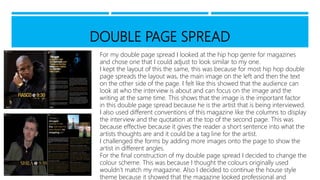
For my double page spread I looked at the hip hop genre for magazines
and chose one that I could adjust to look similar to my one.
I kept the layout of this the same, this was because for most hip hop double
page spreads the layout was, the main image on the left and then the text
on the other side of the page. I felt like this showed that the audience can
look at who the interview is about and can focus on the image and the
writing at the same time. This shows that the image is the important factor
in this double page spread because he is the artist that is being interviewed.
I also used different conventions of this magazine like the columns to display
the interview and the quotation at the top of the second page. This was
because effective because it gives the reader a short sentence into what the
artists thoughts are and it could be a tag line for the artist.
I challenged the forms by adding more images onto the page to show the
artist in different angles.
For the final construction of my double page spread I decided to change the
colour scheme. This was because I thought the colours originally used
wouldn’t match my magazine. Also I decided to continue the house style
theme because it showed that the magazine looked professional and

Question 1

  • 1.
    Question 1: In whatways does your media product use, develop, challenge forms and conventions of real media texts?
  • 2.
    FRONT COVER For mymagazine front cover I used a large mid shot image because this type of shot was very common in hip hop magazines. Also this is good because you can see the artist’s clothes which shows what hip hop artists wear and how they look. Also on my front cover I used the left hand third because this shows how I can put the information about what's inside the magazine. Also in hip hop magazines the sub- headings for the articles are commonly on the left side which I have done as well. Also on my front cover I have added cover lines to it which gives the customer short detail to what is inside and will intrigue them to buying and reading it. Also commonly in music magazines there is a date, prices and a barcode. For my magazine I have added a barcode and have put a QR code on my front cover. I decided to add a QR code because it challenges the conventions of a real magazine which stands out. Also on magazines there is promotions which advertise certain events like music festivals, however I have decided ton advertise a boxing match. This links in well with the theme because the event is between hip hop artists and the music magazine is based on hip hop. I researched different magazines and the front cover for most of them had three main colours. I also did this because it made the magazine look professional and the red, black and white colours I used all linked well with each other.
  • 3.
    CONTENTS PAGE When Idecided to make my contents page I was influenced by one produced by the Source. I thought the layout of this was very professional and I decided to recreate the conventions this. I challenged the forms of this design by adjusting the colour scheme which then linked well with my front cover. Also the combination of red, black and white suited each other, whereas on the one I chosen this was not the same. There was one dominant colour, which was white. First I chose to put the whole name of the masthead at the top and the bottom of the page but then changed this because of feedback I had received. This then changed because on the contents page I chose to develop only used the first letter of the masthead and put an object behind it which looked better so I did the same. Also I liked the subheadings on the contents page that explained what headings were going to be in that section, so I did this myself. Also I took inspiration from the way the contents were written. This is because on the source’s contents page they gave brief explanation to what the heading meant, so I also did this for most of my subheadings. Furthermore, the colour scheme was continued for my contents page because I researched that the house style theme was very popular and successful. Therefore I carried this onto my magazine. Also I challenged the forms of this real media product by adding another image onto the page. This was to show various artist out there and not keep putting the same artist on each page, this would give the audience a view of other upcoming artists.
  • 4.
    DOUBLE PAGE SPREAD Formy double page spread I looked at the hip hop genre for magazines and chose one that I could adjust to look similar to my one. I kept the layout of this the same, this was because for most hip hop double page spreads the layout was, the main image on the left and then the text on the other side of the page. I felt like this showed that the audience can look at who the interview is about and can focus on the image and the writing at the same time. This shows that the image is the important factor in this double page spread because he is the artist that is being interviewed. I also used different conventions of this magazine like the columns to display the interview and the quotation at the top of the second page. This was because effective because it gives the reader a short sentence into what the artists thoughts are and it could be a tag line for the artist. I challenged the forms by adding more images onto the page to show the artist in different angles. For the final construction of my double page spread I decided to change the colour scheme. This was because I thought the colours originally used wouldn’t match my magazine. Also I decided to continue the house style theme because it showed that the magazine looked professional and