Anna Mastora & Sarantos Kapidakis
Laboratory on Digital Libraries and Electronic Publishing
     Department of Archives and Library Science
                   Ionian University

2nd Workshop on Digital Information Management
              25-26 April 2012, Corfu, Greece
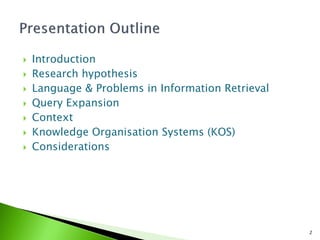
   Introduction
   Research hypothesis
   Language & Problems in Information Retrieval
   Query Expansion
   Context
   Knowledge Organisation Systems (KOS)
   Considerations


                                                   2
   Information Retrieval (IR) is about retrieving
    relevant results as response to expressed
    information needs
   The expression of information needs uses natural
    language representations
    ◦ Language is clearly ambiguous (Szostak, 2010)
       Not all linguistic representations are distinguishably
        informative of the user’s intent


                                                                 3
   Description of terms
    ◦ Deals with each term individually
      e.g. definitions in a dictionary


   Discrimination of terms
    ◦ Deals with the relations between terms
      e.g. hierarchical relationships within a thesaurus


                                                       (Blair, 2006)


                                                                       4
   By studying the actual use of language in every-day
    activities is how we can clarify meaning; deriving
    information about the context within which words
    are used will help us clarify better the identified
    indeterminacies


                                                          5
   […]for it’s not an underlying logic that clarifies what we
    mean, it’s the context, activities and practices in which we
    use language that provide the fundamental clarification of
    meaning we are looking for (Blair, 2006)

   Only in the stream of thought and life do words have
    meaning. (L. Wittgenstein, “Zettel”, §173)

   Meaning depends on consistent usage but requires more than
    that; it also requires that speakers be able to check that
    someone’s usage is consistent (Jaworski, 2011)


                                                                   6
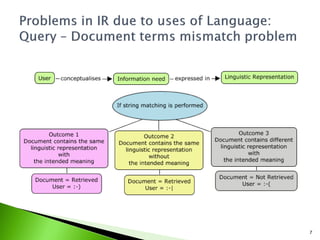
7
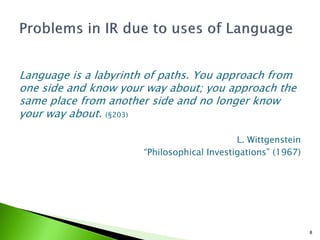
Language is a labyrinth of paths. You approach from
one side and know your way about; you approach the
same place from another side and no longer know
your way about. (§203)

                                            L. Wittgenstein
                      “Philosophical Investigations” (1967)


                                                              8
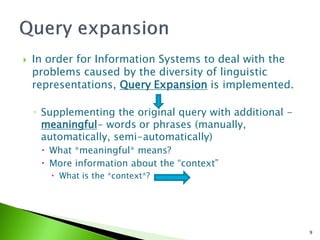
   In order for Information Systems to deal with the
    problems caused by the diversity of linguistic
    representations, Query Expansion is implemented.

    ◦ Supplementing the original query with additional -
      meaningful- words or phrases (manually,
      automatically, semi-automatically)
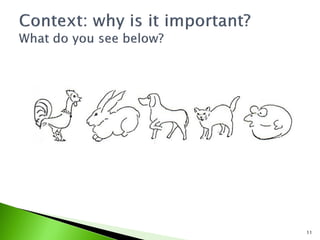
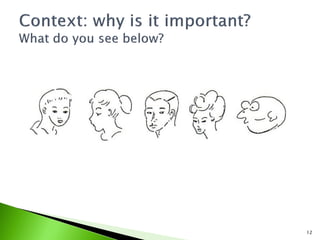
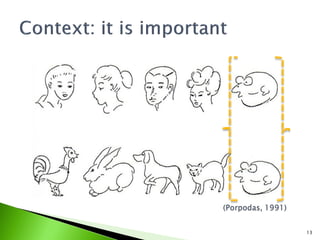
      What *meaningful* means?
      More information about the “context”
        What is the *context*?


                                                           9
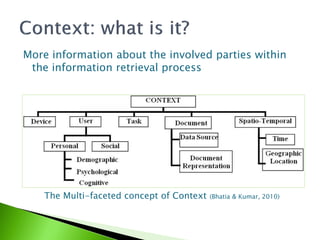
More information about the involved parties within
 the information retrieval process


    The Multi-faceted concept of Context   (Bhatia & Kumar, 2010)
11
12
13
- asking the users explicitly
- statistical processing of log files (e.g. Query chains)
- qualitative evaluation of log files, data or systems
- pre-processing of document corpora
- machine learning techniques (un-, semi-, supervised)
- implementation of user behaviour models
- personalisation/ profiling of users
- knowledge organisation structures
- ...


                                                            14
   Meant to be some kind of a problem solver; a mediator
    between the inquirer and the content which is stored in
    the documents


    ◦ Placing a concept within a hierarchical definition establishes
     what sort of thing this is and what sort of thing it is not,
     and often sorts the subsidiary elements of which it may be
     comprised (Szostak, 2010)


                                                                       15
The expert does not hold a “more complete”
definition of the words than we do. He simply
knows more about certain words than we do, and
by providing this additional information about
them, it may be useful for identifying each word in
different circumstances.
                                         (Blair, 2006)


                                                         16
   Schemes for organising information & promoting knowledge
    management (Hodge, 2000)
    ◦ Term lists (authority files, glossaries, dictionaries, gazetteers)
    ◦ Classification & categories (classification scheme, taxonomy,
      subject headings)
    ◦ Relationship lists (thesaurus, semantic network, ontology)
   Constitute ways for formalising knowledge and,
    consequently, communication through linguistic expressions
    or any other kind of definitional or descriptive sign, like
    visual.
   Used in Query Expansion to derive context


                                                                           17
   The epistemological basis of any theory of
    Knowledge Organization is an accepted postulate.
    In other words, how knowledge is organized and
    represented depends largely on the understanding
    of how knowledge is organized and represented.
                                   (Alexiev & Marksbury, 2010)


                                                                 18
   Since language is involved in their creation and
    development, KOSs bear themselves the inherent
    characteristics of the use of language
    ◦ Ambiguity [PoS: “looks”, Semantic: “bank”, Syntactic: “He hit
      the girl with the hat”]
    ◦ Homonymy [Homophones: “too /two”, Homographs: “tire”]
    ◦ Polysemy [“mouth” (on the face OR the opening of a cave)]
    ◦ Synonymy [“sick – ill”]


                                                                      19
   Even if KOSs try to capture and deliver the absolute
    meaning [or a more targeted one] of what they
    describe, they still are considered “collection
    independent knowledge structures” (Efthimiadis, 1996)
    ◦ There still are missing parts for the communication
      of the intended meaning

    Ambiguity differs only by degree between universal
     and domain-specific classifications, though that
     difference of degree is likely quite significant
                                              (Szostak, 2010)


                                                                20
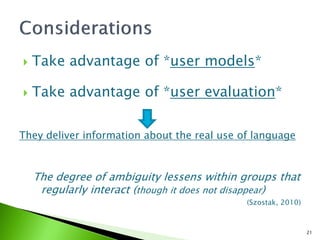
   Take advantage of *user models*

   Take advantage of *user evaluation*

They deliver information about the real use of language


    The degree of ambiguity lessens within groups that
     regularly interact (though it does not disappear)
                                             (Szostak, 2010)


                                                               21
Thank you!
                                                              Contact:
                                                        Anna Mastora
                                            mastora [at] ionio [dot] gr


This research has been co-financed by the European Union (European Social Fund
– ESF) and Greek national funds through the Operational Program "Education and
Lifelong Learning" of the National Strategic Reference Framework (NSRF) -
Research Funding Program: Heracleitus II. Investing in knowledge society through
the European Social Fund.


                                                                                   22

Query Expansion and Context: Thoughts on Language, Meaning and Knowledge Organisation

  • 1.
    Anna Mastora &Sarantos Kapidakis Laboratory on Digital Libraries and Electronic Publishing Department of Archives and Library Science Ionian University 2nd Workshop on Digital Information Management 25-26 April 2012, Corfu, Greece
  • 2.
    Introduction  Research hypothesis  Language & Problems in Information Retrieval  Query Expansion  Context  Knowledge Organisation Systems (KOS)  Considerations 2
  • 3.
    Information Retrieval (IR) is about retrieving relevant results as response to expressed information needs  The expression of information needs uses natural language representations ◦ Language is clearly ambiguous (Szostak, 2010)  Not all linguistic representations are distinguishably informative of the user’s intent 3
  • 4.
    Description of terms ◦ Deals with each term individually  e.g. definitions in a dictionary  Discrimination of terms ◦ Deals with the relations between terms  e.g. hierarchical relationships within a thesaurus (Blair, 2006) 4
  • 5.
    By studying the actual use of language in every-day activities is how we can clarify meaning; deriving information about the context within which words are used will help us clarify better the identified indeterminacies 5
  • 6.
    […]for it’s not an underlying logic that clarifies what we mean, it’s the context, activities and practices in which we use language that provide the fundamental clarification of meaning we are looking for (Blair, 2006)  Only in the stream of thought and life do words have meaning. (L. Wittgenstein, “Zettel”, §173)  Meaning depends on consistent usage but requires more than that; it also requires that speakers be able to check that someone’s usage is consistent (Jaworski, 2011) 6
  • 7.
  • 8.
    Language is alabyrinth of paths. You approach from one side and know your way about; you approach the same place from another side and no longer know your way about. (§203) L. Wittgenstein “Philosophical Investigations” (1967) 8
  • 9.
    In order for Information Systems to deal with the problems caused by the diversity of linguistic representations, Query Expansion is implemented. ◦ Supplementing the original query with additional - meaningful- words or phrases (manually, automatically, semi-automatically)  What *meaningful* means?  More information about the “context”  What is the *context*? 9
  • 10.
    More information aboutthe involved parties within the information retrieval process The Multi-faceted concept of Context (Bhatia & Kumar, 2010)
  • 11.
  • 12.
  • 13.
  • 14.
    - asking theusers explicitly - statistical processing of log files (e.g. Query chains) - qualitative evaluation of log files, data or systems - pre-processing of document corpora - machine learning techniques (un-, semi-, supervised) - implementation of user behaviour models - personalisation/ profiling of users - knowledge organisation structures - ... 14
  • 15.
    Meant to be some kind of a problem solver; a mediator between the inquirer and the content which is stored in the documents ◦ Placing a concept within a hierarchical definition establishes what sort of thing this is and what sort of thing it is not, and often sorts the subsidiary elements of which it may be comprised (Szostak, 2010) 15
  • 16.
    The expert doesnot hold a “more complete” definition of the words than we do. He simply knows more about certain words than we do, and by providing this additional information about them, it may be useful for identifying each word in different circumstances. (Blair, 2006) 16
  • 17.
    Schemes for organising information & promoting knowledge management (Hodge, 2000) ◦ Term lists (authority files, glossaries, dictionaries, gazetteers) ◦ Classification & categories (classification scheme, taxonomy, subject headings) ◦ Relationship lists (thesaurus, semantic network, ontology)  Constitute ways for formalising knowledge and, consequently, communication through linguistic expressions or any other kind of definitional or descriptive sign, like visual.  Used in Query Expansion to derive context 17
  • 18.
    The epistemological basis of any theory of Knowledge Organization is an accepted postulate. In other words, how knowledge is organized and represented depends largely on the understanding of how knowledge is organized and represented. (Alexiev & Marksbury, 2010) 18
  • 19.
    Since language is involved in their creation and development, KOSs bear themselves the inherent characteristics of the use of language ◦ Ambiguity [PoS: “looks”, Semantic: “bank”, Syntactic: “He hit the girl with the hat”] ◦ Homonymy [Homophones: “too /two”, Homographs: “tire”] ◦ Polysemy [“mouth” (on the face OR the opening of a cave)] ◦ Synonymy [“sick – ill”] 19
  • 20.
    Even if KOSs try to capture and deliver the absolute meaning [or a more targeted one] of what they describe, they still are considered “collection independent knowledge structures” (Efthimiadis, 1996) ◦ There still are missing parts for the communication of the intended meaning Ambiguity differs only by degree between universal and domain-specific classifications, though that difference of degree is likely quite significant (Szostak, 2010) 20
  • 21.
    Take advantage of *user models*  Take advantage of *user evaluation* They deliver information about the real use of language The degree of ambiguity lessens within groups that regularly interact (though it does not disappear) (Szostak, 2010) 21
  • 22.
    Thank you! Contact: Anna Mastora mastora [at] ionio [dot] gr This research has been co-financed by the European Union (European Social Fund – ESF) and Greek national funds through the Operational Program "Education and Lifelong Learning" of the National Strategic Reference Framework (NSRF) - Research Funding Program: Heracleitus II. Investing in knowledge society through the European Social Fund. 22