Quarter 1 – Module 5
Colors of Light
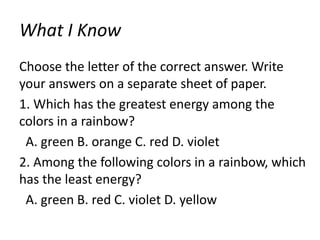
What I Know
Choose the letter of the correct answer. Write
your answers on a separate sheet of paper.
1. Which has the greatest energy among the
colors in a rainbow?
A. green B. orange C. red D. violet
2. Among the following colors in a rainbow, which
has the least energy?
A. green B. red C. violet D. yellow
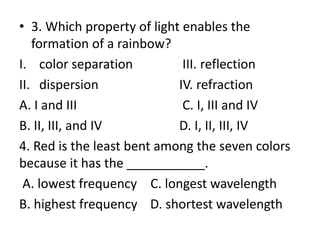
• 3. Which property of light enables the
formation of a rainbow?
I. color separation III. reflection
II. dispersion IV. refraction
A. I and III C. I, III and IV
B. II, III, and IV D. I, II, III, IV
4. Red is the least bent among the seven colors
because it has the ___________.
A. lowest frequency C. longest wavelength
B. highest frequency D. shortest wavelength
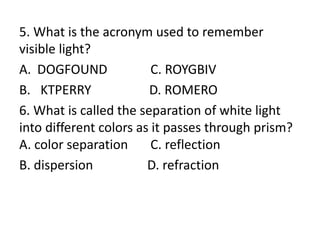
5. What is the acronym used to remember
visible light?
A. DOGFOUND C. ROYGBIV
B. KTPERRY D. ROMERO
6. What is called the separation of white light
into different colors as it passes through prism?
A. color separation C. reflection
B. dispersion D. refraction
7. Which of the following orders of visible light colors
shows increasing wavelength?
A. red, orange, yellow, green, blue, indigo, violet
B. red, yellow, green, orange, violet, blue, indigo
C. violet, indigo, blue, green, yellow, orange, red
D. violet, blue, green, orange, red, indigo, yellow
8. Why does white light separate into different colors
as it passes through a prism?
A. The colors are changed by addition.
B. This is an example of color by subtraction.
C. Different colored light has different wavelengths.
D. The side part of a prism only let certain colors of
light pass through.
• 9. A second prism will change a spectrum back into white
light. What does it show?
A. Prism distorts image.
B. Prisms are transparent.
C. Light travels at a constant speed.
D. White light is composed of colors.
10.Which of the following is true about the relationship
between frequency and energy?
A. The frequency of the color of light and energy are not
related.
B. As the frequency of the color of light increases, its energy
decreases.
C. As the frequency of the color of light decreases, the
energy increases.
D. As the frequency of the color of light increases, the
energy also increases.
11.Which color has the shortest wavelength?
A. green B. red C. yellow D. violet
12. Which of the following statements is incorrect?
A. Short wavelength corresponds to low frequency.
B. Frequency and wavelength are inversely related.
C. High frequency light corresponds to short
wavelength.
D. Low frequency light corresponds to long
wavelength.
13. Based on the colors of light, what color comes
between blue and violet?
A. indigo B. green C. orange D. violet
14. Which of the following colors of light bend the
most?
A. indigo B. green C. orange D. violet
15.White light separated through a prism is an
example of ___________.
A. diffraction B. rarefaction C. reflection D.
refraction
• Lesson 1 Colors of Light
What’s In
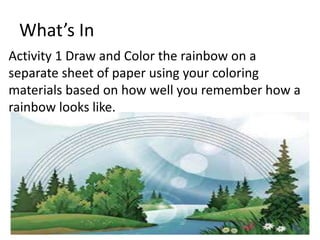
Activity 1 Draw and Color the rainbow on a
separate sheet of paper using your coloring
materials based on how well you remember how a
rainbow looks like.
What’s New
• Activity 2
Perform the activity below and answer the
questions on a separate sheet of paper.
Objective:
At the end of the activity, you will be able to
infer that white light is made up of many
different colors of light.
Materials: Flashlight or any source of light big
bowl water small mirror paper
Procedure:
1. Fill the big bowl with water almost to its rim.
2. Place the mirror with its part partially
submerged into the water.
3. Hold the paper above the bowl with one hand
and use the other hand to turn on the flashlight or
any source of light into the submerged part of the
mirror.
4. Adjust the position of the mirror until you see
color bands on the paper.
5. Record your observation.
• Questions:
Q1. What happens when the light hits the mirror?
_________________________________________
_________________________________________
_________________________________________
_________________________________________
Q2. List and arrange the observed colors based on
how they appear on the paper.
_________________________________________
_________________________________________
_________________________________________
_________________________________________
What is It
• Color
Were you able to get good sets of data from the activity?
Did you enjoy watching how the rainbow colors appear in
the paper? Light is a kind of energy that can travel
through space in a form of wave. Light from the sun or
flashlights looks white, but it is really a mixture of many
colors. The colors in white light are red, orange, yellow,
green, blue indigo and violet. We highlight here the
arrangement of colors of light as ROYGBIV when
dispersion happens. Dispersion is a kind of refraction
which provided us colors of light. This phenomenon is
observed when white light passes through a prism.

Quarter 1 – Module 5.pptx

  • 1.
    Quarter 1 –Module 5 Colors of Light
  • 2.
    What I Know Choosethe letter of the correct answer. Write your answers on a separate sheet of paper. 1. Which has the greatest energy among the colors in a rainbow? A. green B. orange C. red D. violet 2. Among the following colors in a rainbow, which has the least energy? A. green B. red C. violet D. yellow
  • 3.
    • 3. Whichproperty of light enables the formation of a rainbow? I. color separation III. reflection II. dispersion IV. refraction A. I and III C. I, III and IV B. II, III, and IV D. I, II, III, IV 4. Red is the least bent among the seven colors because it has the ___________. A. lowest frequency C. longest wavelength B. highest frequency D. shortest wavelength
  • 4.
    5. What isthe acronym used to remember visible light? A. DOGFOUND C. ROYGBIV B. KTPERRY D. ROMERO 6. What is called the separation of white light into different colors as it passes through prism? A. color separation C. reflection B. dispersion D. refraction
  • 5.
    7. Which ofthe following orders of visible light colors shows increasing wavelength? A. red, orange, yellow, green, blue, indigo, violet B. red, yellow, green, orange, violet, blue, indigo C. violet, indigo, blue, green, yellow, orange, red D. violet, blue, green, orange, red, indigo, yellow 8. Why does white light separate into different colors as it passes through a prism? A. The colors are changed by addition. B. This is an example of color by subtraction. C. Different colored light has different wavelengths. D. The side part of a prism only let certain colors of light pass through.
  • 6.
    • 9. Asecond prism will change a spectrum back into white light. What does it show? A. Prism distorts image. B. Prisms are transparent. C. Light travels at a constant speed. D. White light is composed of colors. 10.Which of the following is true about the relationship between frequency and energy? A. The frequency of the color of light and energy are not related. B. As the frequency of the color of light increases, its energy decreases. C. As the frequency of the color of light decreases, the energy increases. D. As the frequency of the color of light increases, the energy also increases.
  • 7.
    11.Which color hasthe shortest wavelength? A. green B. red C. yellow D. violet 12. Which of the following statements is incorrect? A. Short wavelength corresponds to low frequency. B. Frequency and wavelength are inversely related. C. High frequency light corresponds to short wavelength. D. Low frequency light corresponds to long wavelength.
  • 8.
    13. Based onthe colors of light, what color comes between blue and violet? A. indigo B. green C. orange D. violet 14. Which of the following colors of light bend the most? A. indigo B. green C. orange D. violet 15.White light separated through a prism is an example of ___________. A. diffraction B. rarefaction C. reflection D. refraction
  • 9.
    • Lesson 1Colors of Light
  • 10.
    What’s In Activity 1Draw and Color the rainbow on a separate sheet of paper using your coloring materials based on how well you remember how a rainbow looks like.
  • 11.
    What’s New • Activity2 Perform the activity below and answer the questions on a separate sheet of paper. Objective: At the end of the activity, you will be able to infer that white light is made up of many different colors of light. Materials: Flashlight or any source of light big bowl water small mirror paper
  • 12.
    Procedure: 1. Fill thebig bowl with water almost to its rim. 2. Place the mirror with its part partially submerged into the water. 3. Hold the paper above the bowl with one hand and use the other hand to turn on the flashlight or any source of light into the submerged part of the mirror. 4. Adjust the position of the mirror until you see color bands on the paper. 5. Record your observation.
  • 13.
    • Questions: Q1. Whathappens when the light hits the mirror? _________________________________________ _________________________________________ _________________________________________ _________________________________________ Q2. List and arrange the observed colors based on how they appear on the paper. _________________________________________ _________________________________________ _________________________________________ _________________________________________
  • 14.
    What is It •Color Were you able to get good sets of data from the activity? Did you enjoy watching how the rainbow colors appear in the paper? Light is a kind of energy that can travel through space in a form of wave. Light from the sun or flashlights looks white, but it is really a mixture of many colors. The colors in white light are red, orange, yellow, green, blue indigo and violet. We highlight here the arrangement of colors of light as ROYGBIV when dispersion happens. Dispersion is a kind of refraction which provided us colors of light. This phenomenon is observed when white light passes through a prism.