Quantum Computing – Notes Ver 1.2
Prepared By: Vijayananda Mohire
Sources: Various open courses, MOOC trainings and self study; no intention for any copyright infringements
Question 1
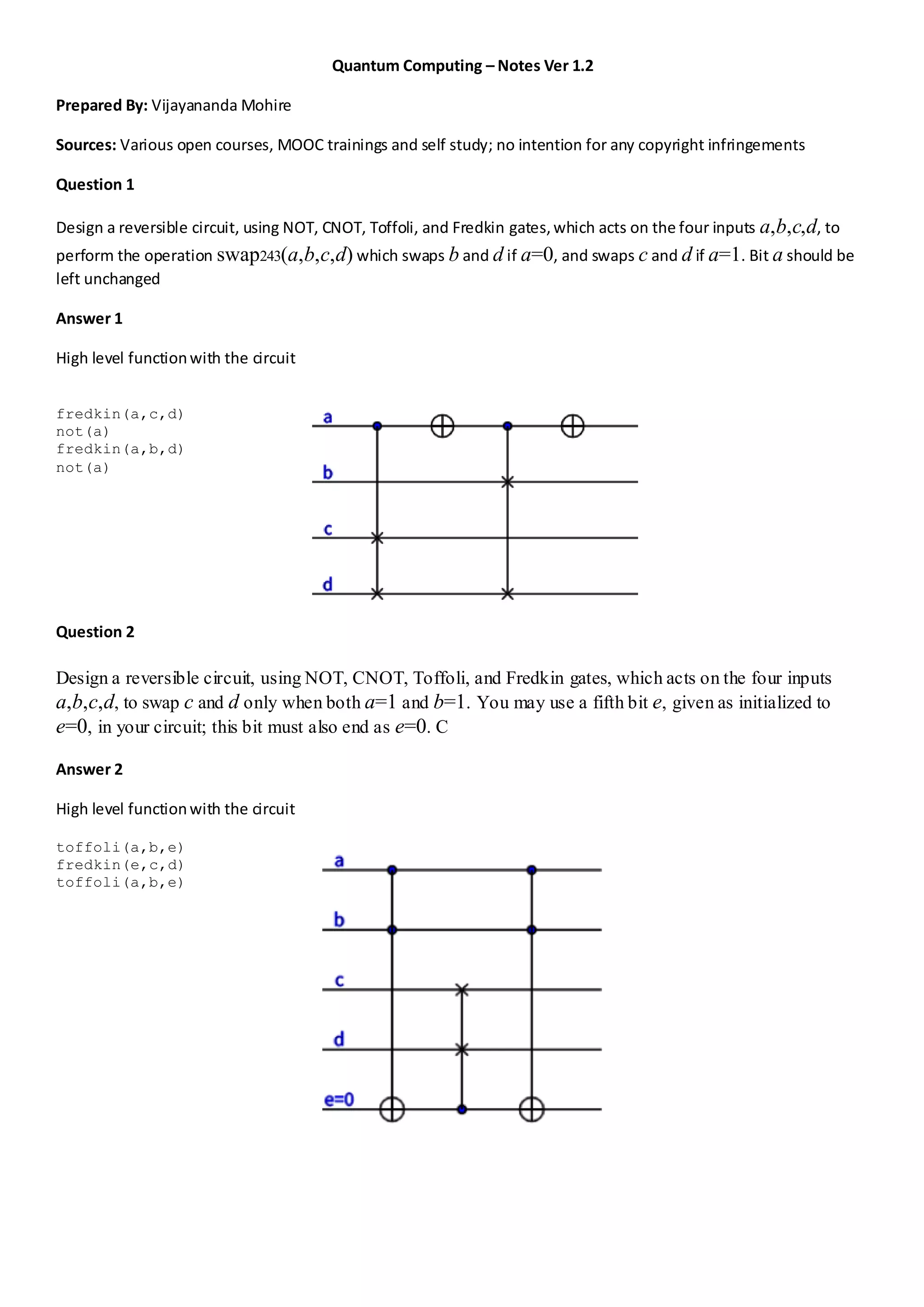
Design a reversible circuit, using NOT, CNOT, Toffoli, and Fredkin gates,which acts on the four inputs a,b,c,d, to
perform the operation swap243(a,b,c,d) which swaps b and d if a=0, and swaps c and d if a=1. Bit a should be
left unchanged
Answer 1
High level functionwith the circuit
fredkin(a,c,d)
not(a)
fredkin(a,b,d)
not(a)
Question 2
Design a reversible circuit, using NOT, CNOT, Toffoli, and Fredkin gates, which acts on the four inputs
a,b,c,d, to swap c and d only when both a=1 and b=1. You may use a fifth bit e, given as initialized to
e=0, in your circuit; this bit must also end as e=0. C
Answer 2
High level functionwith the circuit
toffoli(a,b,e)
fredkin(e,c,d)
toffoli(a,b,e)
Question 3
Sample RandomNumber using Q#
Answer 3
open Microsoft.Quantum.Arrays;
open Microsoft.Quantum.Measurement;
operation SampleRandomNumber(nQubits : Int) : Result[] {
// We prepare a register of qubits in a uniform
// superposition state, such that when we measure,
// all bitstrings occur with equal probability.
use register = Qubit[nQubits] {
// Set qubits in superposition.
ApplyToEachA(H, register);
// Measure all qubits and return.
return ForEach(MResetZ, register);
}
}
Question 4
Run a basic quantum circuit expressed using the Qiskit library to an IonQ target via the Azure Quantum
service.
Answer 4
First, import the required packages for this sample:
from qiskit import QuantumCircuit
from qiskit.visualization import plot_histogram
from qiskit.tools.monitor import job_monitor
from azure.quantum.qiskit import AzureQuantumProvider
#Connect to backend Azure quantum service, using below function
from azure.quantum.qiskit import AzureQuantumProvider
provider = AzureQuantumProvider ( resource_id = " ", location = " " )
# Create a Quantum Circuit acting on the q register
circuit = QuantumCircuit(3, 3)
circuit.name = "Qiskit Sample - 3-qubit GHZ circuit"
circuit.h(0)
circuit.cx(0, 1)
circuit.cx(1, 2)
circuit.measure([0,1,2], [0, 1, 2])
# Print out the circuit
circuit.draw()
┌───┐ ┌─┐
q_0: ┤ H ├──■───────┤M├──────
└───┘┌─┴─┐ └╥┘┌─┐
q_1: ─────┤ X ├──■───╫─┤M├───
└───┘┌─┴─┐ ║ └╥┘┌─┐
q_2: ──────────┤ X ├─╫──╫─┤M├
└───┘ ║ ║ └╥┘
c: 3/════════════════╩══╩══╩═
0 1 2
#Create a Backend object to connect to the IonQ Simulator back-end:
simulator_backend = provider.get_backend("ionq.simulator")
job = simulator_backend.run(circuit, shots=100)
job_id = job.id()
print("Job id", job_id)
#Create a job monitor object
job_monitor(job)
#To wait until the job is completed and return the results, run:
result = job.result()
qiskit.result.result.Result
print(result)
connect to real hardware (Quantum Processing Unit or QPU)
qpu_backend = provider.get_backend("ionq.qpu")
# Submit the circuit to run on Azure Quantum
qpu_job = qpu_backend.run(circuit, shots=1024)
job_id = qpu_job.id()
print("Job id", job_id)
# Monitor job progress and wait until complete:
job_monitor(qpu_job)
# Get the job results (this method also waits for the Job to complete):
result = qpu_job.result()
print(result)
counts = {format(n, "03b"): 0 for n in range(8)}
counts.update(result.get_counts(circuit))
print(counts)
plot_histogram(counts)
Question 5
Develop Google AI sample Cirq circuit
Answer 5
import cirq
qubits = [cirq.GridQubit(x, y) for x in range(3) for y in range(3)]
print(qubits[0])
# This is an Pauli X gate. It is an object instance.
x_gate = cirq.X
# Applying it to the qubit at location (0, 0) (defined above)
# turns it into an operation.
x_op = x_gate(qubits[0])
print(x_op)
cz = cirq.CZ(qubits[0], qubits[1])
x = cirq.X(qubits[2])
moment = cirq.Moment([x, cz])
x2 = cirq.X(qubits[2])
cz12 = cirq.CZ(qubits[1], qubits[2])
moment0 = cirq.Moment([cz01, x2])
moment1 = cirq.Moment([cz12])
circuit = cirq.Circuit((moment0, moment1))
print(circuit)
Question 6
Design a simple Tensorflow based quantum Colab sample
Answer 6
!pip install tensorflow==2.4.1
!pip install tensorflow-quantum
import tensorflow as tf
import tensorflow_quantum as tfq
import cirq
import sympy
import numpy as np
# visualization tools
%matplotlib inline
import matplotlib.pyplot as plt
from cirq.contrib.svg import SVGCircuit
a, b = sympy.symbols('a b')
# Create two qubits
q0, q1 = cirq.GridQubit.rect(1, 2)
# Create a circuit on these qubits using the parameters you created above.
circuit = cirq.Circuit(
cirq.rx(a).on(q0),
cirq.ry(b).on(q1), cirq.CNOT(control=q0, target=q1))
SVGCircuit(circuit)
# Calculate a state vector with a=0.5 and b=-0.5.
resolver = cirq.ParamResolver({a: 0.5, b: -0.5})
output_state_vector = cirq.Simulator().simulate(circuit, resolver).final_state_vector
output_state_vector
Question 7
Design a simple qubit based quantum circuit using IBMQiskit
Answer 7
import numpy as np
# Importing standard Qiskit libraries
from qiskit import QuantumCircuit, transpile, Aer, IBMQ, assemble
from qiskit.tools.jupyter import *
from qiskit.visualization import *
from ibm_quantum_widgets import *
from math import pi, sqrt
# Loading your IBM Quantum account(s)
provider = IBMQ.load_account()
sim = Aer.get_backend('aer_simulator')
# Let's do an X-gate on a |0> qubit
qc = QuantumCircuit(1)
qc.x(0)
qc.draw()
qc.y(0) # Do Y-gate on qubit 0
qc.z(0) # Do Z-gate on qubit 0
qc.draw()
# Create the X-measurement function:
def x_measurement(qc, qubit, cbit):
"""Measure 'qubit' in the X-basis, and store the result in 'cbit'"""
qc.h(qubit)
qc.measure(qubit, cbit)
return qc
initial_state = [1/sqrt(2), -1/sqrt(2)]
# Initialize our qubit and measure it
qc = QuantumCircuit(1,1)
qc.initialize(initial_state, 0)
x_measurement(qc, 0, 0) # measure qubit 0 to classical bit 0
qc.draw()
Question 8
How to find if matrix is Unitary
Answer 8
Consider a 2*2 Matrix A with different values. We take 2 examples as shown below to prove how these are valid or
not for quantum representation
A =
0 1
𝑖 0
and AT
=
0 𝑖
1 0
Next, A*AT
=
𝑖 0
0 𝑖
= i *
1 0
0 1
which is an Identity matrix I
So this matrix is Unitary and valid for quantum representations
Next example,
A =
1 −1
0 1
and AT
=
1 0
−1 1
Next, A*AT
=
2 0
−1 0
= which isNOT an Identity matrix, as 2 is not correct
So this matrix is NOT unitary and NOT valid for quantum representations
Question 9
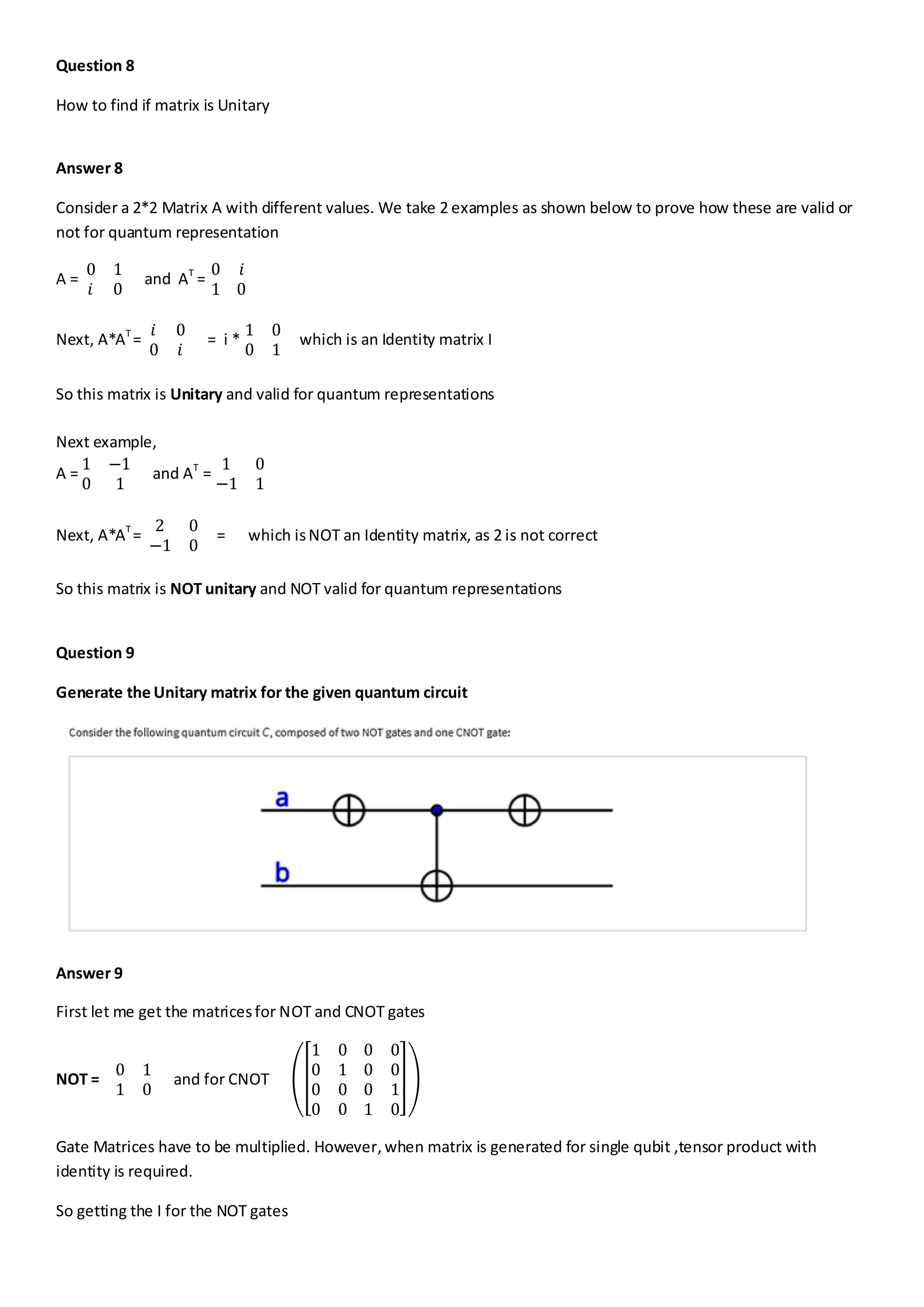
Generate the Unitary matrix for the given quantum circuit
Answer 9
First let me get the matricesfor NOT and CNOT gates
NOT =
0 1
1 0
and for CNOT
1 0 0 0
0 1 0 0
0 0 0 1
0 0 1 0
Gate Matrices have to be multiplied. However, when matrix is generated for single qubit ,tensor product with
identity is required.
So getting the I for the NOT gates
0 1
1 0
tensor product
0 1
1 0
=
0 0 1 0
0 0 0 1
1 0 0 0
0 1 0 0
this is the Identity I
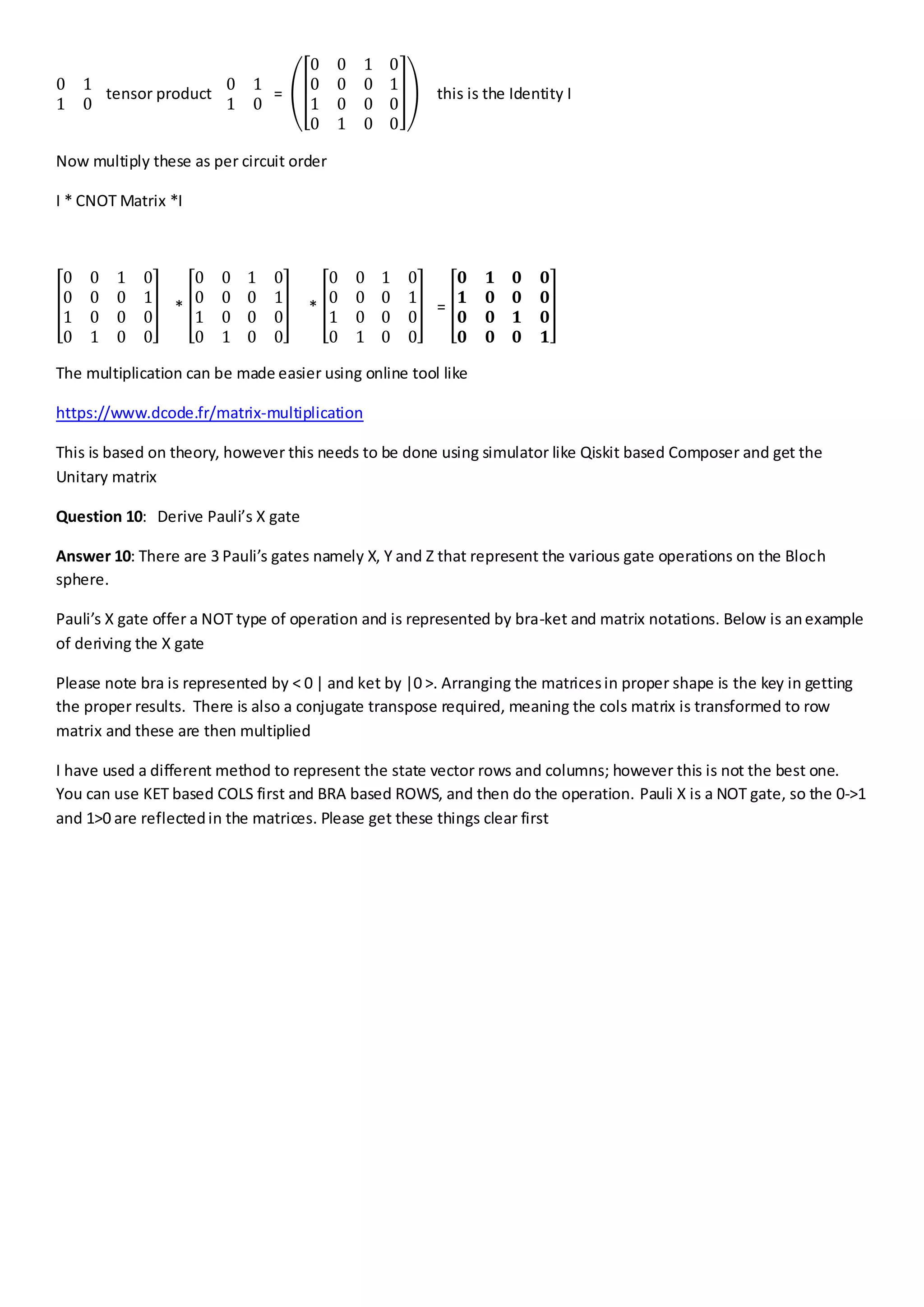
Now multiply these as per circuit order
I * CNOT Matrix *I
0 0 1 0
0 0 0 1
1 0 0 0
0 1 0 0
*
0 0 1 0
0 0 0 1
1 0 0 0
0 1 0 0
*
0 0 1 0
0 0 0 1
1 0 0 0
0 1 0 0
=
𝟎 𝟏 𝟎 𝟎
𝟏 𝟎 𝟎 𝟎
𝟎 𝟎 𝟏 𝟎
𝟎 𝟎 𝟎 𝟏
The multiplication can be made easier using online tool like
https://www.dcode.fr/matrix-multiplication
This is based on theory, however this needs to be done using simulator like Qiskit based Composer and get the
Unitary matrix
Question 10: Derive Pauli’s X gate
Answer 10: There are 3 Pauli’s gates namely X, Y and Z that represent the various gate operations on the Bloch
sphere.
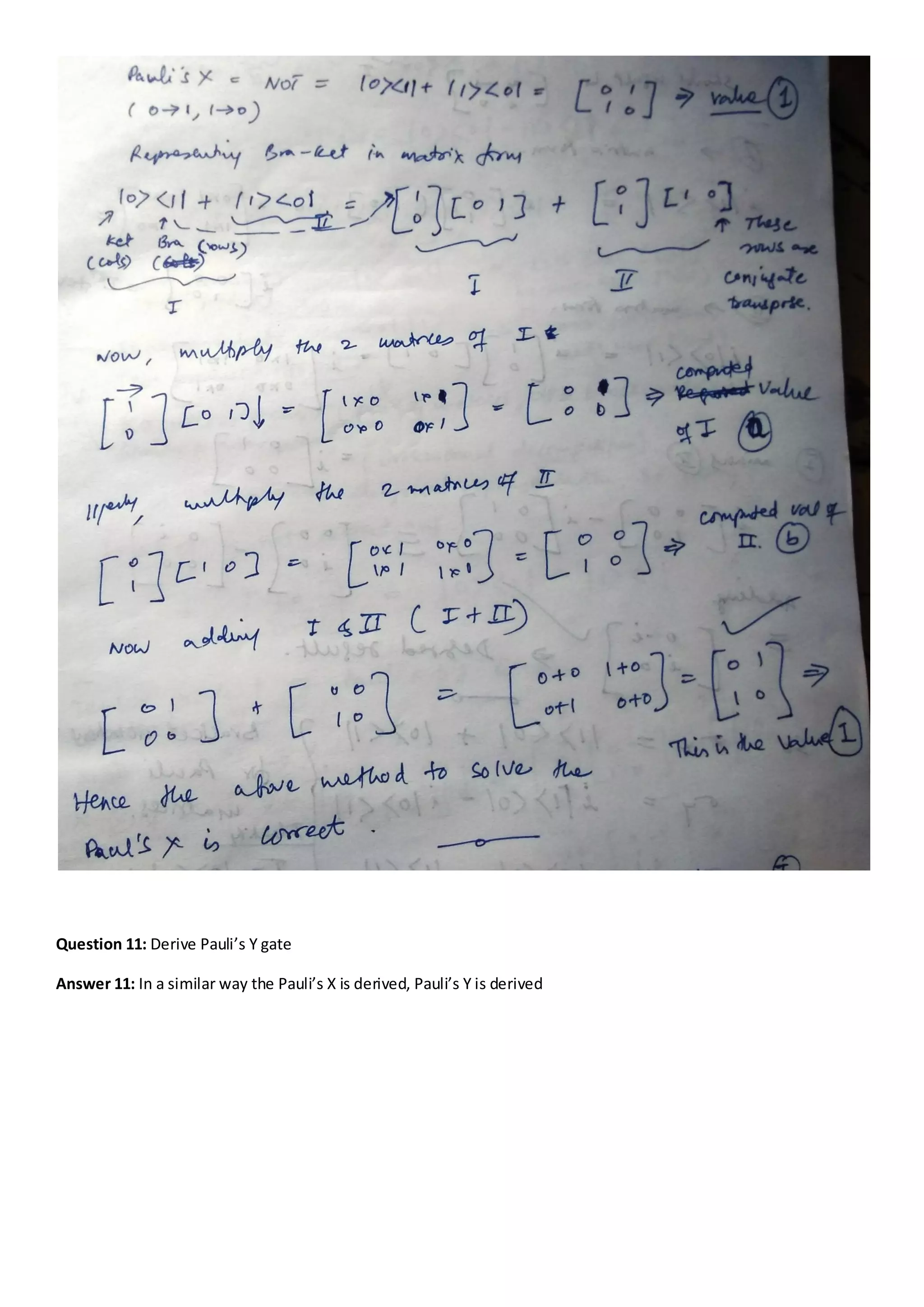
Pauli’s X gate offer a NOT type of operation and is represented by bra-ket and matrix notations. Below is anexample
of deriving the X gate
Please note bra is represented by < 0 | and ket by |0 >. Arranging the matricesin proper shape is the key in getting
the proper results. There is also a conjugate transpose required, meaning the cols matrix is transformed to row
matrix and these are then multiplied
I have used a different method to represent the state vector rows and columns; however this is not the best one.
You can use KET based COLS first and BRA based ROWS, and then do the operation. Pauli X is a NOT gate, so the 0->1
and 1>0 are reflectedin the matrices. Please get these things clear first
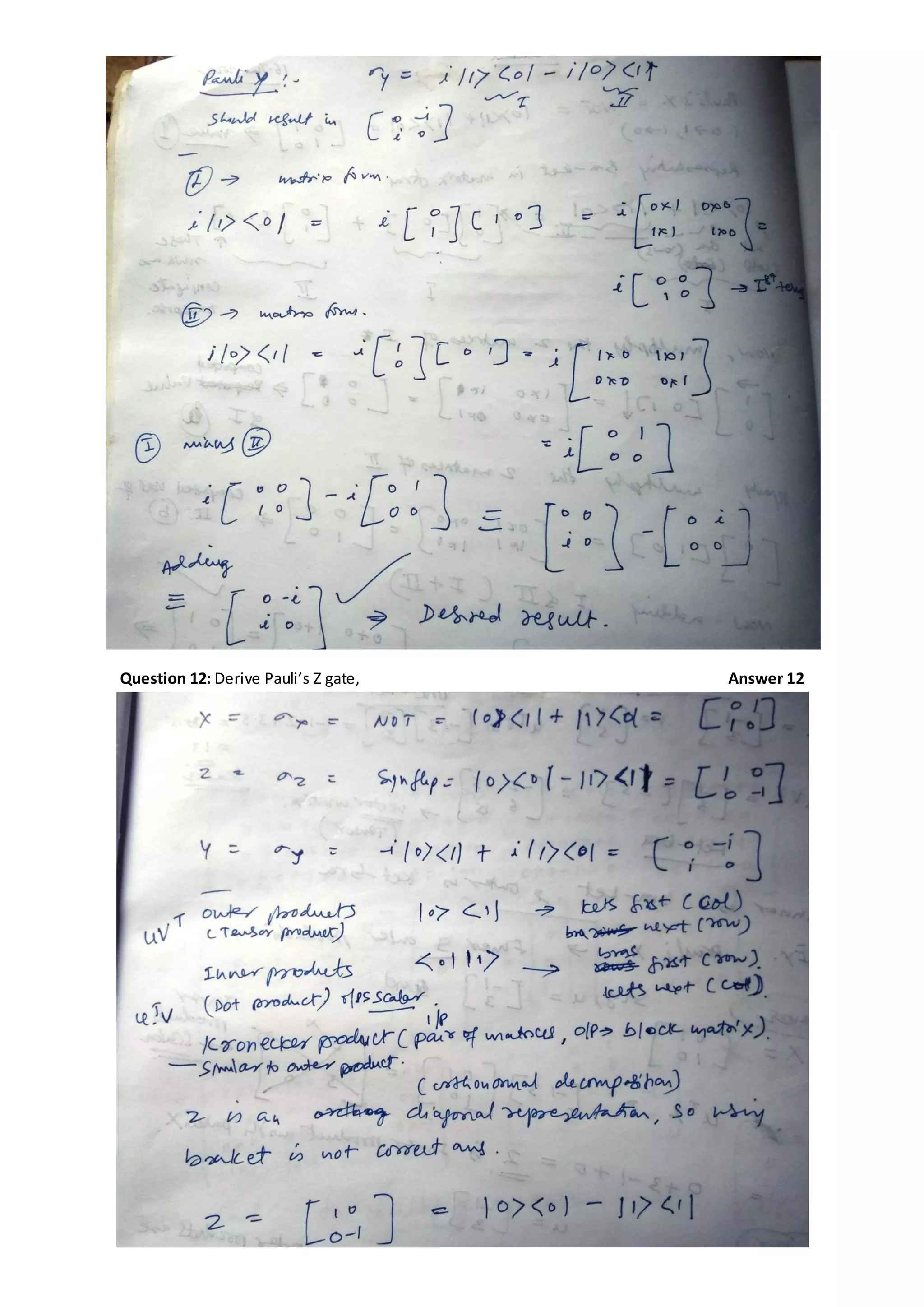
Question 11: Derive Pauli’s Y gate
Answer 11: In a similar way the Pauli’s X is derived, Pauli’s Y is derived
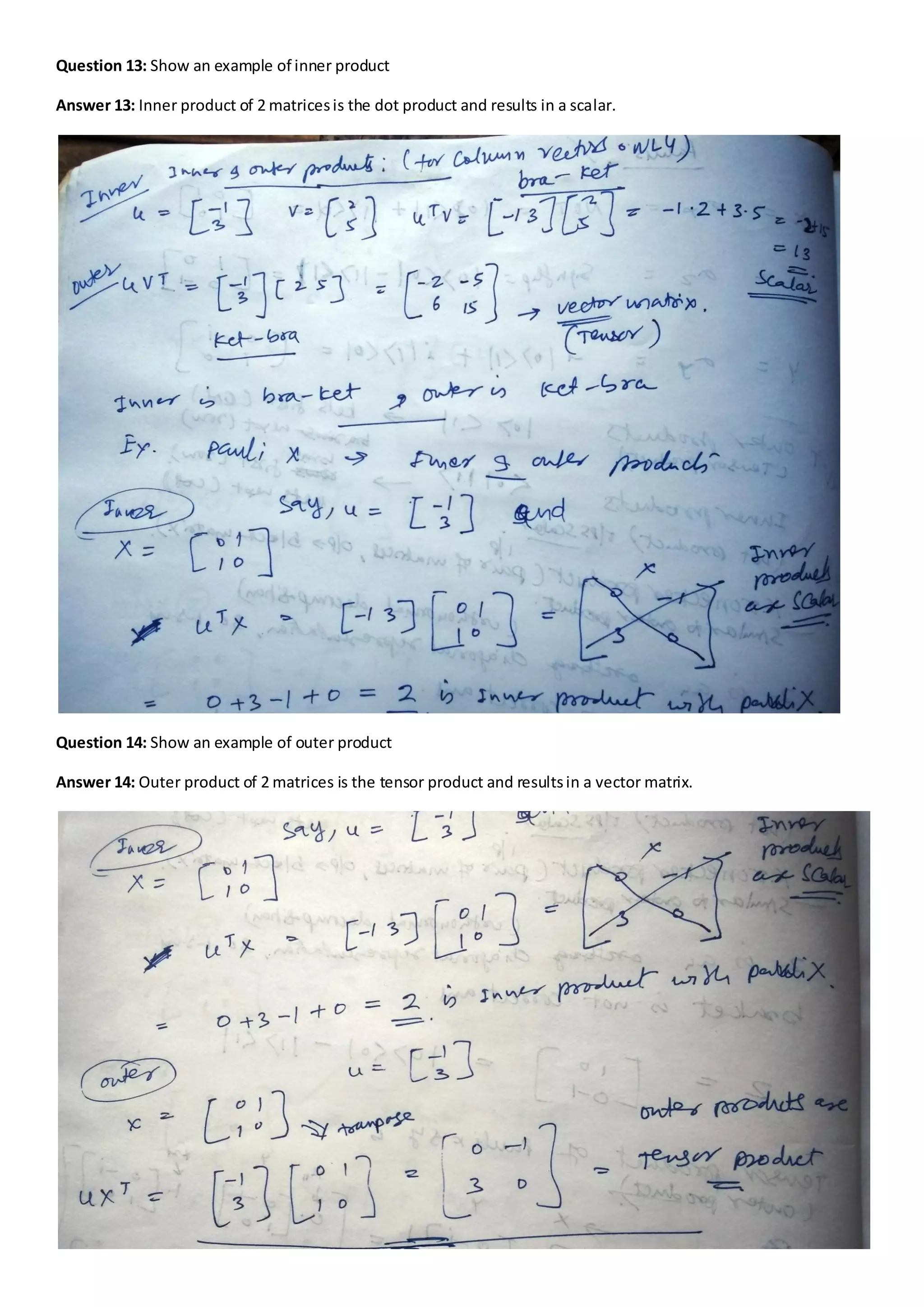
Question 12: Derive Pauli’s Z gate, Answer 12
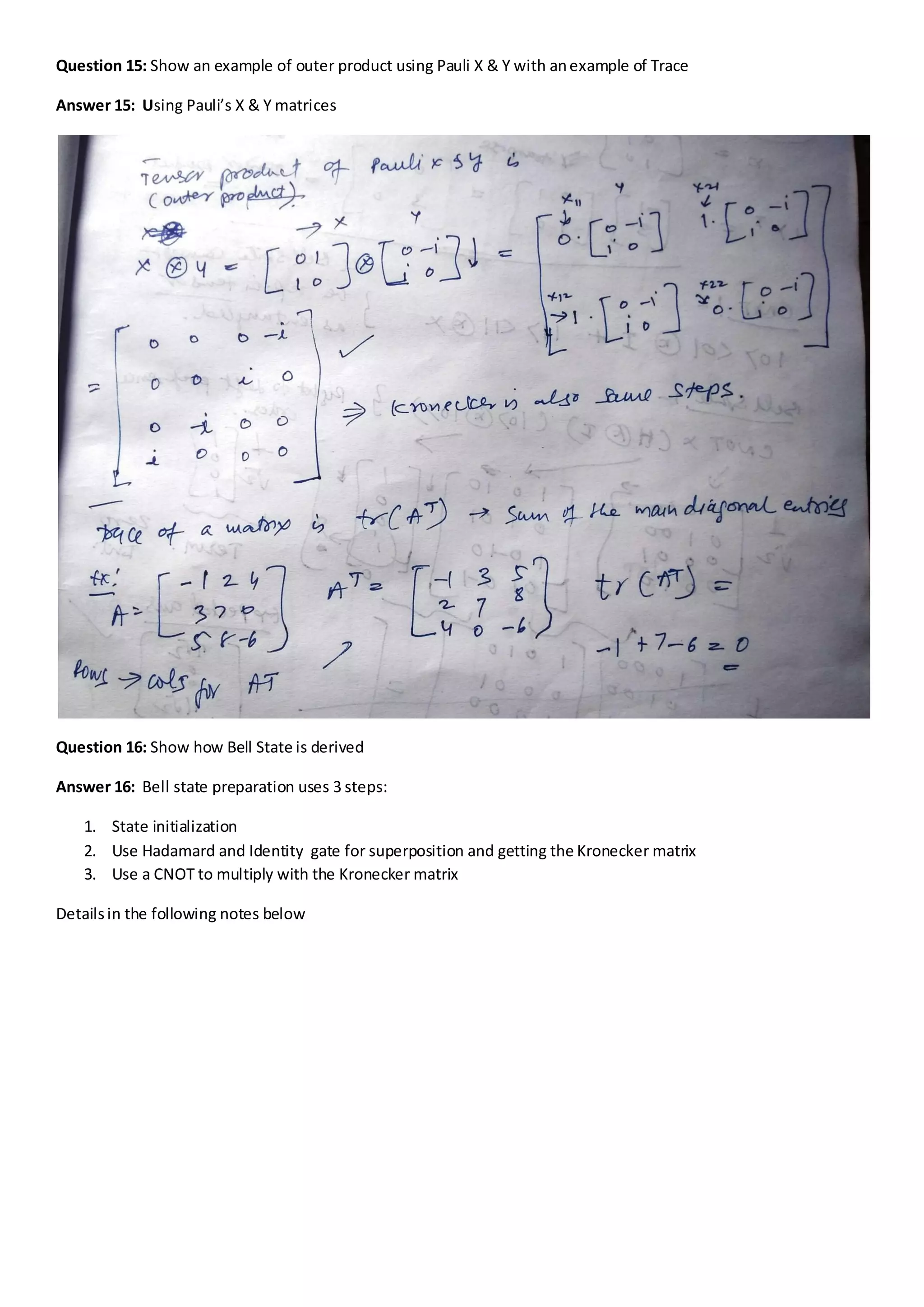
Question 13: Show an example of inner product
Answer 13: Inner product of 2 matricesis the dot product and results in a scalar.
Question 14: Show an example of outer product
Answer 14: Outer product of 2 matrices is the tensor product and resultsin a vector matrix.
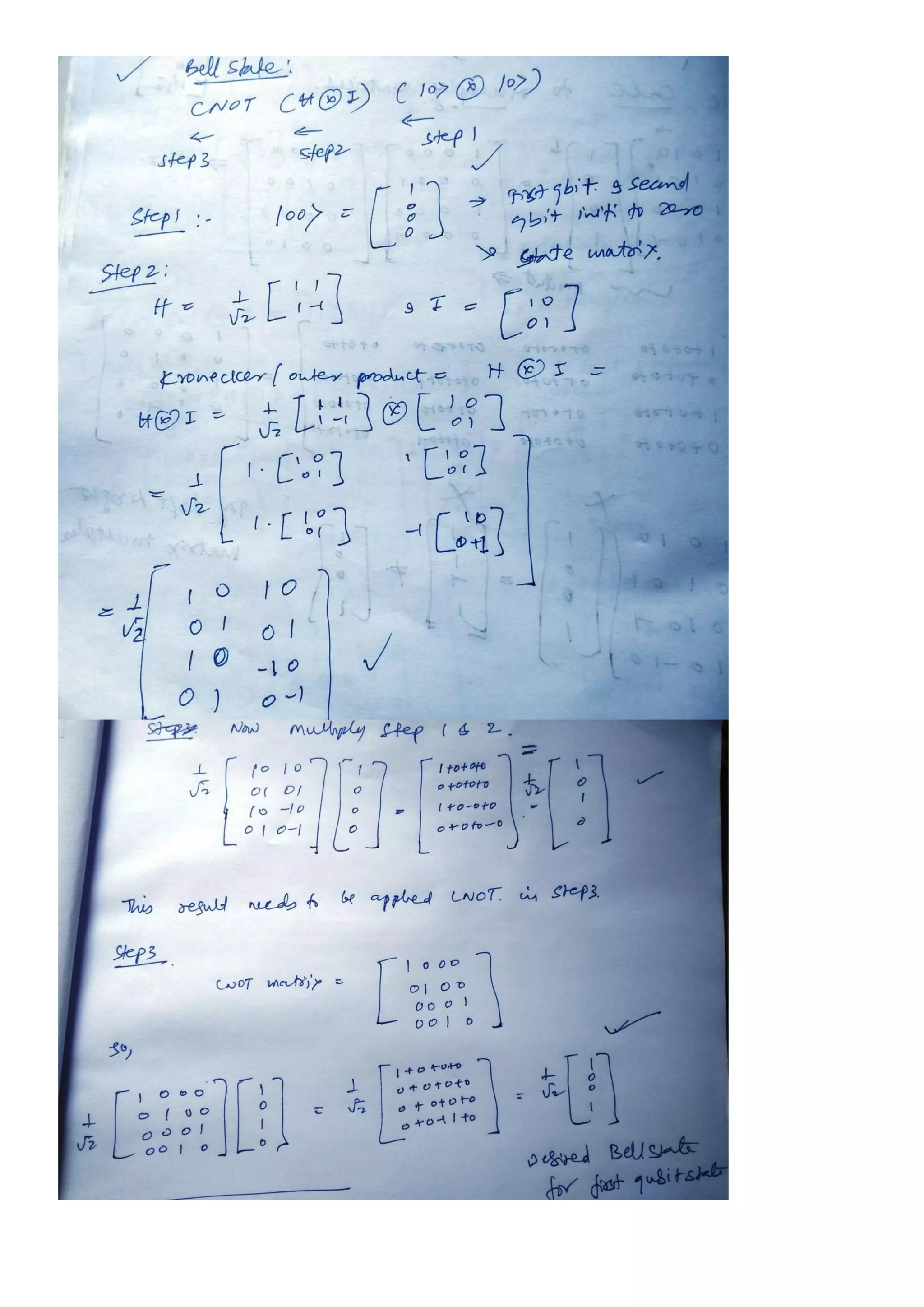
Question 15: Show an example of outer product using Pauli X & Y with anexample of Trace
Answer 15: Using Pauli’s X & Y matrices
Question 16: Show how Bell State is derived
Answer 16: Bell state preparation uses 3 steps:
1. State initialization
2. Use Hadamard and Identity gate for superposition and getting the Kronecker matrix
3. Use a CNOT to multiply with the Kronecker matrix
Detailsin the following notes below
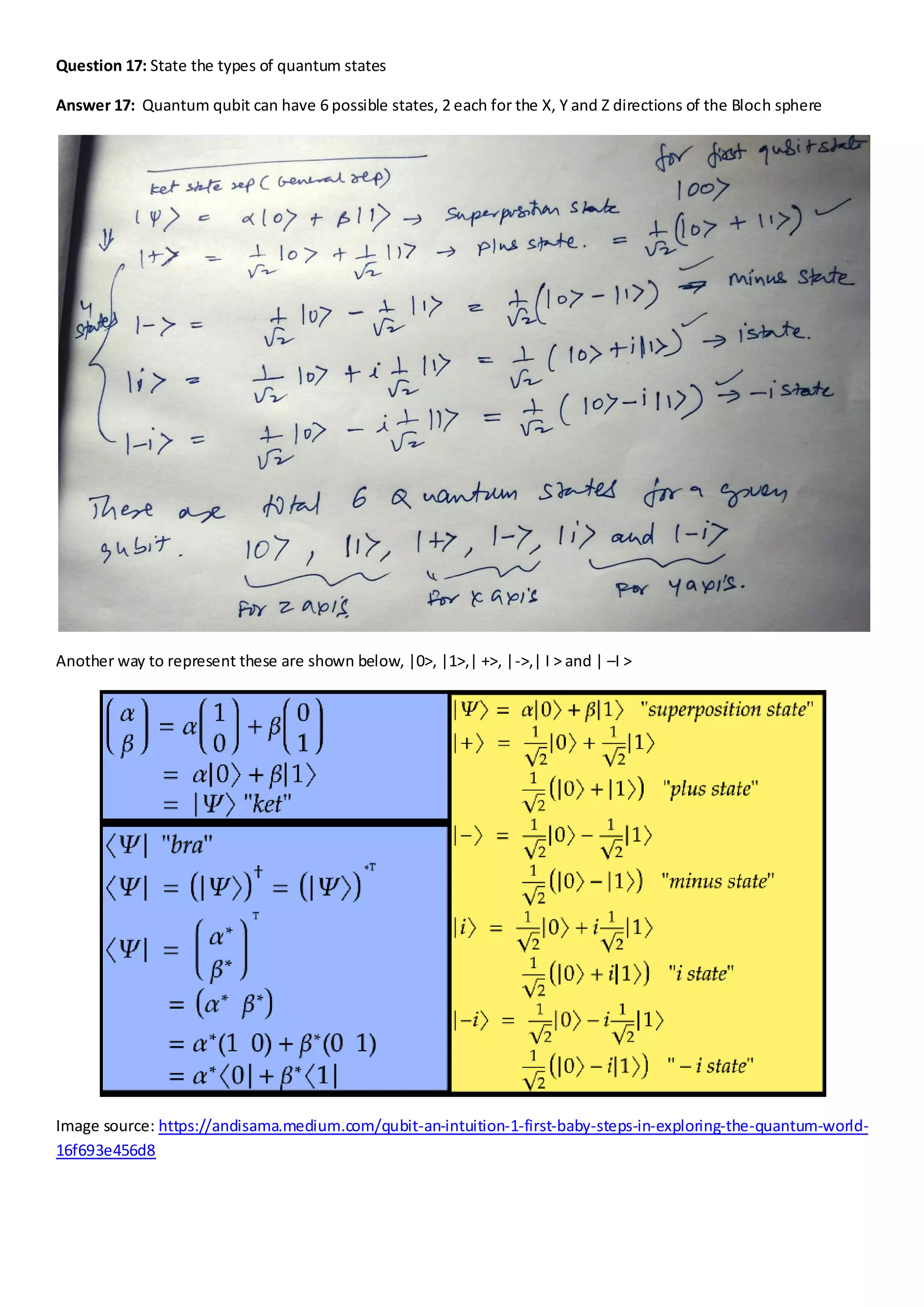
Question 17: State the types of quantum states
Answer 17: Quantum qubit can have 6 possible states, 2 each for the X, Y and Z directions of the Bloch sphere
Another way to represent these are shown below, |0>, |1>,| +>, |->,| I > and | –I >
Image source: https://andisama.medium.com/qubit-an-intuition-1-first-baby-steps-in-exploring-the-quantum-world-
16f693e456d8
Question 18: Define the notations for the different types of quantum states like plus, minus etc
Answer 18: Quantum qubit state notations are mainly represented in matrix and bra-ket forms with transformation
from one notation to another as required to solve a problem .Below are matrix notations for 0,1, + and – states.
These can be re-written from matrix to state, like col matrix [1 0] can be written as ket notation | 0> as per the need
of the problem to be solved
Question 19: Apply an H gate on the |+> and show the results
Answer 19: First we get the matrix notation for H and |+> states, then we multiply them, details shown below
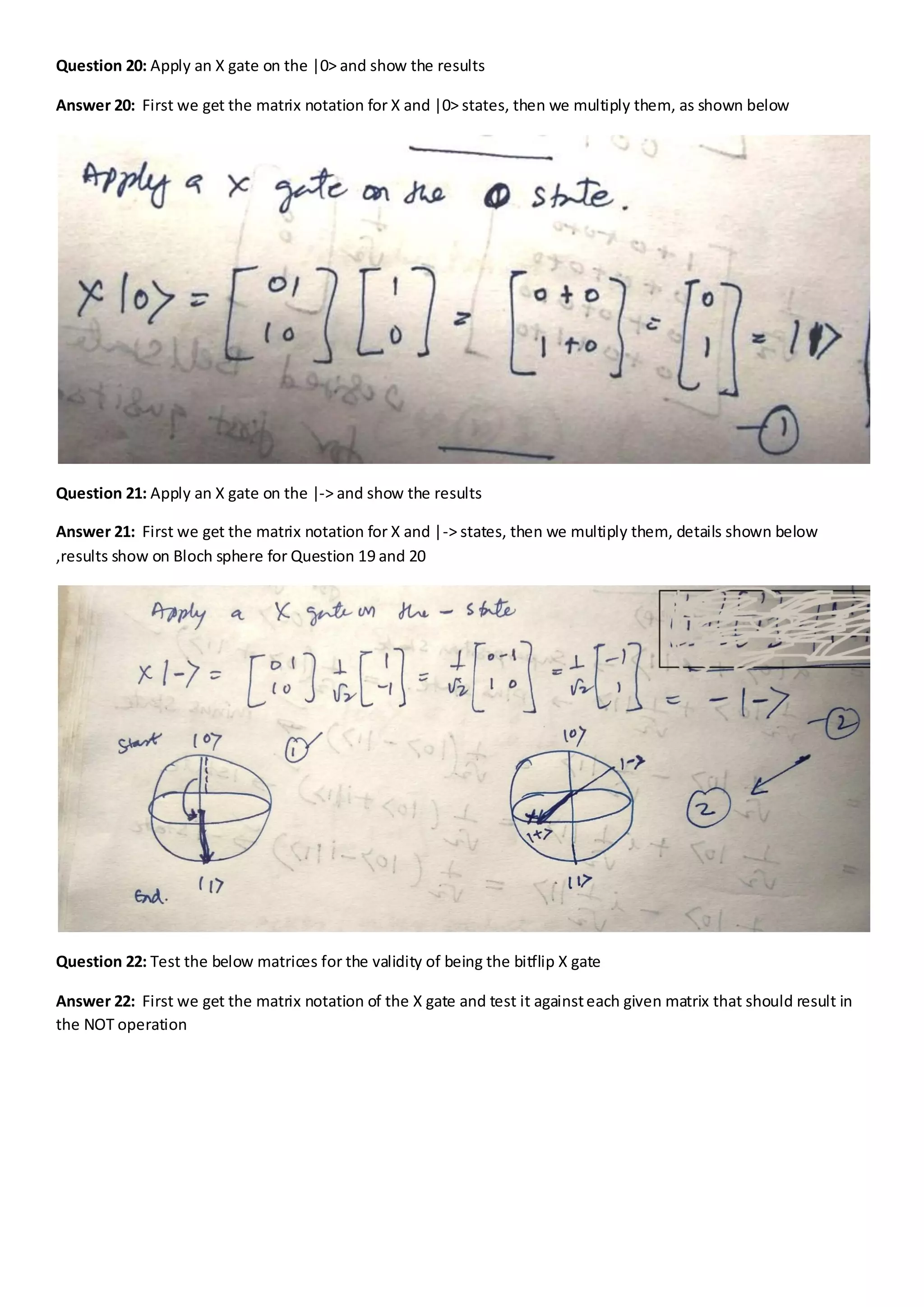
Question 20: Apply an X gate on the |0> and show the results
Answer 20: First we get the matrix notation for X and |0> states, then we multiply them, as shown below
Question 21: Apply an X gate on the |-> and show the results
Answer 21: First we get the matrix notation for X and |-> states, then we multiply them, details shown below
,results show on Bloch sphere for Question 19 and 20
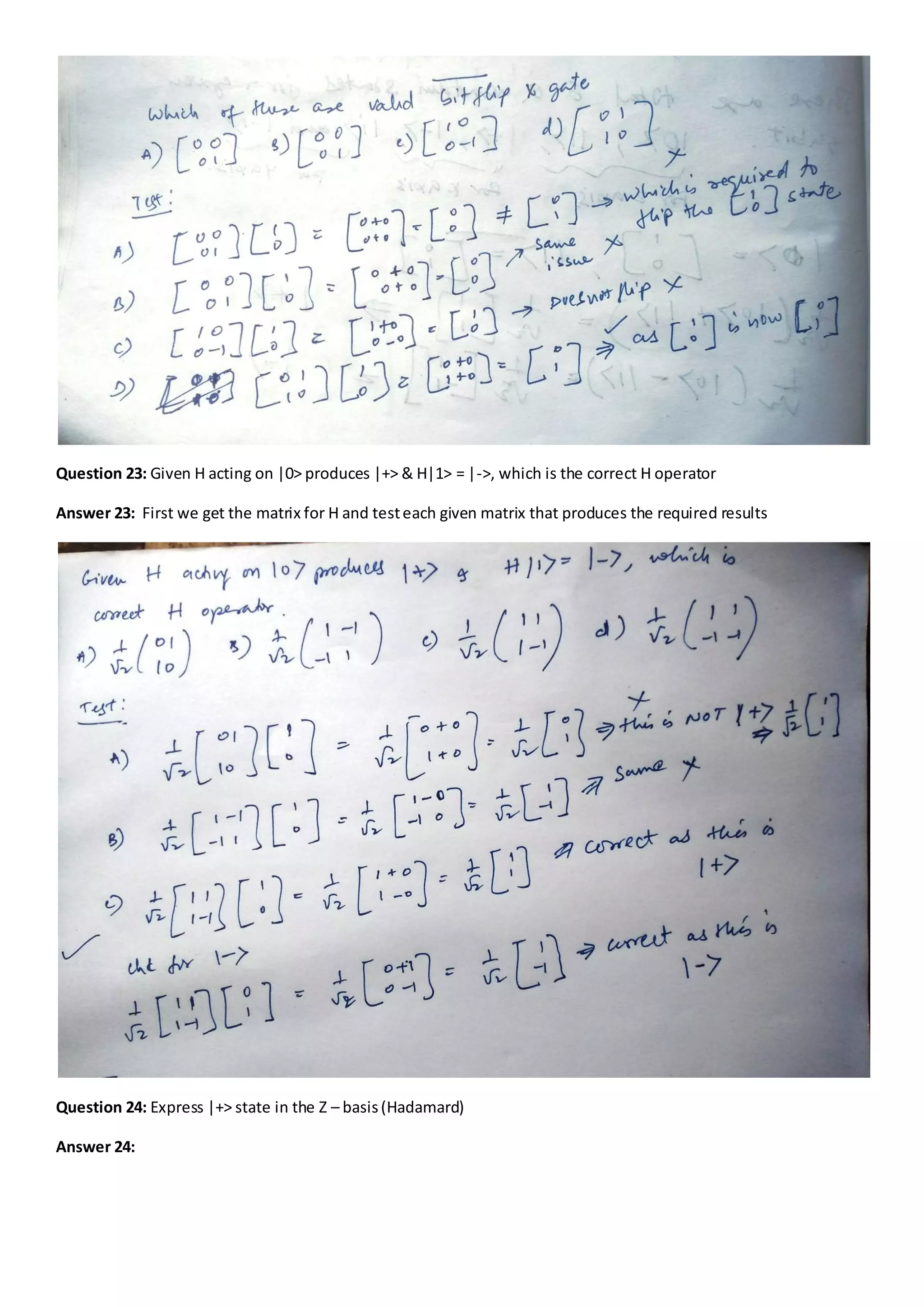
Question 22: Test the below matrices for the validity of being the bitflip X gate
Answer 22: First we get the matrix notation of the X gate and test it againsteach given matrix that should result in
the NOT operation
Question 23: Given H acting on |0> produces |+> & H|1> = |->, which is the correct H operator
Answer 23: First we get the matrix for H and testeach given matrix that produces the required results
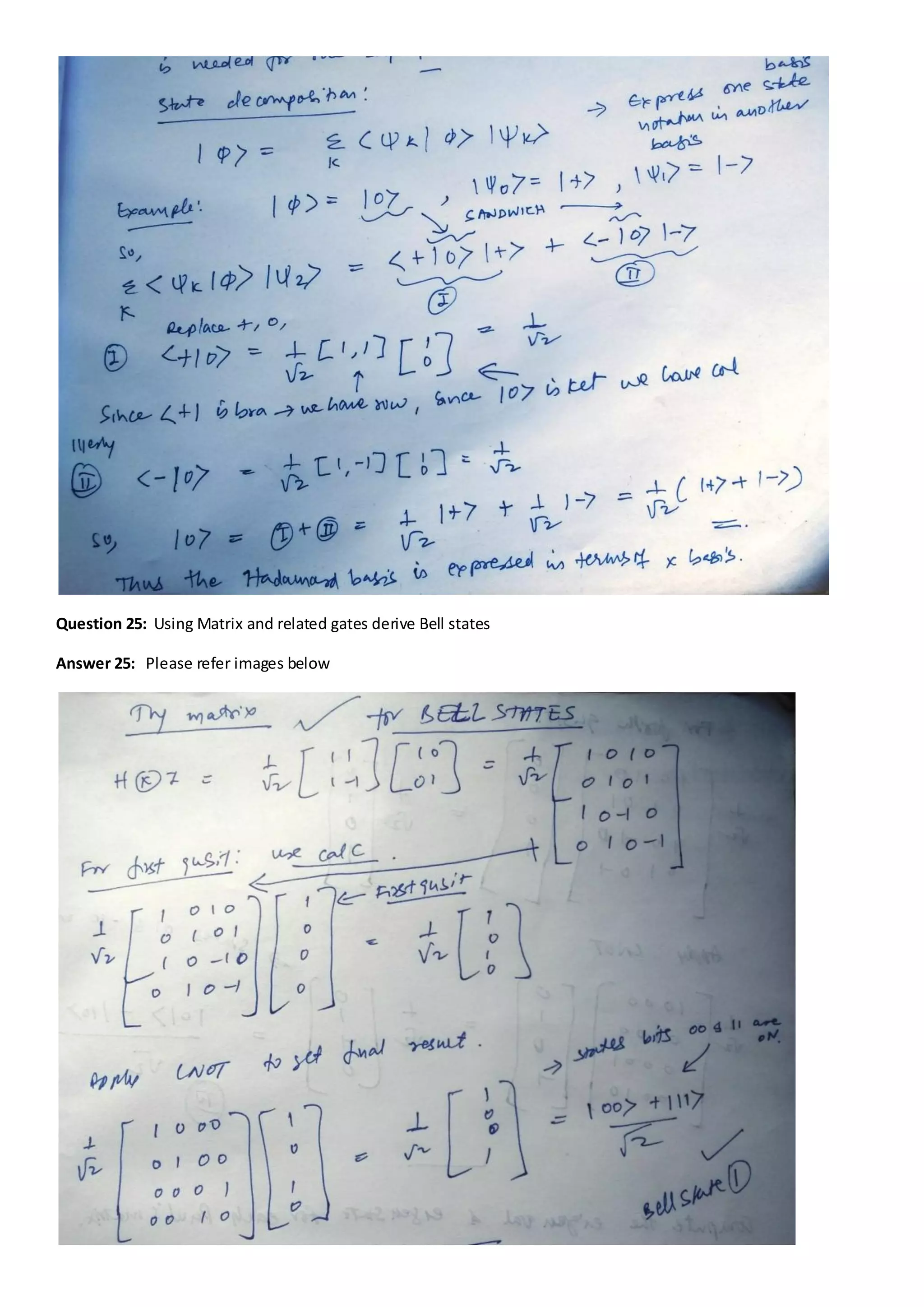
Question 24: Express |+> state in the Z – basis(Hadamard)
Answer 24:
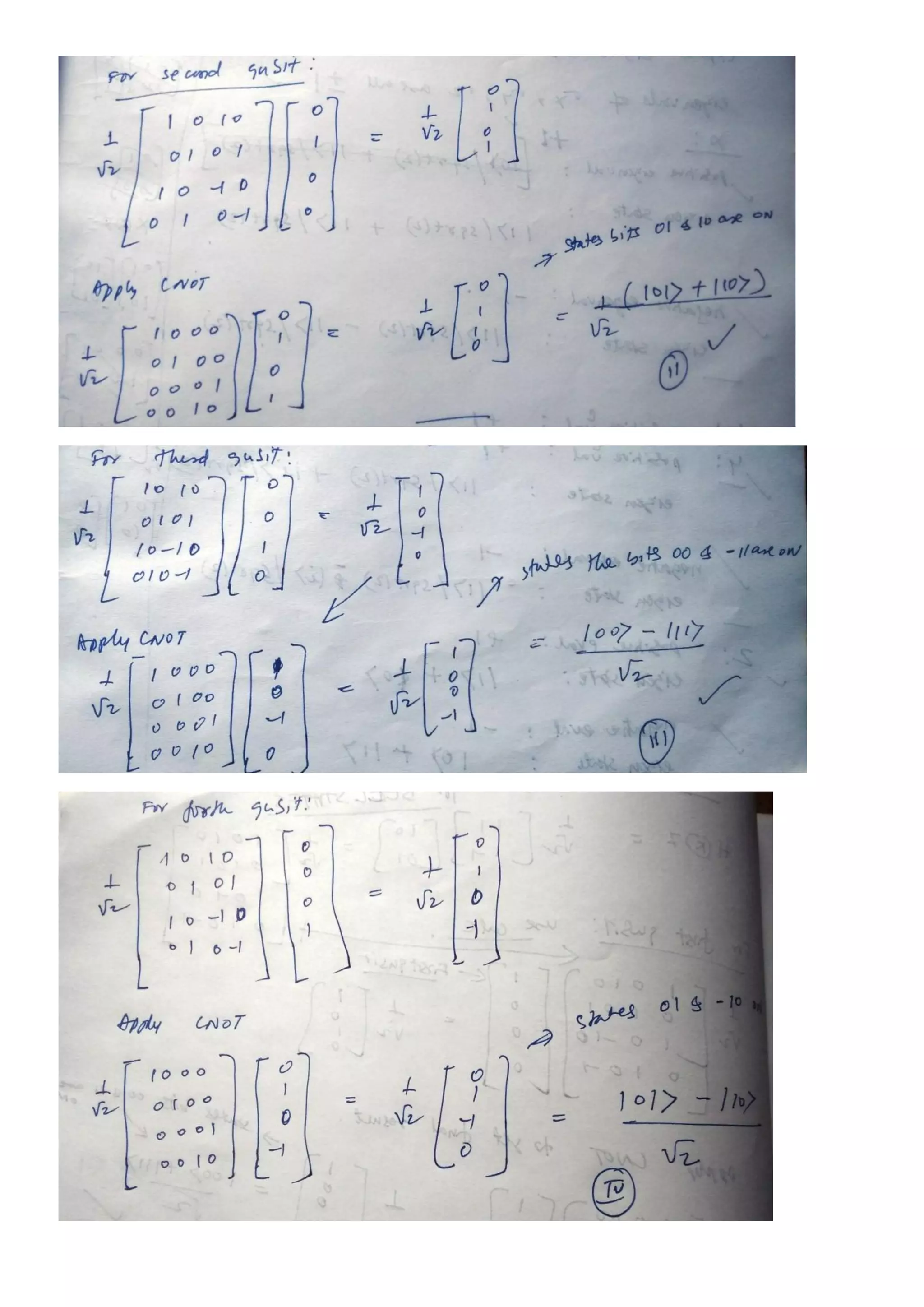
Question 25: Using Matrix and related gates derive Bell states
Answer 25: Please refer images below
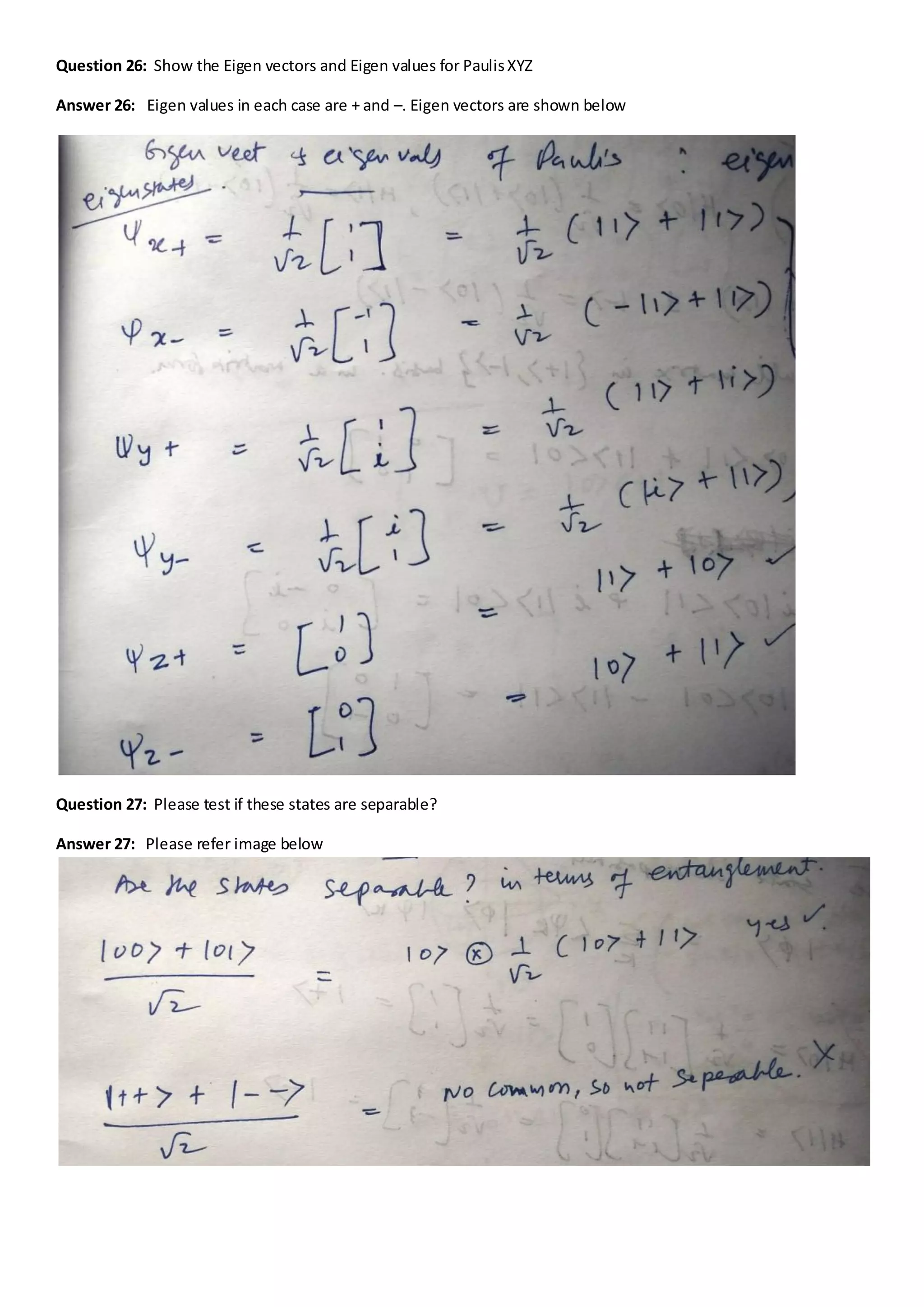
Question 26: Show the Eigen vectors and Eigen values for PaulisXYZ
Answer 26: Eigen values in each case are + and –. Eigen vectors are shown below
Question 27: Please test if these states are separable?
Answer 27: Please refer image below
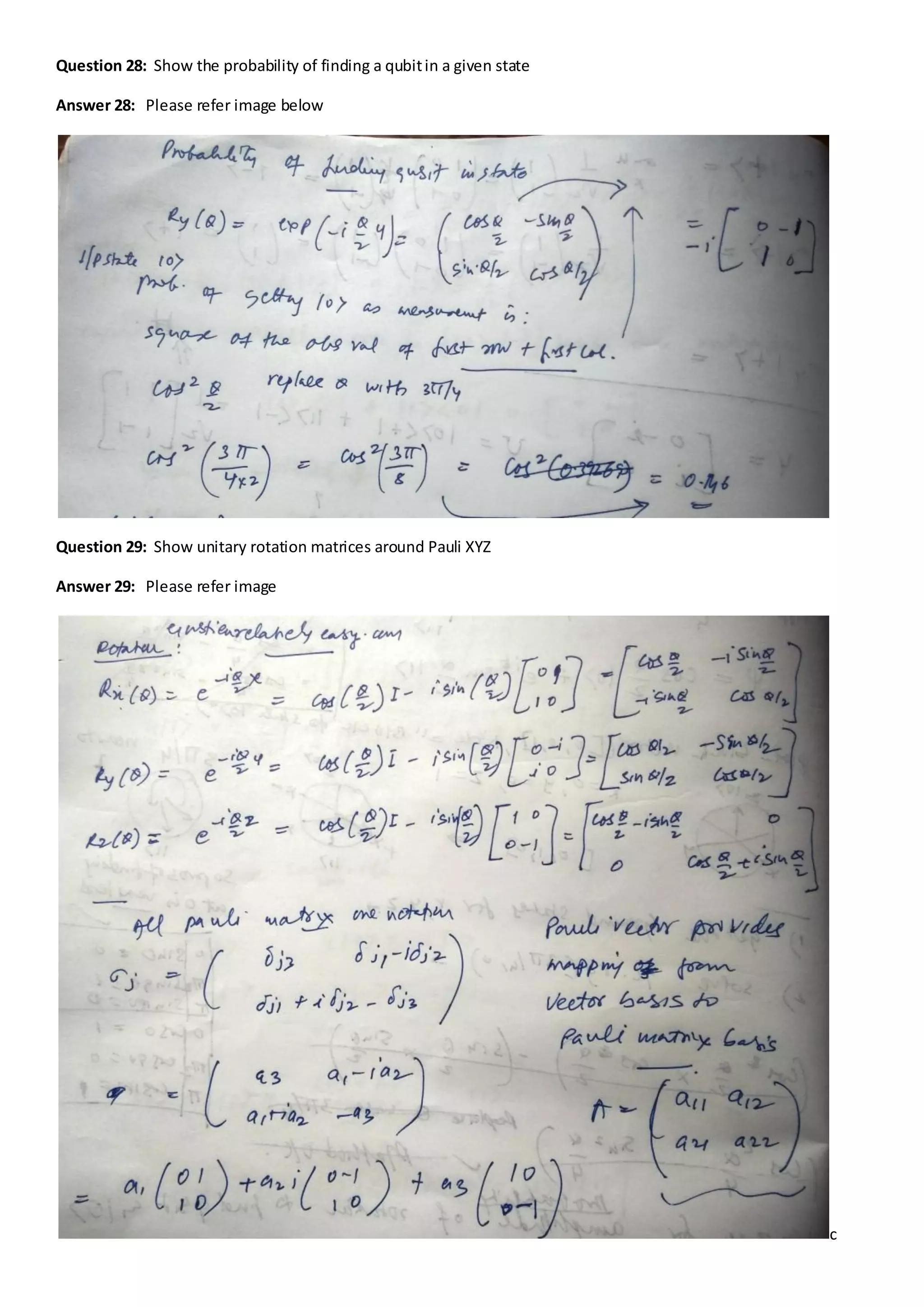
Question 28: Show the probability of finding a qubitin a given state
Answer 28: Please refer image below
Question 29: Show unitary rotation matrices around Pauli XYZ
Answer 29: Please refer image
c
Question 30
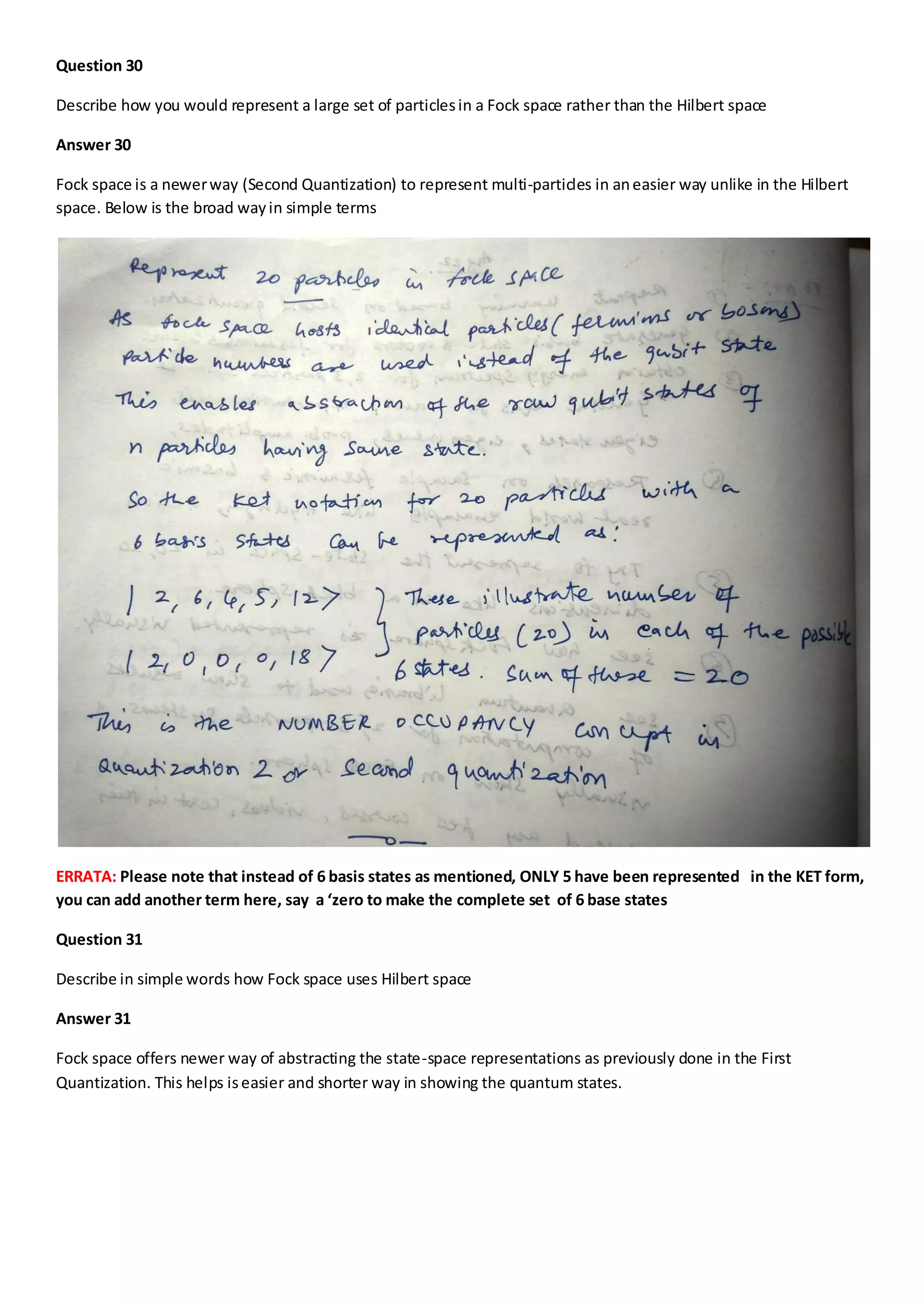
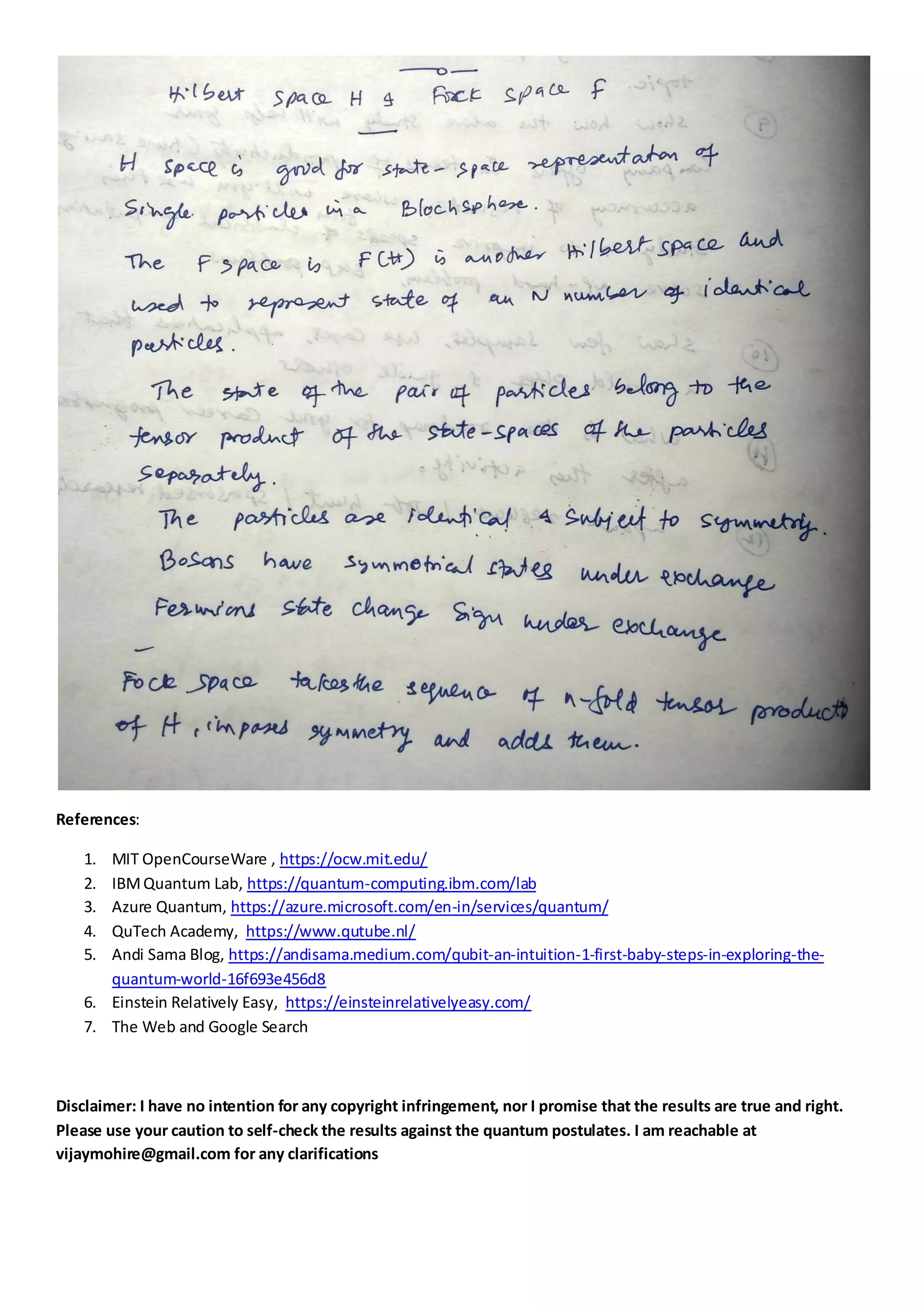
Describe how you would represent a large set of particlesin a Fock space rather than the Hilbert space
Answer 30
Fock space is a newerway (Second Quantization) to represent multi-particles in aneasier way unlike in the Hilbert
space. Below is the broad wayin simple terms
ERRATA: Please note that instead of 6 basis states as mentioned, ONLY 5 have been represented in the KET form,
you can add another term here, say a ‘zero to make the complete set of 6 base states
Question 31
Describe in simple words how Fock space uses Hilbert space
Answer 31
Fock space offers newer way of abstracting the state-space representations as previously done in the First
Quantization. This helps iseasier and shorter way in showing the quantum states.
References:
1. MIT OpenCourseWare , https://ocw.mit.edu/
2. IBMQuantum Lab, https://quantum-computing.ibm.com/lab
3. Azure Quantum, https://azure.microsoft.com/en-in/services/quantum/
4. QuTech Academy, https://www.qutube.nl/
5. Andi Sama Blog, https://andisama.medium.com/qubit-an-intuition-1-first-baby-steps-in-exploring-the-
quantum-world-16f693e456d8
6. Einstein Relatively Easy, https://einsteinrelativelyeasy.com/
7. The Web and Google Search
Disclaimer: I have no intention for any copyright infringement, nor I promise that the results are true and right.
Please use your caution to self-check the results against the quantum postulates. I am reachable at
vijaymohire@gmail.com for any clarifications

Quantum Computing Notes Ver 1.2

  • 1.
    Quantum Computing –Notes Ver 1.2 Prepared By: Vijayananda Mohire Sources: Various open courses, MOOC trainings and self study; no intention for any copyright infringements Question 1 Design a reversible circuit, using NOT, CNOT, Toffoli, and Fredkin gates,which acts on the four inputs a,b,c,d, to perform the operation swap243(a,b,c,d) which swaps b and d if a=0, and swaps c and d if a=1. Bit a should be left unchanged Answer 1 High level functionwith the circuit fredkin(a,c,d) not(a) fredkin(a,b,d) not(a) Question 2 Design a reversible circuit, using NOT, CNOT, Toffoli, and Fredkin gates, which acts on the four inputs a,b,c,d, to swap c and d only when both a=1 and b=1. You may use a fifth bit e, given as initialized to e=0, in your circuit; this bit must also end as e=0. C Answer 2 High level functionwith the circuit toffoli(a,b,e) fredkin(e,c,d) toffoli(a,b,e)
  • 2.
    Question 3 Sample RandomNumberusing Q# Answer 3 open Microsoft.Quantum.Arrays; open Microsoft.Quantum.Measurement; operation SampleRandomNumber(nQubits : Int) : Result[] { // We prepare a register of qubits in a uniform // superposition state, such that when we measure, // all bitstrings occur with equal probability. use register = Qubit[nQubits] { // Set qubits in superposition. ApplyToEachA(H, register); // Measure all qubits and return. return ForEach(MResetZ, register); } } Question 4 Run a basic quantum circuit expressed using the Qiskit library to an IonQ target via the Azure Quantum service. Answer 4 First, import the required packages for this sample: from qiskit import QuantumCircuit from qiskit.visualization import plot_histogram from qiskit.tools.monitor import job_monitor from azure.quantum.qiskit import AzureQuantumProvider #Connect to backend Azure quantum service, using below function from azure.quantum.qiskit import AzureQuantumProvider provider = AzureQuantumProvider ( resource_id = " ", location = " " ) # Create a Quantum Circuit acting on the q register circuit = QuantumCircuit(3, 3) circuit.name = "Qiskit Sample - 3-qubit GHZ circuit" circuit.h(0) circuit.cx(0, 1) circuit.cx(1, 2) circuit.measure([0,1,2], [0, 1, 2]) # Print out the circuit circuit.draw() ┌───┐ ┌─┐ q_0: ┤ H ├──■───────┤M├────── └───┘┌─┴─┐ └╥┘┌─┐ q_1: ─────┤ X ├──■───╫─┤M├─── └───┘┌─┴─┐ ║ └╥┘┌─┐ q_2: ──────────┤ X ├─╫──╫─┤M├ └───┘ ║ ║ └╥┘ c: 3/════════════════╩══╩══╩═ 0 1 2
  • 3.
    #Create a Backendobject to connect to the IonQ Simulator back-end: simulator_backend = provider.get_backend("ionq.simulator") job = simulator_backend.run(circuit, shots=100) job_id = job.id() print("Job id", job_id) #Create a job monitor object job_monitor(job) #To wait until the job is completed and return the results, run: result = job.result() qiskit.result.result.Result print(result) connect to real hardware (Quantum Processing Unit or QPU) qpu_backend = provider.get_backend("ionq.qpu") # Submit the circuit to run on Azure Quantum qpu_job = qpu_backend.run(circuit, shots=1024) job_id = qpu_job.id() print("Job id", job_id) # Monitor job progress and wait until complete: job_monitor(qpu_job) # Get the job results (this method also waits for the Job to complete): result = qpu_job.result() print(result) counts = {format(n, "03b"): 0 for n in range(8)} counts.update(result.get_counts(circuit)) print(counts) plot_histogram(counts) Question 5 Develop Google AI sample Cirq circuit Answer 5 import cirq qubits = [cirq.GridQubit(x, y) for x in range(3) for y in range(3)] print(qubits[0]) # This is an Pauli X gate. It is an object instance. x_gate = cirq.X # Applying it to the qubit at location (0, 0) (defined above) # turns it into an operation. x_op = x_gate(qubits[0]) print(x_op) cz = cirq.CZ(qubits[0], qubits[1]) x = cirq.X(qubits[2]) moment = cirq.Moment([x, cz]) x2 = cirq.X(qubits[2]) cz12 = cirq.CZ(qubits[1], qubits[2]) moment0 = cirq.Moment([cz01, x2])
  • 4.
    moment1 = cirq.Moment([cz12]) circuit= cirq.Circuit((moment0, moment1)) print(circuit) Question 6 Design a simple Tensorflow based quantum Colab sample Answer 6 !pip install tensorflow==2.4.1 !pip install tensorflow-quantum import tensorflow as tf import tensorflow_quantum as tfq import cirq import sympy import numpy as np # visualization tools %matplotlib inline import matplotlib.pyplot as plt from cirq.contrib.svg import SVGCircuit a, b = sympy.symbols('a b') # Create two qubits q0, q1 = cirq.GridQubit.rect(1, 2) # Create a circuit on these qubits using the parameters you created above. circuit = cirq.Circuit( cirq.rx(a).on(q0), cirq.ry(b).on(q1), cirq.CNOT(control=q0, target=q1)) SVGCircuit(circuit) # Calculate a state vector with a=0.5 and b=-0.5. resolver = cirq.ParamResolver({a: 0.5, b: -0.5}) output_state_vector = cirq.Simulator().simulate(circuit, resolver).final_state_vector output_state_vector
  • 5.
    Question 7 Design asimple qubit based quantum circuit using IBMQiskit Answer 7 import numpy as np # Importing standard Qiskit libraries from qiskit import QuantumCircuit, transpile, Aer, IBMQ, assemble from qiskit.tools.jupyter import * from qiskit.visualization import * from ibm_quantum_widgets import * from math import pi, sqrt # Loading your IBM Quantum account(s) provider = IBMQ.load_account() sim = Aer.get_backend('aer_simulator') # Let's do an X-gate on a |0> qubit qc = QuantumCircuit(1) qc.x(0) qc.draw() qc.y(0) # Do Y-gate on qubit 0 qc.z(0) # Do Z-gate on qubit 0 qc.draw() # Create the X-measurement function: def x_measurement(qc, qubit, cbit): """Measure 'qubit' in the X-basis, and store the result in 'cbit'""" qc.h(qubit) qc.measure(qubit, cbit) return qc initial_state = [1/sqrt(2), -1/sqrt(2)] # Initialize our qubit and measure it qc = QuantumCircuit(1,1) qc.initialize(initial_state, 0) x_measurement(qc, 0, 0) # measure qubit 0 to classical bit 0 qc.draw()
  • 6.
    Question 8 How tofind if matrix is Unitary Answer 8 Consider a 2*2 Matrix A with different values. We take 2 examples as shown below to prove how these are valid or not for quantum representation A = 0 1 𝑖 0 and AT = 0 𝑖 1 0 Next, A*AT = 𝑖 0 0 𝑖 = i * 1 0 0 1 which is an Identity matrix I So this matrix is Unitary and valid for quantum representations Next example, A = 1 −1 0 1 and AT = 1 0 −1 1 Next, A*AT = 2 0 −1 0 = which isNOT an Identity matrix, as 2 is not correct So this matrix is NOT unitary and NOT valid for quantum representations Question 9 Generate the Unitary matrix for the given quantum circuit Answer 9 First let me get the matricesfor NOT and CNOT gates NOT = 0 1 1 0 and for CNOT 1 0 0 0 0 1 0 0 0 0 0 1 0 0 1 0 Gate Matrices have to be multiplied. However, when matrix is generated for single qubit ,tensor product with identity is required. So getting the I for the NOT gates
  • 7.
    0 1 1 0 tensorproduct 0 1 1 0 = 0 0 1 0 0 0 0 1 1 0 0 0 0 1 0 0 this is the Identity I Now multiply these as per circuit order I * CNOT Matrix *I 0 0 1 0 0 0 0 1 1 0 0 0 0 1 0 0 * 0 0 1 0 0 0 0 1 1 0 0 0 0 1 0 0 * 0 0 1 0 0 0 0 1 1 0 0 0 0 1 0 0 = 𝟎 𝟏 𝟎 𝟎 𝟏 𝟎 𝟎 𝟎 𝟎 𝟎 𝟏 𝟎 𝟎 𝟎 𝟎 𝟏 The multiplication can be made easier using online tool like https://www.dcode.fr/matrix-multiplication This is based on theory, however this needs to be done using simulator like Qiskit based Composer and get the Unitary matrix Question 10: Derive Pauli’s X gate Answer 10: There are 3 Pauli’s gates namely X, Y and Z that represent the various gate operations on the Bloch sphere. Pauli’s X gate offer a NOT type of operation and is represented by bra-ket and matrix notations. Below is anexample of deriving the X gate Please note bra is represented by < 0 | and ket by |0 >. Arranging the matricesin proper shape is the key in getting the proper results. There is also a conjugate transpose required, meaning the cols matrix is transformed to row matrix and these are then multiplied I have used a different method to represent the state vector rows and columns; however this is not the best one. You can use KET based COLS first and BRA based ROWS, and then do the operation. Pauli X is a NOT gate, so the 0->1 and 1>0 are reflectedin the matrices. Please get these things clear first
  • 8.
    Question 11: DerivePauli’s Y gate Answer 11: In a similar way the Pauli’s X is derived, Pauli’s Y is derived
  • 9.
    Question 12: DerivePauli’s Z gate, Answer 12
  • 10.
    Question 13: Showan example of inner product Answer 13: Inner product of 2 matricesis the dot product and results in a scalar. Question 14: Show an example of outer product Answer 14: Outer product of 2 matrices is the tensor product and resultsin a vector matrix.
  • 11.
    Question 15: Showan example of outer product using Pauli X & Y with anexample of Trace Answer 15: Using Pauli’s X & Y matrices Question 16: Show how Bell State is derived Answer 16: Bell state preparation uses 3 steps: 1. State initialization 2. Use Hadamard and Identity gate for superposition and getting the Kronecker matrix 3. Use a CNOT to multiply with the Kronecker matrix Detailsin the following notes below
  • 13.
    Question 17: Statethe types of quantum states Answer 17: Quantum qubit can have 6 possible states, 2 each for the X, Y and Z directions of the Bloch sphere Another way to represent these are shown below, |0>, |1>,| +>, |->,| I > and | –I > Image source: https://andisama.medium.com/qubit-an-intuition-1-first-baby-steps-in-exploring-the-quantum-world- 16f693e456d8
  • 14.
    Question 18: Definethe notations for the different types of quantum states like plus, minus etc Answer 18: Quantum qubit state notations are mainly represented in matrix and bra-ket forms with transformation from one notation to another as required to solve a problem .Below are matrix notations for 0,1, + and – states. These can be re-written from matrix to state, like col matrix [1 0] can be written as ket notation | 0> as per the need of the problem to be solved Question 19: Apply an H gate on the |+> and show the results Answer 19: First we get the matrix notation for H and |+> states, then we multiply them, details shown below
  • 15.
    Question 20: Applyan X gate on the |0> and show the results Answer 20: First we get the matrix notation for X and |0> states, then we multiply them, as shown below Question 21: Apply an X gate on the |-> and show the results Answer 21: First we get the matrix notation for X and |-> states, then we multiply them, details shown below ,results show on Bloch sphere for Question 19 and 20 Question 22: Test the below matrices for the validity of being the bitflip X gate Answer 22: First we get the matrix notation of the X gate and test it againsteach given matrix that should result in the NOT operation
  • 16.
    Question 23: GivenH acting on |0> produces |+> & H|1> = |->, which is the correct H operator Answer 23: First we get the matrix for H and testeach given matrix that produces the required results Question 24: Express |+> state in the Z – basis(Hadamard) Answer 24:
  • 17.
    Question 25: UsingMatrix and related gates derive Bell states Answer 25: Please refer images below
  • 19.
    Question 26: Showthe Eigen vectors and Eigen values for PaulisXYZ Answer 26: Eigen values in each case are + and –. Eigen vectors are shown below Question 27: Please test if these states are separable? Answer 27: Please refer image below
  • 20.
    Question 28: Showthe probability of finding a qubitin a given state Answer 28: Please refer image below Question 29: Show unitary rotation matrices around Pauli XYZ Answer 29: Please refer image c
  • 21.
    Question 30 Describe howyou would represent a large set of particlesin a Fock space rather than the Hilbert space Answer 30 Fock space is a newerway (Second Quantization) to represent multi-particles in aneasier way unlike in the Hilbert space. Below is the broad wayin simple terms ERRATA: Please note that instead of 6 basis states as mentioned, ONLY 5 have been represented in the KET form, you can add another term here, say a ‘zero to make the complete set of 6 base states Question 31 Describe in simple words how Fock space uses Hilbert space Answer 31 Fock space offers newer way of abstracting the state-space representations as previously done in the First Quantization. This helps iseasier and shorter way in showing the quantum states.
  • 22.
    References: 1. MIT OpenCourseWare, https://ocw.mit.edu/ 2. IBMQuantum Lab, https://quantum-computing.ibm.com/lab 3. Azure Quantum, https://azure.microsoft.com/en-in/services/quantum/ 4. QuTech Academy, https://www.qutube.nl/ 5. Andi Sama Blog, https://andisama.medium.com/qubit-an-intuition-1-first-baby-steps-in-exploring-the- quantum-world-16f693e456d8 6. Einstein Relatively Easy, https://einsteinrelativelyeasy.com/ 7. The Web and Google Search Disclaimer: I have no intention for any copyright infringement, nor I promise that the results are true and right. Please use your caution to self-check the results against the quantum postulates. I am reachable at vijaymohire@gmail.com for any clarifications