The Nature of Inquiry and
Research
Quantitative Research Designs
Practical Research 2:
VON CHRISTOPHER G. CHUA
von_christopher_chua@dlsu.edu.ph
1. What are the differences between
quantitative and qualitative
research?
2. What are the strengths of
quantitative research? Its
weaknesses?
3. What are variables?
4. How do we classify variables?
Let’s look
back…
IDENTITY MAGNITUDE
EQUAL
INTERVALS
ABSOLUTE ZERO
A variable varies and has values. The values of
variables under study are the research data.
Are these variables? chair, shape of table, tweet,
shirt style.
RATIO
INTERVAL
ORDINAL
NOMINAL
Classifying Variables
according to Scales of
Measure
Variables
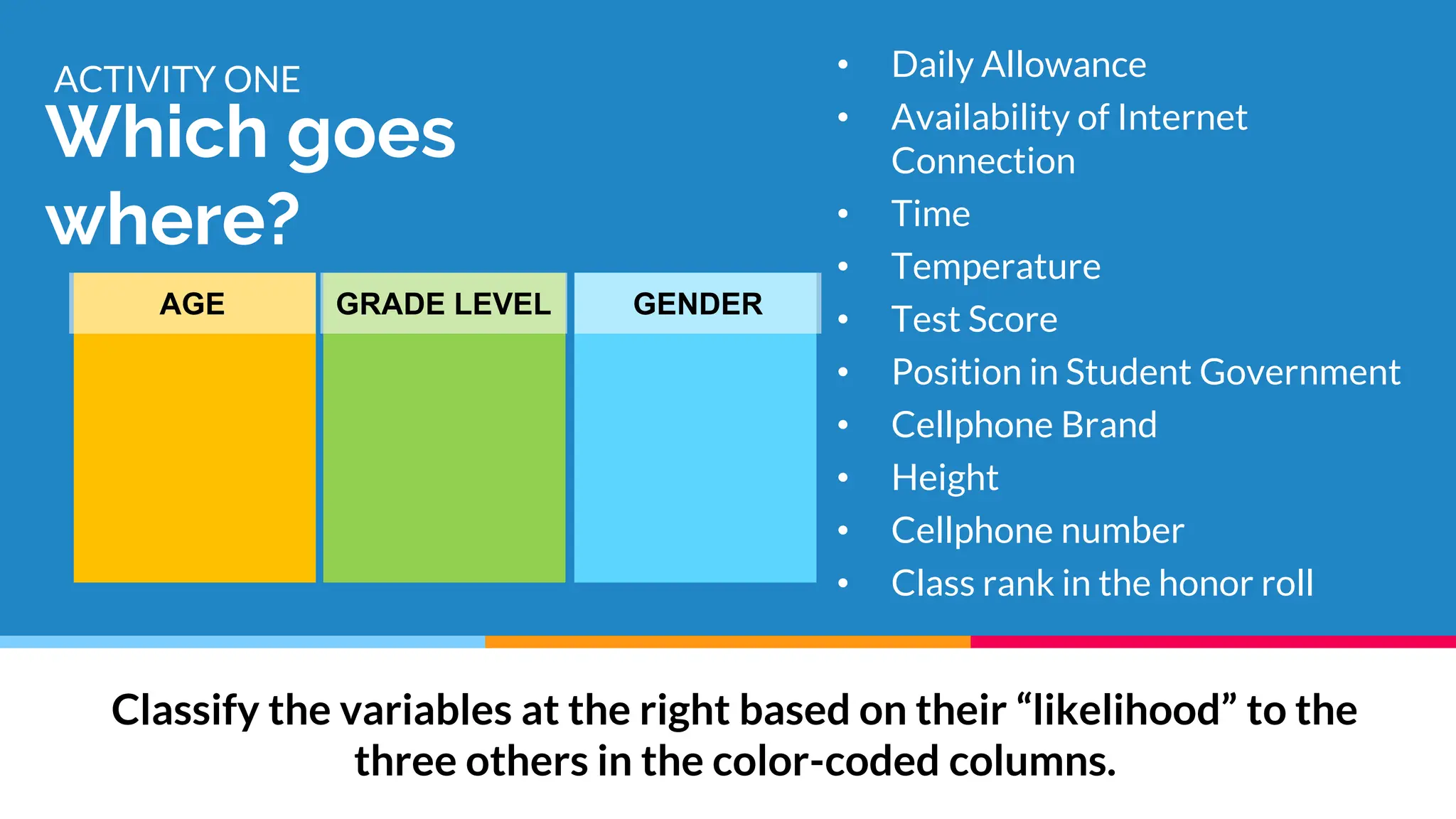
Which goes
where?
ACTIVITY ONE • Daily Allowance
• Availability of Internet
Connection
• Time
• Temperature
• Test Score
• Position in Student Government
• Cellphone Brand
• Height
• Cellphone number
• Class rank in the honor roll
AGE GRADE LEVEL GENDER
Classify the variables at the right based on their “likelihood” to the
three others in the color-coded columns.
Our Learning Goals:
After this discussion, you are expected to have the ability to…
 describe characteristics, strengths, and weaknesses of
quantitative research;
 differentiate kinds of variables according to scales of measure;
and
 contrast kinds of quantitative research.
This slideshow presentation will be made available through the trainer’s website:
mathbychua.weebly.com.
Download the document to use it as reference.
The Nature of Inquiry and Research


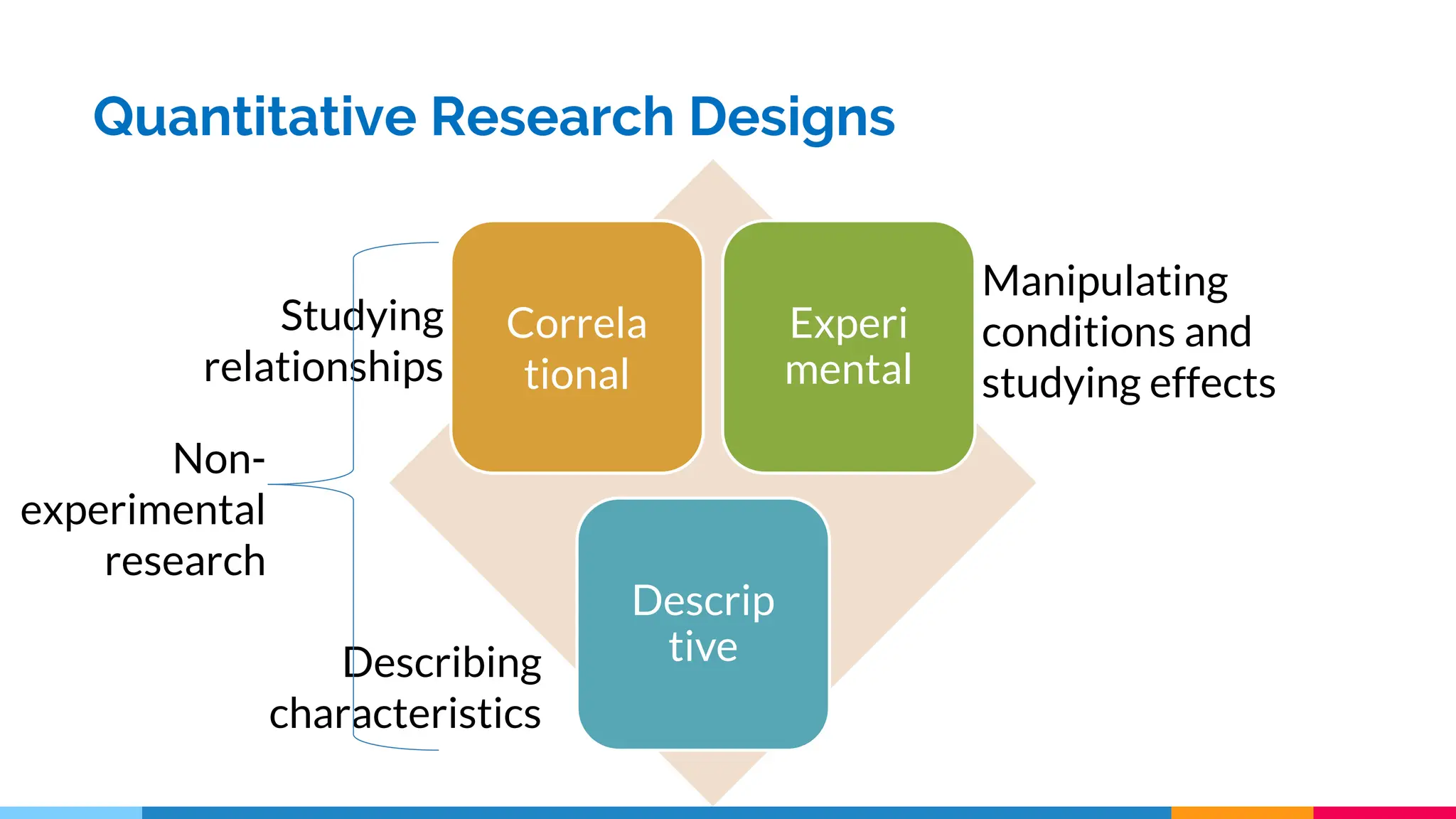
Quantitative Research Designs
Studying
relationships
Describing
characteristics
Manipulating
conditions and
studying effects
Correla
tional
Experi
mental
Descrip
tive
Non-
experimental
research
Quantitative Research Designs
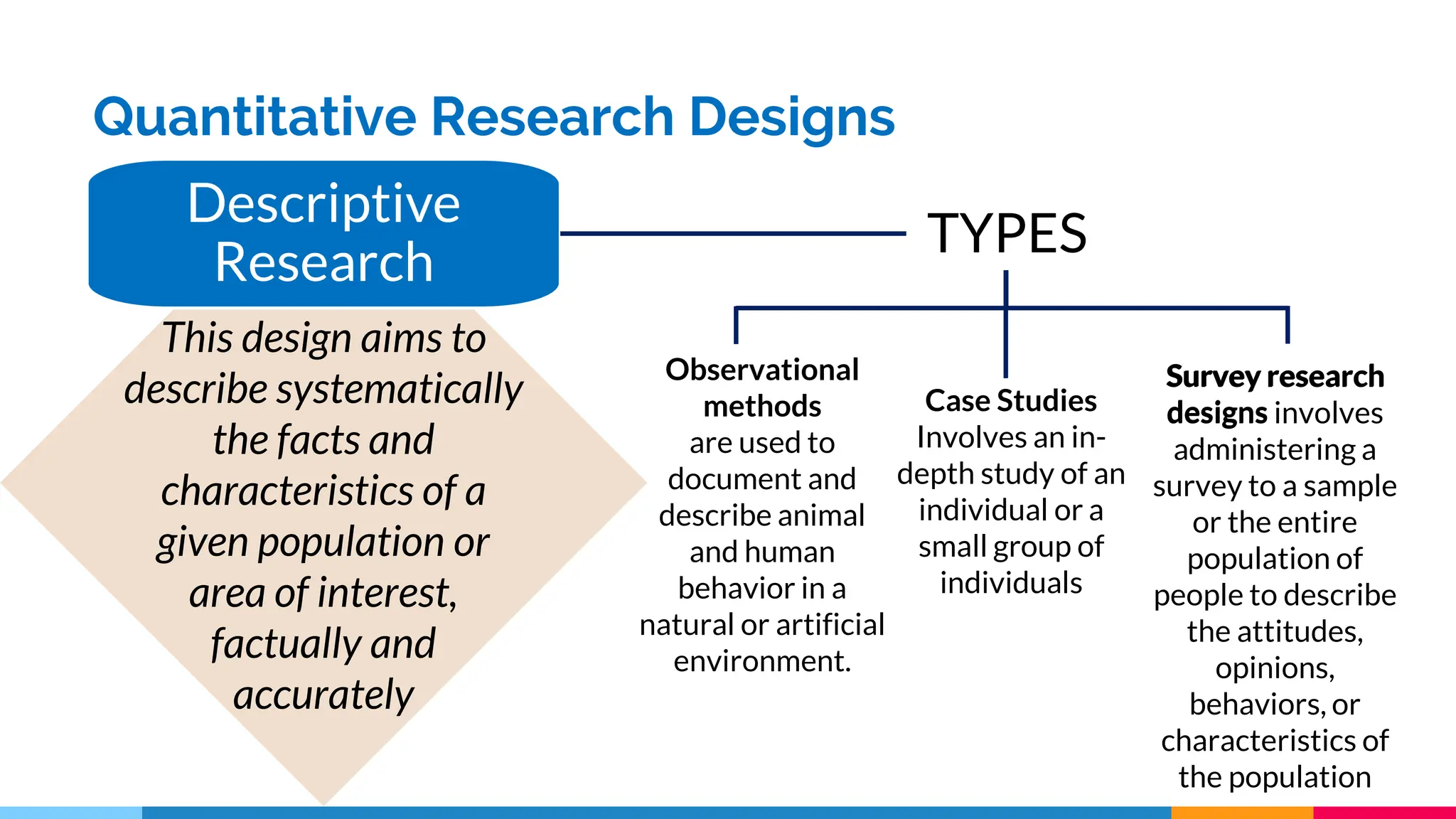
Descriptive
Research
This design aims to
describe systematically
the facts and
characteristics of a
given population or
area of interest,
factually and
accurately
Observational
methods
are used to
document and
describe animal
and human
behavior in a
natural or artificial
environment.
TYPES
Survey research
designs involves
administering a
survey to a sample
or the entire
population of
people to describe
the attitudes,
opinions,
behaviors, or
characteristics of
the population
Case Studies
Involves an in-
depth study of an
individual or a
small group of
individuals
Survey research
designs
• Describing trends
• Determining
individual opinions
about policy
issues
• Identifying
important beliefs
and attitudes of
individuals
Use it when…
Survey research
designs
Cross-sectional survey is used
when the researcher collects
data at one point in time. The
purpose is to examines current
attitudes, beliefs, opinions, or
practices
Compare two or more groups
in terms of attitudes, beliefs,
opinions, or practices.
Evaluates a program.
TYPES
Longitudinal survey designs
involves the survey
procedure of collecting data
about trends with the same
population, changes in a
cohort group or
subpopulation, or changes in a
panel group of the same
individuals over time.
What are the sleeping
habits of SHS students
in DLSAU?
What factors affected
the SHS track choice of
SHS students?
Examples of Research Questions for
Descriptive Research
What do teenagers
consider when buying a
new phone?
What are the most
common stressors that
affect professors?
What is the level of
marketability of
personalized phone
cases on DLSAU
students?
Quantitative Research Designs
Correlational
Research
aims to describe and
measure the degree
of association
between two or
more variables or
sets of scores.
Explanatory research
design determines the
extent to which two
variables (or more) co-
vary.
Co-vary means to predict
a score on one variable
with knowledge about
the individual’s score on
another variable.
Prediction research
design seeks to
identify variables that
will predict an
outcome or criterion.
Variables can be the
predictor variable or
the criterion variable.
TYPES
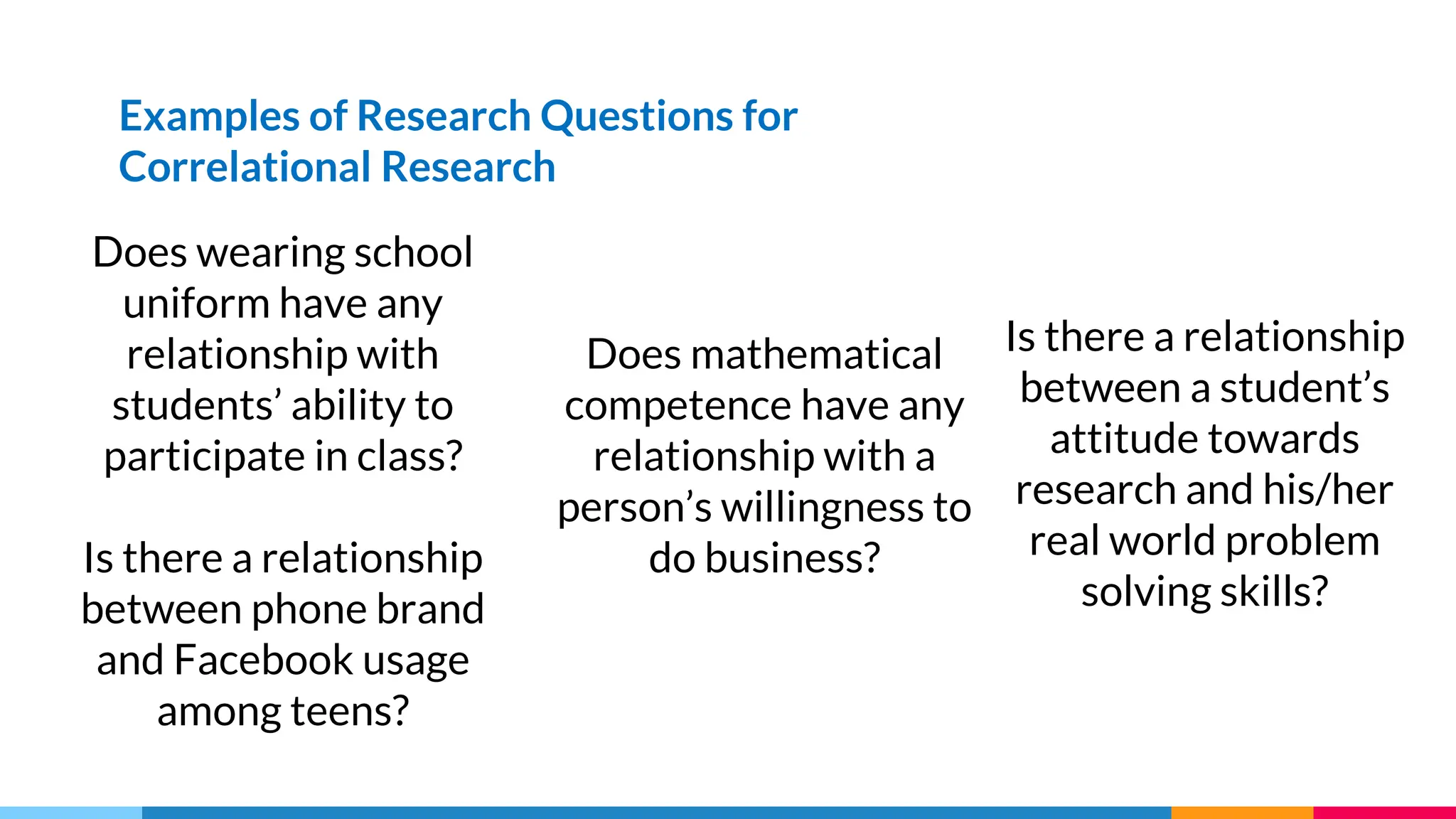
Does wearing school
uniform have any
relationship with
students’ ability to
participate in class?
Is there a relationship
between phone brand
and Facebook usage
among teens?
Examples of Research Questions for
Correlational Research
Does mathematical
competence have any
relationship with a
person’s willingness to
do business?
Is there a relationship
between a student’s
attitude towards
research and his/her
real world problem
solving skills?
Quantitative Research Designs
Experimental
Research
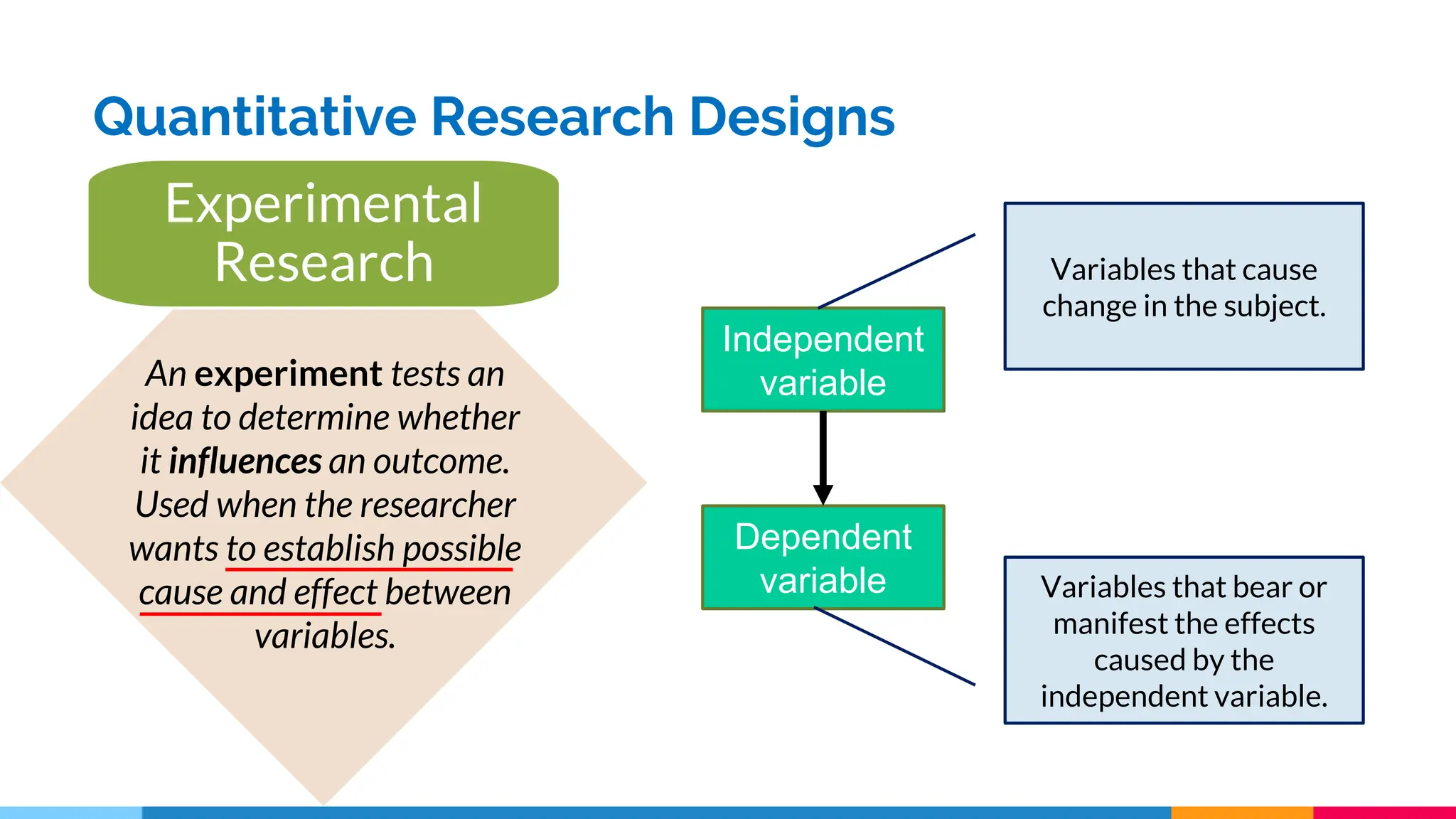
An experiment tests an
idea to determine whether
it influences an outcome.
Used when the researcher
wants to establish possible
cause and effect between
variables.
Independent
variable
Dependent
variable
Variables that cause
change in the subject.
Variables that bear or
manifest the effects
caused by the
independent variable.
Experimental
Research Designs
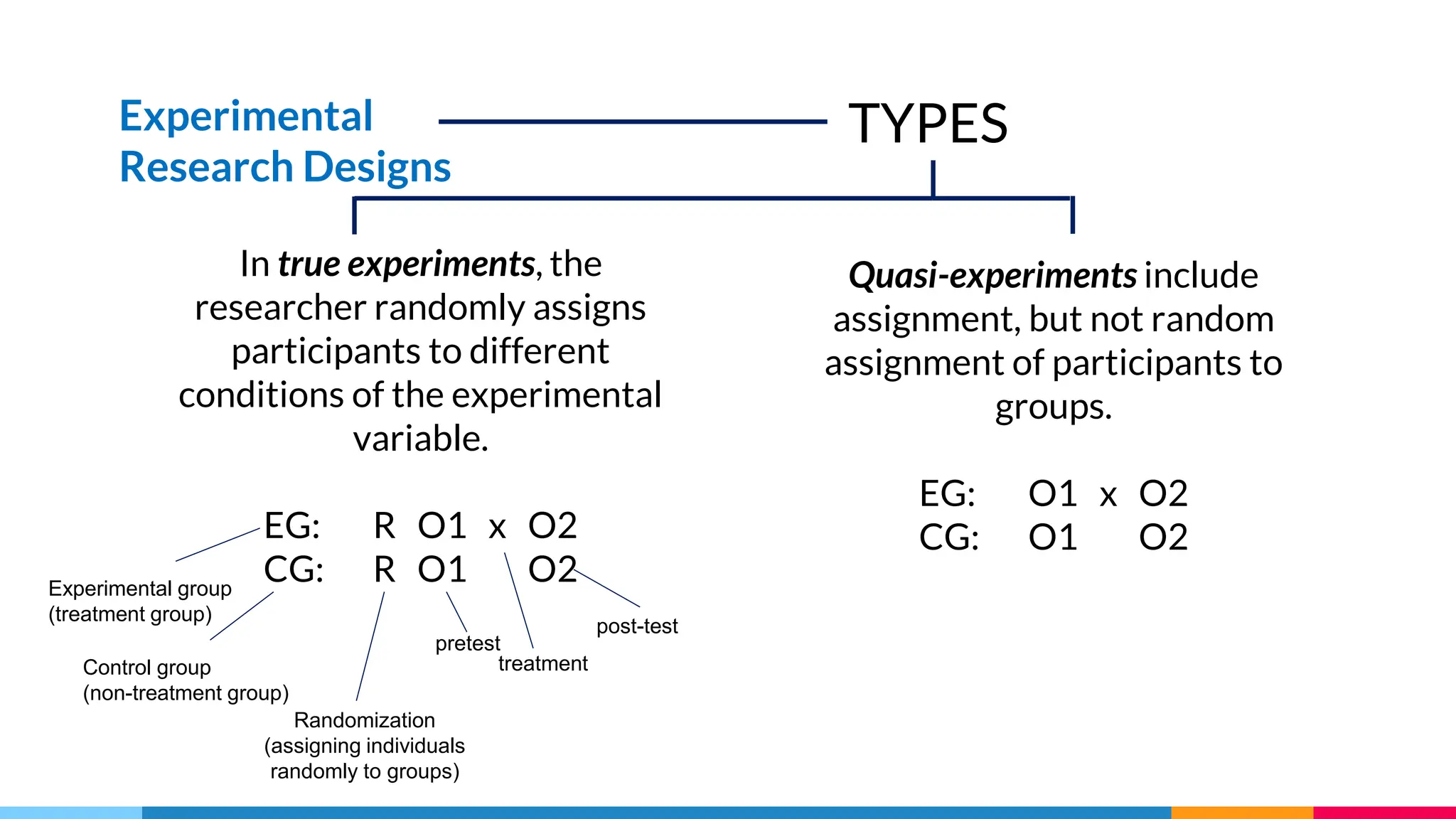
In true experiments, the
researcher randomly assigns
participants to different
conditions of the experimental
variable.
EG: R O1 x O2
CG: R O1 x O2
TYPES
Quasi-experiments include
assignment, but not random
assignment of participants to
groups.
EG: O1 x O2
CG: O1 x O2
Experimental group
(treatment group)
Control group
(non-treatment group)
Randomization
(assigning individuals
randomly to groups)
pretest
post-test
treatment
Does the use of audio-
visuals in class have any
effect on students’
memory?
Does playing indie pop
music improve students’
ability to solve Math
problems while in class?
Examples of Research Questions for
Experimental Research
Does a meme-based ad
on social media improve
a product’s name recall
as compared to an
ordinary ad?
Can peer counseling
improve a person’s
school anxiety?
Determine the
design
ACTIVITY ONE • Internet availability at home and student’s
average sleeping time at night
• Social media involvement and practices of
Grade 12 HUMSS students
• The effect of the use of <a local packaging
material> on the shelf life of a product.
• The marketability of <innovative
product> to SHS students.
• Children of single parents and their level
of Math anxiety.
Quest for
Questions
ACTIVITY TWO As a group, decide on a topic of interest for your
research.
For the next 10 minutes, come up with at least three
research questions, one for each quantitative
research design based on that topic and relevant to
your SHS track.
Present your group’s ideas to the rest of the class by
sharing why your group thinks the question is
interesting and how you see the group doing it.
Be creative. No idea is crazy.
The more innovative the idea, the better.

quantitative research designs - PR2 SHS1

  • 1.
    The Nature ofInquiry and Research Quantitative Research Designs Practical Research 2: VON CHRISTOPHER G. CHUA von_christopher_chua@dlsu.edu.ph
  • 2.
    1. What arethe differences between quantitative and qualitative research? 2. What are the strengths of quantitative research? Its weaknesses? 3. What are variables? 4. How do we classify variables? Let’s look back…
  • 3.
    IDENTITY MAGNITUDE EQUAL INTERVALS ABSOLUTE ZERO Avariable varies and has values. The values of variables under study are the research data. Are these variables? chair, shape of table, tweet, shirt style. RATIO INTERVAL ORDINAL NOMINAL Classifying Variables according to Scales of Measure Variables
  • 4.
    Which goes where? ACTIVITY ONE• Daily Allowance • Availability of Internet Connection • Time • Temperature • Test Score • Position in Student Government • Cellphone Brand • Height • Cellphone number • Class rank in the honor roll AGE GRADE LEVEL GENDER Classify the variables at the right based on their “likelihood” to the three others in the color-coded columns.
  • 5.
    Our Learning Goals: Afterthis discussion, you are expected to have the ability to…  describe characteristics, strengths, and weaknesses of quantitative research;  differentiate kinds of variables according to scales of measure; and  contrast kinds of quantitative research. This slideshow presentation will be made available through the trainer’s website: mathbychua.weebly.com. Download the document to use it as reference. The Nature of Inquiry and Research  
  • 6.
    Quantitative Research Designs Studying relationships Describing characteristics Manipulating conditionsand studying effects Correla tional Experi mental Descrip tive Non- experimental research
  • 7.
    Quantitative Research Designs Descriptive Research Thisdesign aims to describe systematically the facts and characteristics of a given population or area of interest, factually and accurately Observational methods are used to document and describe animal and human behavior in a natural or artificial environment. TYPES Survey research designs involves administering a survey to a sample or the entire population of people to describe the attitudes, opinions, behaviors, or characteristics of the population Case Studies Involves an in- depth study of an individual or a small group of individuals Survey research designs
  • 8.
    • Describing trends •Determining individual opinions about policy issues • Identifying important beliefs and attitudes of individuals Use it when… Survey research designs Cross-sectional survey is used when the researcher collects data at one point in time. The purpose is to examines current attitudes, beliefs, opinions, or practices Compare two or more groups in terms of attitudes, beliefs, opinions, or practices. Evaluates a program. TYPES Longitudinal survey designs involves the survey procedure of collecting data about trends with the same population, changes in a cohort group or subpopulation, or changes in a panel group of the same individuals over time.
  • 9.
    What are thesleeping habits of SHS students in DLSAU? What factors affected the SHS track choice of SHS students? Examples of Research Questions for Descriptive Research What do teenagers consider when buying a new phone? What are the most common stressors that affect professors? What is the level of marketability of personalized phone cases on DLSAU students?
  • 10.
    Quantitative Research Designs Correlational Research aimsto describe and measure the degree of association between two or more variables or sets of scores. Explanatory research design determines the extent to which two variables (or more) co- vary. Co-vary means to predict a score on one variable with knowledge about the individual’s score on another variable. Prediction research design seeks to identify variables that will predict an outcome or criterion. Variables can be the predictor variable or the criterion variable. TYPES
  • 11.
    Does wearing school uniformhave any relationship with students’ ability to participate in class? Is there a relationship between phone brand and Facebook usage among teens? Examples of Research Questions for Correlational Research Does mathematical competence have any relationship with a person’s willingness to do business? Is there a relationship between a student’s attitude towards research and his/her real world problem solving skills?
  • 12.
    Quantitative Research Designs Experimental Research Anexperiment tests an idea to determine whether it influences an outcome. Used when the researcher wants to establish possible cause and effect between variables. Independent variable Dependent variable Variables that cause change in the subject. Variables that bear or manifest the effects caused by the independent variable.
  • 13.
    Experimental Research Designs In trueexperiments, the researcher randomly assigns participants to different conditions of the experimental variable. EG: R O1 x O2 CG: R O1 x O2 TYPES Quasi-experiments include assignment, but not random assignment of participants to groups. EG: O1 x O2 CG: O1 x O2 Experimental group (treatment group) Control group (non-treatment group) Randomization (assigning individuals randomly to groups) pretest post-test treatment
  • 14.
    Does the useof audio- visuals in class have any effect on students’ memory? Does playing indie pop music improve students’ ability to solve Math problems while in class? Examples of Research Questions for Experimental Research Does a meme-based ad on social media improve a product’s name recall as compared to an ordinary ad? Can peer counseling improve a person’s school anxiety?
  • 15.
    Determine the design ACTIVITY ONE• Internet availability at home and student’s average sleeping time at night • Social media involvement and practices of Grade 12 HUMSS students • The effect of the use of <a local packaging material> on the shelf life of a product. • The marketability of <innovative product> to SHS students. • Children of single parents and their level of Math anxiety.
  • 16.
    Quest for Questions ACTIVITY TWOAs a group, decide on a topic of interest for your research. For the next 10 minutes, come up with at least three research questions, one for each quantitative research design based on that topic and relevant to your SHS track. Present your group’s ideas to the rest of the class by sharing why your group thinks the question is interesting and how you see the group doing it. Be creative. No idea is crazy. The more innovative the idea, the better.

Editor's Notes

  • #2 Good morning. T
  • #3 Single reality vs multiple realities; establishing relationships vs understanding perspectives; pre-established design vs emerging design; detached vs immersed; to generalize vs to assess applicability Precision of numbers; level of significance can be computed; sample is less prone to sampling bias; error can be computed Inadequacy of numbers, less than 100% accuracy; limited to proving or disproving an assumption Variables are descriptions that have values that vary
  • #4 Nominal scale is characterized by data that consist of names, labels, or categories only. Ordinal scale involves data that may be arranged in some order but differences between data values either cannot be determined or meaningless. Interval scale is data for which we can determine meaningful amounts of differences between data. However there is no inherent zero starting point. Ratio scale is the interval scale to include the inherent zero starting point. For these values, differences and ratios are both meaningful.
  • #9 When an entire population is surveyed, it is called census. Trend showing a tendency to follow a pattern. Individual opinion is seen as quantitative if these opinions are reflected as level of agreement to statements in a questionnaire. Opinion on War on Drugs: I feel safer walking alone in streets after the War on Drugs campaign. SA A N D SD Beliefs and attitudes work in the same way.
  • #11 An explanatory research design is a correlational design in which the researcher is interested in the extent to which two variables (or more) co-vary, that is, where changes in one variable are reflected in changes in the other. prediction research design is to identify variables that will predict an outcome or criterion. In this form of research, the investigator identifies one or more predictor variable and a criterion (or outcome) variable. A predictor variable is a variable used to make a forecast about an outcome in correlational research.
  • #13 In an experimental study, researchers look at the effect(s) of at least one independent variable on one or more dependent variables. The independent variable in experimental research is also frequently referred to as the experimental, or treatment, variable. The dependent variable, also known as the criterion, or outcome, variable, refers to the results or outcomes of the study. True experiments, the researcher randomly assigns participants to different conditions of the experimental variable. Quasi-experiments include assignment, but not random assignment of participants to groups. Factorial designs represent a modification of the between group design in which the researcher studies two or more categorical, independent variables, each examined at two or more levels (Vogt, 2005) A time series design consists of studying one group, over time, with multiple pretest and posttest measures or observations made by the researcher.
  • #16 Correlational Descriptive Experimental (True) Descriptive Descriptive