Quantifying Energy Consumption
for Practical Fork-Join Parallelism
on an Embedded Real-Time Operating System
Antonio Paolillo - Ph.D student & software engineer
24th ACM International Conference on Real-Time Networks and Systems
21th October 2016
2
Goal:
3
Goal:
Parallelism helps to reduce energy
while meeting real-time requirements
4
5
Quantifying Energy Consumption
for Practical Fork-Join Parallelism
on an Embedded Real-Time Operating System
6
Quantifying Energy Consumption
for Practical Fork-Join Parallelism
on an Embedded Real-Time Operating System
7
Quantifying Energy Consumption
for Practical Fork-Join Parallelism
on an Embedded Real-Time Operating System
8
Quantifying Energy Consumption
for Practical Fork-Join Parallelism
on an Embedded Real-Time Operating System
9
Quantifying Energy Consumption
for Practical Fork-Join Parallelism
on an Embedded Real-Time Operating System
10
Quantifying Energy Consumption
for Practical Fork-Join Parallelism
on an Embedded Real-Time Operating System
11
Quantifying Energy Consumption
for Practical Fork-Join Parallelism
on an Embedded Real-Time Operating System
12
Quantifying Energy Consumption
for Practical Fork-Join Parallelism
on an Embedded Real-Time Operating System
13
14
15
16
17
18
19
20
21
22
23
24
25
26
27
28
29
30
31
32
33
34
35
36
37
38
39
40
41
42
43
44
45
46
47
48
49
50
51
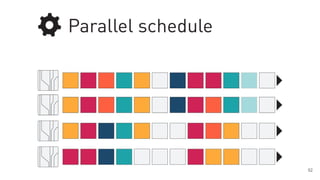
52
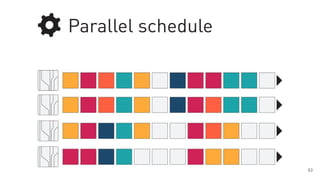
53
54
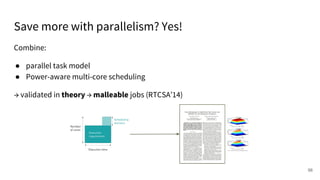
Combine:
● parallel task model
● Power-aware multi-core scheduling
55
Save more with parallelism? Yes!
Combine:
● parallel task model
● Power-aware multi-core scheduling
→ validated in theory → malleable jobs (RTCSA’14)
56
Save more with parallelism? Yes!
This work
Goal:
Reduce energy consumption as much possible
while meeting real-time requirements.
57
This work
Goal:
Reduce energy consumption as much possible
while meeting real-time requirements.
Validate it in practice
58
Validate in practice
● Parallel programming model
● RTOS techniques → power-aware multi-core hard real-time scheduling
● Evaluated with full experimental stack (RTOS + hardware in the loop)
● Simple, but real application use cases
59
1. Run-time framework
2. Task model and analysis
3. Experiments
60
1. Run-time framework
2. Task model and analysis
3. Experiments
61
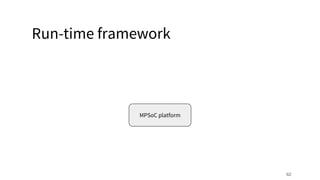
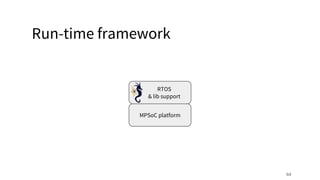
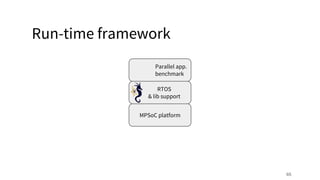
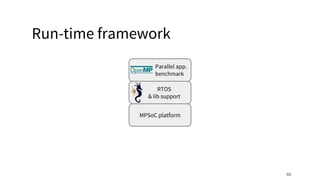
Run-time framework
62
MPSoC platform
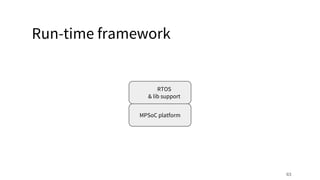
Run-time framework
63
MPSoC platform
RTOS
& lib support
Run-time framework
64
MPSoC platform
RTOS
& lib support
Run-time framework
65
MPSoC platform
RTOS
& lib support
Parallel app.
benchmark
Run-time framework
66
MPSoC platform
RTOS
& lib support
Parallel app.
benchmark
Parallel programming model
67
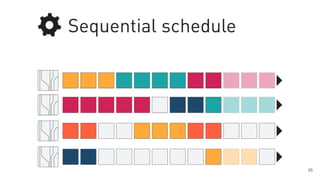
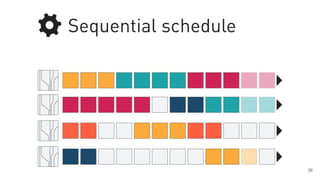
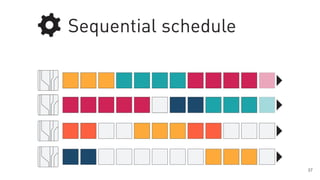
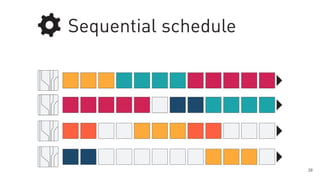
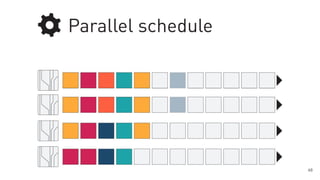
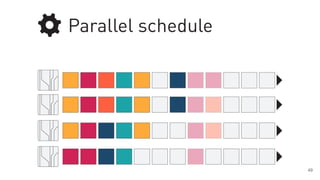
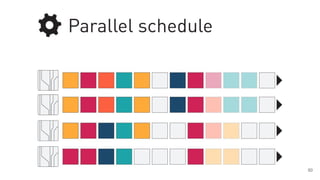
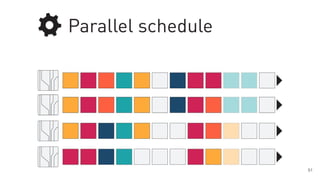
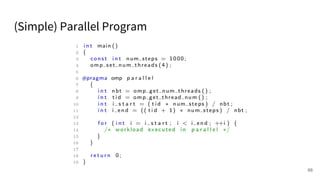
(Simple) Parallel Program
68
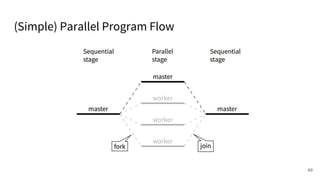
(Simple) Parallel Program Flow
69
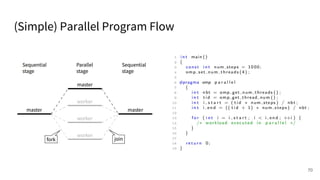
(Simple) Parallel Program Flow
70
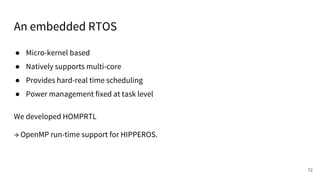
An embedded RTOS
71
An embedded RTOS
72
● Micro-kernel based
● Natively supports multi-core
● Provides hard-real time scheduling
● Power management fixed at task level
We developed HOMPRTL
→ OpenMP run-time support for HIPPEROS.
1. Run-time framework
2. Task model and analysis
3. Experiments
73
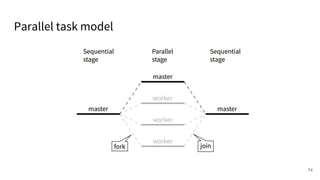
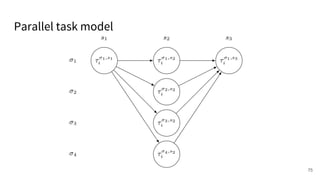
Parallel task model
74
Parallel task model
75
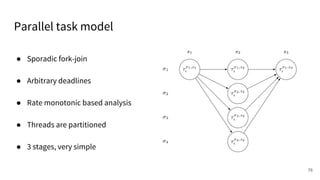
● Sporadic fork-join
● Arbitrary deadlines
● Rate monotonic based analysis
● Threads are partitioned
● 3 stages, very simple
Parallel task model
76
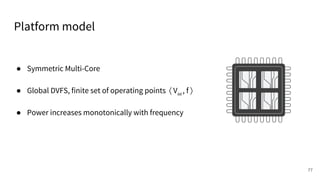
● Symmetric Multi-Core
● Global DVFS, finite set of operating points 〈 Vdd
, f 〉
● Power increases monotonically with frequency
Platform model
77
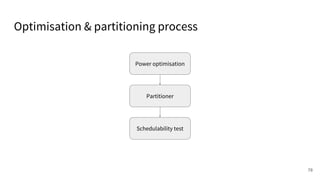
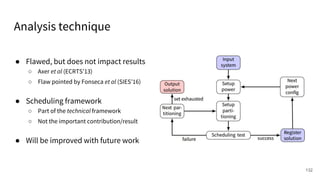
Optimisation & partitioning process
78
Power optimisation
Partitioner
Schedulability test
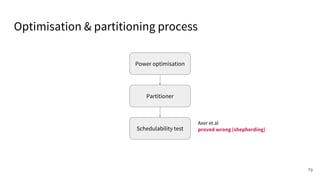
Optimisation & partitioning process
79
Power optimisation
Partitioner
Schedulability test
Axer et al
proved wrong (shepherding)
1. Run-time framework
2. Task model and analysis
3. Experiments
80
1. Run-time framework
2. Task model and analysis
3. Experiments
a. Testbed description
b. Single use cases
c. Task systems
81
1. Run-time framework
2. Task model and analysis
3. Experiments
a. Testbed description
b. Single use cases
c. Task systems
82
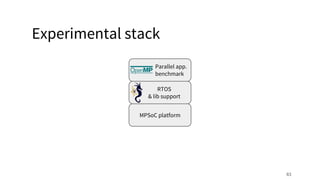
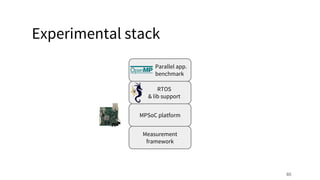
Experimental stack
83
MPSoC platform
RTOS
& lib support
Parallel app.
benchmark
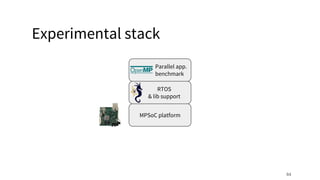
Experimental stack
84
MPSoC platform
RTOS
& lib support
Parallel app.
benchmark
Experimental stack
85
MPSoC platform
RTOS
& lib support
Parallel app.
benchmark
Measurement
framework
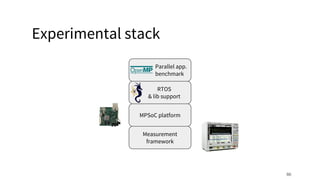
Experimental stack
86
MPSoC platform
RTOS
& lib support
Parallel app.
benchmark
Measurement
framework
Target platform - i.MX6q SabreLite
87
● Embedded board ARM Cortex A9 MP
● Supported by HIPPEROS
● 4 cores, but global DVFS
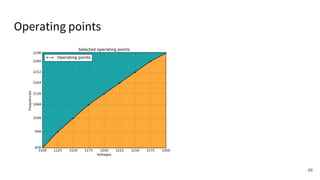
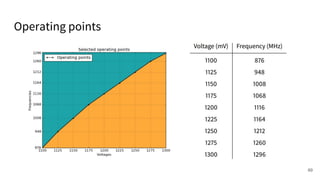
● Operating points
Operating points
88
Operating points
89
90
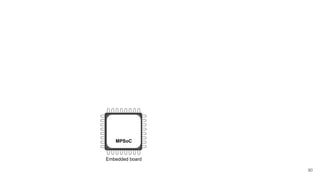
MPSoC
Embedded board
91
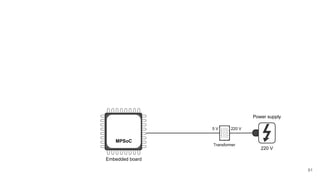
MPSoC
Embedded board
Power supply
220 V
220 V
Transformer
5 V
92
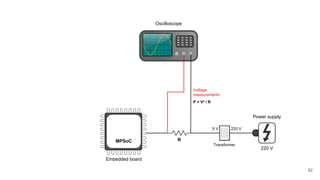
MPSoC
Oscilloscope
Embedded board
Power supply
220 V
220 V5 V
R
Voltage
measurements
P = V² / R
Transformer
93
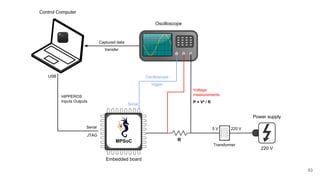
MPSoC
Control Computer
Oscilloscope
Embedded board
Power supply
220 V
220 V5 V
R
Serial
JTAG
USB
Captured data
transfer
Oscilloscope
trigger
Voltage
measurements
P = V² / R
Transformer
HIPPEROS
Inputs Outputs
Serial
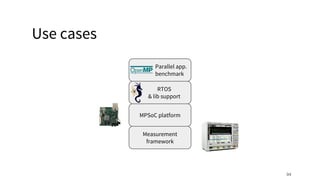
Use cases
94
MPSoC platform
RTOS
& lib support
Parallel app.
benchmark
Measurement
framework
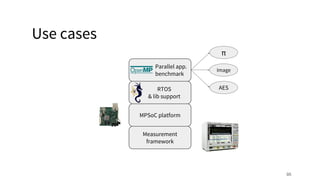
Use cases
95
MPSoC platform
RTOS
& lib support
Parallel app.
benchmark
Measurement
framework
π
AES
Image
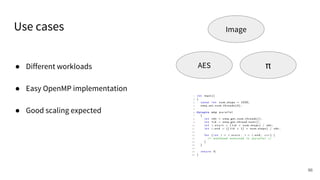
● Different workloads
● Easy OpenMP implementation
● Good scaling expected
Use cases
96
Image
AES π
1. Run-time framework
2. Task model and analysis
3. Experiments
a. Testbed description
b. Single use cases
c. Task systems
97
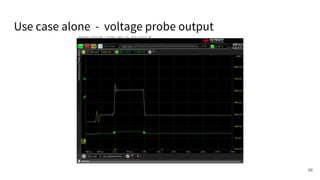
Use case alone - voltage probe output
98
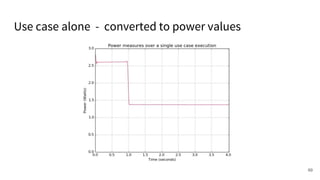
Use case alone - converted to power values
99
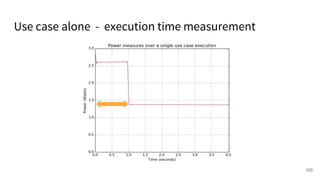
Use case alone - execution time measurement
100
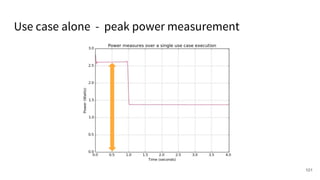
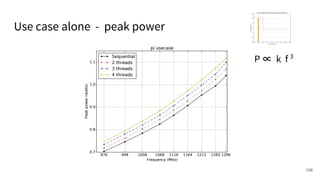
Use case alone - peak power measurement
101
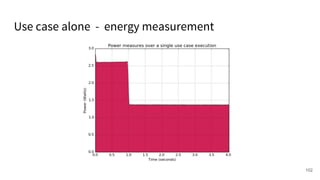
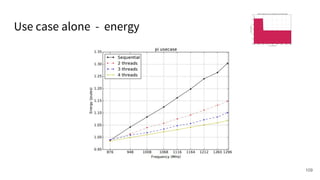
Use case alone - energy measurement
102
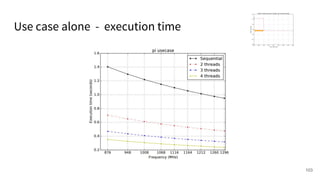
Use case alone - execution time
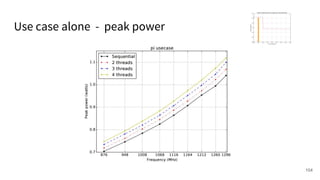
103
Use case alone - peak power
104
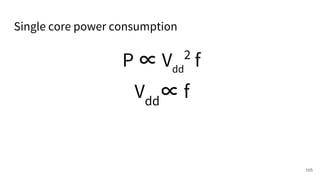
Single core power consumption
105
P ∝ Vdd
2
f
Vdd
∝ f
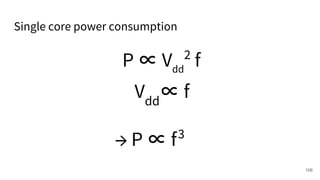
Single core power consumption
106
P ∝ Vdd
2
f
Vdd
∝ f
→ P ∝ f3
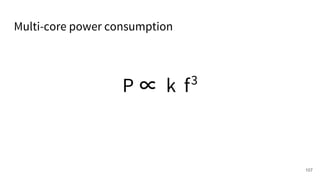
Multi-core power consumption
107
P ∝ k f3
Use case alone - peak power
108
P ∝ k f 3
Use case alone - energy
109
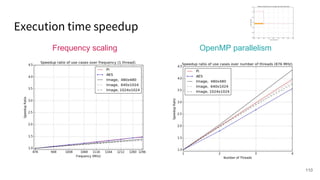
Execution time speedup
110
Frequency scaling OpenMP parallelism
1. Run-time framework
2. Task model and analysis
3. Experiments
a. Testbed description
b. Single use cases
c. Task systems
111
System experiments
112
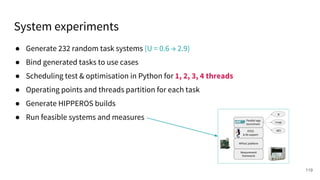
● Generate 232 random task systems (U = 0.6 → 2.9)
System experiments
113
● Generate 232 random task systems (U = 0.6 → 2.9)
● Bind generated tasks to use cases
System experiments
114
● Generate 232 random task systems (U = 0.6 → 2.9)
● Bind generated tasks to use cases
● Scheduling test & optimisation in Python for 1, 2, 3, 4 threads
System experiments
115
● Generate 232 random task systems (U = 0.6 → 2.9)
● Bind generated tasks to use cases
● Scheduling test & optimisation in Python for 1, 2, 3, 4 threads
● Operating points and threads partition for each task
System experiments
116
● Generate 232 random task systems (U = 0.6 → 2.9)
● Bind generated tasks to use cases
● Scheduling test & optimisation in Python for 1, 2, 3, 4 threads
● Operating points and threads partition for each task
● Generate HIPPEROS builds
System experiments
117
● Generate 232 random task systems (U = 0.6 → 2.9)
● Bind generated tasks to use cases
● Scheduling test & optimisation in Python for 1, 2, 3, 4 threads
● Operating points and threads partition for each task
● Generate HIPPEROS builds
● Run feasible systems and measures
System experiments
118
● Generate 232 random task systems (U = 0.6 → 2.9)
● Bind generated tasks to use cases
● Scheduling test & optimisation in Python for 1, 2, 3, 4 threads
● Operating points and threads partition for each task
● Generate HIPPEROS builds
● Run feasible systems and measures
System experiments
119
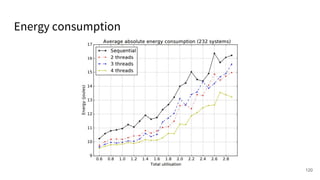
Energy consumption
120
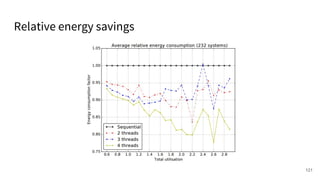
Relative energy savings
121
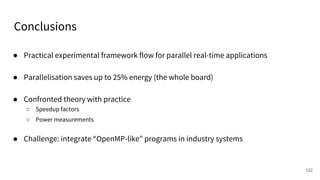
Conclusions
122
● Practical experimental framework flow for parallel real-time applications
● Parallelisation saves up to 25% energy (the whole board)
● Confronted theory with practice
○ Speedup factors
○ Power measurements
● Challenge: integrate “OpenMP-like” programs in industry systems
Conclusion
123
Parallelism helps to reduce energy
while meeting real-time requirements
Thank you.
124
Questions?
125
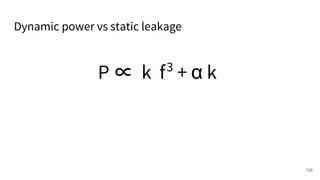
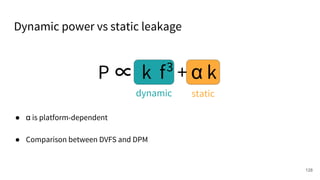
Dynamic power vs static leakage
126
P ∝ k f3
+ α k
P ∝ k f3
+ α k
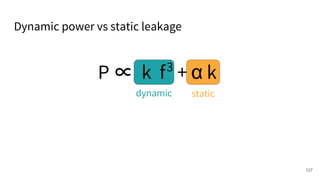
Dynamic power vs static leakage
127
dynamic static
Dynamic power vs static leakage
128
dynamic static
● α is platform-dependent
● Comparison between DVFS and DPM
P ∝ k f3
+ α k
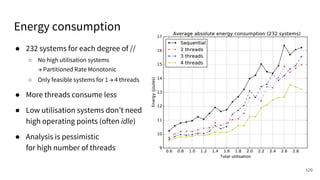
● 232 systems for each degree of //
○ No high utilisation systems
→ Partitioned Rate Monotonic
○ Only feasible systems for 1 → 4 threads
● More threads consume less
● Low utilisation systems don’t need
high operating points (often idle)
● Analysis is pessimistic
for high number of threads
Energy consumption
129
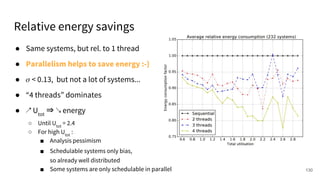
● Same systems, but rel. to 1 thread
● Parallelism helps to save energy :-)
● < 0.13, but not a lot of systems...
● “4 threads” dominates
● ↗ Utot
⇒ ↘ energy
○ Until Utot
= 2.4
○ For high Utot
:
■ Analysis pessimism
■ Schedulable systems only bias,
so already well distributed
■ Some systems are only schedulable in parallel
Relative energy savings
130
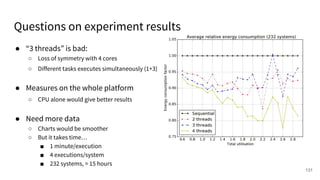
● “3 threads” is bad:
○ Loss of symmetry with 4 cores
○ Different tasks executes simultaneously (1+3)
● Measures on the whole platform
○ CPU alone would give better results
● Need more data
○ Charts would be smoother
○ But it takes time…
■ 1 minute/execution
■ 4 executions/system
■ 232 systems, ≈ 15 hours
Questions on experiment results
131
● Flawed, but does not impact results
○ Axer et al (ECRTS’13)
○ Flaw pointed by Fonseca et al (SIES’16)
● Scheduling framework
○ Part of the technical framework
○ Not the important contribution/result
● Will be improved with future work
Analysis technique
132

Quantifying Energy Consumption for Practical Fork-Join Parallelism on an Embedded Real-Time Operating System