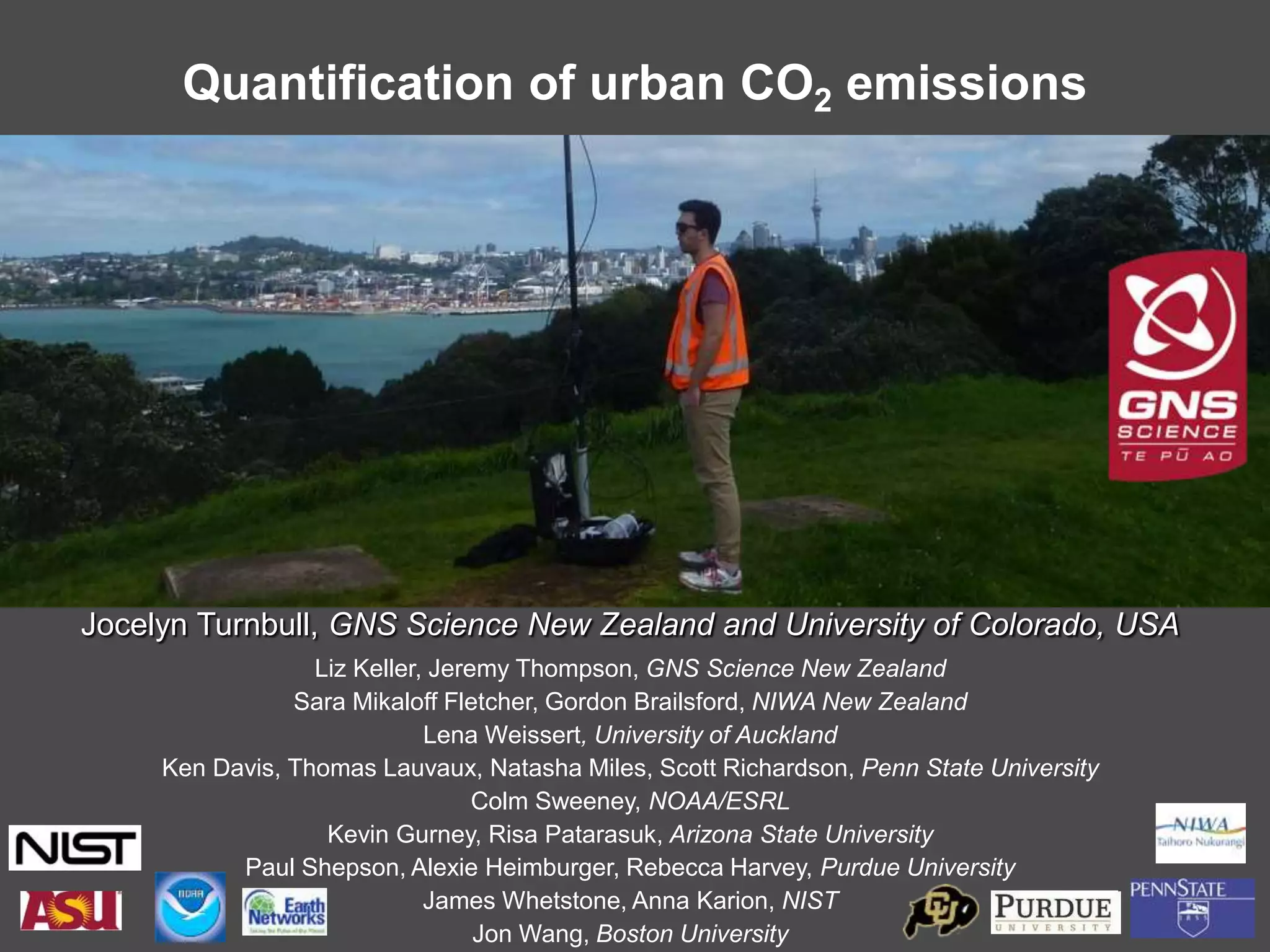
Quantification of urban CO2 emissions
Jocelyn Turnbull, GNS Science New Zealand and University of Colorado, USA
Liz Keller, Jeremy Thompson, GNS Science New Zealand
Sara Mikaloff Fletcher, Gordon Brailsford, NIWA New Zealand
Lena Weissert, University of Auckland
Ken Davis, Thomas Lauvaux, Natasha Miles, Scott Richardson, Penn State University
Colm Sweeney, NOAA/ESRL
Kevin Gurney, Risa Patarasuk, Arizona State University
Paul Shepson, Alexie Heimburger, Rebecca Harvey, Purdue University
James Whetstone, Anna Karion, NIST
Jon Wang, Boston University
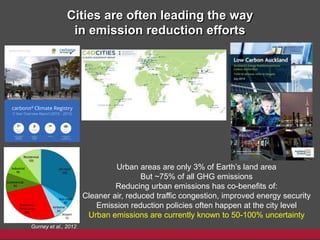
Cities are often leading the way
in emission reduction efforts
Urban areas are only 3% of Earth’s land area
But ~75% of all GHG emissions
Reducing urban emissions has co-benefits of:
Cleaner air, reduced traffic congestion, improved energy security
Emission reduction policies often happen at the city level
Urban emissions are currently known to 50-100% uncertainty
Gurney et al., 2012
On-road
33%
Non-road
4%
Airborne
6%
Airport
1%
Electricity
Production
28%
Commercial
9%
Industrial
9%
Residential
10%
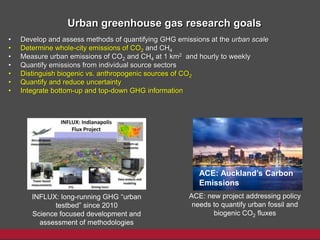
Urban greenhouse gas research goals
• Develop and assess methods of quantifying GHG emissions at the urban scale
• Determine whole-city emissions of CO2 and CH4
• Measure urban emissions of CO2 and CH4 at 1 km2 and hourly to weekly
• Quantify emissions from individual source sectors
• Distinguish biogenic vs. anthropogenic sources of CO2
• Quantify and reduce uncertainty
• Integrate bottom-up and top-down GHG information
INFLUX: long-running GHG “urban
testbed” since 2010
Science focused development and
assessment of methodologies
ACE: Auckland’s Carbon
Emissions
ACE: new project addressing policy
needs to quantify urban fossil and
biogenic CO2 fluxes
Evaluating Indianapolis whole city CO2 fluxes
from top-down and bottom-up methods
• Bottom-up inventory-based data product
• Top-down atmospheric inversion based on tower CO2
measurements
• Top-down mass balance flux calculation using aircraft
observations
• Reconciling differences between methods using flask
observations of fossil fuel CO2 derived from 14CO2
observations
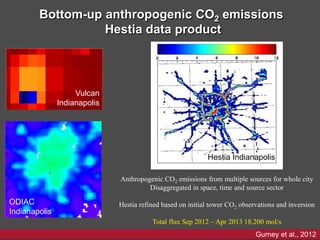
Bottom-up anthropogenic CO2 emissions
Hestia data product
Anthropogenic CO2 emissions from multiple sources for whole city
Disaggregated in space, time and source sector
Hestia refined based on initial tower CO2 observations and inversion
Total flux Sep 2012 – Apr 2013 18,200 mol/s
Gurney et al., 2012
Vulcan
Indianapolis
ODIAC
Indianapolis
Hestia Indianapolis
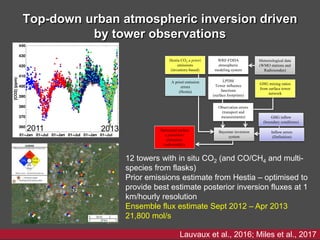
Top-down urban atmospheric inversion driven
by tower observations
12 towers with in situ CO2 (and CO/CH4 and multi-
species from flasks)
Prior emissions estimate from Hestia – optimised to
provide best estimate posterior inversion fluxes at 1
km/hourly resolution
Ensemble flux estimate Sept 2012 – Apr 2013
21,800 mol/s
Lauvaux et al., 2016; Miles et al., 2017
WRF-FDDA
atmospheric
modeling system
LPDM
Tower influence
functions
(surface footprints)
Optimized surface
a posteriori
emissions
(sub-weekly)
Observation errors
(transport and
measurements)
A priori emission
errors
(Hestia)
Inflow errors
(Definition)
GHG mixing ratios
from surface tower
network
Meteorological data
(WMO stations and
Radiosondes)
GHG inflow
(boundary conditions)
Hestia CO2 a priori
emissions
(inventory-based)
Bayesian inversion
system
2011 2013
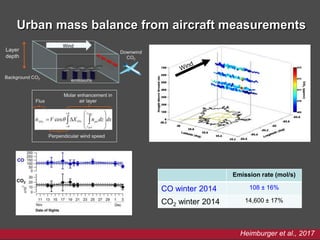
Urban mass balance from aircraft measurements
Heimburger et al., 2017
Emission rate (mol/s)
CO winter 2014 108 ± 16%
CO2 winter 2014 14,600 ± 17%
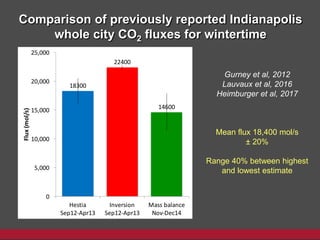
Comparison of previously reported Indianapolis
whole city CO2 fluxes for wintertime
Gurney et al, 2012
Lauvaux et al, 2016
Heimburger et al, 2017
Mean flux 18,400 mol/s
± 20%
Range 40% between highest
and lowest estimate
18300
22400
14600
0
5,000
10,000
15,000
20,000
25,000
Hestia
Sep12-Apr13
Inversion
Sep12-Apr13
Mass balance
Nov-Dec14
Flux(mol/s)
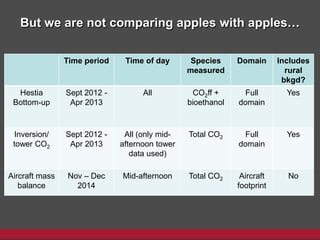
But we are not comparing apples with apples…
Time period Time of day Species
measured
Domain Includes
rural
bkgd?
Hestia
Bottom-up
Sept 2012 -
Apr 2013
All CO2ff +
bioethanol
Full
domain
Yes
Inversion/
tower CO2
Sept 2012 -
Apr 2013
All (only mid-
afternoon tower
data used)
Total CO2 Full
domain
Yes
Aircraft mass
balance
Nov – Dec
2014
Mid-afternoon Total CO2 Aircraft
footprint
No
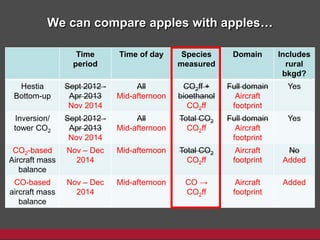
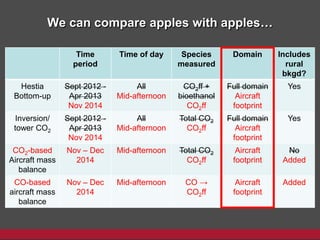
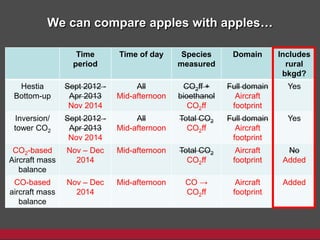
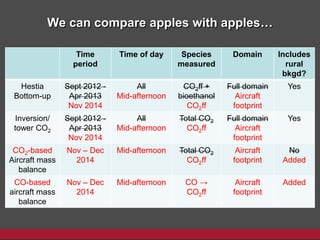
We can compare apples with apples…
Time
period
Time of day Species
measured
Domain Includes
rural
bkgd?
Hestia
Bottom-up
Sept 2012 -
Apr 2013
Nov 2014
All
Mid-afternoon
CO2ff +
bioethanol
CO2ff
Full domain
Aircraft
footprint
Yes
Inversion/
tower CO2
Sept 2012 -
Apr 2013
Nov 2014
All
Mid-afternoon
Total CO2
CO2ff
Full domain
Aircraft
footprint
Yes
CO2-based
Aircraft mass
balance
Nov – Dec
2014
Mid-afternoon Total CO2
CO2ff
Aircraft
footprint
No
Added
CO-based
aircraft mass
balance
Nov – Dec
2014
Mid-afternoon CO →
CO2ff
Aircraft
footprint
Added
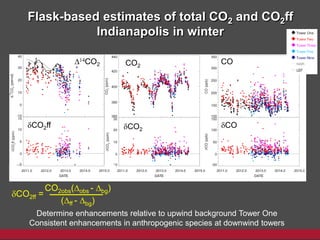
Flask-based estimates of total CO2 and CO2ff
Indianapolis in winter
Determine enhancements relative to upwind background Tower One
Consistent enhancements in anthropogenic species at downwind towers
dCO2ff dCO2
dCO
D14CO2 CO2
CO
dCO2ff =
CO2obs(Dobs - Dbg)
(Dff - Dbg)
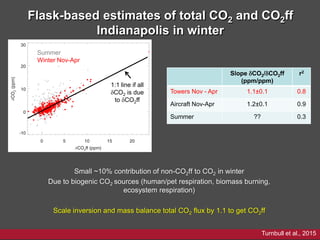
Flask-based estimates of total CO2 and CO2ff
Indianapolis in winter
Small ~10% contribution of non-CO2ff to CO2 in winter
Due to biogenic CO2 sources (human/pet respiration, biomass burning,
ecosystem respiration)
Scale inversion and mass balance total CO2 flux by 1.1 to get CO2ff
Slope dCO2/dCO2ff
(ppm/ppm)
r2
Towers Nov - Apr 1.1±0.1 0.8
Aircraft Nov-Apr 1.2±0.1 0.9
Summer ?? 0.3
Summer
Winter Nov-Apr
1:1 line if all
dCO2 is due
to dCO2ff
Turnbull et al., 2015
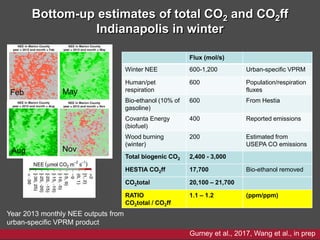
Bottom-up estimates of total CO2 and CO2ff
Indianapolis in winter
Flux (mol/s)
Winter NEE 600-1,200 Urban-specific VPRM
Human/pet
respiration
600 Population/respiration
fluxes
Bio-ethanol (10% of
gasoline)
600 From Hestia
Covanta Energy
(biofuel)
400 Reported emissions
Wood burning
(winter)
200 Estimated from
USEPA CO emissions
Total biogenic CO2 2,400 - 3,000
HESTIA CO2ff 17,700 Bio-ethanol removed
CO2total 20,100 – 21,700
RATIO
CO2total / CO2ff
1.1 – 1.2 (ppm/ppm)
Gurney et al., 2017, Wang et al., in prep
Feb
Aug
May
Nov
Year 2013 monthly NEE outputs from
urban-specific VPRM product
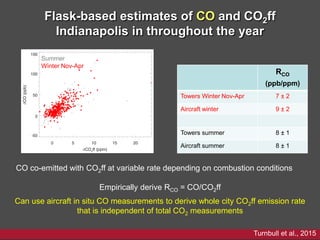
Flask-based estimates of CO and CO2ff
Indianapolis in throughout the year
CO co-emitted with CO2ff at variable rate depending on combustion conditions
Empirically derive RCO = CO/CO2ff
Can use aircraft in situ CO measurements to derive whole city CO2ff emission rate
that is independent of total CO2 measurements
RCO
(ppb/ppm)
Towers Winter Nov-Apr 7 ± 2
Aircraft winter 9 ± 2
Towers summer 8 ± 1
Aircraft summer 8 ± 1
Summer
Winter Nov-Apr
Turnbull et al., 2015
We can compare apples with apples…
Time
period
Time of day Species
measured
Domain Includes
rural
bkgd?
Hestia
Bottom-up
Sept 2012 -
Apr 2013
Nov 2014
All
Mid-afternoon
CO2ff +
bioethanol
CO2ff
Full domain
Aircraft
footprint
Yes
Inversion/
tower CO2
Sept 2012 -
Apr 2013
Nov 2014
All
Mid-afternoon
Total CO2
CO2ff
Full domain
Aircraft
footprint
Yes
CO2-based
Aircraft mass
balance
Nov – Dec
2014
Mid-afternoon Total CO2
CO2ff
Aircraft
footprint
No
Added
CO-based
aircraft mass
balance
Nov – Dec
2014
Mid-afternoon CO →
CO2ff
Aircraft
footprint
Added
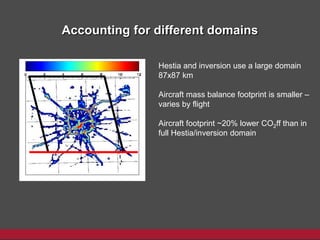
Accounting for different domains
Hestia and inversion use a large domain
87x87 km
Aircraft mass balance footprint is smaller –
varies by flight
Aircraft footprint ~20% lower CO2ff than in
full Hestia/inversion domain
We can compare apples with apples…
Time
period
Time of day Species
measured
Domain Includes
rural
bkgd?
Hestia
Bottom-up
Sept 2012 -
Apr 2013
Nov 2014
All
Mid-afternoon
CO2ff +
bioethanol
CO2ff
Full domain
Aircraft
footprint
Yes
Inversion/
tower CO2
Sept 2012 -
Apr 2013
Nov 2014
All
Mid-afternoon
Total CO2
CO2ff
Full domain
Aircraft
footprint
Yes
CO2-based
Aircraft mass
balance
Nov – Dec
2014
Mid-afternoon Total CO2
CO2ff
Aircraft
footprint
No
Added
CO-based
aircraft mass
balance
Nov – Dec
2014
Mid-afternoon CO →
CO2ff
Aircraft
footprint
Added
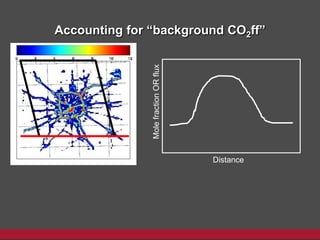
Accounting for “background CO2ff”
DistanceMolefractionORflux
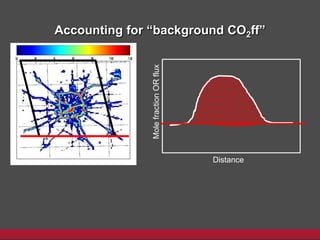
Accounting for “background CO2ff”
DistanceMolefractionORflux
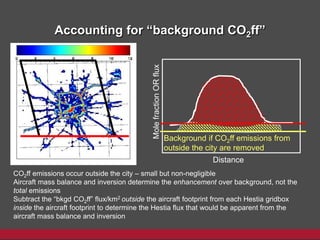
Accounting for “background CO2ff”
DistanceMolefractionORflux
Background if CO2ff emissions from
outside the city are removed
CO2ff emissions occur outside the city – small but non-negligible
Aircraft mass balance and inversion determine the enhancement over background, not the
total emissions
Subtract the “bkgd CO2ff” flux/km2 outside the aircraft footprint from each Hestia gridbox
inside the aircraft footprint to determine the Hestia flux that would be apparent from the
aircraft mass balance and inversion
We can compare apples with apples…
Time
period
Time of day Species
measured
Domain Includes
rural
bkgd?
Hestia
Bottom-up
Sept 2012 -
Apr 2013
Nov 2014
All
Mid-afternoon
CO2ff +
bioethanol
CO2ff
Full domain
Aircraft
footprint
Yes
Inversion/
tower CO2
Sept 2012 -
Apr 2013
Nov 2014
All
Mid-afternoon
Total CO2
CO2ff
Full domain
Aircraft
footprint
Yes
CO2-based
Aircraft mass
balance
Nov – Dec
2014
Mid-afternoon Total CO2
CO2ff
Aircraft
footprint
No
Added
CO-based
aircraft mass
balance
Nov – Dec
2014
Mid-afternoon CO →
CO2ff
Aircraft
footprint
Added
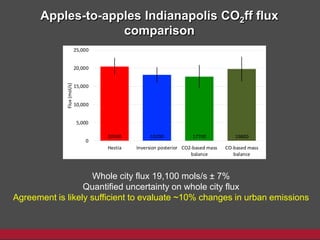
Apples-to-apples Indianapolis CO2ff flux
comparison
Whole city flux 19,100 mols/s ± 7%
Quantified uncertainty on whole city flux
Agreement is likely sufficient to evaluate ~10% changes in urban emissions
20500 18200 17700 19800
0
5,000
10,000
15,000
20,000
25,000
Hestia Inversion posterior CO2-based mass
balance
CO-based mass
balance
Flux(mol/s)
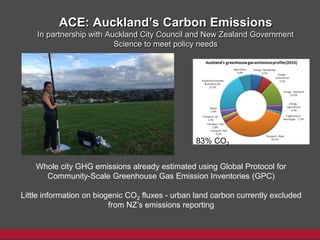
ACE: Auckland’s Carbon Emissions
In partnership with Auckland City Council and New Zealand Government
Science to meet policy needs
Whole city GHG emissions already estimated using Global Protocol for
Community-Scale Greenhouse Gas Emission Inventories (GPC)
Little information on biogenic CO2 fluxes - urban land carbon currently excluded
from NZ’s emissions reporting
83% CO2
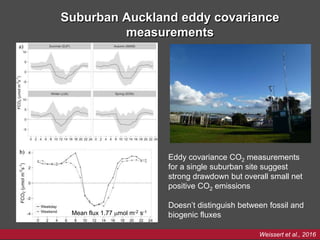
Suburban Auckland eddy covariance
measurements
Weissert et al., 2016
Eddy covariance CO2 measurements
for a single suburban site suggest
strong drawdown but overall small net
positive CO2 emissions
Doesn’t distinguish between fossil and
biogenic fluxesMean flux 1.77 mmol m-2 s-1
ACE: Auckland’s Carbon Emissions
In partnership with Auckland City Council and New Zealand Government
Science to meet policy needs
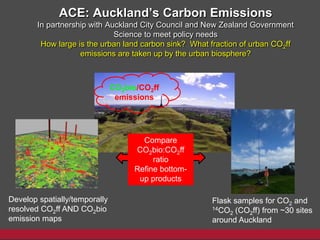
How large is the urban land carbon sink? What fraction of urban CO2ff
emissions are taken up by the urban biosphere?
CO2bio/CO2ff
emissions
Develop spatially/temporally
resolved CO2ff AND CO2bio
emission maps
Flask samples for CO2 and
14CO2 (CO2ff) from ~30 sites
around Auckland
Compare
CO2bio:CO2ff
ratio
Refine bottom-
up products
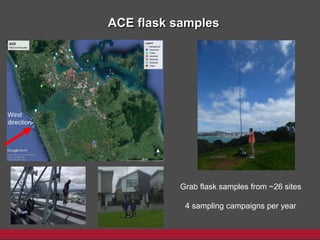
ACE flask samples
Wind
direction
Grab flask samples from ~26 sites
4 sampling campaigns per year
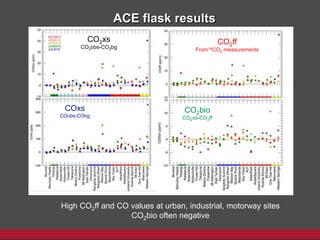
ACE flask results
High CO2ff and CO values at urban, industrial, motorway sites
CO2bio often negative
CO2xs
CO2obs-CO2bg
CO2ff
From14CO2 measurements
CO2bio
CO2xs-CO2ff
COxs
COobs-CObg
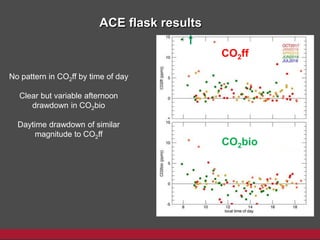
ACE flask results
CO2ff
CO2bio
No pattern in CO2ff by time of day
Clear but variable afternoon
drawdown in CO2bio
Daytime drawdown of similar
magnitude to CO2ff
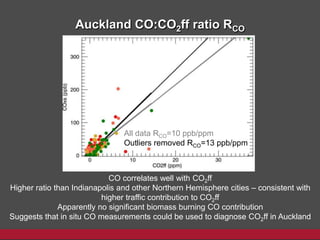
Auckland CO:CO2ff ratio RCO
All data RCO=10 ppb/ppm
Outliers removed RCO=13 ppb/ppm
CO correlates well with CO2ff
Higher ratio than Indianapolis and other Northern Hemisphere cities – consistent with
higher traffic contribution to CO2ff
Apparently no significant biomass burning CO contribution
Suggests that in situ CO measurements could be used to diagnose CO2ff in Auckland
Conclusions
Can quantify urban CO2 emissions to better than 10% using multiple methods:
Inventory-based methods - Atmospheric inversion with tower observations - Aircraft-
based mass balance
Essential to distinguish fossil fuel and biogenic CO2
Measurements of 14CO2, CO2 and CO in combination with modelling likely will allow
quantification of the biogenic CO2 flux all year round in Auckland
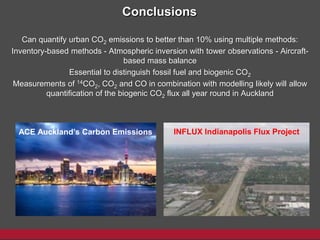
INFLUX Indianapolis Flux ProjectACE Auckland’s Carbon Emissions

Quantification of urban CO2 emissions

  • 1.
    Quantification of urbanCO2 emissions Jocelyn Turnbull, GNS Science New Zealand and University of Colorado, USA Liz Keller, Jeremy Thompson, GNS Science New Zealand Sara Mikaloff Fletcher, Gordon Brailsford, NIWA New Zealand Lena Weissert, University of Auckland Ken Davis, Thomas Lauvaux, Natasha Miles, Scott Richardson, Penn State University Colm Sweeney, NOAA/ESRL Kevin Gurney, Risa Patarasuk, Arizona State University Paul Shepson, Alexie Heimburger, Rebecca Harvey, Purdue University James Whetstone, Anna Karion, NIST Jon Wang, Boston University
  • 2.
    Cities are oftenleading the way in emission reduction efforts Urban areas are only 3% of Earth’s land area But ~75% of all GHG emissions Reducing urban emissions has co-benefits of: Cleaner air, reduced traffic congestion, improved energy security Emission reduction policies often happen at the city level Urban emissions are currently known to 50-100% uncertainty Gurney et al., 2012 On-road 33% Non-road 4% Airborne 6% Airport 1% Electricity Production 28% Commercial 9% Industrial 9% Residential 10%
  • 3.
    Urban greenhouse gasresearch goals • Develop and assess methods of quantifying GHG emissions at the urban scale • Determine whole-city emissions of CO2 and CH4 • Measure urban emissions of CO2 and CH4 at 1 km2 and hourly to weekly • Quantify emissions from individual source sectors • Distinguish biogenic vs. anthropogenic sources of CO2 • Quantify and reduce uncertainty • Integrate bottom-up and top-down GHG information INFLUX: long-running GHG “urban testbed” since 2010 Science focused development and assessment of methodologies ACE: Auckland’s Carbon Emissions ACE: new project addressing policy needs to quantify urban fossil and biogenic CO2 fluxes
  • 4.
    Evaluating Indianapolis wholecity CO2 fluxes from top-down and bottom-up methods • Bottom-up inventory-based data product • Top-down atmospheric inversion based on tower CO2 measurements • Top-down mass balance flux calculation using aircraft observations • Reconciling differences between methods using flask observations of fossil fuel CO2 derived from 14CO2 observations
  • 5.
    Bottom-up anthropogenic CO2emissions Hestia data product Anthropogenic CO2 emissions from multiple sources for whole city Disaggregated in space, time and source sector Hestia refined based on initial tower CO2 observations and inversion Total flux Sep 2012 – Apr 2013 18,200 mol/s Gurney et al., 2012 Vulcan Indianapolis ODIAC Indianapolis Hestia Indianapolis
  • 6.
    Top-down urban atmosphericinversion driven by tower observations 12 towers with in situ CO2 (and CO/CH4 and multi- species from flasks) Prior emissions estimate from Hestia – optimised to provide best estimate posterior inversion fluxes at 1 km/hourly resolution Ensemble flux estimate Sept 2012 – Apr 2013 21,800 mol/s Lauvaux et al., 2016; Miles et al., 2017 WRF-FDDA atmospheric modeling system LPDM Tower influence functions (surface footprints) Optimized surface a posteriori emissions (sub-weekly) Observation errors (transport and measurements) A priori emission errors (Hestia) Inflow errors (Definition) GHG mixing ratios from surface tower network Meteorological data (WMO stations and Radiosondes) GHG inflow (boundary conditions) Hestia CO2 a priori emissions (inventory-based) Bayesian inversion system 2011 2013
  • 7.
    Urban mass balancefrom aircraft measurements Heimburger et al., 2017 Emission rate (mol/s) CO winter 2014 108 ± 16% CO2 winter 2014 14,600 ± 17%
  • 8.
    Comparison of previouslyreported Indianapolis whole city CO2 fluxes for wintertime Gurney et al, 2012 Lauvaux et al, 2016 Heimburger et al, 2017 Mean flux 18,400 mol/s ± 20% Range 40% between highest and lowest estimate 18300 22400 14600 0 5,000 10,000 15,000 20,000 25,000 Hestia Sep12-Apr13 Inversion Sep12-Apr13 Mass balance Nov-Dec14 Flux(mol/s)
  • 9.
    But we arenot comparing apples with apples… Time period Time of day Species measured Domain Includes rural bkgd? Hestia Bottom-up Sept 2012 - Apr 2013 All CO2ff + bioethanol Full domain Yes Inversion/ tower CO2 Sept 2012 - Apr 2013 All (only mid- afternoon tower data used) Total CO2 Full domain Yes Aircraft mass balance Nov – Dec 2014 Mid-afternoon Total CO2 Aircraft footprint No
  • 10.
    We can compareapples with apples… Time period Time of day Species measured Domain Includes rural bkgd? Hestia Bottom-up Sept 2012 - Apr 2013 Nov 2014 All Mid-afternoon CO2ff + bioethanol CO2ff Full domain Aircraft footprint Yes Inversion/ tower CO2 Sept 2012 - Apr 2013 Nov 2014 All Mid-afternoon Total CO2 CO2ff Full domain Aircraft footprint Yes CO2-based Aircraft mass balance Nov – Dec 2014 Mid-afternoon Total CO2 CO2ff Aircraft footprint No Added CO-based aircraft mass balance Nov – Dec 2014 Mid-afternoon CO → CO2ff Aircraft footprint Added
  • 11.
    Flask-based estimates oftotal CO2 and CO2ff Indianapolis in winter Determine enhancements relative to upwind background Tower One Consistent enhancements in anthropogenic species at downwind towers dCO2ff dCO2 dCO D14CO2 CO2 CO dCO2ff = CO2obs(Dobs - Dbg) (Dff - Dbg)
  • 12.
    Flask-based estimates oftotal CO2 and CO2ff Indianapolis in winter Small ~10% contribution of non-CO2ff to CO2 in winter Due to biogenic CO2 sources (human/pet respiration, biomass burning, ecosystem respiration) Scale inversion and mass balance total CO2 flux by 1.1 to get CO2ff Slope dCO2/dCO2ff (ppm/ppm) r2 Towers Nov - Apr 1.1±0.1 0.8 Aircraft Nov-Apr 1.2±0.1 0.9 Summer ?? 0.3 Summer Winter Nov-Apr 1:1 line if all dCO2 is due to dCO2ff Turnbull et al., 2015
  • 13.
    Bottom-up estimates oftotal CO2 and CO2ff Indianapolis in winter Flux (mol/s) Winter NEE 600-1,200 Urban-specific VPRM Human/pet respiration 600 Population/respiration fluxes Bio-ethanol (10% of gasoline) 600 From Hestia Covanta Energy (biofuel) 400 Reported emissions Wood burning (winter) 200 Estimated from USEPA CO emissions Total biogenic CO2 2,400 - 3,000 HESTIA CO2ff 17,700 Bio-ethanol removed CO2total 20,100 – 21,700 RATIO CO2total / CO2ff 1.1 – 1.2 (ppm/ppm) Gurney et al., 2017, Wang et al., in prep Feb Aug May Nov Year 2013 monthly NEE outputs from urban-specific VPRM product
  • 14.
    Flask-based estimates ofCO and CO2ff Indianapolis in throughout the year CO co-emitted with CO2ff at variable rate depending on combustion conditions Empirically derive RCO = CO/CO2ff Can use aircraft in situ CO measurements to derive whole city CO2ff emission rate that is independent of total CO2 measurements RCO (ppb/ppm) Towers Winter Nov-Apr 7 ± 2 Aircraft winter 9 ± 2 Towers summer 8 ± 1 Aircraft summer 8 ± 1 Summer Winter Nov-Apr Turnbull et al., 2015
  • 15.
    We can compareapples with apples… Time period Time of day Species measured Domain Includes rural bkgd? Hestia Bottom-up Sept 2012 - Apr 2013 Nov 2014 All Mid-afternoon CO2ff + bioethanol CO2ff Full domain Aircraft footprint Yes Inversion/ tower CO2 Sept 2012 - Apr 2013 Nov 2014 All Mid-afternoon Total CO2 CO2ff Full domain Aircraft footprint Yes CO2-based Aircraft mass balance Nov – Dec 2014 Mid-afternoon Total CO2 CO2ff Aircraft footprint No Added CO-based aircraft mass balance Nov – Dec 2014 Mid-afternoon CO → CO2ff Aircraft footprint Added
  • 16.
    Accounting for differentdomains Hestia and inversion use a large domain 87x87 km Aircraft mass balance footprint is smaller – varies by flight Aircraft footprint ~20% lower CO2ff than in full Hestia/inversion domain
  • 17.
    We can compareapples with apples… Time period Time of day Species measured Domain Includes rural bkgd? Hestia Bottom-up Sept 2012 - Apr 2013 Nov 2014 All Mid-afternoon CO2ff + bioethanol CO2ff Full domain Aircraft footprint Yes Inversion/ tower CO2 Sept 2012 - Apr 2013 Nov 2014 All Mid-afternoon Total CO2 CO2ff Full domain Aircraft footprint Yes CO2-based Aircraft mass balance Nov – Dec 2014 Mid-afternoon Total CO2 CO2ff Aircraft footprint No Added CO-based aircraft mass balance Nov – Dec 2014 Mid-afternoon CO → CO2ff Aircraft footprint Added
  • 18.
    Accounting for “backgroundCO2ff” DistanceMolefractionORflux
  • 19.
    Accounting for “backgroundCO2ff” DistanceMolefractionORflux
  • 20.
    Accounting for “backgroundCO2ff” DistanceMolefractionORflux Background if CO2ff emissions from outside the city are removed CO2ff emissions occur outside the city – small but non-negligible Aircraft mass balance and inversion determine the enhancement over background, not the total emissions Subtract the “bkgd CO2ff” flux/km2 outside the aircraft footprint from each Hestia gridbox inside the aircraft footprint to determine the Hestia flux that would be apparent from the aircraft mass balance and inversion
  • 21.
    We can compareapples with apples… Time period Time of day Species measured Domain Includes rural bkgd? Hestia Bottom-up Sept 2012 - Apr 2013 Nov 2014 All Mid-afternoon CO2ff + bioethanol CO2ff Full domain Aircraft footprint Yes Inversion/ tower CO2 Sept 2012 - Apr 2013 Nov 2014 All Mid-afternoon Total CO2 CO2ff Full domain Aircraft footprint Yes CO2-based Aircraft mass balance Nov – Dec 2014 Mid-afternoon Total CO2 CO2ff Aircraft footprint No Added CO-based aircraft mass balance Nov – Dec 2014 Mid-afternoon CO → CO2ff Aircraft footprint Added
  • 22.
    Apples-to-apples Indianapolis CO2ffflux comparison Whole city flux 19,100 mols/s ± 7% Quantified uncertainty on whole city flux Agreement is likely sufficient to evaluate ~10% changes in urban emissions 20500 18200 17700 19800 0 5,000 10,000 15,000 20,000 25,000 Hestia Inversion posterior CO2-based mass balance CO-based mass balance Flux(mol/s)
  • 23.
    ACE: Auckland’s CarbonEmissions In partnership with Auckland City Council and New Zealand Government Science to meet policy needs Whole city GHG emissions already estimated using Global Protocol for Community-Scale Greenhouse Gas Emission Inventories (GPC) Little information on biogenic CO2 fluxes - urban land carbon currently excluded from NZ’s emissions reporting 83% CO2
  • 24.
    Suburban Auckland eddycovariance measurements Weissert et al., 2016 Eddy covariance CO2 measurements for a single suburban site suggest strong drawdown but overall small net positive CO2 emissions Doesn’t distinguish between fossil and biogenic fluxesMean flux 1.77 mmol m-2 s-1
  • 25.
    ACE: Auckland’s CarbonEmissions In partnership with Auckland City Council and New Zealand Government Science to meet policy needs How large is the urban land carbon sink? What fraction of urban CO2ff emissions are taken up by the urban biosphere? CO2bio/CO2ff emissions Develop spatially/temporally resolved CO2ff AND CO2bio emission maps Flask samples for CO2 and 14CO2 (CO2ff) from ~30 sites around Auckland Compare CO2bio:CO2ff ratio Refine bottom- up products
  • 26.
    ACE flask samples Wind direction Grabflask samples from ~26 sites 4 sampling campaigns per year
  • 27.
    ACE flask results HighCO2ff and CO values at urban, industrial, motorway sites CO2bio often negative CO2xs CO2obs-CO2bg CO2ff From14CO2 measurements CO2bio CO2xs-CO2ff COxs COobs-CObg
  • 28.
    ACE flask results CO2ff CO2bio Nopattern in CO2ff by time of day Clear but variable afternoon drawdown in CO2bio Daytime drawdown of similar magnitude to CO2ff
  • 29.
    Auckland CO:CO2ff ratioRCO All data RCO=10 ppb/ppm Outliers removed RCO=13 ppb/ppm CO correlates well with CO2ff Higher ratio than Indianapolis and other Northern Hemisphere cities – consistent with higher traffic contribution to CO2ff Apparently no significant biomass burning CO contribution Suggests that in situ CO measurements could be used to diagnose CO2ff in Auckland
  • 30.
    Conclusions Can quantify urbanCO2 emissions to better than 10% using multiple methods: Inventory-based methods - Atmospheric inversion with tower observations - Aircraft- based mass balance Essential to distinguish fossil fuel and biogenic CO2 Measurements of 14CO2, CO2 and CO in combination with modelling likely will allow quantification of the biogenic CO2 flux all year round in Auckland INFLUX Indianapolis Flux ProjectACE Auckland’s Carbon Emissions