Severity & Priority in the area of  Software Testing
Quality P D C A  Plan Do Check Act Plan Check Act Do
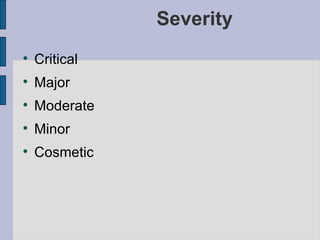
Severity Critical Major Moderate Minor Cosmetic
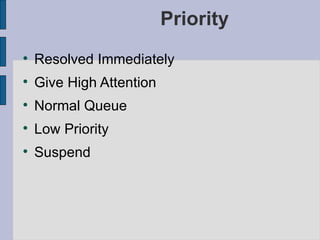
Priority Resolved Immediately Give High Attention Normal Queue Low Priority Suspend
Critical The defect results in the termination of the complete SUT or one or more component applications of the SUT (or of associated software such as the operating system), and/or causes extensive corruption of stored data. The failed function is unusable and there is no acceptable alternative method to achieve the required results
Major The defect results in the termination of the complete SUT or one or more component applications of the SUT (or of associated software such as the operating system), or causes extensive corruption of stored data; but although the failed function is unusable, there exists an acceptable  alternative  method to achieve the required results.
Moderate The defect does not result in a termination, but causes the system to produce incorrect, incomplete, or inconsistent results, or the defect impairs the systems usability.
Minor The defect does not result in a termination, and does not impair usability, and the desired processing results are easily obtained by working around the defect.
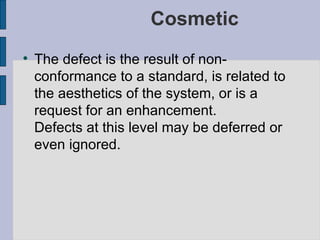
Cosmetic The defect is the result of non- conformance to a standard, is related to the aesthetics of the system, or is a request for an enhancement. Defects at this level may be deferred or even ignored.
Priority Priority will be partially based on Severity, but should take into account other factors such as the frequency with which the defect results in failure, the degree of "visibility" of failure (e.g., how many users it will affect, with what impact on their work, and whether it will be visible to external customers), and project-related factors such as the impact on continued development or testing.
Resolved Immediately Further development and/or testing cannot occur until the defect has been repaired. The system cannot be used until the repair has been effected
Give High Attention The defect must be resolved as soon as possible because it is impairing development/ and or testing activities. System use will be severely affected until the defect is fixed
Normal Queue The defect should be resolved in the normal course of development activities. It can wait until a new build or version is created.
Low Priority The defect is an irritant which should be repaired, but repair can be deferred until after more serious defect have been fixed.
Suspend The defect repair can be put off indefinitely. It can be resolved in a future major system revision or not resolved at all.
Thank You

Severity & priority in software testing

  • 1.
    Severity & Priorityin the area of Software Testing
  • 2.
    Quality P DC A Plan Do Check Act Plan Check Act Do
  • 3.
    Severity Critical MajorModerate Minor Cosmetic
  • 4.
    Priority Resolved ImmediatelyGive High Attention Normal Queue Low Priority Suspend
  • 5.
    Critical The defectresults in the termination of the complete SUT or one or more component applications of the SUT (or of associated software such as the operating system), and/or causes extensive corruption of stored data. The failed function is unusable and there is no acceptable alternative method to achieve the required results
  • 6.
    Major The defectresults in the termination of the complete SUT or one or more component applications of the SUT (or of associated software such as the operating system), or causes extensive corruption of stored data; but although the failed function is unusable, there exists an acceptable alternative method to achieve the required results.
  • 7.
    Moderate The defectdoes not result in a termination, but causes the system to produce incorrect, incomplete, or inconsistent results, or the defect impairs the systems usability.
  • 8.
    Minor The defectdoes not result in a termination, and does not impair usability, and the desired processing results are easily obtained by working around the defect.
  • 9.
    Cosmetic The defectis the result of non- conformance to a standard, is related to the aesthetics of the system, or is a request for an enhancement. Defects at this level may be deferred or even ignored.
  • 10.
    Priority Priority willbe partially based on Severity, but should take into account other factors such as the frequency with which the defect results in failure, the degree of "visibility" of failure (e.g., how many users it will affect, with what impact on their work, and whether it will be visible to external customers), and project-related factors such as the impact on continued development or testing.
  • 11.
    Resolved Immediately Furtherdevelopment and/or testing cannot occur until the defect has been repaired. The system cannot be used until the repair has been effected
  • 12.
    Give High AttentionThe defect must be resolved as soon as possible because it is impairing development/ and or testing activities. System use will be severely affected until the defect is fixed
  • 13.
    Normal Queue Thedefect should be resolved in the normal course of development activities. It can wait until a new build or version is created.
  • 14.
    Low Priority Thedefect is an irritant which should be repaired, but repair can be deferred until after more serious defect have been fixed.
  • 15.
    Suspend The defectrepair can be put off indefinitely. It can be resolved in a future major system revision or not resolved at all.
  • 16.