Software Project Management
Lecture # 3
Outline
 Chapter 22- “Metrics for Process & Projects”
 Measurement
 Measures
 Metrics
 Software Metrics
 Process metrics
 Project metrics
 Direct and Indirect software measures
 Software Measurement
 Size-oriented Metrics
 Function-oriented Metrics
 Object-oriented Metrics
 Use-case-oriented Metrics
 Software Quality Metrics
 Defect Removal Efficiency
Introduction
 Software process and project metrics
 are quantitative measures
 enable software engineers to gain insight into efficacy of
the software process and projects
 Basic quality & productivity data (called measures)
are
 Collected (and normalized using size- or function-oriented
metrics),
 analyzed,
 compared against past averages,
 and assessed to determine whether productivity & quality
improvements have occurred
 Metrics also indicate problem areas in processes
and projects
What is Measurement?
 It is the act of obtaining a measure
 It is a mechanism of objective evaluation
 enables managers and practitioners to improve
software process
 assists in planning, tracking and controlling a
software project and assessing product quality
What is a Measure?
 It provides a quantitative indication of the
size of some product or process attribute
OR
 quantitative indication of the extent, amount,
dimension, capacity, or size of some
attribute of product or process
Metric?
 A metric is quantitative measure of the
degree to which a system, component or
process possesses a given attribute (IEEE
definition)
 Metrics enable people to gain insight into
the effectiveness of the software process
and the projects
Difference between Measure,
Metric, Indicator
 Measure
 It is a value which does not provide enough
information to make meaningful decisions
 Metric
 A comparison of two or more measures, e.g.,
temperature values over time, errors per KLOC
 Indicator
 Compares a metric against a baseline or
expected result and helps in making decisions
 Reference:
http://www.stsc.hill.af.mil/crosstalk/1995/03/Measure.asp
Determinants for software quality
and organizational effectiveness
Process
People Technology
Product
Customer
Characteristics Business
conditions
Development environment
Process connects 3 important factors that influence software quality and
organizational performance
Process Metrics
& Software Process Improvement
 To improve a process
 Measure specific attributes of process
 Develop meaningful metrics based on these attributes
 These metrics provide indicators that lead to strategy for
improvement
 Example
 Metrics can be derived from the following process
outcomes/attributes
 Errors uncovered before software release,
 defects delivered to & reported by end-user,
 work products delivered
 Human efforts expended
 Calendar time expended
 Schedule conformance
Project Metrics
 Used by project managers and software team
to adapt project workflow and technical
activities
 Objective is
 To minimize the development schedule by making
adjustments that can avoid delays and mitigate
potential problems
 To assess product quality on an ongoing basis and
when necessary, modify technical approach to
improve quality
 Most important use of metrics is estimation of time,
effort.
Project Metrics
 Example
 Metrics collected from past projects help to
establish time and effort estimates for current
software projects
 Production rates (in terms of models created,
review hours, function points, delivered source
lines)
 Errors uncovered during each software engg.
Task
 Software projects are assessed against the
project metrics for improvement
Software Measurement Categories
 Direct Measures
 Of software process are
 Cost and effort
 Of product are
 Line of Code (LOC)
 Execution Speed
 Defects over specified period of time
 Indirect Measures
 Of product are
 Functionality
 Quality
 Complexity
 Efficiency
 Reliability
 Maintainability
 .. Other Abilities
Size Oriented Metrics
 Derived by normalizing quality and/or
productivity measures by considering the
size of software that has been produced.
 LOC used as a normalizing factor for other
measures
 Widely used in software industry but their
validity and applicability is debated
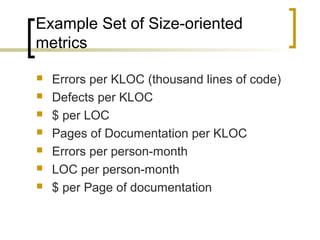
Example Set of Size-oriented
metrics
 Errors per KLOC (thousand lines of code)
 Defects per KLOC
 $ per LOC
 Pages of Documentation per KLOC
 Errors per person-month
 LOC per person-month
 $ per Page of documentation
Pros and cons
 Though widely used but not universally accepted as best way
to measure a software process
 Controversy lies in using LOC as a key measure
 proponents claim
 LOC easy to count
 Many existing estimation models use LOC
 Large literature & data based on LOC exists
 But opponents argue that
 LOC measures are prog. language dependent
 When considering productivity, LOC criteria penalizes well
designed short programs
 Can not accommodate non procedural languages
 Planner must estimate LOC long before analysis and design
Function-oriented Metrics
 These use a measure of the functionality
delivered by application as a normalization
value.
 Most widely used function-oriented metric is
function point (FP)
 FP’s computation – based on characteristics of
software information domain and complexity.
(For details See 15.3.1, page 472)
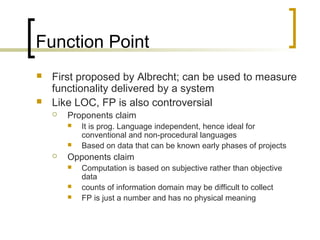
Function Point
 First proposed by Albrecht; can be used to measure
functionality delivered by a system
 Like LOC, FP is also controversial
 Proponents claim
 It is prog. Language independent, hence ideal for
conventional and non-procedural languages
 Based on data that can be known early phases of projects
 Opponents claim
 Computation is based on subjective rather than objective
data
 counts of information domain may be difficult to collect
 FP is just a number and has no physical meaning
Computing function points
(cont..)
 Following empirical relationship is used to
compute Function Point (FP)
FP=total count x [0.65+ 0.01 x Σ(Fi)]
Fi (i=1 to 14 ) are VAF (Value adjustment
factors) or simply ‘adjustment values’ based
on answers to some questions (See list of Qs on
PAGE 473 from book 6th
edition )
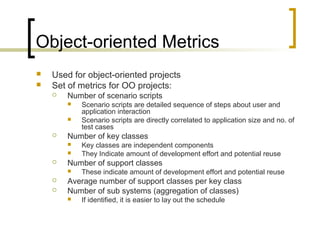
Object-oriented Metrics
 Used for object-oriented projects
 Set of metrics for OO projects:
 Number of scenario scripts
 Scenario scripts are detailed sequence of steps about user and
application interaction
 Scenario scripts are directly correlated to application size and no. of
test cases
 Number of key classes
 Key classes are independent components
 They Indicate amount of development effort and potential reuse
 Number of support classes
 These indicate amount of development effort and potential reuse
 Average number of support classes per key class
 Number of sub systems (aggregation of classes)
 If identified, it is easier to lay out the schedule
Use-case oriented Metrics
 Use-cases describe user visible functions and
features
 They are defined early in software process and can
be used as normalization measure before
significant activities are initiated
 They are independent of programming language
 No. of use cases directly proportional to
 size of application in LOC &
 no. of test cases that will be designed
 There is no standard size of a use case as they are
created at different levels of abstraction
 For this reason, it is a suspect as a normalization measure
Web Engineering Project Metrics
 Reading assignment
Software Quality Metrics
 Measuring quality through
 Correctness
 It is degree to which software performs its required function
 Common measure= defects per KLOC
 For quality assessment defects are counted typically for 1
year
 Maintainability
 It is the ease with which a program can be
 corrected if an error is found
 Adapted if environment changes or
 Enhanced if customer desires
 Measured indirectly, e.g., Mean-time-to change (MTTC)
 Maintainable programs -> lower MTTC
Software Quality Metrics
 Integrity
 System’s ability to withstand (accidental & intentional)
attacks
 Two more attributes that help determine integrity
 threat = probability of attack within a given time (that
causes failure)
 security = probability that an attack will be repelled
 Integrity = Σ [1 – (threat * (1 – security))]
 Usability
 It quantifies ease of use and learning (time)
Defect Removal Efficiency
 It is a measure of the filtering ability of the quality
assurance and control activities as they are applied
through out the process framework.
 DRE = E / (E + D)
 E = # of errors found before delivery
 D = # of defects found after delivery
 Ideal value of DRE is 1
 Realistically D will be greater than 0
 As E increases, DRE begins to approach 1
Redefining DRE
 DRE can also be applied on each process
framework activity and hence find the team’s
ability to assess errors before they are
passed to next activity or software
engineering task.
 DRE = Ei / (Ei + Ei+1)
 Ei = errors in activity i
 Ei+1 = errors in activity i+1 that were not
discovered in activity i

Lecture3

  • 1.
  • 2.
    Outline  Chapter 22-“Metrics for Process & Projects”  Measurement  Measures  Metrics  Software Metrics  Process metrics  Project metrics  Direct and Indirect software measures  Software Measurement  Size-oriented Metrics  Function-oriented Metrics  Object-oriented Metrics  Use-case-oriented Metrics  Software Quality Metrics  Defect Removal Efficiency
  • 3.
    Introduction  Software processand project metrics  are quantitative measures  enable software engineers to gain insight into efficacy of the software process and projects  Basic quality & productivity data (called measures) are  Collected (and normalized using size- or function-oriented metrics),  analyzed,  compared against past averages,  and assessed to determine whether productivity & quality improvements have occurred  Metrics also indicate problem areas in processes and projects
  • 4.
    What is Measurement? It is the act of obtaining a measure  It is a mechanism of objective evaluation  enables managers and practitioners to improve software process  assists in planning, tracking and controlling a software project and assessing product quality
  • 5.
    What is aMeasure?  It provides a quantitative indication of the size of some product or process attribute OR  quantitative indication of the extent, amount, dimension, capacity, or size of some attribute of product or process
  • 6.
    Metric?  A metricis quantitative measure of the degree to which a system, component or process possesses a given attribute (IEEE definition)  Metrics enable people to gain insight into the effectiveness of the software process and the projects
  • 7.
    Difference between Measure, Metric,Indicator  Measure  It is a value which does not provide enough information to make meaningful decisions  Metric  A comparison of two or more measures, e.g., temperature values over time, errors per KLOC  Indicator  Compares a metric against a baseline or expected result and helps in making decisions  Reference: http://www.stsc.hill.af.mil/crosstalk/1995/03/Measure.asp
  • 8.
    Determinants for softwarequality and organizational effectiveness Process People Technology Product Customer Characteristics Business conditions Development environment Process connects 3 important factors that influence software quality and organizational performance
  • 9.
    Process Metrics & SoftwareProcess Improvement  To improve a process  Measure specific attributes of process  Develop meaningful metrics based on these attributes  These metrics provide indicators that lead to strategy for improvement  Example  Metrics can be derived from the following process outcomes/attributes  Errors uncovered before software release,  defects delivered to & reported by end-user,  work products delivered  Human efforts expended  Calendar time expended  Schedule conformance
  • 10.
    Project Metrics  Usedby project managers and software team to adapt project workflow and technical activities  Objective is  To minimize the development schedule by making adjustments that can avoid delays and mitigate potential problems  To assess product quality on an ongoing basis and when necessary, modify technical approach to improve quality  Most important use of metrics is estimation of time, effort.
  • 11.
    Project Metrics  Example Metrics collected from past projects help to establish time and effort estimates for current software projects  Production rates (in terms of models created, review hours, function points, delivered source lines)  Errors uncovered during each software engg. Task  Software projects are assessed against the project metrics for improvement
  • 12.
    Software Measurement Categories Direct Measures  Of software process are  Cost and effort  Of product are  Line of Code (LOC)  Execution Speed  Defects over specified period of time  Indirect Measures  Of product are  Functionality  Quality  Complexity  Efficiency  Reliability  Maintainability  .. Other Abilities
  • 13.
    Size Oriented Metrics Derived by normalizing quality and/or productivity measures by considering the size of software that has been produced.  LOC used as a normalizing factor for other measures  Widely used in software industry but their validity and applicability is debated
  • 14.
    Example Set ofSize-oriented metrics  Errors per KLOC (thousand lines of code)  Defects per KLOC  $ per LOC  Pages of Documentation per KLOC  Errors per person-month  LOC per person-month  $ per Page of documentation
  • 15.
    Pros and cons Though widely used but not universally accepted as best way to measure a software process  Controversy lies in using LOC as a key measure  proponents claim  LOC easy to count  Many existing estimation models use LOC  Large literature & data based on LOC exists  But opponents argue that  LOC measures are prog. language dependent  When considering productivity, LOC criteria penalizes well designed short programs  Can not accommodate non procedural languages  Planner must estimate LOC long before analysis and design
  • 16.
    Function-oriented Metrics  Theseuse a measure of the functionality delivered by application as a normalization value.  Most widely used function-oriented metric is function point (FP)  FP’s computation – based on characteristics of software information domain and complexity. (For details See 15.3.1, page 472)
  • 17.
    Function Point  Firstproposed by Albrecht; can be used to measure functionality delivered by a system  Like LOC, FP is also controversial  Proponents claim  It is prog. Language independent, hence ideal for conventional and non-procedural languages  Based on data that can be known early phases of projects  Opponents claim  Computation is based on subjective rather than objective data  counts of information domain may be difficult to collect  FP is just a number and has no physical meaning
  • 18.
    Computing function points (cont..) Following empirical relationship is used to compute Function Point (FP) FP=total count x [0.65+ 0.01 x Σ(Fi)] Fi (i=1 to 14 ) are VAF (Value adjustment factors) or simply ‘adjustment values’ based on answers to some questions (See list of Qs on PAGE 473 from book 6th edition )
  • 19.
    Object-oriented Metrics  Usedfor object-oriented projects  Set of metrics for OO projects:  Number of scenario scripts  Scenario scripts are detailed sequence of steps about user and application interaction  Scenario scripts are directly correlated to application size and no. of test cases  Number of key classes  Key classes are independent components  They Indicate amount of development effort and potential reuse  Number of support classes  These indicate amount of development effort and potential reuse  Average number of support classes per key class  Number of sub systems (aggregation of classes)  If identified, it is easier to lay out the schedule
  • 20.
    Use-case oriented Metrics Use-cases describe user visible functions and features  They are defined early in software process and can be used as normalization measure before significant activities are initiated  They are independent of programming language  No. of use cases directly proportional to  size of application in LOC &  no. of test cases that will be designed  There is no standard size of a use case as they are created at different levels of abstraction  For this reason, it is a suspect as a normalization measure
  • 21.
    Web Engineering ProjectMetrics  Reading assignment
  • 22.
    Software Quality Metrics Measuring quality through  Correctness  It is degree to which software performs its required function  Common measure= defects per KLOC  For quality assessment defects are counted typically for 1 year  Maintainability  It is the ease with which a program can be  corrected if an error is found  Adapted if environment changes or  Enhanced if customer desires  Measured indirectly, e.g., Mean-time-to change (MTTC)  Maintainable programs -> lower MTTC
  • 23.
    Software Quality Metrics Integrity  System’s ability to withstand (accidental & intentional) attacks  Two more attributes that help determine integrity  threat = probability of attack within a given time (that causes failure)  security = probability that an attack will be repelled  Integrity = Σ [1 – (threat * (1 – security))]  Usability  It quantifies ease of use and learning (time)
  • 24.
    Defect Removal Efficiency It is a measure of the filtering ability of the quality assurance and control activities as they are applied through out the process framework.  DRE = E / (E + D)  E = # of errors found before delivery  D = # of defects found after delivery  Ideal value of DRE is 1  Realistically D will be greater than 0  As E increases, DRE begins to approach 1
  • 25.
    Redefining DRE  DREcan also be applied on each process framework activity and hence find the team’s ability to assess errors before they are passed to next activity or software engineering task.  DRE = Ei / (Ei + Ei+1)  Ei = errors in activity i  Ei+1 = errors in activity i+1 that were not discovered in activity i

Editor's Notes

  • #17 To normalize measures like productivity, quality and other attributes
  • #24 Defect = any problem or lack of conformance to requirements reported by customer/user after delivery