Terri Hood-Brown, MSN, RNC
As you view the slide show and read your articles, focus on the key principles in quality care in both industrialized countries and developing countries. Be prepared to discuss The organization of delivering quality care, common errors in quality, resources available, in the U.S. and a developing country (one you select). What Millennium Development Goals (MDGs) are and how they could assist in improving quality care. What steps the World Health Organization (WHO) and the Institute of Medicine (IOM) would like in place to improve quality of care. How nursing affects quality of care in both the U.S. and your selected developing country. (Positively and Negatively) QUALITY IN HEALTH CARE
A system that is built and continuously maintains in order to contend with death, disease, disability, dissatisfaction and (social) disruption A collection of curative, preventive, rehabilitative and promotive services  Health care is a social and economical attempt involving activities by providers, consumers, financiers and government HEALTH CARE Anand, V. (n.d.)
Avoidable errors Underutilization of services Overuse of services Variation in services Communication problems Lack of Evidence Dissatisfied consumers  What’s wrong in today’s Health Care? Anand, V. (n.d.)
Do nothing Better education and training Regulating, Inspecting, Punishing Change, Improve, Reward Comprehensive Approach: Quality Assurance What can we do about it? Anand, V. (n.d.)
Why should we define quality of care? Reach consensus among employees. Do you define quality the same as your peers? Avoid confusion and in-house fighting. Does the board of directors, nurses and physicians define quality of care the same? Allow for sound evaluation. If we do not agree, how can we measure? Allow consumers to make a choice! Quality of care is reportable. Would you select a healthcare facility with negative quality of care? Definition of Quality Anand, V. (n.d.)
Quality Assurance : the overall philosophy on quality and its promise to provide high quality of care. Total Quality Management : one of the newest organizational and managerial approaches to Quality Assurance in the (not) for profit industry. Continuous Quality Improvement : an important organizational and managerial mechanism for quality assurance in the health sector. You may here these terms used interchangeably! Quality :Terminology Anand, V. (n.d.)
Important elements in determining the success of Quality Assurance: External and internal customer satisfaction (patients, families, other healthcare providers, employees, insurance companies…Can you think of others?) Management leadership Involves all personnel Uses statistical methods (Evidence Based Practice) Focuses on improvements in errors, processes, patient outcomes. Continuous Quality Improvement Anand, V. (n.d.)
Quality is working according to specifications. Following EBP Following policies and procedures Following your scope of practice  Knowing standards of care. Quality is providing effective services with a minimum of unnecessary use of resources. What does that mean to you? Quality is to exceed customers expectations and to have excellent patient outcomes. Definition of healthcare quality   Anand, V. (n.d.)
Quality assurance is an evaluation and improvement process similar to the nursing process, a never ending process… Assess the issue at hand: What data do you have or need? Diagnose the problem(s): Do 60% of our abdominal surgery patients develop wound infections? Why? Plan: What is the overall goal? What are our measurable outcomes? What interventions are we going to put into place? Implementation: Put our plan into action! Evaluate: Are our outcomes being met? Yes or No? Now what happens? You all should know!! The Key Principles Anand, V. (n.d.)
Assuring(i.e. assessing and improving) quality is the responsibility of the provider. Who is the healthcare provider? Remember, we’ve promised (assured) that we would provide quality care! Of all the necessary principles (knowledge, skills, attitudes, values) values and attitudes are the most important! Why?  The Key Principles, cont. Anand, V. (n.d.)
Focus on professional quality Focus on consumer satisfaction  Focus on system(s) effectiveness Focus on interconnections (how are our services intertwined Organizational and societal unification. What does that mean to consumers? What does that mean to you as a nurse? TOTAL QUALITY Anand, V. (n.d.)
Because I know it is needed Because I am told to do so Because I must survive Because I need to follow the rules Why is the word ‘I’ used instead of ‘we’? WILL YOU SURVIVE WITHOUT QUALITY CARE? Why improve our quality of care? Anand, V. (n.d.)
Select key professionals. Who needs to be involved? Why? Design appropriate training. Is training required for all providers? Why? Organize continuous training sessions. Do we need to make the training mandatory? Available for all shifts? Evaluate results of training including satisfaction. Did the providers learn from the training? Were they satisfied with the type of, time of and outcomes of the training? Reward participants. What types of rewards should be made available for the participants, if any? Repeat training regularly. Annually? Bi-annually? Monthly, until quality is improved? Quality Training Anand, V. (n.d.)
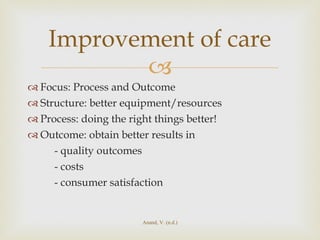
Focus: Process and Outcome Structure: better equipment/resources Process: doing the right things better! Outcome: obtain better results in - quality outcomes - costs - consumer satisfaction Improvement of care Anand, V. (n.d.)
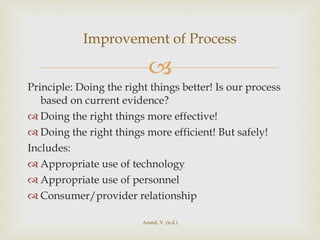
Principle: Doing the right things better! Is our process based on current evidence? Doing the right things more effective! Doing the right things more efficient! But safely! Includes: Appropriate use of technology Appropriate use of personnel Consumer/provider relationship  Improvement of Process Anand, V. (n.d.)
Quality improvement is essential for survival. Why? Consumer satisfaction is important for survival Why? Survival Anand, V. (n.d.)
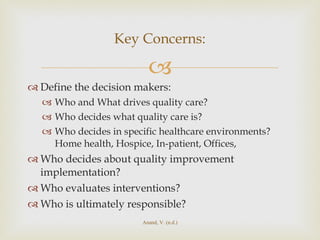
Define the decision makers:  Who and What drives quality care? Who decides what quality care is?  Who decides in specific healthcare environments? Home health, Hospice, In-patient, Offices,  Who decides about quality improvement implementation? Who evaluates interventions? Who is ultimately responsible? Key Concerns: Anand, V. (n.d.)
What are the roles of each of the decision makers? The Consumers The Professionals The Managers The Government, Policy Makers Roles and Functions in Decision making in Quality Improvement Anand, V. (n.d.)
Definers of Quality Evaluators of Quality Informants of Care Co-producers of care Targets of Quality Assurance Controllers of Practitioner Behavior Reformers of Health Services The Seven Roles of the Consumer Anand, V. (n.d.)
To be accountable To provide quality care(plan, implement) To safeguard the quality of care services To be evaluated by colleagues To evaluate his colleagues To continue learning To collaborate with colleagues and management The Seven Roles of the Provider Anand, V. (n.d.)
Do their job(Quality Management) Exert leadership Participate in Quality Management Communicate on Quality matters Be accountable re: quality Evaluation of Quality Management Provide resources Seven Roles and Functions of Management Anand, V. (n.d.)
Who decides the role of government? Is it different from government to government? Should they have an: Active role with responsibilities? Support role with limited responsibilities? No role at all? Role of Government Anand, V. (n.d.)
Improvement in health status Increase in satisfaction Elimination of impairment Elimination of disability Elimination of risks What are benefits of quality care? Anand, V. (n.d.)
After you have viewed this Power Point and read all of the readings for this week participate in the discussion board titled: Quality of Healthcare. Follow the directs and grading rubric carefully to receive full credit. If you have any questions email your instructor. Your Assignment
Anand, V. (n.d.). Quality in health care delivery.  Retrieved from www. hosmac .com References

Quality health care

  • 1.
  • 2.
    As you viewthe slide show and read your articles, focus on the key principles in quality care in both industrialized countries and developing countries. Be prepared to discuss The organization of delivering quality care, common errors in quality, resources available, in the U.S. and a developing country (one you select). What Millennium Development Goals (MDGs) are and how they could assist in improving quality care. What steps the World Health Organization (WHO) and the Institute of Medicine (IOM) would like in place to improve quality of care. How nursing affects quality of care in both the U.S. and your selected developing country. (Positively and Negatively) QUALITY IN HEALTH CARE
  • 3.
    A system thatis built and continuously maintains in order to contend with death, disease, disability, dissatisfaction and (social) disruption A collection of curative, preventive, rehabilitative and promotive services Health care is a social and economical attempt involving activities by providers, consumers, financiers and government HEALTH CARE Anand, V. (n.d.)
  • 4.
    Avoidable errors Underutilizationof services Overuse of services Variation in services Communication problems Lack of Evidence Dissatisfied consumers What’s wrong in today’s Health Care? Anand, V. (n.d.)
  • 5.
    Do nothing Bettereducation and training Regulating, Inspecting, Punishing Change, Improve, Reward Comprehensive Approach: Quality Assurance What can we do about it? Anand, V. (n.d.)
  • 6.
    Why should wedefine quality of care? Reach consensus among employees. Do you define quality the same as your peers? Avoid confusion and in-house fighting. Does the board of directors, nurses and physicians define quality of care the same? Allow for sound evaluation. If we do not agree, how can we measure? Allow consumers to make a choice! Quality of care is reportable. Would you select a healthcare facility with negative quality of care? Definition of Quality Anand, V. (n.d.)
  • 7.
    Quality Assurance :the overall philosophy on quality and its promise to provide high quality of care. Total Quality Management : one of the newest organizational and managerial approaches to Quality Assurance in the (not) for profit industry. Continuous Quality Improvement : an important organizational and managerial mechanism for quality assurance in the health sector. You may here these terms used interchangeably! Quality :Terminology Anand, V. (n.d.)
  • 8.
    Important elements indetermining the success of Quality Assurance: External and internal customer satisfaction (patients, families, other healthcare providers, employees, insurance companies…Can you think of others?) Management leadership Involves all personnel Uses statistical methods (Evidence Based Practice) Focuses on improvements in errors, processes, patient outcomes. Continuous Quality Improvement Anand, V. (n.d.)
  • 9.
    Quality is workingaccording to specifications. Following EBP Following policies and procedures Following your scope of practice Knowing standards of care. Quality is providing effective services with a minimum of unnecessary use of resources. What does that mean to you? Quality is to exceed customers expectations and to have excellent patient outcomes. Definition of healthcare quality Anand, V. (n.d.)
  • 10.
    Quality assurance isan evaluation and improvement process similar to the nursing process, a never ending process… Assess the issue at hand: What data do you have or need? Diagnose the problem(s): Do 60% of our abdominal surgery patients develop wound infections? Why? Plan: What is the overall goal? What are our measurable outcomes? What interventions are we going to put into place? Implementation: Put our plan into action! Evaluate: Are our outcomes being met? Yes or No? Now what happens? You all should know!! The Key Principles Anand, V. (n.d.)
  • 11.
    Assuring(i.e. assessing andimproving) quality is the responsibility of the provider. Who is the healthcare provider? Remember, we’ve promised (assured) that we would provide quality care! Of all the necessary principles (knowledge, skills, attitudes, values) values and attitudes are the most important! Why? The Key Principles, cont. Anand, V. (n.d.)
  • 12.
    Focus on professionalquality Focus on consumer satisfaction Focus on system(s) effectiveness Focus on interconnections (how are our services intertwined Organizational and societal unification. What does that mean to consumers? What does that mean to you as a nurse? TOTAL QUALITY Anand, V. (n.d.)
  • 13.
    Because I knowit is needed Because I am told to do so Because I must survive Because I need to follow the rules Why is the word ‘I’ used instead of ‘we’? WILL YOU SURVIVE WITHOUT QUALITY CARE? Why improve our quality of care? Anand, V. (n.d.)
  • 14.
    Select key professionals.Who needs to be involved? Why? Design appropriate training. Is training required for all providers? Why? Organize continuous training sessions. Do we need to make the training mandatory? Available for all shifts? Evaluate results of training including satisfaction. Did the providers learn from the training? Were they satisfied with the type of, time of and outcomes of the training? Reward participants. What types of rewards should be made available for the participants, if any? Repeat training regularly. Annually? Bi-annually? Monthly, until quality is improved? Quality Training Anand, V. (n.d.)
  • 15.
    Focus: Process andOutcome Structure: better equipment/resources Process: doing the right things better! Outcome: obtain better results in - quality outcomes - costs - consumer satisfaction Improvement of care Anand, V. (n.d.)
  • 16.
    Principle: Doing theright things better! Is our process based on current evidence? Doing the right things more effective! Doing the right things more efficient! But safely! Includes: Appropriate use of technology Appropriate use of personnel Consumer/provider relationship Improvement of Process Anand, V. (n.d.)
  • 17.
    Quality improvement isessential for survival. Why? Consumer satisfaction is important for survival Why? Survival Anand, V. (n.d.)
  • 18.
    Define the decisionmakers: Who and What drives quality care? Who decides what quality care is? Who decides in specific healthcare environments? Home health, Hospice, In-patient, Offices, Who decides about quality improvement implementation? Who evaluates interventions? Who is ultimately responsible? Key Concerns: Anand, V. (n.d.)
  • 19.
    What are theroles of each of the decision makers? The Consumers The Professionals The Managers The Government, Policy Makers Roles and Functions in Decision making in Quality Improvement Anand, V. (n.d.)
  • 20.
    Definers of QualityEvaluators of Quality Informants of Care Co-producers of care Targets of Quality Assurance Controllers of Practitioner Behavior Reformers of Health Services The Seven Roles of the Consumer Anand, V. (n.d.)
  • 21.
    To be accountableTo provide quality care(plan, implement) To safeguard the quality of care services To be evaluated by colleagues To evaluate his colleagues To continue learning To collaborate with colleagues and management The Seven Roles of the Provider Anand, V. (n.d.)
  • 22.
    Do their job(QualityManagement) Exert leadership Participate in Quality Management Communicate on Quality matters Be accountable re: quality Evaluation of Quality Management Provide resources Seven Roles and Functions of Management Anand, V. (n.d.)
  • 23.
    Who decides therole of government? Is it different from government to government? Should they have an: Active role with responsibilities? Support role with limited responsibilities? No role at all? Role of Government Anand, V. (n.d.)
  • 24.
    Improvement in healthstatus Increase in satisfaction Elimination of impairment Elimination of disability Elimination of risks What are benefits of quality care? Anand, V. (n.d.)
  • 25.
    After you haveviewed this Power Point and read all of the readings for this week participate in the discussion board titled: Quality of Healthcare. Follow the directs and grading rubric carefully to receive full credit. If you have any questions email your instructor. Your Assignment
  • 26.
    Anand, V. (n.d.).Quality in health care delivery. Retrieved from www. hosmac .com References