1
Evaluation / Quality Control Test for Tablets
Following are the different official and unofficial quality control test for tablets.
Official quality control test for tablets:
1. Content uniformity
2. Uniformity of weight test / weight
variation test
3. Disintegration test
4. Dissolution test
Unofficial quality control test for
tablets:
1. Appearance
2. Size / diameter
3. Shape
4. Mechanical strength / hardness
5. Friability test
1. Content Uniformity:
To determine the amount of active ingredient in the tablet, 20 tablets are selected
randomly. If 20 tablets are not available at least 5 tablets should be taken randomly for the
test. These tablets are crushed to form powder and dissolved in the suitable media. The
drug content in the media is determined by using colorimeter, UV spectrophotometer,
NMR, gas chromatography, thin layer chromatography, high performance liquid
chromatography etc.. The tablet should comply to the content uniformity test as per the
specifications given in the individual monograph of that drug.
2
2. Uniformity of weight test / weight variation test:
For uniformity of weight test 20 tablets are selected randomly. If 20 tablets
are not available at least 10 tablets are used for the test. Average weight of tablet is
calculated by weighing all the 20 tablets. Depending upon the average weight of
tablets, I.P. given percentage deviation in the weight of tablet. The tablet should
comply to the uniformity of weight test as per I. P.
The tablet will pass the weight variation test when not more than two
tablet should fall outside the limit when 20 tablets are taken and one tablet
should fall outside the limit when 10 tablets are taken for test.
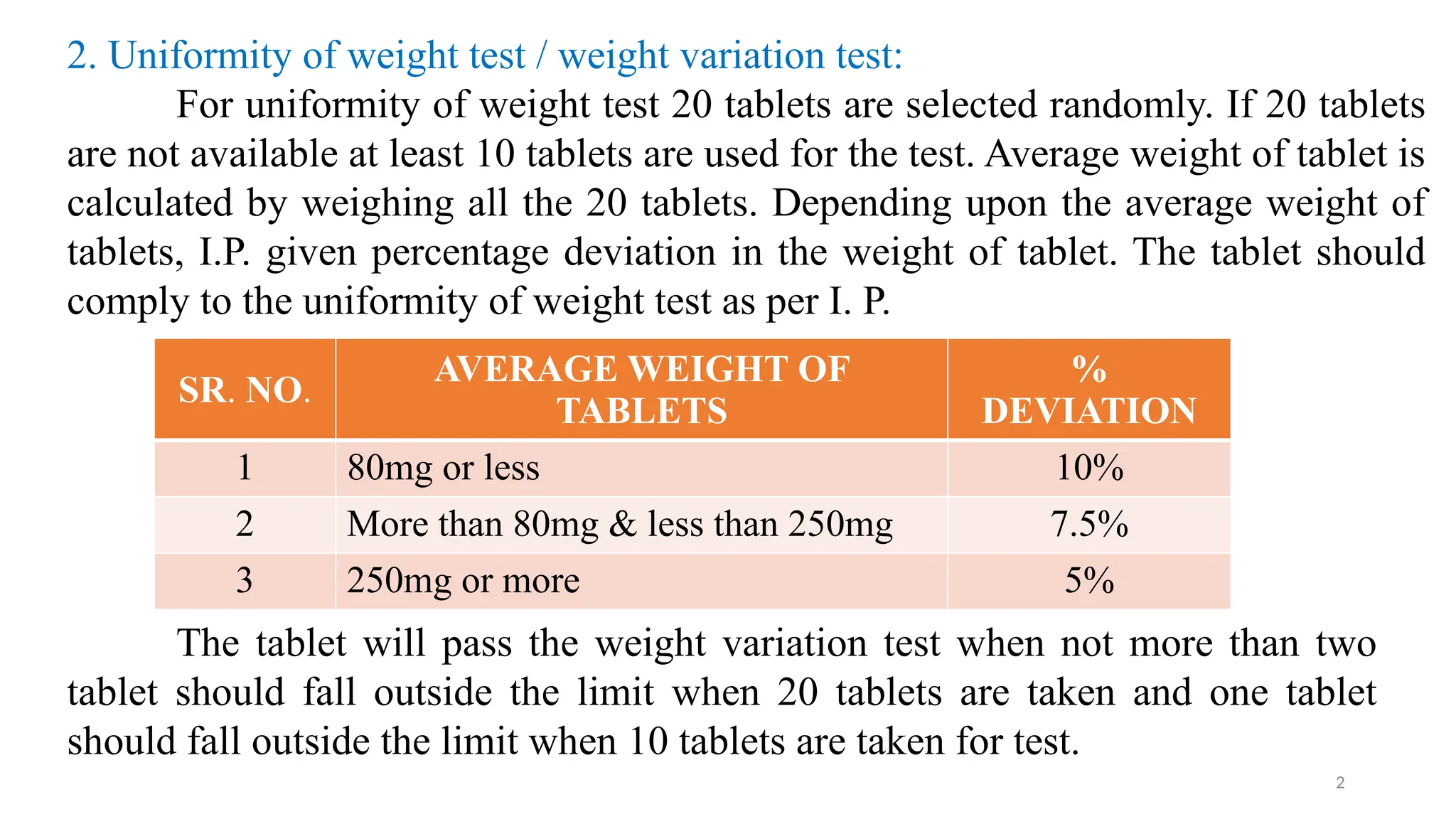
SR. NO.
AVERAGE WEIGHT OF
TABLETS
%
DEVIATION
1 80mg or less 10%
2 More than 80mg & less than 250mg 7.5%
3 250mg or more 5%
3
3. Disintegration test:
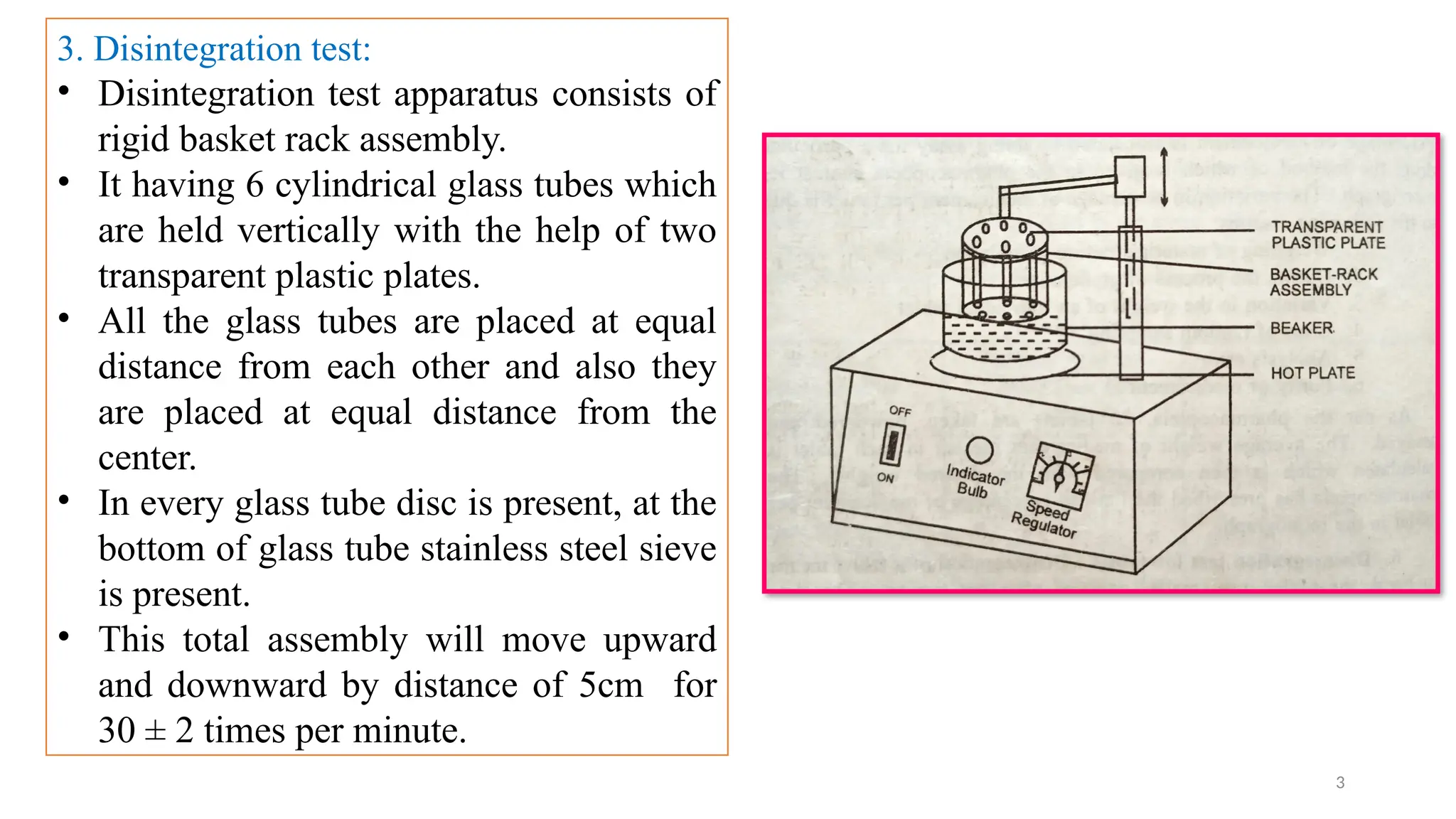
• Disintegration test apparatus consists of
rigid basket rack assembly.
• It having 6 cylindrical glass tubes which
are held vertically with the help of two
transparent plastic plates.
• All the glass tubes are placed at equal
distance from each other and also they
are placed at equal distance from the
center.
• In every glass tube disc is present, at the
bottom of glass tube stainless steel sieve
is present.
• This total assembly will move upward
and downward by distance of 5cm for
30 ± 2 times per minute.
4
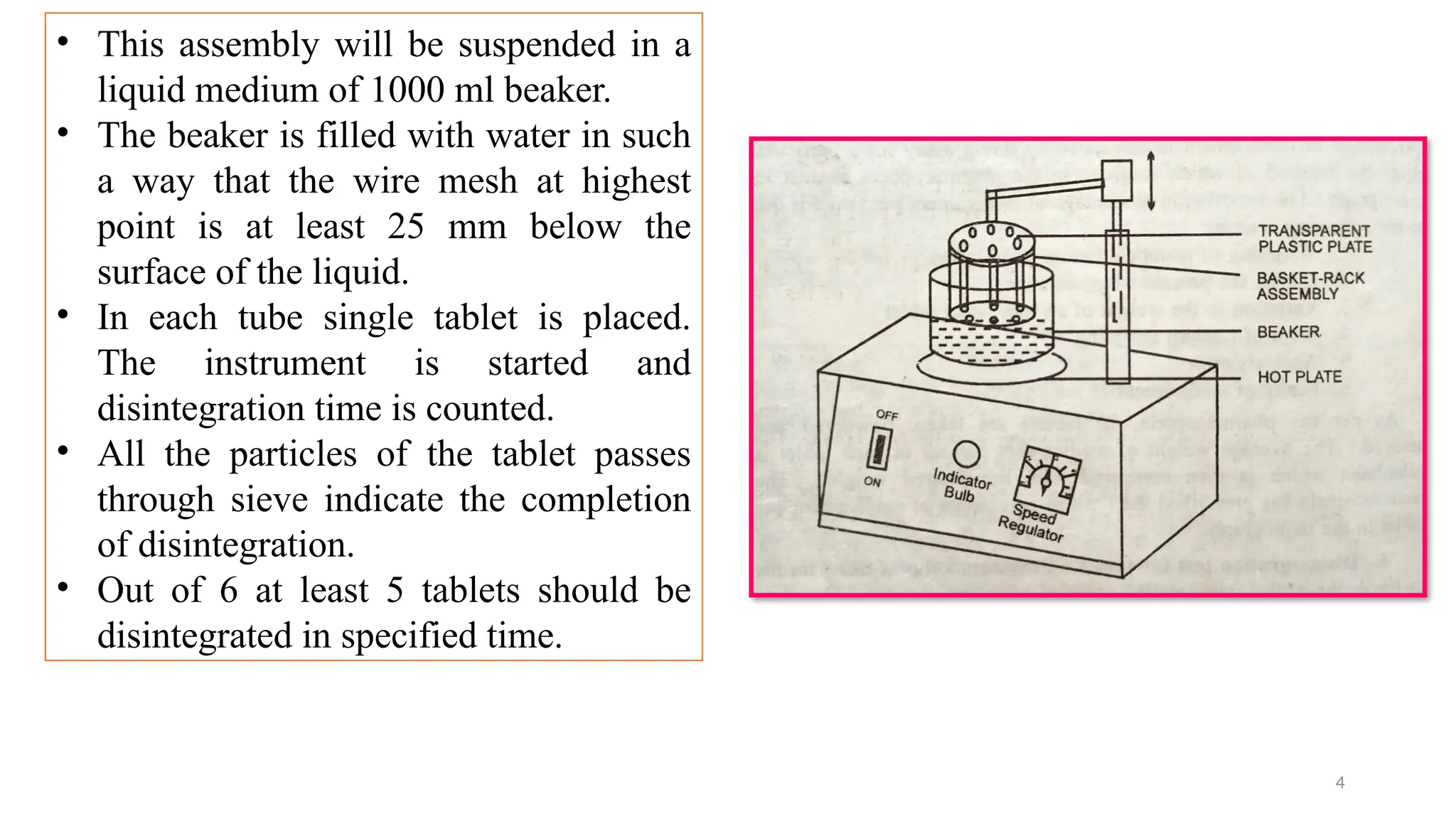
• This assembly will be suspended in a
liquid medium of 1000 ml beaker.
• The beaker is filled with water in such
a way that the wire mesh at highest
point is at least 25 mm below the
surface of the liquid.
• In each tube single tablet is placed.
The instrument is started and
disintegration time is counted.
• All the particles of the tablet passes
through sieve indicate the completion
of disintegration.
• Out of 6 at least 5 tablets should be
disintegrated in specified time.
5
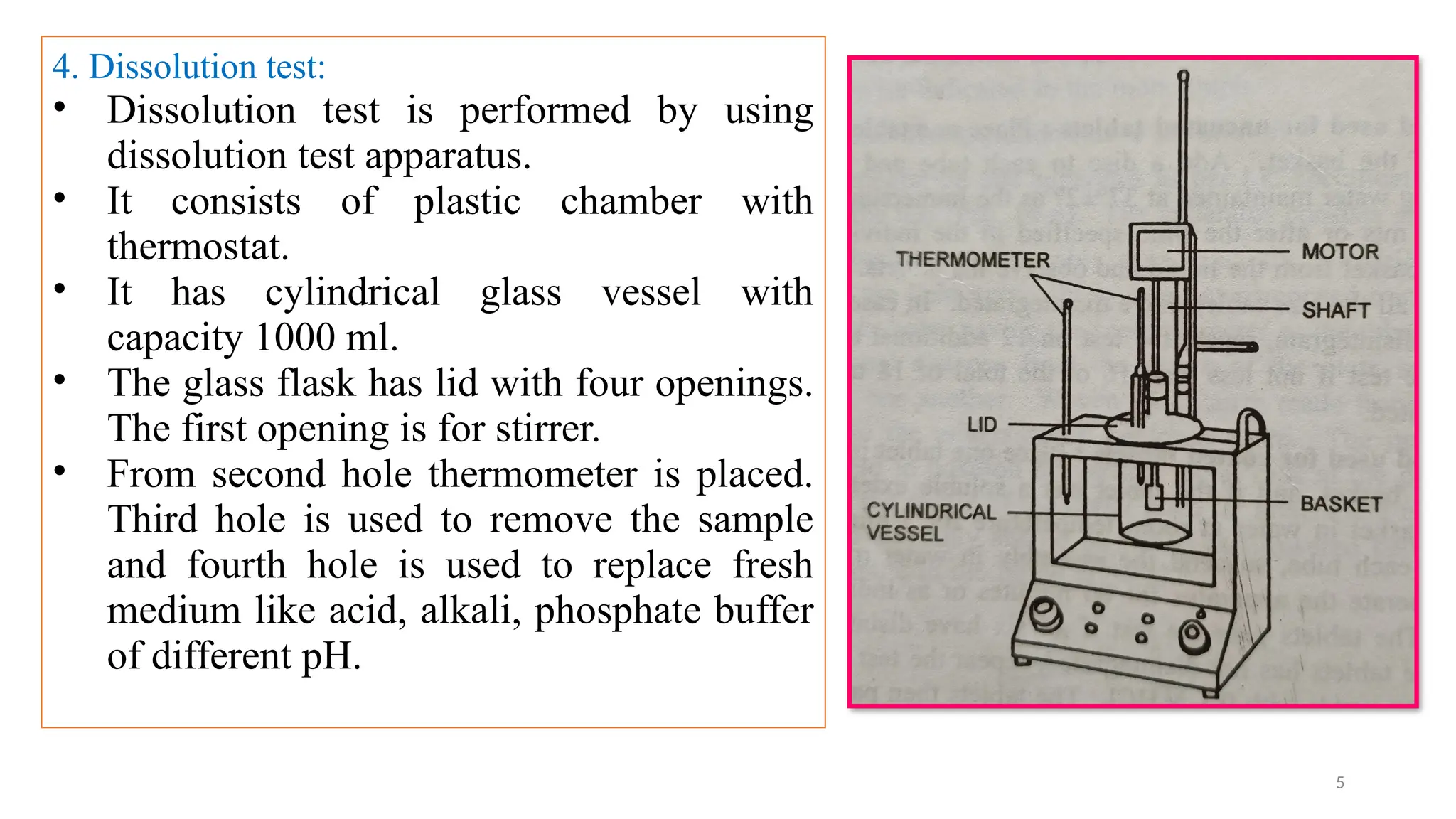
4. Dissolution test:
• Dissolution test is performed by using
dissolution test apparatus.
• It consists of plastic chamber with
thermostat.
• It has cylindrical glass vessel with
capacity 1000 ml.
• The glass flask has lid with four openings.
The first opening is for stirrer.
• From second hole thermometer is placed.
Third hole is used to remove the sample
and fourth hole is used to replace fresh
medium like acid, alkali, phosphate buffer
of different pH.
6
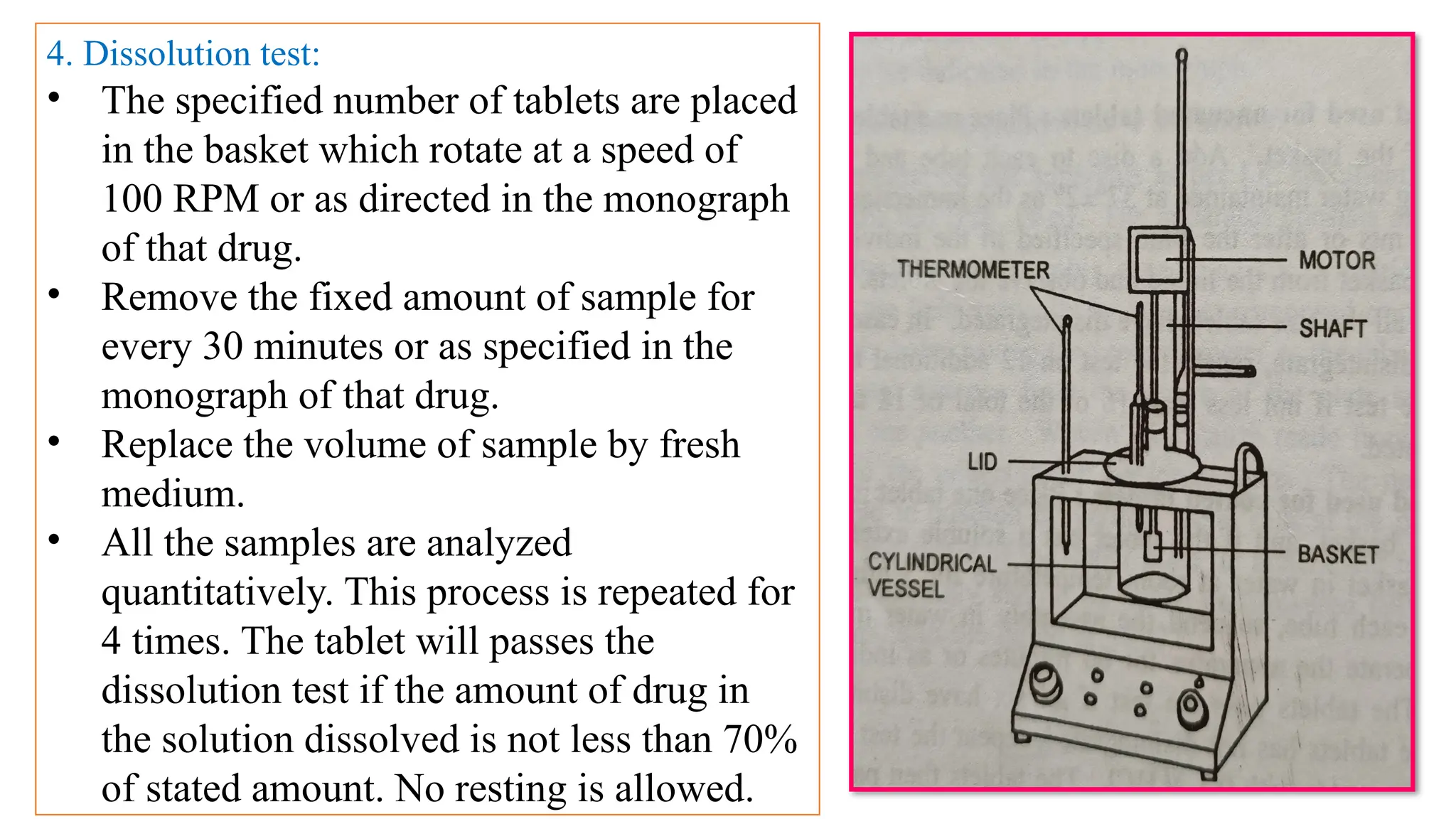
4. Dissolution test:
• The specified number of tablets are placed
in the basket which rotate at a speed of
100 RPM or as directed in the monograph
of that drug.
• Remove the fixed amount of sample for
every 30 minutes or as specified in the
monograph of that drug.
• Replace the volume of sample by fresh
medium.
• All the samples are analyzed
quantitatively. This process is repeated for
4 times. The tablet will passes the
dissolution test if the amount of drug in
the solution dissolved is not less than 70%
of stated amount. No resting is allowed.
7
1. Appearance:
The surface of tablet should be smooth, texture should be uniform and
there is no any sign of coating in case of uncoated tablet.
2. Size / diameter:
The tablet will of uniform size / diameter.
3. Shape:
The official shape of tablet is flat, biconvex disc shape. Also the tablets of
different shapes are available in the market like oblong, triangular, pentagonal,
hexagonal etc. Tablet should be of uniform shape.
4. Mechanical strength / hardness:
Tablet should be sufficient hard so that it should not be break easily while
transportation and handling. General the hardness of tablet should be between 4
to 8 kg/cm2
.
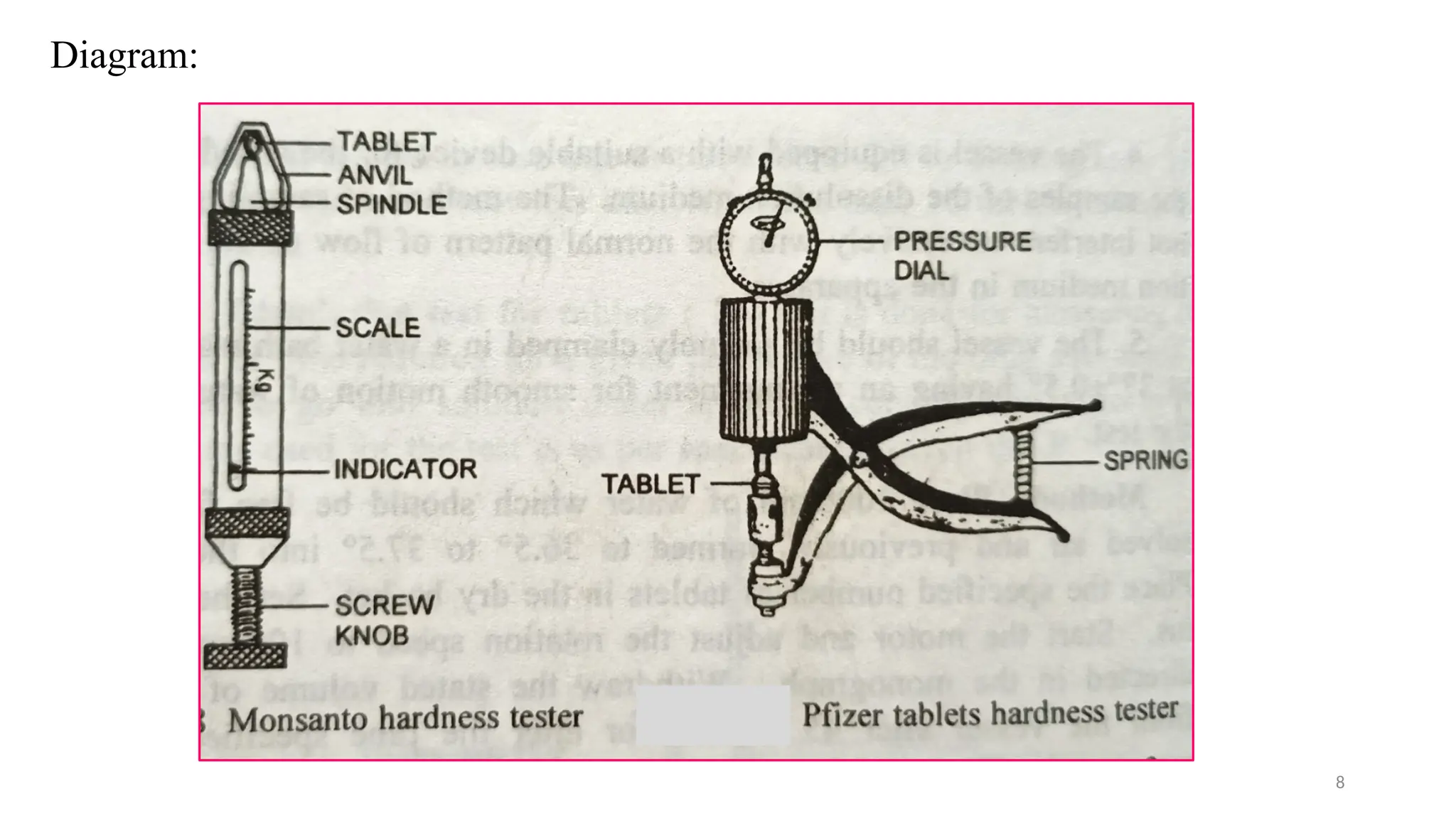
There are two different devices used to determine the hardness of tablet.
1. Monsanto hardness tester
2. Pfizer hardness tester
8
Diagram:
9
5. Friability test:
• Friability test is performed by using Roche friabilator.
• It is performed to determine the ability of tablet to withstand wear and
tear during transportation and handling.
• In this we are observe the powdering characteristic of tablet after
handling. To perform the test 20 tablets are selected randomly.
10
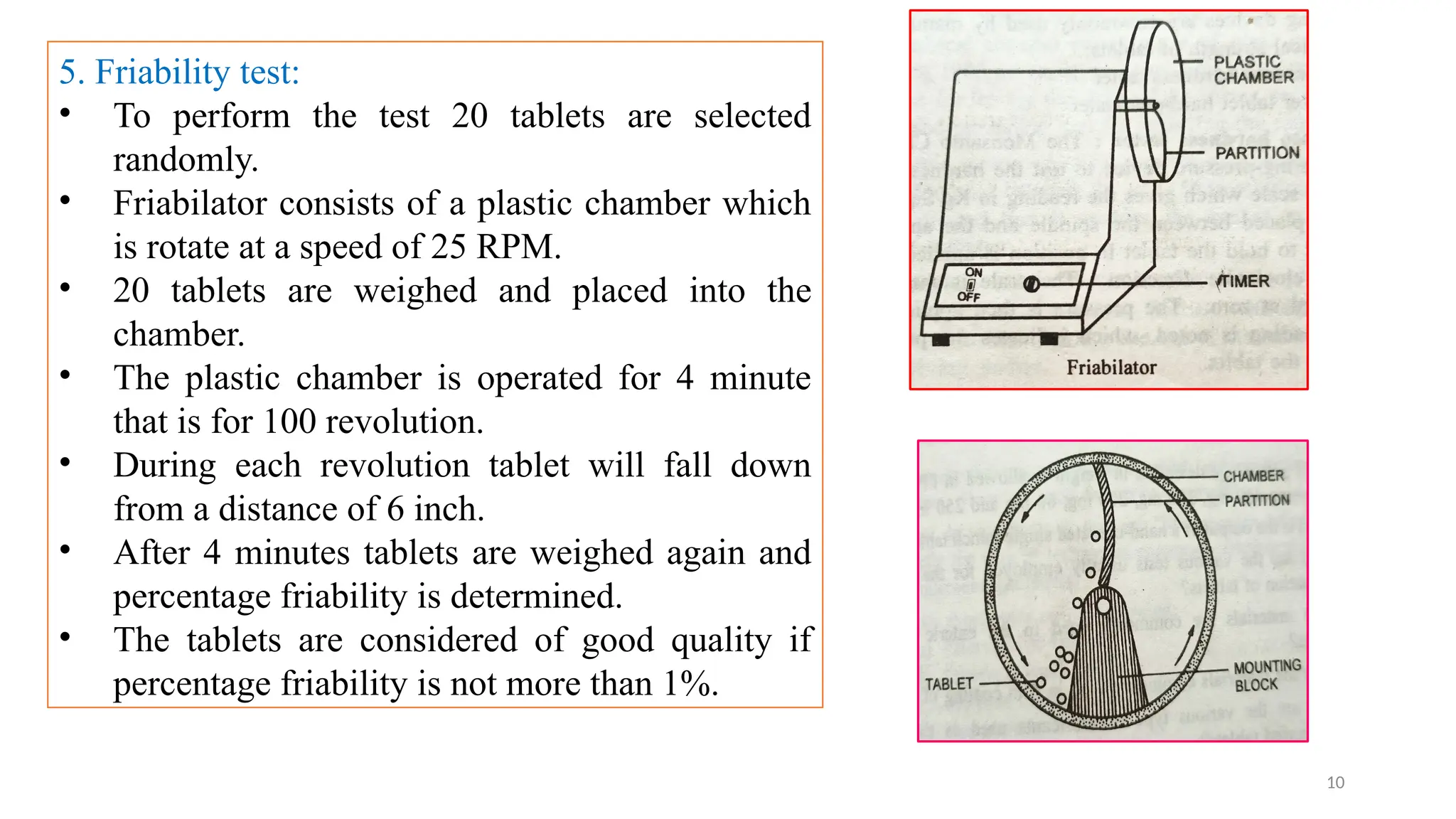
5. Friability test:
• To perform the test 20 tablets are selected
randomly.
• Friabilator consists of a plastic chamber which
is rotate at a speed of 25 RPM.
• 20 tablets are weighed and placed into the
chamber.
• The plastic chamber is operated for 4 minute
that is for 100 revolution.
• During each revolution tablet will fall down
from a distance of 6 inch.
• After 4 minutes tablets are weighed again and
percentage friability is determined.
• The tablets are considered of good quality if
percentage friability is not more than 1%.

Quality Control TESTS FOR TABLETS.present

  • 1.
    1 Evaluation / QualityControl Test for Tablets Following are the different official and unofficial quality control test for tablets. Official quality control test for tablets: 1. Content uniformity 2. Uniformity of weight test / weight variation test 3. Disintegration test 4. Dissolution test Unofficial quality control test for tablets: 1. Appearance 2. Size / diameter 3. Shape 4. Mechanical strength / hardness 5. Friability test 1. Content Uniformity: To determine the amount of active ingredient in the tablet, 20 tablets are selected randomly. If 20 tablets are not available at least 5 tablets should be taken randomly for the test. These tablets are crushed to form powder and dissolved in the suitable media. The drug content in the media is determined by using colorimeter, UV spectrophotometer, NMR, gas chromatography, thin layer chromatography, high performance liquid chromatography etc.. The tablet should comply to the content uniformity test as per the specifications given in the individual monograph of that drug.
  • 2.
    2 2. Uniformity ofweight test / weight variation test: For uniformity of weight test 20 tablets are selected randomly. If 20 tablets are not available at least 10 tablets are used for the test. Average weight of tablet is calculated by weighing all the 20 tablets. Depending upon the average weight of tablets, I.P. given percentage deviation in the weight of tablet. The tablet should comply to the uniformity of weight test as per I. P. The tablet will pass the weight variation test when not more than two tablet should fall outside the limit when 20 tablets are taken and one tablet should fall outside the limit when 10 tablets are taken for test. SR. NO. AVERAGE WEIGHT OF TABLETS % DEVIATION 1 80mg or less 10% 2 More than 80mg & less than 250mg 7.5% 3 250mg or more 5%
  • 3.
    3 3. Disintegration test: •Disintegration test apparatus consists of rigid basket rack assembly. • It having 6 cylindrical glass tubes which are held vertically with the help of two transparent plastic plates. • All the glass tubes are placed at equal distance from each other and also they are placed at equal distance from the center. • In every glass tube disc is present, at the bottom of glass tube stainless steel sieve is present. • This total assembly will move upward and downward by distance of 5cm for 30 ± 2 times per minute.
  • 4.
    4 • This assemblywill be suspended in a liquid medium of 1000 ml beaker. • The beaker is filled with water in such a way that the wire mesh at highest point is at least 25 mm below the surface of the liquid. • In each tube single tablet is placed. The instrument is started and disintegration time is counted. • All the particles of the tablet passes through sieve indicate the completion of disintegration. • Out of 6 at least 5 tablets should be disintegrated in specified time.
  • 5.
    5 4. Dissolution test: •Dissolution test is performed by using dissolution test apparatus. • It consists of plastic chamber with thermostat. • It has cylindrical glass vessel with capacity 1000 ml. • The glass flask has lid with four openings. The first opening is for stirrer. • From second hole thermometer is placed. Third hole is used to remove the sample and fourth hole is used to replace fresh medium like acid, alkali, phosphate buffer of different pH.
  • 6.
    6 4. Dissolution test: •The specified number of tablets are placed in the basket which rotate at a speed of 100 RPM or as directed in the monograph of that drug. • Remove the fixed amount of sample for every 30 minutes or as specified in the monograph of that drug. • Replace the volume of sample by fresh medium. • All the samples are analyzed quantitatively. This process is repeated for 4 times. The tablet will passes the dissolution test if the amount of drug in the solution dissolved is not less than 70% of stated amount. No resting is allowed.
  • 7.
    7 1. Appearance: The surfaceof tablet should be smooth, texture should be uniform and there is no any sign of coating in case of uncoated tablet. 2. Size / diameter: The tablet will of uniform size / diameter. 3. Shape: The official shape of tablet is flat, biconvex disc shape. Also the tablets of different shapes are available in the market like oblong, triangular, pentagonal, hexagonal etc. Tablet should be of uniform shape. 4. Mechanical strength / hardness: Tablet should be sufficient hard so that it should not be break easily while transportation and handling. General the hardness of tablet should be between 4 to 8 kg/cm2 . There are two different devices used to determine the hardness of tablet. 1. Monsanto hardness tester 2. Pfizer hardness tester
  • 8.
  • 9.
    9 5. Friability test: •Friability test is performed by using Roche friabilator. • It is performed to determine the ability of tablet to withstand wear and tear during transportation and handling. • In this we are observe the powdering characteristic of tablet after handling. To perform the test 20 tablets are selected randomly.
  • 10.
    10 5. Friability test: •To perform the test 20 tablets are selected randomly. • Friabilator consists of a plastic chamber which is rotate at a speed of 25 RPM. • 20 tablets are weighed and placed into the chamber. • The plastic chamber is operated for 4 minute that is for 100 revolution. • During each revolution tablet will fall down from a distance of 6 inch. • After 4 minutes tablets are weighed again and percentage friability is determined. • The tablets are considered of good quality if percentage friability is not more than 1%.