QUALITY CONTROL TEST ON
SECONDARY PACKAGING
MATERIALS
MS. ANU CHAUDHARY
Assistant Professor
chaudharyanu1107gmail.com
Global research institute of Pharmacy,
Radaur
CONTENTS
• INTRODUCTION
• PACKAGING TYPES
• SECONDARY PACKAGING
• QUALITY CONTROL TESTS FOR SECONDARY
PACKAGING
• CONCLUSION
• REFERENCES
INTRODUCTION
• Packaging is a process by which the pharmaceuticals are
suitably packed so that they should retain their therapeutic
effectiveness from the time of packaging till they are
consumed.
• Packaging may be defined as the art and science which
involves preparing articles for transport, storage display
and use.
• Pharmaceuticals packaging is the means of providing
protection, presentation, Identification, Information and
convenience to encourage compliance with a course of
therapy.
PACKAGING TYPE
Primary Packaging
Primary packaging is the material that first envelops the product and holds it.
This usually is the smallest unit of distribution or use and is the package which is in direct contact with the contents.
SECONDERY PACKAGING
Secondary packaging is out side the primary packaging- used to group primary packages together.
TERTIARY PACKAGING
Tertiary packaging is used for bulk handling, warehouse storage and transport.
Most common form is palletized unit load that packs tightly in to containers.
SECONDARY
PACKAGING
Secondary packaging
designates the
packaging used to
group
various pre-packaged
products together.
Secondary packaging said to have two
central functions.
1.Branding & Display, Secondary
packaging plays a vital role in the marketing
strategy surrounding the product. This is
especially relevant in case of display
packaging.
2. Logistics, secondary packaging
serves to group several products together for
ease of handling, transport and storage.
Different type of Secondary
Packaging Materials
Paper and boards
Cartons
Corrugated fiber board
Quality control test for secondary packaging materials
Quality control test for cartons
1. Compression
2. Carton opening force
Quality control test for paper and board
Quality control tests for paper and board
Test conditions:
Temperature-23°C
1. Dimensions
2. Thickness
3. Surface Ph
4. Moisture content
5. Folding endurance
6. Air permeability
7. Stiffness & Tensile Strength
8. Bursting strength
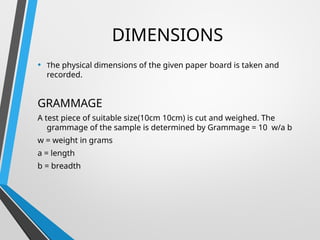
DIMENSIONS
• The physical dimensions of the given paper board is taken and
recorded.
GRAMMAGE
A test piece of suitable size(10cm 10cm) is cut and weighed. The
grammage of the sample is determined by Grammage = 10 w/a b
w = weight in grams
a = length
b = breadth
THICKNESS
• Measured with a micrometer.
• Thickness is related to grammage of paper
and its bulk density. It directly influences
the physical property of paper like
stiffness, varnishing and cutting.
SURFACE pH
• Acidity in paper may be caused by the
presence of residual chemical left in the pulp.
• A drop of distilled water is placed on the top of
the test piece and the electrode of pH meter is
placed in the drop touching the paper.
• The reading is taken after 2 min.
MOISTURE CONTENT TEST
Conditioned specimen is weighed and heated to a constant weight to expel the moisture. The difference of the
two weights gives the moisture content of the paper.
FOLDING ENDURANCE
Fold endurance measures the durability of paper when repeatedly folded under constant load; determining how many times the
paper can be folded until it breaks.
Fold the test piece back and forth until rupture occurs.
AIR PERMEABILITY
Important for using light weight uncoated paper on machine having vacuum pickup system.
STIFFINESS
Degree of resistance offered by paper/board when it is bent.
This involves testing a board piece and folding it through 90°
.
It will then try to recover its position when bending force is removed.
TENSILE STRENGTH
.Maximum load that a material can support without fracture when being stretched, divided by the original cross section area of the material.
.Tensile strengths have dimensions of force per unit area.
.These test provides measurement of attributes we can see and feel: strength, stiffness and resistance to stretching.
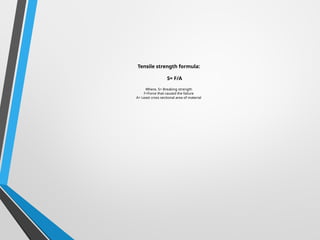
Tensile strength formula:
S= F/A
Where, S= Breaking strength
F=Force that caused the failure
A= Least cross sectional area of material
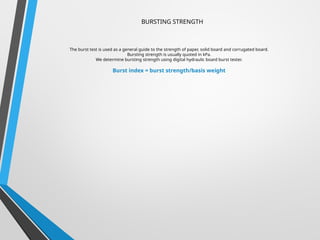
BURSTING STRENGTH
The burst test is used as a general guide to the strength of paper, solid board and corrugated board.
Bursting strength is usually quoted in kPa.
We determine bursting strength using digital hydraulic board burst tester.
Burst index = burst strength/basis weight
QUALITY CONTROL TEST FOR CARTONS
Compression
Used to assess the strength of erected package there by estimating the degree of protection that it confers on the contents.
This is useful for products with no inherent strength in one plane or another.
Carton opening force
The carton should spring open in to its original shape without a need for unreasonable force.
If the carton does not spring open buckles in on itself, it may cause problems on cartooning machine.
THANK YOU

QUALITY CONTROL TEST ON SECONDARY PACKAGING MATERIALS.pptx

  • 1.
    QUALITY CONTROL TESTON SECONDARY PACKAGING MATERIALS MS. ANU CHAUDHARY Assistant Professor chaudharyanu1107gmail.com Global research institute of Pharmacy, Radaur
  • 2.
    CONTENTS • INTRODUCTION • PACKAGINGTYPES • SECONDARY PACKAGING • QUALITY CONTROL TESTS FOR SECONDARY PACKAGING • CONCLUSION • REFERENCES
  • 3.
    INTRODUCTION • Packaging isa process by which the pharmaceuticals are suitably packed so that they should retain their therapeutic effectiveness from the time of packaging till they are consumed. • Packaging may be defined as the art and science which involves preparing articles for transport, storage display and use. • Pharmaceuticals packaging is the means of providing protection, presentation, Identification, Information and convenience to encourage compliance with a course of therapy.
  • 4.
    PACKAGING TYPE Primary Packaging Primarypackaging is the material that first envelops the product and holds it. This usually is the smallest unit of distribution or use and is the package which is in direct contact with the contents.
  • 5.
    SECONDERY PACKAGING Secondary packagingis out side the primary packaging- used to group primary packages together. TERTIARY PACKAGING Tertiary packaging is used for bulk handling, warehouse storage and transport. Most common form is palletized unit load that packs tightly in to containers.
  • 6.
    SECONDARY PACKAGING Secondary packaging designates the packagingused to group various pre-packaged products together.
  • 7.
    Secondary packaging saidto have two central functions. 1.Branding & Display, Secondary packaging plays a vital role in the marketing strategy surrounding the product. This is especially relevant in case of display packaging. 2. Logistics, secondary packaging serves to group several products together for ease of handling, transport and storage.
  • 8.
    Different type ofSecondary Packaging Materials Paper and boards Cartons Corrugated fiber board
  • 9.
    Quality control testfor secondary packaging materials Quality control test for cartons 1. Compression 2. Carton opening force Quality control test for paper and board
  • 10.
    Quality control testsfor paper and board Test conditions: Temperature-23°C 1. Dimensions 2. Thickness 3. Surface Ph 4. Moisture content 5. Folding endurance 6. Air permeability 7. Stiffness & Tensile Strength 8. Bursting strength
  • 11.
    DIMENSIONS • The physicaldimensions of the given paper board is taken and recorded. GRAMMAGE A test piece of suitable size(10cm 10cm) is cut and weighed. The grammage of the sample is determined by Grammage = 10 w/a b w = weight in grams a = length b = breadth
  • 12.
    THICKNESS • Measured witha micrometer. • Thickness is related to grammage of paper and its bulk density. It directly influences the physical property of paper like stiffness, varnishing and cutting.
  • 13.
    SURFACE pH • Acidityin paper may be caused by the presence of residual chemical left in the pulp. • A drop of distilled water is placed on the top of the test piece and the electrode of pH meter is placed in the drop touching the paper. • The reading is taken after 2 min.
  • 14.
    MOISTURE CONTENT TEST Conditionedspecimen is weighed and heated to a constant weight to expel the moisture. The difference of the two weights gives the moisture content of the paper.
  • 15.
    FOLDING ENDURANCE Fold endurancemeasures the durability of paper when repeatedly folded under constant load; determining how many times the paper can be folded until it breaks. Fold the test piece back and forth until rupture occurs.
  • 16.
    AIR PERMEABILITY Important forusing light weight uncoated paper on machine having vacuum pickup system. STIFFINESS Degree of resistance offered by paper/board when it is bent. This involves testing a board piece and folding it through 90° . It will then try to recover its position when bending force is removed.
  • 17.
    TENSILE STRENGTH .Maximum loadthat a material can support without fracture when being stretched, divided by the original cross section area of the material. .Tensile strengths have dimensions of force per unit area. .These test provides measurement of attributes we can see and feel: strength, stiffness and resistance to stretching.
  • 18.
    Tensile strength formula: S=F/A Where, S= Breaking strength F=Force that caused the failure A= Least cross sectional area of material
  • 19.
    BURSTING STRENGTH The bursttest is used as a general guide to the strength of paper, solid board and corrugated board. Bursting strength is usually quoted in kPa. We determine bursting strength using digital hydraulic board burst tester. Burst index = burst strength/basis weight
  • 20.
    QUALITY CONTROL TESTFOR CARTONS Compression Used to assess the strength of erected package there by estimating the degree of protection that it confers on the contents. This is useful for products with no inherent strength in one plane or another.
  • 21.
    Carton opening force Thecarton should spring open in to its original shape without a need for unreasonable force. If the carton does not spring open buckles in on itself, it may cause problems on cartooning machine.
  • 22.