
NewGate India
             Hyderbad, Andhra Pradesh- 500038


               Website: www.newgate.in
               Email: contact@newgate.in
Slideshare URL : http://www.slideshare.net/newgateindia


                     Report on
         Quality Control,Kaizen & 5S
                  In Silica Plant
Table of Contents
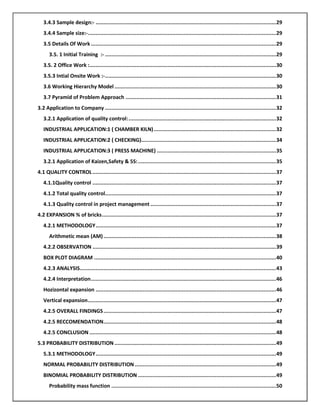
1.Executive Summary .........................................................................................................................7
   1.1       OVERVIEW OF QUALITY CONTROL done in OCL ....................................................................7
   CHAMBER KILN: .............................................................................................................................7
   EXPANSION PROBABILITY : .............................................................................................................7
   APPARENT POSROSITY & BULK DENSITY .........................................................................................8
   EXCEL SHEET SIMULATION ..............................................................................................................8
   1.2       KAIZEN & 5S suggested ........................................................................................................8
   PICTORIAL LAYOUTS .......................................................................................................................8
2.Introduction....................................................................................................................................9
   2.1 INDUSTRY OVERVIEW ...............................................................................................................9
   2.1.1 ABOUT OCL ............................................................................................................................9
   2.1.1.1 CEMENT: .............................................................................................................................9
   2.1.1.2 REFRACTORY.......................................................................................................................9
   2.1.1.3 SPONGE IRON .....................................................................................................................9
   2.1.1.4 IRON & STEEL .................................................................................................................... 10
   2.1.2 EXECUTIVES & BORAD MEMBERS ......................................................................................... 10
      DIRECTORS ............................................................................................................................... 10
      PRESIDENT ............................................................................................................................... 10
   2.1.3 VISION ................................................................................................................................. 10
   2.1.4 MISSION .............................................................................................................................. 10
   2.1.5 Quality Policy....................................................................................................................... 11
   2.1.6 Safety Policy ........................................................................................................................ 11
   2.1.7 Certification ......................................................................................................................... 11
   2.1.8 AWARDS & RECOGNITION .................................................................................................... 12
   2.1.8 Corporate Social Responsibility ............................................................................................ 12
      EDUCATION .............................................................................................................................. 12
      DRINKING WATER..................................................................................................................... 13
      HEALTH .................................................................................................................................... 13
      GAMES & SPORTS ..................................................................................................................... 14
      COMMUNITY DVELOPMENT/DONATION/CHARITY .................................................................... 14
   2.1.9 Summary of expenses incurred ............................................................................................ 15
2.2 SWOT ANALYSIS ..................................................................................................................... 15
   2.2.1 STRENGTH ........................................................................................................................... 15
   2.2.2 WEAKNESS .......................................................................................................................... 16
   2.2.3 OPPORTUNITY ..................................................................................................................... 16
   2.2.4 THREAT ............................................................................................................................... 16
   2.3 Company overview ................................................................................................................. 16
   2.3.1 ABOUT REFRACTORY............................................................................................................ 16
   2.3.2 MILESTONES YEAR WISE....................................................................................................... 17
   2.3.3 REFRACTORY CAPACITY........................................................................................................ 18
   2.3.4 GLOBALIZATION................................................................................................................... 18
   2.3.5 PRODUCTS ........................................................................................................................... 19
   2.3.5.1 Iron & Steel Making .......................................................................................................... 19
   2.3.5.1 Non Ferrous ...................................................................................................................... 19
   2.3.5.1 Glass ................................................................................................................................. 20
   2.3.5.1 Hydrocaron ....................................................................................................................... 20
   2.3.5.1 Cement ............................................................................................................................. 20
   2.3.6 FEW MAJOR PRODUCTS STUDIED ......................................................................................... 20
   2.3.6.1 COKE OVEN ....................................................................................................................... 20
   2.3.6.2 BLAST FURNANE STOVE ..................................................................................................... 21
   2.3.6.3 GLASS MELTING TANK ....................................................................................................... 21
   2.3.6.4 BOF/LD Convertor ............................................................................................................. 22
   2.3.6.5 MELTING & HOLDING FURNANCE ...................................................................................... 23
   2.3.6.6 LF/VD & VAD .................................................................................................................... 24
   2.3.6.7 QSL REACTOR .................................................................................................................... 24
   2.3.6.8 REGENERATOR .................................................................................................................. 25
   2.4. SILICA PLANT OVERVIEW........................................................................................................ 25
   2.4.1 Silica Plant Operational Process Flow ................................................................................... 26
3.1 PROJECT PROFILE ....................................................................................................................... 28
   3.1 Objectives of the Study ........................................................................................................... 28
   3.2 Project Type & Tools ............................................................................................................... 28
            Production Operation Management .................................................................................. 28
   3.3 Target..................................................................................................................................... 28
   3.4 Sources of data:- ..................................................................................................................... 28
      3.4.1 Primary data: ................................................................................................................... 28
      3.4.2 Secondary data: ............................................................................................................... 29
3.4.3 Sample design:- ................................................................................................................... 29
   3.4.4 Sample size:-........................................................................................................................ 29
   3.5 Details Of Work ...................................................................................................................... 29
      3.5. 1 Initial Training :- ............................................................................................................. 29
   3.5. 2 Office Work :....................................................................................................................... 30
   3.5.3 Intial Onsite Work :- ............................................................................................................. 30
   3.6 Working Hierarchy Model ....................................................................................................... 30
   3.7 Pyramid of Problem Approach ................................................................................................ 31
3.2 Application to Company ............................................................................................................. 32
   3.2.1 Application of quality control: .............................................................................................. 32
   INDUSTRIAL APPLICATION:1 ( CHAMBER KILN) .............................................................................. 32
   INDUSTRIAL APPLICATION:2 ( CHECKING)...................................................................................... 34
   INDUSTRIAL APPLICATION:3 ( PRESS MACHINE) ............................................................................ 35
   3.2.1 Application of Kaizen,Safety & 5S: ........................................................................................ 35
4.1 QUALITY CONTROL ..................................................................................................................... 37
   4.1.1Quality control ..................................................................................................................... 37
   4.1.2 Total quality control............................................................................................................. 37
   4.1.3 Quality control in project management ................................................................................ 37
4.2 EXPANSION % of bricks ............................................................................................................... 37
   4.2.1 METHODOLOGY ................................................................................................................... 37
      Arithmetic mean (AM) .............................................................................................................. 38
   4.2.2 OBSERVATION ..................................................................................................................... 39
   BOX PLOT DIAGRAM .................................................................................................................... 40
   4.2.3 ANALYSIS ............................................................................................................................. 43
   4.2.4 Interpretation ...................................................................................................................... 46
   Hozizontal expansion ................................................................................................................... 46
   Vertical expansion ........................................................................................................................ 47
   4.2.5 OVERALL FINDINGS .............................................................................................................. 47
   4.2.5 RECCOMENDATION .............................................................................................................. 48
   4.2.5 CONCLUSION ....................................................................................................................... 48
5.3 PROBABILITY DISTRIBUTION ....................................................................................................... 49
   5.3.1 METHODOLOGY ................................................................................................................... 49
   NORMAL PROBABILITY DISTRIBUTION .......................................................................................... 49
   BINOMIAL PROBABILITY DISTRIBUTION ........................................................................................ 49
      Probability mass function ......................................................................................................... 50
Mean and variance ....................................................................................................................... 51
   Mode and median ........................................................................................................................ 52
   Covariance between two binomials .............................................................................................. 52
   5.3.2 OBSERVATION ..................................................................................................................... 53
   5.3.3 ANALYSIS ............................................................................................................................. 55
   5.3.4 Interpretation ...................................................................................................................... 57
   5.3.5 OVERALL FINDINGS .............................................................................................................. 57
   4.2.5 RECCOMENDATION .............................................................................................................. 57
   4.2.5 CONCLUSION ....................................................................................................................... 57
5.3 Apparent Posrosity Versus Bulk Density ...................................................................................... 58
   5.3.1 METHODOLOGY ................................................................................................................... 58
   5.3.2OBSER VATION ..................................................................................................................... 61
   5.3.3 ANALYSIS ............................................................................................................................. 62
   5.3.3.1 DERIVATION ..................................................................................................................... 62
   5.3.4 Interpretation ...................................................................................................................... 63
   Apparent Porosity is inversely related to burnt Bulk Density. ........................................................ 63
   5.3.5 FINDINGS............................................................................................................................. 64
   4.2.5 RECCOMENDATION .............................................................................................................. 64
   4.2.5 CONCLUSION ....................................................................................................................... 65
4.1 KAIZEN ....................................................................................................................................... 67
4.2 5S .............................................................................................................................................. 68
   4.2.1 Phases of 5S......................................................................................................................... 68
   Sorting (Seiri) ............................................................................................................................... 68
   Straightening or setting in order / stabilize (Seiton) ....................................................................... 68
   Sweeping or shining or cleanliness / systematic cleaning (Seiso) .................................................... 68
   Standardizing (Seiketsu) ............................................................................................................... 68
   Sustaining the discipline or self-discipline (Shitsuke) ..................................................................... 69
4.3 Safety ........................................................................................................................................ 69
4.4 Security ...................................................................................................................................... 69
4.5 SMALL IMPROVEMENT & SAFETY................................................................................................ 69
   5.5.1 METHODOLOGY ................................................................................................................... 69
   DRAWING LAYOUT ....................................................................................................................... 70
   5.3.2 Observation ......................................................................................................................... 70
   5.3.3 ANALYSIS ............................................................................................................................. 71
   5.3.4 INTERPRETATION ................................................................................................................. 71
5.3.5 KEY FINDINGS ...................................................................................................................... 72
   5.3.6 RECCOMENDATION .............................................................................................................. 72
   5.3.7 CONCLUSION ....................................................................................................................... 73
6.EXCEL SIMULATION TOOL .............................................................................................................. 75
   6.1 Tool-1 ..................................................................................................................................... 75
   6. 2 Tool-2 .................................................................................................................................... 76
   6.3 Tool-3 ..................................................................................................................................... 77
   6.4 Tool-4 ..................................................................................................................................... 78
   6.5 Tool-5 ..................................................................................................................................... 79
   6.6 Tool-6 ..................................................................................................................................... 79
7.PICTORIAL RECCOMENDATION ...................................................................................................... 81
   7.1 Suggestion 1: .......................................................................................................................... 81
   7.2 Suggestion 2: .......................................................................................................................... 81
   7.3 Suggestion 3: .......................................................................................................................... 82
   7.4 Suggestion 4: .......................................................................................................................... 82
   7.5 Suggestion 5: .......................................................................................................................... 83
   7.6 Suggestion 6:                                               7.7 Suggestion 7:........................................................ 83
   7.8 Suggestion 8: .......................................................................................................................... 84
   7.9 Suggestion 9: .......................................................................................................................... 84
   7.10 Suggestion 10: ...................................................................................................................... 85
   7.11 Suggestion 11: ...................................................................................................................... 85
   7.12 Suggestion 12: ...................................................................................................................... 86
   7.13 Suggestion 13: ...................................................................................................................... 86
8. LEARNING OUTCOME: .................................................................................................................. 87
   8.1 QUALITY CONTROL PROJECT: .................................................................................................. 87
   8.2 KAIZEN,5S & SAFETY PROJECT ................................................................................................. 87
APPENDIX-1 ..................................................................................................................................... 88
   PROBABILITY DISTRIBUTION ......................................................................................................... 88
APPENDIX-2 ..................................................................................................................................... 89
   EXPANSION % LAYER WISE ........................................................................................................... 89
APPENDIX-3 ..................................................................................................................................... 90
   AP-BD table.................................................................................................................................. 90
APPENDIX-4 ..................................................................................................................................... 95
   Brick Expansion % Data ................................................................................................................ 95
APPENDIX-5 ..................................................................................................................................... 96
                                                                                                                                         Page 5
Box Plot diagram of Expansion % Data .......................................................................................... 96
APPENDIX-6 ..................................................................................................................................... 97
   Stock Data:................................................................................................................................... 97
APPENDIX-7 ..................................................................................................................................... 98
   A7.1 TOTAL ASSETS of OCL ( 2007,2008,2009) ............................................................................... 98
   A7.2 DEBT & NET WORTH of OCL ( 2007,2008,2009) ...................................................................... 98
APPENDIX-8 ..................................................................................................................................... 99
   A8.1CREDIT RISK .......................................................................................................................... 99
   A8.2 TOTAL LIABILILTIES ............................................................................................................... 99
APPENDIX-9 ................................................................................................................................... 100
   A9.1 TOTAL INCOME................................................................................................................... 100
   A9.2 TOTAL EXPENDITURE .......................................................................................................... 100
APPENDIX-10 ................................................................................................................................. 101
   A10.1 OPERATING PROFIT .......................................................................................................... 101
   A10.2 PROFIT AFTER TAX ............................................................................................................ 101
GLOSSARY & ABBREVIATION .......................................................................................................... 102
BIBLIOGRAPHY............................................................................................................................... 103


                                                                                                                                       Page 6
1.Executive Summary
   The Project was focused on quality control using various statistical tool/techniques.

 1.1 OVERVIEW OF QUALITY CONTROL done in OCL

CHAMBER KILN:

OCL Silica Refractory has 8 kilns.Eack Kiln has 22 to 28 chambers. Again each chamber has
4 benches (A,B,C,D) across length & 5 layers ( Top,4th,Middle,2nd,Bottom) across height.
    Experiemntally it was found that the bricks size within the same chamber of a kiln differed
across length & height.Position of bricks inside a kiln mattered a lot.So a very microscopic
obsevation was done using statistical tools & techniques. For this experiment 2700 raw data of
bricks were taken.

It was an assumption that the bricks inside the kiln expanded by 4.2% after firing. So our
motive was to observe if the assumption was accurate & how the bricks expanded at very
microssopic level.

Following were the findings & observation.

          Expansion of silica bricks at Macroscopic level at various physical Parameters.
          Expansion of silica bricks & heat phenemenon at horizontal & vertical direction
           inside a kiln
          Expansion of bricks in each benches inside the kiln.
          Expansion of bricks in each layers inside the kiln.


EXPANSION PROBABILITY :
    Not only bricks expansion was different across different physical parameters but at the
same parameter the probability that the bricks expanded to a defined level varied.Many times
it deviated from its expected size. So probability distribution was done to estimate the
occurence of various sized bricks.

Following were the findings & observation.

      Probability distribution of expansion of bricks to a defined size
      Probaility of deviation
      Probability that a particular lot failed to pass.


                                                                                       Page 7
APPARENT POSROSITY & BULK DENSITY

It is important to know apparent porosity needed for a particular green bulk density.Orders are
placed in terms of maximum apparent posrosity.So it is importnat to know, what should be
the pressure applied by the press machine to maintain a proper bulk density, keeping in mind
the expansion factor & moisture loss due to which density reduces.

Following were the findings & observation.
     Relation between AP & Burnt BD
     Relation between AP & Green BD
     Relation between Burnt BD & Green BD


EXCEL SHEET SIMULATION
  It has been developed to make observation user friendly and flexible in case of any
change of situation and it will be of immense help to our company.


1.2 KAIZEN & 5S suggested

   Small stratigic improvement & safety is an important concern for any company.

   IMPROVEMENT
   Following were the findings & observation.
      Designing layouts of plant,roads & machinery
      What Operational startigies can be implemented
      Safety precautions
      Optimization of paths & tracks
      Housekeeping
      Prioritizing the task
      Kiln operation

   SAFETY
   Following were the findings & observation.
      Trolley safety
      Mixer Bucket pulling
      Chair Car safety
      Road safety
      Plant Safety
      Disaster Management

PICTORIAL LAYOUTS
  It has been developed to make observation user friendly to lay man for whom
understanding technical terms becomes difficult
                                                                                       Page 8
2.Introduction
2.1 INDUSTRY OVERVIEW

 OCL INDIA LTD

                                        OCL


              Refractor                 Cement                   Sponge
                yryct                                             Iron

2.1.1 ABOUT OCL


OCL INDIA LIMITED, formerly "Orissa Cement Limited" and better known as "OCL",

2.1.1.1 CEMENT:
Itwas established in the year 1949, which started producing Cement through wet
process technology under the brand name of "Konark". Keeping a steady progress with
time and technology it has modernized to fully automated dry process plant in 1988. OCL
commands the position of market leadership in the state of Orissa since its inception and
today it is the premier lead brand in the state of Orissa. ‘Konark' brand cement enjoys
brand advantage in the region. It is a name cemented to Quality.

2.1.1.2 REFRACTORY
OCL diversified from Cement to the field of Refractories in 1954. Over the years, it has
become one of the largest and well-equipped state of the art Refractory plant in India
covering a wide range of products for use in the Ferrous & the non-ferrous Industries. Its
customer base spreads from iron and steel to cement, aluminum, glass, copper, chemicals
and hydrocarbon industries. Today, OCL enjoys a huge market share in India and overseas
extending to five continents across the globe.

2.1.1.3 SPONGE IRON
During the year 2001-02 OCL diversified its activities into Sponge Iron and now forayed
further into Steel making. In line with this vision, the Company has already installed a
Captive Power plant and is going to commission 0.25 million tons steel billet plant.

                                                                                  Page 9
2.1.1.4 IRON & STEEL
OCL, as per scheme of arrangement approved by the honourable High Court of Orissa
demerged its Steel undertaking and Real Estate undertaking by transferring the assets
and liabilities as on 1st January 2007 into “OCL Iron and Steel Ltd.” and
“Landmark Property Development Company Ltd(formerly Konark Minerals Ltd.)”
respectively.
       The scheme of arrangement also involved merger of the business of Dalmia Cement
(Meghalaya) Limited, a wholly owned subsidiary of Dalmia Cement (Bharat) Ltd, as on 1st
July 2007 with the approval of the honourable Court of Guwahati.
       OCL is a globally focussed organization with presence in key areas of infrastructure
   development. With its range of product and strong R & D orientation it enjoys a strong
   customer and brand loyalty.2.2 Refractory Overview


2.1.2 EXECUTIVES & BORAD MEMBERS
DIRECTORS
    Shri Pradip Kumar Khaitan (Chairman)
    Shri V.D. Jhunjhunwala
    Shri D.N. Davar
    Shri Puneet Dalmia
    Dr. Ramesh C. Vaish
    Dr. S.R. Jain
    Shri V.P. Sood (Whole time Director & CEO)


PRESIDENT ;Shri M.H. Dalmia


2.1.3 VISION
 »   Grow profitably with commitment to customer satisfaction
 »   Strive for excellence
 »   Be in chosen areas
 »   Continuously develop a committed team of people
 »   Build good corporate image & high customer esteem
 »   Endeavour to serve society

2.1.4 MISSION
 » OCL is in the business of Cement and Refractories. These will continue to be our
   prime business focus areas
   We shall strive to improve our image in the eyes of all stakeholders - present and
 »
   potential
 » We shall endeavour to build a vibrant and responsive organization with a team of
   motivated people driving for excellence, achievement and high performance
 » We will create conditions and climate for empowerment through enhancement of
   Knowledge, Attitudes and Skills with emphasis on multiskilling


                                                                                  Page 10
2.1.5 Quality Policy
OCL, believes and aim at Total Quality in their products and services to satisfy Customers,
and are committed to:

 » Adhere strictly to quality parameters at all stages to provide products / services
   conforming to customer requirements
 » Meet Requirements of Quality management System and strive to continually
   improve its effectiveness
 » Develop competent human resource through planned training
   Establish Quality Objectives and review periodically to achieve continual
 »
   improvement


2.1.6 Safety Policy

OCL INDIA LIMITED considers all its employees as primary asset and attaches utmost
importance to their safety and health. To promote safety & health in all its factories and
mines, the company makes all possible efforts and will continue to do so by which safety
and health of all its employees will be ensured. T

They are committed to:

  » Consider eliminating safety and health hazard while planning, designing and
    adopting any process or system
  » Select and deploy plant machinery which are safe and free of hazard
    Maintain and upgrade the facilities and operations to ensure safety on continuous
  »
    basis
  » Provide the knowledge & necessary skills to employees, contractors & other agency
    through planned training & awareness programs
  » Periodically review safety & health performance to achieve continual
    improvements thereon
  » Implement & abide by all statutory rules & regulations
  » Make available adequate resource for promotion of safety and health
  » Review the policy periodically and revise as necessary


2.1.7 Certification

    ISO 9001:2008 ( Quality Management System)
    ISO 14001:2004 ( Environment )
    ISO 18001:2007 ( Occupational Health and Safety Assement Series)


                                                                                   Page 11
2.1.8 AWARDS & RECOGNITION

    In 2007-08 the Quality circle UTPADAN of Cement Division bagged Silver Medal
     Award in International convention of Quality circle held in BEIJING, CHINA.

    The Quality Circle ANVESHAN of Cement Division was awarded Par Excellent
     Presentation Award in CCQC held at Rourkela

    Achieved Excellent Award in National convention of Quality Circle held in
     Kolkata for their case study presentation during the year 2007-08.

    In 2007-08 one of the Company’s Quality Circles ‘KAMYAB’ bagged award of
     Golden Trophy and Gold medal in International Chapter Quality Circle (ICQC) held at
     Indonesia.

    Quality circle “Nirjharani’ was recognized as par excellence and other two QC
     teams UTPADAN and TALASH were recognized as EXCELLENT in National Chapter
     Quality Circle(NCQC) at Kanpur.

    Engineering personnel won 3 prizes in National Supervisory competition organized
     by IIPM, Khansbahal.

2.1.8 Corporate Social Responsibility

In its 57 years of untiring service to Nation, OCL has always given priority to community
development. In its endeavor to uplift the conditions of poor and hapless tribals of this
locality, OCL has undertaken various developmental activities in peripheral areas of
Rajgangpur and Lanjiberna. The activities are mainly focused on areas like Health,
Education, Drinking Water, Games and Sports etc. Some of the major activities undertaken
during last three years are given below :


 EDUCATION
» Constructed one big hall and made drinking water
  supply arrangement in Gopabandhu High School,
  Rajgangpur
» Constructed boundary wall of Primary School in village
  Kunmuru
» Constructed boundary wall and an additional room in
  Jampali High School
» Continuing Literacy programs in different villages
» Renovated school building of Bastia M E School, I T
  Colony, Rajgangpur
» Donated Rs. 1,00,000/- to Saraswati Sishu Mandir for
  construction of school building in Rajgangpur
» Repaired school building in Saliameta and Kheramuta,
  Lanjiberna
» Repaired roof of Nodal U P School in Lanjiberna

                                                                                 Page 12
» Renovated the school building of Municipal Gandhi Girl’s
  High School, Rajgangpur
» Constructed three new rooms and supplied desk and
  bench for students in M E School, Teleimunda
» Renovated the school building of Santa Devi High
  School, Khatang
» Made drinking water supply arrangement in Lanjiberna
  Shramik High School, Lanjiberna
» Repaired the school play ground in Ramabahal
» Making payment of salary to four adhoc teachers in
  Lanjiberna Shramik High School, Lanjiberna


DRINKING WATER
» Sunk 44 Tube wells in Rajgangpur, Lanjiberna and its
  surrounding villages
» Repaired 7 Tube wells in Lanjiberna
» Supplying water to five villages in Lanjiberna for
  irrigation
» Arranged drinking water supply system in the premises
  of Bar Association, Rajgangpur
» Donated Rs.17,000/- on behalf of villagers of Khatang to
  Village Water and Sanitation Committee for arranging
  drinking water facility under “Sajal Dhara Scheme’ of
  Govt. of Orissa
» Donated Rs.50,000/- on behalf of villagers of Dharuda
  (Kukuda GP) to Village Water and Sanitation Committee
  for arranging drinking water facility under “Sajal Dhara
  Scheme’ of Govt. of Orissa


HEALTH
» Providing medical facilities including supply of medicine
  to villagers in Lanjiberna from OCL Dispensary
» Providing ambulance for shifting serious patients to
  nearby hospitals in Rajgangpur and Lanjiberna
» Operating charitable homoeopathic dispensary in
  Rajgangpur and Lanjiberna
» Carried out renovation work in RGP. Govt. Hospital,
  planted neem trees, arranged water supply system,
  constructed additional toilets etc.
» Provided financial assistance to Bharatiya Jana Seva
  Sansthan, New Delhi for running a charitable dispensary
  at Sonakhan
» Operating mobile health unit (homeopathic) in different
  villages in Rajgangpur and Lanjiberna
                                                              Page 13
» Operating one mobile health unit (allopathic) for senior
  citizens through “Help Age-India” in different villages of
  Jagatsinghpur
» Organised health check-up camp for villagers in
  Lanjiberna
» Organised Eye, E & T and Dental Camp in Rajgangpur
» Organised awareness program on “Maleria, Dengu and
  Chikungunia” and distributed 300 mosquito nets to
  villagers in Lanjiberna


GAMES & SPORTS
» Conducted Inter-village Dalmia Cup Football and Hockey Tournament
» Providing games materials like football, volley ball, hockey sticks etc to villagers


COMMUNITY
DVELOPMENT/DONATION/CHARITY
» Operating ‘SWAYAMPRABHA”, a tailoring centre for
  providing training to poor women and providing swing
  machine free of cost in Lanjiberna
» Provided electricity in two villages i.e, Bihabandha
  Rehabilitated Colony and Tungritoli in Lanjiberna
» Provided financial assistance to Bharatiya Jana Seva
  Sansthan, New Delhi for implementing Gram Mangla
  Yogna in 50 villages in Rajgangpur & Lanjiberna
» Distributed 500 blankets to old and poor people in
  Rajgangpur and Lanjiberna
» Donated Rs. 19,00,000/- to District Peripheral
  Development Committee for undertaking various
  developmental activities in the District
» Donated Rs. 3,50,000/- to “HOPE” for construction of
  school building for mentally retarded children in
  Rajgangpur
» Donated Rs. 31,00,000/- for construction of “Community
  Kalyan Mandap” in Rajgangpur


                                                                                    Page 14
2.1.9 Summary of expenses incurred

Under different heads during 2004-05 and 2005-06 are
given below :


         AREA                       2004-05             2005-06               2007-08
 EDUCATION                      RS. 7,60,320.00      RS. 7,60,320.00      RS. 9,90,347.00
 DRINKING WATER                 RS. 11,51,509.00     RS. 8,95,309.00      RS. 1,69,301.00
 HEALTH                         RS. 6,35,000.00      RS. 13,52,984.00     RS. 15,76,002.00
 GAMES & SPORTS                 RS. 20,845.00        RS. 54,000.00        RS. 76,760.00
 CHARITY & DONATIONS            RS. 13,58,537.00     RS. 46,15,540.00     RS. 11,81,725.00
                TOTAL           RS. 39,26,211.00     RS. 73,80,325.00     RS. 39,94,135.00

Besides, OCL has also donated generously to Prime Minister’s and Chief Minister’s Relief
Fund when natural calamities like cyclone, flood etc struck the Nation.

OCL pledges to continue its endeavor in the above direction more vigorously in future.


2.2 SWOT ANALYSIS


2.2.1 STRENGTH

      OCL cement factory produces its brand Konark cement which has exceeded so
       much of its order that, today this factory has more order than what actually it can
       produce. Customers are having more demand than its capacity.

                                    Demand > Supply.

     OCL Refractory produces the best quality products all over Asia. On the basis of
      quality rating its Ranked – 1 and there is no company which can bid OCL in eastern
      world.
       Rapid industrialization at Jharsuguda ( 55 Km) from OCL and other industrial
        places like
        Jamashedpur,Rourkela,bilaspur,durg,Raipur,Raigarh,Durgapur,Bokaro by
        companies like RSP,L&T,VEDANTA,Bhusan Steel,MCL,Birla
        cement,Jindal,Tata will create more demands.


                                                                                   Page 15
2.2.2 WEAKNESS

      Though the quality of refractory products is good, the cost of product is very high.
       Though other companies have managed to reduce the overall price but OCL
       refractory has not shown much interest on it
      OCL sponge iron has not been very contributing and needs to improve its quality.

2.2.3 OPPORTUNITY

      VEDANTA, OCL, Rourkela Steel plant are in a continuous process of recycling the
       products. The by-product of one company is a raw material for other company.
      Profit and turnover has increased over period of time. Orders have increased to such
       extent that OCL cement factory is coming up with a new plant as cement factory
       line- 2, that will enhance the productivity of company and meet its emerging
       customers.
      Refractory’s high quality bricks & silica will be the major point of target to countries
       like Japan, Korea as they are in scarce of this product. Moreover its competitor in
       Germany, is far distant from Japan than India which reduces the transportation cost
       of good from India to Japan rather than Germany to Japan.

2.2.4 THREAT

      The Refractory companies of china are coming up with same products at very
       cheaper rates. Their product is more subjective to alteration.
      Refractory at Belpahar of TATA industries is located very near to it which is more
       automated than OCL’s manual production.
      Its competitors in Germany also targets the same type of market , controlling half of
       the globe like Europe,Africa,America thus creating hindrance to OCL to go for
       globalization in western countries.


2.3 Company overview


2.3.1 ABOUT REFRACTORY
OCL diversified from Cement to the field of Refractories in 1954. Over the years, it has
become one of the largest and state of the art Refractory plants in India with an annual
capacity of 80,000 Mt, covering a wide range of products for use in the ferrous & the non-
ferrous Industries.

                                                                                     Page 16
The initial technical know how came from M/S Dr.C.Otto of Germany for Coke Oven Silica
bricks and from M/S TYK Corporation of Japan for Magnesia-Carbon, Alumina-Mag-Carbon,
Alumina-Silicon Carbide-Carbon, Concast Refractories, Lance-pipe, Precast, Purging Plug, &
BF Runner castables. All the other products were developed in-house. To keep pace with
ever-growing expectation of customers for quality Refractories, our highly experienced &
well-equipped technology & research teams upgrade these on a continuous basis. With
intensive R&D efforts, OCL has registered a number of patents to its credit.

OCL happens to be the first Refractory Company in India to be certified under ISO 9001, by
RWTUV of Germany in 1994, now updated to 2000 version for all range of its products.

OCL is a globally focussed organization with a large range of product and strong R & D
orientation towards its customer both in product and in services. It has a long-term vision
to emerge as a globally accepted refractory solution provider.


2.3.2 MILESTONES YEAR WISE

             YEAR                                       MILESTONES
             1949                 Established as Orissa Cement Limited
             1954                 Diversified into refractories
             1956                 Commissioning of firebricks plant
             1958                 Commissioning of silica plant
             1959                 Commissioning of burnt basic brick plant
             1962                 Manufacture of chemically bonded basic bricks
             1963                 Manufacture of coke oven silica
             1972                 Expansion of silica plant
             1986                 Manufacture of MG-C brick
             1986                 Manufacture of slide plate
             1992                 Commissioning of concast plant
             1992                 Commissioning of castable & precast plant
             1992                 Export of silica bricks
             1994                 ISO 9001 certification
             1997                 Further expansion of silica plant
             1999                 Manufacture of directional purging element
             2000                 Modernisation of concast plant
             2001                 Modernisation of castable & precast plant
             2004                 Further modernisation of concast started
             2005                 Modernisation of concast plant in process

                                                                                   Page 17
2.3.3 REFRACTORY CAPACITY

             PRODUCTION                             CAPACITY
SILICA BRICKS                                  30,000     MT / YR
BASIC BURNT BRICKS                             22,000     MT / YR
MAGNESIA CARBON BRICKS                         8,000      MT / YR
FIRECLAY & HIGH ALUMINA BRICKS                 25,000     MT / YR
CONTINUOUS CASTING                             2,000      MT / YR
SLIDE GATE REFRACTORIES                        2,000
CASTABLES & PRECAST BLOCKS                     11,000     MT / YR
BASIC, SILICA & HIGH ALUMINA                   6,400      MT / YR
RAMMING MASSES / MORTARS
                             TOTAL             106,400        MT / YR

2.3.4 GLOBALIZATION

OCL is among the market leaders & undisputedly, one of the best in world in the segment of
Silica bricks for Coke ovens & Blast Furnace stoves having extraordinary supply references
all through the globe. With aggressive thrust on the exports of special Refractories like
Continuos casting, Slide plates & Purging Refractories for the Steel Sector, Direct bonded
Mag-Chrome bricks for the Copper and Fireclay & High Alumina bricks for the Aluminum
Industries, it enjoys clientele of reputed overseas customers.
OCL is reckoned to be in the big league of reputed refractory suppliers in the world market.
OCL refractories has been used in the largest Steel plants & other non-ferrous plants in
Canada, USA, Brazil, UK, Sweden, Netherlands, Hungary, Spain, Italy, Turkey, Japan,
South Korea, China, Thailand, Malaysia, Indonesia, Australia, Egypt, Kenya, South
Africa, Saudi Arabia, Jordan, Qatar, Iran, UAE, Kuwait, Pakistan, Bangladesh, Sri
Lanka & many more.


                                                                                   Page 18
2.3.5 PRODUCTS


OCL refractory has various products mainly classified in to 5 categories


                                 PRODUCT CATEGORY


  IRON &            NON                GLASS             HYDROCA           CEMENT
  STEEL             FERROUS                               RBON
  MAKING


2.3.5.1 Iron & Steel Making

             Coke Oven
             Sponge/DRI
             Blast Furnance
             Hot Metal Transport
             Hot Metal Mixer
             Ladles
             BOF/LD Convertor
             Electric Arc Convertor
             Slide Gate Category

2.3.5.1 Non Ferrous

    Aluminium
          o Anode Baking Furnance
          o Melting & Holding Furnance

    Copper Industries
          o   Flash Smeltor
          o   ISA Smeltor
          o   Flash Convertor
          o   Noranda Reactor
          o   Reverberatory Furnance
          o   Top Blown Roatary convertor
          o   RS Convertor
          o   TEINITE Convertor
          o   Slag Cleaning Furnance
          o   Anode Converter


                                                                              Page 19
 NICKEL,ZINC & LEAD
           o Lead Roatart Furnance
           o QSL Reactor
           o KIVCET Proces

2.3.5.1 Glass
    Glass melting tank
    Glass regenerator

2.3.5.1 Hydrocaron
2.3.5.1 Cement


2.3.6 FEW MAJOR PRODUCTS STUDIED


2.3.6.1 COKE OVEN

OCL through its initial know-how from Dr. C. OTTO and subsequent intensive R&D efforts
has established itself as a leading silica coke oven manufacturer in the world. With its
installed capacity of 30000Tons/year OCL has to its credit an impressive list of supply
references for Coke Oven, both in domestic and overseas markets. With its wide experience
OCL can supply silica refractories to all international specifications such as DIN, JIS, BS, NSC
and also all international designs.

The special features of OCL silica bricks for Coke Oven are :

   •   Low residual quartz
   •   Low creep
   •   Consistent thermal expansion characteristics
   •   High hot strength
   •   Low statistical variation in property data ensured by quality assurance system
   •   High dimensional accuracy enabling accurate and fast construction.


                                                                                      Page 20
2.3.6.2 BLAST FURNANE STOVE


With its initial experience in manufacturing silica bricks for coke oven, OCL developed
world class silica bricks for heavy duty Blast Furnace Stoves. Winning the confidence of
world known stove designers like DCE, DME, Siemen-VAI, NSC. OCL has supplied silica, fire
clay and high alumina refractories for a number of projects worldwide.
        OCL India has experience of over four decades for the manufacture of High Duty
Silica bricks having very low flux factor & residual quartz.OCL has received wide
appreciation from overseas customers for timely delivery, god packing and dimensional
accuracy of the product.


2.3.6.3 GLASS MELTING TANK


Glass melting furnaces, particularly of high pulling rate, are lined with various high quality
refractories.Most glass manufacturers have been preferring super duty Silica Bricks for the
crown because crown constructed with Super Duty Silica Bricks can be insulated, resulting
in saving of 10-12% input energy.The advantage of Super Duty Silica bricks over
conventional quality is due to its low Alumina, Titania & Alkali content, its high P.C.E. value,
high resistance to penetration of Alkali vapour encountered during furnace operation &
volume stability at furnace operating temperature.

OCL India has experience of over four decades for the manufacture of High Duty Silica
bricks having very low flux factor & residual quartz.These bricks are having very high
refractoriness under load & shows excellent volume stability at service temperature.

OCL's Silica insulating bricks have very low thermal conductivity which results in excellent
thermal insulation.
                                                                                      Page 21
2.3.6.4 BOF/LD Convertor


New Lining
Different quality Magnesia carbon bricks with improved carbon bonding and having special
characteristics as regard to corrosion resistance, erosion resistance, oxidation resistance
and thermal shock resistance are used in different zones for balanced/ uniform erosion and
cost effective lining.
Maintenance
Tailor made gunning material and hot patching mass is applied for prevention as well as
repair maintenance of BOFs. The characteristics of these materials are--
   »   Gunning Mass
   »   Easy steakability with low rebound loss and high corrosion and erosion resistance
   »   Hot patching Mass
   »   High flowability, steakability, corrosion and erosion resistance
   »   Tap Hole Sleeve Assembly
    • Characterised by excellent corrosion, abrasion and thermal shock resistance
    • Available in single piece made by CIP and also in segmented assembled form
    • Produce different designs of Tap hole sleeve assembly as per customers’
      requirement
   » Tap Hole Fixing Mass
     Magnesia ramming mass is applied in between Tap hole block and tap hole sleeves
     by very high purity gunning material having high bonding strength. Our products OC
     tap ram M95 and OC Tap Ram M95S are specially designed for this purpose


                                                                                  Page 22
2.3.6.5 MELTING & HOLDING FURNANCE


PRECAST SHAPES
These are tailor-made to different shapes and sizes manufactured as per specific customer
requirement.

BURNER BLOCKS (EXCELCAST 70 D)
High thermal spalling resistance, corrosion and abrasion resistance and volume stability at
the operating temperature.

FLOORING BLOCKS (EXCELCAST 45 A)
Precast flooring blocks in variety of sizes and thickness to withstand impact and abuse of
dross handling pots and equipment.

Special features
   • Superior mechanical strength to withstand the load of heavy machinery and
     equipment movement over it.
   • Resistant to liquid Aluminum penetration.

MONOBLOCK FOR FLUEWALL TOP (EXCELCAST 45N)

Superior thermal spalling resistance and high degree of volume stability. Resistant to CO
disintegration.

CASTABLES
     Castables are manufactured for varied application in casthouse, holding furnace
     door and roof etc.


                                                                                   Page 23
2.3.6.6 LF/VD & VAD


Zone and Bottom varies with different operating conditions such as LRF, VD and VAD.
Magnesia carbon bricks with improved carbon bonding and special characteristics like low coked
porosity, high coked CCS, excellent corrosion, erosion, thermal shock and oxidation resistance
and high hot strength have been developed and given for different zones depending on
operational severity and cost effectiveness.
Alumina magnesia carbon bricks having controlled residual expansion are recommended for the
MZ and bottom of ladle furnaces to prevent joint erosion and metal penetration. Specially for
impact resistance in striker pad area AMC-3 bricks are preferred.


2.3.6.7 QSL REACTOR


This is a cylindrical horizontal oxygen reactor where bullion is produced from lead
concentrate. This is a special type of reactor which is characterised by extremely short
mixing time, high turbulence, short reaction time but very high resistance time.
Wet or air dry pellets of concentrated flux and flue dust are fed to reactor and drop in to a
heterogeneous mixture of molten lead, slag, PbO & charge material where oxygen is blown
to form SO2, sulphate content flue dust and PbO and carbothermal reduction of lead oxide
slag by means of coal dust.

OCL’s direct bonded bricks have excellent resistance to PbO containing slag and SO2.
                                                                                    Page 24
2.3.6.8 REGENERATOR


OCL India has series of products for regenerator in Basic & high Alumina quality. In recent
years, Mag-zir quality is added to its range of product. Mag-zir quality chimney blocks in
top course of regenerator shows superior resistance to Silica carry over attack & V2O5
attack as the matrix is completely converted to forsterite and enriched with tiny Zirconia
grains. In the middle course of regenerator Mag-zir shows superior resistance to Alkalies,
Sulphate attack & deposition as the Magnesite grains are enveloped with tiny Zirconia
grains.


2.4. SILICA PLANT OVERVIEW


Silica has 3 palnts
     Silica-1
     Silica-2
     Silica-3


                                                                                   Page 25
2.4.1 Silica Plant Operational Process Flow


Continued ............Next Page


                                              Page 26
Page 27
3.1 PROJECT PROFILE

3.1 Objectives of the Study

   1) Quality Control in chamber kiln.
   2) Kaizan,5S & Safety plan inside the the silica plant


3.2 Project Type & Tools
    Production Operation Management

    Statistical Tools:
        o Regression analysis
        o Correlation
        o Probability Distribution
        o Binomial Probability Distribution
        o Normal Probability Distribution
        o Central Tendencies: Mean,Median,Mode,Quartiles
        o Skewness,Kurtosis,Standard Deviation, Variance
        o Ranges, Outliers & box plot diagrams

    Concepts Applied
        o Density & weight relationship
        o Heat phenomenon
        o Volumetric Expansion of bricks


3.3 Target

   1.   Studying Expansion of bricks
   2.   Probability distribution of bricks
   3.   Deriving relationship between porosity & bulk density
   4.   Kaizen
           a. Desigining Layouts
           b. Suggesting techniques
           c. Safety techniques
           d. Possible improvement within company


3.4 Sources of data:-

3.4.1 Primary data:
       The main source of primary data was recorded from
    Observing few samples alone
    Attending checking department while checking
    Deriving relations scientifically to generate data from given above collected data
                                                                                  Page 28
3.4.2 Secondary data:
       The main source of secondary data was recorded from
      Company’s Resorce allocation book
      Company’s Monthly bricks Checking records
      Slica Brick Failure record
      Bricks dimension layout bulletin
      Mould house specifications
      Laboratory checking results
      Advise of experienced & experts


3.4.3 Sample design:-

    The sample design used for the purpose of the research was randomly taken such
     that it covered all the kilns, chambers type, bench & layer type.
    The sample were taken based on different days & different point of time


3.4.4 Sample size:-

    For target:1, 2700 data were taken
    For target:2, 2700 data were taken
    For target:3, 200 data were taken


3.5 Details Of Work


3.5. 1 Initial Training :-

   During first week of our internship we went through training in OCL INDIA LTD
   regarding operation flow & how silica plant functions .In those period we did following
   thing

    At first , We went through the PPT of OCL INDIA LTD which contained some product
     information and overview of plant.
    We anailzed company’s website carefully
    After that they gave us brief introduction about their
     company,plant,machinery,safety measures to be taken and told us some
     consequence regarding their current operation .
    They also shared their some experience with us .
    They told us that safety is the main motive and suggested us some tips that
     how would can be safe


                                                                                 Page 29
3.5. 2 Office Work :
    We had to report twice in office regarding our work , then we had a discussion with OCL’s
     manager .
    They try to guide us in perfect manner so whatever mistake we have done so far that will
     not be committed again and how can we sharply develop ourselves for future .
    We had to give them regular updates related to our work.

    3.5.3 Intial Onsite Work :-

 We had to start in morning around 8 A.M. , then for a particular day we had to choose
  particular area (example kiln),then we have to cover there every block to know
  opertations
 At first, We had to meet with the person incharge of that operational zone , then we had to
  introduce ourselves & what was our purpose of visting.
 After that, we had to meet with manager,executives & workers to undersand the
  operations better.
 They gave us only information about company . Sometimes as i predict they couldn’t give
  the right answer to our query
 Sometime we used to get appointment with opertational managers/executiuve
  manager/ to dicuss on any particulr topic.
 Company which have tied up with ICICI & Syndicate bank , they are not so satisfied, so in
  that case they want to meet with manager for further discussion of opening a current or
  salary A/C .

    3.6 Working Hierarchy Model
                                                                                 Human
                                                                                Resource
                                     Senior General
                                        Manager


                        Chief                                  Deputy
                       Manager                                 Manager


      Internship        Engineering        Management           Project           vocational
       Trainee            Trainee            Trainee            Trainee            Trainee


                                                                                     Page 30
3.7 Pyramid of Problem Approach

It shows how a client is approached & finally the deal is made in 7 stages.


                                            prepare
                                             report


                                               Excel
                                         simulation/pict
                                          orial diagrams

                                              Derive
                                      conclusion,recommend
                                              ations


                                   Observe & analize the
                                     results obtained

                                  Apply statistical tools &
                                        techniques

                            compare both the data & check if
                                     they match


                            Collect primary & secondary data


                             Design the plan & methods

                         Know the problem statement


                                                                              Page 31
3.2 Application to Company
3.2.1 Application of quality control:

INDUSTRIAL APPLICATION:1 ( CHAMBER KILN)

Refractory has three types of kiln


                                          KILN


     TUNNEL                             CHAMBER                        BELL


 In this klin the Heat is       In this klin the Heat is    In this klin the bricks
 constant & Bricks              rotates & Bricks are        are static & the kiln
 move inside the kiln.          static the kiln.            itself movable.


                   Specifically we did observation for chamber kiln.


                                      KILN     CHAMBER

                                        FB       1 to 24
                                      Kiln-1     1 to 24
                                      Kiln-2     1 to 24
                                      Kiln-3     1 to 22
                                      Kiln-4     1 to 26
                                      Kiln-5     1 to 28
                                      Kiln-6     1 to 28
                                     Kiln-2A     1 to 28


                                                                              Page 32
CHAMBER KILN


                                             CHAMBERS


OCL Silica Refractory has 8 kilns.Eack Kiln has 22 to 28 chambers. Again each chamber has
4 benches (A,B,C,D) across length & 5 layers ( Top,4th,Middle,2nd,Bottom) across height.
    Experiemntally it was found that the bricks size within the same chamber of a kiln differed
across length & height.Position of bricks inside a kiln mattered a lot.So a very microscopic
obsevation was done using statistical tools & techniques. For this experiment 2700 raw data of
bricks were taken.

It was an assumption that the bricks inside the kiln expanded by 4.2% after firing. So our motive
was to observe if the assumption was accurate & how the bricks expanded at very microssopic
level.

Following were the findings & observation.

          Expansion of silica bricks at Macroscopic level at various physical Parameters.
          Expansion of silica bricks & heat phenemenon at horizontal & vertical direction inside a
           kiln
          Expansion of bricks in each benches inside the kiln.
          Expansion of bricks in each layers inside the kiln.

                                                                                      Page 33
CHAMBER LAYOUT

TOP layer

4th layer


 Middle
 layer


2nd layer


 Bottom
  layer


                 BENCH-A           BENCH-B            BENCH-C            BENCH-D


        To check whether Expansion % mean is 4.2
        How the expansion differs over benches & Layers.


    INDUSTRIAL APPLICATION:2 ( CHECKING)


                                              CHECKING


                                 PHYSICAL                     LABORATORY


           To know probabilty of failure
           Probability of brick size deviating
           Probability disribution of occurence of bricks with defined size
           Occurence of a particular type out of whole set
                                                                                   Page 34
INDUSTRIAL APPLICATION:3 ( PRESS MACHINE)


                       Apprarnt Posrosity α Bulk Density

                            Density = Weight / Volume

        Volume reduces increases in Kiln reducing the Bulk Density
                 Weight is lost reducing the Bulk Density

In PRESS MACHINE It is a very complicated process to detect apparent porosity needed for
a particular green bulk density.Orders are placed in terms of maximum apparent
posrosity.So its an importnat that what should be the pressure applied by the press
machine to maintain a proper bulk density, keeping in mind the expansion factor &
moisture loss, due to which density reduces.

    To Know relation between AP & BD
    To know what BD should be maintained for the ordered AP
    How BD depends on Expansion % of bricks.


3.2.1 Application of Kaizen,Safety & 5S:

      To maintain proper house keeping
      Proper synergy in factory
      Improved quality & efficiency
      Maintain Discipine
      Advantage at the time of inspection
      Give a better feel inside the comapny


                                                                               Page 35
QUALITY
CONTROL


      Page 36
4.1 QUALITY CONTROL
4.1.1Quality control

It is a process by which entities review the quality of all factors involved in production. This
approach places an emphasis on three aspects:

   1. Elements such as controls, job management, defined and well managed
      processes, performance and integrity criteria, and identification of records
   2. Competence, such as knowledge, skills, experience, and qualifications
   3. Soft elements, such as personnel integrity, confidence, organizational culture,
      motivation, team spirit, and quality relationships.

The quality of the outputs is at risk if any of these three aspects is deficient in any way.

Quality control emphasizes testing of products to uncover defects, and reporting to
management who make the decision to allow or deny the release, whereas quality
assurance attempts to improve and stabilize production, and associated processes, to
avoid, or at least minimize, issues that led to the defects in the first place

4.1.2 Total quality control

"Total quality control" is a measure used in cases where, despite statistical quality control
techniques or quality improvements implemented, sales decrease. If the original
specification does not reflect the correct quality requirements, quality cannot be inspected
or manufactured into the product. For instance, the parameters for a pressure vessel
should include not only the material and dimensions, but also operating, environmental,
safety, reliability and maintainability requirements.

4.1.3 Quality control in project management

In project management, quality control requires the project manager and the project team
to inspect the accomplished work to ensure that it's aligned with the project scope. In
practice, projects typically have a dedicated quality control team which focuses on this
area.


4.2 EXPANSION % of bricks
4.2.1 METHODOLOGY
      Collecting 2700 raw datas from kiln
      Finding Central Tendencies Mean,Mode,Median,Quartiles
      Calculating Standard deviation,Variance,Skewness
      Calculating Range,Outliers,IQR
      Making Box plot Diagram.
      Comparative Analysis
      Graphical Analysis

                                                                                       Page 37
Arithmetic mean (AM)
Main article: Arithmetic mean

The arithmetic mean is the "standard" average, often simply called the "mean".


Quartile:

      first quartile (designated Q1) = lower quartile = cuts off lowest 25% of data = 25th
       percentile
      second quartile (designated Q2) = median = cuts data set in half = 50th percentile
      third quartile (designated Q3) = upper quartile = cuts off highest 25% of data, or
       lowest 75% = 75th percentile

The difference between the upper and lower quartiles is called the inter quartile range.

There is no universal agreement on choosing the quartile values.

The formula for locating the position of the observation at a given percentile, y, with n data
points sorted in ascending order is:


      Case 1: If L is a whole number, then the value will be found halfway between
       positions L and L+1.
      Case 2: If L is a decimal, round to the nearest whole number. (for example, L = 1.2
       becomes 1).

Variance

If a random variable X has the expected value (mean) μ = E[X], then the variance of X is
given by:


BOX PLOT

Box and whisker plots are uniform in their use of the box: the bottom and top of the box are
always the 25th and 75th percentile (the lower and upper quartiles, respectively), and the
band near the middle of the box is always the 50th percentile (the median). But the ends of
the whiskers can represent several possible alternative values, among them:


                                                                                     Page 38
     the minimum and maximum of all the data
       the lowest datum still within 1.5 IQR of the lower quartile, and the highest datum
        still within 1.5 IQR of the upper quartile
       one standard deviation above and below the mean of the data
       the 9th percentile and the 91st percentile
       the 2nd percentile and the 98th percentile

4.2.2 OBSERVATION

AGGREGATE of ALL BENCHES                        BENCH-A

                       4.165504359      Mean                    4.1271941
Standard Error         0.005251262      Standard Error          0.0127295
Median                          4.2     Median                         4.2
Mode                              4     Mode                             4
Standard Deviation     0.257740157      Standard Deviation      0.3620653
Sample Variance        0.066429988      Sample Variance         0.1310913
Kurtosis               -0.36200066      Kurtosis                2.0335368
Skewness               0.063940314      Skewness               -1.1046595
Range                           1.3     Range                          2.1
Minimum                         3.6     Minimum                        2.8
Maximum                         4.9     Maximum                        4.9
Sum                         10034.7     Sum                         3338.9
Count                         2409      Count                         809
Largest(1)                      4.9     Largest(1)                     4.9
Smallest(1)                     3.6     Smallest(1)                    2.8
     Confidence                              Confidence
                       0.01029746                              0.0249869
    Level(95.0%)                            Level(95.0%)
Q1                    Mean              Q1                              4
Q2                              4.2     Q2                            4.2

Q3                              4.3     Q3                            4.4
   % distribution                           % distribution
above 4.2                      50%      above 4.2                    50%
Below 4.2                      50%      Below 4.2                    50%
b/w 3.55 to 4                  25%      b/w 3.6 to 4                 25%
b/w 4 to 4.2                   25%      b/w 4 to 4.2                 25%
b/w 4.2 to 4.3                 25%      b/w 4.2 to 4.4               25%
b/w 4.3 to 4.75                25%      b/w 4.4 to 5                 25%


IQR                            0.3      IQR                           0.4
Upper                         4.75      Upper                           5
Lower                         3.55      Lower                         3.6


                                                                                    Page 39
BOX PLOT DIAGRAM


AGGREGATE                       BENCH-A


        Max Val     5              Upper       5


                   Upper                     Max Val
                   4.75                       4.9


  Q3                4.3    Q3                  4.4


  Q2                4.2    Q2                  4.2


  Q1                4      Q1                  4


                   Lower                      Lower
                   3.55                        3.6


        Min Val                    Min Val
            1.7                     2.8


                                                       Page 40
BENCH-C                              BENCH-D


Mean                 4.124333   Mean                 4.1451852
Standard Error       0.012193   Standard Error       0.0096234
Median                    4.2   Median                      4.2
Mode                        4   Mode                          4
Standard Deviation   0.365803   Standard Deviation   0.2738866
Sample Variance      0.133812   Sample Variance      0.0750139
Kurtosis             13.36301   Kurtosis             6.0016874
Skewness             -2.13153   Skewness               -0.94433
Range                     3.2   Range                       2.8
Minimum                   1.7   Minimum                     2.2
Maximum                   4.9   Maximum                       5
Sum                    3711.9   Sum                      3357.6
Count                     900   Count                       810
Largest(1)                4.9   Largest(1)                    5
Smallest(1)               1.7   Smallest(1)                 2.2
      Confidence                     Confidence
                     0.023931                        0.0188898
     Level(95.0%)                   Level(95.0%)
Q1                          4   Q1                   0.3164508
Q2                        4.2   Q2                          4.2

Q3                        4.3   Q3                          4.3
    % distribution                  % distribution
above 4.2                50%    above 4.2                 50%
Below 4.2                50%    Below 4.2                 50%
b/w 3.55 to 4            25%    b/w 3.55 to 4             25%
b/w 4 to 4.2             25%    b/w 4 to 4.2              25%
b/w 4.2 to 4.3           25%    b/w 4.2 to 4.3            25%
b/w 4.3 to 4.75          25%    b/w 4.3 to 4.75           25%


IQR                       0.3   IQR                        0.3
Upper                    4.75   Upper                     4.75
Lower                    3.55   Lower                     3.55


                                                                  Page 41
BENCH-C                          BENCH-D


          Max Val    4.9            Max Val    5


                    Upper                     Upper
                    4.75                      4.75


 Q3                  4.3    Q3                 4.3


 Q2                  4.2    Q2                 4.2


 Q1                  4      Q1                 4


                    Lower                     Lower
                    3.55                      3.55


          Min Val                   Min Val
            1.7                       2.2


                                                      Page 42
4.2.3 ANALYSIS

                                                          Bench-A


  4.3                                                                    4.3
                                                                        4.25
4.25                         y = -0.075x + 4.347                          4.2

  4.2
                                  R² = 0.864                            4.15
                                                                          4.1  Top,
4.15                                                                    4.05 4.283333 4th,
                                                                             4  333 4.195061 3rd,
  4.1                                                                    3.95          728 4.138888
                                                                           3.9                889   2nd, Bottom,
4.05                                                                                                     4.018518
                                                                         3.85                     3.966666
                                                                           3.8                       667    519
   4
                                                                                Top   4th
3.95                                                                                         3rd   2nd
                                                                                                         Bottom
        0        1       2   Axis3Title       4       5       6


                                                          Bench-C

 4.3
                                                                  4.3
4.25
                                                                  4.2
 4.2
                                                                  4.1
4.15
                                                                                 4th,
                                                                    4
 4.1                                                                     Top, 4.2444444 3rd,    2nd,
                                                                                      4.1916666
4.05                                                              3.9 4.0855555 44           4.1666666
                                                                                          67
                                                                          56                     67
  4         y = -0.038x + 4.239                                   3.8                                 bottom,
                                                                                                     3.9333333
3.95             R² = 0.248                                       3.7                                    33
                                                                         Top     4th
 3.9                                                                                     3rd    2nd
        0    1       2        3           4       5       6                                           bottom


                                                                                                         Page 43
AGGREGATE OF BENCH - A,C & D

4.25
                                                      4.25

 4.2                                                   4.2
                    y = -0.044x + 4.262               4.15
4.15                     R² = 0.682                    4.1

                                                      4.05
 4.1                                                     4
                                                      3.95
4.05
                                                        3.9
                                                       3.85
  4                                                            Top   4th     3rd
                                                                                        2nd
                                                                                              Bottom
3.95                                                                       Axis Title
        0       2            4              6


                                                    Bench-D


4.35
                         y = -0.018x + 4.2
                                                       4.3
  4.3
                            R² = 0.046
                                                      4.25
4.25                                                   4.2
                                                      4.15
  4.2                                                   4.1
4.15                                                  4.05
                                                          4
  4.1                                                  3.95
4.05                                                    3.9
                                                       3.85
   4                                                     3.8
                                                       3.75
3.95
                                                               Top   4th
  3.9                                                                        3rd
                                                                                        2nd
        0   1       2    3       4      5       6                                             bottom


                                                                                                 Page 44
Layer-Top                                                        Layer-4th

  4.3                                                  4.25


                                                       4.24
 4.25

                           y = -0.0491x + 4.2828       4.23
  4.2                            R² = 0.2463
                                                       4.22
 4.15
                                                       4.21                          y = 0.0191x + 4.186
                                                                                         R² = 0.5456
  4.1
                                                        4.2


 4.05                                                  4.19
        0           1           2           3      4          0     1            2             3           4


Layer-3                                                           Layer-2nd


 4.25                                                  4.35

                                                                        y = 0.1599x + 3.8202
  4.2                                                   4.3
                                                                             R² = 0.9794

                                                       4.25
 4.15
                                                        4.2
  4.1
                                                       4.15
 4.05
                                                        4.1
   4        y = -0.0926x + 4.2799
                  R² = 0.549                           4.05

 3.95                                                    4

  3.9                                                  3.95
        0           1           2           3      4          0     1           2              3           4


                                                                                                   Page 45
Layer-Bottom                                                     Aggregate of All layers


 4.08                                                 4.15

 4.06           y = 0.0244x + 3.9576                 4.145       y = 0.012x + 4.105
                     R² = 0.1293                                     R² = 0.863
 4.04
                                                      4.14
 4.02
                                                     4.135
   4
                                                      4.13
 3.98
                                                     4.125
 3.96

 3.94                                                 4.12

 3.92                                                4.115
        0           1           2      3         4           0       1         2           3         4


        4.2.4 Interpretation
            Hozizontal expansion

                Bench-A
               The expansion is exceptionaly high or low in the 3rd layer of Bench-A. The
                temperature at 3rd layer vastly differs from its neighbouring layer.Most of the
                graphs takes a upward or downward turn in this layer. Somewhat 2nd layer also
                shows same characteristics.

              Bench-C
             The expansion is exceptionaly high or low in the 3rd layer of Bench-B. The
              temperature at 3rd layer vastly differs from its neighbouring layer.Most of the
              graphs takes a upward or downward turn in this layer. Somewhat 2nd layer also
              shows same characteristics.

                Bench-D
               The expansion is exceptionaly low in the 3rd layer of Bench-C. The temperature
                at 3rd layer vastly differs from its neighbouring layer.Most of the graphs takes a
                upward or downward turn in this layer. 2nd layers also shows exceptonally high
                value


                                                                                               Page 46
Vertical expansion

      Layer Top:
      Expansion Max at :C
      Expansion Min at :A
      Expansion Average at: D
      A to C: upward steep slope
        C to D: Curve U turn shape

        Layer 4th:
        Expansion Max at :C
        Expansion Min at :A
        Expansion Average at: D
        A to C: upward steep slope
        C to D: Curve U turn shape

        Layer Middle:
        Expansion Max at :C
        Expansion Min at :D
        Expansion Average at: A
        C to D: Downward steep slope

        Layer 2nd:
        Expansion Max at :D
        Expansion Min at :C
        Expansion Average at: A
        A to D: Straight line,steep,upward with slope 0.98

        Layer Bottom:
        Expansion Max at :D
        Expansion Min at :C
        Expansion Average at: A
        A to C: Downward steep slope
        C to D: Curve U turn shape


4.2.5 OVERALL FINDINGS
     Expansion is maximum at 4th layer.The expansion gradually increases from
      top to 4th layer,maintains a flat structure till the 2nd layer .In between curve
      goes slight down taking a turn in middle( 3rd layer).Curve gradually falls from 2nd
      layer to bottom layer.

     The overall trend is quite similar to the trend of 2nd layer

           Expansion Max at :bench-D
           Expansion Min at :bench-C
           Expansion Average at: bench-A
           A to C: Downward steep slope
           C to D: upward steep slope
           U turn at C
                                                                                 Page 47
4.2.5 RECCOMENDATION

     The bricks which are very sensitive can be put in the 2nd layer as it is highly
      predictable.
     The bricks at Bench-A also can be predicted to large extent with respect to its
      distance from ground.
     The bricks that require minimum expansion can be placed in bottom layer
      of bench-A
     The bricks that require maximum expansion can be placed in Top layer or 4th layer
      of bench-D
     The bricks which are least sensitive can be put in the bottom layer as it is least
      predictable.
     The bricks at Bench-D should be those to whom high tolerance level is allowed.


4.2.5 CONCLUSION

     Bricks are highly predictable layer wise in horizontal direction with
      correlation r>0.8 and thus demosnstrate a stable trend to be followed.

     Bricks at vertical direction that is bench wise is very risky while predicting as
      its trend is very variable with correlation r<0.8

     Standard average expansion of bricks is 4.165%


                                                                                Page 48
5.3 PROBABILITY DISTRIBUTION
5.3.1 METHODOLOGY

      Collecting 2700 raw datas from kiln
      % containt in whole sum
      Finding Binomial Probabilty distribution
      Finding Normal Distribution
      Comparative Analysis
      Graphical Analysis

NORMAL PROBABILITY DISTRIBUTION

In probability theory, the normal (or Gaussian) distribution, is a continuous probability
distribution that is often used as a first approximation to describe real-valued random
variables that tend to cluster around a single mean value. The graph of the associated
probability density function is “bell”-shaped, and is known as the Gaussian function or bell
curve:


Where parameter μ is the mean (location of the peak) and σ 2 is the variance (the measure
of the width of the distribution). The distribution with μ = 0 and σ 2 = 1 is called the
standard normal.


BINOMIAL PROBABILITY DISTRIBUTION

probability theory and statistics, the binomial distribution is the discrete probability
distribution of the number of successes in a sequence of n independent yes/no
experiments, each of which yields success with probability p. Such a success/failure
experiment is also called a Bernoulli experiment or Bernoulli trial. In fact, when n = 1, the
                                                                                     Page 49
binomial distribution is a Bernoulli distribution. The binomial distribution is the basis for
the popular binomial test of statistical significance


Probability mass function

In general, if the random variable K follows the binomial distribution with parameters n
and p, we write K ~ B(n, p). The probability of getting exactly k successes in n trials is given
by the probability mass function:


For k = 0, 1, 2, ..., n, where


is the binomial coefficient (hence the name of the distribution) "n choose k", also denoted
C(n, k), nCk, or nCk. The formula can be understood as follows: we want k successes (pk) and
n − k failures (1 − p)n − k. However, the k successes can occur anywhere among the n trials,
and there are C(n, k) different ways of distributing k successes in a sequence of n trials.

In creating reference tables for binomial distribution probability, usually the table is filled
in up to n/2 values. This is because for k > n/2, the probability can be calculated by its
complement as


So, one must look to a different k and a different p (the binomial is not symmetrical in
general). However, its behavior is not arbitrary. There is always an integer m that satisfies


As a function of k, the expression ƒ(k; n, p) is monotone increasing for k < m and monotone
decreasing for k > m, with the exception of one case where (n + 1)p is an integer. In this
case, there are two maximum values for m = (n + 1)p and m − 1. m is known as the most
probable (most likely) outcome of Bernoulli trials. Note that the probability of it occurring
can be fairly small.

The cumulative distribution function can be expressed as:


where      is the "floor" under x, i.e. the greatest integer less than or equal to x.

                                                                                        Page 50
It can also be represented in terms of the regularized incomplete beta function, as follows:


For k ≤ np, upper bounds for the lower tail of the distribution function can be derived. In
particular, Hoeffding's inequality yields the bound


and Chernoff's inequality can be used to derive the bound


Moreover, these bounds are reasonably tight when p = 1/2, since the following expression
holds for all k ≥ 3n/8


Mean and variance

If X ~ B(n, p) (that is, X is a binomially distributed random variable), then the expected
value of X is


and the variance is


This fact is easily proven as follows. Suppose first that we have a single Bernoulli trial.
There are two possible outcomes: 1 and 0, the first occurring with probability p and the
second having probability 1 − p. The expected value in this trial will be equal to μ = 1 · p +
0 · (1−p) = p. The variance in this trial is calculated similarly: σ2 = (1−p)2·p + (0−p)2·(1−p) =
p(1 − p).

The generic binomial distribution is a sum of n independent Bernoulli trials. The mean and
the variance of such distributions are equal to the sums of means and variances of each
individual trial:

                                                                                        Page 51
Mode and median

Usually the mode of a binomial B(n, p) distribution is equal to ⌊(n + 1)p⌋, where ⌊ ⌋ is the
floor function. However when (n + 1)p is an integer and p is neither 0 nor 1, then the
distribution has two modes: (n + 1)p and (n + 1)p − 1. When p is equal to 0 or 1, the mode
will be 0 and n correspondingly. These cases can be summarized as follows:


In general, there is no single formula to find the median for a binomial distribution, and it
may even be non-unique. However several special results have been established:

      If np is an integer, then the mean, median, and mode coincide.
      Any median m must lie within the interval ⌊np⌋ ≤ m ≤ ⌈np⌉.
      A median m cannot lie too far away from the mean: |m − np| ≤ min{ ln 2, max{p, 1 −
       p} }.
      The median is unique and equal to m = round(np) in cases when either p ≤ 1 − ln 2
       or p ≥ ln 2 or |m − np| ≤ min{p, 1 − p} (except for the case when p = ½ and n is odd)
      When p = 1/2 and n is odd, any number m in the interval ½(n − 1) ≤ m ≤ ½(n + 1) is
       a median of the binomial distribution. If p = 1/2 and n is even, then m = n/2 is the
       unique median.

Covariance between two binomials

If two binomially distributed random variables X and Y are observed together, estimating
their covariance can be useful. Using the definition of covariance, in the case n = 1 we have


The first term is non-zero only when both X and Y are one, and μX and μY are equal to the
two probabilities. Defining pB as the probability of both happening at the same time, this
gives


and for n such trials again due to independence


If X and Y are the same variable, this reduces to the variance formula given above.


                                                                                      Page 52
5.3.2 OBSERVATION

                                     BENCH-A


           Brick with        Numbers         Total       %
          Expansion %         Found        Inspected   Found

         3.6                27.5                810    3.3951       %
         3.8                53                  810    6.5432       %
         4                  225                 810    27.778       %
         4.2                180                 810    22.222       %
         4.4                166                 810    20.494       %
         4.6                89                  810    10.988       %
         4.8                15.5                810    1.9136       %
         5                  0.5                 810    0.0617       %
                                               Total   93.395       %


                                     BENCH-C


               Brick with
                              Numbers       Total     %
               Expansion
                               Found      Inspected Found
                   %

            3.6              40                 900    4.444    %
            3.8              113                900    12.56    %
            4                250.5              900    27.83    %
            4.2              217                900    24.11    %
            4.4              150                900    16.67    %
            4.6              63.5               900    7.056    %
            4.8              29.5               900    3.278    %
            5                4                  900    0.444    %
                                               Total   96.39    %


                                                                        Page 53
BENCH-D


 Brick with
               Numbers        Total          %
 Expansion
                Found       Inspected      Found
     %

3.6           15                810        1.8519   %
3.8           47.5              810        5.8642   %
4             230               810        28.395   %
4.2           253               810        31.235   %
4.4           166               810        20.494   %
4.6           46.5              810        5.7407   %
4.8           28.5              810        3.5185   %
5             3                 810        0.3704   %
                               Total       97.469   %

              Aggregate of Bench-A,C & D


 Brick with
              Numbers        Total          %
 Expansion
               Found       Inspected    Found
     %

3.6           102.5          2520       4.0675      %
3.8           228.5          2520       9.0675      %
4             704.5          2520       27.956      %
4.2           650.5          2520       25.813      %
4.4           367.5          2520       14.583      %
4.6           204            2520       8.0952      %
4.8           78             2520       3.0952      %
5             7              2520       0.2778      %
                             Total      92.956      %


                                                        Page 54
5.3.3 ANALYSIS

                                                                                Bench-A

250                                                                                  250

                              225
200                                                                                  200
                                       180
                                                166
150                                                                                  150


                                                                                                                 225
100                                                                                  100
                                                         89                                                                 180
                                                                                                                                   166

50                  53                                                               50                                                   89
            27.5                                                                                           53
                                                                 15.5                       27.5                                                15.5
 0                                                                         0.5        0                                                                 0.5
      3.6    3.8         4       4.2      4.4      4.6     4.8         5                        3.6     3.8           4     4.2    4.4    4.6    4.8     5


                                                                                Bench-C

300                                                                                    300


250                              250.5                                                 250

                                          217
200                                                                                    200


150                                                150                                 150
                                                                                                                          250.5
                        113                                                                                                       217
100                                                                                    100
                                                                                                                                         150
                                                               63.5
 50                                                                                        50                   113
             40
                                                                       29.5                                                                     63.5
                                                                                                      40                                                29.5
  0                                                                              4          0                                                                  4
       3.6        3.8        4      4.2      4.4         4.6     4.8        5                         3.6       3.8        4      4.2    4.4    4.6     4.8    5


                                                                                                                                                       Page 55
Bench-D

300                                                                         300


250                                    253                                  250
                               230

200                                                                         200

                                               166
150                                                                         150
                                                                                                          253
                                                                                                  230
100                                                                         100
                                                                                                                  166

50                     47.5                            46.5                  50
                                                               28.5                       47.5                            46.5
            15                                                                                                                    28.5
 0                                                                      3     0   15                                                      3
      3.6        3.8      4      4.2     4.4     4.6     4.8        5             3.6     3.8      4      4.2     4.4     4.6     4.8     5


                                                        Aggregate of All benches

800                                                                         800

700                            704.5                                        700
                                       650.5
600                                                                         600

500                                                                         500

400                                                                         400
                                               367.5                                              704.5
                                                                                                          650.5
300                                                                         300
                       228.5
200                                                    204                  200                                   367.5

100         102.5                                                           100           228.5                            204
                                                               78
                                                                                  102.5                                             78
 0                                                                      7     0                                                               7
      3.6        3.8      4      4.2     4.4     4.6     4.8        5              3.6     3.8     4       4.2     4.4      4.6     4.8       5


                                                                                                                                  Page 56
5.3.4 Interpretation

     The curve of bench-A is like a bell curve with maximum probability at 4.0%.
      Followed by 4.2%,4.4%.The probability is low at both the extremes that is 3.6 % &
      5.0%
     The curve of bench-C is like a bell curve with maximum probability at 4.0%.
      Followed by 4.2%,4.4%.The probability is low at both the extremes that is 3.6 % &
      5.0%
     The curve of bench-D is like a bell curve with maximum probability at 4.2%.
      Followed by 4.0%,4.4%.The probability is low at both the extremes that is 3.6 % &
      5.0%

5.3.5 OVERALL FINDINGS

     Maximum probability is of getting a brick with 4.0% expansion,followed by
      4.2%,4.4%.
     The probability of getting bricks is low at both the extremes of expansion that is
      3.6 % & 5.0%
     The probability that bricks will expand only between 3.6% to 5.0% is 92.9%

4.2.5 RECCOMENDATION

     Bricks should be monitored carefully that what is their expansion %.

     If the number of bricks falling above 5.0% & below 3.6% goes more than 7.1%,
      the situation can be considered alarming and hence the whole process of
      firing in kiln should be reevaluated & reviewed.

4.2.5 CONCLUSION

     92.9% of bricks as per the box plot diagram falls within the 1.5 times of inter
      quartile ranges.( expansion between 3.6 % to 5%)

     7.1% of bricks can be outliers ( expansion below 3.6% & above 5.0%)

     Most common expansion figure expected is 4.0%


                                                                                  Page 57
5.3 Apparent Posrosity Versus Bulk Density

5.3.1 METHODOLOGY

      Collecting 150 raw datas from kiln
      Regression analysis
      Correlation Analysis
      Graphical Analysis


Regression Analysis

In linear regression, the model specification is that the dependent variable, yi is a linear
combination of the parameters (but need not be linear in the independent variables). For
example, in simple linear regression for modeling n data points there is one independent
variable: xi, and two parameters, β0 and β1:

       straight line:

In multiple linear regression, there are several independent variables or functions of
independent variables. For example, adding a term in xi2 to the preceding regression gives:


       parabola:

This is still linear regression; although the expression on the right hand side is quadratic in
the independent variable xi, it is linear in the parameters β0, β1 and β2.

In both cases, is an error term and the subscript i indexes a particular observation. Given
a random sample from the population, we estimate the population parameters and obtain
the sample linear regression model:


The residual,                , is the difference between the value of the dependent variable
predicted by the model, and the true value of the dependent variable yi. One method of
estimation is ordinary least squares. This method obtains parameter estimates that
minimize the sum of squared residuals, SSE:


                                                                                      Page 58
Minimization of this function results in a set of normal equations, a set of simultaneous
linear equations in the parameters, which are solved to yield the parameter estimators,
       .


Illustration of linear regression on a data set.

In the case of simple regression, the formulas for the least squares estimates are


where is the mean (average) of the x values and is the mean of the y values. See simple
linear regression for a derivation of these formulas and a numerical example. Under the
assumption that the population error term has a constant variance, the estimate of that
variance is given by:


This is called the mean square error (MSE) of the regression. The standard errors of the
parameter estimates are given by


                                                                                     Page 59
Under the further assumption that the population error term is normally distributed, the
researcher can use these estimated standard errors to create confidence intervals and
conduct hypothesis tests about the population parameters.


Correlation

The population correlation coefficient ρX,Y between two random variables X and Y with
expecte values μX and μY and standard deviations σX and σY is defined as:


where E is the expected value operator, cov means covariance, and, corr a widely used
alternative notation for Pearson's correlation.


The Pearson correlation is defined only if both of the standard deviations are finite and
both of them are nonzero. It is a corollary of the Cauchy–Schwarz inequality that the
correlation cannot exceed 1 in absolute value. The correlation coefficient is symmetric:
corr(X,Y) = corr(Y,X).


                                                                                    Page 60
5.3.2OBSER VATION

                                                           AP Vs BD
         2

       1.95
                         y = -0.0207x + 2.2537
        1.9                    R² = 0.9051

       1.85

        1.8

       1.75

        1.7

       1.65
              0                     5               10          15        20        25        30


∑ e²                      0.07238
N                             150

                                                         AP Vs GGBD
                          2.4

                         2.35
                                        y = -0.0249x + 2.7098
                          2.3
                                              R² = 0.9051
                         2.25
                  GGBD


                          2.2

                         2.15

                          2.1

                         2.05

                           2
                                0             5           10         15   20   25        30


∑ e²                            0.1
N                               150


                                                                                              Page 61
5.3.3 ANALYSIS

5.3.3.1 DERIVATION


                     Page 62
Applying X% = 4.1699% expansion as per the standards from target1

        Applying L% = 6% ,loss of moisture as per the laboratory standard


  BBD =           -0.02 AP +               2.253


 FGBD = -0.0251 AP + 2.8246


 GGBD=          -0.024 AP +                2.709

 AGBD= -0.0245 AP + 2.7668

  BBD = 0.7976 FGBD

 FGBD = 1.2537 BBD


5.3.4 Interpretation


Apparent Porosity is inversely related to burnt Bulk Density.

                                      BBD α 1/ AP

                                    BBD = - K * AP + C

where K is the rate at which BBD decreases with increase in AP.C is a constant

Rate is 0.020 change per unit alteration

Formula Accuracy: 90.5%

Green Burnt Bulk density is directly related to Burnt Bulk Density

                                      GBD α BBD
                                    GBD = M* BBD + C
                                                                                 Page 63
where M is the rate at which BBD increases with increase in AP.
Again
                                   M = (1 + X°)/ (1-L°)
                                X° = X/100; L° = L /100
X is Expansion % of bricks
L is % Loss in weight
Formula Accuracy: 100 %

Apparent Porosity is inversely related to burnt Bulk Density.

                                      GBD α 1/ AP

                                    GBD = - L * AP + C


where L is the rate at which BBD decreases with increase in AP.C is a constant
Again
                               L = { 0.020 (1 + X°)} / (1-L°)
                                 X° = X/100; L° = L /100

X is Expansion % of bricks
L is % Loss in weight
Formula Accuracy: 90.5 %


5.3.5 FINDINGS

      AP vs GGBD is a linearly decreasing function where GGBD is inversely proportional
       to AP. GGBD decreases with increase in AP.
      Slope is negative.
      R² > 0.8, suggest that AP & GGBD are well correlated & forms a property.
      AP vs. BBD is a linearly decreasing function where BBD is inversely proportional to
       AP. BBD decreases with increase in AP.
      Slope is negative.
      R² > 0.8, suggest that AP & BBD are well correlated & forms a property
      Moisture loss ( weight loss) & expansion in kiln is an important parameter to get
       apparent porosity because density decreases in both of above situation

4.2.5 RECCOMENDATION

      Weight loss % due to moisture loss should be reviewed on monthly basis by
       the laboratory & also when their is some changes done to the operation of kiln
       temperature as it can alter the existing the AP and BBD relationship

      Expansion % due to firing isnide kiln should be reviewed as it can alter the
       existing the AP and BBD relationship.


                                                                                 Page 64
   The composition of powder put in press machine must be ensured, otherwise
      wrong composition may produce wrong data due to variation in standard
      density,leading to altered apparent porosity.


4.2.5 CONCLUSION

     When the weight loss %increases , the apparent porosity for the same
      pressure applied increases.

                                    L% α AP

     When the expansion % increases , the apparent porosity for the same
      pressure applied increases.

                                    X% α AP
      .


                                                                             Page 65
KAIZEN
  &
  5S


         Page 66
4.1 KAIZEN
Kaizen (Japanese for "improvement" or "change for the better") refers to philosophy or
practices that focus upon continuous improvement of processes in manufacturing,
engineering, supporting business processes, and management. It has been applied in
healthcare, psychotherapy, life-coaching, government, banking, and many other industries.
When used in the business sense and applied to the workplace, kaizen refers to activities
that continually improve all functions, and involves all employees from the CEO to the
assembly line workers. It also applies to processes, such as purchasing and logistics, that
cross organizational boundaries into the supply chain.By improving standardized activities
and processes, kaizen aims to eliminate waste (see lean manufacturing). Kaizen was first
implemented in several Japanese businesses after the Second World War, influenced in part
by American business and quality management teachers who visited the country. It has
since spread throughout the world and is now being implemented in many other venues
besides just business and productivity.

The cycle of kaizen activity can be defined as:

      Standardize an operation
      Measure the standardized operation (find cycle time and amount of in-process
       inventory)
      Gauge measurements against requirements
      Innovate to meet requirements and increase productivity
      Standardize the new, improved operations
      Continue cycle ad infinitum

This is also known as the Shewhart cycle, Deming cycle, or PDCA.


                                                                                 Page 67
4.2 5S
5S is the name of a workplace organization methodology that uses a list of five Japanese
words which are seiri, seiton, seiso, seiketsu and shitsuke. Transliterated or translated
into English, they all start with the letter "S". The list describes how items are stored and
how the new order is maintained. The decision-making process usually comes from a
dialogue about standardization which builds a clear understanding among employees of
how work should be done. It also instills ownership of the process in each employee.

4.2.1 Phases of 5S

There are 5 primary phases of 5S: sorting, straightening, systematic cleaning,
standardizing, and sustaining. Additionally, there are two other phases sometimes
included, safety & security.

Sorting (Seiri)

Eliminate all unnecessary tools, parts, and instructions. Go through all tools, materials,
and so forth in the plant and work area. Keep only essential items and eliminate what is not
required, prioritizing things as per requirements and keeping them in approachable places.
Everything else is stored or discarded.

Straightening or setting in order / stabilize (Seiton)

There should be a place for everything and everything should be in its place. The place
for each item should be clearly labeled or demarcated. Items should be arranged in a
manner that promotes efficient work flow. Workers should not have to bend repetitively to
access materials. Each tool, part, supply, or piece of equipment should be kept close to
where it will be used – in other words, straightening the flow path. Seiton is one of the
features that distinguish 5S from "standardized cleanup". This phase can also be referred to
as Simplifying

Sweeping or shining or cleanliness / systematic cleaning (Seiso)

Keep the workplace tidy and organized. At the end of each shift, clean the work area and
be sure everything is restored to its place. This makes it easy to know what goes where and
ensures that everything is where it belongs. A key point is that maintaining cleanliness
should be part of the daily work – not an occasional activity initiated when things get too
messy.

Standardizing (Seiketsu)

Work practices should be consistent and standardized. Everyone should know exactly
what his or her responsibilities are for adhering to the first 3 S's.


                                                                                     Page 68
Sustaining the discipline or self-discipline (Shitsuke)

Maintain and review standards. Once the previous 4 S's have been established, they
become the new way to operate. Maintain focus on this new way and do not allow a gradual
decline back to the old ways. While thinking about the new way, also be thinking about yet
better ways. When an issue arises such as a suggested improvement, a new way of working,
a new tool or a new output requirement, review the first 4 S's and make changes as
appropriate.


4.3 Safety
A sixth phase, "Safety", is sometimes added. While it is reasonable to assume that a
properly planned and executed 5S program will improve workplace safety, some argue
that explicitly including this sixth "S" ensures that workplace safety is given at least a
secondary consideration.


4.4 Security
A seventh phase, "Security", can also be added. In order to leverage security as an
investment rather than an expense, the seventh "S" identifies and addresses risks to key
business categories including fixed assets (PP&E), material, human capital, brand
equity, intellectual property, information technology, assets-in-transit and the extended
supply chain.

It is important to have continuous education about maintaining standards. When there are
changes that affect the 5S program such as new equipment, new products or new work
rules, it is essential to make changes in the standards and provide training. Companies
embracing 5S often use posters and signs as a way of educating employees and maintaining
standards.


4.5 SMALL IMPROVEMENT & SAFETY

5.5.1 METHODOLOGY

      Identifying the problem
      Drawing layout & Analizing it
      Observational analysis
      Deriving Solution & Suggestion


                                                                                   Page 69
DRAWING LAYOUT


5.3.2 Observation

     Different Work stations were observed
     Operations of machinery items & how the workers operated it was observed
     Plant layout including traffic system was Observed
     All safety plans & precautionary measures were understood
     All instructions in the boards were read & noted down
     The vesting area, seminar hall, executive desks etc were observed
     Timings,meetings,shifts time etc were recorded
     All old accidental records were noted down irrespective of whether it was major
      or minor
     The company management hierarchy was also observed


                                                                              Page 70
5.3.3 ANALYSIS

TASK PRIORITY


5.3.4 INTERPRETATION

     It was difficult to identify which are the high alert & risky zones within the plant
     Cautions & safety measures were not conveyed each & every part of the company
     Safety plan were their for third part but not for those who directly were in thaw
      work station
     Road safety was a major concern, as people & cranes moved on the same road
     Road were covered with producer gas hot steam chambers that generated hot coal
      residue with touched the corner of road
     Minor accidents with mixer buckets falling or trolleys derailing occurred
     Transfer cars were driven fast.
     Transfer car jam on the rail was a major concern because of bidirectional movement
      on one single rail track
     Machines that were operating & non operating was difficult to be identified by
      inspectors, outsiders & new comers.
     During loading & unloading of kiln the routes become very busy
     Telephone extension code should was not written on the telephone itself.
     Refractory layout was so big & identical that reaching & identifying a particular
      work station from other was very difficult. New Comers would get confused that in
      which plant they are working.


                                                                                 Page 71
5.3.5 KEY FINDINGS

     Most of the workers were so uneducated that they didn’t know how to read a
      digital machine
     Most of the workers didn’t have time to attend training on safety techniques
     Though saftety plans were made, most of the workers were not aware of it
     Importnace & priority towards safety was a less concern
     Safety is not about taking measures but making a habit


5.3.6 RECCOMENDATION

     There should be various safety zones within a work station. Safe Zone, Highly
      Alert Zone & Core member zone.

     Different Colour codes should be used to represent each zone

     Safety plan should be made with the help of industry layout
      .
     Road safety layout is a must, having different passage for employee walking &
      cranes that are moving.

     Transfer cars should be handled properly, driven slowly & only pushed. No
      pulling effort should be given. Alert message should be written on transfer car.


     Chamber kiln operation status should be labeled

     Operation status of almost all work station should be mentioned whether
      operating/not operating

     Name & contact number of person who holds in charge of that particular work
      station should be mentioned.

     Busy routes should be tackled by creating passage from alternate routes that are
      free with the help of direction board mentioning stipulated time till it will remain
      busy.

     All desk should have purpose mentioned on there table. All work station should
      have note of what they do.
     Name of the person should be mentioned on their cabin desk.

     Telephone extension code should be written on the telephone itself.

     We should prioritize our task according to how urgent or important or both it is,
      on the basis of that we should arrange our table & documents for the day.


                                                                                  Page 72
   Map & additional information should be provided inside the plant.

     Caution & Danger symbol must be well defined.

     Mixer bucket should be operated carefully. Helmet is a must. While string pulls up,
      the person should leave the station area & close the gate. Whistle before operation
      starts to create alert.

     Use of railway tracks should be optimized to reduce the traffic


5.3.7 CONCLUSION

     The safety plan was developed with the help of pictorial layouts

     List of recommendations were suggested with pictorial diagrams

     Small startegic improvement plans were proposed

      All plans were implemented & specially with the help of pictures so that they can
      be understood by the lay man & those worker who didn’t understand.

      The layouts should be brought out in three languages English,Hindi & Oriya (
      state lenguage)


                                                                               Page 73
EXCEL
SIMULATION
   TOOL


         Page 74
6.EXCEL SIMULATION TOOL

   6.1 Tool-1


                            CHECK ABNORMAL CASES       HELP
                                                                              0


Check Output
         5                                  NORMAL

  Enter Expansion
                                            REMARK      0.806
     Value %


                                                        Deviation
                                                OK
         A                                           from MEAN %


                                            STATUS
  Enter Bench


 After entering press

  ENTER KEY
   This tool will give an idea about

    1) Maximum possible expansion %

   2) Minimum possible expansion %

   3) Average expansion %


     USER GUIDE

    * In left hand side top enter the sigma σ
       level to fix standard deviation

    * Press ENTER to see the result at right hand
      side
                                                                    Page 75
6. 2 Tool-2


        CALCULATE Expansion % Range                       HELP


        Check Output
                 2               4.680984672        %       %


          Sigma Level σ
                                Maximum Expansion
                                                        4.165504359

                                 3.650024045        %
         After entering press                            Average
              ENTER KEY         Minimum Expansion


CALCULATE Bench wise Expansion % Range                    HELP


        Check Output
                 3.8             5.190651846        %       %

             Enter              Maximum Expansion       4.692610691
         Sigma Level σ

                                 4.194569536        %
                 a
                                                         Average
           Enter Bench          Minimum Expansion


         After entering press

          ENTER KEY


                                                                Page 76
6.3 Tool-3


Check Output
                        EQUATION IS


       A           Y=       -0.075         X +       4.347


                        Y -> Expansion %
ENTER BENCH
                                                      -0.075
    NO                  X-> Layer Number
  After entering
      press                                           SLOPE
 ENTER KEY
                             57.96                    4.347

                        Meets at X-axix             Meets Y-
                              at                     Axix at
       A                                            Intercept

                           85.71085        °        175.71085     °
Check Output
       1                                           Angle with Y-axix


ENTER LAYER                   Function              Increasing
    NO

  After entering
      press                 4.272              %      86.4        %
 ENTER KEY               Expansion                 Accuracy


                                                                 Page 77
6.4 Tool-4


                                      CHECK
                                     VERTICAL
                                                                   HELP
                                    VARIATION


        Check Output
                    45                          4.23633333   %
             Enter Height in
                                                 Expansion       0.070828975   %
                 mm
                                                                   Deviation
                                                  68.2       %   from MEAN
             After entering press               ACCURACY
              ENTER KEY


                                                                  Page 78
6.5 Tool-5


                    Enter   Bench No         Enter    Bench No


Bench Comaprision              T                          T
                      After entering press        After entering press
                        ENTER KEY                  ENTER KEY
 Enter Bench Number at Top
 shown with Arrow Mark . Enter
 both the entries.

*Brench No should be : A,B,C
 D.

* ENTER 'T' in case to see the
 aggregate summary of all
  benches together

* Press Enter to see the results
  down


6.6 Tool-6


                                                              %
          ENTER                Expansion      5

                                   Loss in
                                   Weight     6               %
          ENTER


                                                                         Page 79
PICTORIAL
RECOMMENDATION


              Page 80
7.PICTORIAL RECCOMENDATION
7.1 Suggestion 1:


7.2 Suggestion 2:


                             Page 81
7.3 Suggestion 3:


7.4 Suggestion 4:


                    Page 82
7.5 Suggestion 5:


7.6 Suggestion 6:   7.7 Suggestion 7:


                                        Page 83
7.8 Suggestion 8:


7.9 Suggestion 9:


                    Page 84
7.10 Suggestion 10:


7.11 Suggestion 11:


                      Page 85
7.12 Suggestion 12:


7.13 Suggestion 13:


                      Page 86
8. LEARNING OUTCOME:
Follwoing were the learning & notions that i got from my internship project,that would be
careerd by me wherever I work further.


8.1 QUALITY CONTROL PROJECT:

   1. Microscopic level observation is very important though it may not be helpful in
      broader sense, beacuse it is always important to know the scientific reasons
      behind any happenings
   2. Predicting future results statistically helps taking neccessary action before hand.
   3. Statistical tools used efficiently makes our work easy,systematic,fast & gives a new
      perception & way to look at existing things
   4. But results derived statistically has to be updated on timely basis & should be
      improved,croscheckd,re calculated with the evolutionof new tools & techniques &
      modernization in technology.
   5. Quality ensures how much value we add to our customers & satisfy them , resulting
      in better return on investment & loyal relationship with them


8.2 KAIZEN,5S & SAFETY PROJECT

   1. Safety is has to be a major priority
   2. Smaller level strategic operational improvement make a comany shine longer
   3. House keeping gives a good impression to outsiders,visitors & brings a feel good
      factor within the emplyees
   4. Safety is not about taking measures,following instructions,obeying,cautioning
      ourselves or becoming carefull.It should be made unconditional habit within each
      employee.Instructions may be skipped but nature of habit decides certain actions
      which a person cannot skip even when he is busy,absence minded & is not thinking
      deep into it. This is how company should position & implement safety policy within
      its employees.
   5. Adopting Safety policy should be a culture within a company.
   6. It helps developing better relationship between the company & employee.


                                                                                 Page 87
APPENDIX-1

            PROBABILITY DISTRIBUTION


 Brick with
                     Numbers        Total            %
 Expansion
                      Found       Inspected      Found
     %

3.6             102.5               2520         4.0675    %
3.8             228.5               2520         9.0675    %
4               704.5               2520         27.956    %
4.2             650.5               2520         25.813    %
4.4             367.5               2520         14.583    %
4.6             204                 2520         8.0952    %
4.8             78                  2520         3.0952    %
5               7                   2520         0.2778    %
                                    Total        92.956    %

                         SAMPLE SIZE

        Sample          No of     Sample
      Distribution     samples     type           Type

      Bench Wise      850/bench   Bench      A,C & D

                      540/layer              Top,bottom,
      Layer wise                   Layer
                        type                 2nd,3rd,4th

      Each Half of     425/half              1st half &
                                  Partiion
         bench          bench                2nd half


                                  CAPACITY

                      Bottom Layer : 0.8 Tone
                      2nd Layer   : 1.0 Tone
                      3rd Layer    : 2.0 Tone
                      4th Layer   : 1.5 Tone
                      Top Layer   : 0.5 Tone


                                                               Page 88
APPENDIX-2

                         EXPANSION % LAYER WISE


        1st Half
           Top           4th        3rd        2nd     Bottom
        4.29876543   4.17160494 4.19259259 4.01728395 4.008642
        4.04555556   4.20888889 4.19222222 4.17111111 3.926667
        4.11358025   4.20740741 3.9691358 4.29506173 4.046914
Total   4.15263374   4.19596708 4.11798354 4.16115226 3.994074


        2nd Half
          Top            4th        3rd        2nd     Bottom
        4.12555556    4.28    4.19111111 4.16222222   3.94
        4.26790123 4.21851852 4.08518519 3.91604938 4.028395
        4.25679012 4.25925926 3.9382716 4.27777778 4.087654
Total   4.21674897 4.25259259 4.07152263 4.11868313 4.018683


        Aggregate
          Top            4th        3rd        2nd     Bottom
        4.18518519   4.23333333 3.9537037 4.28641975 4.067284
        4.28333333   4.19506173 4.13888889 3.96666667 4.018519
        4.08555556   4.24444444 4.19166667 4.16666667 3.933333
Total   4.18469136   4.22427984 4.09475309 4.1399177 4.006379

                            EXPANSION % BENCH WISE

                     Layer          Bench-
                                             Bench-C Bench-D
                                      A

             Top Layer             4.28333 4.08556     4.18519

                                   4.19506 4.24444     4.23333
             4th Layer
             3rd Layer             4.13889 4.19167      3.9537
             2ndLayer              3.96667 4.16667     4.28642
             Bottom Layer          4.01852 3.93333     4.06728
             Total                   4.194     4.149     4.155
                                                                 Page 89
APPENDIX-3
               At 6% wieght loss
                5% Expansion


                AP-BD table


        BBD         FGBD       GGBD         AGBD
AP %
       gm/CC       gm/CC       gm/CC        gm/CC
 14    1.973     2.429780984       2.373   2.4013905
14.1   1.971     2.427317952   2.3706      2.398959
14.2   1.969      2.42485492   2.3682      2.3965275
14.3   1.967     2.422391888   2.3658      2.3940959
14.4   1.965     2.419928856   2.3634      2.3916644
14.5   1.963     2.417465824       2.361   2.3892329
14.6   1.961     2.415002793   2.3586      2.3868014
14.7   1.959     2.412539761   2.3562      2.3843699
14.8   1.957     2.410076729   2.3538      2.3819384
14.9   1.955     2.407613697   2.3514      2.3795068
 15    1.953     2.405150665       2.349   2.3770753
15.1   1.951     2.402687633   2.3466      2.3746438
15.2   1.949     2.400224601   2.3442      2.3722123
15.3   1.947     2.397761569   2.3418      2.3697808
15.4   1.945     2.395298537   2.3394      2.3673493
15.5   1.943     2.392835505       2.337   2.3649178
15.6   1.941     2.390372473   2.3346      2.3624862
15.7   1.939     2.387909441   2.3322      2.3600547
15.8   1.937      2.38544641   2.3298      2.3576232
15.9   1.935     2.382983378   2.3274      2.3551917
 16    1.933     2.380520346       2.325   2.3527602
16.1   1.931     2.378057314   2.3226      2.3503287
16.2   1.929     2.375594282   2.3202      2.3478971
16.3   1.927      2.37313125   2.3178      2.3454656
16.4   1.925     2.370668218   2.3154      2.3430341
                                                       Page 90
16.5   1.923   2.368205186   2.313    2.3406026
16.6   1.921   2.365742154   2.3106   2.3381711
16.7   1.919   2.363279122   2.3082   2.3357396
16.8   1.917    2.36081609   2.3058   2.333308
16.9   1.915   2.358353059   2.3034   2.3308765
17     1.913   2.355890027   2.301    2.328445
17.1   1.911   2.353426995   2.2986   2.3260135
17.2   1.909   2.350963963   2.2962   2.323582
17.3   1.907   2.348500931   2.2938   2.3211505
17.4   1.905   2.346037899   2.2914   2.3187189
17.5   1.903   2.343574867   2.289    2.3162874
17.6   1.901   2.341111835   2.2866   2.3138559
17.7   1.899   2.338648803   2.2842   2.3114244
17.8   1.897   2.336185771   2.2818   2.3089929
17.9   1.895   2.333722739   2.2794   2.3065614
18     1.893   2.331259707   2.277    2.3041299
18.1   1.891   2.328796676   2.2746   2.3016983
18.2   1.889   2.326333644   2.2722   2.2992668
18.3   1.887   2.323870612   2.2698   2.2968353
18.4   1.885    2.32140758   2.2674   2.2944038
18.5   1.883   2.318944548   2.265    2.2919723
18.6   1.881   2.316481516   2.2626   2.2895408
18.7   1.879   2.314018484   2.2602   2.2871092
18.8   1.877   2.311555452   2.2578   2.2846777
18.9   1.875    2.30909242   2.2554   2.2822462
19     1.873   2.306629388   2.253    2.2798147
19.1   1.871   2.304166356   2.2506   2.2773832
19.2   1.869   2.301703324   2.2482   2.2749517
19.3   1.867   2.299240293   2.2458   2.2725201
19.4   1.865   2.296777261   2.2434   2.2700886
19.5   1.863   2.294314229   2.241    2.2676571
19.6   1.861   2.291851197   2.2386   2.2652256
19.7   1.859   2.289388165   2.2362   2.2627941
19.8   1.857   2.286925133   2.2338   2.2603626

                                                  Page 91
19.9   1.855   2.284462101   2.2314   2.2579311
20     1.853   2.281999069   2.229    2.2554995
20.1   1.851   2.279536037   2.2266   2.253068
20.2   1.849   2.277073005   2.2242   2.2506365
20.3   1.847   2.274609973   2.2218   2.248205
20.4   1.845   2.272146941   2.2194   2.2457735
20.5   1.843    2.26968391   2.217    2.243342
20.6   1.841   2.267220878   2.2146   2.2409104
20.7   1.839   2.264757846   2.2122   2.2384789
20.8   1.837   2.262294814   2.2098   2.2360474
20.9   1.835   2.259831782   2.2074   2.2336159
21     1.833    2.25736875   2.205    2.2311844
21.1   1.831   2.254905718   2.2026   2.2287529
21.2   1.829   2.252442686   2.2002   2.2263213
21.3   1.827   2.249979654   2.1978   2.2238898
21.4   1.825   2.247516622   2.1954   2.2214583
21.5   1.823    2.24505359   2.193    2.2190268
21.6   1.821   2.242590559   2.1906   2.2165953
21.7   1.819   2.240127527   2.1882   2.2141638
21.8   1.817   2.237664495   2.1858   2.2117322
21.9   1.815   2.235201463   2.1834   2.2093007
22     1.813   2.232738431   2.181    2.2068692
22.1   1.811   2.230275399   2.1786   2.2044377
22.2   1.809   2.227812367   2.1762   2.2020062
22.3   1.807   2.225349335   2.1738   2.1995747
22.4   1.805   2.222886303   2.1714   2.1971432
22.5   1.803   2.220423271   2.169    2.1947116
22.6   1.801   2.217960239   2.1666   2.1922801
22.7   1.799   2.215497207   2.1642   2.1898486
22.8   1.797   2.213034176   2.1618   2.1874171
22.9   1.795   2.210571144   2.1594   2.1849856
23     1.793   2.208108112   2.157    2.1825541
23.1   1.791    2.20564508   2.1546   2.1801225
23.2   1.789   2.203182048   2.1522   2.177691

                                                  Page 92
23.3   1.787   2.200719016   2.1498   2.1752595
23.4   1.785   2.198255984   2.1474   2.172828
23.5   1.783   2.195792952   2.145    2.1703965
23.6   1.781    2.19332992   2.1426   2.167965
23.7   1.779   2.190866888   2.1402   2.1655334
23.8   1.777   2.188403856   2.1378   2.1631019
23.9   1.775   2.185940824   2.1354   2.1606704
24     1.773   2.183477793   2.133    2.1582389
24.1   1.771   2.181014761   2.1306   2.1558074
24.2   1.769   2.178551729   2.1282   2.1533759
24.3   1.767   2.176088697   2.1258   2.1509443
24.4   1.765   2.173625665   2.1234   2.1485128
24.5   1.763   2.171162633   2.121    2.1460813
24.6   1.761   2.168699601   2.1186   2.1436498
24.7   1.759   2.166236569   2.1162   2.1412183
24.8   1.757   2.163773537   2.1138   2.1387868
24.9   1.755   2.161310505   2.1114   2.1363553
25     1.753   2.158847473   2.109    2.1339237
25.1   1.751   2.156384441   2.1066   2.1314922
25.2   1.749    2.15392141   2.1042   2.1290607
25.3   1.747   2.151458378   2.1018   2.1266292
25.4   1.745   2.148995346   2.0994   2.1241977
25.5   1.743   2.146532314   2.097    2.1217662
25.6   1.741   2.144069282   2.0946   2.1193346
25.7   1.739    2.14160625   2.0922   2.1169031
25.8   1.737   2.139143218   2.0898   2.1144716
25.9   1.735   2.136680186   2.0874   2.1120401
26     1.733   2.134217154   2.085    2.1096086
26.1   1.731   2.131754122   2.0826   2.1071771
26.2   1.729    2.12929109   2.0802   2.1047455
26.3   1.727   2.126828059   2.0778   2.102314
26.4   1.725   2.124365027   2.0754   2.0998825
26.5   1.723   2.121901995   2.073    2.097451
26.6   1.721   2.119438963   2.0706   2.0950195

                                                  Page 93
26.7   1.719   2.116975931   2.0682   2.092588
26.8   1.717   2.114512899   2.0658   2.0901564
26.9   1.715   2.112049867   2.0634   2.0877249
27     1.713   2.109586835   2.061    2.0852934
27.1   1.711   2.107123803   2.0586   2.0828619
27.2   1.709   2.104660771   2.0562   2.0804304
27.3   1.707   2.102197739   2.0538   2.0779989
27.4   1.705   2.099734707   2.0514   2.0755674
27.5   1.703   2.097271676   2.049    2.0731358


                                                  Page 94
APPENDIX-4
                                     Brick Expansion % Data


  Consolidated
     Data                                      % distribution
                                             above 4.2          50%
               Chamber Kiln                  Below 4.2          50%
                                             b/w 3.55 to 4      25%
Mean                          4.165504359    b/w 4 to 4.2       25%
Standard Error                0.005251262    b/w 4.2 to 4.3     25%
Median                                4.2    b/w 4.3 to 4.75    25%

Mode                                   4
Standard Deviation            0.257740157    IQR                 0.3
Sample Variance               0.066429988    Lower              4.75
Kurtosis                  -0.362000657       Upper              3.55
Skewness                      0.063940314
Range                                 1.3
Minimum                               3.6
Maximum                               4.9
Sum                               10034.7
Count                                2409
Largest(1)                            4.9
Smallest(1)                           3.6
Confidence
Level(95.0%)                   0.01029746
Q1                                      4
Q2                                    4.2
Q3                                    4.3


                                                                       Page 95
APPENDIX-5
               Box Plot diagram of Expansion % Data


     Max Val          5


                    Upper
                    4.75


Q3                   4.3


Q2                   4.2


Q1                    4


                    Lower
                    3.55


     Min Val
       1.7


                                                      Page 96
APPENDIX-6


Stock Data:                                     Recent Stock Performance:
    Current Price (11/5/2010): 137.40           1 Week         4.3%      13 Weeks   -1.2%
    (Figures in Indian Rupees)                  4 Weeks        5.3%      52 Weeks   24.5%

    OCL India Ltd Key Data:
    Ticker:           OCL                         Country:               INDIA
    Exchanges:        BOM                         Major Industry:        Construction
                                                  Sub Industry:          Cement Producers
                      13,696,185,000
    2010 Sales                                    Employees:             N/A
                      (Year Ending Jan 2011).
    Currency:         Indian Rupees               Market Cap:            7,818,060,000
    Fiscal Yr Ends:   March                       Shares Outstanding:    56,900,000
    Share Type:       Ordinary                    Closely Held Shares:   11,399,293


                                                                            Page 97
APPENDIX-7
A7.1 TOTAL ASSETS of OCL ( 2007,2008,2009)


  2007

                                                                       Total Current Assets
  2008
                                                                       Total Assets

  2009

         0%       20%    40%       60%       80%   100%


                    Total Asset = Total Current Asset + Total Fixed Assets


 900
 800
 700
 600
                                                                 Net Block
 500
                                                                 Capital Work in Progress
 400
                                                                  Investments
 300
 200
 100
   0
              1                2               3


A7.2 DEBT & NET WORTH of OCL ( 2007,2008,2009)


 100%
  90%
  80%
  70%
  60%                                                     Total Debt
  50%
                                                          Total Shareholders Funds
  40%
  30%
  20%
  10%
   0%
              1           2              3


                                                                                         Page 98
APPENDIX-8

A8.1CREDIT RISK


                Secured
               Loans                                      Secured
                                                         Loans                                1   2
                Unsecured
               Loans


        2009                             2008                                        2007
                                     Figure 2.4


A8.2 TOTAL LIABILILTIES


                                       2009
                                     Share Capital
                                         0%
                                                                          Equity Share
                                                                           Warrants
                                                Reserves Total                0% Equity
               Total Liabilities                    16%
                                                                                Application
                    33%                                    Total Shareholders     Money
                                                                 Funds             0%
                                                                  16%


                                                         Secured Loans
                      Total Debt
                                                             17%
                        17%


                                      Unsecured Loans
                                            1%


                                                                                      Page 99
APPENDIX-9

A9.1 TOTAL INCOME


                                               Total Income
                          1,400.00

                          1,200.00

                          1,000.00
                                                                              Total Income,
             Axis Title


                           800.00                                               841.16
                           600.00

                           400.00

                           200.00

                              0.00
                                        2009             2008               2007

                                          Figure 2.5
                  Total Income has increased at an average rate of (22.3 %)
With time both income and expenditure have increased. Rise was also found in tax as well as
depreciation charges and interest charged upon various items.


A9.2 TOTAL EXPENDITURE


                                          Total Expenditure
            1000
             900
             800
             700
             600
             500
                                                                         Total Expenditure
             400
             300
             200
             100
               0
                                 2009      2008        2007


                                                 Figure 2.6
                      Total expenditure has increased at an average rate of ( 26.7 %)

                                                                                              Page 100
APPENDIX-10
A10.1 OPERATING PROFIT


                                         Operating Profit
                      300

                      250

                      200
         Axis Title


                      150
                                                                          Operating Profit
                      100

                       50

                        0
                                 1            2            3

                                                  Figure 2.7
                      Total operating profit has increased at an average by ( 9.5 %)


A10.2 PROFIT AFTER TAX

                                       Reported Net Profit
        140

        120

        100

        80

        60                                                             Reported Net Profit

        40

        20

           0
                             1            2            3


                            Total Income has increased at an average by ( 7.32 %)


                                                                                             Page 101
GLOSSARY & ABBREVIATION


1    AGBD            Average Green Bulk Density

2    AP              Apparent Posrosity

3    BBD             Burnt Bulk Density

4    BD              Bulk Density

5    BENCH:          Each chamber has 4 benches A,B,C and D

6    CHAMBER:        Eack kilns are further partitioned to chamber

7    FGBD            Formula Based Green Bulk Density

8    GBD             Green Bulk Density

9    GGBD            Graphical Green Bulk Density

10   KILN            It is long chamber where bricks are being fired

11   LAYER:          Each bench has 5 layers, Top,4th,Middle,2nd & bottom
                     It is used to transfer mixed materials used by press
12   MIXER BUCKET:
                     machines.
13   TRANSFER CAR    It is used to transfer trolleys between two work stations
                     It is used to transfer bricks bewteen two work stations or
14   TRANSFER CAR
                     between work station & transfer car


                                                                Page 102
BIBLIOGRAPHY


                                   Websites

                                    www.ocl.in

                               www.wikipedia.org

                              www.mathstool.com

                           www.probabilitytool.com

                             www.yahoosearch.com

                           www.google/images.com

                                Books/Journal

 Mathematics Plus 2 ( By Dr. R. D. Sharma,2008 edition,Tata Mcgrawhil Publication)

Stastistics for Business & Economics(Andreson,Sweney,William,11th edition,Prentice
                                  hall publication)

     Production operation management ( by Sheetal Banasari,5th edition,Vikas
                                 publication)

               Total Quality control ( by OCL India Ltd,2005 edition)


                                                                        Page 103

Quality control report

  • 1.
    NewGate India Hyderbad, Andhra Pradesh- 500038 Website: www.newgate.in Email: contact@newgate.in Slideshare URL : http://www.slideshare.net/newgateindia Report on Quality Control,Kaizen & 5S In Silica Plant
  • 2.
    Table of Contents 1.ExecutiveSummary .........................................................................................................................7 1.1 OVERVIEW OF QUALITY CONTROL done in OCL ....................................................................7 CHAMBER KILN: .............................................................................................................................7 EXPANSION PROBABILITY : .............................................................................................................7 APPARENT POSROSITY & BULK DENSITY .........................................................................................8 EXCEL SHEET SIMULATION ..............................................................................................................8 1.2 KAIZEN & 5S suggested ........................................................................................................8 PICTORIAL LAYOUTS .......................................................................................................................8 2.Introduction....................................................................................................................................9 2.1 INDUSTRY OVERVIEW ...............................................................................................................9 2.1.1 ABOUT OCL ............................................................................................................................9 2.1.1.1 CEMENT: .............................................................................................................................9 2.1.1.2 REFRACTORY.......................................................................................................................9 2.1.1.3 SPONGE IRON .....................................................................................................................9 2.1.1.4 IRON & STEEL .................................................................................................................... 10 2.1.2 EXECUTIVES & BORAD MEMBERS ......................................................................................... 10 DIRECTORS ............................................................................................................................... 10 PRESIDENT ............................................................................................................................... 10 2.1.3 VISION ................................................................................................................................. 10 2.1.4 MISSION .............................................................................................................................. 10 2.1.5 Quality Policy....................................................................................................................... 11 2.1.6 Safety Policy ........................................................................................................................ 11 2.1.7 Certification ......................................................................................................................... 11 2.1.8 AWARDS & RECOGNITION .................................................................................................... 12 2.1.8 Corporate Social Responsibility ............................................................................................ 12 EDUCATION .............................................................................................................................. 12 DRINKING WATER..................................................................................................................... 13 HEALTH .................................................................................................................................... 13 GAMES & SPORTS ..................................................................................................................... 14 COMMUNITY DVELOPMENT/DONATION/CHARITY .................................................................... 14 2.1.9 Summary of expenses incurred ............................................................................................ 15
  • 3.
    2.2 SWOT ANALYSIS..................................................................................................................... 15 2.2.1 STRENGTH ........................................................................................................................... 15 2.2.2 WEAKNESS .......................................................................................................................... 16 2.2.3 OPPORTUNITY ..................................................................................................................... 16 2.2.4 THREAT ............................................................................................................................... 16 2.3 Company overview ................................................................................................................. 16 2.3.1 ABOUT REFRACTORY............................................................................................................ 16 2.3.2 MILESTONES YEAR WISE....................................................................................................... 17 2.3.3 REFRACTORY CAPACITY........................................................................................................ 18 2.3.4 GLOBALIZATION................................................................................................................... 18 2.3.5 PRODUCTS ........................................................................................................................... 19 2.3.5.1 Iron & Steel Making .......................................................................................................... 19 2.3.5.1 Non Ferrous ...................................................................................................................... 19 2.3.5.1 Glass ................................................................................................................................. 20 2.3.5.1 Hydrocaron ....................................................................................................................... 20 2.3.5.1 Cement ............................................................................................................................. 20 2.3.6 FEW MAJOR PRODUCTS STUDIED ......................................................................................... 20 2.3.6.1 COKE OVEN ....................................................................................................................... 20 2.3.6.2 BLAST FURNANE STOVE ..................................................................................................... 21 2.3.6.3 GLASS MELTING TANK ....................................................................................................... 21 2.3.6.4 BOF/LD Convertor ............................................................................................................. 22 2.3.6.5 MELTING & HOLDING FURNANCE ...................................................................................... 23 2.3.6.6 LF/VD & VAD .................................................................................................................... 24 2.3.6.7 QSL REACTOR .................................................................................................................... 24 2.3.6.8 REGENERATOR .................................................................................................................. 25 2.4. SILICA PLANT OVERVIEW........................................................................................................ 25 2.4.1 Silica Plant Operational Process Flow ................................................................................... 26 3.1 PROJECT PROFILE ....................................................................................................................... 28 3.1 Objectives of the Study ........................................................................................................... 28 3.2 Project Type & Tools ............................................................................................................... 28  Production Operation Management .................................................................................. 28 3.3 Target..................................................................................................................................... 28 3.4 Sources of data:- ..................................................................................................................... 28 3.4.1 Primary data: ................................................................................................................... 28 3.4.2 Secondary data: ............................................................................................................... 29
  • 4.
    3.4.3 Sample design:-................................................................................................................... 29 3.4.4 Sample size:-........................................................................................................................ 29 3.5 Details Of Work ...................................................................................................................... 29 3.5. 1 Initial Training :- ............................................................................................................. 29 3.5. 2 Office Work :....................................................................................................................... 30 3.5.3 Intial Onsite Work :- ............................................................................................................. 30 3.6 Working Hierarchy Model ....................................................................................................... 30 3.7 Pyramid of Problem Approach ................................................................................................ 31 3.2 Application to Company ............................................................................................................. 32 3.2.1 Application of quality control: .............................................................................................. 32 INDUSTRIAL APPLICATION:1 ( CHAMBER KILN) .............................................................................. 32 INDUSTRIAL APPLICATION:2 ( CHECKING)...................................................................................... 34 INDUSTRIAL APPLICATION:3 ( PRESS MACHINE) ............................................................................ 35 3.2.1 Application of Kaizen,Safety & 5S: ........................................................................................ 35 4.1 QUALITY CONTROL ..................................................................................................................... 37 4.1.1Quality control ..................................................................................................................... 37 4.1.2 Total quality control............................................................................................................. 37 4.1.3 Quality control in project management ................................................................................ 37 4.2 EXPANSION % of bricks ............................................................................................................... 37 4.2.1 METHODOLOGY ................................................................................................................... 37 Arithmetic mean (AM) .............................................................................................................. 38 4.2.2 OBSERVATION ..................................................................................................................... 39 BOX PLOT DIAGRAM .................................................................................................................... 40 4.2.3 ANALYSIS ............................................................................................................................. 43 4.2.4 Interpretation ...................................................................................................................... 46 Hozizontal expansion ................................................................................................................... 46 Vertical expansion ........................................................................................................................ 47 4.2.5 OVERALL FINDINGS .............................................................................................................. 47 4.2.5 RECCOMENDATION .............................................................................................................. 48 4.2.5 CONCLUSION ....................................................................................................................... 48 5.3 PROBABILITY DISTRIBUTION ....................................................................................................... 49 5.3.1 METHODOLOGY ................................................................................................................... 49 NORMAL PROBABILITY DISTRIBUTION .......................................................................................... 49 BINOMIAL PROBABILITY DISTRIBUTION ........................................................................................ 49 Probability mass function ......................................................................................................... 50
  • 5.
    Mean and variance....................................................................................................................... 51 Mode and median ........................................................................................................................ 52 Covariance between two binomials .............................................................................................. 52 5.3.2 OBSERVATION ..................................................................................................................... 53 5.3.3 ANALYSIS ............................................................................................................................. 55 5.3.4 Interpretation ...................................................................................................................... 57 5.3.5 OVERALL FINDINGS .............................................................................................................. 57 4.2.5 RECCOMENDATION .............................................................................................................. 57 4.2.5 CONCLUSION ....................................................................................................................... 57 5.3 Apparent Posrosity Versus Bulk Density ...................................................................................... 58 5.3.1 METHODOLOGY ................................................................................................................... 58 5.3.2OBSER VATION ..................................................................................................................... 61 5.3.3 ANALYSIS ............................................................................................................................. 62 5.3.3.1 DERIVATION ..................................................................................................................... 62 5.3.4 Interpretation ...................................................................................................................... 63 Apparent Porosity is inversely related to burnt Bulk Density. ........................................................ 63 5.3.5 FINDINGS............................................................................................................................. 64 4.2.5 RECCOMENDATION .............................................................................................................. 64 4.2.5 CONCLUSION ....................................................................................................................... 65 4.1 KAIZEN ....................................................................................................................................... 67 4.2 5S .............................................................................................................................................. 68 4.2.1 Phases of 5S......................................................................................................................... 68 Sorting (Seiri) ............................................................................................................................... 68 Straightening or setting in order / stabilize (Seiton) ....................................................................... 68 Sweeping or shining or cleanliness / systematic cleaning (Seiso) .................................................... 68 Standardizing (Seiketsu) ............................................................................................................... 68 Sustaining the discipline or self-discipline (Shitsuke) ..................................................................... 69 4.3 Safety ........................................................................................................................................ 69 4.4 Security ...................................................................................................................................... 69 4.5 SMALL IMPROVEMENT & SAFETY................................................................................................ 69 5.5.1 METHODOLOGY ................................................................................................................... 69 DRAWING LAYOUT ....................................................................................................................... 70 5.3.2 Observation ......................................................................................................................... 70 5.3.3 ANALYSIS ............................................................................................................................. 71 5.3.4 INTERPRETATION ................................................................................................................. 71
  • 6.
    5.3.5 KEY FINDINGS...................................................................................................................... 72 5.3.6 RECCOMENDATION .............................................................................................................. 72 5.3.7 CONCLUSION ....................................................................................................................... 73 6.EXCEL SIMULATION TOOL .............................................................................................................. 75 6.1 Tool-1 ..................................................................................................................................... 75 6. 2 Tool-2 .................................................................................................................................... 76 6.3 Tool-3 ..................................................................................................................................... 77 6.4 Tool-4 ..................................................................................................................................... 78 6.5 Tool-5 ..................................................................................................................................... 79 6.6 Tool-6 ..................................................................................................................................... 79 7.PICTORIAL RECCOMENDATION ...................................................................................................... 81 7.1 Suggestion 1: .......................................................................................................................... 81 7.2 Suggestion 2: .......................................................................................................................... 81 7.3 Suggestion 3: .......................................................................................................................... 82 7.4 Suggestion 4: .......................................................................................................................... 82 7.5 Suggestion 5: .......................................................................................................................... 83 7.6 Suggestion 6: 7.7 Suggestion 7:........................................................ 83 7.8 Suggestion 8: .......................................................................................................................... 84 7.9 Suggestion 9: .......................................................................................................................... 84 7.10 Suggestion 10: ...................................................................................................................... 85 7.11 Suggestion 11: ...................................................................................................................... 85 7.12 Suggestion 12: ...................................................................................................................... 86 7.13 Suggestion 13: ...................................................................................................................... 86 8. LEARNING OUTCOME: .................................................................................................................. 87 8.1 QUALITY CONTROL PROJECT: .................................................................................................. 87 8.2 KAIZEN,5S & SAFETY PROJECT ................................................................................................. 87 APPENDIX-1 ..................................................................................................................................... 88 PROBABILITY DISTRIBUTION ......................................................................................................... 88 APPENDIX-2 ..................................................................................................................................... 89 EXPANSION % LAYER WISE ........................................................................................................... 89 APPENDIX-3 ..................................................................................................................................... 90 AP-BD table.................................................................................................................................. 90 APPENDIX-4 ..................................................................................................................................... 95 Brick Expansion % Data ................................................................................................................ 95 APPENDIX-5 ..................................................................................................................................... 96 Page 5
  • 7.
    Box Plot diagramof Expansion % Data .......................................................................................... 96 APPENDIX-6 ..................................................................................................................................... 97 Stock Data:................................................................................................................................... 97 APPENDIX-7 ..................................................................................................................................... 98 A7.1 TOTAL ASSETS of OCL ( 2007,2008,2009) ............................................................................... 98 A7.2 DEBT & NET WORTH of OCL ( 2007,2008,2009) ...................................................................... 98 APPENDIX-8 ..................................................................................................................................... 99 A8.1CREDIT RISK .......................................................................................................................... 99 A8.2 TOTAL LIABILILTIES ............................................................................................................... 99 APPENDIX-9 ................................................................................................................................... 100 A9.1 TOTAL INCOME................................................................................................................... 100 A9.2 TOTAL EXPENDITURE .......................................................................................................... 100 APPENDIX-10 ................................................................................................................................. 101 A10.1 OPERATING PROFIT .......................................................................................................... 101 A10.2 PROFIT AFTER TAX ............................................................................................................ 101 GLOSSARY & ABBREVIATION .......................................................................................................... 102 BIBLIOGRAPHY............................................................................................................................... 103 Page 6
  • 8.
    1.Executive Summary The Project was focused on quality control using various statistical tool/techniques. 1.1 OVERVIEW OF QUALITY CONTROL done in OCL CHAMBER KILN: OCL Silica Refractory has 8 kilns.Eack Kiln has 22 to 28 chambers. Again each chamber has 4 benches (A,B,C,D) across length & 5 layers ( Top,4th,Middle,2nd,Bottom) across height. Experiemntally it was found that the bricks size within the same chamber of a kiln differed across length & height.Position of bricks inside a kiln mattered a lot.So a very microscopic obsevation was done using statistical tools & techniques. For this experiment 2700 raw data of bricks were taken. It was an assumption that the bricks inside the kiln expanded by 4.2% after firing. So our motive was to observe if the assumption was accurate & how the bricks expanded at very microssopic level. Following were the findings & observation.  Expansion of silica bricks at Macroscopic level at various physical Parameters.  Expansion of silica bricks & heat phenemenon at horizontal & vertical direction inside a kiln  Expansion of bricks in each benches inside the kiln.  Expansion of bricks in each layers inside the kiln. EXPANSION PROBABILITY : Not only bricks expansion was different across different physical parameters but at the same parameter the probability that the bricks expanded to a defined level varied.Many times it deviated from its expected size. So probability distribution was done to estimate the occurence of various sized bricks. Following were the findings & observation.  Probability distribution of expansion of bricks to a defined size  Probaility of deviation  Probability that a particular lot failed to pass. Page 7
  • 9.
    APPARENT POSROSITY &BULK DENSITY It is important to know apparent porosity needed for a particular green bulk density.Orders are placed in terms of maximum apparent posrosity.So it is importnat to know, what should be the pressure applied by the press machine to maintain a proper bulk density, keeping in mind the expansion factor & moisture loss due to which density reduces. Following were the findings & observation.  Relation between AP & Burnt BD  Relation between AP & Green BD  Relation between Burnt BD & Green BD EXCEL SHEET SIMULATION It has been developed to make observation user friendly and flexible in case of any change of situation and it will be of immense help to our company. 1.2 KAIZEN & 5S suggested Small stratigic improvement & safety is an important concern for any company. IMPROVEMENT Following were the findings & observation.  Designing layouts of plant,roads & machinery  What Operational startigies can be implemented  Safety precautions  Optimization of paths & tracks  Housekeeping  Prioritizing the task  Kiln operation SAFETY Following were the findings & observation.  Trolley safety  Mixer Bucket pulling  Chair Car safety  Road safety  Plant Safety  Disaster Management PICTORIAL LAYOUTS It has been developed to make observation user friendly to lay man for whom understanding technical terms becomes difficult Page 8
  • 10.
    2.Introduction 2.1 INDUSTRY OVERVIEW OCL INDIA LTD OCL Refractor Cement Sponge yryct Iron 2.1.1 ABOUT OCL OCL INDIA LIMITED, formerly "Orissa Cement Limited" and better known as "OCL", 2.1.1.1 CEMENT: Itwas established in the year 1949, which started producing Cement through wet process technology under the brand name of "Konark". Keeping a steady progress with time and technology it has modernized to fully automated dry process plant in 1988. OCL commands the position of market leadership in the state of Orissa since its inception and today it is the premier lead brand in the state of Orissa. ‘Konark' brand cement enjoys brand advantage in the region. It is a name cemented to Quality. 2.1.1.2 REFRACTORY OCL diversified from Cement to the field of Refractories in 1954. Over the years, it has become one of the largest and well-equipped state of the art Refractory plant in India covering a wide range of products for use in the Ferrous & the non-ferrous Industries. Its customer base spreads from iron and steel to cement, aluminum, glass, copper, chemicals and hydrocarbon industries. Today, OCL enjoys a huge market share in India and overseas extending to five continents across the globe. 2.1.1.3 SPONGE IRON During the year 2001-02 OCL diversified its activities into Sponge Iron and now forayed further into Steel making. In line with this vision, the Company has already installed a Captive Power plant and is going to commission 0.25 million tons steel billet plant. Page 9
  • 11.
    2.1.1.4 IRON &STEEL OCL, as per scheme of arrangement approved by the honourable High Court of Orissa demerged its Steel undertaking and Real Estate undertaking by transferring the assets and liabilities as on 1st January 2007 into “OCL Iron and Steel Ltd.” and “Landmark Property Development Company Ltd(formerly Konark Minerals Ltd.)” respectively. The scheme of arrangement also involved merger of the business of Dalmia Cement (Meghalaya) Limited, a wholly owned subsidiary of Dalmia Cement (Bharat) Ltd, as on 1st July 2007 with the approval of the honourable Court of Guwahati. OCL is a globally focussed organization with presence in key areas of infrastructure development. With its range of product and strong R & D orientation it enjoys a strong customer and brand loyalty.2.2 Refractory Overview 2.1.2 EXECUTIVES & BORAD MEMBERS DIRECTORS  Shri Pradip Kumar Khaitan (Chairman)  Shri V.D. Jhunjhunwala  Shri D.N. Davar  Shri Puneet Dalmia  Dr. Ramesh C. Vaish  Dr. S.R. Jain  Shri V.P. Sood (Whole time Director & CEO) PRESIDENT ;Shri M.H. Dalmia 2.1.3 VISION » Grow profitably with commitment to customer satisfaction » Strive for excellence » Be in chosen areas » Continuously develop a committed team of people » Build good corporate image & high customer esteem » Endeavour to serve society 2.1.4 MISSION » OCL is in the business of Cement and Refractories. These will continue to be our prime business focus areas We shall strive to improve our image in the eyes of all stakeholders - present and » potential » We shall endeavour to build a vibrant and responsive organization with a team of motivated people driving for excellence, achievement and high performance » We will create conditions and climate for empowerment through enhancement of Knowledge, Attitudes and Skills with emphasis on multiskilling Page 10
  • 12.
    2.1.5 Quality Policy OCL,believes and aim at Total Quality in their products and services to satisfy Customers, and are committed to: » Adhere strictly to quality parameters at all stages to provide products / services conforming to customer requirements » Meet Requirements of Quality management System and strive to continually improve its effectiveness » Develop competent human resource through planned training Establish Quality Objectives and review periodically to achieve continual » improvement 2.1.6 Safety Policy OCL INDIA LIMITED considers all its employees as primary asset and attaches utmost importance to their safety and health. To promote safety & health in all its factories and mines, the company makes all possible efforts and will continue to do so by which safety and health of all its employees will be ensured. T They are committed to: » Consider eliminating safety and health hazard while planning, designing and adopting any process or system » Select and deploy plant machinery which are safe and free of hazard Maintain and upgrade the facilities and operations to ensure safety on continuous » basis » Provide the knowledge & necessary skills to employees, contractors & other agency through planned training & awareness programs » Periodically review safety & health performance to achieve continual improvements thereon » Implement & abide by all statutory rules & regulations » Make available adequate resource for promotion of safety and health » Review the policy periodically and revise as necessary 2.1.7 Certification  ISO 9001:2008 ( Quality Management System)  ISO 14001:2004 ( Environment )  ISO 18001:2007 ( Occupational Health and Safety Assement Series) Page 11
  • 13.
    2.1.8 AWARDS &RECOGNITION  In 2007-08 the Quality circle UTPADAN of Cement Division bagged Silver Medal Award in International convention of Quality circle held in BEIJING, CHINA.  The Quality Circle ANVESHAN of Cement Division was awarded Par Excellent Presentation Award in CCQC held at Rourkela  Achieved Excellent Award in National convention of Quality Circle held in Kolkata for their case study presentation during the year 2007-08.  In 2007-08 one of the Company’s Quality Circles ‘KAMYAB’ bagged award of Golden Trophy and Gold medal in International Chapter Quality Circle (ICQC) held at Indonesia.  Quality circle “Nirjharani’ was recognized as par excellence and other two QC teams UTPADAN and TALASH were recognized as EXCELLENT in National Chapter Quality Circle(NCQC) at Kanpur.  Engineering personnel won 3 prizes in National Supervisory competition organized by IIPM, Khansbahal. 2.1.8 Corporate Social Responsibility In its 57 years of untiring service to Nation, OCL has always given priority to community development. In its endeavor to uplift the conditions of poor and hapless tribals of this locality, OCL has undertaken various developmental activities in peripheral areas of Rajgangpur and Lanjiberna. The activities are mainly focused on areas like Health, Education, Drinking Water, Games and Sports etc. Some of the major activities undertaken during last three years are given below : EDUCATION » Constructed one big hall and made drinking water supply arrangement in Gopabandhu High School, Rajgangpur » Constructed boundary wall of Primary School in village Kunmuru » Constructed boundary wall and an additional room in Jampali High School » Continuing Literacy programs in different villages » Renovated school building of Bastia M E School, I T Colony, Rajgangpur » Donated Rs. 1,00,000/- to Saraswati Sishu Mandir for construction of school building in Rajgangpur » Repaired school building in Saliameta and Kheramuta, Lanjiberna » Repaired roof of Nodal U P School in Lanjiberna Page 12
  • 14.
    » Renovated theschool building of Municipal Gandhi Girl’s High School, Rajgangpur » Constructed three new rooms and supplied desk and bench for students in M E School, Teleimunda » Renovated the school building of Santa Devi High School, Khatang » Made drinking water supply arrangement in Lanjiberna Shramik High School, Lanjiberna » Repaired the school play ground in Ramabahal » Making payment of salary to four adhoc teachers in Lanjiberna Shramik High School, Lanjiberna DRINKING WATER » Sunk 44 Tube wells in Rajgangpur, Lanjiberna and its surrounding villages » Repaired 7 Tube wells in Lanjiberna » Supplying water to five villages in Lanjiberna for irrigation » Arranged drinking water supply system in the premises of Bar Association, Rajgangpur » Donated Rs.17,000/- on behalf of villagers of Khatang to Village Water and Sanitation Committee for arranging drinking water facility under “Sajal Dhara Scheme’ of Govt. of Orissa » Donated Rs.50,000/- on behalf of villagers of Dharuda (Kukuda GP) to Village Water and Sanitation Committee for arranging drinking water facility under “Sajal Dhara Scheme’ of Govt. of Orissa HEALTH » Providing medical facilities including supply of medicine to villagers in Lanjiberna from OCL Dispensary » Providing ambulance for shifting serious patients to nearby hospitals in Rajgangpur and Lanjiberna » Operating charitable homoeopathic dispensary in Rajgangpur and Lanjiberna » Carried out renovation work in RGP. Govt. Hospital, planted neem trees, arranged water supply system, constructed additional toilets etc. » Provided financial assistance to Bharatiya Jana Seva Sansthan, New Delhi for running a charitable dispensary at Sonakhan » Operating mobile health unit (homeopathic) in different villages in Rajgangpur and Lanjiberna Page 13
  • 15.
    » Operating onemobile health unit (allopathic) for senior citizens through “Help Age-India” in different villages of Jagatsinghpur » Organised health check-up camp for villagers in Lanjiberna » Organised Eye, E & T and Dental Camp in Rajgangpur » Organised awareness program on “Maleria, Dengu and Chikungunia” and distributed 300 mosquito nets to villagers in Lanjiberna GAMES & SPORTS » Conducted Inter-village Dalmia Cup Football and Hockey Tournament » Providing games materials like football, volley ball, hockey sticks etc to villagers COMMUNITY DVELOPMENT/DONATION/CHARITY » Operating ‘SWAYAMPRABHA”, a tailoring centre for providing training to poor women and providing swing machine free of cost in Lanjiberna » Provided electricity in two villages i.e, Bihabandha Rehabilitated Colony and Tungritoli in Lanjiberna » Provided financial assistance to Bharatiya Jana Seva Sansthan, New Delhi for implementing Gram Mangla Yogna in 50 villages in Rajgangpur & Lanjiberna » Distributed 500 blankets to old and poor people in Rajgangpur and Lanjiberna » Donated Rs. 19,00,000/- to District Peripheral Development Committee for undertaking various developmental activities in the District » Donated Rs. 3,50,000/- to “HOPE” for construction of school building for mentally retarded children in Rajgangpur » Donated Rs. 31,00,000/- for construction of “Community Kalyan Mandap” in Rajgangpur Page 14
  • 16.
    2.1.9 Summary ofexpenses incurred Under different heads during 2004-05 and 2005-06 are given below : AREA 2004-05 2005-06 2007-08 EDUCATION RS. 7,60,320.00 RS. 7,60,320.00 RS. 9,90,347.00 DRINKING WATER RS. 11,51,509.00 RS. 8,95,309.00 RS. 1,69,301.00 HEALTH RS. 6,35,000.00 RS. 13,52,984.00 RS. 15,76,002.00 GAMES & SPORTS RS. 20,845.00 RS. 54,000.00 RS. 76,760.00 CHARITY & DONATIONS RS. 13,58,537.00 RS. 46,15,540.00 RS. 11,81,725.00 TOTAL RS. 39,26,211.00 RS. 73,80,325.00 RS. 39,94,135.00 Besides, OCL has also donated generously to Prime Minister’s and Chief Minister’s Relief Fund when natural calamities like cyclone, flood etc struck the Nation. OCL pledges to continue its endeavor in the above direction more vigorously in future. 2.2 SWOT ANALYSIS 2.2.1 STRENGTH  OCL cement factory produces its brand Konark cement which has exceeded so much of its order that, today this factory has more order than what actually it can produce. Customers are having more demand than its capacity. Demand > Supply.  OCL Refractory produces the best quality products all over Asia. On the basis of quality rating its Ranked – 1 and there is no company which can bid OCL in eastern world.  Rapid industrialization at Jharsuguda ( 55 Km) from OCL and other industrial places like Jamashedpur,Rourkela,bilaspur,durg,Raipur,Raigarh,Durgapur,Bokaro by companies like RSP,L&T,VEDANTA,Bhusan Steel,MCL,Birla cement,Jindal,Tata will create more demands. Page 15
  • 17.
    2.2.2 WEAKNESS  Though the quality of refractory products is good, the cost of product is very high. Though other companies have managed to reduce the overall price but OCL refractory has not shown much interest on it  OCL sponge iron has not been very contributing and needs to improve its quality. 2.2.3 OPPORTUNITY  VEDANTA, OCL, Rourkela Steel plant are in a continuous process of recycling the products. The by-product of one company is a raw material for other company.  Profit and turnover has increased over period of time. Orders have increased to such extent that OCL cement factory is coming up with a new plant as cement factory line- 2, that will enhance the productivity of company and meet its emerging customers.  Refractory’s high quality bricks & silica will be the major point of target to countries like Japan, Korea as they are in scarce of this product. Moreover its competitor in Germany, is far distant from Japan than India which reduces the transportation cost of good from India to Japan rather than Germany to Japan. 2.2.4 THREAT  The Refractory companies of china are coming up with same products at very cheaper rates. Their product is more subjective to alteration.  Refractory at Belpahar of TATA industries is located very near to it which is more automated than OCL’s manual production.  Its competitors in Germany also targets the same type of market , controlling half of the globe like Europe,Africa,America thus creating hindrance to OCL to go for globalization in western countries. 2.3 Company overview 2.3.1 ABOUT REFRACTORY OCL diversified from Cement to the field of Refractories in 1954. Over the years, it has become one of the largest and state of the art Refractory plants in India with an annual capacity of 80,000 Mt, covering a wide range of products for use in the ferrous & the non- ferrous Industries. Page 16
  • 18.
    The initial technicalknow how came from M/S Dr.C.Otto of Germany for Coke Oven Silica bricks and from M/S TYK Corporation of Japan for Magnesia-Carbon, Alumina-Mag-Carbon, Alumina-Silicon Carbide-Carbon, Concast Refractories, Lance-pipe, Precast, Purging Plug, & BF Runner castables. All the other products were developed in-house. To keep pace with ever-growing expectation of customers for quality Refractories, our highly experienced & well-equipped technology & research teams upgrade these on a continuous basis. With intensive R&D efforts, OCL has registered a number of patents to its credit. OCL happens to be the first Refractory Company in India to be certified under ISO 9001, by RWTUV of Germany in 1994, now updated to 2000 version for all range of its products. OCL is a globally focussed organization with a large range of product and strong R & D orientation towards its customer both in product and in services. It has a long-term vision to emerge as a globally accepted refractory solution provider. 2.3.2 MILESTONES YEAR WISE YEAR MILESTONES 1949 Established as Orissa Cement Limited 1954 Diversified into refractories 1956 Commissioning of firebricks plant 1958 Commissioning of silica plant 1959 Commissioning of burnt basic brick plant 1962 Manufacture of chemically bonded basic bricks 1963 Manufacture of coke oven silica 1972 Expansion of silica plant 1986 Manufacture of MG-C brick 1986 Manufacture of slide plate 1992 Commissioning of concast plant 1992 Commissioning of castable & precast plant 1992 Export of silica bricks 1994 ISO 9001 certification 1997 Further expansion of silica plant 1999 Manufacture of directional purging element 2000 Modernisation of concast plant 2001 Modernisation of castable & precast plant 2004 Further modernisation of concast started 2005 Modernisation of concast plant in process Page 17
  • 19.
    2.3.3 REFRACTORY CAPACITY PRODUCTION CAPACITY SILICA BRICKS 30,000 MT / YR BASIC BURNT BRICKS 22,000 MT / YR MAGNESIA CARBON BRICKS 8,000 MT / YR FIRECLAY & HIGH ALUMINA BRICKS 25,000 MT / YR CONTINUOUS CASTING 2,000 MT / YR SLIDE GATE REFRACTORIES 2,000 CASTABLES & PRECAST BLOCKS 11,000 MT / YR BASIC, SILICA & HIGH ALUMINA 6,400 MT / YR RAMMING MASSES / MORTARS TOTAL 106,400 MT / YR 2.3.4 GLOBALIZATION OCL is among the market leaders & undisputedly, one of the best in world in the segment of Silica bricks for Coke ovens & Blast Furnace stoves having extraordinary supply references all through the globe. With aggressive thrust on the exports of special Refractories like Continuos casting, Slide plates & Purging Refractories for the Steel Sector, Direct bonded Mag-Chrome bricks for the Copper and Fireclay & High Alumina bricks for the Aluminum Industries, it enjoys clientele of reputed overseas customers. OCL is reckoned to be in the big league of reputed refractory suppliers in the world market. OCL refractories has been used in the largest Steel plants & other non-ferrous plants in Canada, USA, Brazil, UK, Sweden, Netherlands, Hungary, Spain, Italy, Turkey, Japan, South Korea, China, Thailand, Malaysia, Indonesia, Australia, Egypt, Kenya, South Africa, Saudi Arabia, Jordan, Qatar, Iran, UAE, Kuwait, Pakistan, Bangladesh, Sri Lanka & many more. Page 18
  • 20.
    2.3.5 PRODUCTS OCL refractoryhas various products mainly classified in to 5 categories PRODUCT CATEGORY IRON & NON GLASS HYDROCA CEMENT STEEL FERROUS RBON MAKING 2.3.5.1 Iron & Steel Making  Coke Oven  Sponge/DRI  Blast Furnance  Hot Metal Transport  Hot Metal Mixer  Ladles  BOF/LD Convertor  Electric Arc Convertor  Slide Gate Category 2.3.5.1 Non Ferrous  Aluminium o Anode Baking Furnance o Melting & Holding Furnance  Copper Industries o Flash Smeltor o ISA Smeltor o Flash Convertor o Noranda Reactor o Reverberatory Furnance o Top Blown Roatary convertor o RS Convertor o TEINITE Convertor o Slag Cleaning Furnance o Anode Converter Page 19
  • 21.
     NICKEL,ZINC &LEAD o Lead Roatart Furnance o QSL Reactor o KIVCET Proces 2.3.5.1 Glass  Glass melting tank  Glass regenerator 2.3.5.1 Hydrocaron 2.3.5.1 Cement 2.3.6 FEW MAJOR PRODUCTS STUDIED 2.3.6.1 COKE OVEN OCL through its initial know-how from Dr. C. OTTO and subsequent intensive R&D efforts has established itself as a leading silica coke oven manufacturer in the world. With its installed capacity of 30000Tons/year OCL has to its credit an impressive list of supply references for Coke Oven, both in domestic and overseas markets. With its wide experience OCL can supply silica refractories to all international specifications such as DIN, JIS, BS, NSC and also all international designs. The special features of OCL silica bricks for Coke Oven are : • Low residual quartz • Low creep • Consistent thermal expansion characteristics • High hot strength • Low statistical variation in property data ensured by quality assurance system • High dimensional accuracy enabling accurate and fast construction. Page 20
  • 22.
    2.3.6.2 BLAST FURNANESTOVE With its initial experience in manufacturing silica bricks for coke oven, OCL developed world class silica bricks for heavy duty Blast Furnace Stoves. Winning the confidence of world known stove designers like DCE, DME, Siemen-VAI, NSC. OCL has supplied silica, fire clay and high alumina refractories for a number of projects worldwide. OCL India has experience of over four decades for the manufacture of High Duty Silica bricks having very low flux factor & residual quartz.OCL has received wide appreciation from overseas customers for timely delivery, god packing and dimensional accuracy of the product. 2.3.6.3 GLASS MELTING TANK Glass melting furnaces, particularly of high pulling rate, are lined with various high quality refractories.Most glass manufacturers have been preferring super duty Silica Bricks for the crown because crown constructed with Super Duty Silica Bricks can be insulated, resulting in saving of 10-12% input energy.The advantage of Super Duty Silica bricks over conventional quality is due to its low Alumina, Titania & Alkali content, its high P.C.E. value, high resistance to penetration of Alkali vapour encountered during furnace operation & volume stability at furnace operating temperature. OCL India has experience of over four decades for the manufacture of High Duty Silica bricks having very low flux factor & residual quartz.These bricks are having very high refractoriness under load & shows excellent volume stability at service temperature. OCL's Silica insulating bricks have very low thermal conductivity which results in excellent thermal insulation. Page 21
  • 23.
    2.3.6.4 BOF/LD Convertor NewLining Different quality Magnesia carbon bricks with improved carbon bonding and having special characteristics as regard to corrosion resistance, erosion resistance, oxidation resistance and thermal shock resistance are used in different zones for balanced/ uniform erosion and cost effective lining. Maintenance Tailor made gunning material and hot patching mass is applied for prevention as well as repair maintenance of BOFs. The characteristics of these materials are-- » Gunning Mass » Easy steakability with low rebound loss and high corrosion and erosion resistance » Hot patching Mass » High flowability, steakability, corrosion and erosion resistance » Tap Hole Sleeve Assembly • Characterised by excellent corrosion, abrasion and thermal shock resistance • Available in single piece made by CIP and also in segmented assembled form • Produce different designs of Tap hole sleeve assembly as per customers’ requirement » Tap Hole Fixing Mass Magnesia ramming mass is applied in between Tap hole block and tap hole sleeves by very high purity gunning material having high bonding strength. Our products OC tap ram M95 and OC Tap Ram M95S are specially designed for this purpose Page 22
  • 24.
    2.3.6.5 MELTING &HOLDING FURNANCE PRECAST SHAPES These are tailor-made to different shapes and sizes manufactured as per specific customer requirement. BURNER BLOCKS (EXCELCAST 70 D) High thermal spalling resistance, corrosion and abrasion resistance and volume stability at the operating temperature. FLOORING BLOCKS (EXCELCAST 45 A) Precast flooring blocks in variety of sizes and thickness to withstand impact and abuse of dross handling pots and equipment. Special features • Superior mechanical strength to withstand the load of heavy machinery and equipment movement over it. • Resistant to liquid Aluminum penetration. MONOBLOCK FOR FLUEWALL TOP (EXCELCAST 45N) Superior thermal spalling resistance and high degree of volume stability. Resistant to CO disintegration. CASTABLES Castables are manufactured for varied application in casthouse, holding furnace door and roof etc. Page 23
  • 25.
    2.3.6.6 LF/VD &VAD Zone and Bottom varies with different operating conditions such as LRF, VD and VAD. Magnesia carbon bricks with improved carbon bonding and special characteristics like low coked porosity, high coked CCS, excellent corrosion, erosion, thermal shock and oxidation resistance and high hot strength have been developed and given for different zones depending on operational severity and cost effectiveness. Alumina magnesia carbon bricks having controlled residual expansion are recommended for the MZ and bottom of ladle furnaces to prevent joint erosion and metal penetration. Specially for impact resistance in striker pad area AMC-3 bricks are preferred. 2.3.6.7 QSL REACTOR This is a cylindrical horizontal oxygen reactor where bullion is produced from lead concentrate. This is a special type of reactor which is characterised by extremely short mixing time, high turbulence, short reaction time but very high resistance time. Wet or air dry pellets of concentrated flux and flue dust are fed to reactor and drop in to a heterogeneous mixture of molten lead, slag, PbO & charge material where oxygen is blown to form SO2, sulphate content flue dust and PbO and carbothermal reduction of lead oxide slag by means of coal dust. OCL’s direct bonded bricks have excellent resistance to PbO containing slag and SO2. Page 24
  • 26.
    2.3.6.8 REGENERATOR OCL Indiahas series of products for regenerator in Basic & high Alumina quality. In recent years, Mag-zir quality is added to its range of product. Mag-zir quality chimney blocks in top course of regenerator shows superior resistance to Silica carry over attack & V2O5 attack as the matrix is completely converted to forsterite and enriched with tiny Zirconia grains. In the middle course of regenerator Mag-zir shows superior resistance to Alkalies, Sulphate attack & deposition as the Magnesite grains are enveloped with tiny Zirconia grains. 2.4. SILICA PLANT OVERVIEW Silica has 3 palnts  Silica-1  Silica-2  Silica-3 Page 25
  • 27.
    2.4.1 Silica PlantOperational Process Flow Continued ............Next Page Page 26
  • 28.
  • 29.
    3.1 PROJECT PROFILE 3.1Objectives of the Study 1) Quality Control in chamber kiln. 2) Kaizan,5S & Safety plan inside the the silica plant 3.2 Project Type & Tools  Production Operation Management  Statistical Tools: o Regression analysis o Correlation o Probability Distribution o Binomial Probability Distribution o Normal Probability Distribution o Central Tendencies: Mean,Median,Mode,Quartiles o Skewness,Kurtosis,Standard Deviation, Variance o Ranges, Outliers & box plot diagrams  Concepts Applied o Density & weight relationship o Heat phenomenon o Volumetric Expansion of bricks 3.3 Target 1. Studying Expansion of bricks 2. Probability distribution of bricks 3. Deriving relationship between porosity & bulk density 4. Kaizen a. Desigining Layouts b. Suggesting techniques c. Safety techniques d. Possible improvement within company 3.4 Sources of data:- 3.4.1 Primary data: The main source of primary data was recorded from  Observing few samples alone  Attending checking department while checking  Deriving relations scientifically to generate data from given above collected data Page 28
  • 30.
    3.4.2 Secondary data: The main source of secondary data was recorded from  Company’s Resorce allocation book  Company’s Monthly bricks Checking records  Slica Brick Failure record  Bricks dimension layout bulletin  Mould house specifications  Laboratory checking results  Advise of experienced & experts 3.4.3 Sample design:-  The sample design used for the purpose of the research was randomly taken such that it covered all the kilns, chambers type, bench & layer type.  The sample were taken based on different days & different point of time 3.4.4 Sample size:-  For target:1, 2700 data were taken  For target:2, 2700 data were taken  For target:3, 200 data were taken 3.5 Details Of Work 3.5. 1 Initial Training :- During first week of our internship we went through training in OCL INDIA LTD regarding operation flow & how silica plant functions .In those period we did following thing  At first , We went through the PPT of OCL INDIA LTD which contained some product information and overview of plant.  We anailzed company’s website carefully  After that they gave us brief introduction about their company,plant,machinery,safety measures to be taken and told us some consequence regarding their current operation .  They also shared their some experience with us .  They told us that safety is the main motive and suggested us some tips that how would can be safe Page 29
  • 31.
    3.5. 2 OfficeWork :  We had to report twice in office regarding our work , then we had a discussion with OCL’s manager .  They try to guide us in perfect manner so whatever mistake we have done so far that will not be committed again and how can we sharply develop ourselves for future .  We had to give them regular updates related to our work. 3.5.3 Intial Onsite Work :-  We had to start in morning around 8 A.M. , then for a particular day we had to choose particular area (example kiln),then we have to cover there every block to know opertations  At first, We had to meet with the person incharge of that operational zone , then we had to introduce ourselves & what was our purpose of visting.  After that, we had to meet with manager,executives & workers to undersand the operations better.  They gave us only information about company . Sometimes as i predict they couldn’t give the right answer to our query  Sometime we used to get appointment with opertational managers/executiuve manager/ to dicuss on any particulr topic.  Company which have tied up with ICICI & Syndicate bank , they are not so satisfied, so in that case they want to meet with manager for further discussion of opening a current or salary A/C . 3.6 Working Hierarchy Model Human Resource Senior General Manager Chief Deputy Manager Manager Internship Engineering Management Project vocational Trainee Trainee Trainee Trainee Trainee Page 30
  • 32.
    3.7 Pyramid ofProblem Approach It shows how a client is approached & finally the deal is made in 7 stages. prepare report Excel simulation/pict orial diagrams Derive conclusion,recommend ations Observe & analize the results obtained Apply statistical tools & techniques compare both the data & check if they match Collect primary & secondary data Design the plan & methods Know the problem statement Page 31
  • 33.
    3.2 Application toCompany 3.2.1 Application of quality control: INDUSTRIAL APPLICATION:1 ( CHAMBER KILN) Refractory has three types of kiln KILN TUNNEL CHAMBER BELL In this klin the Heat is In this klin the Heat is In this klin the bricks constant & Bricks rotates & Bricks are are static & the kiln move inside the kiln. static the kiln. itself movable. Specifically we did observation for chamber kiln. KILN CHAMBER FB 1 to 24 Kiln-1 1 to 24 Kiln-2 1 to 24 Kiln-3 1 to 22 Kiln-4 1 to 26 Kiln-5 1 to 28 Kiln-6 1 to 28 Kiln-2A 1 to 28 Page 32
  • 34.
    CHAMBER KILN CHAMBERS OCL Silica Refractory has 8 kilns.Eack Kiln has 22 to 28 chambers. Again each chamber has 4 benches (A,B,C,D) across length & 5 layers ( Top,4th,Middle,2nd,Bottom) across height. Experiemntally it was found that the bricks size within the same chamber of a kiln differed across length & height.Position of bricks inside a kiln mattered a lot.So a very microscopic obsevation was done using statistical tools & techniques. For this experiment 2700 raw data of bricks were taken. It was an assumption that the bricks inside the kiln expanded by 4.2% after firing. So our motive was to observe if the assumption was accurate & how the bricks expanded at very microssopic level. Following were the findings & observation.  Expansion of silica bricks at Macroscopic level at various physical Parameters.  Expansion of silica bricks & heat phenemenon at horizontal & vertical direction inside a kiln  Expansion of bricks in each benches inside the kiln.  Expansion of bricks in each layers inside the kiln. Page 33
  • 35.
    CHAMBER LAYOUT TOP layer 4thlayer Middle layer 2nd layer Bottom layer BENCH-A BENCH-B BENCH-C BENCH-D  To check whether Expansion % mean is 4.2  How the expansion differs over benches & Layers. INDUSTRIAL APPLICATION:2 ( CHECKING) CHECKING PHYSICAL LABORATORY  To know probabilty of failure  Probability of brick size deviating  Probability disribution of occurence of bricks with defined size  Occurence of a particular type out of whole set Page 34
  • 36.
    INDUSTRIAL APPLICATION:3 (PRESS MACHINE) Apprarnt Posrosity α Bulk Density Density = Weight / Volume Volume reduces increases in Kiln reducing the Bulk Density Weight is lost reducing the Bulk Density In PRESS MACHINE It is a very complicated process to detect apparent porosity needed for a particular green bulk density.Orders are placed in terms of maximum apparent posrosity.So its an importnat that what should be the pressure applied by the press machine to maintain a proper bulk density, keeping in mind the expansion factor & moisture loss, due to which density reduces.  To Know relation between AP & BD  To know what BD should be maintained for the ordered AP  How BD depends on Expansion % of bricks. 3.2.1 Application of Kaizen,Safety & 5S:  To maintain proper house keeping  Proper synergy in factory  Improved quality & efficiency  Maintain Discipine  Advantage at the time of inspection  Give a better feel inside the comapny Page 35
  • 37.
  • 38.
    4.1 QUALITY CONTROL 4.1.1Qualitycontrol It is a process by which entities review the quality of all factors involved in production. This approach places an emphasis on three aspects: 1. Elements such as controls, job management, defined and well managed processes, performance and integrity criteria, and identification of records 2. Competence, such as knowledge, skills, experience, and qualifications 3. Soft elements, such as personnel integrity, confidence, organizational culture, motivation, team spirit, and quality relationships. The quality of the outputs is at risk if any of these three aspects is deficient in any way. Quality control emphasizes testing of products to uncover defects, and reporting to management who make the decision to allow or deny the release, whereas quality assurance attempts to improve and stabilize production, and associated processes, to avoid, or at least minimize, issues that led to the defects in the first place 4.1.2 Total quality control "Total quality control" is a measure used in cases where, despite statistical quality control techniques or quality improvements implemented, sales decrease. If the original specification does not reflect the correct quality requirements, quality cannot be inspected or manufactured into the product. For instance, the parameters for a pressure vessel should include not only the material and dimensions, but also operating, environmental, safety, reliability and maintainability requirements. 4.1.3 Quality control in project management In project management, quality control requires the project manager and the project team to inspect the accomplished work to ensure that it's aligned with the project scope. In practice, projects typically have a dedicated quality control team which focuses on this area. 4.2 EXPANSION % of bricks 4.2.1 METHODOLOGY  Collecting 2700 raw datas from kiln  Finding Central Tendencies Mean,Mode,Median,Quartiles  Calculating Standard deviation,Variance,Skewness  Calculating Range,Outliers,IQR  Making Box plot Diagram.  Comparative Analysis  Graphical Analysis Page 37
  • 39.
    Arithmetic mean (AM) Mainarticle: Arithmetic mean The arithmetic mean is the "standard" average, often simply called the "mean". Quartile:  first quartile (designated Q1) = lower quartile = cuts off lowest 25% of data = 25th percentile  second quartile (designated Q2) = median = cuts data set in half = 50th percentile  third quartile (designated Q3) = upper quartile = cuts off highest 25% of data, or lowest 75% = 75th percentile The difference between the upper and lower quartiles is called the inter quartile range. There is no universal agreement on choosing the quartile values. The formula for locating the position of the observation at a given percentile, y, with n data points sorted in ascending order is:  Case 1: If L is a whole number, then the value will be found halfway between positions L and L+1.  Case 2: If L is a decimal, round to the nearest whole number. (for example, L = 1.2 becomes 1). Variance If a random variable X has the expected value (mean) μ = E[X], then the variance of X is given by: BOX PLOT Box and whisker plots are uniform in their use of the box: the bottom and top of the box are always the 25th and 75th percentile (the lower and upper quartiles, respectively), and the band near the middle of the box is always the 50th percentile (the median). But the ends of the whiskers can represent several possible alternative values, among them: Page 38
  • 40.
    the minimum and maximum of all the data  the lowest datum still within 1.5 IQR of the lower quartile, and the highest datum still within 1.5 IQR of the upper quartile  one standard deviation above and below the mean of the data  the 9th percentile and the 91st percentile  the 2nd percentile and the 98th percentile 4.2.2 OBSERVATION AGGREGATE of ALL BENCHES BENCH-A 4.165504359 Mean 4.1271941 Standard Error 0.005251262 Standard Error 0.0127295 Median 4.2 Median 4.2 Mode 4 Mode 4 Standard Deviation 0.257740157 Standard Deviation 0.3620653 Sample Variance 0.066429988 Sample Variance 0.1310913 Kurtosis -0.36200066 Kurtosis 2.0335368 Skewness 0.063940314 Skewness -1.1046595 Range 1.3 Range 2.1 Minimum 3.6 Minimum 2.8 Maximum 4.9 Maximum 4.9 Sum 10034.7 Sum 3338.9 Count 2409 Count 809 Largest(1) 4.9 Largest(1) 4.9 Smallest(1) 3.6 Smallest(1) 2.8 Confidence Confidence 0.01029746 0.0249869 Level(95.0%) Level(95.0%) Q1 Mean Q1 4 Q2 4.2 Q2 4.2 Q3 4.3 Q3 4.4 % distribution % distribution above 4.2 50% above 4.2 50% Below 4.2 50% Below 4.2 50% b/w 3.55 to 4 25% b/w 3.6 to 4 25% b/w 4 to 4.2 25% b/w 4 to 4.2 25% b/w 4.2 to 4.3 25% b/w 4.2 to 4.4 25% b/w 4.3 to 4.75 25% b/w 4.4 to 5 25% IQR 0.3 IQR 0.4 Upper 4.75 Upper 5 Lower 3.55 Lower 3.6 Page 39
  • 41.
    BOX PLOT DIAGRAM AGGREGATE BENCH-A Max Val 5 Upper 5 Upper Max Val 4.75 4.9 Q3 4.3 Q3 4.4 Q2 4.2 Q2 4.2 Q1 4 Q1 4 Lower Lower 3.55 3.6 Min Val Min Val 1.7 2.8 Page 40
  • 42.
    BENCH-C BENCH-D Mean 4.124333 Mean 4.1451852 Standard Error 0.012193 Standard Error 0.0096234 Median 4.2 Median 4.2 Mode 4 Mode 4 Standard Deviation 0.365803 Standard Deviation 0.2738866 Sample Variance 0.133812 Sample Variance 0.0750139 Kurtosis 13.36301 Kurtosis 6.0016874 Skewness -2.13153 Skewness -0.94433 Range 3.2 Range 2.8 Minimum 1.7 Minimum 2.2 Maximum 4.9 Maximum 5 Sum 3711.9 Sum 3357.6 Count 900 Count 810 Largest(1) 4.9 Largest(1) 5 Smallest(1) 1.7 Smallest(1) 2.2 Confidence Confidence 0.023931 0.0188898 Level(95.0%) Level(95.0%) Q1 4 Q1 0.3164508 Q2 4.2 Q2 4.2 Q3 4.3 Q3 4.3 % distribution % distribution above 4.2 50% above 4.2 50% Below 4.2 50% Below 4.2 50% b/w 3.55 to 4 25% b/w 3.55 to 4 25% b/w 4 to 4.2 25% b/w 4 to 4.2 25% b/w 4.2 to 4.3 25% b/w 4.2 to 4.3 25% b/w 4.3 to 4.75 25% b/w 4.3 to 4.75 25% IQR 0.3 IQR 0.3 Upper 4.75 Upper 4.75 Lower 3.55 Lower 3.55 Page 41
  • 43.
    BENCH-C BENCH-D Max Val 4.9 Max Val 5 Upper Upper 4.75 4.75 Q3 4.3 Q3 4.3 Q2 4.2 Q2 4.2 Q1 4 Q1 4 Lower Lower 3.55 3.55 Min Val Min Val 1.7 2.2 Page 42
  • 44.
    4.2.3 ANALYSIS Bench-A 4.3 4.3 4.25 4.25 y = -0.075x + 4.347 4.2 4.2 R² = 0.864 4.15 4.1 Top, 4.15 4.05 4.283333 4th, 4 333 4.195061 3rd, 4.1 3.95 728 4.138888 3.9 889 2nd, Bottom, 4.05 4.018518 3.85 3.966666 3.8 667 519 4 Top 4th 3.95 3rd 2nd Bottom 0 1 2 Axis3Title 4 5 6 Bench-C 4.3 4.3 4.25 4.2 4.2 4.1 4.15 4th, 4 4.1 Top, 4.2444444 3rd, 2nd, 4.1916666 4.05 3.9 4.0855555 44 4.1666666 67 56 67 4 y = -0.038x + 4.239 3.8 bottom, 3.9333333 3.95 R² = 0.248 3.7 33 Top 4th 3.9 3rd 2nd 0 1 2 3 4 5 6 bottom Page 43
  • 45.
    AGGREGATE OF BENCH- A,C & D 4.25 4.25 4.2 4.2 y = -0.044x + 4.262 4.15 4.15 R² = 0.682 4.1 4.05 4.1 4 3.95 4.05 3.9 3.85 4 Top 4th 3rd 2nd Bottom 3.95 Axis Title 0 2 4 6 Bench-D 4.35 y = -0.018x + 4.2 4.3 4.3 R² = 0.046 4.25 4.25 4.2 4.15 4.2 4.1 4.15 4.05 4 4.1 3.95 4.05 3.9 3.85 4 3.8 3.75 3.95 Top 4th 3.9 3rd 2nd 0 1 2 3 4 5 6 bottom Page 44
  • 46.
    Layer-Top Layer-4th 4.3 4.25 4.24 4.25 y = -0.0491x + 4.2828 4.23 4.2 R² = 0.2463 4.22 4.15 4.21 y = 0.0191x + 4.186 R² = 0.5456 4.1 4.2 4.05 4.19 0 1 2 3 4 0 1 2 3 4 Layer-3 Layer-2nd 4.25 4.35 y = 0.1599x + 3.8202 4.2 4.3 R² = 0.9794 4.25 4.15 4.2 4.1 4.15 4.05 4.1 4 y = -0.0926x + 4.2799 R² = 0.549 4.05 3.95 4 3.9 3.95 0 1 2 3 4 0 1 2 3 4 Page 45
  • 47.
    Layer-Bottom Aggregate of All layers 4.08 4.15 4.06 y = 0.0244x + 3.9576 4.145 y = 0.012x + 4.105 R² = 0.1293 R² = 0.863 4.04 4.14 4.02 4.135 4 4.13 3.98 4.125 3.96 3.94 4.12 3.92 4.115 0 1 2 3 4 0 1 2 3 4 4.2.4 Interpretation Hozizontal expansion Bench-A  The expansion is exceptionaly high or low in the 3rd layer of Bench-A. The temperature at 3rd layer vastly differs from its neighbouring layer.Most of the graphs takes a upward or downward turn in this layer. Somewhat 2nd layer also shows same characteristics. Bench-C  The expansion is exceptionaly high or low in the 3rd layer of Bench-B. The temperature at 3rd layer vastly differs from its neighbouring layer.Most of the graphs takes a upward or downward turn in this layer. Somewhat 2nd layer also shows same characteristics. Bench-D  The expansion is exceptionaly low in the 3rd layer of Bench-C. The temperature at 3rd layer vastly differs from its neighbouring layer.Most of the graphs takes a upward or downward turn in this layer. 2nd layers also shows exceptonally high value Page 46
  • 48.
    Vertical expansion Layer Top: Expansion Max at :C Expansion Min at :A Expansion Average at: D A to C: upward steep slope C to D: Curve U turn shape Layer 4th: Expansion Max at :C Expansion Min at :A Expansion Average at: D A to C: upward steep slope C to D: Curve U turn shape Layer Middle: Expansion Max at :C Expansion Min at :D Expansion Average at: A C to D: Downward steep slope Layer 2nd: Expansion Max at :D Expansion Min at :C Expansion Average at: A A to D: Straight line,steep,upward with slope 0.98 Layer Bottom: Expansion Max at :D Expansion Min at :C Expansion Average at: A A to C: Downward steep slope C to D: Curve U turn shape 4.2.5 OVERALL FINDINGS  Expansion is maximum at 4th layer.The expansion gradually increases from top to 4th layer,maintains a flat structure till the 2nd layer .In between curve goes slight down taking a turn in middle( 3rd layer).Curve gradually falls from 2nd layer to bottom layer.  The overall trend is quite similar to the trend of 2nd layer Expansion Max at :bench-D Expansion Min at :bench-C Expansion Average at: bench-A A to C: Downward steep slope C to D: upward steep slope U turn at C Page 47
  • 49.
    4.2.5 RECCOMENDATION  The bricks which are very sensitive can be put in the 2nd layer as it is highly predictable.  The bricks at Bench-A also can be predicted to large extent with respect to its distance from ground.  The bricks that require minimum expansion can be placed in bottom layer of bench-A  The bricks that require maximum expansion can be placed in Top layer or 4th layer of bench-D  The bricks which are least sensitive can be put in the bottom layer as it is least predictable.  The bricks at Bench-D should be those to whom high tolerance level is allowed. 4.2.5 CONCLUSION  Bricks are highly predictable layer wise in horizontal direction with correlation r>0.8 and thus demosnstrate a stable trend to be followed.  Bricks at vertical direction that is bench wise is very risky while predicting as its trend is very variable with correlation r<0.8  Standard average expansion of bricks is 4.165% Page 48
  • 50.
    5.3 PROBABILITY DISTRIBUTION 5.3.1METHODOLOGY  Collecting 2700 raw datas from kiln  % containt in whole sum  Finding Binomial Probabilty distribution  Finding Normal Distribution  Comparative Analysis  Graphical Analysis NORMAL PROBABILITY DISTRIBUTION In probability theory, the normal (or Gaussian) distribution, is a continuous probability distribution that is often used as a first approximation to describe real-valued random variables that tend to cluster around a single mean value. The graph of the associated probability density function is “bell”-shaped, and is known as the Gaussian function or bell curve: Where parameter μ is the mean (location of the peak) and σ 2 is the variance (the measure of the width of the distribution). The distribution with μ = 0 and σ 2 = 1 is called the standard normal. BINOMIAL PROBABILITY DISTRIBUTION probability theory and statistics, the binomial distribution is the discrete probability distribution of the number of successes in a sequence of n independent yes/no experiments, each of which yields success with probability p. Such a success/failure experiment is also called a Bernoulli experiment or Bernoulli trial. In fact, when n = 1, the Page 49
  • 51.
    binomial distribution isa Bernoulli distribution. The binomial distribution is the basis for the popular binomial test of statistical significance Probability mass function In general, if the random variable K follows the binomial distribution with parameters n and p, we write K ~ B(n, p). The probability of getting exactly k successes in n trials is given by the probability mass function: For k = 0, 1, 2, ..., n, where is the binomial coefficient (hence the name of the distribution) "n choose k", also denoted C(n, k), nCk, or nCk. The formula can be understood as follows: we want k successes (pk) and n − k failures (1 − p)n − k. However, the k successes can occur anywhere among the n trials, and there are C(n, k) different ways of distributing k successes in a sequence of n trials. In creating reference tables for binomial distribution probability, usually the table is filled in up to n/2 values. This is because for k > n/2, the probability can be calculated by its complement as So, one must look to a different k and a different p (the binomial is not symmetrical in general). However, its behavior is not arbitrary. There is always an integer m that satisfies As a function of k, the expression ƒ(k; n, p) is monotone increasing for k < m and monotone decreasing for k > m, with the exception of one case where (n + 1)p is an integer. In this case, there are two maximum values for m = (n + 1)p and m − 1. m is known as the most probable (most likely) outcome of Bernoulli trials. Note that the probability of it occurring can be fairly small. The cumulative distribution function can be expressed as: where is the "floor" under x, i.e. the greatest integer less than or equal to x. Page 50
  • 52.
    It can alsobe represented in terms of the regularized incomplete beta function, as follows: For k ≤ np, upper bounds for the lower tail of the distribution function can be derived. In particular, Hoeffding's inequality yields the bound and Chernoff's inequality can be used to derive the bound Moreover, these bounds are reasonably tight when p = 1/2, since the following expression holds for all k ≥ 3n/8 Mean and variance If X ~ B(n, p) (that is, X is a binomially distributed random variable), then the expected value of X is and the variance is This fact is easily proven as follows. Suppose first that we have a single Bernoulli trial. There are two possible outcomes: 1 and 0, the first occurring with probability p and the second having probability 1 − p. The expected value in this trial will be equal to μ = 1 · p + 0 · (1−p) = p. The variance in this trial is calculated similarly: σ2 = (1−p)2·p + (0−p)2·(1−p) = p(1 − p). The generic binomial distribution is a sum of n independent Bernoulli trials. The mean and the variance of such distributions are equal to the sums of means and variances of each individual trial: Page 51
  • 53.
    Mode and median Usuallythe mode of a binomial B(n, p) distribution is equal to ⌊(n + 1)p⌋, where ⌊ ⌋ is the floor function. However when (n + 1)p is an integer and p is neither 0 nor 1, then the distribution has two modes: (n + 1)p and (n + 1)p − 1. When p is equal to 0 or 1, the mode will be 0 and n correspondingly. These cases can be summarized as follows: In general, there is no single formula to find the median for a binomial distribution, and it may even be non-unique. However several special results have been established:  If np is an integer, then the mean, median, and mode coincide.  Any median m must lie within the interval ⌊np⌋ ≤ m ≤ ⌈np⌉.  A median m cannot lie too far away from the mean: |m − np| ≤ min{ ln 2, max{p, 1 − p} }.  The median is unique and equal to m = round(np) in cases when either p ≤ 1 − ln 2 or p ≥ ln 2 or |m − np| ≤ min{p, 1 − p} (except for the case when p = ½ and n is odd)  When p = 1/2 and n is odd, any number m in the interval ½(n − 1) ≤ m ≤ ½(n + 1) is a median of the binomial distribution. If p = 1/2 and n is even, then m = n/2 is the unique median. Covariance between two binomials If two binomially distributed random variables X and Y are observed together, estimating their covariance can be useful. Using the definition of covariance, in the case n = 1 we have The first term is non-zero only when both X and Y are one, and μX and μY are equal to the two probabilities. Defining pB as the probability of both happening at the same time, this gives and for n such trials again due to independence If X and Y are the same variable, this reduces to the variance formula given above. Page 52
  • 54.
    5.3.2 OBSERVATION BENCH-A Brick with Numbers Total % Expansion % Found Inspected Found 3.6 27.5 810 3.3951 % 3.8 53 810 6.5432 % 4 225 810 27.778 % 4.2 180 810 22.222 % 4.4 166 810 20.494 % 4.6 89 810 10.988 % 4.8 15.5 810 1.9136 % 5 0.5 810 0.0617 % Total 93.395 % BENCH-C Brick with Numbers Total % Expansion Found Inspected Found % 3.6 40 900 4.444 % 3.8 113 900 12.56 % 4 250.5 900 27.83 % 4.2 217 900 24.11 % 4.4 150 900 16.67 % 4.6 63.5 900 7.056 % 4.8 29.5 900 3.278 % 5 4 900 0.444 % Total 96.39 % Page 53
  • 55.
    BENCH-D Brick with Numbers Total % Expansion Found Inspected Found % 3.6 15 810 1.8519 % 3.8 47.5 810 5.8642 % 4 230 810 28.395 % 4.2 253 810 31.235 % 4.4 166 810 20.494 % 4.6 46.5 810 5.7407 % 4.8 28.5 810 3.5185 % 5 3 810 0.3704 % Total 97.469 % Aggregate of Bench-A,C & D Brick with Numbers Total % Expansion Found Inspected Found % 3.6 102.5 2520 4.0675 % 3.8 228.5 2520 9.0675 % 4 704.5 2520 27.956 % 4.2 650.5 2520 25.813 % 4.4 367.5 2520 14.583 % 4.6 204 2520 8.0952 % 4.8 78 2520 3.0952 % 5 7 2520 0.2778 % Total 92.956 % Page 54
  • 56.
    5.3.3 ANALYSIS Bench-A 250 250 225 200 200 180 166 150 150 225 100 100 89 180 166 50 53 50 89 27.5 53 15.5 27.5 15.5 0 0.5 0 0.5 3.6 3.8 4 4.2 4.4 4.6 4.8 5 3.6 3.8 4 4.2 4.4 4.6 4.8 5 Bench-C 300 300 250 250.5 250 217 200 200 150 150 150 250.5 113 217 100 100 150 63.5 50 50 113 40 29.5 63.5 40 29.5 0 4 0 4 3.6 3.8 4 4.2 4.4 4.6 4.8 5 3.6 3.8 4 4.2 4.4 4.6 4.8 5 Page 55
  • 57.
    Bench-D 300 300 250 253 250 230 200 200 166 150 150 253 230 100 100 166 50 47.5 46.5 50 28.5 47.5 46.5 15 28.5 0 3 0 15 3 3.6 3.8 4 4.2 4.4 4.6 4.8 5 3.6 3.8 4 4.2 4.4 4.6 4.8 5 Aggregate of All benches 800 800 700 704.5 700 650.5 600 600 500 500 400 400 367.5 704.5 650.5 300 300 228.5 200 204 200 367.5 100 102.5 100 228.5 204 78 102.5 78 0 7 0 7 3.6 3.8 4 4.2 4.4 4.6 4.8 5 3.6 3.8 4 4.2 4.4 4.6 4.8 5 Page 56
  • 58.
    5.3.4 Interpretation  The curve of bench-A is like a bell curve with maximum probability at 4.0%. Followed by 4.2%,4.4%.The probability is low at both the extremes that is 3.6 % & 5.0%  The curve of bench-C is like a bell curve with maximum probability at 4.0%. Followed by 4.2%,4.4%.The probability is low at both the extremes that is 3.6 % & 5.0%  The curve of bench-D is like a bell curve with maximum probability at 4.2%. Followed by 4.0%,4.4%.The probability is low at both the extremes that is 3.6 % & 5.0% 5.3.5 OVERALL FINDINGS  Maximum probability is of getting a brick with 4.0% expansion,followed by 4.2%,4.4%.  The probability of getting bricks is low at both the extremes of expansion that is 3.6 % & 5.0%  The probability that bricks will expand only between 3.6% to 5.0% is 92.9% 4.2.5 RECCOMENDATION  Bricks should be monitored carefully that what is their expansion %.  If the number of bricks falling above 5.0% & below 3.6% goes more than 7.1%, the situation can be considered alarming and hence the whole process of firing in kiln should be reevaluated & reviewed. 4.2.5 CONCLUSION  92.9% of bricks as per the box plot diagram falls within the 1.5 times of inter quartile ranges.( expansion between 3.6 % to 5%)  7.1% of bricks can be outliers ( expansion below 3.6% & above 5.0%)  Most common expansion figure expected is 4.0% Page 57
  • 59.
    5.3 Apparent PosrosityVersus Bulk Density 5.3.1 METHODOLOGY  Collecting 150 raw datas from kiln  Regression analysis  Correlation Analysis  Graphical Analysis Regression Analysis In linear regression, the model specification is that the dependent variable, yi is a linear combination of the parameters (but need not be linear in the independent variables). For example, in simple linear regression for modeling n data points there is one independent variable: xi, and two parameters, β0 and β1: straight line: In multiple linear regression, there are several independent variables or functions of independent variables. For example, adding a term in xi2 to the preceding regression gives: parabola: This is still linear regression; although the expression on the right hand side is quadratic in the independent variable xi, it is linear in the parameters β0, β1 and β2. In both cases, is an error term and the subscript i indexes a particular observation. Given a random sample from the population, we estimate the population parameters and obtain the sample linear regression model: The residual, , is the difference between the value of the dependent variable predicted by the model, and the true value of the dependent variable yi. One method of estimation is ordinary least squares. This method obtains parameter estimates that minimize the sum of squared residuals, SSE: Page 58
  • 60.
    Minimization of thisfunction results in a set of normal equations, a set of simultaneous linear equations in the parameters, which are solved to yield the parameter estimators, . Illustration of linear regression on a data set. In the case of simple regression, the formulas for the least squares estimates are where is the mean (average) of the x values and is the mean of the y values. See simple linear regression for a derivation of these formulas and a numerical example. Under the assumption that the population error term has a constant variance, the estimate of that variance is given by: This is called the mean square error (MSE) of the regression. The standard errors of the parameter estimates are given by Page 59
  • 61.
    Under the furtherassumption that the population error term is normally distributed, the researcher can use these estimated standard errors to create confidence intervals and conduct hypothesis tests about the population parameters. Correlation The population correlation coefficient ρX,Y between two random variables X and Y with expecte values μX and μY and standard deviations σX and σY is defined as: where E is the expected value operator, cov means covariance, and, corr a widely used alternative notation for Pearson's correlation. The Pearson correlation is defined only if both of the standard deviations are finite and both of them are nonzero. It is a corollary of the Cauchy–Schwarz inequality that the correlation cannot exceed 1 in absolute value. The correlation coefficient is symmetric: corr(X,Y) = corr(Y,X). Page 60
  • 62.
    5.3.2OBSER VATION AP Vs BD 2 1.95 y = -0.0207x + 2.2537 1.9 R² = 0.9051 1.85 1.8 1.75 1.7 1.65 0 5 10 15 20 25 30 ∑ e² 0.07238 N 150 AP Vs GGBD 2.4 2.35 y = -0.0249x + 2.7098 2.3 R² = 0.9051 2.25 GGBD 2.2 2.15 2.1 2.05 2 0 5 10 15 20 25 30 ∑ e² 0.1 N 150 Page 61
  • 63.
  • 64.
    Applying X% =4.1699% expansion as per the standards from target1 Applying L% = 6% ,loss of moisture as per the laboratory standard BBD = -0.02 AP + 2.253 FGBD = -0.0251 AP + 2.8246 GGBD= -0.024 AP + 2.709 AGBD= -0.0245 AP + 2.7668 BBD = 0.7976 FGBD FGBD = 1.2537 BBD 5.3.4 Interpretation Apparent Porosity is inversely related to burnt Bulk Density. BBD α 1/ AP BBD = - K * AP + C where K is the rate at which BBD decreases with increase in AP.C is a constant Rate is 0.020 change per unit alteration Formula Accuracy: 90.5% Green Burnt Bulk density is directly related to Burnt Bulk Density GBD α BBD GBD = M* BBD + C Page 63
  • 65.
    where M isthe rate at which BBD increases with increase in AP. Again M = (1 + X°)/ (1-L°) X° = X/100; L° = L /100 X is Expansion % of bricks L is % Loss in weight Formula Accuracy: 100 % Apparent Porosity is inversely related to burnt Bulk Density. GBD α 1/ AP GBD = - L * AP + C where L is the rate at which BBD decreases with increase in AP.C is a constant Again L = { 0.020 (1 + X°)} / (1-L°) X° = X/100; L° = L /100 X is Expansion % of bricks L is % Loss in weight Formula Accuracy: 90.5 % 5.3.5 FINDINGS  AP vs GGBD is a linearly decreasing function where GGBD is inversely proportional to AP. GGBD decreases with increase in AP.  Slope is negative.  R² > 0.8, suggest that AP & GGBD are well correlated & forms a property.  AP vs. BBD is a linearly decreasing function where BBD is inversely proportional to AP. BBD decreases with increase in AP.  Slope is negative.  R² > 0.8, suggest that AP & BBD are well correlated & forms a property  Moisture loss ( weight loss) & expansion in kiln is an important parameter to get apparent porosity because density decreases in both of above situation 4.2.5 RECCOMENDATION  Weight loss % due to moisture loss should be reviewed on monthly basis by the laboratory & also when their is some changes done to the operation of kiln temperature as it can alter the existing the AP and BBD relationship  Expansion % due to firing isnide kiln should be reviewed as it can alter the existing the AP and BBD relationship. Page 64
  • 66.
    The composition of powder put in press machine must be ensured, otherwise wrong composition may produce wrong data due to variation in standard density,leading to altered apparent porosity. 4.2.5 CONCLUSION  When the weight loss %increases , the apparent porosity for the same pressure applied increases. L% α AP  When the expansion % increases , the apparent porosity for the same pressure applied increases. X% α AP . Page 65
  • 67.
    KAIZEN & 5S Page 66
  • 68.
    4.1 KAIZEN Kaizen (Japanesefor "improvement" or "change for the better") refers to philosophy or practices that focus upon continuous improvement of processes in manufacturing, engineering, supporting business processes, and management. It has been applied in healthcare, psychotherapy, life-coaching, government, banking, and many other industries. When used in the business sense and applied to the workplace, kaizen refers to activities that continually improve all functions, and involves all employees from the CEO to the assembly line workers. It also applies to processes, such as purchasing and logistics, that cross organizational boundaries into the supply chain.By improving standardized activities and processes, kaizen aims to eliminate waste (see lean manufacturing). Kaizen was first implemented in several Japanese businesses after the Second World War, influenced in part by American business and quality management teachers who visited the country. It has since spread throughout the world and is now being implemented in many other venues besides just business and productivity. The cycle of kaizen activity can be defined as:  Standardize an operation  Measure the standardized operation (find cycle time and amount of in-process inventory)  Gauge measurements against requirements  Innovate to meet requirements and increase productivity  Standardize the new, improved operations  Continue cycle ad infinitum This is also known as the Shewhart cycle, Deming cycle, or PDCA. Page 67
  • 69.
    4.2 5S 5S isthe name of a workplace organization methodology that uses a list of five Japanese words which are seiri, seiton, seiso, seiketsu and shitsuke. Transliterated or translated into English, they all start with the letter "S". The list describes how items are stored and how the new order is maintained. The decision-making process usually comes from a dialogue about standardization which builds a clear understanding among employees of how work should be done. It also instills ownership of the process in each employee. 4.2.1 Phases of 5S There are 5 primary phases of 5S: sorting, straightening, systematic cleaning, standardizing, and sustaining. Additionally, there are two other phases sometimes included, safety & security. Sorting (Seiri) Eliminate all unnecessary tools, parts, and instructions. Go through all tools, materials, and so forth in the plant and work area. Keep only essential items and eliminate what is not required, prioritizing things as per requirements and keeping them in approachable places. Everything else is stored or discarded. Straightening or setting in order / stabilize (Seiton) There should be a place for everything and everything should be in its place. The place for each item should be clearly labeled or demarcated. Items should be arranged in a manner that promotes efficient work flow. Workers should not have to bend repetitively to access materials. Each tool, part, supply, or piece of equipment should be kept close to where it will be used – in other words, straightening the flow path. Seiton is one of the features that distinguish 5S from "standardized cleanup". This phase can also be referred to as Simplifying Sweeping or shining or cleanliness / systematic cleaning (Seiso) Keep the workplace tidy and organized. At the end of each shift, clean the work area and be sure everything is restored to its place. This makes it easy to know what goes where and ensures that everything is where it belongs. A key point is that maintaining cleanliness should be part of the daily work – not an occasional activity initiated when things get too messy. Standardizing (Seiketsu) Work practices should be consistent and standardized. Everyone should know exactly what his or her responsibilities are for adhering to the first 3 S's. Page 68
  • 70.
    Sustaining the disciplineor self-discipline (Shitsuke) Maintain and review standards. Once the previous 4 S's have been established, they become the new way to operate. Maintain focus on this new way and do not allow a gradual decline back to the old ways. While thinking about the new way, also be thinking about yet better ways. When an issue arises such as a suggested improvement, a new way of working, a new tool or a new output requirement, review the first 4 S's and make changes as appropriate. 4.3 Safety A sixth phase, "Safety", is sometimes added. While it is reasonable to assume that a properly planned and executed 5S program will improve workplace safety, some argue that explicitly including this sixth "S" ensures that workplace safety is given at least a secondary consideration. 4.4 Security A seventh phase, "Security", can also be added. In order to leverage security as an investment rather than an expense, the seventh "S" identifies and addresses risks to key business categories including fixed assets (PP&E), material, human capital, brand equity, intellectual property, information technology, assets-in-transit and the extended supply chain. It is important to have continuous education about maintaining standards. When there are changes that affect the 5S program such as new equipment, new products or new work rules, it is essential to make changes in the standards and provide training. Companies embracing 5S often use posters and signs as a way of educating employees and maintaining standards. 4.5 SMALL IMPROVEMENT & SAFETY 5.5.1 METHODOLOGY  Identifying the problem  Drawing layout & Analizing it  Observational analysis  Deriving Solution & Suggestion Page 69
  • 71.
    DRAWING LAYOUT 5.3.2 Observation  Different Work stations were observed  Operations of machinery items & how the workers operated it was observed  Plant layout including traffic system was Observed  All safety plans & precautionary measures were understood  All instructions in the boards were read & noted down  The vesting area, seminar hall, executive desks etc were observed  Timings,meetings,shifts time etc were recorded  All old accidental records were noted down irrespective of whether it was major or minor  The company management hierarchy was also observed Page 70
  • 72.
    5.3.3 ANALYSIS TASK PRIORITY 5.3.4INTERPRETATION  It was difficult to identify which are the high alert & risky zones within the plant  Cautions & safety measures were not conveyed each & every part of the company  Safety plan were their for third part but not for those who directly were in thaw work station  Road safety was a major concern, as people & cranes moved on the same road  Road were covered with producer gas hot steam chambers that generated hot coal residue with touched the corner of road  Minor accidents with mixer buckets falling or trolleys derailing occurred  Transfer cars were driven fast.  Transfer car jam on the rail was a major concern because of bidirectional movement on one single rail track  Machines that were operating & non operating was difficult to be identified by inspectors, outsiders & new comers.  During loading & unloading of kiln the routes become very busy  Telephone extension code should was not written on the telephone itself.  Refractory layout was so big & identical that reaching & identifying a particular work station from other was very difficult. New Comers would get confused that in which plant they are working. Page 71
  • 73.
    5.3.5 KEY FINDINGS  Most of the workers were so uneducated that they didn’t know how to read a digital machine  Most of the workers didn’t have time to attend training on safety techniques  Though saftety plans were made, most of the workers were not aware of it  Importnace & priority towards safety was a less concern  Safety is not about taking measures but making a habit 5.3.6 RECCOMENDATION  There should be various safety zones within a work station. Safe Zone, Highly Alert Zone & Core member zone.  Different Colour codes should be used to represent each zone  Safety plan should be made with the help of industry layout .  Road safety layout is a must, having different passage for employee walking & cranes that are moving.  Transfer cars should be handled properly, driven slowly & only pushed. No pulling effort should be given. Alert message should be written on transfer car.  Chamber kiln operation status should be labeled  Operation status of almost all work station should be mentioned whether operating/not operating  Name & contact number of person who holds in charge of that particular work station should be mentioned.  Busy routes should be tackled by creating passage from alternate routes that are free with the help of direction board mentioning stipulated time till it will remain busy.  All desk should have purpose mentioned on there table. All work station should have note of what they do.  Name of the person should be mentioned on their cabin desk.  Telephone extension code should be written on the telephone itself.  We should prioritize our task according to how urgent or important or both it is, on the basis of that we should arrange our table & documents for the day. Page 72
  • 74.
    Map & additional information should be provided inside the plant.  Caution & Danger symbol must be well defined.  Mixer bucket should be operated carefully. Helmet is a must. While string pulls up, the person should leave the station area & close the gate. Whistle before operation starts to create alert.  Use of railway tracks should be optimized to reduce the traffic 5.3.7 CONCLUSION  The safety plan was developed with the help of pictorial layouts  List of recommendations were suggested with pictorial diagrams  Small startegic improvement plans were proposed All plans were implemented & specially with the help of pictures so that they can be understood by the lay man & those worker who didn’t understand. The layouts should be brought out in three languages English,Hindi & Oriya ( state lenguage) Page 73
  • 75.
    EXCEL SIMULATION TOOL Page 74
  • 76.
    6.EXCEL SIMULATION TOOL 6.1 Tool-1 CHECK ABNORMAL CASES HELP 0 Check Output 5 NORMAL Enter Expansion REMARK 0.806 Value % Deviation OK A from MEAN % STATUS Enter Bench After entering press ENTER KEY This tool will give an idea about 1) Maximum possible expansion % 2) Minimum possible expansion % 3) Average expansion % USER GUIDE * In left hand side top enter the sigma σ level to fix standard deviation * Press ENTER to see the result at right hand side Page 75
  • 77.
    6. 2 Tool-2 CALCULATE Expansion % Range HELP Check Output 2 4.680984672 % % Sigma Level σ Maximum Expansion 4.165504359 3.650024045 % After entering press Average ENTER KEY Minimum Expansion CALCULATE Bench wise Expansion % Range HELP Check Output 3.8 5.190651846 % % Enter Maximum Expansion 4.692610691 Sigma Level σ 4.194569536 % a Average Enter Bench Minimum Expansion After entering press ENTER KEY Page 76
  • 78.
    6.3 Tool-3 Check Output EQUATION IS A Y= -0.075 X + 4.347 Y -> Expansion % ENTER BENCH -0.075 NO X-> Layer Number After entering press SLOPE ENTER KEY 57.96 4.347 Meets at X-axix Meets Y- at Axix at A Intercept 85.71085 ° 175.71085 ° Check Output 1 Angle with Y-axix ENTER LAYER Function Increasing NO After entering press 4.272 % 86.4 % ENTER KEY Expansion Accuracy Page 77
  • 79.
    6.4 Tool-4 CHECK VERTICAL HELP VARIATION Check Output 45 4.23633333 % Enter Height in Expansion 0.070828975 % mm Deviation 68.2 % from MEAN After entering press ACCURACY ENTER KEY Page 78
  • 80.
    6.5 Tool-5 Enter Bench No Enter Bench No Bench Comaprision T T After entering press After entering press ENTER KEY ENTER KEY Enter Bench Number at Top shown with Arrow Mark . Enter both the entries. *Brench No should be : A,B,C D. * ENTER 'T' in case to see the aggregate summary of all benches together * Press Enter to see the results down 6.6 Tool-6 % ENTER Expansion 5 Loss in Weight 6 % ENTER Page 79
  • 81.
  • 82.
    7.PICTORIAL RECCOMENDATION 7.1 Suggestion1: 7.2 Suggestion 2: Page 81
  • 83.
    7.3 Suggestion 3: 7.4Suggestion 4: Page 82
  • 84.
    7.5 Suggestion 5: 7.6Suggestion 6: 7.7 Suggestion 7: Page 83
  • 85.
    7.8 Suggestion 8: 7.9Suggestion 9: Page 84
  • 86.
    7.10 Suggestion 10: 7.11Suggestion 11: Page 85
  • 87.
    7.12 Suggestion 12: 7.13Suggestion 13: Page 86
  • 88.
    8. LEARNING OUTCOME: Follwoingwere the learning & notions that i got from my internship project,that would be careerd by me wherever I work further. 8.1 QUALITY CONTROL PROJECT: 1. Microscopic level observation is very important though it may not be helpful in broader sense, beacuse it is always important to know the scientific reasons behind any happenings 2. Predicting future results statistically helps taking neccessary action before hand. 3. Statistical tools used efficiently makes our work easy,systematic,fast & gives a new perception & way to look at existing things 4. But results derived statistically has to be updated on timely basis & should be improved,croscheckd,re calculated with the evolutionof new tools & techniques & modernization in technology. 5. Quality ensures how much value we add to our customers & satisfy them , resulting in better return on investment & loyal relationship with them 8.2 KAIZEN,5S & SAFETY PROJECT 1. Safety is has to be a major priority 2. Smaller level strategic operational improvement make a comany shine longer 3. House keeping gives a good impression to outsiders,visitors & brings a feel good factor within the emplyees 4. Safety is not about taking measures,following instructions,obeying,cautioning ourselves or becoming carefull.It should be made unconditional habit within each employee.Instructions may be skipped but nature of habit decides certain actions which a person cannot skip even when he is busy,absence minded & is not thinking deep into it. This is how company should position & implement safety policy within its employees. 5. Adopting Safety policy should be a culture within a company. 6. It helps developing better relationship between the company & employee. Page 87
  • 89.
    APPENDIX-1 PROBABILITY DISTRIBUTION Brick with Numbers Total % Expansion Found Inspected Found % 3.6 102.5 2520 4.0675 % 3.8 228.5 2520 9.0675 % 4 704.5 2520 27.956 % 4.2 650.5 2520 25.813 % 4.4 367.5 2520 14.583 % 4.6 204 2520 8.0952 % 4.8 78 2520 3.0952 % 5 7 2520 0.2778 % Total 92.956 % SAMPLE SIZE Sample No of Sample Distribution samples type Type Bench Wise 850/bench Bench A,C & D 540/layer Top,bottom, Layer wise Layer type 2nd,3rd,4th Each Half of 425/half 1st half & Partiion bench bench 2nd half CAPACITY Bottom Layer : 0.8 Tone 2nd Layer : 1.0 Tone 3rd Layer : 2.0 Tone 4th Layer : 1.5 Tone Top Layer : 0.5 Tone Page 88
  • 90.
    APPENDIX-2 EXPANSION % LAYER WISE 1st Half Top 4th 3rd 2nd Bottom 4.29876543 4.17160494 4.19259259 4.01728395 4.008642 4.04555556 4.20888889 4.19222222 4.17111111 3.926667 4.11358025 4.20740741 3.9691358 4.29506173 4.046914 Total 4.15263374 4.19596708 4.11798354 4.16115226 3.994074 2nd Half Top 4th 3rd 2nd Bottom 4.12555556 4.28 4.19111111 4.16222222 3.94 4.26790123 4.21851852 4.08518519 3.91604938 4.028395 4.25679012 4.25925926 3.9382716 4.27777778 4.087654 Total 4.21674897 4.25259259 4.07152263 4.11868313 4.018683 Aggregate Top 4th 3rd 2nd Bottom 4.18518519 4.23333333 3.9537037 4.28641975 4.067284 4.28333333 4.19506173 4.13888889 3.96666667 4.018519 4.08555556 4.24444444 4.19166667 4.16666667 3.933333 Total 4.18469136 4.22427984 4.09475309 4.1399177 4.006379 EXPANSION % BENCH WISE Layer Bench- Bench-C Bench-D A Top Layer 4.28333 4.08556 4.18519 4.19506 4.24444 4.23333 4th Layer 3rd Layer 4.13889 4.19167 3.9537 2ndLayer 3.96667 4.16667 4.28642 Bottom Layer 4.01852 3.93333 4.06728 Total 4.194 4.149 4.155 Page 89
  • 91.
    APPENDIX-3 At 6% wieght loss 5% Expansion AP-BD table BBD FGBD GGBD AGBD AP % gm/CC gm/CC gm/CC gm/CC 14 1.973 2.429780984 2.373 2.4013905 14.1 1.971 2.427317952 2.3706 2.398959 14.2 1.969 2.42485492 2.3682 2.3965275 14.3 1.967 2.422391888 2.3658 2.3940959 14.4 1.965 2.419928856 2.3634 2.3916644 14.5 1.963 2.417465824 2.361 2.3892329 14.6 1.961 2.415002793 2.3586 2.3868014 14.7 1.959 2.412539761 2.3562 2.3843699 14.8 1.957 2.410076729 2.3538 2.3819384 14.9 1.955 2.407613697 2.3514 2.3795068 15 1.953 2.405150665 2.349 2.3770753 15.1 1.951 2.402687633 2.3466 2.3746438 15.2 1.949 2.400224601 2.3442 2.3722123 15.3 1.947 2.397761569 2.3418 2.3697808 15.4 1.945 2.395298537 2.3394 2.3673493 15.5 1.943 2.392835505 2.337 2.3649178 15.6 1.941 2.390372473 2.3346 2.3624862 15.7 1.939 2.387909441 2.3322 2.3600547 15.8 1.937 2.38544641 2.3298 2.3576232 15.9 1.935 2.382983378 2.3274 2.3551917 16 1.933 2.380520346 2.325 2.3527602 16.1 1.931 2.378057314 2.3226 2.3503287 16.2 1.929 2.375594282 2.3202 2.3478971 16.3 1.927 2.37313125 2.3178 2.3454656 16.4 1.925 2.370668218 2.3154 2.3430341 Page 90
  • 92.
    16.5 1.923 2.368205186 2.313 2.3406026 16.6 1.921 2.365742154 2.3106 2.3381711 16.7 1.919 2.363279122 2.3082 2.3357396 16.8 1.917 2.36081609 2.3058 2.333308 16.9 1.915 2.358353059 2.3034 2.3308765 17 1.913 2.355890027 2.301 2.328445 17.1 1.911 2.353426995 2.2986 2.3260135 17.2 1.909 2.350963963 2.2962 2.323582 17.3 1.907 2.348500931 2.2938 2.3211505 17.4 1.905 2.346037899 2.2914 2.3187189 17.5 1.903 2.343574867 2.289 2.3162874 17.6 1.901 2.341111835 2.2866 2.3138559 17.7 1.899 2.338648803 2.2842 2.3114244 17.8 1.897 2.336185771 2.2818 2.3089929 17.9 1.895 2.333722739 2.2794 2.3065614 18 1.893 2.331259707 2.277 2.3041299 18.1 1.891 2.328796676 2.2746 2.3016983 18.2 1.889 2.326333644 2.2722 2.2992668 18.3 1.887 2.323870612 2.2698 2.2968353 18.4 1.885 2.32140758 2.2674 2.2944038 18.5 1.883 2.318944548 2.265 2.2919723 18.6 1.881 2.316481516 2.2626 2.2895408 18.7 1.879 2.314018484 2.2602 2.2871092 18.8 1.877 2.311555452 2.2578 2.2846777 18.9 1.875 2.30909242 2.2554 2.2822462 19 1.873 2.306629388 2.253 2.2798147 19.1 1.871 2.304166356 2.2506 2.2773832 19.2 1.869 2.301703324 2.2482 2.2749517 19.3 1.867 2.299240293 2.2458 2.2725201 19.4 1.865 2.296777261 2.2434 2.2700886 19.5 1.863 2.294314229 2.241 2.2676571 19.6 1.861 2.291851197 2.2386 2.2652256 19.7 1.859 2.289388165 2.2362 2.2627941 19.8 1.857 2.286925133 2.2338 2.2603626 Page 91
  • 93.
    19.9 1.855 2.284462101 2.2314 2.2579311 20 1.853 2.281999069 2.229 2.2554995 20.1 1.851 2.279536037 2.2266 2.253068 20.2 1.849 2.277073005 2.2242 2.2506365 20.3 1.847 2.274609973 2.2218 2.248205 20.4 1.845 2.272146941 2.2194 2.2457735 20.5 1.843 2.26968391 2.217 2.243342 20.6 1.841 2.267220878 2.2146 2.2409104 20.7 1.839 2.264757846 2.2122 2.2384789 20.8 1.837 2.262294814 2.2098 2.2360474 20.9 1.835 2.259831782 2.2074 2.2336159 21 1.833 2.25736875 2.205 2.2311844 21.1 1.831 2.254905718 2.2026 2.2287529 21.2 1.829 2.252442686 2.2002 2.2263213 21.3 1.827 2.249979654 2.1978 2.2238898 21.4 1.825 2.247516622 2.1954 2.2214583 21.5 1.823 2.24505359 2.193 2.2190268 21.6 1.821 2.242590559 2.1906 2.2165953 21.7 1.819 2.240127527 2.1882 2.2141638 21.8 1.817 2.237664495 2.1858 2.2117322 21.9 1.815 2.235201463 2.1834 2.2093007 22 1.813 2.232738431 2.181 2.2068692 22.1 1.811 2.230275399 2.1786 2.2044377 22.2 1.809 2.227812367 2.1762 2.2020062 22.3 1.807 2.225349335 2.1738 2.1995747 22.4 1.805 2.222886303 2.1714 2.1971432 22.5 1.803 2.220423271 2.169 2.1947116 22.6 1.801 2.217960239 2.1666 2.1922801 22.7 1.799 2.215497207 2.1642 2.1898486 22.8 1.797 2.213034176 2.1618 2.1874171 22.9 1.795 2.210571144 2.1594 2.1849856 23 1.793 2.208108112 2.157 2.1825541 23.1 1.791 2.20564508 2.1546 2.1801225 23.2 1.789 2.203182048 2.1522 2.177691 Page 92
  • 94.
    23.3 1.787 2.200719016 2.1498 2.1752595 23.4 1.785 2.198255984 2.1474 2.172828 23.5 1.783 2.195792952 2.145 2.1703965 23.6 1.781 2.19332992 2.1426 2.167965 23.7 1.779 2.190866888 2.1402 2.1655334 23.8 1.777 2.188403856 2.1378 2.1631019 23.9 1.775 2.185940824 2.1354 2.1606704 24 1.773 2.183477793 2.133 2.1582389 24.1 1.771 2.181014761 2.1306 2.1558074 24.2 1.769 2.178551729 2.1282 2.1533759 24.3 1.767 2.176088697 2.1258 2.1509443 24.4 1.765 2.173625665 2.1234 2.1485128 24.5 1.763 2.171162633 2.121 2.1460813 24.6 1.761 2.168699601 2.1186 2.1436498 24.7 1.759 2.166236569 2.1162 2.1412183 24.8 1.757 2.163773537 2.1138 2.1387868 24.9 1.755 2.161310505 2.1114 2.1363553 25 1.753 2.158847473 2.109 2.1339237 25.1 1.751 2.156384441 2.1066 2.1314922 25.2 1.749 2.15392141 2.1042 2.1290607 25.3 1.747 2.151458378 2.1018 2.1266292 25.4 1.745 2.148995346 2.0994 2.1241977 25.5 1.743 2.146532314 2.097 2.1217662 25.6 1.741 2.144069282 2.0946 2.1193346 25.7 1.739 2.14160625 2.0922 2.1169031 25.8 1.737 2.139143218 2.0898 2.1144716 25.9 1.735 2.136680186 2.0874 2.1120401 26 1.733 2.134217154 2.085 2.1096086 26.1 1.731 2.131754122 2.0826 2.1071771 26.2 1.729 2.12929109 2.0802 2.1047455 26.3 1.727 2.126828059 2.0778 2.102314 26.4 1.725 2.124365027 2.0754 2.0998825 26.5 1.723 2.121901995 2.073 2.097451 26.6 1.721 2.119438963 2.0706 2.0950195 Page 93
  • 95.
    26.7 1.719 2.116975931 2.0682 2.092588 26.8 1.717 2.114512899 2.0658 2.0901564 26.9 1.715 2.112049867 2.0634 2.0877249 27 1.713 2.109586835 2.061 2.0852934 27.1 1.711 2.107123803 2.0586 2.0828619 27.2 1.709 2.104660771 2.0562 2.0804304 27.3 1.707 2.102197739 2.0538 2.0779989 27.4 1.705 2.099734707 2.0514 2.0755674 27.5 1.703 2.097271676 2.049 2.0731358 Page 94
  • 96.
    APPENDIX-4 Brick Expansion % Data Consolidated Data % distribution above 4.2 50% Chamber Kiln Below 4.2 50% b/w 3.55 to 4 25% Mean 4.165504359 b/w 4 to 4.2 25% Standard Error 0.005251262 b/w 4.2 to 4.3 25% Median 4.2 b/w 4.3 to 4.75 25% Mode 4 Standard Deviation 0.257740157 IQR 0.3 Sample Variance 0.066429988 Lower 4.75 Kurtosis -0.362000657 Upper 3.55 Skewness 0.063940314 Range 1.3 Minimum 3.6 Maximum 4.9 Sum 10034.7 Count 2409 Largest(1) 4.9 Smallest(1) 3.6 Confidence Level(95.0%) 0.01029746 Q1 4 Q2 4.2 Q3 4.3 Page 95
  • 97.
    APPENDIX-5 Box Plot diagram of Expansion % Data Max Val 5 Upper 4.75 Q3 4.3 Q2 4.2 Q1 4 Lower 3.55 Min Val 1.7 Page 96
  • 98.
    APPENDIX-6 Stock Data: Recent Stock Performance: Current Price (11/5/2010): 137.40 1 Week 4.3% 13 Weeks -1.2% (Figures in Indian Rupees) 4 Weeks 5.3% 52 Weeks 24.5% OCL India Ltd Key Data: Ticker: OCL Country: INDIA Exchanges: BOM Major Industry: Construction Sub Industry: Cement Producers 13,696,185,000 2010 Sales Employees: N/A (Year Ending Jan 2011). Currency: Indian Rupees Market Cap: 7,818,060,000 Fiscal Yr Ends: March Shares Outstanding: 56,900,000 Share Type: Ordinary Closely Held Shares: 11,399,293 Page 97
  • 99.
    APPENDIX-7 A7.1 TOTAL ASSETSof OCL ( 2007,2008,2009) 2007 Total Current Assets 2008 Total Assets 2009 0% 20% 40% 60% 80% 100% Total Asset = Total Current Asset + Total Fixed Assets 900 800 700 600 Net Block 500 Capital Work in Progress 400 Investments 300 200 100 0 1 2 3 A7.2 DEBT & NET WORTH of OCL ( 2007,2008,2009) 100% 90% 80% 70% 60% Total Debt 50% Total Shareholders Funds 40% 30% 20% 10% 0% 1 2 3 Page 98
  • 100.
    APPENDIX-8 A8.1CREDIT RISK Secured Loans Secured Loans 1 2 Unsecured Loans 2009 2008 2007 Figure 2.4 A8.2 TOTAL LIABILILTIES 2009 Share Capital 0% Equity Share Warrants Reserves Total 0% Equity Total Liabilities 16% Application 33% Total Shareholders Money Funds 0% 16% Secured Loans Total Debt 17% 17% Unsecured Loans 1% Page 99
  • 101.
    APPENDIX-9 A9.1 TOTAL INCOME Total Income 1,400.00 1,200.00 1,000.00 Total Income, Axis Title 800.00 841.16 600.00 400.00 200.00 0.00 2009 2008 2007 Figure 2.5 Total Income has increased at an average rate of (22.3 %) With time both income and expenditure have increased. Rise was also found in tax as well as depreciation charges and interest charged upon various items. A9.2 TOTAL EXPENDITURE Total Expenditure 1000 900 800 700 600 500 Total Expenditure 400 300 200 100 0 2009 2008 2007 Figure 2.6 Total expenditure has increased at an average rate of ( 26.7 %) Page 100
  • 102.
    APPENDIX-10 A10.1 OPERATING PROFIT Operating Profit 300 250 200 Axis Title 150 Operating Profit 100 50 0 1 2 3 Figure 2.7 Total operating profit has increased at an average by ( 9.5 %) A10.2 PROFIT AFTER TAX Reported Net Profit 140 120 100 80 60 Reported Net Profit 40 20 0 1 2 3 Total Income has increased at an average by ( 7.32 %) Page 101
  • 103.
    GLOSSARY & ABBREVIATION 1 AGBD Average Green Bulk Density 2 AP Apparent Posrosity 3 BBD Burnt Bulk Density 4 BD Bulk Density 5 BENCH: Each chamber has 4 benches A,B,C and D 6 CHAMBER: Eack kilns are further partitioned to chamber 7 FGBD Formula Based Green Bulk Density 8 GBD Green Bulk Density 9 GGBD Graphical Green Bulk Density 10 KILN It is long chamber where bricks are being fired 11 LAYER: Each bench has 5 layers, Top,4th,Middle,2nd & bottom It is used to transfer mixed materials used by press 12 MIXER BUCKET: machines. 13 TRANSFER CAR It is used to transfer trolleys between two work stations It is used to transfer bricks bewteen two work stations or 14 TRANSFER CAR between work station & transfer car Page 102
  • 104.
    BIBLIOGRAPHY Websites www.ocl.in www.wikipedia.org www.mathstool.com www.probabilitytool.com www.yahoosearch.com www.google/images.com Books/Journal Mathematics Plus 2 ( By Dr. R. D. Sharma,2008 edition,Tata Mcgrawhil Publication) Stastistics for Business & Economics(Andreson,Sweney,William,11th edition,Prentice hall publication) Production operation management ( by Sheetal Banasari,5th edition,Vikas publication) Total Quality control ( by OCL India Ltd,2005 edition) Page 103