Care in the operating room
By Dr. Masoom & Dr. Jason
Moderator : Dr. Pradeep Saxena
Learning Objectives
• How to prepare a patient for theatre
• The importance of the WHO checklist and its
components
• How to reduce intraoperative risks of positioning,
venous thromboembolism, infection and
hypothermia, by using appropriate monitoring
and equipment.
• The operating theatre environment and how to
behave in it, including scrubbing up, the role of
the assistant and how to write an operation note.
Preoperative Preparation
• Before theatre
■ Patient must be seen by anaesthetist and
operating surgeon preoperatively
■ Communicate early with theatre team
regarding specific requirements
■ Arrange theatre list appropriately for the
case-mix and resources available
IN THEATRE
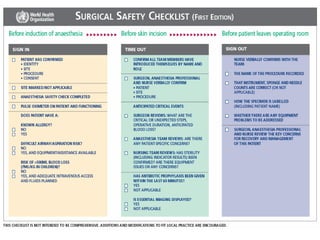
• WHO Surgical Safety Checklist: UK process
■ Step 1: Prelist briefing
■ Step 2: Sign in
■ Step 3: Time out
■ Step 4: Sign out
■ Step 5: Postlist debriefing
Prelist briefing
• A short meeting before the start of the
operating list
• Introduction between team members
• Share information about potential safety
problems and highlight concerns about
specific patients to ensure smooth running of
the list
Antibiotics
• To be given within an hour of surgical incision
to prevent surgical site infections
• Discontinued within 24 hours of surgery
• Cephalosporins are commonly given
• Can be given in clean cases involving
prosthesis/implant
Venous thromboembolism
• Risk assessment should be done preoperatively
• Optimum hydration to be maintained
• Mechanical and pharmacological VTE prophylaxis can
be used
• Mechanical methods include:
• • anti-embolism graduated compression stockings;
• • foot impulse devices;
• • intermittent pneumatic compression devices
Monitoring
• The most important ‘monitor’ is the presence
of a trained, dedicated individual to observe
the patient throughout anaesthesia
Operating theatre environment
Ventilation
Aim: prevent airborne microorganisms entering the
surgical wound
• Filtered air is introduced at ceiling height and
exhausted at the floor (min 20 air changes/hour)
• Maintain positive pressure relative to surroundings
• Keep doors closed and limit the movement of
personnel in and out of theatre
• Laminar air flow provides 100–300 air changes per
hour
Operating theatre environment
Humidity and temperature
• Ideal working temperatures for surgeons are
19–20°C
• Patients may develop hypothermia below
21°C
• Temperatures of 20–24°C are acceptable with
a relative humidity of 50–60 per cent to
protect against electrostatic charges
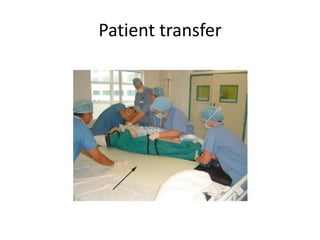
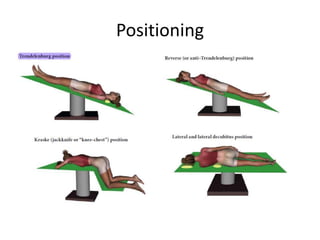
Patient transfer and positioning
• Under the supervision of the anaesthetist and surgeon
• Transfer
Coordinated by the anaesthetist, who protects airway devices
and other connections during the move
Sliding boards and low friction sliding sheets are helpful
• Positioning
The plan for intraoperative positioning should be
communicated to the entire team
Stability of the patient on the table should be ensured using
straps/solid supports
Patient transfer
Positioning
Pressure areas which must be given
special consideration
• The skin over bony prominences
• Nerves in superficial courses, e.g. common peroneal
nerve.
• Nerves at risk of stretch injury, e.g. brachial plexus
• To avoid electrical injury, no part of the patient
should be in contact with any metal other than the
diathermy plate
Equipments
• Diathermy
In monopolar, the electrode plate site should be:
• clean and dry, free of hair
• situated over well-perfused muscle mass,
avoiding bony prominences, scar tissue, areas
distal to tourniquets and implanted metal work
• as close to the operative site as feasible
• checked at the end of surgery for injury
Equipments
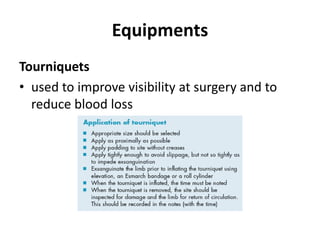
Tourniquets
• used to improve visibility at surgery and to
reduce blood loss
Equipments
Precautions while using tourniquets:
• Avoided in high risk patients
• Proper padding and taping of tourniquet
• Cuff pressure to be minimum
• Use of tourniquet clock : reminded every 1 hr
and not to exceed >1.5hr in total
Time out
Performed immediately before the surgical procedure
starts:
• Team introductions
• Verbal confirmation of the patient’s identity
• Operative site and procedure to be performed
• Discussion of anticipated critical events by the surgeon,
anaesthetist and nursing team
• Confirmation of antibiotic prophylaxis
• Review of essential imaging
Temperature control
• Patients undergoing anaesthesia and surgery lose
heat rapidly from radiation
• Measures to limit the development of
intraoperative hypothermia :
Warming blankets
Warmed intravenous and irrigation fluids,
Increasing the operating room ambient
temperature and
Minimising exposure of the patient
Hair removal
• Necessary over the operative field to facilitate
exposure
• infections may be reduced if hair is clipped rather than
shaved
• Wound infection rate is 1% if done immediately before
surgery
• Rises to 5% if done 12 hours prior
• Clipping and depilatory creams have infection rate of
<1%
Glycaemic control
• Hyperglycaemia perioperatively may increase
the incidence of postoperative wound
infection
• Unrecognised hypoglycaemia may lead to
seizures and death
• Diabetic patients need more strict monitoring
• OHA are stopped on day of surgery and
patient started on insulin if reqd
Infection control
Asepsis and universal precautions:
Universal precautions should be taken in every case involving
exposure to body fluids :
• protective non-porous gloves, eyewear, mask, apron for staff
• safe sharps handling techniques and adequate provision of
sharps bins
• staff vaccination for hepatitis B
• staff with infected wounds or active dermatitis should not
work in theatre
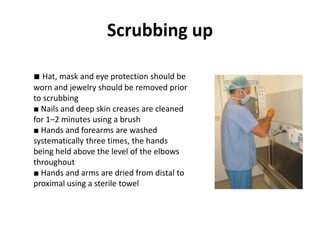
Scrubbing up
■ Hat, mask and eye protection should be
worn and jewelry should be removed prior
to scrubbing
■ Nails and deep skin creases are cleaned
for 1–2 minutes using a brush
■ Hands and forearms are washed
systematically three times, the hands
being held above the level of the elbows
throughout
■ Hands and arms are dried from distal to
proximal using a sterile towel
Scrubbing up
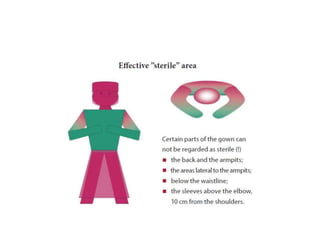
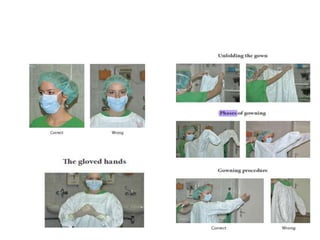
■ The folded gown is lifted away from the trolley
and allowed to unfold (inside facing the wearer),
while the top is held
■ Arms are inserted into the armholes
simultaneously
The gown is secured by an unscrubbed staff
member
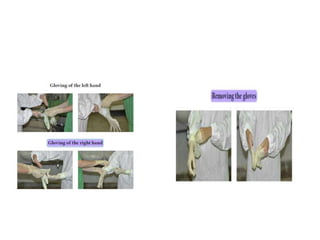
■ Gloves are put on using a one- or two-person
technique:
from this point on, hands remain above waist
level at all times.
Scrubbing
Standard scrubbing solution:
• 2 per cent chlorhexidine: effective for 4 hrs
• 7.5 per cent povidone-iodine
• Alcohols (70% isopropranolol)
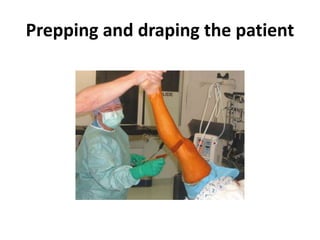
Prepping and draping the patient
• Skin preparation should include the surgical site and
a wide area around it.
• Draping aims to create a protective zone around the
operative site to avoid contamination of items used
for the procedure
• Diathermy and suction equipment are attached to
the drape
Prepping and draping the patient
Role of the assistant
• Preparation: Assistants should review the
anatomy and the operation before surgery.
They should start scrubbing first, having
checked that the patient is ready for theatre.
• Training: Trainees should write important
steps of proposed operation in brief on a
board in the operating theatre.
Role of the assistant
• At surgery. The assistant should try to provide
the surgeon with the best access possible and
showing the surgeon the field where they are
working.
• After surgery. The assistant should help transfer
the patient safely off the table and may write the
operative note.
• They should keep a log of all operations attended
and what they have learnt from each case.
Summary
• In theatre
■ The WHO checklist is a universal tool to improve
patient safety and should be completed for every patient
coming to theatre
■ Risks to the patient are minimised by appropriate
antibiotic and venous thromboembolism (VTE)
prophylaxis, monitoring, careful positioning,
temperature, glycaemic and infection control
■ The operating theatre environment should be
optimised with regard to lighting, ventilation, humidity
and temperature
Summary
• ■ Additional equipment, such as diathermy
and tourniquets, should be used while
recognising their potential complications.
■ Theatre etiquette including scrubbing,
prepping and draping and personnel
movement is designed to minimise cross
infection.
Sign out
• These include checking that the procedure
has been recorded
• Instrument and swab counts
• Specimen labelling
• No equipment problems requiring further
action and
• Key concerns for recovery recorded for the
staff taking over care of the patient
• ■ The ‘sign out’ process and postlist briefing
complete the WHO checklist
■ The operation note should be completed at
the time of surgery and contain full patient,
personnel and operative information
■ Clear postoperative instructions are vital
Writing the operation note
The following information should be included:
• Patient details (name, date of birth, hospital number,
address, ward)
• Date and start/finish times of the operation
• Location of the operation
• Name of the operation
• Surgeon, assistant and anaesthetist
• Anaesthetic type
• Patient position and set up
Writing the operation note
• If applicable, tourniquet use (location and time), antibiotics
given, catheterisation, skin prep used and draping method
• Operative information:
– incision and approach
– findings
– procedure (illustrate if appropriate)
– complications or untoward events
– implants used
– closure and suture material used
– dressing
Postoperative instructions
• Observations and frequency
• Possible complications and required action
• Specific treatment, e.g. intravenous fluids
• Time line for normal recovery (when to
mobilise, when to resume oral intake,
physiotherapy, dressing changes, etc.)
• Discharge and follow-up details
THANK YOU

Care in the operating room.pptx

  • 1.
    Care in theoperating room By Dr. Masoom & Dr. Jason Moderator : Dr. Pradeep Saxena
  • 2.
    Learning Objectives • Howto prepare a patient for theatre • The importance of the WHO checklist and its components • How to reduce intraoperative risks of positioning, venous thromboembolism, infection and hypothermia, by using appropriate monitoring and equipment. • The operating theatre environment and how to behave in it, including scrubbing up, the role of the assistant and how to write an operation note.
  • 3.
    Preoperative Preparation • Beforetheatre ■ Patient must be seen by anaesthetist and operating surgeon preoperatively ■ Communicate early with theatre team regarding specific requirements ■ Arrange theatre list appropriately for the case-mix and resources available
  • 4.
    IN THEATRE • WHOSurgical Safety Checklist: UK process ■ Step 1: Prelist briefing ■ Step 2: Sign in ■ Step 3: Time out ■ Step 4: Sign out ■ Step 5: Postlist debriefing
  • 5.
    Prelist briefing • Ashort meeting before the start of the operating list • Introduction between team members • Share information about potential safety problems and highlight concerns about specific patients to ensure smooth running of the list
  • 7.
    Antibiotics • To begiven within an hour of surgical incision to prevent surgical site infections • Discontinued within 24 hours of surgery • Cephalosporins are commonly given • Can be given in clean cases involving prosthesis/implant
  • 8.
    Venous thromboembolism • Riskassessment should be done preoperatively • Optimum hydration to be maintained • Mechanical and pharmacological VTE prophylaxis can be used • Mechanical methods include: • • anti-embolism graduated compression stockings; • • foot impulse devices; • • intermittent pneumatic compression devices
  • 9.
    Monitoring • The mostimportant ‘monitor’ is the presence of a trained, dedicated individual to observe the patient throughout anaesthesia
  • 10.
    Operating theatre environment Ventilation Aim:prevent airborne microorganisms entering the surgical wound • Filtered air is introduced at ceiling height and exhausted at the floor (min 20 air changes/hour) • Maintain positive pressure relative to surroundings • Keep doors closed and limit the movement of personnel in and out of theatre • Laminar air flow provides 100–300 air changes per hour
  • 11.
    Operating theatre environment Humidityand temperature • Ideal working temperatures for surgeons are 19–20°C • Patients may develop hypothermia below 21°C • Temperatures of 20–24°C are acceptable with a relative humidity of 50–60 per cent to protect against electrostatic charges
  • 12.
    Patient transfer andpositioning • Under the supervision of the anaesthetist and surgeon • Transfer Coordinated by the anaesthetist, who protects airway devices and other connections during the move Sliding boards and low friction sliding sheets are helpful • Positioning The plan for intraoperative positioning should be communicated to the entire team Stability of the patient on the table should be ensured using straps/solid supports
  • 13.
  • 14.
  • 15.
    Pressure areas whichmust be given special consideration • The skin over bony prominences • Nerves in superficial courses, e.g. common peroneal nerve. • Nerves at risk of stretch injury, e.g. brachial plexus • To avoid electrical injury, no part of the patient should be in contact with any metal other than the diathermy plate
  • 16.
    Equipments • Diathermy In monopolar,the electrode plate site should be: • clean and dry, free of hair • situated over well-perfused muscle mass, avoiding bony prominences, scar tissue, areas distal to tourniquets and implanted metal work • as close to the operative site as feasible • checked at the end of surgery for injury
  • 17.
    Equipments Tourniquets • used toimprove visibility at surgery and to reduce blood loss
  • 18.
    Equipments Precautions while usingtourniquets: • Avoided in high risk patients • Proper padding and taping of tourniquet • Cuff pressure to be minimum • Use of tourniquet clock : reminded every 1 hr and not to exceed >1.5hr in total
  • 19.
    Time out Performed immediatelybefore the surgical procedure starts: • Team introductions • Verbal confirmation of the patient’s identity • Operative site and procedure to be performed • Discussion of anticipated critical events by the surgeon, anaesthetist and nursing team • Confirmation of antibiotic prophylaxis • Review of essential imaging
  • 20.
    Temperature control • Patientsundergoing anaesthesia and surgery lose heat rapidly from radiation • Measures to limit the development of intraoperative hypothermia : Warming blankets Warmed intravenous and irrigation fluids, Increasing the operating room ambient temperature and Minimising exposure of the patient
  • 21.
    Hair removal • Necessaryover the operative field to facilitate exposure • infections may be reduced if hair is clipped rather than shaved • Wound infection rate is 1% if done immediately before surgery • Rises to 5% if done 12 hours prior • Clipping and depilatory creams have infection rate of <1%
  • 22.
    Glycaemic control • Hyperglycaemiaperioperatively may increase the incidence of postoperative wound infection • Unrecognised hypoglycaemia may lead to seizures and death • Diabetic patients need more strict monitoring • OHA are stopped on day of surgery and patient started on insulin if reqd
  • 23.
    Infection control Asepsis anduniversal precautions: Universal precautions should be taken in every case involving exposure to body fluids : • protective non-porous gloves, eyewear, mask, apron for staff • safe sharps handling techniques and adequate provision of sharps bins • staff vaccination for hepatitis B • staff with infected wounds or active dermatitis should not work in theatre
  • 24.
    Scrubbing up ■ Hat,mask and eye protection should be worn and jewelry should be removed prior to scrubbing ■ Nails and deep skin creases are cleaned for 1–2 minutes using a brush ■ Hands and forearms are washed systematically three times, the hands being held above the level of the elbows throughout ■ Hands and arms are dried from distal to proximal using a sterile towel
  • 25.
    Scrubbing up ■ Thefolded gown is lifted away from the trolley and allowed to unfold (inside facing the wearer), while the top is held ■ Arms are inserted into the armholes simultaneously The gown is secured by an unscrubbed staff member ■ Gloves are put on using a one- or two-person technique: from this point on, hands remain above waist level at all times.
  • 29.
    Scrubbing Standard scrubbing solution: •2 per cent chlorhexidine: effective for 4 hrs • 7.5 per cent povidone-iodine • Alcohols (70% isopropranolol)
  • 30.
    Prepping and drapingthe patient • Skin preparation should include the surgical site and a wide area around it. • Draping aims to create a protective zone around the operative site to avoid contamination of items used for the procedure • Diathermy and suction equipment are attached to the drape
  • 31.
  • 32.
    Role of theassistant • Preparation: Assistants should review the anatomy and the operation before surgery. They should start scrubbing first, having checked that the patient is ready for theatre. • Training: Trainees should write important steps of proposed operation in brief on a board in the operating theatre.
  • 33.
    Role of theassistant • At surgery. The assistant should try to provide the surgeon with the best access possible and showing the surgeon the field where they are working. • After surgery. The assistant should help transfer the patient safely off the table and may write the operative note. • They should keep a log of all operations attended and what they have learnt from each case.
  • 34.
    Summary • In theatre ■The WHO checklist is a universal tool to improve patient safety and should be completed for every patient coming to theatre ■ Risks to the patient are minimised by appropriate antibiotic and venous thromboembolism (VTE) prophylaxis, monitoring, careful positioning, temperature, glycaemic and infection control ■ The operating theatre environment should be optimised with regard to lighting, ventilation, humidity and temperature
  • 35.
    Summary • ■ Additionalequipment, such as diathermy and tourniquets, should be used while recognising their potential complications. ■ Theatre etiquette including scrubbing, prepping and draping and personnel movement is designed to minimise cross infection.
  • 36.
    Sign out • Theseinclude checking that the procedure has been recorded • Instrument and swab counts • Specimen labelling • No equipment problems requiring further action and • Key concerns for recovery recorded for the staff taking over care of the patient
  • 37.
    • ■ The‘sign out’ process and postlist briefing complete the WHO checklist ■ The operation note should be completed at the time of surgery and contain full patient, personnel and operative information ■ Clear postoperative instructions are vital
  • 38.
    Writing the operationnote The following information should be included: • Patient details (name, date of birth, hospital number, address, ward) • Date and start/finish times of the operation • Location of the operation • Name of the operation • Surgeon, assistant and anaesthetist • Anaesthetic type • Patient position and set up
  • 39.
    Writing the operationnote • If applicable, tourniquet use (location and time), antibiotics given, catheterisation, skin prep used and draping method • Operative information: – incision and approach – findings – procedure (illustrate if appropriate) – complications or untoward events – implants used – closure and suture material used – dressing
  • 40.
    Postoperative instructions • Observationsand frequency • Possible complications and required action • Specific treatment, e.g. intravenous fluids • Time line for normal recovery (when to mobilise, when to resume oral intake, physiotherapy, dressing changes, etc.) • Discharge and follow-up details
  • 41.