HL1 Math - Santowski
Lesson 13 – Quadratic & Polynomial
Equations & Complex Numbers
12/04/24
1 HL1 Math - Santowski
Lesson Objectives
 Find and classify all real and complex roots of a quadratic equation
 Understand the “need for” an additional number system
 Add, subtract, multiply, divide, and graph complex numbers
 Find and graph the conjugate of a complex number
12/04/24
2 HL1 Math - Santowski
Fast Five
 STORY TIME.....
 http://mathforum.org/johnandbetty/frame.htm
12/04/24
3 HL1 Math - Santowski
(A) Introduction to Complex Numbers
 Solve the equation x2
– 1 = 0
 We can solve this many ways (factoring, quadratic formula,
completing the square & graphically)
 In all methods, we come up with the solution x = + 1, meaning
that the graph of the quadratic (the parabola) has 2 roots at x = +
1.
 Now solve the equation x2
+ 1= 0
12/04/24
4 HL1 Math - Santowski
(A) Introduction to Complex Numbers
 Now solve the equation x2
+ 1= 0
 The equation x2
= - 1 has no roots because you cannot take the
square root of a negative number.
 Long ago mathematicians decided that this was too restrictive.
 They did not like the idea of an equation having no solutions -- so
they invented them.
 They proved to be very useful, even in practical subjects like
engineering.
12/04/24
5 HL1 Math - Santowski
(A) Introduction to Complex Numbers
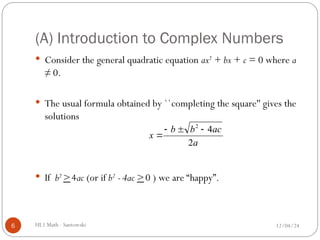
 Consider the general quadratic equation ax2
+ bx + c = 0 where a
≠ 0.
 The usual formula obtained by ``completing the square'' gives the
solutions
 If b2
>4ac (or if b2
-4ac >0 ) we are “happy”.
a
ac
b
b
x
2
4
2




12/04/24
6 HL1 Math - Santowski
(A) Introduction to Complex Numbers
 If b2
>4ac (or if b2
-4ac >0 ) we are happy.
 If b2
< 4ac (or if b2
-4ac <0 ) then the number under the square root is negative
and you would say that the equation has no solutions.
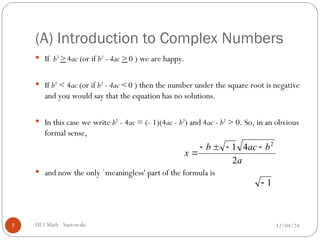
 In this case we write b2
- 4ac = (- 1)(4ac - b2
) and 4ac - b2
> 0. So, in an obvious
formal sense,
 and now the only `meaningless' part of the formula is
a
b
ac
b
x
2
4
1 2





1

12/04/24
7 HL1 Math - Santowski
(A) Introduction to Complex Numbers
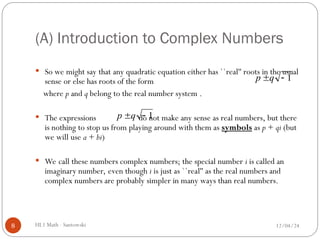
 So we might say that any quadratic equation either has ``real'' roots in the usual
sense or else has roots of the form
where p and q belong to the real number system .
 The expressions do not make any sense as real numbers, but there
is nothing to stop us from playing around with them as symbols as p + qi (but
we will use a + bi)
 We call these numbers complex numbers; the special number i is called an
imaginary number, even though i is just as ``real'' as the real numbers and
complex numbers are probably simpler in many ways than real numbers.
1

q
p
1

q
p
12/04/24
8 HL1 Math - Santowski
(B) Using Complex Numbers  Solving
Equations
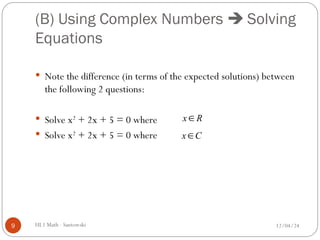
 Note the difference (in terms of the expected solutions) between
the following 2 questions:
 Solve x2
+ 2x + 5 = 0 where
 Solve x2
+ 2x + 5 = 0 where
R
x
C
x
12/04/24
9 HL1 Math - Santowski
(B) Using Complex Numbers  Solving
Equations
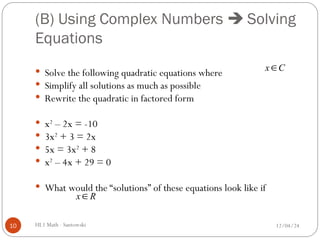
 Solve the following quadratic equations where
 Simplify all solutions as much as possible
 Rewrite the quadratic in factored form
 x2
– 2x = -10
 3x2
+ 3 = 2x
 5x = 3x2
+ 8
 x2
– 4x + 29 = 0
 What would the “solutions” of these equations look like if
C
x
R
x
12/04/24
10 HL1 Math - Santowski
(B) Using Complex Numbers  Solving
Equations
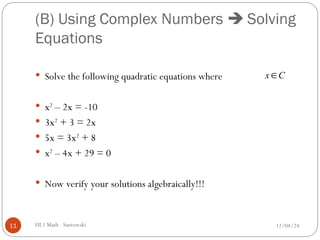
 Solve the following quadratic equations where
 x2
– 2x = -10
 3x2
+ 3 = 2x
 5x = 3x2
+ 8
 x2
– 4x + 29 = 0
 Now verify your solutions algebraically!!!
C
x
12/04/24
11 HL1 Math - Santowski
(B) Using Complex Numbers  Solving
Equations
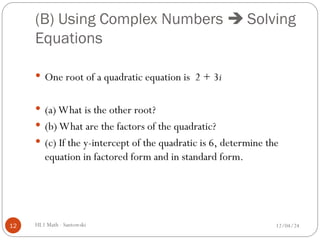
 One root of a quadratic equation is 2 + 3i
 (a) What is the other root?
 (b) What are the factors of the quadratic?
 (c) If the y-intercept of the quadratic is 6, determine the
equation in factored form and in standard form.
12/04/24
12 HL1 Math - Santowski
(B) Solving Polynomials if x ε C
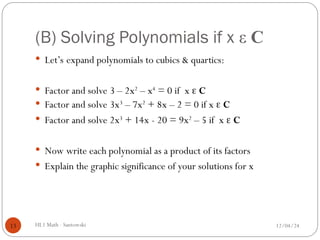
 Let’s expand polynomials to cubics & quartics:
 Factor and solve 3 – 2x2
– x4
= 0 if x  C
 Factor and solve 3x3
– 7x2
+ 8x – 2 = 0 if x  C
 Factor and solve 2x3
+ 14x - 20 = 9x2
– 5 if x  C
 Now write each polynomial as a product of its factors
 Explain the graphic significance of your solutions for x
12/04/24
HL1 Math - Santowski
13
(B) Solving if x ε C – Solution to Ex 1
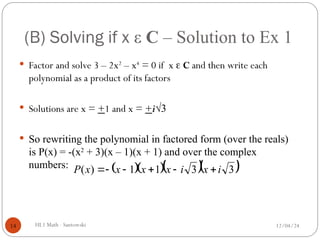
 Factor and solve 3 – 2x2
– x4
= 0 if x  C and then write each
polynomial as a product of its factors
 Solutions are x = +1 and x = +i√3
 So rewriting the polynomial in factored form (over the reals)
is P(x) = -(x2
+ 3)(x – 1)(x + 1) and over the complex
numbers:
12/04/24
HL1 Math - Santowski
14
    
3
3
1
1
)
( i
x
i
x
x
x
x
P 





(B) Solving if x ε C – Graphic
Connection
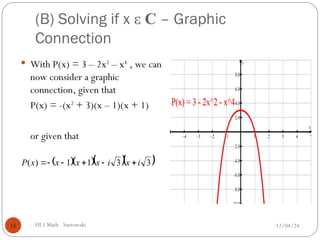
 With P(x) = 3 – 2x2
– x4
, we can
now consider a graphic
connection, given that
P(x) = -(x2
+ 3)(x – 1)(x + 1)
or given that
12/04/24
HL1 Math - Santowski
15
    
3
3
1
1
)
( i
x
i
x
x
x
x
P 





(C) Fundamental Theorem of
Algebra
 The fundamental theorem of algebra can be stated in many ways:
 (a) If P(x) is a polynomial of degree n then P(x) will have exactly n zeroes (real or
complex), some of which may repeat.
 (b) Every polynomial function of degree n > 1 has exactly n complex zeroes,
counting multiplicities
 (c) If P(x) has a nonreal root, a+bi, where b ≠ 0, then its conjugate, a–bi is also a
root
 (d) Every polynomial can be factored (over the real numbers) into a product of
linear factors and irreducible quadratic factors
 What does it all mean  we can solve EVERY polynomial (it may be
REALLY difficult, but it can be done!)
12/04/24
HL1 Math - Santowski
16
(D) Using the FTA
 Write an equation of a polynomial
whose roots are x = 1, x = 2 and x
= ¾
 Write the equation of the
polynomial whose roots are 1, -2, -
4, & 6 and a point (-1, -84)
 Write the equation of a polynomial
whose roots are x = 2 (with a
multiplicity of 2) as well as x = -1
+ √2
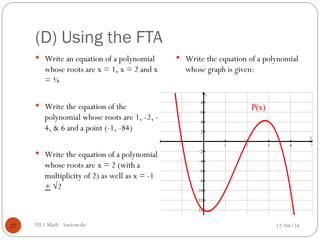
 Write the equation of a polynomial
whose graph is given:
12/04/24
HL1 Math - Santowski
17
(D) Using the FTA
 Given that 1 – 3i is a root of x4
– 4x3
+ 13x2
– 18x – 10 = 0, find
the remaining roots.
 Write an equation of a third degree polynomial whose given roots
are 1 and i. Additionally, the polynomial passes through (0,5)
 Write the equation of a quartic wherein you know that one root is
2 – i and that the root x = 3 has a multiplicity of 2.
12/04/24
HL1 Math - Santowski
18
(E) Further Examples
 The equation x3
– 3x2
– 10x + 24 = 0 has roots of 2, h, and
k. Determine a quadratic equation whose roots are h – k and
hk.
 The 5th
degree polynomial, f(x), is divisible by x3
and f(x) – 1
is divisible by (x – 1)3
. Find f(x).
 Find the polynomial p(x) with integer coefficients such that
one solution of the equation p(x)=0 is 1+√2+√3 .
12/04/24
HL1 Math - Santowski
19
(E) Further Examples
 Start with the linear polynomial: y = −3x + 9. The x-coefficient,
the root and the intercept are -3, 3 and 9 respectively, and these
are in arithmetic progression. Are there any other linear
polynomials that enjoy this property?
 What about quadratic polynomials? That is, if the polynomial y =
ax2
+ bx + c has roots r1 and r2 can a, r1, b, r2 and c be in
arithmetic progression?
12/04/24
HL1 Math - Santowski
20

QUADRATIC EQUATION USING COMPLEX NUMBERS.ppt

  • 1.
    HL1 Math -Santowski Lesson 13 – Quadratic & Polynomial Equations & Complex Numbers 12/04/24 1 HL1 Math - Santowski
  • 2.
    Lesson Objectives  Findand classify all real and complex roots of a quadratic equation  Understand the “need for” an additional number system  Add, subtract, multiply, divide, and graph complex numbers  Find and graph the conjugate of a complex number 12/04/24 2 HL1 Math - Santowski
  • 3.
    Fast Five  STORYTIME.....  http://mathforum.org/johnandbetty/frame.htm 12/04/24 3 HL1 Math - Santowski
  • 4.
    (A) Introduction toComplex Numbers  Solve the equation x2 – 1 = 0  We can solve this many ways (factoring, quadratic formula, completing the square & graphically)  In all methods, we come up with the solution x = + 1, meaning that the graph of the quadratic (the parabola) has 2 roots at x = + 1.  Now solve the equation x2 + 1= 0 12/04/24 4 HL1 Math - Santowski
  • 5.
    (A) Introduction toComplex Numbers  Now solve the equation x2 + 1= 0  The equation x2 = - 1 has no roots because you cannot take the square root of a negative number.  Long ago mathematicians decided that this was too restrictive.  They did not like the idea of an equation having no solutions -- so they invented them.  They proved to be very useful, even in practical subjects like engineering. 12/04/24 5 HL1 Math - Santowski
  • 6.
    (A) Introduction toComplex Numbers  Consider the general quadratic equation ax2 + bx + c = 0 where a ≠ 0.  The usual formula obtained by ``completing the square'' gives the solutions  If b2 >4ac (or if b2 -4ac >0 ) we are “happy”. a ac b b x 2 4 2     12/04/24 6 HL1 Math - Santowski
  • 7.
    (A) Introduction toComplex Numbers  If b2 >4ac (or if b2 -4ac >0 ) we are happy.  If b2 < 4ac (or if b2 -4ac <0 ) then the number under the square root is negative and you would say that the equation has no solutions.  In this case we write b2 - 4ac = (- 1)(4ac - b2 ) and 4ac - b2 > 0. So, in an obvious formal sense,  and now the only `meaningless' part of the formula is a b ac b x 2 4 1 2      1  12/04/24 7 HL1 Math - Santowski
  • 8.
    (A) Introduction toComplex Numbers  So we might say that any quadratic equation either has ``real'' roots in the usual sense or else has roots of the form where p and q belong to the real number system .  The expressions do not make any sense as real numbers, but there is nothing to stop us from playing around with them as symbols as p + qi (but we will use a + bi)  We call these numbers complex numbers; the special number i is called an imaginary number, even though i is just as ``real'' as the real numbers and complex numbers are probably simpler in many ways than real numbers. 1  q p 1  q p 12/04/24 8 HL1 Math - Santowski
  • 9.
    (B) Using ComplexNumbers  Solving Equations  Note the difference (in terms of the expected solutions) between the following 2 questions:  Solve x2 + 2x + 5 = 0 where  Solve x2 + 2x + 5 = 0 where R x C x 12/04/24 9 HL1 Math - Santowski
  • 10.
    (B) Using ComplexNumbers  Solving Equations  Solve the following quadratic equations where  Simplify all solutions as much as possible  Rewrite the quadratic in factored form  x2 – 2x = -10  3x2 + 3 = 2x  5x = 3x2 + 8  x2 – 4x + 29 = 0  What would the “solutions” of these equations look like if C x R x 12/04/24 10 HL1 Math - Santowski
  • 11.
    (B) Using ComplexNumbers  Solving Equations  Solve the following quadratic equations where  x2 – 2x = -10  3x2 + 3 = 2x  5x = 3x2 + 8  x2 – 4x + 29 = 0  Now verify your solutions algebraically!!! C x 12/04/24 11 HL1 Math - Santowski
  • 12.
    (B) Using ComplexNumbers  Solving Equations  One root of a quadratic equation is 2 + 3i  (a) What is the other root?  (b) What are the factors of the quadratic?  (c) If the y-intercept of the quadratic is 6, determine the equation in factored form and in standard form. 12/04/24 12 HL1 Math - Santowski
  • 13.
    (B) Solving Polynomialsif x ε C  Let’s expand polynomials to cubics & quartics:  Factor and solve 3 – 2x2 – x4 = 0 if x  C  Factor and solve 3x3 – 7x2 + 8x – 2 = 0 if x  C  Factor and solve 2x3 + 14x - 20 = 9x2 – 5 if x  C  Now write each polynomial as a product of its factors  Explain the graphic significance of your solutions for x 12/04/24 HL1 Math - Santowski 13
  • 14.
    (B) Solving ifx ε C – Solution to Ex 1  Factor and solve 3 – 2x2 – x4 = 0 if x  C and then write each polynomial as a product of its factors  Solutions are x = +1 and x = +i√3  So rewriting the polynomial in factored form (over the reals) is P(x) = -(x2 + 3)(x – 1)(x + 1) and over the complex numbers: 12/04/24 HL1 Math - Santowski 14      3 3 1 1 ) ( i x i x x x x P      
  • 15.
    (B) Solving ifx ε C – Graphic Connection  With P(x) = 3 – 2x2 – x4 , we can now consider a graphic connection, given that P(x) = -(x2 + 3)(x – 1)(x + 1) or given that 12/04/24 HL1 Math - Santowski 15      3 3 1 1 ) ( i x i x x x x P      
  • 16.
    (C) Fundamental Theoremof Algebra  The fundamental theorem of algebra can be stated in many ways:  (a) If P(x) is a polynomial of degree n then P(x) will have exactly n zeroes (real or complex), some of which may repeat.  (b) Every polynomial function of degree n > 1 has exactly n complex zeroes, counting multiplicities  (c) If P(x) has a nonreal root, a+bi, where b ≠ 0, then its conjugate, a–bi is also a root  (d) Every polynomial can be factored (over the real numbers) into a product of linear factors and irreducible quadratic factors  What does it all mean  we can solve EVERY polynomial (it may be REALLY difficult, but it can be done!) 12/04/24 HL1 Math - Santowski 16
  • 17.
    (D) Using theFTA  Write an equation of a polynomial whose roots are x = 1, x = 2 and x = ¾  Write the equation of the polynomial whose roots are 1, -2, - 4, & 6 and a point (-1, -84)  Write the equation of a polynomial whose roots are x = 2 (with a multiplicity of 2) as well as x = -1 + √2  Write the equation of a polynomial whose graph is given: 12/04/24 HL1 Math - Santowski 17
  • 18.
    (D) Using theFTA  Given that 1 – 3i is a root of x4 – 4x3 + 13x2 – 18x – 10 = 0, find the remaining roots.  Write an equation of a third degree polynomial whose given roots are 1 and i. Additionally, the polynomial passes through (0,5)  Write the equation of a quartic wherein you know that one root is 2 – i and that the root x = 3 has a multiplicity of 2. 12/04/24 HL1 Math - Santowski 18
  • 19.
    (E) Further Examples The equation x3 – 3x2 – 10x + 24 = 0 has roots of 2, h, and k. Determine a quadratic equation whose roots are h – k and hk.  The 5th degree polynomial, f(x), is divisible by x3 and f(x) – 1 is divisible by (x – 1)3 . Find f(x).  Find the polynomial p(x) with integer coefficients such that one solution of the equation p(x)=0 is 1+√2+√3 . 12/04/24 HL1 Math - Santowski 19
  • 20.
    (E) Further Examples Start with the linear polynomial: y = −3x + 9. The x-coefficient, the root and the intercept are -3, 3 and 9 respectively, and these are in arithmetic progression. Are there any other linear polynomials that enjoy this property?  What about quadratic polynomials? That is, if the polynomial y = ax2 + bx + c has roots r1 and r2 can a, r1, b, r2 and c be in arithmetic progression? 12/04/24 HL1 Math - Santowski 20