WHITE PAPER
TaqMan® Assays QPCR Guarantee Program


            Gene Expression Assay Performance Guaranteed
           With the TaqMan® Assays QPCR Guarantee Program


Real-Time PCR for the Quantification of Gene Expression                   Life Technologies guarantees that TaqMan® Gene Expression Assays
Real-time or quantitative PCR (qPCR) is one of the most powerful          will perform to your satisfaction. If you are not satisfied with the
and sensitive techniques available for gene expression analysis. It       performance of a TaqMan® Assay, we’ll replace it at no cost or give
is used for a broad range of applications, including quantification of    you a credit for the purchase price of such assays.
gene expression, measuring RNA interference, biomarker discovery,
pathogen detection, and drug target validation. When studying gene        What to Look for in Assay Performance
expression with qPCR, scientists usually investigate changes—             Assay performance depends on a number of factors, including experi­
increases or decreases—in the quantity of particular gene products or     mental design, the quality of the sample, the reagents and thermal
a set of gene products. Investigations typically evaluate gene response   cycling conditions used in the qPCR reaction, and the instrument used
to biological conditions such as disease states, exposure to pathogens    for thermal cycling. We measure TaqMan® Gene Expression Assay
or chemical compounds, the organ or tissue location, or cell cycle or     performance using the criteria below. Details on how we measured
differentiation status.                                                   performance of our assays can be found in the Appendix.

Real-time PCR for the quantification of gene expression using the         Specificity
5’ nuclease assay with TaqMan® probes has become a standard               •	 Assays will amplify the intended target at least 10 Ct values earlier
method in basic and clinical research. The technique is economical,          than the gene with the closest sequence homology.
has relatively high throughput, and provides quantitative data. Life      •	 Assays run in a no template control (NTC) reaction will not produce
Technologies offers a complete suite of Applied Biosystems® products         detectable amplification signal (Ct >38).
for the entire qPCR gene expression analysis workflow—from
sample prep to reverse transcription and thermal cycling to data          Reproducibility
analysis. These reagents and instruments enable users to meet the         •	 When different lots of an assay are used with the same sample
highest standards for performing qPCR experiments. TaqMan® Gene              input and master mix and are run on the same sample plate, the
Expression Assays (PCR primer and TaqMan® probe sets) are tested             resulting difference in mean Ct values of the two lots will be ≤0.5.
and optimized for specificity, reproducibility, linear dynamic range,
sensitivity, and efficiency in gene expression analyses. These require-   Linear Dynamic Range/Sensitivity
ments help enable you to perform well-executed qPCR experiments           •	 Assays will provide linear qPCR results over a seven-log range
without having to independently test each parameter. In addition, we         of input template using eight 10-fold dilutions (when Ct is plotted
provide the relevant information on targets and oligonucleotides, as         against log10 input template quantity, R2 value ≥0.98)
well as protocols required for publication, as is consistent with the     •	 Every assay will detect ≥10 copies of target with a Ct value that is
MIQE guidelines that describe the minimal elements necessary for             statistically different (p-value <0.05) than that of the NTC.
publication of real-time qPCR data [1].
                                                                          Efficiency
The TaqMan® Assays QPCR Guarantee                                         •	 Every assay will exhibit 100% ±10% amplification efficiency when
Whether testing a large or small number of targets against a few or          tested in reactions over five orders of magnitude of input template.
hundreds of samples, having confidence in the data you produce is
paramount. Life Technologies has developed the TaqMan® Assays             Specificity
QPCR Guarantee to provide you with confidence in the data you gener-      The TaqMan® Gene Expression Assay design pipeline helps ensure
ate with a pre-designed TaqMan® Assay.                                    high target specificity through the use of up-to-date transcript
                                                                          sequence data, robust primer design algorithms, and extensive
bioinformatics tools and processes. Specificity of assays for their         For example, assay Hs00364424_m1 was designed in 2004 to the
intended target is critically important; it means that if a detection       RefSeq NM_033627 (gene symbol TREX1). When the assay was
signal is seen in a sample, you can be confident that the sample            remapped, it was found to match with 100% identity to NM_130384.1,
contains your target of interest.                                           GeneID: 84126 (ATRIP). NCBI had permanently obsoleted NM_033627.
                                                                            Thus, based on the updated annotation, assay Hs00364424_m1 does
Most TaqMan® Gene Expression Assays are designed using transcript           not map to TREX1: NM_016381. Although the assay annotation has
sequences from the NCBI Reference Sequence (RefSeq) Project                 changed, the assay ID and assay sequence have not.
database [2], which is the most highly curated set of non-redundant
transcripts in the public domain. It is also the most stable set of         Updating Available Assays Based on New Information
sequences available. Each transcript in the RefSeq database has             Because TaqMan® Gene Expression Assays are evaluated every six
undergone provisional or manual curation, and the majority of               months for annotation updates and the latest genome information,
transcript sequences were derived from cDNA clones, providing good          it is occasionally necessary to remove an assay from our collection
evidence that they are expressed sequences.                                 because it no longer meets our quality criteria. This may be due to a
                                                                            new SNP that is found in the sequence that binds the primers/probe
The design pipeline starts with this up-to-date sequence information,       of the assay, or an assay that becomes nonspecific with the new
then the algorithm masks ambiguous sequences, SNPs, and repeats.            NCBI annotations at the gene transcript or genome level. Assays may
Next, assay candidates with probes spanning exon–exon junctions             also fail during the manufacturing and functional testing processes.
are preferentially selected, so that the assay specifically amplifies       When we obsolete an assay from our catalog we will recommend
the intended transcript(s)—targeting cDNA rather than genomic               another assay that is specific for that transcript. Alternatively, we
sequence. Assays are then further refined and optimized, based on           provide mechanisms for the customer to continue to receive the assay
thermodynamic and chemical properties: optimal Tm, GC content,              through an alternative ordering system (Quick Order) or as a Custom
secondary structure, amplicon size, and minimal primer-dimer                TaqMan® Gene Expression Assay [6].
formation. Finally, a three part in silico quality control process imple-
ments a complex scoring matrix to select assays with the highest            Reproducibility Through Manufacturing Quality
transcript specificity, even for members of gene families with high         TaqMan® Gene Expression Assays are made using validated
sequence homology.                                                          manufacturing processes that include stringent manufacturing QC
                                                                            criteria: assay identity is confirmed by mass spectrometry and assay
The outcome of this carefully engineered assay design pipeline is           concentration is determined using quantitative spectrophotometry.
that Applied Biosystems® TaqMan® Gene Expression Assays detect              TaqMan® Assays are formulated ready-to-use right out of the tube,
only their intended target. NTC reactions yield a Ct >38, and reactions     eliminating the need to optimize primer and probe concentrations.
containing target amplify the intended target at least 10 Ct values         Final 1X reaction concentrations are 250 nM TaqMan® probe and 900
earlier than the next closely related homolog. In addition, we are          nM of each PCR primer. Assays are designed to be run with recom-
committed to continual improvement in our design pipeline, includ-          mended Applied Biosystems® Master Mixes, using universal thermal
ing case-by-case analysis for difficult targets such as transcribed         cycling conditions.
pseudogenes [3].
                                                                            Because researchers often use multiple lots of assays to complete
Linking Assays to Transcripts                                               a research study, we validated our manufacturing process to help
During the process of designing an assay, a large number of BLAST           minimize lot-to-lot variability. We tested the functional performance
searches in the RefSeq and RNA GenBank® databases are performed.            of eight randomly selected TaqMan® Gene Expression Assays across
Most assays are found to align with multiple transcript accession           multiple manufacturing lots using the recommended reagent and
IDs. This information is displayed in the TaqMan® Gene Expression           cycling conditions. Established QC specifications were used as criteria
Assay online ordering system, so that researchers can easily see all        to evaluate the performance of each assay over 24 lots for each of
the accession IDs with 100% identity to the assay probe and primers,        the assays. All assays passed NTC testing to rule out contamination
as well as amplicon size, and the assay location on each detected           (Ct >38). All assay lots tested with synthetic DNA had a range of Ct val-
transcript. For clarity and traceability, TaqMan® Assay IDs are always      ues that were consistently within the specification of ±0.5 Ct (Figure 1).
linked to the same primer and probe sequence.                               These data show that the mean difference will be no more than 0.5
                                                                            Ct between two manufacturing lots when run in quadruplicate on the
Remapping                                                                   same plate for the same sample.
Because public transcript and genome databases change over time
as new sequence information and transcripts are deposited, we use           Linear Dynamic Range and Sensitivity
BLAST searches to remap our assays to the updated information               The dynamic range of an assay can be defined as the relationship of
every six months (using RefSeq and the latest genome assemblies).           signal (Ct value) between the highest- and lowest-diluted samples
This keeps the assay alignment information on the Assay Details page        (Ct vs. log10 of input) that generates linear data with high correlation.
current; identifying every known transcript that a particular assay can     Using either a sample with highly abundant target, a cloned sequence,
amplify (with 100% identity to the assay probe and primers). Note that      an artificial template, or an amplicon as the reaction template,
assays and their associated assay IDs are not changed with these            TaqMan® Gene Expression Assays have a dynamic range of at least seven
updates; however, the annotation or sequence (transcript or genome)         logs with R2 >0.98. The reliability of Ct measurement decreases as the
that assays map to may change.                                              copy number decreases to one copy due to Poisson statistics, thus the
functional dynamic range actually begins at concentrations greater than
                                                                                                             1
~10 copies per reaction (Figure 2).                                                                                                                                     Hs00182986_m1
                                                                                                           0.8
                                                                                                                                                                        Hs00182896_m1
                                                                                                           0.6
Here we define assay sensitivity as the number of template copies an
                                                                                                           0.4
assay can detect above an NTC background on a specified platform.
                                                                                                           0.2
For TaqMan® Gene Expression Assays, we guarantee that the Ct of


                                                                                                Delta Ct
                                                                                                             0
a 10-copy sample (Ct ~35) will be less than the Ct of the NTC with a
                                                                                                           -0.2
p-value <0.05.
                                                                                                           -0.4
                                                                                                           -0.6
Efficiency
                                                                                                           -0.8
Amplification efficiency is a major concern for any real-time PCR–
                                                                                                            -1
based assay product because reliable qPCR results depend upon                                                      1 2 3     4 5 6 7 8 9 10 11 12 13 14 15 16 17 18 19 20 21 22 23 24
a doubling of PCR product at every PCR cycle. We have performed                                                                                Lot
extensive validation to demonstrate the nearly perfect amplification
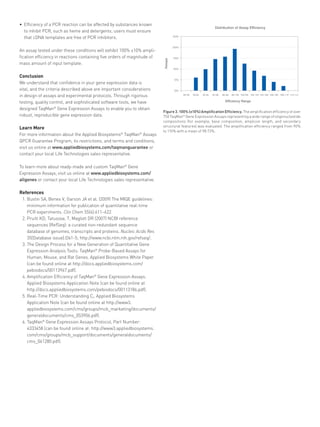
efficiency of TaqMan® Gene Expression Assays. A set of more than 750                              Figure 1. TaqMan® Gene Expression Assays Exhibit Lot-to-Lot Consistency.
                                                                                                  Twenty-four lots were sampled for each of eight TaqMan® Gene Expression Assays.
TaqMan® Gene Expression Assays were selected to represent a wide
                                                                                                  Each assay was tested in quadruplicate on 384-well plates, thus each lot of each
variety of challenges for efficient amplification, including a wide range                         assay was tested four times for a total of 192 lots. Synthetic targets with TaqMan®
of GC content, amplicon lengths, and secondary structure tendencies.                              Universal PCR Master Mix were run with each assay to measure C t values. Analysis
                                                                                                  was performed with SDS 2.3 software using a manual threshold of 0.2 and an
The assays exhibited amplification efficiency values ranging from
                                                                                                  automatic baseline setting. The ΔCt for each lot prepared for Hs00182986_m1 and
90–110%, and the distribution approximated a normal distribution                                  Hs00182896_m1 was calculated by subtracting the average Ct of a single lot tested
with a mean of 98.73% (Figure 3). In this study we determined that a                              in quadruplicate from the average Ct of all 24 lots. The ΔCt for each assay lot is
                                                                                                  shown. Open red square = Hs00182986_m1; open green diamond = Hs00182896_m1.
dilution series of at least five logs was necessary to accurately calcu-
late assay efficiency [4]. Efficiency estimates can vary significantly if a
rigorous measurement protocol is not followed:

•	 Measurements must be obtained over a broad dilution range (five to
   six logs) and include replicates to decrease the effects of laboratory
   errors (i.e., pipetting accuracy).


             A. mRNA quantitation—at least 7 logs of dynamic range                                                B. Standard curve plot

           10
                                                                          PPIA assay

                                                                          Hs99999904_m1                      38                                      Slope: -3.4670854
                                                                          UHR Dilution Series
                                                                                                                                                     Y-Inter: 35.920795
                                                                          1.64 x 10⁶ pg
                                                                                                                                                     R2:      0.9994835
           1.0                                                                                               34
                                                                          1.64 x 10⁵ pg                                                              Amplification
                                                                          1.64 x 10⁴ pg                                                              Efficiency = 94.3%
                                                                          1.64 x 10³ pg

                                                                          164 pg
                                                                                                             30
           0.1                                                            16.4 pg

                                                                          1.64 pg
                                                                                                             26
                                                                                                  Ct


                                                                          0.164 pg
   ∆Rn


                                                                          NTC no amplification


          0.01                                                                                               22


                                                                                                             18

          0.001
                                                                                                             14


                                                                                                             10
         0.0001
                                                                                                                   0.1     1.0   10    102    103    104   105    106       107
                                                                                                                                              Quantity


         0.00001
                0   5      10    15       20    25     30     35     40
                                      Cycle

  Figure 2. Linear Dynamic Range of Over Seven Logs and Sensitivity Down to 10 Copies. (A) Linear Dynamic Range: Amplification plot showing seven 10-fold dilutions
  of preamplified UHR cDNA run with Hs99999904_m1 (PPIA). Four replicates were run for each dilution point (average standard deviation = 0.1).The calculated R 2 is
  0.999; slope = –3.4. (B) Sensitivity (limit of detection) is estimated at 10 copies: cDNA at estimated copy number of 107 to 10 copies (1.64 X10⁶–1.64 pg cDNA) were run
  in parallel with NTC (n=4). Sufficient replicates were run to determine statistical difference (p <0.0004 between NTC and lowest copy number (estimate one copy)).
•	 Efficiency of a PCR reaction can be affected by substances known
                                                                                                                    Distribution of Assay Efficiency
   to inhibit PCR, such as heme and detergents; users must ensure
   that cDNA templates are free of PCR inhibitors.                                 25%


                                                                                   20%
An assay tested under these conditions will exhibit 100% ±10% ampli-
fication efficiency in reactions containing five orders of magnitude of            15%


                                                                          Assays
mass amount of input template.
                                                                                   10%

Conclusion
                                                                                   5%
We understand that confidence in your gene expression data is
vital, and the criteria described above are important considerations               0%

in design of assays and experimental protocols. Through rigorous                         80–90   90 – 2
                                                                                                     9    92–94   94–96   96–98   98–100 100–102 102–104 104–106 106–108 108–110 110–112


testing, quality control, and sophisticated software tools, we have                                                         Efficiency Range

designed TaqMan® Gene Expression Assays to enable you to obtain
                                                                          Figure 3. 100% (±10%) Amplification Efficiency. The amplification efficiency of over
robust, reproducible gene expression data.                                750 TaqMan® Gene Expression Assays representing a wide range of oligonucleotide
                                                                          compositions (for example, base composition, amplicon length, and secondary
                                                                          structural features) was evaluated. The amplification efficiency ranged from 90%
Learn More
                                                                          to 110% with a mean of 98.73%.
For more information about the Applied Biosystems® TaqMan® Assays
QPCR Guarantee Program, its restrictions, and terms and conditions,
visit us online at www.appliedbiosystems.com/taqmanguarantee or
contact your local Life Technologies sales representative.

To learn more about ready-made and custom TaqMan® Gene
Expression Assays, visit us online at www.appliedbiosystems.com/
allgenes or contact your local Life Technologies sales representative.

References
 1.	Bustin SA, Benes V, Garson JA et al. (2009) The MIQE guidelines:
    minimum information for publication of quantitative real-time
    PCR experiments. Clin Chem 55(4):611–622.
 2.	Pruitt KD, Tatusova, T, Maglott DR (2007) NCBI reference
    sequences (RefSeq): a curated non-redundant sequence
    database of genomes, transcripts and proteins. Nucleic Acids Res
    35(Database issue):D61-5; http://www.ncbi.nlm.nih.gov/refseq/.
 3.	The Design Process for a New Generation of Quantitative Gene
    Expression Analysis Tools: TaqMan® Probe-Based Assays for
    Human, Mouse, and Rat Genes. Applied Biosystems White Paper
    (can be found online at http://docs.appliedbiosystems.com/
    pebiodocs/00113967.pdf).
 4.	Amplification Efficiency of TaqMan® Gene Expression Assays.
    Applied Biosystems Application Note (can be found online at
    http://docs.appliedbiosystems.com/pebiodocs/00113186.pdf).
 5.	Real-Time PCR: Understanding Ct. Applied Biosystems
    Application Note (can be found online at http://www3.
    appliedbiosystems.com/cms/groups/mcb_marketing/documents/
    generaldocuments/cms_053906.pdf).
 6.	TaqMan® Gene Expression Assays Protocol, Part Number:
    4333458 (can be found online at: http://www3.appliedbiosystems.
    com/cms/groups/mcb_support/documents/generaldocuments/
    cms_041280.pdf).
Appendix                                                                                with the center of the series containing a mid-range quantity of
                                                                                        template DNA, having a Ct of 27 to 28. Because this experiment
Specificity and Assay Design                                                            depends on accurate dilutions, set up the experiment so that
The determination of cDNA specificity relative to genomic DNA is                        pipetting steps contain at least 5 µL—use calibrated pipettors.
important because RNA samples can be contaminated with gDNA                             In general, Good PCR Practices should always be followed (see
depending on the purification method utilized; however, the potential                   Appendix B in TaqMan® Gene Expression Assays Protocol (Applied
for this can be minimized by using a good RNA purification method                       Biosystems Part No. 4333458, see reference 6).
or DNase treatment along with quality control of the prepared RNA                    2.	Amplify the diluted samples with a chosen TaqMan® Gene
samples. For guidelines on sample acquisition, handling, preparation,                   Expression Assay, using a minimum of four technical replicates.
or QC of nucleic acids, see Bustin et al. [1].                                          The assay should be directed to a high expressed target and/or the
                                                                                        sample concentration should be adjusted in order to measure ∆Ct
The TaqMan® Gene Expression Assay ID                                                    values over the dilution range.
The TaqMan® Gene Expression Assay ID suffix provides information on                  3.	Use the Standard Curve (Absolute Quantitation) option within the
the placement of the probe on the transcript. The suffix is assigned at                 SDS software to plot and analyze the results.
the time the assay is designed and may change. For example, if the
probe position is shifted with an updated genome assembly, a change                  Result:	
in the suffix may result. The change will be described in the Important              •	 The ∆Ct between each point on the curve should average ~3.3.
Information link for a given assay. Note that suffix changes have                    •	 Inhibitor in the sample will typically result in a ∆Ct of <3.3 between
more to do with the target that the assay will detect than the assay                    10-fold dilutions. The effect of inhibitors is usually highest in the
performance.                                                                            more concentrated samples and reduced in more dilute samples.

                                                                                     How to Test for Specificity
 Suffix           Description of Suffix (Indicates the Assay Placement)
                                                                                     Assays are designed to amplify the intended target at least 10 Ct
                                                                                     values earlier than the gene with the closest homology .
 _m       _m indicates an assay whose probe spans an exon junction and one
          that will not detect genomic DNA.
                                                                                     1.	To test that an assay amplifies the intended target specifically
 _s       _s indicates an assay whose primers and probes are designed within a
                                                                                        compared to a homologous sequence, we used individual plasmids
          single exon. Such assays will, by definition, detect genomic DNA.
                                                                                        or artificial templates that contain the target and homologous
 _g       _g indicates an assay that may detect genomic DNA. The assay primers
                                                                                        sequences.
          and probe may also be within a single exon.
                                                                                     2.	In order to run a test for specificity, verify that the templates are
 _mH      _mH, _sH, or _gH indicates that the assay was designed to a transcript        amplified by the assay to be tested.
          belonging to a gene family with high sequence homology. The assays
 _sH      have been designed to give between 10 Ct and 15 Ct difference between      3.	Adjust the concentration (e.g., ng/µL) of the template for the
 _gH
          the target gene and the gene with the closest sequence homology.              intended target to yield a Ct <30 in real-time PCR; then adjust the
          This means that an assay will detect the target transcript with 1,000         homologous sequence template(s) to the same concentration(s).
          to 30,000-fold greater discrimination (sensitivity) than the closest
          homologous transcript, if they are present at the same copy number in      4.	Run the assay with a minimum of four technical replicates on the
          a sample.                                                                     same plate following the recommended protocol.
 _u       _u indicates an assay whose amplicon spans an exon junction and the
          probe sits completely in one of the spanned exons.                         Result:
 _ft      _ft indicates an assay designed to detect fusion transcripts that result   The ∆Ct between the intended target and homologous sequence
          from chromosomal translocation. One primer and the probe are located       templates should average >10 Ct.
          on one side of the fusion transcript breakpoint.

 _at      _at indicates an assay that is designed to detect a specific synthetic     Assays run in a no template control (NTC) reaction will not produce
          RNA transcript with a unique sequence that lacks homology to current       detectable amplification signal (Ct >38).
          automated biological sequences.

Procedures Used to Test Assay Performance                                            1.	Set up an NTC reaction mix using the qPCR reagents and the
Below are descriptions of the procedures and expected results for the                   TaqMan® Assay being tested, but with molecular biology–grade
performance testing. All qPCR tests described below were performed                      water in place of sample.
according to the TaqMan® Gene Expression Assays Protocol (Applied                    2.	Amplify a minimum of four technical replicates.
Biosystems Part No. 4333458, see reference 6) and:
                                                                                     Result:	
•	 The sample and reaction conditions, reagents, and instrument and                  NTC reactions should yield Ct values >38 with a proper threshold and
   thermal cycling parameters used were those recommended in the                     baseline setting. Note that it is easier to set an appropriate threshold
   protocol                                                                          when there are also “real” amplified samples in the experiment for
•	 Samples were free of PCR inhibitors and impurities                                comparison.

How to Test for PCR Inhibitors in the Sample                                         To make sure that the reagents and TaqMan® Assay are not con-
1.	Identify a gene that displays moderate expression in the sample.                  taminated with PCR products, consider running another set of NTC
   Serially dilute the sample to obtain five to seven 10-fold dilutions,             reactions using a second TaqMan® Assay.
How to Test for Manufacturing Reproducibility                                                      software was used to generate the Standard Curve Plot with slope,
When different lots of an assay are used with the same sample input                                Y-intercept, and R2 value.]
and master mix, and are run on the same sample plate, the resulting                             Result:	
difference in mean Ct value of the two lots will be ≤0.5.                                       The expected R2 ≥0.98.

1.	Prepare a reaction mix containing sample and qPCR master                                     3.	Determine the statistical difference between the lowest dilution and
   mix, except the assay, sufficient for a minimum of four technical                               the NTC by performing a student t-test.
   replicates for each TaqMan® Assay lot to be tested. Include enough
   sample for each replicate to yield a Ct <30 with a properly set                              Result:	
   baseline and threshold.                                                                      The p-value should be <0.05, indicating that there is a statistically
2.	Aliquot the mixture for the number of TaqMan® Assay lots to be                               significant difference between the lowest dilution and the NTC.
   tested, then add the TaqMan® Assay to the mixtures. Pipette the
   technical replicates into individual plate wells, and run the assays.                        How to Test for Efficiency
3.	Determine the Ct average for each assay lot.                                                 Every assay will exhibit 100% ±10% amplification efficiency when
                                                                                                tested in reactions over five orders of magnitude of mass amount of
Result:                                                                                         input template. (For background on testing amplification efficiency,
The ∆Ct between average Ctt of each assay lot should be ≤0.5.                                   refer to the Amplification Efficiency of TaqMan® Gene Expression
                                                                                                Assays application note [4].)
How to Test for Linear Dynamic Range/Sensitivity
Assays will provide linear qPCR results over a seven-log range of                               This test is similar to the Linear Dyanmic Range test. A relatively high
input template mass using eight 10-fold dilutions (when Ct is plotted                           concentration of template containing the amplicon for this experiment
against log10 input template quantity, R2 value ≥0.98).                                         to set up 10-fold serial dilutions is needed.

Every assay will detect ≥10 copies of target with a Ct value that is                            1.	Prepare 10-fold serially diluted template to cover at least five
statistically different (p-value <0.05) than that of the NTC.                                      orders of magnitude (six dilution points) of input template quantity.
                                                                                                   Each dilution must contain enough template to generate Ct values
To test for efficiency, a relatively high concentration of template                                <35. Prepare enough material for at least four technical replicates
containing the amplicon for this experiment is needed. The protocol                                per dilution, plus an NTC. This experiment depends on accurate
suggests that a PCR product be used (being careful to avoid con-                                   dilutions. The experiment should be set up so that pipetting steps
tamination of the lab with amplified DNA) or a cDNA clone at a high                                contain at least 5 µL—calibrated pipettors and Good PCR Practices
template concentration.                                                                            should be used [6].
                                                                                                2.	Plot the Ct versus log10 input template amount and determine
1.	Prepare 10-fold serially diluted template to cover seven orders of                              the slope of the line that can be drawn through the data points.
   magnitude (eight dilution points). The most dilute sample should                                Recommended Applied Biosystems® instrument software may
   contain ≥10 copies of the amplicon (Ct<35). Prepare enough                                      be used, or export the Ct values to Microsoft® Excel and plot the
   material for at least four technical replicates per dilution, plus                              Standard Curve. Applied Biosystems® SDS 2.3 software was used
   an NTC. As stated above, this experiment depends on accurate                                    here.
   dilutions. Pipetting steps should contain at least 5 µL using                                3.	Calculate the amplification efficiency of the assay from the slope of
   calibrated pipettors. Refer to Good PCR Practices [in Appendix B                                the curve.
   in TaqMan® Gene Expression Assays Protocol (Applied Biosystems                                  Amplification efficiency = 10(-1/slope) – 1.
   Part No. 4333458, see reference 6).]
2.	Plot the Ct versus log10 input template amount. Use recommended                              Result:	
   Applied Biosystems® instrument software or export the Ct values to                           Assays should have 100% efficiency (±10%).
   Excel and plot the Standard Curve. [Applied Biosystems® SDS v2.3


Life Technologies offers a breadth of products       DNA | RNA | protein | cell culture | instruments
For research use only. Not intended for any human or animal therapeutic or diagnostic use.
Practice of the patented 5’ Nuclease Process requires a license from Applied Biosystems. The purchase of TaqMan® Assays includes an immunity from suit under patents specified in
the product insert to use only the amount purchased for the purchaser’s own internal research when used with the separate purchase of an Authorized 5’ Nuclease Core Kit. No other
patent rights are conveyed expressly, by implication, or by estoppel. For further information on purchasing licenses contact the Director of Licensing, Applied Biosystems, 850 Lincoln
Centre Drive, Foster City, California 94404, USA.
Information in this document is subject to change without notice. Applied biosystems disclaims all warranties with respect to this document, expressed or implied, including but not
limited to those of merchantability or fitness for a particular purpose. To the fullest extent allowed by law, in no event shall Applied Biosystems be liable, whether in contract, tort,
warranty, or under any statute or on any other basis for special, incidental, indirect, punitive, multiple or consequential damages in connection with or arising from this document,
including but not limited to the use thereof, whether or not foreseeable and whether or not applied biosystems is advised of the possibility of such damages.
© 2010 Life Technologies Corporation. All rights reserved. The trademarks mentioned herein are the property of Life Technologies Corporation or their respective owners. TaqMan is a
registered trademark of Roche Molecular Systems, Inc. Printed in the USA. 11/2010 Publication CO13369


Headquarters                                                    International Sales
5791 Van Allen Way | Carlsbad, CA 92008 USA                     For our office locations please call the division
Phone 760.123.4567 | Toll Free 800.123.4567                     headquarters or refer to our Web site at
www.lifetechnologies.com                                        http://www.lifetechnologies.com/about-life-technologies/contact-us.html

Gene Expression Assay Performance Guaranteed With the TaqMan® Assays QPCR Guarantee Program

  • 1.
    WHITE PAPER TaqMan® AssaysQPCR Guarantee Program Gene Expression Assay Performance Guaranteed With the TaqMan® Assays QPCR Guarantee Program Real-Time PCR for the Quantification of Gene Expression Life Technologies guarantees that TaqMan® Gene Expression Assays Real-time or quantitative PCR (qPCR) is one of the most powerful will perform to your satisfaction. If you are not satisfied with the and sensitive techniques available for gene expression analysis. It performance of a TaqMan® Assay, we’ll replace it at no cost or give is used for a broad range of applications, including quantification of you a credit for the purchase price of such assays. gene expression, measuring RNA interference, biomarker discovery, pathogen detection, and drug target validation. When studying gene What to Look for in Assay Performance expression with qPCR, scientists usually investigate changes— Assay performance depends on a number of factors, including experi­ increases or decreases—in the quantity of particular gene products or mental design, the quality of the sample, the reagents and thermal a set of gene products. Investigations typically evaluate gene response cycling conditions used in the qPCR reaction, and the instrument used to biological conditions such as disease states, exposure to pathogens for thermal cycling. We measure TaqMan® Gene Expression Assay or chemical compounds, the organ or tissue location, or cell cycle or performance using the criteria below. Details on how we measured differentiation status. performance of our assays can be found in the Appendix. Real-time PCR for the quantification of gene expression using the Specificity 5’ nuclease assay with TaqMan® probes has become a standard • Assays will amplify the intended target at least 10 Ct values earlier method in basic and clinical research. The technique is economical, than the gene with the closest sequence homology. has relatively high throughput, and provides quantitative data. Life • Assays run in a no template control (NTC) reaction will not produce Technologies offers a complete suite of Applied Biosystems® products detectable amplification signal (Ct >38). for the entire qPCR gene expression analysis workflow—from sample prep to reverse transcription and thermal cycling to data Reproducibility analysis. These reagents and instruments enable users to meet the • When different lots of an assay are used with the same sample highest standards for performing qPCR experiments. TaqMan® Gene input and master mix and are run on the same sample plate, the Expression Assays (PCR primer and TaqMan® probe sets) are tested resulting difference in mean Ct values of the two lots will be ≤0.5. and optimized for specificity, reproducibility, linear dynamic range, sensitivity, and efficiency in gene expression analyses. These require- Linear Dynamic Range/Sensitivity ments help enable you to perform well-executed qPCR experiments • Assays will provide linear qPCR results over a seven-log range without having to independently test each parameter. In addition, we of input template using eight 10-fold dilutions (when Ct is plotted provide the relevant information on targets and oligonucleotides, as against log10 input template quantity, R2 value ≥0.98) well as protocols required for publication, as is consistent with the • Every assay will detect ≥10 copies of target with a Ct value that is MIQE guidelines that describe the minimal elements necessary for statistically different (p-value <0.05) than that of the NTC. publication of real-time qPCR data [1]. Efficiency The TaqMan® Assays QPCR Guarantee • Every assay will exhibit 100% ±10% amplification efficiency when Whether testing a large or small number of targets against a few or tested in reactions over five orders of magnitude of input template. hundreds of samples, having confidence in the data you produce is paramount. Life Technologies has developed the TaqMan® Assays Specificity QPCR Guarantee to provide you with confidence in the data you gener- The TaqMan® Gene Expression Assay design pipeline helps ensure ate with a pre-designed TaqMan® Assay. high target specificity through the use of up-to-date transcript sequence data, robust primer design algorithms, and extensive
  • 2.
    bioinformatics tools andprocesses. Specificity of assays for their For example, assay Hs00364424_m1 was designed in 2004 to the intended target is critically important; it means that if a detection RefSeq NM_033627 (gene symbol TREX1). When the assay was signal is seen in a sample, you can be confident that the sample remapped, it was found to match with 100% identity to NM_130384.1, contains your target of interest. GeneID: 84126 (ATRIP). NCBI had permanently obsoleted NM_033627. Thus, based on the updated annotation, assay Hs00364424_m1 does Most TaqMan® Gene Expression Assays are designed using transcript not map to TREX1: NM_016381. Although the assay annotation has sequences from the NCBI Reference Sequence (RefSeq) Project changed, the assay ID and assay sequence have not. database [2], which is the most highly curated set of non-redundant transcripts in the public domain. It is also the most stable set of Updating Available Assays Based on New Information sequences available. Each transcript in the RefSeq database has Because TaqMan® Gene Expression Assays are evaluated every six undergone provisional or manual curation, and the majority of months for annotation updates and the latest genome information, transcript sequences were derived from cDNA clones, providing good it is occasionally necessary to remove an assay from our collection evidence that they are expressed sequences. because it no longer meets our quality criteria. This may be due to a new SNP that is found in the sequence that binds the primers/probe The design pipeline starts with this up-to-date sequence information, of the assay, or an assay that becomes nonspecific with the new then the algorithm masks ambiguous sequences, SNPs, and repeats. NCBI annotations at the gene transcript or genome level. Assays may Next, assay candidates with probes spanning exon–exon junctions also fail during the manufacturing and functional testing processes. are preferentially selected, so that the assay specifically amplifies When we obsolete an assay from our catalog we will recommend the intended transcript(s)—targeting cDNA rather than genomic another assay that is specific for that transcript. Alternatively, we sequence. Assays are then further refined and optimized, based on provide mechanisms for the customer to continue to receive the assay thermodynamic and chemical properties: optimal Tm, GC content, through an alternative ordering system (Quick Order) or as a Custom secondary structure, amplicon size, and minimal primer-dimer TaqMan® Gene Expression Assay [6]. formation. Finally, a three part in silico quality control process imple- ments a complex scoring matrix to select assays with the highest Reproducibility Through Manufacturing Quality transcript specificity, even for members of gene families with high TaqMan® Gene Expression Assays are made using validated sequence homology. manufacturing processes that include stringent manufacturing QC criteria: assay identity is confirmed by mass spectrometry and assay The outcome of this carefully engineered assay design pipeline is concentration is determined using quantitative spectrophotometry. that Applied Biosystems® TaqMan® Gene Expression Assays detect TaqMan® Assays are formulated ready-to-use right out of the tube, only their intended target. NTC reactions yield a Ct >38, and reactions eliminating the need to optimize primer and probe concentrations. containing target amplify the intended target at least 10 Ct values Final 1X reaction concentrations are 250 nM TaqMan® probe and 900 earlier than the next closely related homolog. In addition, we are nM of each PCR primer. Assays are designed to be run with recom- committed to continual improvement in our design pipeline, includ- mended Applied Biosystems® Master Mixes, using universal thermal ing case-by-case analysis for difficult targets such as transcribed cycling conditions. pseudogenes [3]. Because researchers often use multiple lots of assays to complete Linking Assays to Transcripts a research study, we validated our manufacturing process to help During the process of designing an assay, a large number of BLAST minimize lot-to-lot variability. We tested the functional performance searches in the RefSeq and RNA GenBank® databases are performed. of eight randomly selected TaqMan® Gene Expression Assays across Most assays are found to align with multiple transcript accession multiple manufacturing lots using the recommended reagent and IDs. This information is displayed in the TaqMan® Gene Expression cycling conditions. Established QC specifications were used as criteria Assay online ordering system, so that researchers can easily see all to evaluate the performance of each assay over 24 lots for each of the accession IDs with 100% identity to the assay probe and primers, the assays. All assays passed NTC testing to rule out contamination as well as amplicon size, and the assay location on each detected (Ct >38). All assay lots tested with synthetic DNA had a range of Ct val- transcript. For clarity and traceability, TaqMan® Assay IDs are always ues that were consistently within the specification of ±0.5 Ct (Figure 1). linked to the same primer and probe sequence. These data show that the mean difference will be no more than 0.5 Ct between two manufacturing lots when run in quadruplicate on the Remapping same plate for the same sample. Because public transcript and genome databases change over time as new sequence information and transcripts are deposited, we use Linear Dynamic Range and Sensitivity BLAST searches to remap our assays to the updated information The dynamic range of an assay can be defined as the relationship of every six months (using RefSeq and the latest genome assemblies). signal (Ct value) between the highest- and lowest-diluted samples This keeps the assay alignment information on the Assay Details page (Ct vs. log10 of input) that generates linear data with high correlation. current; identifying every known transcript that a particular assay can Using either a sample with highly abundant target, a cloned sequence, amplify (with 100% identity to the assay probe and primers). Note that an artificial template, or an amplicon as the reaction template, assays and their associated assay IDs are not changed with these TaqMan® Gene Expression Assays have a dynamic range of at least seven updates; however, the annotation or sequence (transcript or genome) logs with R2 >0.98. The reliability of Ct measurement decreases as the that assays map to may change. copy number decreases to one copy due to Poisson statistics, thus the
  • 3.
    functional dynamic rangeactually begins at concentrations greater than 1 ~10 copies per reaction (Figure 2). Hs00182986_m1 0.8 Hs00182896_m1 0.6 Here we define assay sensitivity as the number of template copies an 0.4 assay can detect above an NTC background on a specified platform. 0.2 For TaqMan® Gene Expression Assays, we guarantee that the Ct of Delta Ct 0 a 10-copy sample (Ct ~35) will be less than the Ct of the NTC with a -0.2 p-value <0.05. -0.4 -0.6 Efficiency -0.8 Amplification efficiency is a major concern for any real-time PCR– -1 based assay product because reliable qPCR results depend upon 1 2 3 4 5 6 7 8 9 10 11 12 13 14 15 16 17 18 19 20 21 22 23 24 a doubling of PCR product at every PCR cycle. We have performed Lot extensive validation to demonstrate the nearly perfect amplification efficiency of TaqMan® Gene Expression Assays. A set of more than 750 Figure 1. TaqMan® Gene Expression Assays Exhibit Lot-to-Lot Consistency. Twenty-four lots were sampled for each of eight TaqMan® Gene Expression Assays. TaqMan® Gene Expression Assays were selected to represent a wide Each assay was tested in quadruplicate on 384-well plates, thus each lot of each variety of challenges for efficient amplification, including a wide range assay was tested four times for a total of 192 lots. Synthetic targets with TaqMan® of GC content, amplicon lengths, and secondary structure tendencies. Universal PCR Master Mix were run with each assay to measure C t values. Analysis was performed with SDS 2.3 software using a manual threshold of 0.2 and an The assays exhibited amplification efficiency values ranging from automatic baseline setting. The ΔCt for each lot prepared for Hs00182986_m1 and 90–110%, and the distribution approximated a normal distribution Hs00182896_m1 was calculated by subtracting the average Ct of a single lot tested with a mean of 98.73% (Figure 3). In this study we determined that a in quadruplicate from the average Ct of all 24 lots. The ΔCt for each assay lot is shown. Open red square = Hs00182986_m1; open green diamond = Hs00182896_m1. dilution series of at least five logs was necessary to accurately calcu- late assay efficiency [4]. Efficiency estimates can vary significantly if a rigorous measurement protocol is not followed: • Measurements must be obtained over a broad dilution range (five to six logs) and include replicates to decrease the effects of laboratory errors (i.e., pipetting accuracy). A. mRNA quantitation—at least 7 logs of dynamic range B. Standard curve plot 10 PPIA assay Hs99999904_m1 38 Slope: -3.4670854 UHR Dilution Series Y-Inter: 35.920795 1.64 x 10⁶ pg R2: 0.9994835 1.0 34 1.64 x 10⁵ pg Amplification 1.64 x 10⁴ pg Efficiency = 94.3% 1.64 x 10³ pg 164 pg 30 0.1 16.4 pg 1.64 pg 26 Ct 0.164 pg ∆Rn NTC no amplification 0.01 22 18 0.001 14 10 0.0001 0.1 1.0 10 102 103 104 105 106 107 Quantity 0.00001 0 5 10 15 20 25 30 35 40 Cycle Figure 2. Linear Dynamic Range of Over Seven Logs and Sensitivity Down to 10 Copies. (A) Linear Dynamic Range: Amplification plot showing seven 10-fold dilutions of preamplified UHR cDNA run with Hs99999904_m1 (PPIA). Four replicates were run for each dilution point (average standard deviation = 0.1).The calculated R 2 is 0.999; slope = –3.4. (B) Sensitivity (limit of detection) is estimated at 10 copies: cDNA at estimated copy number of 107 to 10 copies (1.64 X10⁶–1.64 pg cDNA) were run in parallel with NTC (n=4). Sufficient replicates were run to determine statistical difference (p <0.0004 between NTC and lowest copy number (estimate one copy)).
  • 4.
    • Efficiency ofa PCR reaction can be affected by substances known Distribution of Assay Efficiency to inhibit PCR, such as heme and detergents; users must ensure that cDNA templates are free of PCR inhibitors. 25% 20% An assay tested under these conditions will exhibit 100% ±10% ampli- fication efficiency in reactions containing five orders of magnitude of 15% Assays mass amount of input template. 10% Conclusion 5% We understand that confidence in your gene expression data is vital, and the criteria described above are important considerations 0% in design of assays and experimental protocols. Through rigorous 80–90 90 – 2 9 92–94 94–96 96–98 98–100 100–102 102–104 104–106 106–108 108–110 110–112 testing, quality control, and sophisticated software tools, we have Efficiency Range designed TaqMan® Gene Expression Assays to enable you to obtain Figure 3. 100% (±10%) Amplification Efficiency. The amplification efficiency of over robust, reproducible gene expression data. 750 TaqMan® Gene Expression Assays representing a wide range of oligonucleotide compositions (for example, base composition, amplicon length, and secondary structural features) was evaluated. The amplification efficiency ranged from 90% Learn More to 110% with a mean of 98.73%. For more information about the Applied Biosystems® TaqMan® Assays QPCR Guarantee Program, its restrictions, and terms and conditions, visit us online at www.appliedbiosystems.com/taqmanguarantee or contact your local Life Technologies sales representative. To learn more about ready-made and custom TaqMan® Gene Expression Assays, visit us online at www.appliedbiosystems.com/ allgenes or contact your local Life Technologies sales representative. References 1. Bustin SA, Benes V, Garson JA et al. (2009) The MIQE guidelines: minimum information for publication of quantitative real-time PCR experiments. Clin Chem 55(4):611–622. 2. Pruitt KD, Tatusova, T, Maglott DR (2007) NCBI reference sequences (RefSeq): a curated non-redundant sequence database of genomes, transcripts and proteins. Nucleic Acids Res 35(Database issue):D61-5; http://www.ncbi.nlm.nih.gov/refseq/. 3. The Design Process for a New Generation of Quantitative Gene Expression Analysis Tools: TaqMan® Probe-Based Assays for Human, Mouse, and Rat Genes. Applied Biosystems White Paper (can be found online at http://docs.appliedbiosystems.com/ pebiodocs/00113967.pdf). 4. Amplification Efficiency of TaqMan® Gene Expression Assays. Applied Biosystems Application Note (can be found online at http://docs.appliedbiosystems.com/pebiodocs/00113186.pdf). 5. Real-Time PCR: Understanding Ct. Applied Biosystems Application Note (can be found online at http://www3. appliedbiosystems.com/cms/groups/mcb_marketing/documents/ generaldocuments/cms_053906.pdf). 6. TaqMan® Gene Expression Assays Protocol, Part Number: 4333458 (can be found online at: http://www3.appliedbiosystems. com/cms/groups/mcb_support/documents/generaldocuments/ cms_041280.pdf).
  • 5.
    Appendix with the center of the series containing a mid-range quantity of template DNA, having a Ct of 27 to 28. Because this experiment Specificity and Assay Design depends on accurate dilutions, set up the experiment so that The determination of cDNA specificity relative to genomic DNA is pipetting steps contain at least 5 µL—use calibrated pipettors. important because RNA samples can be contaminated with gDNA In general, Good PCR Practices should always be followed (see depending on the purification method utilized; however, the potential Appendix B in TaqMan® Gene Expression Assays Protocol (Applied for this can be minimized by using a good RNA purification method Biosystems Part No. 4333458, see reference 6). or DNase treatment along with quality control of the prepared RNA 2. Amplify the diluted samples with a chosen TaqMan® Gene samples. For guidelines on sample acquisition, handling, preparation, Expression Assay, using a minimum of four technical replicates. or QC of nucleic acids, see Bustin et al. [1]. The assay should be directed to a high expressed target and/or the sample concentration should be adjusted in order to measure ∆Ct The TaqMan® Gene Expression Assay ID values over the dilution range. The TaqMan® Gene Expression Assay ID suffix provides information on 3. Use the Standard Curve (Absolute Quantitation) option within the the placement of the probe on the transcript. The suffix is assigned at SDS software to plot and analyze the results. the time the assay is designed and may change. For example, if the probe position is shifted with an updated genome assembly, a change Result: in the suffix may result. The change will be described in the Important • The ∆Ct between each point on the curve should average ~3.3. Information link for a given assay. Note that suffix changes have • Inhibitor in the sample will typically result in a ∆Ct of <3.3 between more to do with the target that the assay will detect than the assay 10-fold dilutions. The effect of inhibitors is usually highest in the performance. more concentrated samples and reduced in more dilute samples. How to Test for Specificity Suffix Description of Suffix (Indicates the Assay Placement) Assays are designed to amplify the intended target at least 10 Ct values earlier than the gene with the closest homology . _m _m indicates an assay whose probe spans an exon junction and one that will not detect genomic DNA. 1. To test that an assay amplifies the intended target specifically _s _s indicates an assay whose primers and probes are designed within a compared to a homologous sequence, we used individual plasmids single exon. Such assays will, by definition, detect genomic DNA. or artificial templates that contain the target and homologous _g _g indicates an assay that may detect genomic DNA. The assay primers sequences. and probe may also be within a single exon. 2. In order to run a test for specificity, verify that the templates are _mH _mH, _sH, or _gH indicates that the assay was designed to a transcript amplified by the assay to be tested. belonging to a gene family with high sequence homology. The assays _sH have been designed to give between 10 Ct and 15 Ct difference between 3. Adjust the concentration (e.g., ng/µL) of the template for the _gH the target gene and the gene with the closest sequence homology. intended target to yield a Ct <30 in real-time PCR; then adjust the This means that an assay will detect the target transcript with 1,000 homologous sequence template(s) to the same concentration(s). to 30,000-fold greater discrimination (sensitivity) than the closest homologous transcript, if they are present at the same copy number in 4. Run the assay with a minimum of four technical replicates on the a sample. same plate following the recommended protocol. _u _u indicates an assay whose amplicon spans an exon junction and the probe sits completely in one of the spanned exons. Result: _ft _ft indicates an assay designed to detect fusion transcripts that result The ∆Ct between the intended target and homologous sequence from chromosomal translocation. One primer and the probe are located templates should average >10 Ct. on one side of the fusion transcript breakpoint. _at _at indicates an assay that is designed to detect a specific synthetic Assays run in a no template control (NTC) reaction will not produce RNA transcript with a unique sequence that lacks homology to current detectable amplification signal (Ct >38). automated biological sequences. Procedures Used to Test Assay Performance 1. Set up an NTC reaction mix using the qPCR reagents and the Below are descriptions of the procedures and expected results for the TaqMan® Assay being tested, but with molecular biology–grade performance testing. All qPCR tests described below were performed water in place of sample. according to the TaqMan® Gene Expression Assays Protocol (Applied 2. Amplify a minimum of four technical replicates. Biosystems Part No. 4333458, see reference 6) and: Result: • The sample and reaction conditions, reagents, and instrument and NTC reactions should yield Ct values >38 with a proper threshold and thermal cycling parameters used were those recommended in the baseline setting. Note that it is easier to set an appropriate threshold protocol when there are also “real” amplified samples in the experiment for • Samples were free of PCR inhibitors and impurities comparison. How to Test for PCR Inhibitors in the Sample To make sure that the reagents and TaqMan® Assay are not con- 1. Identify a gene that displays moderate expression in the sample. taminated with PCR products, consider running another set of NTC Serially dilute the sample to obtain five to seven 10-fold dilutions, reactions using a second TaqMan® Assay.
  • 6.
    How to Testfor Manufacturing Reproducibility software was used to generate the Standard Curve Plot with slope, When different lots of an assay are used with the same sample input Y-intercept, and R2 value.] and master mix, and are run on the same sample plate, the resulting Result: difference in mean Ct value of the two lots will be ≤0.5. The expected R2 ≥0.98. 1. Prepare a reaction mix containing sample and qPCR master 3. Determine the statistical difference between the lowest dilution and mix, except the assay, sufficient for a minimum of four technical the NTC by performing a student t-test. replicates for each TaqMan® Assay lot to be tested. Include enough sample for each replicate to yield a Ct <30 with a properly set Result: baseline and threshold. The p-value should be <0.05, indicating that there is a statistically 2. Aliquot the mixture for the number of TaqMan® Assay lots to be significant difference between the lowest dilution and the NTC. tested, then add the TaqMan® Assay to the mixtures. Pipette the technical replicates into individual plate wells, and run the assays. How to Test for Efficiency 3. Determine the Ct average for each assay lot. Every assay will exhibit 100% ±10% amplification efficiency when tested in reactions over five orders of magnitude of mass amount of Result: input template. (For background on testing amplification efficiency, The ∆Ct between average Ctt of each assay lot should be ≤0.5. refer to the Amplification Efficiency of TaqMan® Gene Expression Assays application note [4].) How to Test for Linear Dynamic Range/Sensitivity Assays will provide linear qPCR results over a seven-log range of This test is similar to the Linear Dyanmic Range test. A relatively high input template mass using eight 10-fold dilutions (when Ct is plotted concentration of template containing the amplicon for this experiment against log10 input template quantity, R2 value ≥0.98). to set up 10-fold serial dilutions is needed. Every assay will detect ≥10 copies of target with a Ct value that is 1. Prepare 10-fold serially diluted template to cover at least five statistically different (p-value <0.05) than that of the NTC. orders of magnitude (six dilution points) of input template quantity. Each dilution must contain enough template to generate Ct values To test for efficiency, a relatively high concentration of template <35. Prepare enough material for at least four technical replicates containing the amplicon for this experiment is needed. The protocol per dilution, plus an NTC. This experiment depends on accurate suggests that a PCR product be used (being careful to avoid con- dilutions. The experiment should be set up so that pipetting steps tamination of the lab with amplified DNA) or a cDNA clone at a high contain at least 5 µL—calibrated pipettors and Good PCR Practices template concentration. should be used [6]. 2. Plot the Ct versus log10 input template amount and determine 1. Prepare 10-fold serially diluted template to cover seven orders of the slope of the line that can be drawn through the data points. magnitude (eight dilution points). The most dilute sample should Recommended Applied Biosystems® instrument software may contain ≥10 copies of the amplicon (Ct<35). Prepare enough be used, or export the Ct values to Microsoft® Excel and plot the material for at least four technical replicates per dilution, plus Standard Curve. Applied Biosystems® SDS 2.3 software was used an NTC. As stated above, this experiment depends on accurate here. dilutions. Pipetting steps should contain at least 5 µL using 3. Calculate the amplification efficiency of the assay from the slope of calibrated pipettors. Refer to Good PCR Practices [in Appendix B the curve. in TaqMan® Gene Expression Assays Protocol (Applied Biosystems Amplification efficiency = 10(-1/slope) – 1. Part No. 4333458, see reference 6).] 2. Plot the Ct versus log10 input template amount. Use recommended Result: Applied Biosystems® instrument software or export the Ct values to Assays should have 100% efficiency (±10%). Excel and plot the Standard Curve. [Applied Biosystems® SDS v2.3 Life Technologies offers a breadth of products DNA | RNA | protein | cell culture | instruments For research use only. Not intended for any human or animal therapeutic or diagnostic use. Practice of the patented 5’ Nuclease Process requires a license from Applied Biosystems. The purchase of TaqMan® Assays includes an immunity from suit under patents specified in the product insert to use only the amount purchased for the purchaser’s own internal research when used with the separate purchase of an Authorized 5’ Nuclease Core Kit. No other patent rights are conveyed expressly, by implication, or by estoppel. For further information on purchasing licenses contact the Director of Licensing, Applied Biosystems, 850 Lincoln Centre Drive, Foster City, California 94404, USA. Information in this document is subject to change without notice. Applied biosystems disclaims all warranties with respect to this document, expressed or implied, including but not limited to those of merchantability or fitness for a particular purpose. To the fullest extent allowed by law, in no event shall Applied Biosystems be liable, whether in contract, tort, warranty, or under any statute or on any other basis for special, incidental, indirect, punitive, multiple or consequential damages in connection with or arising from this document, including but not limited to the use thereof, whether or not foreseeable and whether or not applied biosystems is advised of the possibility of such damages. © 2010 Life Technologies Corporation. All rights reserved. The trademarks mentioned herein are the property of Life Technologies Corporation or their respective owners. TaqMan is a registered trademark of Roche Molecular Systems, Inc. Printed in the USA. 11/2010 Publication CO13369 Headquarters International Sales 5791 Van Allen Way | Carlsbad, CA 92008 USA For our office locations please call the division Phone 760.123.4567 | Toll Free 800.123.4567 headquarters or refer to our Web site at www.lifetechnologies.com http://www.lifetechnologies.com/about-life-technologies/contact-us.html