QUALITY CONTROL IN
HISTOPATHOLOGY
PRESENTED BY : DR. AVANI PANCHAL
MODERATED BY : DR. NIRALI SHAH
OUTLINE
Introduction
What is Quality Control?
Related Terminologies
QC as it relates to Histopathology
Variables that affect the quality of results
How to achieve Quality Control
General recommendations
Conclusion
 Maintaining a high standard of care in medicine is important both
to the public and to the medical profession.
 The processes by which these standards are monitored and
maintained have been given different labels depending on their
geographical and political contexts.
 Such terms include Medical Audit, Clinical Audit and Quality
Control
The following comments are heard far too often in laboratory
medicine:
‘‘This result can’t be right!”
“The laboratory messed up again!’’
Clinicians often attribute many patient results that do not fit
expected findings to laboratory error.
The National Academics Institute of Medicine (IOM) in the U.S.A.
estimates that approximately 44,000 to 98,000 deaths occur
annually in that country alone due to medical errors.
What is QC
Quality Control - QC refers to the measures that must be included during each
assay run (tissue processing) to verify that the test is working properly.
It is a process or system for monitoring the quality of laboratory testing, and the
accuracy and precision of results
It involves routine receiving of sample and analysis of data from every test run
or procedure.
Thus, QC allows detection of errors for immediate corrective action.
Quality Assurance (QA)
Quality Assurance - QA is defined as the overall program that
ensures that the final results reported by the laboratory are correct.
The aim of quality control is simply to ensure that the results
generated by the test are correct.
However, quality assurance is concerned with much more: that the
right test is carried out on the right specimen, and that the right
result and right interpretation is delivered to the right person at the
right time
Quality Assurance vs. Quality Control
Quality Control
A series of analytical
measurements used to
assess the quality of the
analytical data
(The “tools”)
Quality Assurance
An overall management plan
to guarantee the integrity of
data
(The “system”)
Quality control, Quality Assurance
and Total Quality Management
Thus the terms QC, and Quality Assurance (QA) differ from each
other in the degree of process and organizational involvement,
which is overall and maximal in TQM.
 For all practical purposes, all these elements should be focused to
◦ a) generate an accurate histopathology report and
◦ b) enable easy retrieval and review if needed over a defined time period.
Objectives of Quality Control
The main objectives of the quality control are:
1. To give correct and complete test report to the patient
2. To generate and deliver the report in a minimum amount of time
3. To maintain ethics and professional service
4. To provide excellent service to the patient so that it satisfies the
patient
5. To provide continuous training and current education to the
laboratory staffs
Essential Technical Requirements for
Quality Control
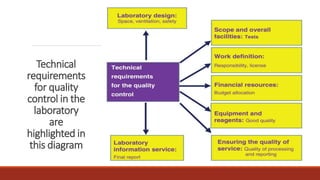
1. Laboratory design: The laboratory should be designed in such a
way that there remains enough space for receiving the sample,
processing and staining and for the interpretation area, storage, etc.
There should be proper ventilation and safety arrangement in the
laboratory.
2. Scope and overall facilities in the laboratory: Overall laboratory
facilities should be clearly documented. Detailed description of all
the tests in the laboratory should be mentioned to the patients.
3. The work definition of the laboratory personnel: The work responsibilities of
the different categories of the laboratory staffs should be clearly described. The
staffs should be highly competent with professional license to practice the
respective work
4. Financial resources: It is necessary to know the overall financial budget
allocation for laboratory personnel, equipments, chemicals, etc. This knowledge
of the financial budget gives the idea of the capability of the laboratory to fulfil
the customer’s need.
5. Laboratory equipments and reagents: The standard equipments and reagents
are needed to provide good quality well-stained sections and smears. The
microtome, processing machine, etc. should be regularly updated. There should
be a proper log book mentioning the use of the equipments, purchase date and
expiry date of the chemicals.
6.Ensuring the quality of the processing and reporting: The quality of the
processing should be regularly checked and recorded. Similarly the reporting

quality should be verified periodically.
7. Laboratory information service (LIS): LIS generates unique accession
number of the specimen. This number provides the identification of the
sample or section. The patient’s clinical history and other necessary
information are listed in LIS. The final report is also entered in LIS, and the
report is recoverable instantly by the end service providers.
Technical
requirements
for quality
control in the
laboratory
are
highlighted in
this diagram
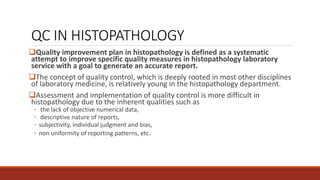
QC IN HISTOPATHOLOGY
Quality improvement plan in histopathology is defined as a systematic
attempt to improve specific quality measures in histopathology laboratory
service with a goal to generate an accurate report.
The concept of quality control, which is deeply rooted in most other disciplines
of laboratory medicine, is relatively young in the histopathology department.
Assessment and implementation of quality control is more difficult in
histopathology due to the inherent qualities such as
◦ the lack of objective numerical data,
◦ descriptive nature of reports,
◦ subjectivity, individual judgment and bias,
◦ non uniformity of reporting patterns, etc.
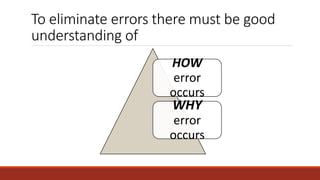
To eliminate errors there must be good
understanding of
HOW
error
occurs
WHY
error
occurs
Variables that affect the quality of results
The educational background and training of the laboratory
personnel
The condition of the specimens
Reagents
Equipment
The interpretation of the results
The transcription of results
The reporting of results
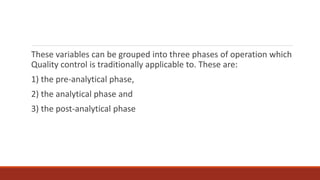
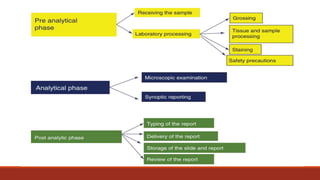
These variables can be grouped into three phases of operation which
Quality control is traditionally applicable to. These are:
1) the pre-analytical phase,
2) the analytical phase and
3) the post-analytical phase
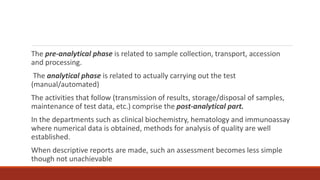
The pre-analytical phase is related to sample collection, transport, accession
and processing.
The analytical phase is related to actually carrying out the test
(manual/automated)
The activities that follow (transmission of results, storage/disposal of samples,
maintenance of test data, etc.) comprise the post-analytical part.
In the departments such as clinical biochemistry, hematology and immunoassay
where numerical data is obtained, methods for analysis of quality are well
established.
When descriptive reports are made, such an assessment becomes less simple
though not unachievable
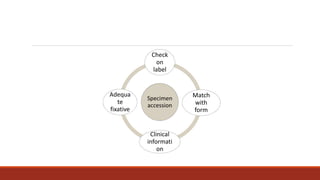
Specimen
accession
Check
on
label
Match
with
form
Clinical
informati
on
Adequa
te
fixative
Majority of errors in the laboratory (histolab inclusive) relate to the pre-
analytical phase.
A lot has been said and written about the importance of primary fixation
and the choice of fixatives for specific histopathology investigations.
It is the responsibility of the lab to ensure that documented instructions
containing relevant information are made available at all points of
specimen collection.
Correct patient identification by a unique accession number that is
traceable to the specimen and report all through the process is of prime
importance.
Similarly, wrong identification of anatomic location as well as laterality of
biopsy (right/left) are common errors that should be avoided.
It would be worth while for the laboratory to design its own "referral form" for
histopathology and make it available to all areas of sample collection.
This form should provide space for entry of the relevant clinical data.
◦ It may be useful to insert check boxes for better clinician compliance.
Dialogue with the clinician about the importance of properly filled forms may
be needed and whenever clinical data is not provided, the laboratory should
take the initiative to extract relevant data either from the treating physician or
hospital files.
Other areas of error in the pre-analytical phase include
Lost specimens,
Inadequate volume,
Size,
Gross description,
Gross sampling,
 Erroneous measurements,
Extraneous tissue (floaters),
Improper sections/inadequate serials,
 Poor staining and mounting quality, etc.
Steps on how to achieve proper control of the
pre-analytical process
1. Standard procedures for sample accession, identification,
acceptance/rejection, gross examination and sampling and all the steps that
follow must be documented.
This SOP should be written in simple language that can be understood by all and should be
available at the workplace and all technical staff should be aware of its contents.
2. Planned changing of chemicals used for processing based on the number of
tissues passed through. This schedule will prevent under processing and
unnecessary rework and loss of tissue.
The same also applies to the deparaffinization, staining, dehydration and clearing steps for
sections.
Steps on how to achieve proper control
of the pre-analytical process
3. Usage of controls for routine and special stains daily as a routine
is strongly recommended.
For routine H & E staining, the laboratory may identify one tissue block with a good mixture of
hematoxyphilic and eosinophilic tissue (cervix, fibroadenoma, etc.) as a control.
4. The microtome should be of good quality and serviced regularly.
Periodic calibration of the micrometer should be made to ensure consistency of section
thickness.
5. Care should be taken not to induce tissue artifacts due to
improper processing, sectioning, staining and mounting.
6. The label affixed on the stained slide should be of an appropriate
size so that it does not project beyond the slide or cover the
tissue sections.
1. The identification should be legible and should ideally carry the name of
the laboratory.
2. Using bar code labels, one can incorporate demographic data such as the
name of the laboratory, the name of the patient, the laboratory ID
number and the date.
Analytic phase
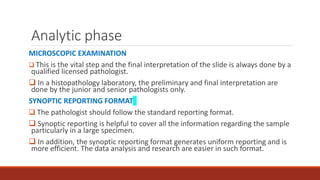
MICROSCOPIC EXAMINATION
 This is the vital step and the final interpretation of the slide is always done by a
qualified licensed pathologist.
 In a histopathology laboratory, the preliminary and final interpretation are
done by the junior and senior pathologists only.
SYNOPTIC REPORTING FORMAT
 The pathologist should follow the standard reporting format.
 Synoptic reporting is helpful to cover all the information regarding the sample
particularly in a large specimen.
 In addition, the synoptic reporting format generates uniform reporting and is
more efficient. The data analysis and research are easier in such format.
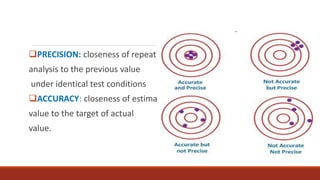
PRECISION: closeness of repeat
analysis to the previous value
under identical test conditions
ACCURACY: closeness of estimated
value to the target of actual
value.
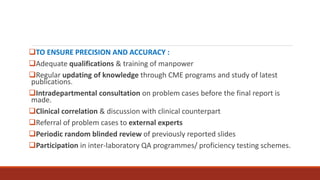
TO ENSURE PRECISION AND ACCURACY :
Adequate qualifications & training of manpower
Regular updating of knowledge through CME programs and study of latest
publications.
Intradepartmental consultation on problem cases before the final report is
made.
Clinical correlation & discussion with clinical counterpart
Referral of problem cases to external experts
Periodic random blinded review of previously reported slides
Participation in inter-laboratory QA programmes/ proficiency testing schemes.
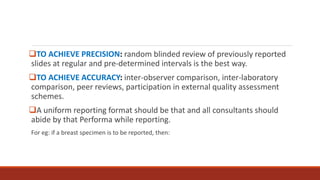
TO ACHIEVE PRECISION: random blinded review of previously reported
slides at regular and pre-determined intervals is the best way.
TO ACHIEVE ACCURACY: inter-observer comparison, inter-laboratory
comparison, peer reviews, participation in external quality assessment
schemes.
A uniform reporting format should be that and all consultants should
abide by that Performa while reporting.
For eg: if a breast specimen is to be reported, then:
INTERLABORATORY COMPARISON
 The laboratory should join in the interlaboratory slide exchange
program.
The primary diagnosis offered by the laboratory should be verified
by other groups of laboratory and vice versa.
 There should be a periodic meeting or feedback to correct the
error.
External Quality Assurance
EXTERNAL QUALITY ASSURANCE CONSISTS OF:
 Proficiency test
 Continuing medical education
PROFICIENCY TEST
The proficiency test is a voluntary program.
The various laboratories should take part in the proficiency test to improve the
diagnostic skill.
Overall the proficiency test is educational, and it points out the strength and
weakness of the pathologists
CONTINUING MEDICAL EDUCATION
 All the laboratory personnel should take active participation in the various
workshops, CME, seminars, etc.
Post-analytical Phase
The traditional laboratory approach to the post-analytical phase
involves
 report generation without transcription errors,
 report transmission/dispatch to the right person(s),
 storage of reported material as well as reported data and
 safe disposal of specimens thereafter.
Newer models include billing issues, reporting of critical results,
turn around time (TAT) and general customer satisfaction (waiting
time), etc.
Monitoring of TAT is of vital importance and laboratories should
strive to achieve the goal of signing out the majority of cases within
48 working hours(5 to 6 working days) of receiving of the specimen.
The use of microwaves may assist in improving the TAT especially
for small biopsies.
The TAT of frozen sections should also be monitored.
The retention period for specimens has always been a subject of
debate and national guidelines for this are warranted.
Quality Check of the Signed Out Report
The following measures may help in this aspect:
 Review the report of a specific system by the expert second consultant in that
system.
 Random review of certain percentages of cases (2–10%) depending on the resource
of the laboratory.
 Different interdepartmental meeting: Liver biopsy round, kidney biopsy round,
various oncology meeting, clinicopathological conference, etc.
 Correlation of frozen section and permanent section.
 Cytology and final histopathology correlation: All the non correlated cases should
be discussed in detail so that the error can be overcome in future.
 Review of the cases by other institutions
RECOMMENDATIONS FOR ANALYTICAL PHASE
Intra-departmental consultation (review of selected cases by colleagues)
Comparison with other reports (frozen/cytology/histopathology)
Random case review (blinded re-reporting of random cases)
By the same person (check for precision)
By a different person (check for accuracy)
Hierarchical form of reporting
Using clinicopathological meetings to ensure diagnostic accuracy and
maintain good clinical liaison; audit diagnostic changes at these meetings
Analytical aspects
Unlike in other disciplines of laboratory medicine, assessment of
analytical aspects in histopathology is not easy given the subjectivity
of the reports.
Error detection and avoidance in histopathology has been written
about very often.
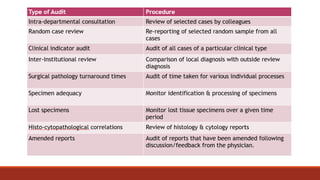
Various modes of internal audits have been described and
recommended, each with their advantages.
Audit workload levels to ensure an even distribution of the
departmental caseload where possible.
Utilize recommended reporting guidelines and templates,
wherever available, with audit of compliance.
External consultations (may need to be done more often).
Review by experts.
Participation in continued medical education (CME) programs.
CONCLUSION
Error reduction and improved quality are essentially two
names for the same goal; you can’t have one without the
other.
qc histo ss final - Copy.pptx

qc histo ss final - Copy.pptx

  • 1.
    QUALITY CONTROL IN HISTOPATHOLOGY PRESENTEDBY : DR. AVANI PANCHAL MODERATED BY : DR. NIRALI SHAH
  • 2.
    OUTLINE Introduction What is QualityControl? Related Terminologies QC as it relates to Histopathology Variables that affect the quality of results How to achieve Quality Control General recommendations Conclusion
  • 3.
     Maintaining ahigh standard of care in medicine is important both to the public and to the medical profession.  The processes by which these standards are monitored and maintained have been given different labels depending on their geographical and political contexts.  Such terms include Medical Audit, Clinical Audit and Quality Control
  • 4.
    The following commentsare heard far too often in laboratory medicine: ‘‘This result can’t be right!” “The laboratory messed up again!’’ Clinicians often attribute many patient results that do not fit expected findings to laboratory error. The National Academics Institute of Medicine (IOM) in the U.S.A. estimates that approximately 44,000 to 98,000 deaths occur annually in that country alone due to medical errors.
  • 5.
    What is QC QualityControl - QC refers to the measures that must be included during each assay run (tissue processing) to verify that the test is working properly. It is a process or system for monitoring the quality of laboratory testing, and the accuracy and precision of results It involves routine receiving of sample and analysis of data from every test run or procedure. Thus, QC allows detection of errors for immediate corrective action.
  • 6.
    Quality Assurance (QA) QualityAssurance - QA is defined as the overall program that ensures that the final results reported by the laboratory are correct. The aim of quality control is simply to ensure that the results generated by the test are correct. However, quality assurance is concerned with much more: that the right test is carried out on the right specimen, and that the right result and right interpretation is delivered to the right person at the right time
  • 7.
    Quality Assurance vs.Quality Control Quality Control A series of analytical measurements used to assess the quality of the analytical data (The “tools”) Quality Assurance An overall management plan to guarantee the integrity of data (The “system”)
  • 8.
    Quality control, QualityAssurance and Total Quality Management Thus the terms QC, and Quality Assurance (QA) differ from each other in the degree of process and organizational involvement, which is overall and maximal in TQM.  For all practical purposes, all these elements should be focused to ◦ a) generate an accurate histopathology report and ◦ b) enable easy retrieval and review if needed over a defined time period.
  • 9.
    Objectives of QualityControl The main objectives of the quality control are: 1. To give correct and complete test report to the patient 2. To generate and deliver the report in a minimum amount of time 3. To maintain ethics and professional service 4. To provide excellent service to the patient so that it satisfies the patient 5. To provide continuous training and current education to the laboratory staffs
  • 10.
    Essential Technical Requirementsfor Quality Control 1. Laboratory design: The laboratory should be designed in such a way that there remains enough space for receiving the sample, processing and staining and for the interpretation area, storage, etc. There should be proper ventilation and safety arrangement in the laboratory. 2. Scope and overall facilities in the laboratory: Overall laboratory facilities should be clearly documented. Detailed description of all the tests in the laboratory should be mentioned to the patients.
  • 11.
    3. The workdefinition of the laboratory personnel: The work responsibilities of the different categories of the laboratory staffs should be clearly described. The staffs should be highly competent with professional license to practice the respective work 4. Financial resources: It is necessary to know the overall financial budget allocation for laboratory personnel, equipments, chemicals, etc. This knowledge of the financial budget gives the idea of the capability of the laboratory to fulfil the customer’s need. 5. Laboratory equipments and reagents: The standard equipments and reagents are needed to provide good quality well-stained sections and smears. The microtome, processing machine, etc. should be regularly updated. There should be a proper log book mentioning the use of the equipments, purchase date and expiry date of the chemicals.
  • 12.
    6.Ensuring the qualityof the processing and reporting: The quality of the processing should be regularly checked and recorded. Similarly the reporting quality should be verified periodically. 7. Laboratory information service (LIS): LIS generates unique accession number of the specimen. This number provides the identification of the sample or section. The patient’s clinical history and other necessary information are listed in LIS. The final report is also entered in LIS, and the report is recoverable instantly by the end service providers.
  • 13.
    Technical requirements for quality control inthe laboratory are highlighted in this diagram
  • 14.
    QC IN HISTOPATHOLOGY Qualityimprovement plan in histopathology is defined as a systematic attempt to improve specific quality measures in histopathology laboratory service with a goal to generate an accurate report. The concept of quality control, which is deeply rooted in most other disciplines of laboratory medicine, is relatively young in the histopathology department. Assessment and implementation of quality control is more difficult in histopathology due to the inherent qualities such as ◦ the lack of objective numerical data, ◦ descriptive nature of reports, ◦ subjectivity, individual judgment and bias, ◦ non uniformity of reporting patterns, etc.
  • 15.
    To eliminate errorsthere must be good understanding of HOW error occurs WHY error occurs
  • 16.
    Variables that affectthe quality of results The educational background and training of the laboratory personnel The condition of the specimens Reagents Equipment The interpretation of the results The transcription of results The reporting of results
  • 17.
    These variables canbe grouped into three phases of operation which Quality control is traditionally applicable to. These are: 1) the pre-analytical phase, 2) the analytical phase and 3) the post-analytical phase
  • 19.
    The pre-analytical phaseis related to sample collection, transport, accession and processing. The analytical phase is related to actually carrying out the test (manual/automated) The activities that follow (transmission of results, storage/disposal of samples, maintenance of test data, etc.) comprise the post-analytical part. In the departments such as clinical biochemistry, hematology and immunoassay where numerical data is obtained, methods for analysis of quality are well established. When descriptive reports are made, such an assessment becomes less simple though not unachievable
  • 20.
  • 21.
    Majority of errorsin the laboratory (histolab inclusive) relate to the pre- analytical phase. A lot has been said and written about the importance of primary fixation and the choice of fixatives for specific histopathology investigations. It is the responsibility of the lab to ensure that documented instructions containing relevant information are made available at all points of specimen collection. Correct patient identification by a unique accession number that is traceable to the specimen and report all through the process is of prime importance.
  • 22.
    Similarly, wrong identificationof anatomic location as well as laterality of biopsy (right/left) are common errors that should be avoided. It would be worth while for the laboratory to design its own "referral form" for histopathology and make it available to all areas of sample collection. This form should provide space for entry of the relevant clinical data. ◦ It may be useful to insert check boxes for better clinician compliance. Dialogue with the clinician about the importance of properly filled forms may be needed and whenever clinical data is not provided, the laboratory should take the initiative to extract relevant data either from the treating physician or hospital files.
  • 24.
    Other areas oferror in the pre-analytical phase include Lost specimens, Inadequate volume, Size, Gross description, Gross sampling,  Erroneous measurements, Extraneous tissue (floaters), Improper sections/inadequate serials,  Poor staining and mounting quality, etc.
  • 25.
    Steps on howto achieve proper control of the pre-analytical process 1. Standard procedures for sample accession, identification, acceptance/rejection, gross examination and sampling and all the steps that follow must be documented. This SOP should be written in simple language that can be understood by all and should be available at the workplace and all technical staff should be aware of its contents. 2. Planned changing of chemicals used for processing based on the number of tissues passed through. This schedule will prevent under processing and unnecessary rework and loss of tissue. The same also applies to the deparaffinization, staining, dehydration and clearing steps for sections.
  • 26.
    Steps on howto achieve proper control of the pre-analytical process 3. Usage of controls for routine and special stains daily as a routine is strongly recommended. For routine H & E staining, the laboratory may identify one tissue block with a good mixture of hematoxyphilic and eosinophilic tissue (cervix, fibroadenoma, etc.) as a control. 4. The microtome should be of good quality and serviced regularly. Periodic calibration of the micrometer should be made to ensure consistency of section thickness. 5. Care should be taken not to induce tissue artifacts due to improper processing, sectioning, staining and mounting.
  • 27.
    6. The labelaffixed on the stained slide should be of an appropriate size so that it does not project beyond the slide or cover the tissue sections. 1. The identification should be legible and should ideally carry the name of the laboratory. 2. Using bar code labels, one can incorporate demographic data such as the name of the laboratory, the name of the patient, the laboratory ID number and the date.
  • 28.
    Analytic phase MICROSCOPIC EXAMINATION This is the vital step and the final interpretation of the slide is always done by a qualified licensed pathologist.  In a histopathology laboratory, the preliminary and final interpretation are done by the junior and senior pathologists only. SYNOPTIC REPORTING FORMAT  The pathologist should follow the standard reporting format.  Synoptic reporting is helpful to cover all the information regarding the sample particularly in a large specimen.  In addition, the synoptic reporting format generates uniform reporting and is more efficient. The data analysis and research are easier in such format.
  • 29.
    PRECISION: closeness ofrepeat analysis to the previous value under identical test conditions ACCURACY: closeness of estimated value to the target of actual value.
  • 30.
    TO ENSURE PRECISIONAND ACCURACY : Adequate qualifications & training of manpower Regular updating of knowledge through CME programs and study of latest publications. Intradepartmental consultation on problem cases before the final report is made. Clinical correlation & discussion with clinical counterpart Referral of problem cases to external experts Periodic random blinded review of previously reported slides Participation in inter-laboratory QA programmes/ proficiency testing schemes.
  • 31.
    TO ACHIEVE PRECISION:random blinded review of previously reported slides at regular and pre-determined intervals is the best way. TO ACHIEVE ACCURACY: inter-observer comparison, inter-laboratory comparison, peer reviews, participation in external quality assessment schemes. A uniform reporting format should be that and all consultants should abide by that Performa while reporting. For eg: if a breast specimen is to be reported, then:
  • 32.
    INTERLABORATORY COMPARISON  Thelaboratory should join in the interlaboratory slide exchange program. The primary diagnosis offered by the laboratory should be verified by other groups of laboratory and vice versa.  There should be a periodic meeting or feedback to correct the error.
  • 34.
    External Quality Assurance EXTERNALQUALITY ASSURANCE CONSISTS OF:  Proficiency test  Continuing medical education
  • 35.
    PROFICIENCY TEST The proficiencytest is a voluntary program. The various laboratories should take part in the proficiency test to improve the diagnostic skill. Overall the proficiency test is educational, and it points out the strength and weakness of the pathologists CONTINUING MEDICAL EDUCATION  All the laboratory personnel should take active participation in the various workshops, CME, seminars, etc.
  • 37.
    Post-analytical Phase The traditionallaboratory approach to the post-analytical phase involves  report generation without transcription errors,  report transmission/dispatch to the right person(s),  storage of reported material as well as reported data and  safe disposal of specimens thereafter. Newer models include billing issues, reporting of critical results, turn around time (TAT) and general customer satisfaction (waiting time), etc.
  • 38.
    Monitoring of TATis of vital importance and laboratories should strive to achieve the goal of signing out the majority of cases within 48 working hours(5 to 6 working days) of receiving of the specimen. The use of microwaves may assist in improving the TAT especially for small biopsies. The TAT of frozen sections should also be monitored. The retention period for specimens has always been a subject of debate and national guidelines for this are warranted.
  • 39.
    Quality Check ofthe Signed Out Report The following measures may help in this aspect:  Review the report of a specific system by the expert second consultant in that system.  Random review of certain percentages of cases (2–10%) depending on the resource of the laboratory.  Different interdepartmental meeting: Liver biopsy round, kidney biopsy round, various oncology meeting, clinicopathological conference, etc.  Correlation of frozen section and permanent section.  Cytology and final histopathology correlation: All the non correlated cases should be discussed in detail so that the error can be overcome in future.  Review of the cases by other institutions
  • 40.
    RECOMMENDATIONS FOR ANALYTICALPHASE Intra-departmental consultation (review of selected cases by colleagues) Comparison with other reports (frozen/cytology/histopathology) Random case review (blinded re-reporting of random cases) By the same person (check for precision) By a different person (check for accuracy) Hierarchical form of reporting Using clinicopathological meetings to ensure diagnostic accuracy and maintain good clinical liaison; audit diagnostic changes at these meetings
  • 41.
    Analytical aspects Unlike inother disciplines of laboratory medicine, assessment of analytical aspects in histopathology is not easy given the subjectivity of the reports. Error detection and avoidance in histopathology has been written about very often. Various modes of internal audits have been described and recommended, each with their advantages.
  • 42.
    Audit workload levelsto ensure an even distribution of the departmental caseload where possible. Utilize recommended reporting guidelines and templates, wherever available, with audit of compliance. External consultations (may need to be done more often). Review by experts. Participation in continued medical education (CME) programs.
  • 43.
    CONCLUSION Error reduction andimproved quality are essentially two names for the same goal; you can’t have one without the other.