Q2
How does your media product represent particular social groups?
The Protagonist

Our protagonist is:
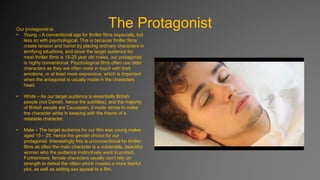
• Young – A conventional age for thriller films especially, but
less so with psychological. This is because thriller films
create tension and horror by placing ordinary characters in
terrifying situations, and since the target audience for
most thriller films is 15-25 year old males, our protagonist
is highly conventional. Psychological films often use older
characters as they are often more in touch with their
emotions, or at least more expressive, which is important
when the antagonist is usually made in the characters
head.
•

White – As our target audience is essentially British
people (not Danish, hence the subtitles), and the majority
of British people are Caucasian, it made sense to make
the character white in keeping with the theme of a
relatable character.

•

Male – The target audience for our film was young males
aged 15 – 25, hence the gender choice for our
protagonist. Interestingly this is unconventional for thriller
films as often the main character is a vulnerable, beautiful
woman who the audience instinctively want to protect.
Furthermore, female characters usually can’t rely on
strength to defeat the villain which creates a more fearful
plot, as well as adding sex appeal to a film.
The Protagonist
Our protagonist is:
• Middle-class – As 31% of British people are, to some
degree, middle-class it made sense to create an average,
middle-class protagonist which the audience would find
more relatable, and therefore easier to identify with.
•

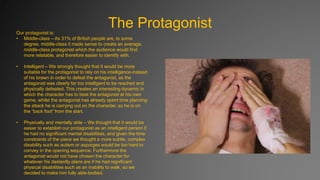
Intelligent – We strongly thought that it would be more
suitable for the protagonist to rely on his intelligence instead
of his brawn in order to defeat the antagonist, as the
antagonist was clearly far too intelligent to be reached and
physically defeated. This creates an interesting dynamic in
which the character has to beat the antagonist at his own
game, whilst the antagonist has already spent time planning
the attack he is carrying out on the character, so he is on
the “back foot” from the start.

•

Physically and mentally able – We thought that it would be
easier to establish our protagonist as an intelligent person if
he had no significant mental disabilities, and given the time
constraints of the piece we thought a more subtle, complex
disability such as autism or aspurges would be too hard to
convey in the opening sequence. Furthermore the
antagonist would not have chosen the character for
whatever his dastardly plans are if he had significant
physical disabilities such as an inability to walk, so we
decided to make him fully able-bodied.
The Antagonist
The “Overseer” is:
• Young – We agreed that while an older, middle-aged
antagonist might make more sense, having a young
man carry out the evil deeds we see that he has begun
was far more interesting to us as filmmakers. We asked
ourselves why someone our age would want to take
advantage of another person in such an extreme way,
and we realised the possibilities are endless. If this was
a feature film we would definitely explore his age as a
characteristic further.
•

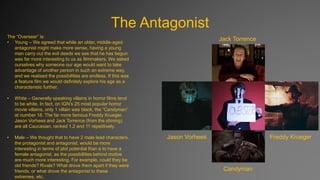
White – Generally speaking villains in horror films tend
to be white. In fact, on IGN’s 25 most popular horror
movie villains, only 1 villain was black, the “Candyman”
at number 18. The far more famous Freddy Krueger,
Jason Vorhees and Jack Torrence (from the shining)
are all Caucasian, ranked 1,2 and 11 repetitively.

•

Male – We thought that to have 2 male lead characters,
the protagonist and antagonist, would be more
interesting in terms of plot potential than a to have a
female antagonist, as the possibilities behind motive
are much more interesting. For example, could they be
old friends? Rivals? What drove them apart if they were
friends, or what drove the antagonist to these
extremes, etc.

Jack Torrence

Jason Vorhees

Freddy Krueger

Candyman
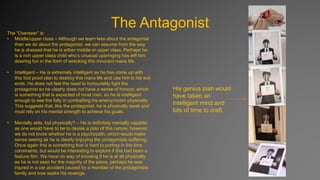
The Antagonist

The “Overseer” is:
• Middle/upper class – Although we learn less about the antagonist
than we do about the protagonist, we can assume from the way
he is dressed that he is either middle or upper class. Perhaps he
is a rich upper class child who’s unusual upbringing has left him
desiring fun in the form of wrecking this innocent mans life.
•

•

Intelligent – He is extremely intelligent as he has come up with
this fool proof plan to destroy this mans life and use him to his evil
ends. He does not feel the need to honourably fight the
protagonist so he clearly does not have a sense of honour, which
is something that is expected of most men, so he is intelligent
enough to see the folly in combatting his enemy/victim physically.
This suggests that, like the protagonist, he is physically weak and
must rely on his mental strength to achieve his goals.
Mentally able, but physically? – He is definitely mentally capable,
as one would have to be to devise a plan of this nature, however
we do not know whether he is a psychopath, which would make
sense seeing as he is clearly enjoying the protagonists suffering.
Once again this is something that is hard to portray in the time
constraints, but would be interesting to explore if this had been a
feature film. We have no way of knowing if he is at all physically
as he is not seen for the majority of the piece, perhaps he was
injured in a car accident caused by a member of the protagonists
family and now seeks his revenge.

His genius plan would
have taken an
intelligent mind and
lots of time to craft.
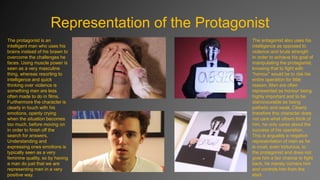
Representation of the Protagonist
The protagonist is an
intelligent man who uses his
brains instead of his brawn to
overcome the challenges he
faces. Using muscle power is
seen as a very masculine
thing, whereas resorting to
intelligence and quick
thinking over violence is
something men are less
often made to do in films.
Furthermore the character is
clearly in touch with his
emotions, openly crying
when the situation becomes
too much, before moving on
in order to finish off the
search for answers.
Understanding and
expressing ones emotions is
typically seen as a very
feminine quality, so by having
a man do just that we are
representing men in a very
positive way.

The antagonist also uses his
intelligence as opposed to
violence and brute strength
in order to achieve his goal of
manipulating the protagonist,
knowing that to fight with
“honour” would be to risk his
entire operation for little
reason. Men are often
represented as honour being
highly important and to be
dishonourable as being
pathetic and weak. Clearly
therefore this character does
not care what others think of
him, he only cares about the
success of his operation.
This is arguably a negative
representation of men as he
is cruel, even torturous, to
the protagonist and does not
give him a fair chance to fight
back, he merely corners him
and controls him from the
start.
Construction of Representation of Men
Sound:
• Dialogue?
Camera:
• Low/high angle?
Mise-en-scene:
• Location (barren)
• Costume
Editing:
• Titles? (scrawled)
Ideology
IDEOLOGY NOTES

Evaluation Question 2

  • 1.
    Q2 How does yourmedia product represent particular social groups?
  • 2.
    The Protagonist Our protagonistis: • Young – A conventional age for thriller films especially, but less so with psychological. This is because thriller films create tension and horror by placing ordinary characters in terrifying situations, and since the target audience for most thriller films is 15-25 year old males, our protagonist is highly conventional. Psychological films often use older characters as they are often more in touch with their emotions, or at least more expressive, which is important when the antagonist is usually made in the characters head. • White – As our target audience is essentially British people (not Danish, hence the subtitles), and the majority of British people are Caucasian, it made sense to make the character white in keeping with the theme of a relatable character. • Male – The target audience for our film was young males aged 15 – 25, hence the gender choice for our protagonist. Interestingly this is unconventional for thriller films as often the main character is a vulnerable, beautiful woman who the audience instinctively want to protect. Furthermore, female characters usually can’t rely on strength to defeat the villain which creates a more fearful plot, as well as adding sex appeal to a film.
  • 3.
    The Protagonist Our protagonistis: • Middle-class – As 31% of British people are, to some degree, middle-class it made sense to create an average, middle-class protagonist which the audience would find more relatable, and therefore easier to identify with. • Intelligent – We strongly thought that it would be more suitable for the protagonist to rely on his intelligence instead of his brawn in order to defeat the antagonist, as the antagonist was clearly far too intelligent to be reached and physically defeated. This creates an interesting dynamic in which the character has to beat the antagonist at his own game, whilst the antagonist has already spent time planning the attack he is carrying out on the character, so he is on the “back foot” from the start. • Physically and mentally able – We thought that it would be easier to establish our protagonist as an intelligent person if he had no significant mental disabilities, and given the time constraints of the piece we thought a more subtle, complex disability such as autism or aspurges would be too hard to convey in the opening sequence. Furthermore the antagonist would not have chosen the character for whatever his dastardly plans are if he had significant physical disabilities such as an inability to walk, so we decided to make him fully able-bodied.
  • 4.
    The Antagonist The “Overseer”is: • Young – We agreed that while an older, middle-aged antagonist might make more sense, having a young man carry out the evil deeds we see that he has begun was far more interesting to us as filmmakers. We asked ourselves why someone our age would want to take advantage of another person in such an extreme way, and we realised the possibilities are endless. If this was a feature film we would definitely explore his age as a characteristic further. • White – Generally speaking villains in horror films tend to be white. In fact, on IGN’s 25 most popular horror movie villains, only 1 villain was black, the “Candyman” at number 18. The far more famous Freddy Krueger, Jason Vorhees and Jack Torrence (from the shining) are all Caucasian, ranked 1,2 and 11 repetitively. • Male – We thought that to have 2 male lead characters, the protagonist and antagonist, would be more interesting in terms of plot potential than a to have a female antagonist, as the possibilities behind motive are much more interesting. For example, could they be old friends? Rivals? What drove them apart if they were friends, or what drove the antagonist to these extremes, etc. Jack Torrence Jason Vorhees Freddy Krueger Candyman
  • 5.
    The Antagonist The “Overseer”is: • Middle/upper class – Although we learn less about the antagonist than we do about the protagonist, we can assume from the way he is dressed that he is either middle or upper class. Perhaps he is a rich upper class child who’s unusual upbringing has left him desiring fun in the form of wrecking this innocent mans life. • • Intelligent – He is extremely intelligent as he has come up with this fool proof plan to destroy this mans life and use him to his evil ends. He does not feel the need to honourably fight the protagonist so he clearly does not have a sense of honour, which is something that is expected of most men, so he is intelligent enough to see the folly in combatting his enemy/victim physically. This suggests that, like the protagonist, he is physically weak and must rely on his mental strength to achieve his goals. Mentally able, but physically? – He is definitely mentally capable, as one would have to be to devise a plan of this nature, however we do not know whether he is a psychopath, which would make sense seeing as he is clearly enjoying the protagonists suffering. Once again this is something that is hard to portray in the time constraints, but would be interesting to explore if this had been a feature film. We have no way of knowing if he is at all physically as he is not seen for the majority of the piece, perhaps he was injured in a car accident caused by a member of the protagonists family and now seeks his revenge. His genius plan would have taken an intelligent mind and lots of time to craft.
  • 6.
    Representation of theProtagonist The protagonist is an intelligent man who uses his brains instead of his brawn to overcome the challenges he faces. Using muscle power is seen as a very masculine thing, whereas resorting to intelligence and quick thinking over violence is something men are less often made to do in films. Furthermore the character is clearly in touch with his emotions, openly crying when the situation becomes too much, before moving on in order to finish off the search for answers. Understanding and expressing ones emotions is typically seen as a very feminine quality, so by having a man do just that we are representing men in a very positive way. The antagonist also uses his intelligence as opposed to violence and brute strength in order to achieve his goal of manipulating the protagonist, knowing that to fight with “honour” would be to risk his entire operation for little reason. Men are often represented as honour being highly important and to be dishonourable as being pathetic and weak. Clearly therefore this character does not care what others think of him, he only cares about the success of his operation. This is arguably a negative representation of men as he is cruel, even torturous, to the protagonist and does not give him a fair chance to fight back, he merely corners him and controls him from the start.
  • 7.
    Construction of Representationof Men Sound: • Dialogue? Camera: • Low/high angle? Mise-en-scene: • Location (barren) • Costume Editing: • Titles? (scrawled)
  • 8.