Lesson 2: The Utility and
Application of Applied
Economics to Solve Economic
Issues and Problems
What are Economic
Resources?
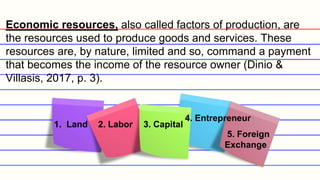
Economic resources, also called factors of production, are
the resources used to produce goods and services. These
resources are, by nature, limited and so, command a payment
that becomes the income of the resource owner (Dinio &
Villasis, 2017, p. 3).
1. Land 2. Labor 3. Capital
4. Entrepreneur
5. Foreign
Exchange
1. Land - soil and natural resources that are found in nature and are not man-
made.
Owners of lands receive a payment known as rent
- these resources consist of gifts of nature which include:
* Soil
* Rivers
* Lakes, oceans
* Forests
* Mountains
* Mineral resources
- land is considered an economic resource because it has a price attached
to it.
2. Labor - physical and human effort exerted in production.
- also called “human resources” or all human efforts, be it mental or
physical, that help to produce satisfying goods and services.
- it covers manual workers like
● Construction workers
● Machine operators
● Production workers * In return, he earns an income in the form of wages and salaries
As well as professionals like
● Nurses
● Lawyers
● Doctors
The terms also include
Jeepney drivers
Farmers
Fishermen
3. Capital - man-made resources used in the production of goods and services like:
● Machinery
● Equipment
Two (2) economic definitions of capital:
A. Capital - can represent the monetary resources use to purchase natural resources.
Example:
Companies use capital to buy land and other goods
B. Capital - represents the major physical assets individuals and companies use when
producing goods and services.
Example:
Buildings, vehicles, equipment
4. Entrepreneurs -organizers and coordinators of other factors of
production: land, labor, and capital.
-someone who uses his initiative, talent and resourcefulness to
create economic goods and services
5. Foreign Exchange -refers to the dollar and dollar reserves that the
economy has.
-foreign exchange is part of economic resources because we need
foreign currency for international trading and buying materials
from other countries.
- International medium - dollar
The Four (4) Basic
Problems of an
Economy
The central economic problem of scarcity of resources is
broken down into four basic problems
of an economy (Toppr, n.d.).
1. What to Produce?
2. How to Produce?
3. For whom to Produce?
4. What provision should be made for economic growth?
Examples of the Economic Problem:
1. Consumers
2. Workers
3. Producers
4. Government
Opportunity Cost and
the Economic Problem
Economic Systems
The economic system is the mechanism through
which society determines the solutions
to the aforementioned basic economic issues.
Any of the four economic systems, or perhaps a
combination of them, can govern a
country:
1. Traditional economy- Traditions and customs
that have been passed down from generation to
generation are used to make decisions.
Methodologies are stale and so unprogressive.
Traditional communities
can be found in both advanced and primitive cultures.
Traditional economies rely on agriculture, fishing,
hunting, gathering, or a combination
of these activities. Instead than using money, they
use barter.
2. Command economy
● This is a centralized decision-making
system in which the government or a
planning
committee makes decisions.
● People who do not have a say in
what things are created are forced to
make decisions.
● This economics applies to
authoritarian, socialist, and
communist countries
alike.
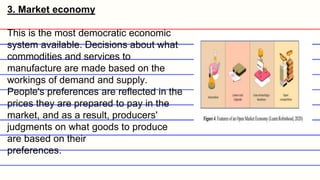
3. Market economy
This is the most democratic economic
system available. Decisions about what
commodities and services to
manufacture are made based on the
workings of demand and supply.
People's preferences are reflected in the
prices they are prepared to pay in the
market, and as a result, producers'
judgments on what goods to produce
are based on their
preferences.
4. Mixed Economy
A mixed economy is a system that blends market,
command, and traditional economic
elements. It has the benefits of all three while only having a
few of the downsides.
Economic Utility
Economic Utility
● Economic utility must be considered in the midst of our society’s
limited resources to determine the usefulness or value that
consumers derive from a product or service, and can be judged
based on the form, time, place, and possession; these factors aid
in assessing purchase decisions and the factors that drive those
decisions.
● Economic Utility gives a relative measure of a product’s
satisfaction. The product’s utility may be assigned based on the
customer's requirements.
● It is entirely dependent on a customer's requirements and
preferences.
Done on the Lesson 2,
any questions,
clarifications, comment?
Directions: Read carefully the statements or questions below and write your
answers on your
¼ sheet of paper.
I. Identify which resource is referred to by the following words.
______________________ 1. Organizer and coordinator of land, labor, capital
______________________ 2. Call center agents
______________________ 3. Forests
______________________ 4. Teachers
______________________ 5. Minerals
______________________ 6. Technology
______________________ 7. Marine resources
______________________ 8. Nurses
______________________ 9. Medical equipment
______________________10. Dollar or dollar reserves

Lesson-2_-The-Utility-and-Application-of-Applied-Economics-to-Solve-Economic-Issues-and-Problems.pptx

  • 1.
    Lesson 2: TheUtility and Application of Applied Economics to Solve Economic Issues and Problems
  • 2.
  • 3.
    Economic resources, alsocalled factors of production, are the resources used to produce goods and services. These resources are, by nature, limited and so, command a payment that becomes the income of the resource owner (Dinio & Villasis, 2017, p. 3). 1. Land 2. Labor 3. Capital 4. Entrepreneur 5. Foreign Exchange
  • 4.
    1. Land -soil and natural resources that are found in nature and are not man- made. Owners of lands receive a payment known as rent - these resources consist of gifts of nature which include: * Soil * Rivers * Lakes, oceans * Forests * Mountains * Mineral resources - land is considered an economic resource because it has a price attached to it.
  • 5.
    2. Labor -physical and human effort exerted in production. - also called “human resources” or all human efforts, be it mental or physical, that help to produce satisfying goods and services. - it covers manual workers like ● Construction workers ● Machine operators ● Production workers * In return, he earns an income in the form of wages and salaries As well as professionals like ● Nurses ● Lawyers ● Doctors The terms also include Jeepney drivers Farmers Fishermen
  • 6.
    3. Capital -man-made resources used in the production of goods and services like: ● Machinery ● Equipment Two (2) economic definitions of capital: A. Capital - can represent the monetary resources use to purchase natural resources. Example: Companies use capital to buy land and other goods B. Capital - represents the major physical assets individuals and companies use when producing goods and services. Example: Buildings, vehicles, equipment
  • 7.
    4. Entrepreneurs -organizersand coordinators of other factors of production: land, labor, and capital. -someone who uses his initiative, talent and resourcefulness to create economic goods and services 5. Foreign Exchange -refers to the dollar and dollar reserves that the economy has. -foreign exchange is part of economic resources because we need foreign currency for international trading and buying materials from other countries. - International medium - dollar
  • 9.
    The Four (4)Basic Problems of an Economy
  • 10.
    The central economicproblem of scarcity of resources is broken down into four basic problems of an economy (Toppr, n.d.). 1. What to Produce? 2. How to Produce? 3. For whom to Produce? 4. What provision should be made for economic growth?
  • 11.
    Examples of theEconomic Problem: 1. Consumers 2. Workers 3. Producers 4. Government
  • 12.
    Opportunity Cost and theEconomic Problem
  • 14.
  • 15.
    The economic systemis the mechanism through which society determines the solutions to the aforementioned basic economic issues. Any of the four economic systems, or perhaps a combination of them, can govern a country: 1. Traditional economy- Traditions and customs that have been passed down from generation to generation are used to make decisions. Methodologies are stale and so unprogressive. Traditional communities can be found in both advanced and primitive cultures. Traditional economies rely on agriculture, fishing, hunting, gathering, or a combination of these activities. Instead than using money, they use barter.
  • 16.
    2. Command economy ●This is a centralized decision-making system in which the government or a planning committee makes decisions. ● People who do not have a say in what things are created are forced to make decisions. ● This economics applies to authoritarian, socialist, and communist countries alike.
  • 17.
    3. Market economy Thisis the most democratic economic system available. Decisions about what commodities and services to manufacture are made based on the workings of demand and supply. People's preferences are reflected in the prices they are prepared to pay in the market, and as a result, producers' judgments on what goods to produce are based on their preferences.
  • 18.
    4. Mixed Economy Amixed economy is a system that blends market, command, and traditional economic elements. It has the benefits of all three while only having a few of the downsides.
  • 19.
  • 20.
    Economic Utility ● Economicutility must be considered in the midst of our society’s limited resources to determine the usefulness or value that consumers derive from a product or service, and can be judged based on the form, time, place, and possession; these factors aid in assessing purchase decisions and the factors that drive those decisions. ● Economic Utility gives a relative measure of a product’s satisfaction. The product’s utility may be assigned based on the customer's requirements. ● It is entirely dependent on a customer's requirements and preferences.
  • 21.
    Done on theLesson 2, any questions, clarifications, comment?
  • 24.
    Directions: Read carefullythe statements or questions below and write your answers on your ¼ sheet of paper. I. Identify which resource is referred to by the following words. ______________________ 1. Organizer and coordinator of land, labor, capital ______________________ 2. Call center agents ______________________ 3. Forests ______________________ 4. Teachers ______________________ 5. Minerals ______________________ 6. Technology ______________________ 7. Marine resources ______________________ 8. Nurses ______________________ 9. Medical equipment ______________________10. Dollar or dollar reserves