1
MONDAY TUESDAY WEDNESDAY THURSDAY FRIDAY
I. OBJECTIVES
A. Content standard The learners demonstrate understanding of holistic health and its management of health concerns, the
growth and development of adolescents and how to manage its challenges.
B. Performance standard The learners appropriately manage concerns and challenges during adolescence to achieve holistic
health.
C. Learning competencies/
Objectives
The learners…
 recognize that
changes in
different
dimensions are
normal during
adolescence
(H7GD-If-h-19)
 explain that the
pattern of change
during
adolescence is
similar but the
pace of growth
and development
is unique for each
adolescent
(H7GD-If-h-20)
The learners identify
health concerns during
adolescence
(H7GD-Ii-j-21)
The learners…
 explain the
proper health
appraisal
procedures
(H7GD-Ii-j-22)
 demonstrate
health appraisal
procedures
during
adolescence in
order to achieve
holistic health
(H7GD-Ii-j-23)
 avails of health
services in the
school and
community in
The learners apply
coping skills in
dealing with health
concerns during
adolescence
(H7GD-Ii-j-25)
Daily Lesson Log
in
MAPEH
SCHOOL CALAMBA NATIONAL HIGH SCHOOL - ANNEX GRADE LEVEL SEVEN
TEACHER MS. MELODIA C. DE GUZMAN LEARNING AREA HEALTH
TEACHING DATE AND
TIME
WEEK 2 QUARTER FIRST
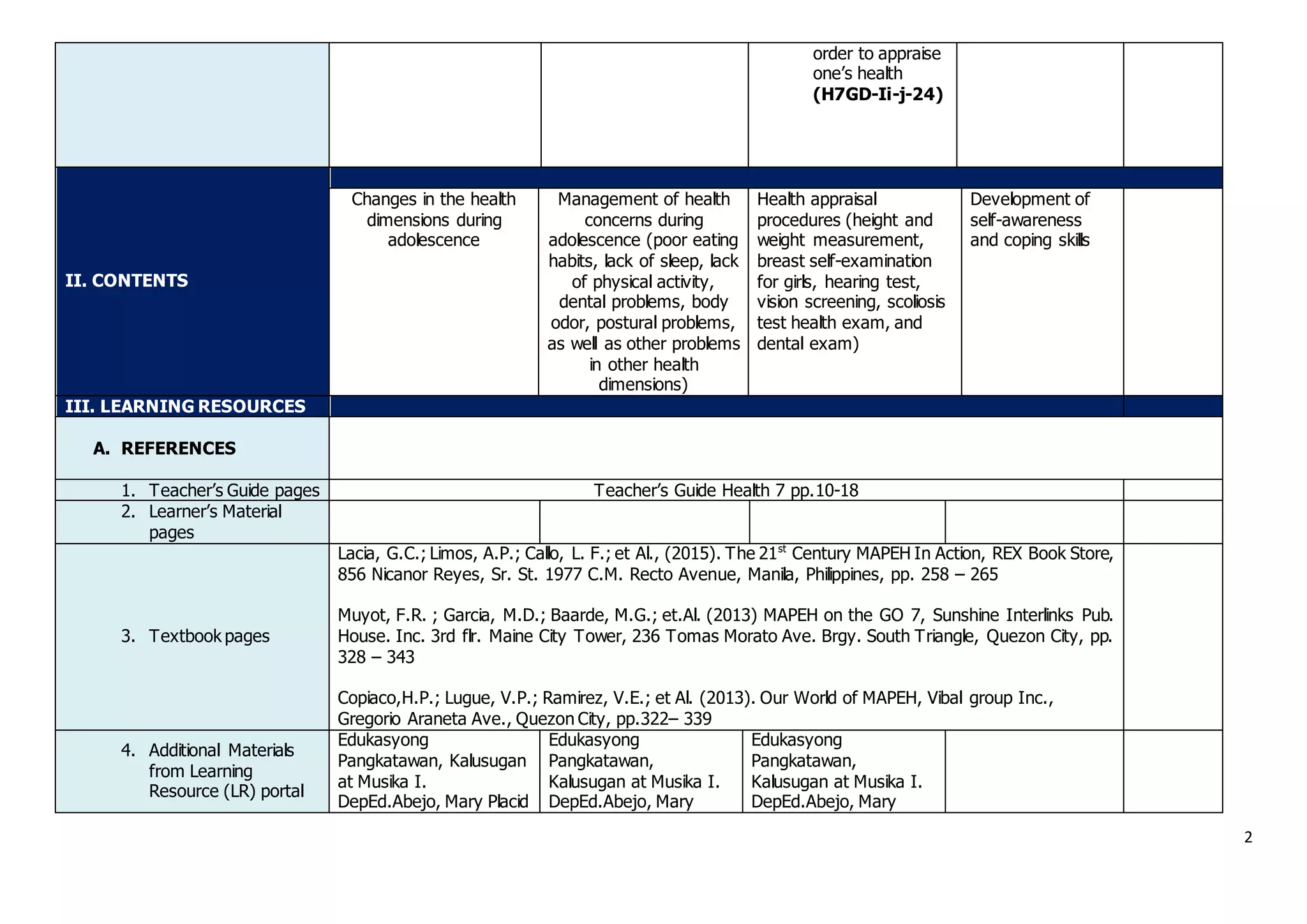
2
order to appraise
one’s health
(H7GD-Ii-j-24)
II. CONTENTS
Changes in the health
dimensions during
adolescence
Management of health
concerns during
adolescence (poor eating
habits, lack of sleep, lack
of physical activity,
dental problems, body
odor, postural problems,
as well as other problems
in other health
dimensions)
Health appraisal
procedures (height and
weight measurement,
breast self-examination
for girls, hearing test,
vision screening, scoliosis
test health exam, and
dental exam)
Development of
self-awareness
and coping skills
III. LEARNING RESOURCES
A. REFERENCES
1. Teacher’s Guide pages Teacher’s Guide Health 7 pp.10-18
2. Learner’s Material
pages
3. Textbook pages
Lacia, G.C.; Limos, A.P.; Callo, L. F.; et Al., (2015). The 21st
Century MAPEH In Action, REX Book Store,
856 Nicanor Reyes, Sr. St. 1977 C.M. Recto Avenue, Manila, Philippines, pp. 258 – 265
Muyot, F.R. ; Garcia, M.D.; Baarde, M.G.; et.Al. (2013) MAPEH on the GO 7, Sunshine Interlinks Pub.
House. Inc. 3rd flr. Maine City Tower, 236 Tomas Morato Ave. Brgy. South Triangle, Quezon City, pp.
328 – 343
Copiaco,H.P.; Lugue, V.P.; Ramirez, V.E.; et Al. (2013). Our World of MAPEH, Vibal group Inc.,
Gregorio Araneta Ave., Quezon City, pp.322– 339
4. Additional Materials
from Learning
Resource (LR) portal
Edukasyong
Pangkatawan, Kalusugan
at Musika I.
DepEd.Abejo, Mary Placid
Edukasyong
Pangkatawan,
Kalusugan at Musika I.
DepEd.Abejo, Mary
Edukasyong
Pangkatawan,
Kalusugan at Musika I.
DepEd.Abejo, Mary
3
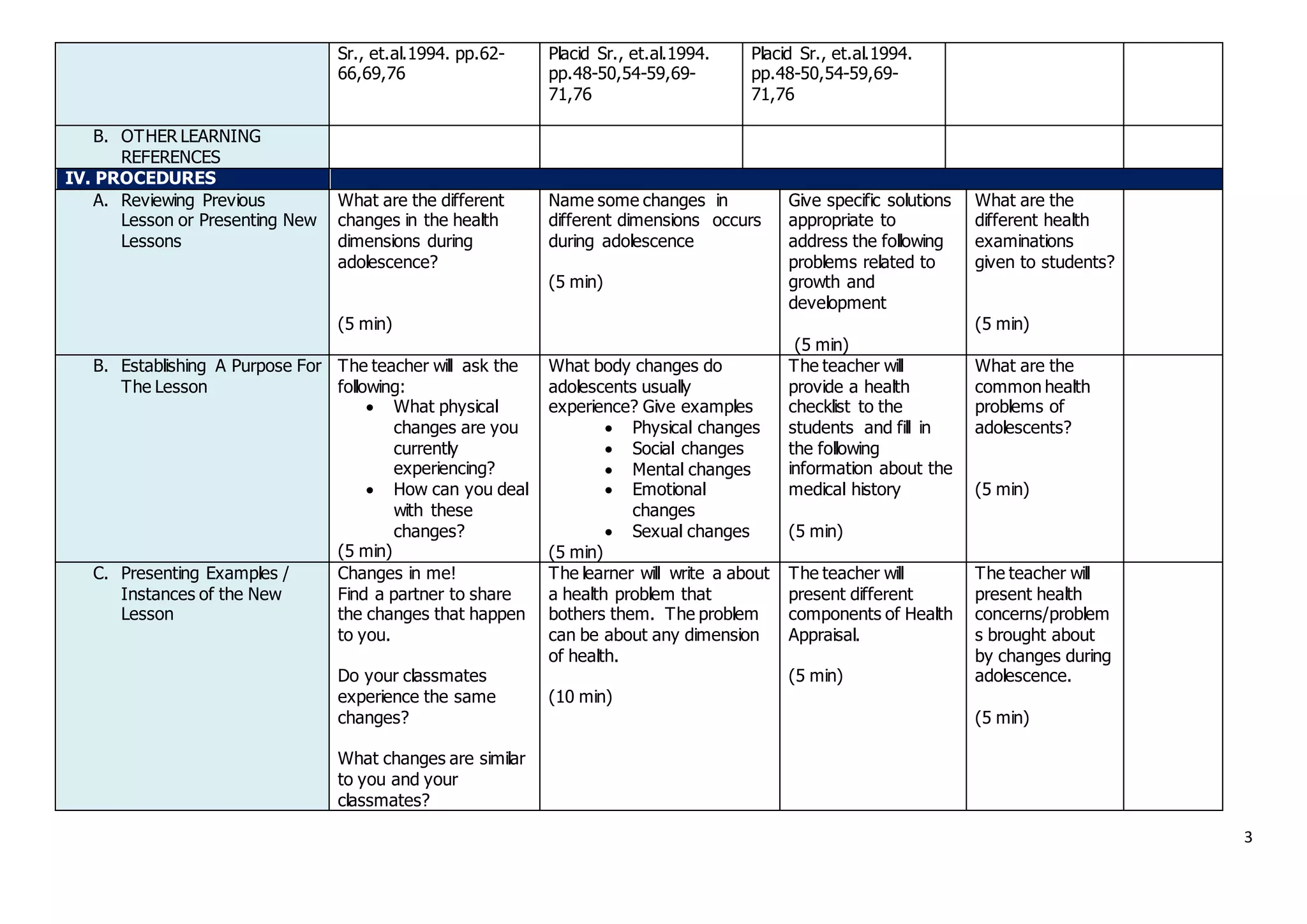
Sr., et.al.1994. pp.62-
66,69,76
Placid Sr., et.al.1994.
pp.48-50,54-59,69-
71,76
Placid Sr., et.al.1994.
pp.48-50,54-59,69-
71,76
B. OTHER LEARNING
REFERENCES
IV. PROCEDURES
A. Reviewing Previous
Lesson or Presenting New
Lessons
What are the different
changes in the health
dimensions during
adolescence?
(5 min)
Name some changes in
different dimensions occurs
during adolescence
(5 min)
Give specific solutions
appropriate to
address the following
problems related to
growth and
development
(5 min)
What are the
different health
examinations
given to students?
(5 min)
B. Establishing A Purpose For
The Lesson
The teacher will ask the
following:
 What physical
changes are you
currently
experiencing?
 How can you deal
with these
changes?
(5 min)
What body changes do
adolescents usually
experience? Give examples
 Physical changes
 Social changes
 Mental changes
 Emotional
changes
 Sexual changes
(5 min)
The teacher will
provide a health
checklist to the
students and fill in
the following
information about the
medical history
(5 min)
What are the
common health
problems of
adolescents?
(5 min)
C. Presenting Examples /
Instances of the New
Lesson
Changes in me!
Find a partner to share
the changes that happen
to you.
Do your classmates
experience the same
changes?
What changes are similar
to you and your
classmates?
The learner will write a about
a health problem that
bothers them. The problem
can be about any dimension
of health.
(10 min)
The teacher will
present different
components of Health
Appraisal.
(5 min)
The teacher will
present health
concerns/problem
s brought about
by changes during
adolescence.
(5 min)
4
(5 min)
D. Discussing New Concepts
and Practicing New Skills
# 1
The teacher will discuss
that the changes in
different dimensions are
normal during
adolescence and the
pattern of changes are
similar but the pace of
growth and development
is unique for each
adolescent
(10mins.)
Discussion on the health
concerns during adolescence
and how to manage it.
(10 min)
The teacher will
discuss the proper
health appraisal
procedures
(10 min)
The teacher will
discuss the coping
skills in dealing
with health
concerns during
adolescence
(10 min)
E. Discussing New Concepts
and Practicing New Skills
# 2
F. Developing Mastery
(Leads To Formative
Assessment 3)
Group activity
We are Growing and
Developing!
*See attachment
Let the group leaders
present the consolidated
output by groups.
What are the common
changes that happens to
boys and girls
(15 min)
Group report
Divide the class into 5
groups corresponding
to the health
concerns of
adolescence.
List down the health
concerns/problems
related to:
Group 1 Physical changes
Group 2 Social changes
Group 3 Mental changes
Group 4 Emotional changes
Group 5 Sexual changes
(10 min)
Health Appraisal
Station
Station 1: Height
taking
Station 2: Weight
taking
Station 3: Vision
testing
Station 4: Scoliosis
test
(5 min)
Cite an example
of Coping
techniques that
you can use in
ordinary life
situations.
(10 min)
5
G. Finding Practical
Applications of the
Concepts And Skills In
Daily Living
Changes in different
dimensions are normal
during adolescence.
Why can growth spurts
cause some adolescents
to feel awkward?
(5 min)
List all the possible solutions
in dealing with some health
concerns during puberty
(10min)
 Is it important
to know your
family’s health
history?
Which part of
the activity
interests you
the most?
Why?
 How are you
going to apply
the activity in
your daily live?
(10 min)
Group report
Divide the class
into 5 groups.
Each member of
the group will
share personal
experiences about
their health
problems brought
about by changes
during
adolescence.
Afterwards they
will think of the
possible ways to
overcome them
by applying the
Coping
techniques/strateg
ies.
(10 min)
H. Making Generalizations
and Abstractions About
the Lesson
The students will sum up
the lesson by filling up
the Venn Diagram on the
board
Changes – Similarities
and Differences
(5 mins.)
The students will summarize
the lesson by giving specific
solutions appropriate to
address the following health
concerns during adolescence
(5 mins)
Let the students
explain the
importance of health
appraisal in
adolescence in order
to achieve holistic
health.
(10mins.)
The students will
summarize the
lesson by
answering the
Spider Map
activity
See attachment
(5 mins.)
6
I. Evaluating Learning Fill up the chart with the
changes that occur on
female and male during
puberty.
Male Female
1.
2.
3.
4.
5.
(5 min)
Identify the health concerns
of during adolescence
 Problems with
relationships
 Lack of sleep
 Mood swing
 Adolescent girls
experience the onset
of menstruation
 Thinking skills are
develop
(5 min)
Divide the class into 5
each group will be
given situation
showing the
importance of health
examination
 Poor eyesight
 Obesity/malno
urish
 Postural
problem
 Dental
problem
 Lumps in the
breast (girls
only)
Their presentation
can be assessed
based on the
following criteria:
 Clarity of the
message
 Accuracy of
information
 Message
impact
Self-Talk Bubble
See attachment
(10 min)
J. Additional Activities for
Application and
Remediation
Interview five classmates
of the same gender. Ask
them the developmental
changes they experience.
Ask them the also the
problems they encounter.
Use a chart in presenting
your answers. Compare
Know your body Changes
 List 5 changes that
you have noticed in
your body.
 Research and explain
why these changes
happen to your body.
Create your own
Personal Health Care
Plan
See attachment
Make a scrapbook
about the changes
and problems you
go through in the
health dimensions
during puberty.
7
your experiences and
take note of similarities.
 Explain how you
should handle these
changes happening to
your body.
K. Assignment List 5 changes that you
have noticed in your
body?
Explain how you should
handle these changes
happening to your body.
List 5 health concerns
and issues of an
adolescence.
V. REMARKS
VI.REFLECTION
A. No. of Learners Who
Earned 80% In The
Evaluation
B. No. of Learners Who
Require Additional For
Remediation Who Scored
Below 80%
C. Did The Remedial Lessons
Work? No. of Learners
Who Have Caught Up
With The Lesson.
D. No. of Learners Who
Continue To Require
Remediation
E. Which of My Strategies
Worked Well? Why Did
These Work?
F. What Difficulties Did I
Encounter Which My
Principal Or Supervisor
Helped Me Solved?
G. What Innovation or
Localized Materials Did I
8
Use / Discover Which I
Wish To Share With Other
Teachers?

Q1 Grade 7 HEALTH DLL Week 2.docx

  • 1.
    1 MONDAY TUESDAY WEDNESDAYTHURSDAY FRIDAY I. OBJECTIVES A. Content standard The learners demonstrate understanding of holistic health and its management of health concerns, the growth and development of adolescents and how to manage its challenges. B. Performance standard The learners appropriately manage concerns and challenges during adolescence to achieve holistic health. C. Learning competencies/ Objectives The learners…  recognize that changes in different dimensions are normal during adolescence (H7GD-If-h-19)  explain that the pattern of change during adolescence is similar but the pace of growth and development is unique for each adolescent (H7GD-If-h-20) The learners identify health concerns during adolescence (H7GD-Ii-j-21) The learners…  explain the proper health appraisal procedures (H7GD-Ii-j-22)  demonstrate health appraisal procedures during adolescence in order to achieve holistic health (H7GD-Ii-j-23)  avails of health services in the school and community in The learners apply coping skills in dealing with health concerns during adolescence (H7GD-Ii-j-25) Daily Lesson Log in MAPEH SCHOOL CALAMBA NATIONAL HIGH SCHOOL - ANNEX GRADE LEVEL SEVEN TEACHER MS. MELODIA C. DE GUZMAN LEARNING AREA HEALTH TEACHING DATE AND TIME WEEK 2 QUARTER FIRST
  • 2.
    2 order to appraise one’shealth (H7GD-Ii-j-24) II. CONTENTS Changes in the health dimensions during adolescence Management of health concerns during adolescence (poor eating habits, lack of sleep, lack of physical activity, dental problems, body odor, postural problems, as well as other problems in other health dimensions) Health appraisal procedures (height and weight measurement, breast self-examination for girls, hearing test, vision screening, scoliosis test health exam, and dental exam) Development of self-awareness and coping skills III. LEARNING RESOURCES A. REFERENCES 1. Teacher’s Guide pages Teacher’s Guide Health 7 pp.10-18 2. Learner’s Material pages 3. Textbook pages Lacia, G.C.; Limos, A.P.; Callo, L. F.; et Al., (2015). The 21st Century MAPEH In Action, REX Book Store, 856 Nicanor Reyes, Sr. St. 1977 C.M. Recto Avenue, Manila, Philippines, pp. 258 – 265 Muyot, F.R. ; Garcia, M.D.; Baarde, M.G.; et.Al. (2013) MAPEH on the GO 7, Sunshine Interlinks Pub. House. Inc. 3rd flr. Maine City Tower, 236 Tomas Morato Ave. Brgy. South Triangle, Quezon City, pp. 328 – 343 Copiaco,H.P.; Lugue, V.P.; Ramirez, V.E.; et Al. (2013). Our World of MAPEH, Vibal group Inc., Gregorio Araneta Ave., Quezon City, pp.322– 339 4. Additional Materials from Learning Resource (LR) portal Edukasyong Pangkatawan, Kalusugan at Musika I. DepEd.Abejo, Mary Placid Edukasyong Pangkatawan, Kalusugan at Musika I. DepEd.Abejo, Mary Edukasyong Pangkatawan, Kalusugan at Musika I. DepEd.Abejo, Mary
  • 3.
    3 Sr., et.al.1994. pp.62- 66,69,76 PlacidSr., et.al.1994. pp.48-50,54-59,69- 71,76 Placid Sr., et.al.1994. pp.48-50,54-59,69- 71,76 B. OTHER LEARNING REFERENCES IV. PROCEDURES A. Reviewing Previous Lesson or Presenting New Lessons What are the different changes in the health dimensions during adolescence? (5 min) Name some changes in different dimensions occurs during adolescence (5 min) Give specific solutions appropriate to address the following problems related to growth and development (5 min) What are the different health examinations given to students? (5 min) B. Establishing A Purpose For The Lesson The teacher will ask the following:  What physical changes are you currently experiencing?  How can you deal with these changes? (5 min) What body changes do adolescents usually experience? Give examples  Physical changes  Social changes  Mental changes  Emotional changes  Sexual changes (5 min) The teacher will provide a health checklist to the students and fill in the following information about the medical history (5 min) What are the common health problems of adolescents? (5 min) C. Presenting Examples / Instances of the New Lesson Changes in me! Find a partner to share the changes that happen to you. Do your classmates experience the same changes? What changes are similar to you and your classmates? The learner will write a about a health problem that bothers them. The problem can be about any dimension of health. (10 min) The teacher will present different components of Health Appraisal. (5 min) The teacher will present health concerns/problem s brought about by changes during adolescence. (5 min)
  • 4.
    4 (5 min) D. DiscussingNew Concepts and Practicing New Skills # 1 The teacher will discuss that the changes in different dimensions are normal during adolescence and the pattern of changes are similar but the pace of growth and development is unique for each adolescent (10mins.) Discussion on the health concerns during adolescence and how to manage it. (10 min) The teacher will discuss the proper health appraisal procedures (10 min) The teacher will discuss the coping skills in dealing with health concerns during adolescence (10 min) E. Discussing New Concepts and Practicing New Skills # 2 F. Developing Mastery (Leads To Formative Assessment 3) Group activity We are Growing and Developing! *See attachment Let the group leaders present the consolidated output by groups. What are the common changes that happens to boys and girls (15 min) Group report Divide the class into 5 groups corresponding to the health concerns of adolescence. List down the health concerns/problems related to: Group 1 Physical changes Group 2 Social changes Group 3 Mental changes Group 4 Emotional changes Group 5 Sexual changes (10 min) Health Appraisal Station Station 1: Height taking Station 2: Weight taking Station 3: Vision testing Station 4: Scoliosis test (5 min) Cite an example of Coping techniques that you can use in ordinary life situations. (10 min)
  • 5.
    5 G. Finding Practical Applicationsof the Concepts And Skills In Daily Living Changes in different dimensions are normal during adolescence. Why can growth spurts cause some adolescents to feel awkward? (5 min) List all the possible solutions in dealing with some health concerns during puberty (10min)  Is it important to know your family’s health history? Which part of the activity interests you the most? Why?  How are you going to apply the activity in your daily live? (10 min) Group report Divide the class into 5 groups. Each member of the group will share personal experiences about their health problems brought about by changes during adolescence. Afterwards they will think of the possible ways to overcome them by applying the Coping techniques/strateg ies. (10 min) H. Making Generalizations and Abstractions About the Lesson The students will sum up the lesson by filling up the Venn Diagram on the board Changes – Similarities and Differences (5 mins.) The students will summarize the lesson by giving specific solutions appropriate to address the following health concerns during adolescence (5 mins) Let the students explain the importance of health appraisal in adolescence in order to achieve holistic health. (10mins.) The students will summarize the lesson by answering the Spider Map activity See attachment (5 mins.)
  • 6.
    6 I. Evaluating LearningFill up the chart with the changes that occur on female and male during puberty. Male Female 1. 2. 3. 4. 5. (5 min) Identify the health concerns of during adolescence  Problems with relationships  Lack of sleep  Mood swing  Adolescent girls experience the onset of menstruation  Thinking skills are develop (5 min) Divide the class into 5 each group will be given situation showing the importance of health examination  Poor eyesight  Obesity/malno urish  Postural problem  Dental problem  Lumps in the breast (girls only) Their presentation can be assessed based on the following criteria:  Clarity of the message  Accuracy of information  Message impact Self-Talk Bubble See attachment (10 min) J. Additional Activities for Application and Remediation Interview five classmates of the same gender. Ask them the developmental changes they experience. Ask them the also the problems they encounter. Use a chart in presenting your answers. Compare Know your body Changes  List 5 changes that you have noticed in your body.  Research and explain why these changes happen to your body. Create your own Personal Health Care Plan See attachment Make a scrapbook about the changes and problems you go through in the health dimensions during puberty.
  • 7.
    7 your experiences and takenote of similarities.  Explain how you should handle these changes happening to your body. K. Assignment List 5 changes that you have noticed in your body? Explain how you should handle these changes happening to your body. List 5 health concerns and issues of an adolescence. V. REMARKS VI.REFLECTION A. No. of Learners Who Earned 80% In The Evaluation B. No. of Learners Who Require Additional For Remediation Who Scored Below 80% C. Did The Remedial Lessons Work? No. of Learners Who Have Caught Up With The Lesson. D. No. of Learners Who Continue To Require Remediation E. Which of My Strategies Worked Well? Why Did These Work? F. What Difficulties Did I Encounter Which My Principal Or Supervisor Helped Me Solved? G. What Innovation or Localized Materials Did I
  • 8.
    8 Use / DiscoverWhich I Wish To Share With Other Teachers?