Python For BIG DATA ANALYTICS 
View Mastering Python course details at http://www.edureka.co/python 
For Queries: 
Post on Twitter @edurekaIN: #askEdureka 
Post on Facebook /edurekaIN 
For more details please contact us: 
US : 1800 275 9730 (toll free) 
INDIA : +91 88808 62004 
Email Us : sales@edureka.co
Objectives 
At the end of this module, you will be able to 
 Understand Python 
 Understand Web Scrapping example using Python 
 Understand PyDoop: Python API for Hadoop 
 Implement Word Count example in Pydoop 
 Integrate Data Science with Python 
 Implement Zombie Invasion modeling using Python 
Slide 2 www.edureka.co/python
Why Python? 
 Python is a great language for the beginner programmers since it is easy-to-learn and easy-to-maintain. 
 Python’s biggest strength is that the bulk of it’s library is portable. It also supports GUI Programming and 
can be used to create Applications portable on Mac, Windows and Unix X-Windows system. 
 With libraries like PyDoop and SciPy, it’s a dream come true for Big Data Analytics. 
Slide 3 www.edureka.co/python
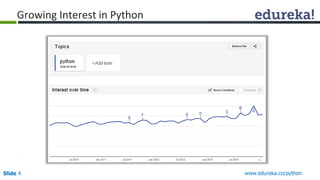
Growing Interest in Python 
Slide 4 www.edureka.co/python
Demo: Web Scraping using Python 
 This example demonstrates how to scrape basic financial data from IMDB webpage 
 We shall use open source web scraping framework for Python called Beautiful Soup to crawl and 
extract data from webpages 
 Scraping is used for a wide range of purposes, from data mining to monitoring and automated testing 
Slide 5 www.edureka.co/python
Demo: Collecting Tweets using Python 
 This example demonstrates how to extract historical tweets for a particular brand like “nike” or “apple” 
 We shall make a REST API call to twitter to extract tweets 
 This data can be further used to perform sentiment analysis for a particular brand on Twitter 
Slide 6 www.edureka.co/python
Big Data 
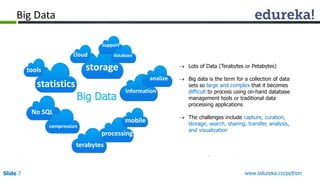
 Lots of Data (Terabytes or Petabytes) 
 Big data is the term for a collection of data 
sets so large and complex that it becomes 
difficult to process using on-hand database 
management tools or traditional data 
processing applications 
 The challenges include capture, curation, 
storage, search, sharing, transfer, analysis, 
and visualization 
cloud 
tools 
statistics 
No SQL 
Big Data 
compression 
support 
database 
storage 
analize 
information 
mobile 
processing 
terabytes 
Slide 7 www.edureka.co/python
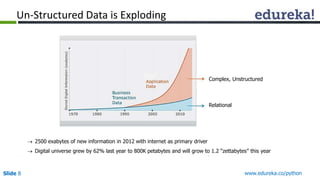
Un-Structured Data is Exploding 
Complex, Unstructured 
Relational 
 2500 exabytes of new information in 2012 with internet as primary driver 
 Digital universe grew by 62% last year to 800K petabytes and will grow to 1.2 “zettabytes” this year 
Slide 8 www.edureka.co/python
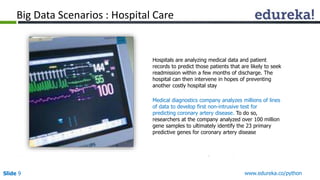
Big Data Scenarios : Hospital Care 
Hospitals are analyzing medical data and patient 
records to predict those patients that are likely to seek 
readmission within a few months of discharge. The 
hospital can then intervene in hopes of preventing 
another costly hospital stay 
Medical diagnostics company analyzes millions of lines 
of data to develop first non-intrusive test for 
predicting coronary artery disease. To do so, 
researchers at the company analyzed over 100 million 
gene samples to ultimately identify the 23 primary 
predictive genes for coronary artery disease 
Slide 9 www.edureka.co/python
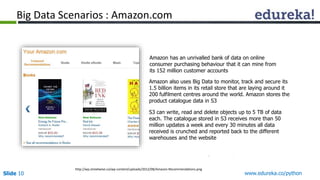
Big Data Scenarios : Amazon.com 
Amazon has an unrivalled bank of data on online 
consumer purchasing behaviour that it can mine from 
its 152 million customer accounts 
Amazon also uses Big Data to monitor, track and secure its 
1.5 billion items in its retail store that are laying around it 
200 fulfilment centres around the world. Amazon stores the 
product catalogue data in S3 
S3 can write, read and delete objects up to 5 TB of data 
each. The catalogue stored in S3 receives more than 50 
million updates a week and every 30 minutes all data 
received is crunched and reported back to the different 
warehouses and the website 
http://wp.streetwise.co/wp-content/uploads/2012/08/Amazon-Recommendations.png 
Slide 10 www.edureka.co/python
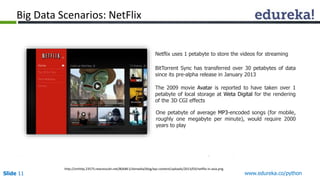
Netflix uses 1 petabyte to store the videos for streaming 
BitTorrent Sync has transferred over 30 petabytes of data 
since its pre-alpha release in January 2013 
The 2009 movie Avatar is reported to have taken over 1 
petabyte of local storage at Weta Digital for the rendering 
of the 3D CGI effects 
One petabyte of average MP3-encoded songs (for mobile, 
roughly one megabyte per minute), would require 2000 
years to play 
Big Data Scenarios: NetFlix 
http://smhttp.23575.nexcesscdn.net/80ABE1/sbmedia/blog/wp-content/uploads/2013/03/netflix-in-asia.png 
Slide 11 www.edureka.co/python
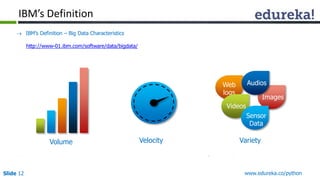
IBM’s Definition 
 IBM’s Definition – Big Data Characteristics 
http://www-01.ibm.com/software/data/bigdata/ 
Web 
logs 
Audios 
Images 
Videos 
Sensor 
Data 
Volume Velocity Variety 
Slide 12 www.edureka.co/python
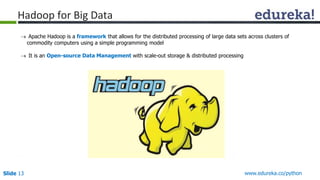
Hadoop for Big Data 
 Apache Hadoop is a framework that allows for the distributed processing of large data sets across clusters of 
commodity computers using a simple programming model 
 It is an Open-source Data Management with scale-out storage & distributed processing 
Slide 13 www.edureka.co/python
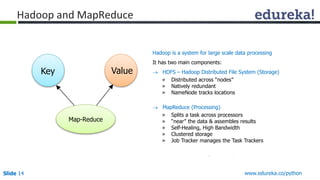
Hadoop and MapReduce 
Hadoop is a system for large scale data processing 
It has two main components: 
 HDFS – Hadoop Distributed File System (Storage) 
» Distributed across “nodes” 
» Natively redundant 
» NameNode tracks locations 
 MapReduce (Processing) 
» Splits a task across processors 
» “near” the data & assembles results 
» Self-Healing, High Bandwidth 
» Clustered storage 
» Job Tracker manages the Task Trackers 
Key Value 
Map-Reduce 
Slide 14 www.edureka.co/python
PyDoop – Hadoop with Python 
Python can be used to write Hadoop MapReduce programs and applications to access HDFS API for Hadoop with 
PyDoop package 
 PyDoop package provides a Python API for Hadoop MapReduce and 
HDFS 
 PyDoop has several advantages over Hadoop’s built-in solutions for 
Python programming, i.e., Hadoop Streaming and Jython 
 One of the biggest advantage of PyDoop is it’s HDFS API. This 
allows you to connect to an HDFS installation, read and write files, and 
get information on files, directories and global file system properties 
 The MapReduce API of PyDoop allows you to solve many complex 
problems with minimal programming efforts. Advance MapReduce 
concepts such as ‘Counters’ and ‘Record Readers’ can be implemented 
in Python using PyDoop 
Slide 15 www.edureka.co/python
Demo: Word Count using Hadoop Streaming API 
 The example shows the simple word count application written in Python 
 We shall use Hadoop Streaming APIs to run MapReduce code written in Python 
 Word Count application can be used to index text documents/files for a given “search query” 
Slide 16 www.edureka.co/python
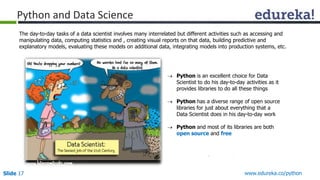
Python and Data Science 
The day-to-day tasks of a data scientist involves many interrelated but different activities such as accessing and 
manipulating data, computing statistics and , creating visual reports on that data, building predictive and 
explanatory models, evaluating these models on additional data, integrating models into production systems, etc. 
 Python is an excellent choice for Data 
Scientist to do his day-to-day activities as it 
provides libraries to do all these things 
 Python has a diverse range of open source 
libraries for just about everything that a 
Data Scientist does in his day-to-day work 
 Python and most of its libraries are both 
open source and free 
Slide 17 www.edureka.co/python
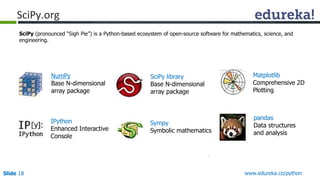
SciPy.org 
SciPy (pronounced “Sigh Pie”) is a Python-based ecosystem of open-source software for mathematics, science, and 
engineering. 
NumPy 
Base N-dimensional 
array package 
IPython 
Enhanced Interactive 
Console 
SciPy library 
Base N-dimensional 
array package 
Sympy 
Symbolic mathematics 
Matplotlib 
Comprehensive 2D 
Plotting 
pandas 
Data structures 
and analysis 
Slide 18 www.edureka.co/python
Demo: Zombie Invasion Model 
This is a lighthearted example, a system of ODEs(Ordinary differential equations) can be used to model a "zombie 
invasion", using the equations specified by Philip Munz. 
The system is given as: 
dS/dt = P - B*S*Z - d*S 
dZ/dt = B*S*Z + G*R - A*S*Z 
dR/dt = d*S + A*S*Z - G*R 
Where: 
S: the number of susceptible victims 
Z: the number of zombies 
R: the number of people "killed” 
P: the population birth rate 
d: the chance of a natural death 
B: the chance the "zombie disease" is transmitted (an alive person becomes a zombie) 
G: the chance a dead person is resurrected into a zombie 
A: the chance a zombie is totally destroyed 
There are three scenarios given in the program to show how Zombie Apocalypse vary with different initial 
conditions. 
This involves solving a system of first order ODEs given by: dy/dt = f(y, t) Where y = [S, Z, R]. 
Slide 19 www.edureka.co/python
Questions 
Slide 20 Twitter @edurekaIN, Facebook /edurekaIN, use #askEdureka for Questions www.edureka.co/python
Slide 21 Course Url

Webinar: Mastering Python - An Excellent tool for Web Scraping and Data Analysis

  • 1.
    Python For BIGDATA ANALYTICS View Mastering Python course details at http://www.edureka.co/python For Queries: Post on Twitter @edurekaIN: #askEdureka Post on Facebook /edurekaIN For more details please contact us: US : 1800 275 9730 (toll free) INDIA : +91 88808 62004 Email Us : sales@edureka.co
  • 2.
    Objectives At theend of this module, you will be able to  Understand Python  Understand Web Scrapping example using Python  Understand PyDoop: Python API for Hadoop  Implement Word Count example in Pydoop  Integrate Data Science with Python  Implement Zombie Invasion modeling using Python Slide 2 www.edureka.co/python
  • 3.
    Why Python? Python is a great language for the beginner programmers since it is easy-to-learn and easy-to-maintain.  Python’s biggest strength is that the bulk of it’s library is portable. It also supports GUI Programming and can be used to create Applications portable on Mac, Windows and Unix X-Windows system.  With libraries like PyDoop and SciPy, it’s a dream come true for Big Data Analytics. Slide 3 www.edureka.co/python
  • 4.
    Growing Interest inPython Slide 4 www.edureka.co/python
  • 5.
    Demo: Web Scrapingusing Python  This example demonstrates how to scrape basic financial data from IMDB webpage  We shall use open source web scraping framework for Python called Beautiful Soup to crawl and extract data from webpages  Scraping is used for a wide range of purposes, from data mining to monitoring and automated testing Slide 5 www.edureka.co/python
  • 6.
    Demo: Collecting Tweetsusing Python  This example demonstrates how to extract historical tweets for a particular brand like “nike” or “apple”  We shall make a REST API call to twitter to extract tweets  This data can be further used to perform sentiment analysis for a particular brand on Twitter Slide 6 www.edureka.co/python
  • 7.
    Big Data Lots of Data (Terabytes or Petabytes)  Big data is the term for a collection of data sets so large and complex that it becomes difficult to process using on-hand database management tools or traditional data processing applications  The challenges include capture, curation, storage, search, sharing, transfer, analysis, and visualization cloud tools statistics No SQL Big Data compression support database storage analize information mobile processing terabytes Slide 7 www.edureka.co/python
  • 8.
    Un-Structured Data isExploding Complex, Unstructured Relational  2500 exabytes of new information in 2012 with internet as primary driver  Digital universe grew by 62% last year to 800K petabytes and will grow to 1.2 “zettabytes” this year Slide 8 www.edureka.co/python
  • 9.
    Big Data Scenarios: Hospital Care Hospitals are analyzing medical data and patient records to predict those patients that are likely to seek readmission within a few months of discharge. The hospital can then intervene in hopes of preventing another costly hospital stay Medical diagnostics company analyzes millions of lines of data to develop first non-intrusive test for predicting coronary artery disease. To do so, researchers at the company analyzed over 100 million gene samples to ultimately identify the 23 primary predictive genes for coronary artery disease Slide 9 www.edureka.co/python
  • 10.
    Big Data Scenarios: Amazon.com Amazon has an unrivalled bank of data on online consumer purchasing behaviour that it can mine from its 152 million customer accounts Amazon also uses Big Data to monitor, track and secure its 1.5 billion items in its retail store that are laying around it 200 fulfilment centres around the world. Amazon stores the product catalogue data in S3 S3 can write, read and delete objects up to 5 TB of data each. The catalogue stored in S3 receives more than 50 million updates a week and every 30 minutes all data received is crunched and reported back to the different warehouses and the website http://wp.streetwise.co/wp-content/uploads/2012/08/Amazon-Recommendations.png Slide 10 www.edureka.co/python
  • 11.
    Netflix uses 1petabyte to store the videos for streaming BitTorrent Sync has transferred over 30 petabytes of data since its pre-alpha release in January 2013 The 2009 movie Avatar is reported to have taken over 1 petabyte of local storage at Weta Digital for the rendering of the 3D CGI effects One petabyte of average MP3-encoded songs (for mobile, roughly one megabyte per minute), would require 2000 years to play Big Data Scenarios: NetFlix http://smhttp.23575.nexcesscdn.net/80ABE1/sbmedia/blog/wp-content/uploads/2013/03/netflix-in-asia.png Slide 11 www.edureka.co/python
  • 12.
    IBM’s Definition IBM’s Definition – Big Data Characteristics http://www-01.ibm.com/software/data/bigdata/ Web logs Audios Images Videos Sensor Data Volume Velocity Variety Slide 12 www.edureka.co/python
  • 13.
    Hadoop for BigData  Apache Hadoop is a framework that allows for the distributed processing of large data sets across clusters of commodity computers using a simple programming model  It is an Open-source Data Management with scale-out storage & distributed processing Slide 13 www.edureka.co/python
  • 14.
    Hadoop and MapReduce Hadoop is a system for large scale data processing It has two main components:  HDFS – Hadoop Distributed File System (Storage) » Distributed across “nodes” » Natively redundant » NameNode tracks locations  MapReduce (Processing) » Splits a task across processors » “near” the data & assembles results » Self-Healing, High Bandwidth » Clustered storage » Job Tracker manages the Task Trackers Key Value Map-Reduce Slide 14 www.edureka.co/python
  • 15.
    PyDoop – Hadoopwith Python Python can be used to write Hadoop MapReduce programs and applications to access HDFS API for Hadoop with PyDoop package  PyDoop package provides a Python API for Hadoop MapReduce and HDFS  PyDoop has several advantages over Hadoop’s built-in solutions for Python programming, i.e., Hadoop Streaming and Jython  One of the biggest advantage of PyDoop is it’s HDFS API. This allows you to connect to an HDFS installation, read and write files, and get information on files, directories and global file system properties  The MapReduce API of PyDoop allows you to solve many complex problems with minimal programming efforts. Advance MapReduce concepts such as ‘Counters’ and ‘Record Readers’ can be implemented in Python using PyDoop Slide 15 www.edureka.co/python
  • 16.
    Demo: Word Countusing Hadoop Streaming API  The example shows the simple word count application written in Python  We shall use Hadoop Streaming APIs to run MapReduce code written in Python  Word Count application can be used to index text documents/files for a given “search query” Slide 16 www.edureka.co/python
  • 17.
    Python and DataScience The day-to-day tasks of a data scientist involves many interrelated but different activities such as accessing and manipulating data, computing statistics and , creating visual reports on that data, building predictive and explanatory models, evaluating these models on additional data, integrating models into production systems, etc.  Python is an excellent choice for Data Scientist to do his day-to-day activities as it provides libraries to do all these things  Python has a diverse range of open source libraries for just about everything that a Data Scientist does in his day-to-day work  Python and most of its libraries are both open source and free Slide 17 www.edureka.co/python
  • 18.
    SciPy.org SciPy (pronounced“Sigh Pie”) is a Python-based ecosystem of open-source software for mathematics, science, and engineering. NumPy Base N-dimensional array package IPython Enhanced Interactive Console SciPy library Base N-dimensional array package Sympy Symbolic mathematics Matplotlib Comprehensive 2D Plotting pandas Data structures and analysis Slide 18 www.edureka.co/python
  • 19.
    Demo: Zombie InvasionModel This is a lighthearted example, a system of ODEs(Ordinary differential equations) can be used to model a "zombie invasion", using the equations specified by Philip Munz. The system is given as: dS/dt = P - B*S*Z - d*S dZ/dt = B*S*Z + G*R - A*S*Z dR/dt = d*S + A*S*Z - G*R Where: S: the number of susceptible victims Z: the number of zombies R: the number of people "killed” P: the population birth rate d: the chance of a natural death B: the chance the "zombie disease" is transmitted (an alive person becomes a zombie) G: the chance a dead person is resurrected into a zombie A: the chance a zombie is totally destroyed There are three scenarios given in the program to show how Zombie Apocalypse vary with different initial conditions. This involves solving a system of first order ODEs given by: dy/dt = f(y, t) Where y = [S, Z, R]. Slide 19 www.edureka.co/python
  • 20.
    Questions Slide 20Twitter @edurekaIN, Facebook /edurekaIN, use #askEdureka for Questions www.edureka.co/python
  • 21.