

What will you learn today?
 Introduction to Big Data
 Why Python is popular with Big Data?
 Running MapReduce in Python
 Working with Python NLTK and Hadoop
 Demo on Zombie Invasion Model
 Data Analytics with Pandas
Big Data and Hadoop
Big Data
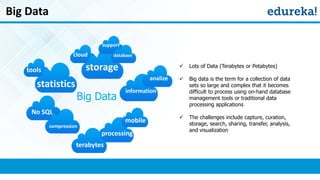
 Lots of Data (Terabytes or Petabytes)
 Big data is the term for a collection of data
sets so large and complex that it becomes
difficult to process using on-hand database
management tools or traditional data
processing applications
 The challenges include capture, curation,
storage, search, sharing, transfer, analysis,
and visualization
cloud
tools
statistics
No SQL
compression
storage
support
database
analize
information
terabytes
processing
mobile
Big Data
Un-Structured Data is Exploding
Complex, Unstructured
Relational
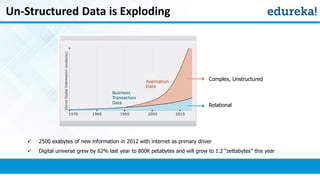
 2500 exabytes of new information in 2012 with internet as primary driver
 Digital universe grew by 62% last year to 800K petabytes and will grow to 1.2 “zettabytes” this year
Hadoop for Big Data
 Apache Hadoop is a framework that allows for the distributed processing of large data sets across clusters of
commodity computers using a simple programming model
 It is an Open-source Data Management with scale-out storage & distributed processing
Why Python With Big Data?
Why Python is popular with Big data?
 Data Cleansing / Preparation
 Writing Map Reduce Using Python
 Leveraging Analytical power of Python on Big Data Set
 With libraries like PyDoop and SciPy, it’s a dream come true for Big Data Analytics
Demo: Data Preparation / Cleaning
 Extracting Data
- Extract Data from Complex JSON for processing
 Text analytics
- Remove stop words from a text Paragraph for further processing
Demo
PyDoop – Hadoop with Python
 One of the biggest advantage of PyDoop is it’s HDFS API. This allows
you to connect to an HDFS installation, read and write files, and get
information on files, directories and global file system properties
 The MapReduce API of PyDoop allows you to solve many complex
problems with minimal programming efforts. Advance MapReduce
concepts such as ‘Counters’ and ‘Record Readers’ can be implemented
in Python using PyDoop
 Python can be used to write Hadoop MapReduce programs and applications to access HDFS API for Hadoop with
PyDoop package
Python NLTK on Hadoop
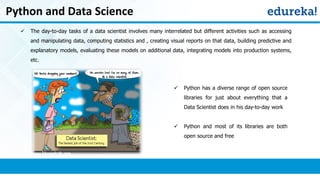
Python and Data Science
 Python has a diverse range of open source
libraries for just about everything that a
Data Scientist does in his day-to-day work
 Python and most of its libraries are both
open source and free
 The day-to-day tasks of a data scientist involves many interrelated but different activities such as accessing
and manipulating data, computing statistics and , creating visual reports on that data, building predictive and
explanatory models, evaluating these models on additional data, integrating models into production systems,
etc.
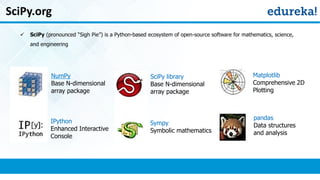
SciPy.org
 SciPy (pronounced “Sigh Pie”) is a Python-based ecosystem of open-source software for mathematics, science,
and engineering
NumPy
Base N-dimensional
array package
IPython
Enhanced Interactive
Console
SciPy library
Base N-dimensional
array package
Sympy
Symbolic mathematics
Matplotlib
Comprehensive 2D
Plotting
pandas
Data structures
and analysis
Demo: Zombie Invasion Model
 This is a lighthearted example, a system of ODEs(Ordinary differential equations) can be used to model a
"zombie invasion", using the equations specified by Philip Munz
The system is given as:
dS/dt = P - B*S*Z - d*S
dZ/dt = B*S*Z + G*R - A*S*Z
dR/dt = d*S + A*S*Z - G*R
 There are three scenarios given in the program to show how Zombie Apocalypse vary with different initial
conditions
 This involves solving a system of first order ODEs given by: dy/dt = f(y, t) Where y = [S, Z, R]
Where:
S: the number of susceptible victims
Z: the number of zombies
R: the number of people "killed”
P: the population birth rate
d: the chance of a natural death
B: the chance the "zombie disease" is transmitted (an alive person becomes a zombie)
G: the chance a dead person is resurrected into a zombie
A: the chance a zombie is totally destroyed
Demo
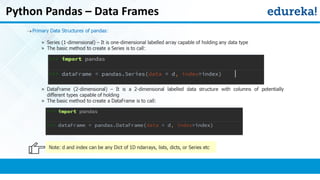
Python Pandas – Data Frames
Demo
Course Details
Become an expert in Python by Edureka
Go to www.edureka.co/python
Edureka's Mastering Python course:
• This course will cover both basic and advance concepts of Python like writing python scripts, sequence and file operations in
python, Machine Learning in Python, Web Scraping, Map Reduce in Python, Hadoop Streaming, Python UDF for Pig and Hive.
• You will also go through important and most widely used packages like pydoop, pandas, scikit, numpy, scipy etc.
• Online Live Courses: 30 hours
• Assignments: 40 hours
• Project: 20 hours
• Lifetime Access + 24 X 7 Support
Thank You
Questions/Queries/Feedback
Recording and presentation will be made available to you within 24 hours

Power of Python with Big Data

  • 2.
    What will youlearn today?  Introduction to Big Data  Why Python is popular with Big Data?  Running MapReduce in Python  Working with Python NLTK and Hadoop  Demo on Zombie Invasion Model  Data Analytics with Pandas
  • 3.
  • 4.
    Big Data  Lotsof Data (Terabytes or Petabytes)  Big data is the term for a collection of data sets so large and complex that it becomes difficult to process using on-hand database management tools or traditional data processing applications  The challenges include capture, curation, storage, search, sharing, transfer, analysis, and visualization cloud tools statistics No SQL compression storage support database analize information terabytes processing mobile Big Data
  • 5.
    Un-Structured Data isExploding Complex, Unstructured Relational  2500 exabytes of new information in 2012 with internet as primary driver  Digital universe grew by 62% last year to 800K petabytes and will grow to 1.2 “zettabytes” this year
  • 6.
    Hadoop for BigData  Apache Hadoop is a framework that allows for the distributed processing of large data sets across clusters of commodity computers using a simple programming model  It is an Open-source Data Management with scale-out storage & distributed processing
  • 7.
    Why Python WithBig Data?
  • 8.
    Why Python ispopular with Big data?  Data Cleansing / Preparation  Writing Map Reduce Using Python  Leveraging Analytical power of Python on Big Data Set  With libraries like PyDoop and SciPy, it’s a dream come true for Big Data Analytics
  • 9.
    Demo: Data Preparation/ Cleaning  Extracting Data - Extract Data from Complex JSON for processing  Text analytics - Remove stop words from a text Paragraph for further processing
  • 10.
  • 11.
    PyDoop – Hadoopwith Python  One of the biggest advantage of PyDoop is it’s HDFS API. This allows you to connect to an HDFS installation, read and write files, and get information on files, directories and global file system properties  The MapReduce API of PyDoop allows you to solve many complex problems with minimal programming efforts. Advance MapReduce concepts such as ‘Counters’ and ‘Record Readers’ can be implemented in Python using PyDoop  Python can be used to write Hadoop MapReduce programs and applications to access HDFS API for Hadoop with PyDoop package
  • 12.
  • 13.
    Python and DataScience  Python has a diverse range of open source libraries for just about everything that a Data Scientist does in his day-to-day work  Python and most of its libraries are both open source and free  The day-to-day tasks of a data scientist involves many interrelated but different activities such as accessing and manipulating data, computing statistics and , creating visual reports on that data, building predictive and explanatory models, evaluating these models on additional data, integrating models into production systems, etc.
  • 14.
    SciPy.org  SciPy (pronounced“Sigh Pie”) is a Python-based ecosystem of open-source software for mathematics, science, and engineering NumPy Base N-dimensional array package IPython Enhanced Interactive Console SciPy library Base N-dimensional array package Sympy Symbolic mathematics Matplotlib Comprehensive 2D Plotting pandas Data structures and analysis
  • 15.
    Demo: Zombie InvasionModel  This is a lighthearted example, a system of ODEs(Ordinary differential equations) can be used to model a "zombie invasion", using the equations specified by Philip Munz The system is given as: dS/dt = P - B*S*Z - d*S dZ/dt = B*S*Z + G*R - A*S*Z dR/dt = d*S + A*S*Z - G*R  There are three scenarios given in the program to show how Zombie Apocalypse vary with different initial conditions  This involves solving a system of first order ODEs given by: dy/dt = f(y, t) Where y = [S, Z, R] Where: S: the number of susceptible victims Z: the number of zombies R: the number of people "killed” P: the population birth rate d: the chance of a natural death B: the chance the "zombie disease" is transmitted (an alive person becomes a zombie) G: the chance a dead person is resurrected into a zombie A: the chance a zombie is totally destroyed
  • 16.
  • 17.
    Python Pandas –Data Frames
  • 18.
  • 19.
    Course Details Become anexpert in Python by Edureka Go to www.edureka.co/python Edureka's Mastering Python course: • This course will cover both basic and advance concepts of Python like writing python scripts, sequence and file operations in python, Machine Learning in Python, Web Scraping, Map Reduce in Python, Hadoop Streaming, Python UDF for Pig and Hive. • You will also go through important and most widely used packages like pydoop, pandas, scikit, numpy, scipy etc. • Online Live Courses: 30 hours • Assignments: 40 hours • Project: 20 hours • Lifetime Access + 24 X 7 Support
  • 20.
    Thank You Questions/Queries/Feedback Recording andpresentation will be made available to you within 24 hours