Bigdata
Presented By
P.Manoja
Contents
• What is Bigdata
• Sources of Bigdata
• What can be done with Big
data?
• Handling Bigdata
• MapReduce
• What is Hadoop?
• Why Hadoop is Useful?
• Other bigdata use cases
2
How much time did it
take?
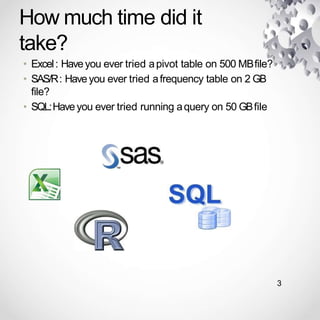
• Excel: Haveyou ever tried apivot table on 500 MBfile?
• SAS/R: Haveyou ever tried afrequency table on 2 GB
file?
• SQL:Haveyou ever tried running aquery on 50 GBfile
3
Can you think of…
• Canyou think of running aquery on 20,980,000 GB
file.
• Yes google deals with more than 20 PBdata
everyday
4
Yes….its true
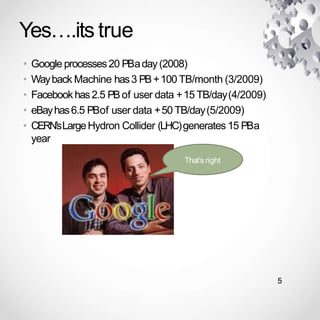
• Google processes20 PBaday(2008)
• Wayback Machine has3 PB+100 TB/month (3/2009)
• Facebookhas2.5 PBof user data +15 TB/day(4/2009)
• eBayhas6.5 PBof user data +50 TB/day(5/2009)
• CERN’sLargeHydron Collider (LHC)generates 15 PBa
year
That’s right
5
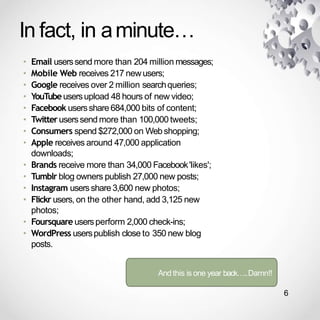
In fact, in aminute…
• Email userssend more than 204 million messages;
• Mobile Web receives 217 newusers;
• Google receives over 2 million searchqueries;
• YouTubeusersupload 48 hours of new video;
• Facebook usersshare 684,000 bits of content;
• Twitteruserssend more than 100,000 tweets;
• Consumers spend $272,000 on Webshopping;
• Apple receives around 47,000 application
downloads;
• Brands receive more than 34,000 Facebook'likes';
• Tumblr blog owners publish 27,000 new posts;
• Instagram usersshare3,600 new photos;
• Flickr users, on the other hand, add 3,125 new
photos;
• Foursquare usersperform 2,000 check-ins;
• WordPress userspublish close to 350 new blog
posts.
And this is one year back…..Damn!!
6
What is a large
file?
• If you are using a32 bit OSthen 4GBis alargefile
• Traditionally, many operating systems and their
underlying file system implementations used 32-bit
integers to represent file sizes and positions.
Consequently no file could be larger than 232-1 bytes
(4 GB).
• In many implementations the problem was
exacerbated by treating the sizes assigned
numbers, which further lowered the limit to 231-1
bytes (2GB).
• Files larger than this, too large for 32-bit operating
systems to handle, came to be known aslarge
files.
7
DefinitionofBigdata
Sorry …Thereis no single standard
definition…
8
Bigdata …
Any data that is difficultto
• Capture
• Curate
• Store
• Search
• Share
• Transfer
• Analyze
• and to createvisualizations
9
Bigdata means
• Collection of data sets solarge and complex that it
becomes difficult to process using on-hand database
management tools or traditional data processing
applications
• “Big Data” is the data whose scale, diversity, and
complexity require new architecture, techniques,
algorithms, and analytics to manage it and extract
value andhidden knowledge from it…
10
Bigdata is not just about
size
• Volume
• Data volumes are becoming unmanageable
• Variety
• Data complexity is growing. more types of data
capturedthan previously
• Velocity
• Somedata is arriving so rapidly that it must either
be processed instantly, or lost. This is awhole
subfield called “stream processing”
11
Types ofdata
• Relational Data (Tables/Transaction/Legacy
Data)
• Text Data (Web)
• Semi-structured Data (XML)
• Graph Data
• Social Network, Semantic Web (RDF), …
• Streaming Data
• Youcan only scan the data once
• Text, numerical, images, audio, video,
sequences, time series,
social media data, multi-dim arrays,etc…
12
What can be done with
Bigdata?
• Social media brand value analytics
• Product sentiment analysis
• Customer buying preference
predictions
• Video analytics
• Fraud detection
• Aggregation and Statistics
• Data warehouse and OLAP
• Indexing, Searching, and Querying
• Keyword based search
• Pattern matching (XML/RDF)
• Knowledge discovery
• Data Mining
• Statistical Modeling
13
Ok..….Analysisonthisbigdatacangiveus
awesomeinsights
But,datasetsarehuge,complexanddifficult
toprocess
Whatis thesolution?
14
Handling bigdata- Parallelcomputing
• Imagine a1gb text file, all the status updates on
Facebook inaday
• Now suppose that asimple counting of the number of
rows takes 10 minutes.
• Select count(*) from fb_status
• What do you do if you have 6 months data, a file of
size 200GB, if
you still want to find the results in 10 minutes?
• Parallel computing?
• Put multiple CPUsin amachine(100?)
• Write acode that will calculate 200 parallel counts
and finally
sums up
• But you need asuper computer
15
Handling bigdata –Is there abetter
way?
• Till 1985, There is no way to connect multiple
computers.All
systems were Centralized Systems.
• Somulti-core system or super computers were the
onlyoptions for big dataproblems
• After 1985,We have powerful microprocessors and High
Speed Computer Networks (LANs, WANs),which lead to
distributed systems
• Now that we have adistributed system that ensures a
collection of independent computers appears to its
users asa single coherent system, can we use some
cheap computers and process our bigdata quickly?
16
Distributed computing
• Wewant to cut the data into small pieces & place themon
different machines
• Divide the overall problem into small tasks & run these small
tasks locally
• Finally collate the results from localmachines
• So,we want to processour bigdata in aparallelprogramming
model and associatedimplementation.
• Thisis known as MapReduce
17
MapReduce…. Programming
Model
• Processing data using special map() and reduce()
functions
• Themap() function is called on every item in the
inputand emits aseries of intermediate key/value
pairs(Local calculation)
• All values associated with agiven key are grouped
together
• Thereduce() function is called on every unique key,
and its value list, and emits avalue that is added to
theoutput(final organization)
18
Mummy ‘s
MapReduce
19
Not just MapReduce
• Earlier count=count+1 was sufficient but now, we need
to
1. Setup acluster of machines, then divide the whole
dataset into blocks and store them in local
machines
2. Assign amaster node that takes charge of all meta
data,work scheduling and distribution, and job
orchestration
3. Assign worker slots to execute map or reduce
functions
4. Load Balance (What ifone machine is very slow in
the cluster?)
5. Fault Tolerance (What if the intermediate data is
partiallyread, but the machine fails before all
reduce(collation) operations can complete?)
6. Finally write the map reduce code that solves our
problem
20
Ok..….Analysisonbigdatacangiveusawesome
insights
But,datasetsarehuge,complexanddifficultto
process
Ifoundasolution,distributedcomputingor
MapReduce
Butlookslikethisdatastorage&parallelprocessing
iscomplicated
Whatisthesolution?
21
Hadoop
22
• Hadoop is abunch of tools, it hasmany
components.
HDFS and MapReduce are two core components of
Hadoop
• HDFS:Hadoop Distributed FileSystem
• makes our job easy tostore the data on
commodity hardware
• Built to expect hardware failures
• Intended for large files & batchinserts
• MapReduce:
• For parallel processing
• SoHadoop is asoftware platform that lets one easily
write
and run applications that processbigdata
Why Hadoop isuseful
• Scalable
• Economical
• Efficient
• Reliable
• And Hadoop is free
23
So what isHadoop?
• Hadoop is not Bigdata
• Hadoop is not adatabase
• Hadoop is a platform/framework
• Which allows the user to quickly write and test
distributed
systems
• Which is efficient in automatically distributing the
data andwork across machines
24
Ok..….Analysisonbigdatacangiveus
awesome insights
But,datasets arehuge,complex and difficult
to process
Ifoundasolution,distributedcomputingor
MapReduce
Butlooks likethisdatastorage&parallel
processing iscomplicated
Ok,IcanuseHadoopframework…..Idon’tknowJava,
howdoIwriteMapReduceprograms?
25
MapReduce made easy
• Hive:
• Hive is for data analysts with strong SQLskills providing anSQL-like
interface and arelational data model
• Hive usesalanguage called HiveQL;very similar to SQL
• Hive translates queries into aseries of MapReducejobs
• Pig:
• Pigis ahigh-level platform for processing big data onHadoop
clusters.
• Pig consists of a data flow language, called Pig Latin, supporting
writing queries on large datasets and an execution
environment running programs from aconsole
• ThePigLatin programs consist of dataset transformation series
converted under the covers, to aMapReduce program series
• Mahout
• Mahout is an open source machine-learning library facilitating
building scalable matching learning libraries
26
Bigdata use cases
27
• Ford collects and aggregates data from the 4 million vehicles
thatuse in-car
sensing and remote app management software
• The data allows to glean information on arange of issues,
from howdrivers are using their vehicles, to the driving
environment that could help them improve the quality of
thevehicle
• Amazon has been collecting customer information for years--
not just addresses and payment information but the identity
of everything that acustomer had ever bought or even
looked at.
• While dozensof other companies do that, too,Amazon’s doing
something
remarkable with theirs. They’re using that data to build
customer relationship
• Corporations and investors want to be able to track the
consumer market asclosely aspossible to signal trends
that will inform their next product launches.
• LinkedIn is abank of data not just about people, but how
people are making their money and what industries they
are working inand how they connect to eachother.
28
Thank you
29

Big Data

  • 1.
  • 2.
    Contents • What isBigdata • Sources of Bigdata • What can be done with Big data? • Handling Bigdata • MapReduce • What is Hadoop? • Why Hadoop is Useful? • Other bigdata use cases 2
  • 3.
    How much timedid it take? • Excel: Haveyou ever tried apivot table on 500 MBfile? • SAS/R: Haveyou ever tried afrequency table on 2 GB file? • SQL:Haveyou ever tried running aquery on 50 GBfile 3
  • 4.
    Can you thinkof… • Canyou think of running aquery on 20,980,000 GB file. • Yes google deals with more than 20 PBdata everyday 4
  • 5.
    Yes….its true • Googleprocesses20 PBaday(2008) • Wayback Machine has3 PB+100 TB/month (3/2009) • Facebookhas2.5 PBof user data +15 TB/day(4/2009) • eBayhas6.5 PBof user data +50 TB/day(5/2009) • CERN’sLargeHydron Collider (LHC)generates 15 PBa year That’s right 5
  • 6.
    In fact, inaminute… • Email userssend more than 204 million messages; • Mobile Web receives 217 newusers; • Google receives over 2 million searchqueries; • YouTubeusersupload 48 hours of new video; • Facebook usersshare 684,000 bits of content; • Twitteruserssend more than 100,000 tweets; • Consumers spend $272,000 on Webshopping; • Apple receives around 47,000 application downloads; • Brands receive more than 34,000 Facebook'likes'; • Tumblr blog owners publish 27,000 new posts; • Instagram usersshare3,600 new photos; • Flickr users, on the other hand, add 3,125 new photos; • Foursquare usersperform 2,000 check-ins; • WordPress userspublish close to 350 new blog posts. And this is one year back…..Damn!! 6
  • 7.
    What is alarge file? • If you are using a32 bit OSthen 4GBis alargefile • Traditionally, many operating systems and their underlying file system implementations used 32-bit integers to represent file sizes and positions. Consequently no file could be larger than 232-1 bytes (4 GB). • In many implementations the problem was exacerbated by treating the sizes assigned numbers, which further lowered the limit to 231-1 bytes (2GB). • Files larger than this, too large for 32-bit operating systems to handle, came to be known aslarge files. 7
  • 8.
    DefinitionofBigdata Sorry …Thereis nosingle standard definition… 8
  • 9.
    Bigdata … Any datathat is difficultto • Capture • Curate • Store • Search • Share • Transfer • Analyze • and to createvisualizations 9
  • 10.
    Bigdata means • Collectionof data sets solarge and complex that it becomes difficult to process using on-hand database management tools or traditional data processing applications • “Big Data” is the data whose scale, diversity, and complexity require new architecture, techniques, algorithms, and analytics to manage it and extract value andhidden knowledge from it… 10
  • 11.
    Bigdata is notjust about size • Volume • Data volumes are becoming unmanageable • Variety • Data complexity is growing. more types of data capturedthan previously • Velocity • Somedata is arriving so rapidly that it must either be processed instantly, or lost. This is awhole subfield called “stream processing” 11
  • 12.
    Types ofdata • RelationalData (Tables/Transaction/Legacy Data) • Text Data (Web) • Semi-structured Data (XML) • Graph Data • Social Network, Semantic Web (RDF), … • Streaming Data • Youcan only scan the data once • Text, numerical, images, audio, video, sequences, time series, social media data, multi-dim arrays,etc… 12
  • 13.
    What can bedone with Bigdata? • Social media brand value analytics • Product sentiment analysis • Customer buying preference predictions • Video analytics • Fraud detection • Aggregation and Statistics • Data warehouse and OLAP • Indexing, Searching, and Querying • Keyword based search • Pattern matching (XML/RDF) • Knowledge discovery • Data Mining • Statistical Modeling 13
  • 14.
  • 15.
    Handling bigdata- Parallelcomputing •Imagine a1gb text file, all the status updates on Facebook inaday • Now suppose that asimple counting of the number of rows takes 10 minutes. • Select count(*) from fb_status • What do you do if you have 6 months data, a file of size 200GB, if you still want to find the results in 10 minutes? • Parallel computing? • Put multiple CPUsin amachine(100?) • Write acode that will calculate 200 parallel counts and finally sums up • But you need asuper computer 15
  • 16.
    Handling bigdata –Isthere abetter way? • Till 1985, There is no way to connect multiple computers.All systems were Centralized Systems. • Somulti-core system or super computers were the onlyoptions for big dataproblems • After 1985,We have powerful microprocessors and High Speed Computer Networks (LANs, WANs),which lead to distributed systems • Now that we have adistributed system that ensures a collection of independent computers appears to its users asa single coherent system, can we use some cheap computers and process our bigdata quickly? 16
  • 17.
    Distributed computing • Wewantto cut the data into small pieces & place themon different machines • Divide the overall problem into small tasks & run these small tasks locally • Finally collate the results from localmachines • So,we want to processour bigdata in aparallelprogramming model and associatedimplementation. • Thisis known as MapReduce 17
  • 18.
    MapReduce…. Programming Model • Processingdata using special map() and reduce() functions • Themap() function is called on every item in the inputand emits aseries of intermediate key/value pairs(Local calculation) • All values associated with agiven key are grouped together • Thereduce() function is called on every unique key, and its value list, and emits avalue that is added to theoutput(final organization) 18
  • 19.
  • 20.
    Not just MapReduce •Earlier count=count+1 was sufficient but now, we need to 1. Setup acluster of machines, then divide the whole dataset into blocks and store them in local machines 2. Assign amaster node that takes charge of all meta data,work scheduling and distribution, and job orchestration 3. Assign worker slots to execute map or reduce functions 4. Load Balance (What ifone machine is very slow in the cluster?) 5. Fault Tolerance (What if the intermediate data is partiallyread, but the machine fails before all reduce(collation) operations can complete?) 6. Finally write the map reduce code that solves our problem 20
  • 21.
  • 22.
    Hadoop 22 • Hadoop isabunch of tools, it hasmany components. HDFS and MapReduce are two core components of Hadoop • HDFS:Hadoop Distributed FileSystem • makes our job easy tostore the data on commodity hardware • Built to expect hardware failures • Intended for large files & batchinserts • MapReduce: • For parallel processing • SoHadoop is asoftware platform that lets one easily write and run applications that processbigdata
  • 23.
    Why Hadoop isuseful •Scalable • Economical • Efficient • Reliable • And Hadoop is free 23
  • 24.
    So what isHadoop? •Hadoop is not Bigdata • Hadoop is not adatabase • Hadoop is a platform/framework • Which allows the user to quickly write and test distributed systems • Which is efficient in automatically distributing the data andwork across machines 24
  • 25.
    Ok..….Analysisonbigdatacangiveus awesome insights But,datasets arehuge,complexand difficult to process Ifoundasolution,distributedcomputingor MapReduce Butlooks likethisdatastorage&parallel processing iscomplicated Ok,IcanuseHadoopframework…..Idon’tknowJava, howdoIwriteMapReduceprograms? 25
  • 26.
    MapReduce made easy •Hive: • Hive is for data analysts with strong SQLskills providing anSQL-like interface and arelational data model • Hive usesalanguage called HiveQL;very similar to SQL • Hive translates queries into aseries of MapReducejobs • Pig: • Pigis ahigh-level platform for processing big data onHadoop clusters. • Pig consists of a data flow language, called Pig Latin, supporting writing queries on large datasets and an execution environment running programs from aconsole • ThePigLatin programs consist of dataset transformation series converted under the covers, to aMapReduce program series • Mahout • Mahout is an open source machine-learning library facilitating building scalable matching learning libraries 26
  • 27.
    Bigdata use cases 27 •Ford collects and aggregates data from the 4 million vehicles thatuse in-car sensing and remote app management software • The data allows to glean information on arange of issues, from howdrivers are using their vehicles, to the driving environment that could help them improve the quality of thevehicle • Amazon has been collecting customer information for years-- not just addresses and payment information but the identity of everything that acustomer had ever bought or even looked at. • While dozensof other companies do that, too,Amazon’s doing something remarkable with theirs. They’re using that data to build customer relationship • Corporations and investors want to be able to track the consumer market asclosely aspossible to signal trends that will inform their next product launches. • LinkedIn is abank of data not just about people, but how people are making their money and what industries they are working inand how they connect to eachother.
  • 28.
  • 29.