WEB SCRAPING
WITH PYTHON
10/2019
Applied Analytics Club
Set Up
• Google Chrome is needed to follow along with this tutorial.
• *Install the Selector Gadget Extension for Chrome as well.*
• If you haven’t done already, download and install Anaconda
Python 3 Version at:
• https://www.anaconda.com/distribution
• Next, use Terminal or Command Prompt to enter the
following, one by one:
• pip install bs4
• pip install selenium
• pip install requests
• Download all workshop materials @ ^
• In case of errors, raise your hand and we will come around. For those who have
successfully completed the install, please assist others.
bit.ly/2Mmi6vH
Contents
■ Define Scraping
■ Python Basic Components (Data Types, Functions, Containers, For Loops)
■ Applications:
– Beautiful Soup
■ Demonstration with Follow Up
■ Practice Exercise
– Selenium
■ Demonstration with Follow Up
■ Practice Exercise
■ Things to keep in mind when scraping (robots.txt)
■ Challenge Introduction
■ Q & A
Web Scraping
■ Used for extracting data from websites
■ Automates the process of gathering data
which is typically only accessible via a web
browser
■ Each website is naturally different,
therefore each requires a slightly modified
approach while scraping
■ Not everything can be scrapped
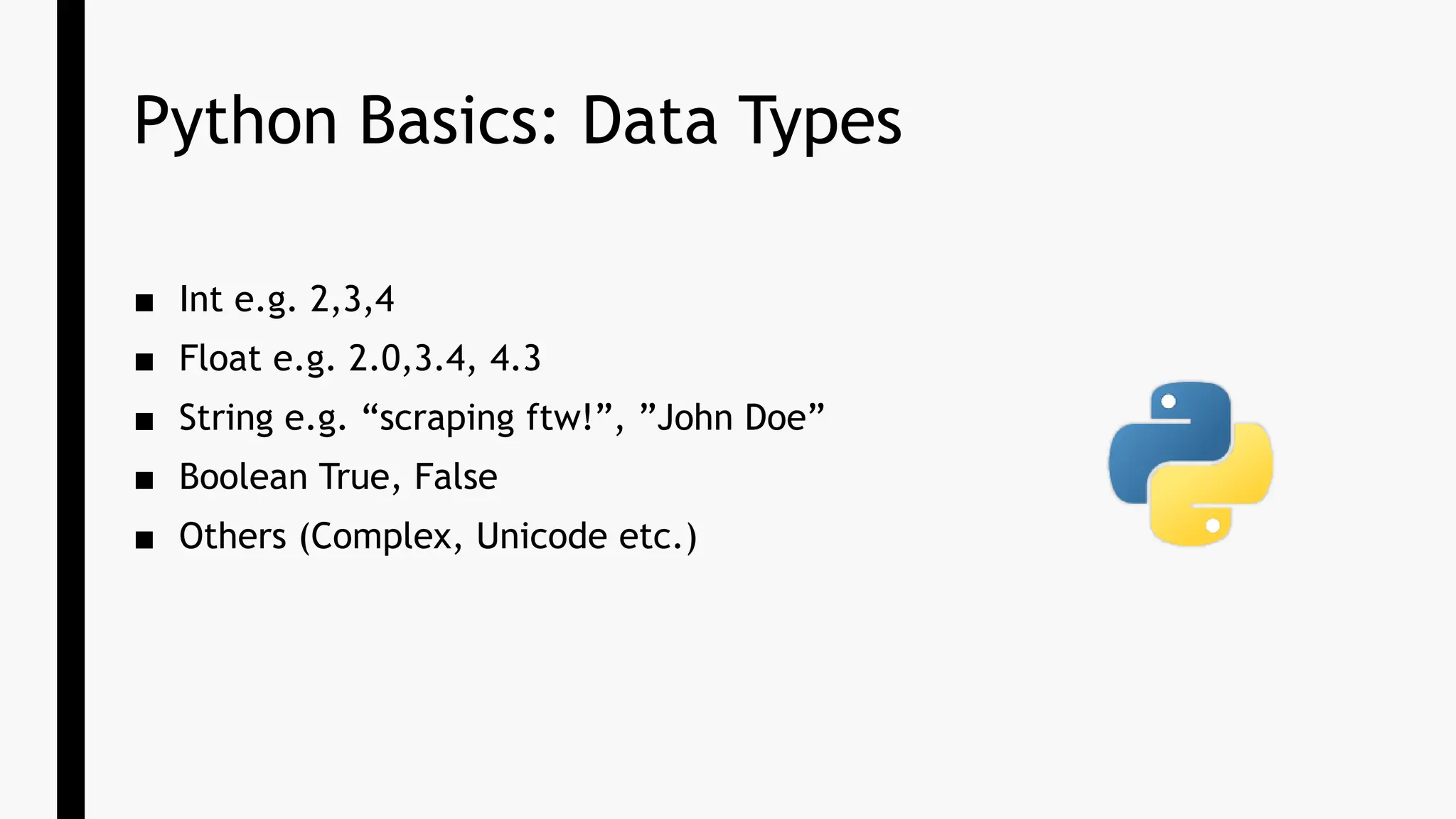
Python Basics: Data Types
■ Int e.g. 2,3,4
■ Float e.g. 2.0,3.4, 4.3
■ String e.g. “scraping ftw!”, ”John Doe”
■ Boolean True, False
■ Others (Complex, Unicode etc.)
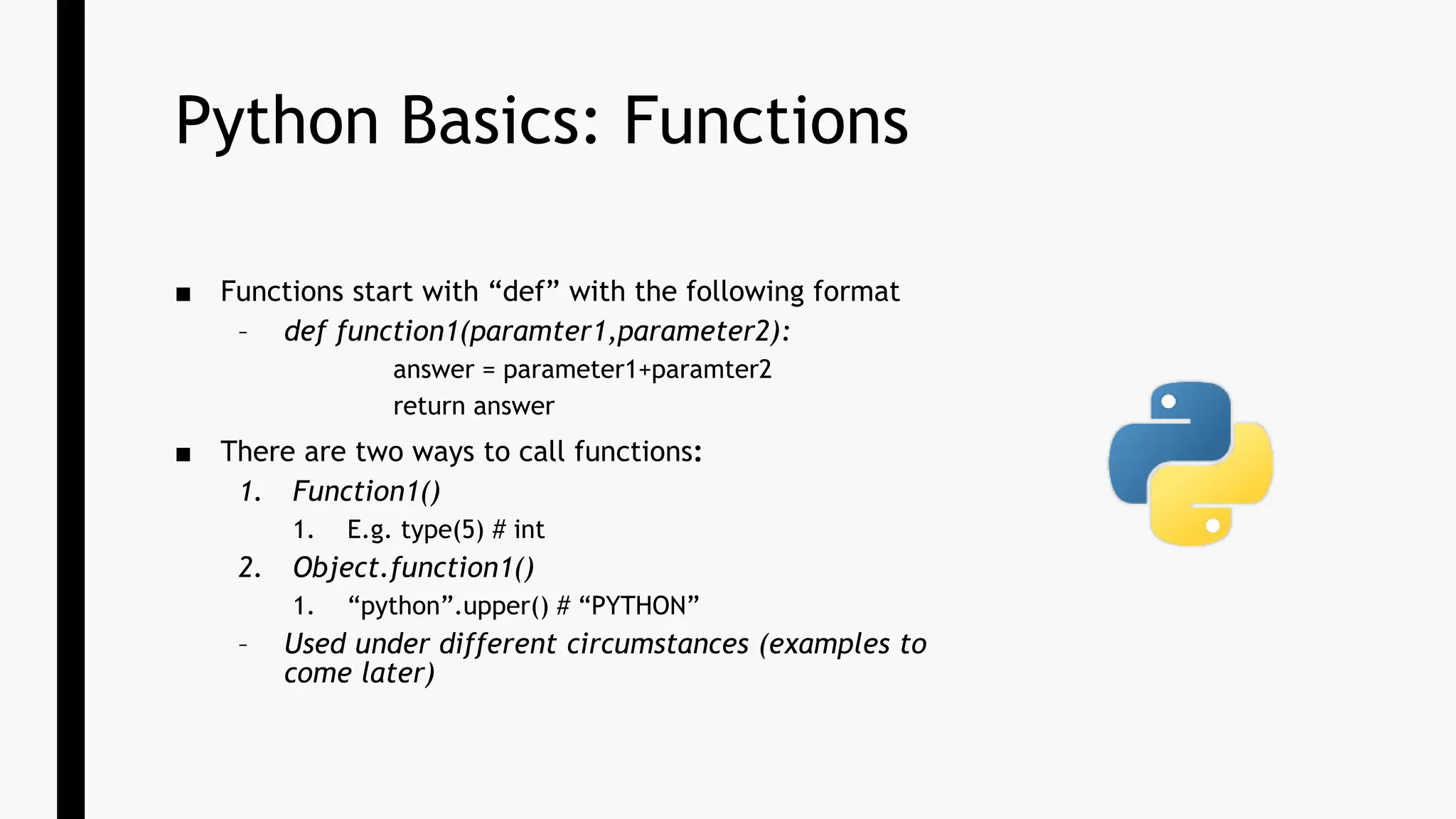
Python Basics: Functions
■ Functions start with “def” with the following format
– def function1(paramter1,parameter2):
answer = parameter1+paramter2
return answer
■ There are two ways to call functions:
1. Function1()
1. E.g. type(5) # int
2. Object.function1()
1. “python”.upper() # “PYTHON”
– Used under different circumstances (examples to
come later)
Python Basics: Lists
■ Type of data container which is used to store multiple data at the same time
■ Mutable (Can be changed)
■ Comparable to R’s vector
– E.g. list1 = [0,1,2,3,4]
■ Can contain items of varying data types
– E.g. list2 = [6,’harry’, True, 1.0]
■ Indexing starts with 0
– E.g. list2[0] = 6
■ A list can be nested in another list
– E.g. [1 , [98,109], 6, 7]
■ Call the ”append” function to add an item to a list
– E.g. list1.append(5)
Python Basics: Dictionaries
■ Collection of key-value pairs
■ Very similar to JSON objects
■ Mutable
■ E.g. dict1 = {‘r’:4,’w’:9, ‘t’:5}
■ Indexed with keys
– E.g. dict1[‘r’]
■ Keys are unique
■ Values can be lists or other nested dictionaries
■ A dictionary can also be nested into a list e.g. [{3:4,5:6}, 6,7]
Python Basics: For Loops
■ Used for iterating over a sequence (a list, a tuple, a dictionary, a set, or a
string)
■ E.g.
– cities_list = [‘hong kong”, “new york”, “miami”]
– for item in cities_list:
print(item)
# hong kong
# new york
# miami
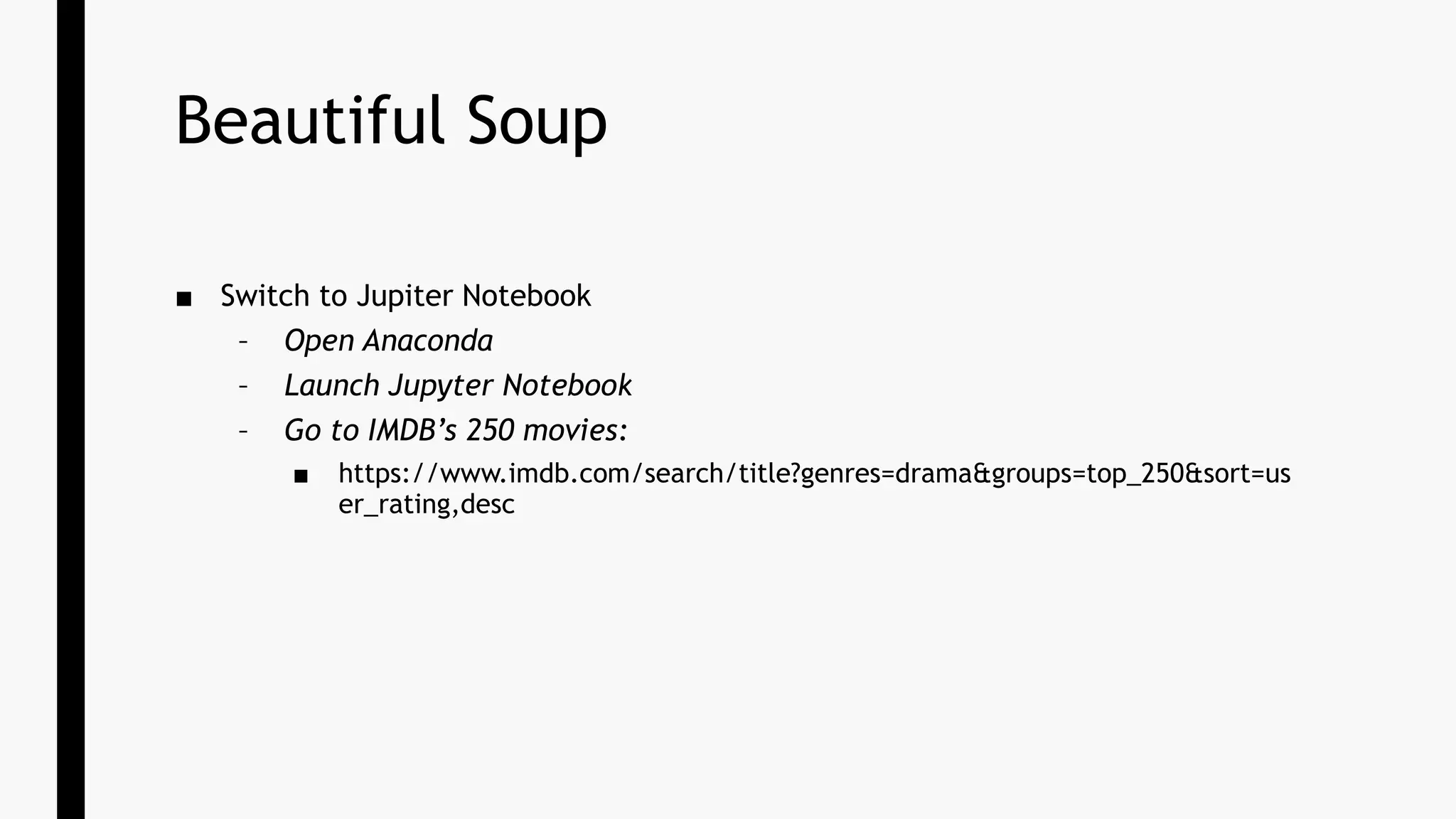
Beautiful Soup
■ Switch to Jupiter Notebook
– Open Anaconda
– Launch Jupyter Notebook
– Go to IMDB’s 250 movies:
■ https://www.imdb.com/search/title?genres=drama&groups=top_250&sort=us
er_rating,desc
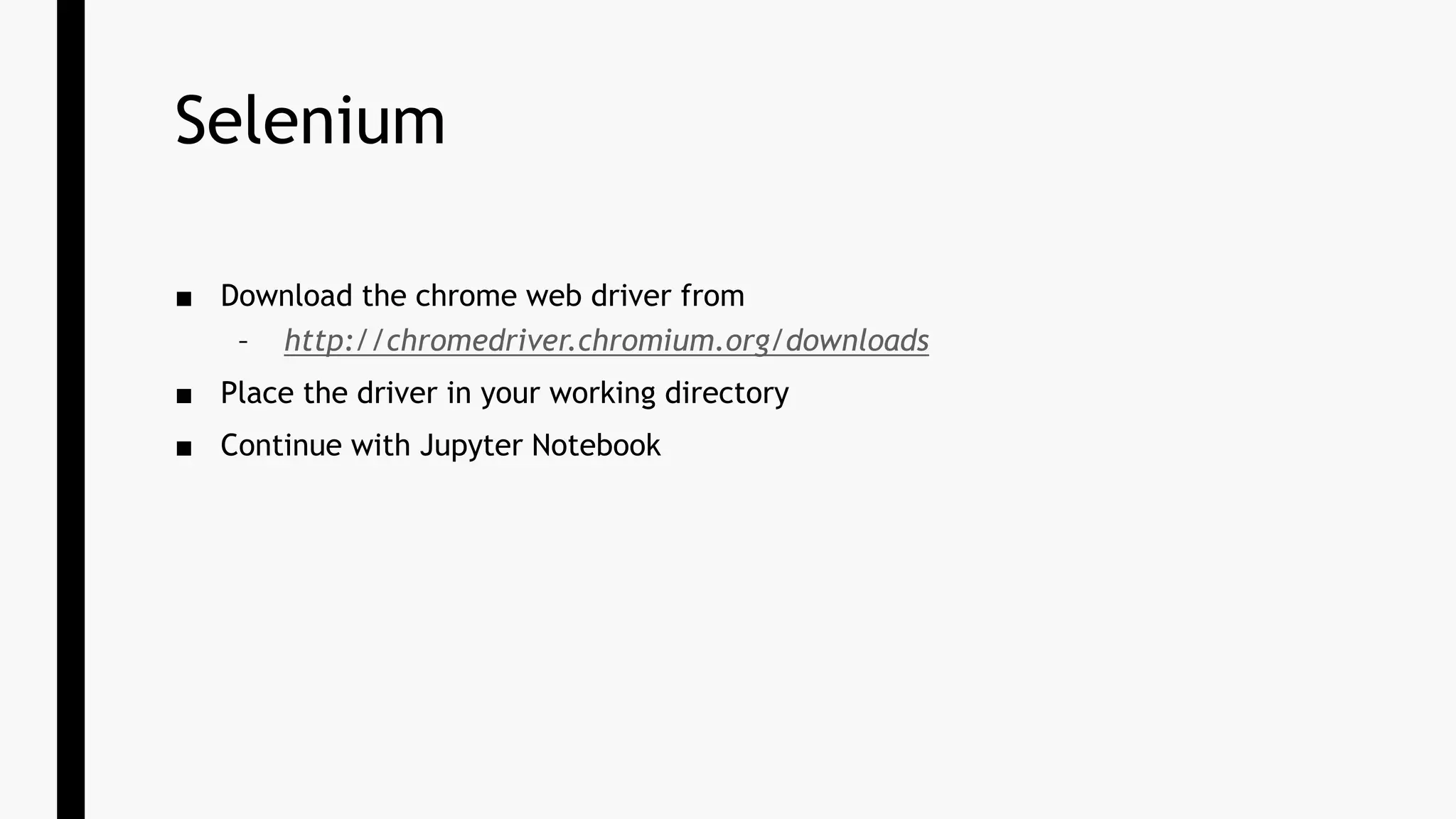
Selenium
■ Download the chrome web driver from
– http://chromedriver.chromium.org/downloads
■ Place the driver in your working directory
■ Continue with Jupyter Notebook
Scraping Ethics
■ Be respectful of websites’ permissions
■ View the website’s robots.txt file to learn which areas of the site are allowed
or disallowed from scraping
– You can access this file by replacing sitename.com in the following:
www.[sitename.com]/robots.txt
– E.g. imdb’s robots txt can be found at https://www.imdb.com/robots.txt
– You can also use https://canicrawl.com/ to check if a website allows
scrapping
■ Don’t overload website servers by sending too many requests. Use
“time.sleep(xx)” function to delay requests.
– This will also prevent your IP address from being banned
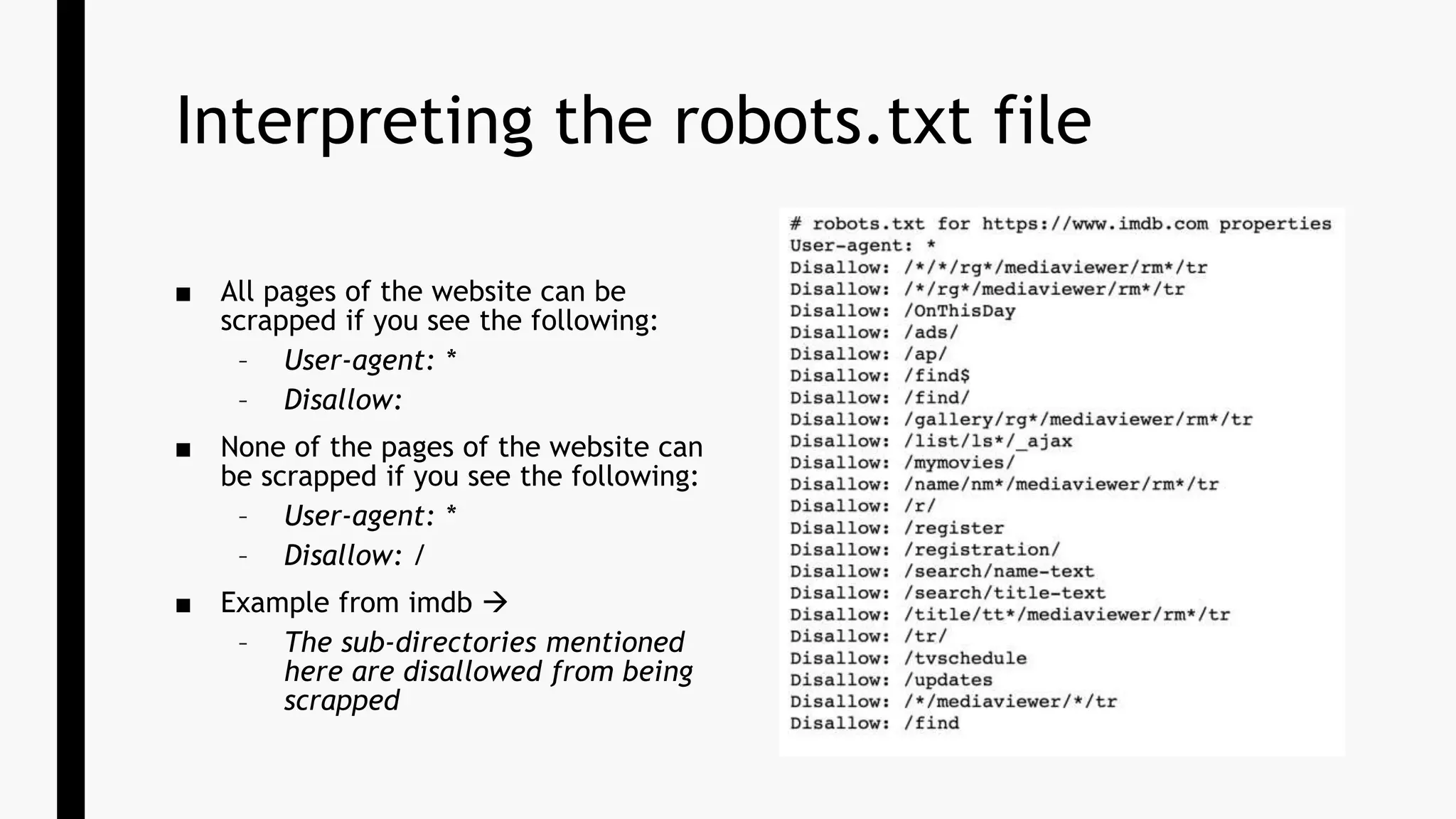
Interpreting the robots.txt file
■ All pages of the website can be
scrapped if you see the following:
– User-agent: *
– Disallow:
■ None of the pages of the website can
be scrapped if you see the following:
– User-agent: *
– Disallow: /
■ Example from imdb 
– The sub-directories mentioned
here are disallowed from being
scrapped
Take-home Challenge
■ Scrape a fictional book store: http://books.toscrape.com/?
■ Use what you have learned to create efficiently scrape the following data for
Travel, Poetry, Art, Humor and Academic books:
– Book Title
– Product Description
– Price (excl. tax)
– Number of Reviews
■ Store all of the data in a single Pandas DataFrame
■ The most efficient scraper will be awarded with a prize
■ Deadline for submissions are in a week from today, 4/18/2019 11:59pm
Resources
■ https://github.com/devkosal/scraping_tutorial
– All code provided in this lecture can be found here
■ http://toscrape.com/
– Great sample websites to perform beginner to intermediate scrapping on
■ https://www.edx.org/course/introduction-to-computer-science-and-programming-
using-python-0
– Introduction to Computer Science using Python
– Highly recommended course on learning Python and CS form scratch
■ https://www.promptcloud.com/blog/how-to-read-and-respect-robots-file/
– Further reading on interpreting robots.txt
■ https://canicrawl.com/
– Check scraping permissions for any website

Python ScrapingPresentation for dummy.pptx

  • 1.
  • 2.
    Set Up • GoogleChrome is needed to follow along with this tutorial. • *Install the Selector Gadget Extension for Chrome as well.* • If you haven’t done already, download and install Anaconda Python 3 Version at: • https://www.anaconda.com/distribution • Next, use Terminal or Command Prompt to enter the following, one by one: • pip install bs4 • pip install selenium • pip install requests • Download all workshop materials @ ^ • In case of errors, raise your hand and we will come around. For those who have successfully completed the install, please assist others. bit.ly/2Mmi6vH
  • 3.
    Contents ■ Define Scraping ■Python Basic Components (Data Types, Functions, Containers, For Loops) ■ Applications: – Beautiful Soup ■ Demonstration with Follow Up ■ Practice Exercise – Selenium ■ Demonstration with Follow Up ■ Practice Exercise ■ Things to keep in mind when scraping (robots.txt) ■ Challenge Introduction ■ Q & A
  • 4.
    Web Scraping ■ Usedfor extracting data from websites ■ Automates the process of gathering data which is typically only accessible via a web browser ■ Each website is naturally different, therefore each requires a slightly modified approach while scraping ■ Not everything can be scrapped
  • 5.
    Python Basics: DataTypes ■ Int e.g. 2,3,4 ■ Float e.g. 2.0,3.4, 4.3 ■ String e.g. “scraping ftw!”, ”John Doe” ■ Boolean True, False ■ Others (Complex, Unicode etc.)
  • 6.
    Python Basics: Functions ■Functions start with “def” with the following format – def function1(paramter1,parameter2): answer = parameter1+paramter2 return answer ■ There are two ways to call functions: 1. Function1() 1. E.g. type(5) # int 2. Object.function1() 1. “python”.upper() # “PYTHON” – Used under different circumstances (examples to come later)
  • 7.
    Python Basics: Lists ■Type of data container which is used to store multiple data at the same time ■ Mutable (Can be changed) ■ Comparable to R’s vector – E.g. list1 = [0,1,2,3,4] ■ Can contain items of varying data types – E.g. list2 = [6,’harry’, True, 1.0] ■ Indexing starts with 0 – E.g. list2[0] = 6 ■ A list can be nested in another list – E.g. [1 , [98,109], 6, 7] ■ Call the ”append” function to add an item to a list – E.g. list1.append(5)
  • 8.
    Python Basics: Dictionaries ■Collection of key-value pairs ■ Very similar to JSON objects ■ Mutable ■ E.g. dict1 = {‘r’:4,’w’:9, ‘t’:5} ■ Indexed with keys – E.g. dict1[‘r’] ■ Keys are unique ■ Values can be lists or other nested dictionaries ■ A dictionary can also be nested into a list e.g. [{3:4,5:6}, 6,7]
  • 9.
    Python Basics: ForLoops ■ Used for iterating over a sequence (a list, a tuple, a dictionary, a set, or a string) ■ E.g. – cities_list = [‘hong kong”, “new york”, “miami”] – for item in cities_list: print(item) # hong kong # new york # miami
  • 10.
    Beautiful Soup ■ Switchto Jupiter Notebook – Open Anaconda – Launch Jupyter Notebook – Go to IMDB’s 250 movies: ■ https://www.imdb.com/search/title?genres=drama&groups=top_250&sort=us er_rating,desc
  • 11.
    Selenium ■ Download thechrome web driver from – http://chromedriver.chromium.org/downloads ■ Place the driver in your working directory ■ Continue with Jupyter Notebook
  • 12.
    Scraping Ethics ■ Berespectful of websites’ permissions ■ View the website’s robots.txt file to learn which areas of the site are allowed or disallowed from scraping – You can access this file by replacing sitename.com in the following: www.[sitename.com]/robots.txt – E.g. imdb’s robots txt can be found at https://www.imdb.com/robots.txt – You can also use https://canicrawl.com/ to check if a website allows scrapping ■ Don’t overload website servers by sending too many requests. Use “time.sleep(xx)” function to delay requests. – This will also prevent your IP address from being banned
  • 13.
    Interpreting the robots.txtfile ■ All pages of the website can be scrapped if you see the following: – User-agent: * – Disallow: ■ None of the pages of the website can be scrapped if you see the following: – User-agent: * – Disallow: / ■ Example from imdb  – The sub-directories mentioned here are disallowed from being scrapped
  • 14.
    Take-home Challenge ■ Scrapea fictional book store: http://books.toscrape.com/? ■ Use what you have learned to create efficiently scrape the following data for Travel, Poetry, Art, Humor and Academic books: – Book Title – Product Description – Price (excl. tax) – Number of Reviews ■ Store all of the data in a single Pandas DataFrame ■ The most efficient scraper will be awarded with a prize ■ Deadline for submissions are in a week from today, 4/18/2019 11:59pm
  • 15.
    Resources ■ https://github.com/devkosal/scraping_tutorial – Allcode provided in this lecture can be found here ■ http://toscrape.com/ – Great sample websites to perform beginner to intermediate scrapping on ■ https://www.edx.org/course/introduction-to-computer-science-and-programming- using-python-0 – Introduction to Computer Science using Python – Highly recommended course on learning Python and CS form scratch ■ https://www.promptcloud.com/blog/how-to-read-and-respect-robots-file/ – Further reading on interpreting robots.txt ■ https://canicrawl.com/ – Check scraping permissions for any website