Introduction to 
Presented by 
Felix Homann 
@Felix11H 
felix11h.github.io/ 
Slides 
Slideshare: 
tiny.cc/pyg-into 
Source: 
tiny.cc/pyg-into-github 
References 
- Pygame website: pygame.org 
- Richard Jones' Pygame lecture: 
- recording on Youtube 
- code samples on Bitbucket 
- List of keys: 
pygame.org/docs/ref/key.html 
This work is licensed under a Creative Commons Attribution 4.0 International License.
http://www.pygame.org 
Pygame is a Python wrapper around the SDL library (Simple 
DirectMedia Layer) with a few unique libraries with an emphasis on 
game programming, written by Pete Shinners.
From the FAQ 
Does not require OpenGL 
Uses either opengl, directx, windib, X11, linux frame buer, 
and many other dierent backends... including an ASCII art 
backend! 
Truly portable 
Supports Linux, Windows, Windows CE, BeOS, MacOS, Mac 
OS X, FreeBSD, NetBSD, OpenBSD, BSD/OS, Solaris, IRIX, 
and QNX . . . 
Silliness built in!
A simple Pygame example 
1 import pygame 
2 
3 pygame.init() 
4 screen = pygame.display.set_mode((640, 480)) 
5 
6 color = [(0,0,0),(255,255,255)] 
7 running = True 
8 
9 while running: 
10 for event in pygame.event.get(): 
11 if event.type == pygame.QUIT: 
12 running = False 
13 if event.type == pygame.KEYDOWN: 
14 color[0], color[1] = color[1],color[0] 
15 
16 screen.fill(color[0]) 
17 pygame.display.flip() 
01-simple_pygame.py
What each element does: Importing  Initializing 
import pygame 
to import the Pygame module. 
from pygame.locals import * 
Optional. Puts limited set of constant and function in the global 
namespace. 
pygame.init() 
to initialize Pygame's modules (e.g. pygame.font). Not always 
needed, but recommended in any case.
What each element does: Setting Window  Screen 
screen = pygame.display.set_mode((640, 480)) 
initializes a window with dimensions 640  480 and returns the 
screen object. 
Everything to be displayed needs to be drawn on the screen.
Initializing a Pygame window 
Together: 
1 import pygame 
2 
3 pygame.init() 
4 screen = pygame.display.set_mode((640, 480)) 
02-window.py
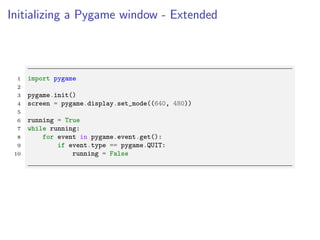
Initializing a Pygame window - Extended 
1 import pygame 
2 
3 pygame.init() 
4 screen = pygame.display.set_mode((640, 480)) 
5 
6 running = True 
7 while running: 
8 for event in pygame.event.get(): 
9 if event.type == pygame.QUIT: 
10 running = False
What each element does: The Main Loop 
1 running = True 
2 while running: 
3 for event in pygame.event.get(): 
4 if event.type == pygame.QUIT: 
5 running = False 
6 if event.type == pygame.KEYDOWN: 
7 color[0], color[1] = color[1],color[0] 
8 
9 screen.fill(color[0]) 
10 pygame.display.flip() 
is the main loop of the game. 
I listen to events ! respond 
I proceed the game 
I draw on the screen 
I stop when done
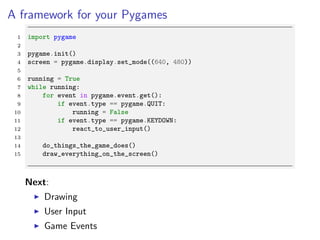
A framework for your Pygames 
1 import pygame 
2 
3 pygame.init() 
4 screen = pygame.display.set_mode((640, 480)) 
5 
6 running = True 
7 while running: 
8 for event in pygame.event.get(): 
9 if event.type == pygame.QUIT: 
10 running = False 
11 if event.type == pygame.KEYDOWN: 
12 react_to_user_input() 
13 
14 do_things_the_game_does() 
15 draw_everything_on_the_screen() 
Next: 
I Drawing 
I User Input 
I Game Events
Drawing
Drawing on the screen I 
Filling the screen with a color: 
1 blue = (0,0,255) 
2 screen.fill(blue) 
3 pygame.display.flip() 
After all drawing is done, call display.flip() to update the 
display. 
Use pygame.draw to draw geometric shapes. A circle: 
1 red = (255,0,0) 
2 # position (320,240), radius = 50 
3 pygame.draw.circle(screen, red, (320,240), 50)
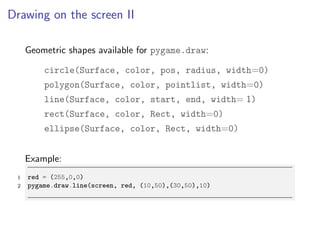
Drawing on the screen II 
Geometric shapes available for pygame.draw: 
circle(Surface, color, pos, radius, width=0) 
polygon(Surface, color, pointlist, width=0) 
line(Surface, color, start, end, width= 1) 
rect(Surface, color, Rect, width=0) 
ellipse(Surface, color, Rect, width=0) 
Example: 
1 red = (255,0,0) 
2 pygame.draw.line(screen, red, (10,50),(30,50),10)
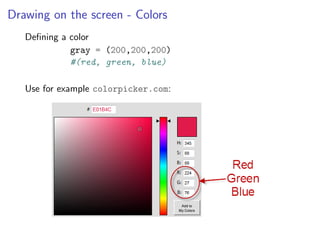
Drawing on the screen - Colors 
De
ning a color 
gray = (200,200,200) 
#(red, green, blue) 
Use for example colorpicker.com:
Drawing on the screen - Positions 
De
ning a position: 
P = (11,9) 
#(x-axis, y-axis) 
To the reference coordinate system
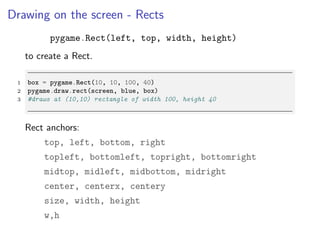
Drawing on the screen - Rects 
pygame.Rect(left, top, width, height) 
to create a Rect. 
1 box = pygame.Rect(10, 10, 100, 40) 
2 pygame.draw.rect(screen, blue, box) 
3 #draws at (10,10) rectangle of width 100, height 40 
Rect anchors: 
top, left, bottom, right 
topleft, bottomleft, topright, bottomright 
midtop, midleft, midbottom, midright 
center, centerx, centery 
size, width, height 
w,h
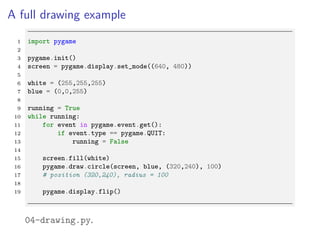
A full drawing example 
1 import pygame 
2 
3 pygame.init() 
4 screen = pygame.display.set_mode((640, 480)) 
5 
6 white = (255,255,255) 
7 blue = (0,0,255) 
8 
9 running = True 
10 while running: 
11 for event in pygame.event.get(): 
12 if event.type == pygame.QUIT: 
13 running = False 
14 
15 screen.fill(white) 
16 pygame.draw.circle(screen, blue, (320,240), 100) 
17 # position (320,240), radius = 100 
18 
19 pygame.display.flip() 
04-drawing.py.
User Input
Events 
get all events in Pygame's event queue 
pygame.event.get() 
usually used as 
1 for event in pygame.event.get(): 
2 if event.type == YourEvent: 
3 react_to_your_event()
Event types 
Some of the most important event types are: 
pygame.QUIT 
pygame.KEYDOWN 
pygame.KEYUP 
pygame.USEREVENT 
With 
from pygame.locals import * 
from earlier, pre
x pygame isn't needed.
Events 
React to KEYDOWN event: 
1 while running: 
2 for event in pygame.event.get(): 
3 if event.type == KEYDOWN: 
4 react_to_key() 
Which key? ! if event type is KEYDOWN or KEYUP event has 
attribute key. 
1 for event in pygame.event.get(): 
2 if event.type == KEYDOWN: 
3 if event.key == K_ESCAPE: 
4 running = False
Pygame Keys 
Some of the most important keys are: 
K_RETURN 
K_SPACE 
K_ESCAPE 
K_UP, K_DOWN, K_LEFT, K_RIGHT 
K_a, K_b, ... 
K_0, K_1, ... 
Full list of keys: http://www.pygame.org/docs/ref/key.html
Getting continuous input 
KEYDOWN is a unique event. 
key = pygame.key.get_pressed() 
to get keys currently pressed. 
if key[pygame.K_UP]: 
move_up() 
to check and react on a speci
c key.
A user input example 
1 color = [0,0,0] 
2 
3 while running: 
4 for event in pygame.event.get(): 
5 if event.type == pygame.QUIT: 
6 running = False 
7 if event.type == KEYDOWN and event.key == K_SPACE: 
8 color = [0,0,0] 
9 
10 keys = pygame.key.get_pressed() 
11 if keys[K_UP]: 
12 color = [(rgb+1)%256 for rgb in color] 
13 
14 screen.fill(color) 
15 pygame.display.flip() 
05-user_input.py
Pygame's Clock
Limiting the frames per second 
clock = pygame.time.Clock() 
to initialize the clock. 
In your main loop call 
clock.tick(60) #limit to 60 fps
Clock example 
1 clock = pygame.time.Clock() 
2 
3 while running: 
4 for event in pygame.event.get(): 
5 if event.type == pygame.QUIT: 
6 running = False 
7 if event.type == KEYDOWN and event.key == K_SPACE: 
8 color = [0,0,0] 
9 
10 keys = pygame.key.get_pressed() 
11 if keys[K_UP]: 
12 color = [(rgb+1)%256 for rgb in color] 
13 
14 screen.fill(color) 
15 pygame.display.flip() 
16 
17 clock.tick(60) 
06-clock.py
Game Events
Sprites 
Pygame's sprite class gives convenient options for handling 
interactive graphical objects. 
If you want to draw and move (or manipulate) and object, make it 
a sprite. 
Sprites 
can be grouped together 
are easily drawn to a surface (even as a group!) 
have an update method that can be modi
ed 
have collision detection
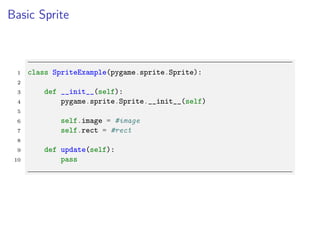
Basic Sprite 
1 class SpriteExample(pygame.sprite.Sprite): 
2 
3 def __init__(self): 
4 pygame.sprite.Sprite.__init__(self) 
5 
6 self.image = #image 
7 self.rect = #rect 
8 
9 def update(self): 
10 pass
Sprite from a local image 
1 class SpriteExample(pygame.sprite.Sprite): 
2 
3 def __init__(self): 
4 pygame.sprite.Sprite.__init__(self) 
5 
6 self.image = pygame.image.load('local_img.png') 
7 self.rect = self.image.get_rect() 
8 self.rect.topleft = (80,120) 
9 
10 def update(self): 
11 pass
Self-drawn sprites: Rectangle 
1 class Rectangle(pygame.sprite.Sprite): 
2 
3 def __init__(self): 
4 pygame.sprite.Sprite.__init__(self) 
5 self.image = pygame.Surface([200, 50]) 
6 self.image.fill(blue) 
7 self.rect = self.image.get_rect() 
8 self.rect.top, self.rect.left = 100, 100 
9 
10 def update(self): 
11 pass
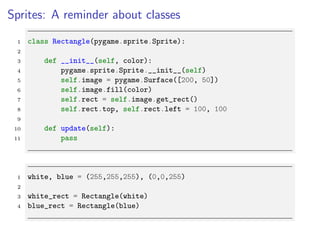
Sprites: A reminder about classes 
1 class Rectangle(pygame.sprite.Sprite): 
2 
3 def __init__(self, color): 
4 pygame.sprite.Sprite.__init__(self) 
5 self.image = pygame.Surface([200, 50]) 
6 self.image.fill(color) 
7 self.rect = self.image.get_rect() 
8 self.rect.top, self.rect.left = 100, 100 
9 
10 def update(self): 
11 pass 
1 white, blue = (255,255,255), (0,0,255) 
2 
3 white_rect = Rectangle(white) 
4 blue_rect = Rectangle(blue)
Sprite groups 
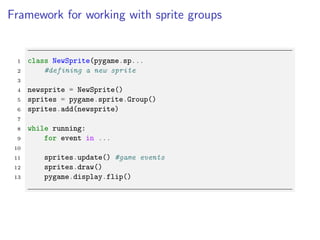
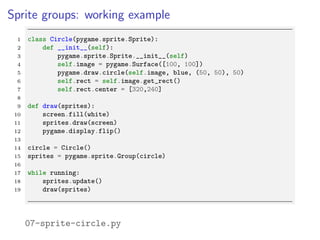
new_sprite_group = pygame.sprite.Group(sprite1) 
to create a new sprite group containing sprite sprite1. 
new_sprite_group.add(sprite2) 
to add another sprite later. 
Group updating and drawing: 
1 #inside main loop: 
2 
3 new_sprite_group.update() #game events 
4 new_sprite_group.draw() #drawing

Pygame presentation

  • 1.
    Introduction to Presentedby Felix Homann @Felix11H felix11h.github.io/ Slides Slideshare: tiny.cc/pyg-into Source: tiny.cc/pyg-into-github References - Pygame website: pygame.org - Richard Jones' Pygame lecture: - recording on Youtube - code samples on Bitbucket - List of keys: pygame.org/docs/ref/key.html This work is licensed under a Creative Commons Attribution 4.0 International License.
  • 2.
    http://www.pygame.org Pygame isa Python wrapper around the SDL library (Simple DirectMedia Layer) with a few unique libraries with an emphasis on game programming, written by Pete Shinners.
  • 3.
    From the FAQ Does not require OpenGL Uses either opengl, directx, windib, X11, linux frame buer, and many other dierent backends... including an ASCII art backend! Truly portable Supports Linux, Windows, Windows CE, BeOS, MacOS, Mac OS X, FreeBSD, NetBSD, OpenBSD, BSD/OS, Solaris, IRIX, and QNX . . . Silliness built in!
  • 4.
    A simple Pygameexample 1 import pygame 2 3 pygame.init() 4 screen = pygame.display.set_mode((640, 480)) 5 6 color = [(0,0,0),(255,255,255)] 7 running = True 8 9 while running: 10 for event in pygame.event.get(): 11 if event.type == pygame.QUIT: 12 running = False 13 if event.type == pygame.KEYDOWN: 14 color[0], color[1] = color[1],color[0] 15 16 screen.fill(color[0]) 17 pygame.display.flip() 01-simple_pygame.py
  • 5.
    What each elementdoes: Importing Initializing import pygame to import the Pygame module. from pygame.locals import * Optional. Puts limited set of constant and function in the global namespace. pygame.init() to initialize Pygame's modules (e.g. pygame.font). Not always needed, but recommended in any case.
  • 6.
    What each elementdoes: Setting Window Screen screen = pygame.display.set_mode((640, 480)) initializes a window with dimensions 640 480 and returns the screen object. Everything to be displayed needs to be drawn on the screen.
  • 7.
    Initializing a Pygamewindow Together: 1 import pygame 2 3 pygame.init() 4 screen = pygame.display.set_mode((640, 480)) 02-window.py
  • 8.
    Initializing a Pygamewindow - Extended 1 import pygame 2 3 pygame.init() 4 screen = pygame.display.set_mode((640, 480)) 5 6 running = True 7 while running: 8 for event in pygame.event.get(): 9 if event.type == pygame.QUIT: 10 running = False
  • 9.
    What each elementdoes: The Main Loop 1 running = True 2 while running: 3 for event in pygame.event.get(): 4 if event.type == pygame.QUIT: 5 running = False 6 if event.type == pygame.KEYDOWN: 7 color[0], color[1] = color[1],color[0] 8 9 screen.fill(color[0]) 10 pygame.display.flip() is the main loop of the game. I listen to events ! respond I proceed the game I draw on the screen I stop when done
  • 10.
    A framework foryour Pygames 1 import pygame 2 3 pygame.init() 4 screen = pygame.display.set_mode((640, 480)) 5 6 running = True 7 while running: 8 for event in pygame.event.get(): 9 if event.type == pygame.QUIT: 10 running = False 11 if event.type == pygame.KEYDOWN: 12 react_to_user_input() 13 14 do_things_the_game_does() 15 draw_everything_on_the_screen() Next: I Drawing I User Input I Game Events
  • 11.
  • 12.
    Drawing on thescreen I Filling the screen with a color: 1 blue = (0,0,255) 2 screen.fill(blue) 3 pygame.display.flip() After all drawing is done, call display.flip() to update the display. Use pygame.draw to draw geometric shapes. A circle: 1 red = (255,0,0) 2 # position (320,240), radius = 50 3 pygame.draw.circle(screen, red, (320,240), 50)
  • 13.
    Drawing on thescreen II Geometric shapes available for pygame.draw: circle(Surface, color, pos, radius, width=0) polygon(Surface, color, pointlist, width=0) line(Surface, color, start, end, width= 1) rect(Surface, color, Rect, width=0) ellipse(Surface, color, Rect, width=0) Example: 1 red = (255,0,0) 2 pygame.draw.line(screen, red, (10,50),(30,50),10)
  • 14.
    Drawing on thescreen - Colors De
  • 15.
    ning a color gray = (200,200,200) #(red, green, blue) Use for example colorpicker.com:
  • 16.
    Drawing on thescreen - Positions De
  • 17.
    ning a position: P = (11,9) #(x-axis, y-axis) To the reference coordinate system
  • 18.
    Drawing on thescreen - Rects pygame.Rect(left, top, width, height) to create a Rect. 1 box = pygame.Rect(10, 10, 100, 40) 2 pygame.draw.rect(screen, blue, box) 3 #draws at (10,10) rectangle of width 100, height 40 Rect anchors: top, left, bottom, right topleft, bottomleft, topright, bottomright midtop, midleft, midbottom, midright center, centerx, centery size, width, height w,h
  • 19.
    A full drawingexample 1 import pygame 2 3 pygame.init() 4 screen = pygame.display.set_mode((640, 480)) 5 6 white = (255,255,255) 7 blue = (0,0,255) 8 9 running = True 10 while running: 11 for event in pygame.event.get(): 12 if event.type == pygame.QUIT: 13 running = False 14 15 screen.fill(white) 16 pygame.draw.circle(screen, blue, (320,240), 100) 17 # position (320,240), radius = 100 18 19 pygame.display.flip() 04-drawing.py.
  • 20.
  • 21.
    Events get allevents in Pygame's event queue pygame.event.get() usually used as 1 for event in pygame.event.get(): 2 if event.type == YourEvent: 3 react_to_your_event()
  • 22.
    Event types Someof the most important event types are: pygame.QUIT pygame.KEYDOWN pygame.KEYUP pygame.USEREVENT With from pygame.locals import * from earlier, pre
  • 23.
  • 24.
    Events React toKEYDOWN event: 1 while running: 2 for event in pygame.event.get(): 3 if event.type == KEYDOWN: 4 react_to_key() Which key? ! if event type is KEYDOWN or KEYUP event has attribute key. 1 for event in pygame.event.get(): 2 if event.type == KEYDOWN: 3 if event.key == K_ESCAPE: 4 running = False
  • 25.
    Pygame Keys Someof the most important keys are: K_RETURN K_SPACE K_ESCAPE K_UP, K_DOWN, K_LEFT, K_RIGHT K_a, K_b, ... K_0, K_1, ... Full list of keys: http://www.pygame.org/docs/ref/key.html
  • 26.
    Getting continuous input KEYDOWN is a unique event. key = pygame.key.get_pressed() to get keys currently pressed. if key[pygame.K_UP]: move_up() to check and react on a speci
  • 27.
  • 28.
    A user inputexample 1 color = [0,0,0] 2 3 while running: 4 for event in pygame.event.get(): 5 if event.type == pygame.QUIT: 6 running = False 7 if event.type == KEYDOWN and event.key == K_SPACE: 8 color = [0,0,0] 9 10 keys = pygame.key.get_pressed() 11 if keys[K_UP]: 12 color = [(rgb+1)%256 for rgb in color] 13 14 screen.fill(color) 15 pygame.display.flip() 05-user_input.py
  • 29.
  • 30.
    Limiting the framesper second clock = pygame.time.Clock() to initialize the clock. In your main loop call clock.tick(60) #limit to 60 fps
  • 31.
    Clock example 1clock = pygame.time.Clock() 2 3 while running: 4 for event in pygame.event.get(): 5 if event.type == pygame.QUIT: 6 running = False 7 if event.type == KEYDOWN and event.key == K_SPACE: 8 color = [0,0,0] 9 10 keys = pygame.key.get_pressed() 11 if keys[K_UP]: 12 color = [(rgb+1)%256 for rgb in color] 13 14 screen.fill(color) 15 pygame.display.flip() 16 17 clock.tick(60) 06-clock.py
  • 32.
  • 33.
    Sprites Pygame's spriteclass gives convenient options for handling interactive graphical objects. If you want to draw and move (or manipulate) and object, make it a sprite. Sprites can be grouped together are easily drawn to a surface (even as a group!) have an update method that can be modi
  • 34.
  • 35.
    Basic Sprite 1class SpriteExample(pygame.sprite.Sprite): 2 3 def __init__(self): 4 pygame.sprite.Sprite.__init__(self) 5 6 self.image = #image 7 self.rect = #rect 8 9 def update(self): 10 pass
  • 36.
    Sprite from alocal image 1 class SpriteExample(pygame.sprite.Sprite): 2 3 def __init__(self): 4 pygame.sprite.Sprite.__init__(self) 5 6 self.image = pygame.image.load('local_img.png') 7 self.rect = self.image.get_rect() 8 self.rect.topleft = (80,120) 9 10 def update(self): 11 pass
  • 37.
    Self-drawn sprites: Rectangle 1 class Rectangle(pygame.sprite.Sprite): 2 3 def __init__(self): 4 pygame.sprite.Sprite.__init__(self) 5 self.image = pygame.Surface([200, 50]) 6 self.image.fill(blue) 7 self.rect = self.image.get_rect() 8 self.rect.top, self.rect.left = 100, 100 9 10 def update(self): 11 pass
  • 38.
    Sprites: A reminderabout classes 1 class Rectangle(pygame.sprite.Sprite): 2 3 def __init__(self, color): 4 pygame.sprite.Sprite.__init__(self) 5 self.image = pygame.Surface([200, 50]) 6 self.image.fill(color) 7 self.rect = self.image.get_rect() 8 self.rect.top, self.rect.left = 100, 100 9 10 def update(self): 11 pass 1 white, blue = (255,255,255), (0,0,255) 2 3 white_rect = Rectangle(white) 4 blue_rect = Rectangle(blue)
  • 39.
    Sprite groups new_sprite_group= pygame.sprite.Group(sprite1) to create a new sprite group containing sprite sprite1. new_sprite_group.add(sprite2) to add another sprite later. Group updating and drawing: 1 #inside main loop: 2 3 new_sprite_group.update() #game events 4 new_sprite_group.draw() #drawing