1 © 2001-2003 Marty Hall, Larry Brown http://www.corewebprogramming.com
core
programming
Multithreaded
Graphics
Multithreaded Graphics2 www.corewebprogramming.com
Agenda
• Approaches for multithreaded graphics
– Redraw everything in paint
– Have routines other than paint draw directly on window
– Override update and have paint do incremental updating
– Double buffering
• Reducing flicker in animations
• Implementing double buffering
• Animating images
• Controlling timers
Multithreaded Graphics3 www.corewebprogramming.com
Multithreaded Graphics:
Alternative Approaches
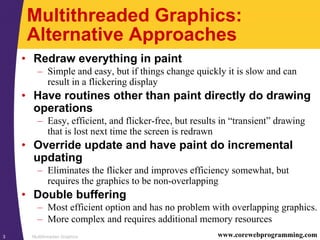
• Redraw everything in paint
– Simple and easy, but if things change quickly it is slow and can
result in a flickering display
• Have routines other than paint directly do drawing
operations
– Easy, efficient, and flicker-free, but results in “transient” drawing
that is lost next time the screen is redrawn
• Override update and have paint do incremental
updating
– Eliminates the flicker and improves efficiency somewhat, but
requires the graphics to be non-overlapping
• Double buffering
– Most efficient option and has no problem with overlapping graphics.
– More complex and requires additional memory resources
Multithreaded Graphics4 www.corewebprogramming.com
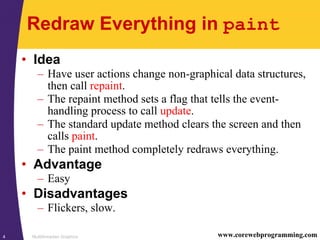
Redraw Everything in paint
• Idea
– Have user actions change non-graphical data structures,
then call repaint.
– The repaint method sets a flag that tells the event-
handling process to call update.
– The standard update method clears the screen and then
calls paint.
– The paint method completely redraws everything.
• Advantage
– Easy
• Disadvantages
– Flickers, slow.
Multithreaded Graphics5 www.corewebprogramming.com
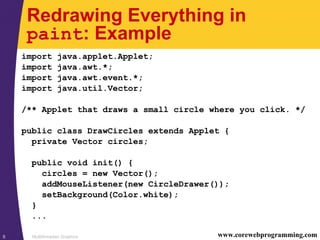
Redrawing Everything in
paint: Example
import java.applet.Applet;
import java.awt.*;
import java.awt.event.*;
import java.util.Vector;
/** Applet that draws a small circle where you click. */
public class DrawCircles extends Applet {
private Vector circles;
public void init() {
circles = new Vector();
addMouseListener(new CircleDrawer());
setBackground(Color.white);
}
...
Multithreaded Graphics6 www.corewebprogramming.com
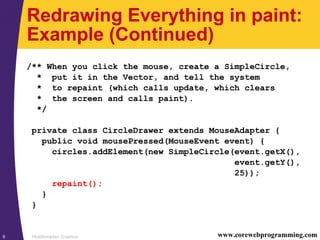
Redrawing Everything in paint:
Example (Continued)
/** When you click the mouse, create a SimpleCircle,
* put it in the Vector, and tell the system
* to repaint (which calls update, which clears
* the screen and calls paint).
*/
private class CircleDrawer extends MouseAdapter {
public void mousePressed(MouseEvent event) {
circles.addElement(new SimpleCircle(event.getX(),
event.getY(),
25));
repaint();
}
}
Multithreaded Graphics7 www.corewebprogramming.com
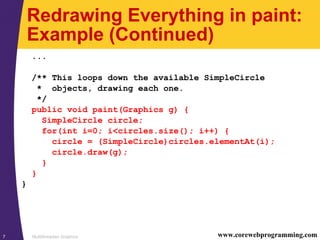
Redrawing Everything in paint:
Example (Continued)
...
/** This loops down the available SimpleCircle
* objects, drawing each one.
*/
public void paint(Graphics g) {
SimpleCircle circle;
for(int i=0; i<circles.size(); i++) {
circle = (SimpleCircle)circles.elementAt(i);
circle.draw(g);
}
}
}
Multithreaded Graphics8 www.corewebprogramming.com
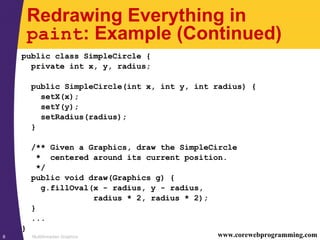
Redrawing Everything in
paint: Example (Continued)
public class SimpleCircle {
private int x, y, radius;
public SimpleCircle(int x, int y, int radius) {
setX(x);
setY(y);
setRadius(radius);
}
/** Given a Graphics, draw the SimpleCircle
* centered around its current position.
*/
public void draw(Graphics g) {
g.fillOval(x - radius, y - radius,
radius * 2, radius * 2);
}
...
}
Multithreaded Graphics9 www.corewebprogramming.com
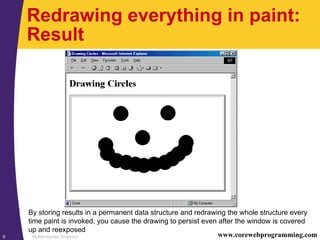
Redrawing everything in paint:
Result
By storing results in a permanent data structure and redrawing the whole structure every
time paint is invoked, you cause the drawing to persist even after the window is covered
up and reexposed
Multithreaded Graphics10 www.corewebprogramming.com
Have Other Routines Draw
Directly on Window
• Idea
– Arbitrary methods (i.e., other than paint) can call
getGraphics to obtain the window’s Graphics object
– Use that Graphics object to draw
– Drawing lost if
• Window covered up and reexposed
• The update method called (e.g., via repaint)
• Advantage
– Fast
• Disadvantage
– Temporary
Multithreaded Graphics11 www.corewebprogramming.com
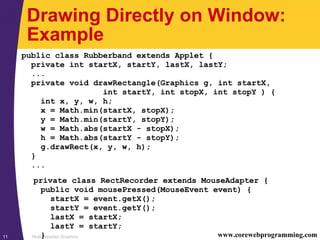
Drawing Directly on Window:
Example
public class Rubberband extends Applet {
private int startX, startY, lastX, lastY;
...
private void drawRectangle(Graphics g, int startX,
int startY, int stopX, int stopY ) {
int x, y, w, h;
x = Math.min(startX, stopX);
y = Math.min(startY, stopY);
w = Math.abs(startX - stopX);
h = Math.abs(startY - stopY);
g.drawRect(x, y, w, h);
}
...
private class RectRecorder extends MouseAdapter {
public void mousePressed(MouseEvent event) {
startX = event.getX();
startY = event.getY();
lastX = startX;
lastY = startY;
}
Multithreaded Graphics12 www.corewebprogramming.com
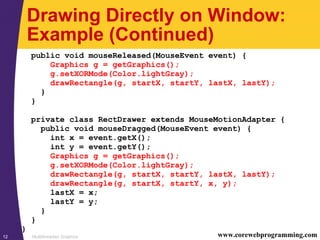
Drawing Directly on Window:
Example (Continued)
public void mouseReleased(MouseEvent event) {
Graphics g = getGraphics();
g.setXORMode(Color.lightGray);
drawRectangle(g, startX, startY, lastX, lastY);
}
}
private class RectDrawer extends MouseMotionAdapter {
public void mouseDragged(MouseEvent event) {
int x = event.getX();
int y = event.getY();
Graphics g = getGraphics();
g.setXORMode(Color.lightGray);
drawRectangle(g, startX, startY, lastX, lastY);
drawRectangle(g, startX, startY, x, y);
lastX = x;
lastY = y;
}
}
}
Multithreaded Graphics13 www.corewebprogramming.com
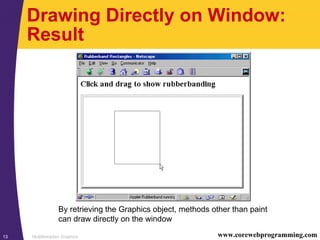
Drawing Directly on Window:
Result
By retrieving the Graphics object, methods other than paint
can draw directly on the window
Multithreaded Graphics14 www.corewebprogramming.com
Override update and Have
paint do Incremental Updating
• Idea
– Have repaint (which triggers update) avoid clearing the
screen each time by overriding update as follows:
public void update(Graphics g) {
paint(g);
}
– Then, assuming objects don’t overlap, erase each object
at its old location by drawing over it in the background
color then drawing it at the new location
• Advantages
– No flicker, faster
• Disadvantage
– Fails for overlapping images
Multithreaded Graphics15 www.corewebprogramming.com
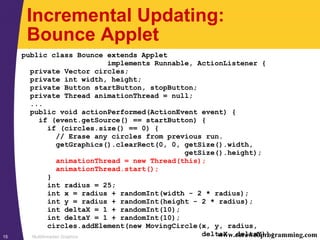
Incremental Updating:
Bounce Applet
public class Bounce extends Applet
implements Runnable, ActionListener {
private Vector circles;
private int width, height;
private Button startButton, stopButton;
private Thread animationThread = null;
...
public void actionPerformed(ActionEvent event) {
if (event.getSource() == startButton) {
if (circles.size() == 0) {
// Erase any circles from previous run.
getGraphics().clearRect(0, 0, getSize().width,
getSize().height);
animationThread = new Thread(this);
animationThread.start();
}
int radius = 25;
int x = radius + randomInt(width - 2 * radius);
int y = radius + randomInt(height - 2 * radius);
int deltaX = 1 + randomInt(10);
int deltaY = 1 + randomInt(10);
circles.addElement(new MovingCircle(x, y, radius,
deltaX, deltaY));
Multithreaded Graphics16 www.corewebprogramming.com
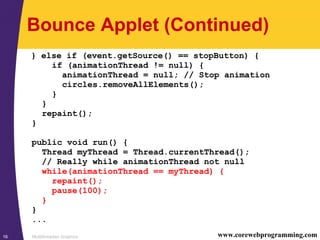
Bounce Applet (Continued)
} else if (event.getSource() == stopButton) {
if (animationThread != null) {
animationThread = null; // Stop animation
circles.removeAllElements();
}
}
repaint();
}
public void run() {
Thread myThread = Thread.currentThread();
// Really while animationThread not null
while(animationThread == myThread) {
repaint();
pause(100);
}
}
...
Multithreaded Graphics17 www.corewebprogramming.com
Bounce Applet (Continued)
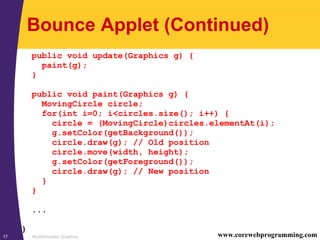
public void update(Graphics g) {
paint(g);
}
public void paint(Graphics g) {
MovingCircle circle;
for(int i=0; i<circles.size(); i++) {
circle = (MovingCircle)circles.elementAt(i);
g.setColor(getBackground());
circle.draw(g); // Old position
circle.move(width, height);
g.setColor(getForeground());
circle.draw(g); // New position
}
}
...
}
Multithreaded Graphics18 www.corewebprogramming.com
Incremental Updating:
MovingCircle Class
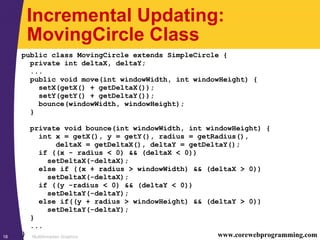
public class MovingCircle extends SimpleCircle {
private int deltaX, deltaY;
...
public void move(int windowWidth, int windowHeight) {
setX(getX() + getDeltaX());
setY(getY() + getDeltaY());
bounce(windowWidth, windowHeight);
}
private void bounce(int windowWidth, int windowHeight) {
int x = getX(), y = getY(), radius = getRadius(),
deltaX = getDeltaX(), deltaY = getDeltaY();
if ((x - radius < 0) && (deltaX < 0))
setDeltaX(-deltaX);
else if ((x + radius > windowWidth) && (deltaX > 0))
setDeltaX(-deltaX);
if ((y -radius < 0) && (deltaY < 0))
setDeltaY(-deltaY);
else if((y + radius > windowHeight) && (deltaY > 0))
setDeltaY(-deltaY);
}
...
}
Multithreaded Graphics19 www.corewebprogramming.com
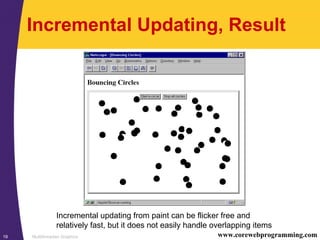
Incremental Updating, Result
Incremental updating from paint can be flicker free and
relatively fast, but it does not easily handle overlapping items
Multithreaded Graphics20 www.corewebprogramming.com
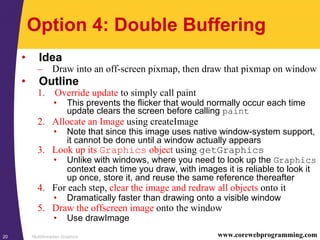
Option 4: Double Buffering
• Idea
– Draw into an off-screen pixmap, then draw that pixmap on window
• Outline
1. Override update to simply call paint
• This prevents the flicker that would normally occur each time
update clears the screen before calling paint
2. Allocate an Image using createImage
• Note that since this image uses native window-system support,
it cannot be done until a window actually appears
3. Look up its Graphics object using getGraphics
• Unlike with windows, where you need to look up the Graphics
context each time you draw, with images it is reliable to look it
up once, store it, and reuse the same reference thereafter
4. For each step, clear the image and redraw all objects onto it
• Dramatically faster than drawing onto a visible window
5. Draw the offscreen image onto the window
• Use drawImage
Multithreaded Graphics21 www.corewebprogramming.com
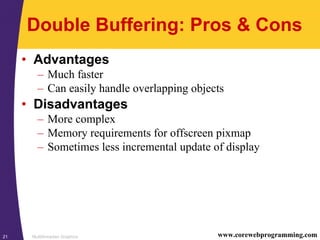
Double Buffering: Pros & Cons
• Advantages
– Much faster
– Can easily handle overlapping objects
• Disadvantages
– More complex
– Memory requirements for offscreen pixmap
– Sometimes less incremental update of display
Multithreaded Graphics22 www.corewebprogramming.com
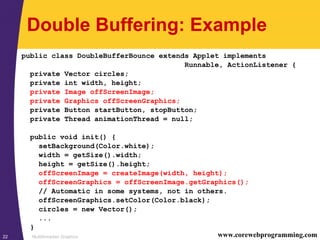
Double Buffering: Example
public class DoubleBufferBounce extends Applet implements
Runnable, ActionListener {
private Vector circles;
private int width, height;
private Image offScreenImage;
private Graphics offScreenGraphics;
private Button startButton, stopButton;
private Thread animationThread = null;
public void init() {
setBackground(Color.white);
width = getSize().width;
height = getSize().height;
offScreenImage = createImage(width, height);
offScreenGraphics = offScreenImage.getGraphics();
// Automatic in some systems, not in others.
offScreenGraphics.setColor(Color.black);
circles = new Vector();
...
}
Multithreaded Graphics23 www.corewebprogramming.com
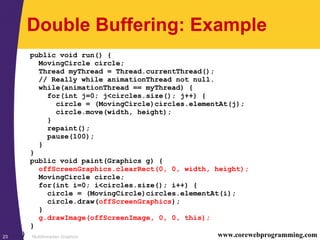
Double Buffering: Example
public void run() {
MovingCircle circle;
Thread myThread = Thread.currentThread();
// Really while animationThread not null.
while(animationThread == myThread) {
for(int j=0; j<circles.size(); j++) {
circle = (MovingCircle)circles.elementAt(j);
circle.move(width, height);
}
repaint();
pause(100);
}
}
public void paint(Graphics g) {
offScreenGraphics.clearRect(0, 0, width, height);
MovingCircle circle;
for(int i=0; i<circles.size(); i++) {
circle = (MovingCircle)circles.elementAt(i);
circle.draw(offScreenGraphics);
}
g.drawImage(offScreenImage, 0, 0, this);
}
}
Multithreaded Graphics24 www.corewebprogramming.com
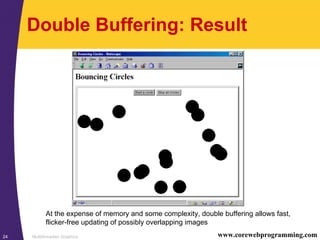
Double Buffering: Result
At the expense of memory and some complexity, double buffering allows fast,
flicker-free updating of possibly overlapping images
Multithreaded Graphics25 www.corewebprogramming.com
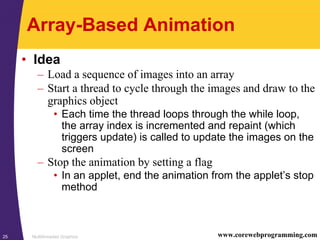
Array-Based Animation
• Idea
– Load a sequence of images into an array
– Start a thread to cycle through the images and draw to the
graphics object
• Each time the thread loops through the while loop,
the array index is incremented and repaint (which
triggers update) is called to update the images on the
screen
– Stop the animation by setting a flag
• In an applet, end the animation from the applet’s stop
method
Multithreaded Graphics26 www.corewebprogramming.com
Array-Based Animation:
Example
public class ImageAnimation extends Applet {
private static final int NUMDUKES = 2;
private Duke[] dukes; // Duke has array of images
private int i;
public void init() {
dukes = new Duke[NUMDUKES];
setBackground(Color.white);
}
public void start() {
int tumbleDirection;
for (int i=0; i<NUMDUKES ; i++) {
tumbleDirection = (i%2 == 0) ? 1 :-1;
dukes[i] = new Duke(tumbleDirection, this);
dukes[i].start();
}
}
...
Multithreaded Graphics27 www.corewebprogramming.com
Animation Example (Continued)
public void update(Graphics g) {
paint(g);
}
public void paint(Graphics g) {
for (i=0 ; i<NUMDUKES ; i++) {
if (dukes[i] != null) {
g.drawImage(Duke.images[dukes[i].getIndex()],
200*i, 0, this);
}
}
}
public void stop() {
for (int i=0; i<NUMDUKES ; i++) {
if (dukes[i] != null) {
dukes[i].setState(Duke.STOP);
}
}
}
}
Multithreaded Graphics28 www.corewebprogramming.com
Animation Example (Continued)
public class Duke extends Thread {
...
public static Image[] images;
private static final int NUMIMAGES = 15;
private static Object lock = new Object();
private int state = RUN;
public Duke(int tumbleDirection, Applet parent) {
this.tumbleDirection = tumbleDirection;
this.parent = parent;
synchronized(lock) {
if (images == null) { // If not previously loaded.
images = new Image[ NUMIMAGES ];
for (int i=0; i<NUMIMAGES; i++) {
images[i] = parent.getImage( parent.getCodeBase(),
"images/T" + i + ".gif");
}
}
}
}
...
Multithreaded Graphics29 www.corewebprogramming.com
Animation Example (Continued)
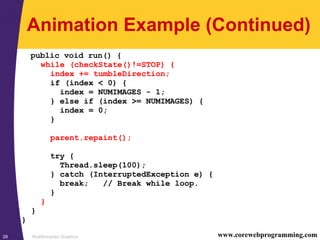
public void run() {
while (checkState()!=STOP) {
index += tumbleDirection;
if (index < 0) {
index = NUMIMAGES - 1;
} else if (index >= NUMIMAGES) {
index = 0;
}
parent.repaint();
try {
Thread.sleep(100);
} catch (InterruptedException e) {
break; // Break while loop.
}
}
}
}
Multithreaded Graphics30 www.corewebprogramming.com
Animation: Result
Duke is a registered trademark of Sun Microsystems, Inc.
All restrictions apply (http://www.sun.com/policies/trademarks/).
Used with permission.
Multithreaded Graphics31 www.corewebprogramming.com
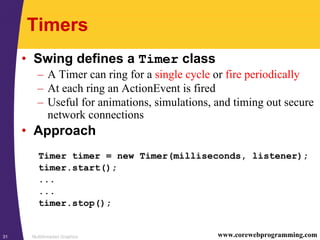
Timers
• Swing defines a Timer class
– A Timer can ring for a single cycle or fire periodically
– At each ring an ActionEvent is fired
– Useful for animations, simulations, and timing out secure
network connections
• Approach
Timer timer = new Timer(milliseconds, listener);
timer.start();
...
...
timer.stop();
Multithreaded Graphics32 www.corewebprogramming.com
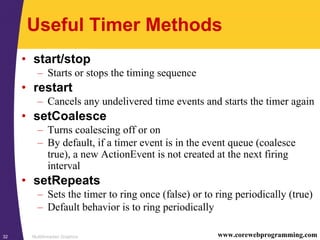
Useful Timer Methods
• start/stop
– Starts or stops the timing sequence
• restart
– Cancels any undelivered time events and starts the timer again
• setCoalesce
– Turns coalescing off or on
– By default, if a timer event is in the event queue (coalesce
true), a new ActionEvent is not created at the next firing
interval
• setRepeats
– Sets the timer to ring once (false) or to ring periodically (true)
– Default behavior is to ring periodically
Multithreaded Graphics33 www.corewebprogramming.com
Timer: Example
import java.awt.*;
import javax.swing.*;
public class TimedAnimation extends JApplet {
private static final int NUMDUKES = 2;
private TimedDuke[] dukes;
private int i, index;
public void init() {
dukes = new TimedDuke[NUMDUKES];
setBackground(Color.white);
dukes[0] = new TimedDuke( 1, 100, this);
dukes[1] = new TimedDuke(-1, 500, this);
}
// Start each Duke timer.
public void start() {
for (int i=0; i<NUMDUKES ; i++) {
dukes[i].start();
}
} ...
Multithreaded Graphics34 www.corewebprogramming.com
Timer Example (Continued)
...
public void paint(Graphics g) {
for (i=0 ; i<NUMDUKES ; i++) {
if (dukes[i] != null) {
index = dukes[i].getIndex();
g.drawImage(TimedDuke.images[index], 200*i, 0, this);
}
}
}
// Stop each Duke timer.
public void stop() {
for (int i=0; i<NUMDUKES ; i++) {
dukes[i].stop();
}
}
}
Multithreaded Graphics35 www.corewebprogramming.com
Timer Example (Continued)
import java.applet.Applet;
import java.awt.*;
import java.awt.event.*;
import javax.swing.*;
public class TimedDuke extends Timer
implements ActionListener {
private static final int NUMIMAGES = 15;
private static boolean loaded = false;
private static Object lock = new Object();
private int tumbleDirection;
private int index = 0;
private Applet parent;
public static Image[] images = new Image[NUMIMAGES];
public TimedDuke(int tumbleDirection, int msec,
Applet parent) {
super(msec, null);
addActionListener(this);
this.tumbleDirection = tumbleDirection;
this.parent = parent; ...
Multithreaded Graphics36 www.corewebprogramming.com
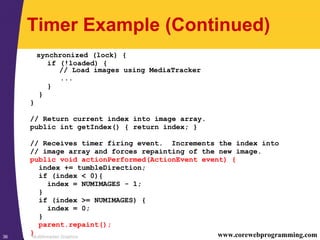
Timer Example (Continued)
synchronized (lock) {
if (!loaded) {
// Load images using MediaTracker
...
}
}
}
// Return current index into image array.
public int getIndex() { return index; }
// Receives timer firing event. Increments the index into
// image array and forces repainting of the new image.
public void actionPerformed(ActionEvent event) {
index += tumbleDirection;
if (index < 0){
index = NUMIMAGES - 1;
}
if (index >= NUMIMAGES) {
index = 0;
}
parent.repaint();
}
}
Multithreaded Graphics37 www.corewebprogramming.com
Timer Example: Result
Each Duke moves at a different speed
Duke is a registered trademark of Sun Microsystems, Inc.
All restrictions apply (http://www.sun.com/policies/trademarks/).
Used with permission.
Multithreaded Graphics38 www.corewebprogramming.com
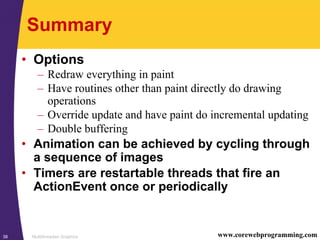
Summary
• Options
– Redraw everything in paint
– Have routines other than paint directly do drawing
operations
– Override update and have paint do incremental updating
– Double buffering
• Animation can be achieved by cycling through
a sequence of images
• Timers are restartable threads that fire an
ActionEvent once or periodically
39 © 2001-2003 Marty Hall, Larry Brown http://www.corewebprogramming.com
core
programming
Questions?

14multithreaded Graphics

  • 1.
    1 © 2001-2003Marty Hall, Larry Brown http://www.corewebprogramming.com core programming Multithreaded Graphics
  • 2.
    Multithreaded Graphics2 www.corewebprogramming.com Agenda •Approaches for multithreaded graphics – Redraw everything in paint – Have routines other than paint draw directly on window – Override update and have paint do incremental updating – Double buffering • Reducing flicker in animations • Implementing double buffering • Animating images • Controlling timers
  • 3.
    Multithreaded Graphics3 www.corewebprogramming.com MultithreadedGraphics: Alternative Approaches • Redraw everything in paint – Simple and easy, but if things change quickly it is slow and can result in a flickering display • Have routines other than paint directly do drawing operations – Easy, efficient, and flicker-free, but results in “transient” drawing that is lost next time the screen is redrawn • Override update and have paint do incremental updating – Eliminates the flicker and improves efficiency somewhat, but requires the graphics to be non-overlapping • Double buffering – Most efficient option and has no problem with overlapping graphics. – More complex and requires additional memory resources
  • 4.
    Multithreaded Graphics4 www.corewebprogramming.com RedrawEverything in paint • Idea – Have user actions change non-graphical data structures, then call repaint. – The repaint method sets a flag that tells the event- handling process to call update. – The standard update method clears the screen and then calls paint. – The paint method completely redraws everything. • Advantage – Easy • Disadvantages – Flickers, slow.
  • 5.
    Multithreaded Graphics5 www.corewebprogramming.com RedrawingEverything in paint: Example import java.applet.Applet; import java.awt.*; import java.awt.event.*; import java.util.Vector; /** Applet that draws a small circle where you click. */ public class DrawCircles extends Applet { private Vector circles; public void init() { circles = new Vector(); addMouseListener(new CircleDrawer()); setBackground(Color.white); } ...
  • 6.
    Multithreaded Graphics6 www.corewebprogramming.com RedrawingEverything in paint: Example (Continued) /** When you click the mouse, create a SimpleCircle, * put it in the Vector, and tell the system * to repaint (which calls update, which clears * the screen and calls paint). */ private class CircleDrawer extends MouseAdapter { public void mousePressed(MouseEvent event) { circles.addElement(new SimpleCircle(event.getX(), event.getY(), 25)); repaint(); } }
  • 7.
    Multithreaded Graphics7 www.corewebprogramming.com RedrawingEverything in paint: Example (Continued) ... /** This loops down the available SimpleCircle * objects, drawing each one. */ public void paint(Graphics g) { SimpleCircle circle; for(int i=0; i<circles.size(); i++) { circle = (SimpleCircle)circles.elementAt(i); circle.draw(g); } } }
  • 8.
    Multithreaded Graphics8 www.corewebprogramming.com RedrawingEverything in paint: Example (Continued) public class SimpleCircle { private int x, y, radius; public SimpleCircle(int x, int y, int radius) { setX(x); setY(y); setRadius(radius); } /** Given a Graphics, draw the SimpleCircle * centered around its current position. */ public void draw(Graphics g) { g.fillOval(x - radius, y - radius, radius * 2, radius * 2); } ... }
  • 9.
    Multithreaded Graphics9 www.corewebprogramming.com Redrawingeverything in paint: Result By storing results in a permanent data structure and redrawing the whole structure every time paint is invoked, you cause the drawing to persist even after the window is covered up and reexposed
  • 10.
    Multithreaded Graphics10 www.corewebprogramming.com HaveOther Routines Draw Directly on Window • Idea – Arbitrary methods (i.e., other than paint) can call getGraphics to obtain the window’s Graphics object – Use that Graphics object to draw – Drawing lost if • Window covered up and reexposed • The update method called (e.g., via repaint) • Advantage – Fast • Disadvantage – Temporary
  • 11.
    Multithreaded Graphics11 www.corewebprogramming.com DrawingDirectly on Window: Example public class Rubberband extends Applet { private int startX, startY, lastX, lastY; ... private void drawRectangle(Graphics g, int startX, int startY, int stopX, int stopY ) { int x, y, w, h; x = Math.min(startX, stopX); y = Math.min(startY, stopY); w = Math.abs(startX - stopX); h = Math.abs(startY - stopY); g.drawRect(x, y, w, h); } ... private class RectRecorder extends MouseAdapter { public void mousePressed(MouseEvent event) { startX = event.getX(); startY = event.getY(); lastX = startX; lastY = startY; }
  • 12.
    Multithreaded Graphics12 www.corewebprogramming.com DrawingDirectly on Window: Example (Continued) public void mouseReleased(MouseEvent event) { Graphics g = getGraphics(); g.setXORMode(Color.lightGray); drawRectangle(g, startX, startY, lastX, lastY); } } private class RectDrawer extends MouseMotionAdapter { public void mouseDragged(MouseEvent event) { int x = event.getX(); int y = event.getY(); Graphics g = getGraphics(); g.setXORMode(Color.lightGray); drawRectangle(g, startX, startY, lastX, lastY); drawRectangle(g, startX, startY, x, y); lastX = x; lastY = y; } } }
  • 13.
    Multithreaded Graphics13 www.corewebprogramming.com DrawingDirectly on Window: Result By retrieving the Graphics object, methods other than paint can draw directly on the window
  • 14.
    Multithreaded Graphics14 www.corewebprogramming.com Overrideupdate and Have paint do Incremental Updating • Idea – Have repaint (which triggers update) avoid clearing the screen each time by overriding update as follows: public void update(Graphics g) { paint(g); } – Then, assuming objects don’t overlap, erase each object at its old location by drawing over it in the background color then drawing it at the new location • Advantages – No flicker, faster • Disadvantage – Fails for overlapping images
  • 15.
    Multithreaded Graphics15 www.corewebprogramming.com IncrementalUpdating: Bounce Applet public class Bounce extends Applet implements Runnable, ActionListener { private Vector circles; private int width, height; private Button startButton, stopButton; private Thread animationThread = null; ... public void actionPerformed(ActionEvent event) { if (event.getSource() == startButton) { if (circles.size() == 0) { // Erase any circles from previous run. getGraphics().clearRect(0, 0, getSize().width, getSize().height); animationThread = new Thread(this); animationThread.start(); } int radius = 25; int x = radius + randomInt(width - 2 * radius); int y = radius + randomInt(height - 2 * radius); int deltaX = 1 + randomInt(10); int deltaY = 1 + randomInt(10); circles.addElement(new MovingCircle(x, y, radius, deltaX, deltaY));
  • 16.
    Multithreaded Graphics16 www.corewebprogramming.com BounceApplet (Continued) } else if (event.getSource() == stopButton) { if (animationThread != null) { animationThread = null; // Stop animation circles.removeAllElements(); } } repaint(); } public void run() { Thread myThread = Thread.currentThread(); // Really while animationThread not null while(animationThread == myThread) { repaint(); pause(100); } } ...
  • 17.
    Multithreaded Graphics17 www.corewebprogramming.com BounceApplet (Continued) public void update(Graphics g) { paint(g); } public void paint(Graphics g) { MovingCircle circle; for(int i=0; i<circles.size(); i++) { circle = (MovingCircle)circles.elementAt(i); g.setColor(getBackground()); circle.draw(g); // Old position circle.move(width, height); g.setColor(getForeground()); circle.draw(g); // New position } } ... }
  • 18.
    Multithreaded Graphics18 www.corewebprogramming.com IncrementalUpdating: MovingCircle Class public class MovingCircle extends SimpleCircle { private int deltaX, deltaY; ... public void move(int windowWidth, int windowHeight) { setX(getX() + getDeltaX()); setY(getY() + getDeltaY()); bounce(windowWidth, windowHeight); } private void bounce(int windowWidth, int windowHeight) { int x = getX(), y = getY(), radius = getRadius(), deltaX = getDeltaX(), deltaY = getDeltaY(); if ((x - radius < 0) && (deltaX < 0)) setDeltaX(-deltaX); else if ((x + radius > windowWidth) && (deltaX > 0)) setDeltaX(-deltaX); if ((y -radius < 0) && (deltaY < 0)) setDeltaY(-deltaY); else if((y + radius > windowHeight) && (deltaY > 0)) setDeltaY(-deltaY); } ... }
  • 19.
    Multithreaded Graphics19 www.corewebprogramming.com IncrementalUpdating, Result Incremental updating from paint can be flicker free and relatively fast, but it does not easily handle overlapping items
  • 20.
    Multithreaded Graphics20 www.corewebprogramming.com Option4: Double Buffering • Idea – Draw into an off-screen pixmap, then draw that pixmap on window • Outline 1. Override update to simply call paint • This prevents the flicker that would normally occur each time update clears the screen before calling paint 2. Allocate an Image using createImage • Note that since this image uses native window-system support, it cannot be done until a window actually appears 3. Look up its Graphics object using getGraphics • Unlike with windows, where you need to look up the Graphics context each time you draw, with images it is reliable to look it up once, store it, and reuse the same reference thereafter 4. For each step, clear the image and redraw all objects onto it • Dramatically faster than drawing onto a visible window 5. Draw the offscreen image onto the window • Use drawImage
  • 21.
    Multithreaded Graphics21 www.corewebprogramming.com DoubleBuffering: Pros & Cons • Advantages – Much faster – Can easily handle overlapping objects • Disadvantages – More complex – Memory requirements for offscreen pixmap – Sometimes less incremental update of display
  • 22.
    Multithreaded Graphics22 www.corewebprogramming.com DoubleBuffering: Example public class DoubleBufferBounce extends Applet implements Runnable, ActionListener { private Vector circles; private int width, height; private Image offScreenImage; private Graphics offScreenGraphics; private Button startButton, stopButton; private Thread animationThread = null; public void init() { setBackground(Color.white); width = getSize().width; height = getSize().height; offScreenImage = createImage(width, height); offScreenGraphics = offScreenImage.getGraphics(); // Automatic in some systems, not in others. offScreenGraphics.setColor(Color.black); circles = new Vector(); ... }
  • 23.
    Multithreaded Graphics23 www.corewebprogramming.com DoubleBuffering: Example public void run() { MovingCircle circle; Thread myThread = Thread.currentThread(); // Really while animationThread not null. while(animationThread == myThread) { for(int j=0; j<circles.size(); j++) { circle = (MovingCircle)circles.elementAt(j); circle.move(width, height); } repaint(); pause(100); } } public void paint(Graphics g) { offScreenGraphics.clearRect(0, 0, width, height); MovingCircle circle; for(int i=0; i<circles.size(); i++) { circle = (MovingCircle)circles.elementAt(i); circle.draw(offScreenGraphics); } g.drawImage(offScreenImage, 0, 0, this); } }
  • 24.
    Multithreaded Graphics24 www.corewebprogramming.com DoubleBuffering: Result At the expense of memory and some complexity, double buffering allows fast, flicker-free updating of possibly overlapping images
  • 25.
    Multithreaded Graphics25 www.corewebprogramming.com Array-BasedAnimation • Idea – Load a sequence of images into an array – Start a thread to cycle through the images and draw to the graphics object • Each time the thread loops through the while loop, the array index is incremented and repaint (which triggers update) is called to update the images on the screen – Stop the animation by setting a flag • In an applet, end the animation from the applet’s stop method
  • 26.
    Multithreaded Graphics26 www.corewebprogramming.com Array-BasedAnimation: Example public class ImageAnimation extends Applet { private static final int NUMDUKES = 2; private Duke[] dukes; // Duke has array of images private int i; public void init() { dukes = new Duke[NUMDUKES]; setBackground(Color.white); } public void start() { int tumbleDirection; for (int i=0; i<NUMDUKES ; i++) { tumbleDirection = (i%2 == 0) ? 1 :-1; dukes[i] = new Duke(tumbleDirection, this); dukes[i].start(); } } ...
  • 27.
    Multithreaded Graphics27 www.corewebprogramming.com AnimationExample (Continued) public void update(Graphics g) { paint(g); } public void paint(Graphics g) { for (i=0 ; i<NUMDUKES ; i++) { if (dukes[i] != null) { g.drawImage(Duke.images[dukes[i].getIndex()], 200*i, 0, this); } } } public void stop() { for (int i=0; i<NUMDUKES ; i++) { if (dukes[i] != null) { dukes[i].setState(Duke.STOP); } } } }
  • 28.
    Multithreaded Graphics28 www.corewebprogramming.com AnimationExample (Continued) public class Duke extends Thread { ... public static Image[] images; private static final int NUMIMAGES = 15; private static Object lock = new Object(); private int state = RUN; public Duke(int tumbleDirection, Applet parent) { this.tumbleDirection = tumbleDirection; this.parent = parent; synchronized(lock) { if (images == null) { // If not previously loaded. images = new Image[ NUMIMAGES ]; for (int i=0; i<NUMIMAGES; i++) { images[i] = parent.getImage( parent.getCodeBase(), "images/T" + i + ".gif"); } } } } ...
  • 29.
    Multithreaded Graphics29 www.corewebprogramming.com AnimationExample (Continued) public void run() { while (checkState()!=STOP) { index += tumbleDirection; if (index < 0) { index = NUMIMAGES - 1; } else if (index >= NUMIMAGES) { index = 0; } parent.repaint(); try { Thread.sleep(100); } catch (InterruptedException e) { break; // Break while loop. } } } }
  • 30.
    Multithreaded Graphics30 www.corewebprogramming.com Animation:Result Duke is a registered trademark of Sun Microsystems, Inc. All restrictions apply (http://www.sun.com/policies/trademarks/). Used with permission.
  • 31.
    Multithreaded Graphics31 www.corewebprogramming.com Timers •Swing defines a Timer class – A Timer can ring for a single cycle or fire periodically – At each ring an ActionEvent is fired – Useful for animations, simulations, and timing out secure network connections • Approach Timer timer = new Timer(milliseconds, listener); timer.start(); ... ... timer.stop();
  • 32.
    Multithreaded Graphics32 www.corewebprogramming.com UsefulTimer Methods • start/stop – Starts or stops the timing sequence • restart – Cancels any undelivered time events and starts the timer again • setCoalesce – Turns coalescing off or on – By default, if a timer event is in the event queue (coalesce true), a new ActionEvent is not created at the next firing interval • setRepeats – Sets the timer to ring once (false) or to ring periodically (true) – Default behavior is to ring periodically
  • 33.
    Multithreaded Graphics33 www.corewebprogramming.com Timer:Example import java.awt.*; import javax.swing.*; public class TimedAnimation extends JApplet { private static final int NUMDUKES = 2; private TimedDuke[] dukes; private int i, index; public void init() { dukes = new TimedDuke[NUMDUKES]; setBackground(Color.white); dukes[0] = new TimedDuke( 1, 100, this); dukes[1] = new TimedDuke(-1, 500, this); } // Start each Duke timer. public void start() { for (int i=0; i<NUMDUKES ; i++) { dukes[i].start(); } } ...
  • 34.
    Multithreaded Graphics34 www.corewebprogramming.com TimerExample (Continued) ... public void paint(Graphics g) { for (i=0 ; i<NUMDUKES ; i++) { if (dukes[i] != null) { index = dukes[i].getIndex(); g.drawImage(TimedDuke.images[index], 200*i, 0, this); } } } // Stop each Duke timer. public void stop() { for (int i=0; i<NUMDUKES ; i++) { dukes[i].stop(); } } }
  • 35.
    Multithreaded Graphics35 www.corewebprogramming.com TimerExample (Continued) import java.applet.Applet; import java.awt.*; import java.awt.event.*; import javax.swing.*; public class TimedDuke extends Timer implements ActionListener { private static final int NUMIMAGES = 15; private static boolean loaded = false; private static Object lock = new Object(); private int tumbleDirection; private int index = 0; private Applet parent; public static Image[] images = new Image[NUMIMAGES]; public TimedDuke(int tumbleDirection, int msec, Applet parent) { super(msec, null); addActionListener(this); this.tumbleDirection = tumbleDirection; this.parent = parent; ...
  • 36.
    Multithreaded Graphics36 www.corewebprogramming.com TimerExample (Continued) synchronized (lock) { if (!loaded) { // Load images using MediaTracker ... } } } // Return current index into image array. public int getIndex() { return index; } // Receives timer firing event. Increments the index into // image array and forces repainting of the new image. public void actionPerformed(ActionEvent event) { index += tumbleDirection; if (index < 0){ index = NUMIMAGES - 1; } if (index >= NUMIMAGES) { index = 0; } parent.repaint(); } }
  • 37.
    Multithreaded Graphics37 www.corewebprogramming.com TimerExample: Result Each Duke moves at a different speed Duke is a registered trademark of Sun Microsystems, Inc. All restrictions apply (http://www.sun.com/policies/trademarks/). Used with permission.
  • 38.
    Multithreaded Graphics38 www.corewebprogramming.com Summary •Options – Redraw everything in paint – Have routines other than paint directly do drawing operations – Override update and have paint do incremental updating – Double buffering • Animation can be achieved by cycling through a sequence of images • Timers are restartable threads that fire an ActionEvent once or periodically
  • 39.
    39 © 2001-2003Marty Hall, Larry Brown http://www.corewebprogramming.com core programming Questions?