8
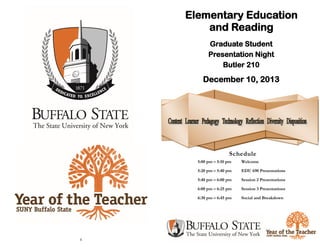
Elementary Education
and Reading
Graduate Student
Presentation Night
Butler 210
December 10, 2013
5:00 pm – 5:10 pm Welcome
5:20 pm – 5:40 pm EDU 690 Presentations
5:40 pm – 6:00 pm Session 2 Presentations
6:00 pm – 6:25 pm Session 3 Presentations
6:30 pm – 6:45 pm Social and Breakdown
Schedule
2
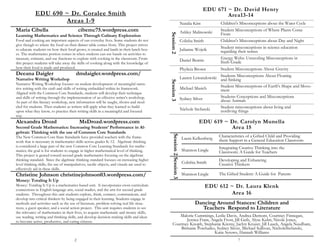
EDU 690 ~ Dr. Coralee Smith
Areas 1-9
Maria Cibella cibemc75.wordpress.com
Learning Mathematics and Science Through Culinary Exploration
Food and cooking are important aspects of our everyday lives. Some students do not
give though to where the food on their dinner table comes from. This project strives
to educate students on how their food grows, is created and lands in their lunch box-
es. The mathematics portion comes in when students can use hands on activities to
measure, estimate, and use fractions to explore with cooking in the classroom. From
this project students will take away the skills of cooking along with the knowledge of
how their food is made and produced.
Deeana Daigler dmdaigler.wordpress.com/
Narrative Writing Workshop
Narrative Writing Workshop focuses on student development of meaningful narra-
tive writing with the craft and skills of writing embedded within its framework.
Aligned with the Common Core Standards, students will develop their technique
and skills of writing through the implementation of an effective writer’s workshop.
As part of this literacy workshop, new information will be taught, shown and mod-
eled for students. Then students as writers will apply what they learned to build
upon what they know, to practice their writing skills in a meaningful and focused
way.
Alexandra Drozd MsDrozd.wordpress.com
Second Grade Mathematics: Increasing Students’ Performance in Al-
gebraic Thinking with the use of Common Core Standards
The New Common Core State Standards have provided teachers with the frame-
work that is necessary in mathematics skills across grades K-12. Algebraic thinking
is considered a large part of the new Common Core Learning Standards for mathe-
matics; the goal is for students to engage in higher mathematical level of thinking.
This project is geared toward second grade mathematics focusing on the algebraic
thinking standard. Since the algebraic thinking standard focuses on increasing higher
level thinking skills, the use of manipulatives, tactile objects, and visuals are used to
effectively aid in these skills.
Christine Johnson christinejohnson03.wordpress.com/
Money: Totaling It Up
Money: Totaling It Up is a mathematics-based unit. It incorporates cross curriculum
connections in English language arts, social studies, and the arts for second grade
students. Throughout this unit students explore, think, connect, communicate, and
develop into critical thinkers by being engaged in their learning. Students engage in
methods and activities such as the use of literature, problem solving real life situa-
tions, a guest speaker, and a social action project. This unit requires students to see
the relevancy of mathematics in their lives, to acquire mathematic and money skills,
use reading, writing and thinking skills, and develop decision-making skills and ideas
to become active, productive, and caring citizens.
7
EDU 671 ~ Dr. David Henry
Area13-14
Session2
Natalia Kim Children's Misconceptions about the Water Cycle
Ashley Malinowski Student Misconceptions of Where Plants Come
From
Colisha Smith Children's Misconceptions about Day and Night
Julianne Wojcik Student misconceptions in science education
regarding their senses
Daniel Beattie Energy Webs: Unraveling Misconceptions in
Sixth Grade
Phylicia Brown Student Misconceptions About Gravity
Session3
Lauren Lewandowski Students Misconceptions About Floating
and Sinking
Michael Masich Student Misconceptions of Earth's Shape and Move-
ment
Sydney Silver Students Conceptions and Misconceptions
about Animals
Nichole Stefanski Student misconceptions about living and
nonliving things
EDU 612 ~ Dr. Laura Klenk
Area 16
EDU 619 ~ Dr. Carolyn Munella
Area 15
Session2
Laura Kelkenberg
Characteristics of a Gifted Child and Providing
them Support in a General Education Classroom
Shannon Lingle
Integrating Creative Thinking into the
Classroom: A Guide for Teachers
Colishia Smith
Developing and Enhancing
Creative Thinkers
Session3 Shannon Lingle The Gifted Student: A Guide for Parents
Dancing Around Stances: Children and
Teachers Respond to Literature
Malorie Cummings, Leslie Davis, Andrea Demont, Courtney Finnegan,
Jessica Frain, Angela Frost, Jill Geib, Alyse Kelm, Nicole Jones,
Courtney Knoph, Stephanie Krentz, Jaclyn Kruzer, Jill Lauck, Angela Needham,
Brittanie Potchatko, Sydney Silver, Michael Sullivan, NicholeStefanski,
Katie Syruws, Hannah Williams
6
Erin Cappello, Matthew Dixon,
Natalia Kim, Jenna Santora,
Colisha Smith
Bringing Back Critical Citizenship:
Empowerment vs.
Disempowerment
Malorie Cummings, AnnMarie
Henesey, Dominique Johnson,
Lakiesha Price, Kelsey Sheehan
Child Labor
Shirley Drew, Emily Kelly,
Sydney Silver, Ashley Malinowski
Classism and Educational
Discrimination
Sara Banas, Jessica Hills,
Asma Mohamoud, Ashton Vertalino,
Sara Suranyi
Linguicism vs. Social Justice: The
Fight that Needs to be Fought
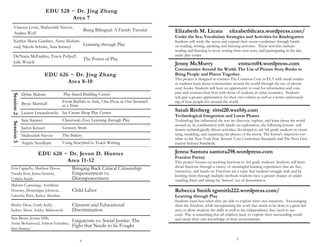
EDU 620 ~ Dr. Jevon D. Hunter
Area 11-12
EDU 528 ~ Dr. Jing Zhang
Area 7
Session2
Dylan Malone Play-based Building Center
Bryce Marshall From Buffalo to Italy, One Pizza in Our Stomach
at a Time
Lauren Lewandowski Ice Cream Shop Play Center
Session3
Sara Suranyi Classroom Zoo: Learning through Play
Jaclyn Kruzer Grocery Store
Shaheedah Nieves The Bakery
Angela Needham Using Storybird to Teach Writing
Vanessa Louis, Shaheedah Nieves,
Andrea Wolf
Being Bilingual: A Family Tutorial
Kaitlyn Marie Gardner, Asma Moham-
oud, Nicole Schiske, Sara Suranyi
Learning through Play
Da'Nasia McFadden, Travis Pufpaff,
Julie Wojcik
The Power of Play
EDU 626 ~ Dr. Jing Zhang
Area 8-10
3
Elizabeth M. Licata elizabethlicata.wordpress.com/
Under the Sea: Vocabulary Strategies and Activities for Kindergarten
Students will study the ocean and expand their ocean vocabulary through hands-
on reading, writing, speaking and listening activities. These activities include:
reading and listening to texts, writing their own texts, and participating in the dra-
matic play center
Jenny McMurry enmcm04.wordpress.com
Communities Around the World: The Use of Picture Story Books to
Bring People and Places Together.
This project is designed to connect The Common Core in ELA with social studies
as students learn about communities around the world through the use of picture
story books. Students will have an opportunity to read for information and com-
pare and contrast their lives with those of students in other countries. Students
will gain a greater appreciation for their own culture as well as a better understand-
ing of how people live around the world.
Sarah Rittberg rittsl20.weebly.com
Technological Integration and Lunar Phases
Technology has influenced the way we discover, explore, and learn about the world
around us. In combination with hands-on exploration, the following lessons will
feature technologically driven activities, developed to aid 5th grade students in visual-
izing, modeling, and explaining the phases of the moon. The lesson's objectives cor-
relate to the New York State Science Core Curriculum Standards and The Next Gen-
eration Science Standards.
Jenna Santora santora298.wordpress.com
Fraction Frenzy
This project focuses on teaching fractions to 3rd grade students. Students will learn
about fractions through a variety of meaningful learning experiences that are fun,
interactive, and hands on. Fractions are a topic that students struggle with and by
learning them through multiple methods students have a greater chance of under-
standing them and taking the 'demon' out of denominator.
Rebecca Smith rgsmith222.wordpress.com/
Learning through Play
Students learn best when they are able to explore their own intuitions. Encouraging
them the freedom, while incorporating the work that needs to be done is a great bal-
ance to allow students the skills as well as the independence they need to suc-
ceed. Play is something that all children need, to explore their surrounding world
and create their own knowledge of their environments.
4
EDU 535 ~ Dr. Laura Klenk
Area 16
Hilary Berbach
Text Messaging as a Form of Communication for One Individual with
Limited Verbal Skills Abstract: This paper examined how an individual with lim-
ited verbal skills used text messaging to communicate with members of his family.
This study was important to the field of special education because the use of text mes-
saging has the potential to be a new form of assistive technology for students who
have limited verbal skills. Data was collected from two participant's archived text mes-
sages. The findings showed that a person with limited verbal skills can use text mes-
saging 1.) to tell another person something; 2) to convey emotion or feelings; 3) to ask
a question or make a request; 4) to check in with another, and 5) to respond to direct
questions or requests.
Brittany Fehskens
Teacher Ideologies on implementing Diverse Family Structure of
Same-Sex Couples into The Elementary Curriculum: Provoking Critical
Thinking or Masking The Controversy? Abstract: This paper examined how
teachers implement or would implement a unit on families within their classroom.
Would their implementation cover diverse family structures, and more specifically,
cover the topic of same-sex couples. This study was important to the field of educa-
tion because students come from diverse family structures. Data was collected from
four participants who were pre-, post-, or current teachers within the elementary edu-
cation field and fourteen graduate students. Findings revealed that most participants
thought families consisted of a mom, dad and children; the teacher-participants be-
lieved they had a professional responsibility to teach about diverse family structure
despite moral beliefs about the controversial topic of same-sex couples; and that the
word diversity masked the controversy of teaching about same-sex families.
Bonnie Gervase
Reexamining Science Misconceptions and What we Assumed Our Stu-
dents Understood: Elementary Students’ Scientific Explanations for
Why Day Turns Into Night Abstract: This paper examined the scientific expla-
nations and understandings for day and night. This study was important to the field of
education because understanding students' common science conceptions can help a
teacher to be mindful in their planning. Data was collected from eight elementary-
aged students who ranged in age from 6 - 11 years. The results showed that all the
participants had misconceptions about the phenomenon of day and night; the older
students exhibited more abstract thinking in their explanations for how day turns into
night than the younger students; and the participants were able to express their think-
ing about day and night better through pictures than through a written response.
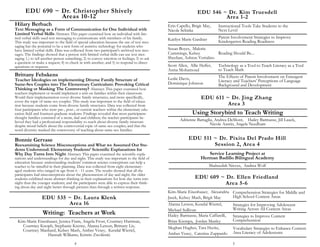
EDU 690 ~ Dr. Christopher Shively
Areas 10-12
Writing: Teachers at Work
Kim-Marie Eisenhauer, Jessica Frain, Angela Frost, Courtney Hartman,
Courtney Knoph, Stephanie Krentz, Alanna Letson, Brittany Lis,
Courtney Manhard, Kelsey Mash, Amber Vesey, Kendal Wiertel,
Hannah Williams, Kristin Zwolinski
5
EDU 609 ~ Dr. Ellen Friedland
Area 5-6
Kim-Marie Eisenhauer, Alexandria
Jasek, Kelsey Mash, Brigit May
Comprehension Strategies for Middle and
High School Content Areas
Alanna Letson, Kendal Wiertel,
Michael Sullivan
Strategies for Improving Adolescent
Writing Across All Content Areas
Hailey Barmasse, Maria Caffarelli,
Brian Krempa, Jordan Manley
Strategies to Improve Content
Comprehension
Meghan Hughes, Tara Hecke,
Amber Vesey, Caterina Zuppardo
Vocabulary Strategies to Enhance Content
Area Literacy of Adolescents
EDU 511 ~ Dr. Pixita Del Prado Hill
Session 2, Area 4
Service Learning Project at
Herman Badillo Bilingual Academy
Shaheedah Nieves, Andrea Wolf
EDU 611 ~ Dr. Jing Zhang
Area 3
Using Storybird to Teach Writing
Adrienne Battaglia, Andrea DeMont, Hailey Barmasse, Jill Lauck,
Nicole Austin, Angela Needham
EDU 546 ~ Dr. Kim Truesdell
Area 1-2
Erin Capello, Brigit May,
Nicole Schiske
Instructional Tools Take Students to the
Next Level
Kaitlyn Marie Gardner Parent Involvement Strategies to Improve
Kindergarten Reading Readiness
Susan Boyes, Malorie
Cummings, Kelsey
Sheehan, Ashton Vertalino
Reading Should Be...
Scott Allen, Allie Helfer,
Asma Mohamoud
Technology as a Tool to Teach Literacy as a Tool
to Teach Math
Leslie Davis,
Dominique Johnson
The Effects of Parent Involvement on Emergent
Literacy and Teachers' Perceptions of Language
Background and Development

Graduate Presentation Night 2013

  • 1.
    8 Elementary Education and Reading GraduateStudent Presentation Night Butler 210 December 10, 2013 5:00 pm – 5:10 pm Welcome 5:20 pm – 5:40 pm EDU 690 Presentations 5:40 pm – 6:00 pm Session 2 Presentations 6:00 pm – 6:25 pm Session 3 Presentations 6:30 pm – 6:45 pm Social and Breakdown Schedule
  • 2.
    2 EDU 690 ~Dr. Coralee Smith Areas 1-9 Maria Cibella cibemc75.wordpress.com Learning Mathematics and Science Through Culinary Exploration Food and cooking are important aspects of our everyday lives. Some students do not give though to where the food on their dinner table comes from. This project strives to educate students on how their food grows, is created and lands in their lunch box- es. The mathematics portion comes in when students can use hands on activities to measure, estimate, and use fractions to explore with cooking in the classroom. From this project students will take away the skills of cooking along with the knowledge of how their food is made and produced. Deeana Daigler dmdaigler.wordpress.com/ Narrative Writing Workshop Narrative Writing Workshop focuses on student development of meaningful narra- tive writing with the craft and skills of writing embedded within its framework. Aligned with the Common Core Standards, students will develop their technique and skills of writing through the implementation of an effective writer’s workshop. As part of this literacy workshop, new information will be taught, shown and mod- eled for students. Then students as writers will apply what they learned to build upon what they know, to practice their writing skills in a meaningful and focused way. Alexandra Drozd MsDrozd.wordpress.com Second Grade Mathematics: Increasing Students’ Performance in Al- gebraic Thinking with the use of Common Core Standards The New Common Core State Standards have provided teachers with the frame- work that is necessary in mathematics skills across grades K-12. Algebraic thinking is considered a large part of the new Common Core Learning Standards for mathe- matics; the goal is for students to engage in higher mathematical level of thinking. This project is geared toward second grade mathematics focusing on the algebraic thinking standard. Since the algebraic thinking standard focuses on increasing higher level thinking skills, the use of manipulatives, tactile objects, and visuals are used to effectively aid in these skills. Christine Johnson christinejohnson03.wordpress.com/ Money: Totaling It Up Money: Totaling It Up is a mathematics-based unit. It incorporates cross curriculum connections in English language arts, social studies, and the arts for second grade students. Throughout this unit students explore, think, connect, communicate, and develop into critical thinkers by being engaged in their learning. Students engage in methods and activities such as the use of literature, problem solving real life situa- tions, a guest speaker, and a social action project. This unit requires students to see the relevancy of mathematics in their lives, to acquire mathematic and money skills, use reading, writing and thinking skills, and develop decision-making skills and ideas to become active, productive, and caring citizens. 7 EDU 671 ~ Dr. David Henry Area13-14 Session2 Natalia Kim Children's Misconceptions about the Water Cycle Ashley Malinowski Student Misconceptions of Where Plants Come From Colisha Smith Children's Misconceptions about Day and Night Julianne Wojcik Student misconceptions in science education regarding their senses Daniel Beattie Energy Webs: Unraveling Misconceptions in Sixth Grade Phylicia Brown Student Misconceptions About Gravity Session3 Lauren Lewandowski Students Misconceptions About Floating and Sinking Michael Masich Student Misconceptions of Earth's Shape and Move- ment Sydney Silver Students Conceptions and Misconceptions about Animals Nichole Stefanski Student misconceptions about living and nonliving things EDU 612 ~ Dr. Laura Klenk Area 16 EDU 619 ~ Dr. Carolyn Munella Area 15 Session2 Laura Kelkenberg Characteristics of a Gifted Child and Providing them Support in a General Education Classroom Shannon Lingle Integrating Creative Thinking into the Classroom: A Guide for Teachers Colishia Smith Developing and Enhancing Creative Thinkers Session3 Shannon Lingle The Gifted Student: A Guide for Parents Dancing Around Stances: Children and Teachers Respond to Literature Malorie Cummings, Leslie Davis, Andrea Demont, Courtney Finnegan, Jessica Frain, Angela Frost, Jill Geib, Alyse Kelm, Nicole Jones, Courtney Knoph, Stephanie Krentz, Jaclyn Kruzer, Jill Lauck, Angela Needham, Brittanie Potchatko, Sydney Silver, Michael Sullivan, NicholeStefanski, Katie Syruws, Hannah Williams
  • 3.
    6 Erin Cappello, MatthewDixon, Natalia Kim, Jenna Santora, Colisha Smith Bringing Back Critical Citizenship: Empowerment vs. Disempowerment Malorie Cummings, AnnMarie Henesey, Dominique Johnson, Lakiesha Price, Kelsey Sheehan Child Labor Shirley Drew, Emily Kelly, Sydney Silver, Ashley Malinowski Classism and Educational Discrimination Sara Banas, Jessica Hills, Asma Mohamoud, Ashton Vertalino, Sara Suranyi Linguicism vs. Social Justice: The Fight that Needs to be Fought EDU 620 ~ Dr. Jevon D. Hunter Area 11-12 EDU 528 ~ Dr. Jing Zhang Area 7 Session2 Dylan Malone Play-based Building Center Bryce Marshall From Buffalo to Italy, One Pizza in Our Stomach at a Time Lauren Lewandowski Ice Cream Shop Play Center Session3 Sara Suranyi Classroom Zoo: Learning through Play Jaclyn Kruzer Grocery Store Shaheedah Nieves The Bakery Angela Needham Using Storybird to Teach Writing Vanessa Louis, Shaheedah Nieves, Andrea Wolf Being Bilingual: A Family Tutorial Kaitlyn Marie Gardner, Asma Moham- oud, Nicole Schiske, Sara Suranyi Learning through Play Da'Nasia McFadden, Travis Pufpaff, Julie Wojcik The Power of Play EDU 626 ~ Dr. Jing Zhang Area 8-10 3 Elizabeth M. Licata elizabethlicata.wordpress.com/ Under the Sea: Vocabulary Strategies and Activities for Kindergarten Students will study the ocean and expand their ocean vocabulary through hands- on reading, writing, speaking and listening activities. These activities include: reading and listening to texts, writing their own texts, and participating in the dra- matic play center Jenny McMurry enmcm04.wordpress.com Communities Around the World: The Use of Picture Story Books to Bring People and Places Together. This project is designed to connect The Common Core in ELA with social studies as students learn about communities around the world through the use of picture story books. Students will have an opportunity to read for information and com- pare and contrast their lives with those of students in other countries. Students will gain a greater appreciation for their own culture as well as a better understand- ing of how people live around the world. Sarah Rittberg rittsl20.weebly.com Technological Integration and Lunar Phases Technology has influenced the way we discover, explore, and learn about the world around us. In combination with hands-on exploration, the following lessons will feature technologically driven activities, developed to aid 5th grade students in visual- izing, modeling, and explaining the phases of the moon. The lesson's objectives cor- relate to the New York State Science Core Curriculum Standards and The Next Gen- eration Science Standards. Jenna Santora santora298.wordpress.com Fraction Frenzy This project focuses on teaching fractions to 3rd grade students. Students will learn about fractions through a variety of meaningful learning experiences that are fun, interactive, and hands on. Fractions are a topic that students struggle with and by learning them through multiple methods students have a greater chance of under- standing them and taking the 'demon' out of denominator. Rebecca Smith rgsmith222.wordpress.com/ Learning through Play Students learn best when they are able to explore their own intuitions. Encouraging them the freedom, while incorporating the work that needs to be done is a great bal- ance to allow students the skills as well as the independence they need to suc- ceed. Play is something that all children need, to explore their surrounding world and create their own knowledge of their environments.
  • 4.
    4 EDU 535 ~Dr. Laura Klenk Area 16 Hilary Berbach Text Messaging as a Form of Communication for One Individual with Limited Verbal Skills Abstract: This paper examined how an individual with lim- ited verbal skills used text messaging to communicate with members of his family. This study was important to the field of special education because the use of text mes- saging has the potential to be a new form of assistive technology for students who have limited verbal skills. Data was collected from two participant's archived text mes- sages. The findings showed that a person with limited verbal skills can use text mes- saging 1.) to tell another person something; 2) to convey emotion or feelings; 3) to ask a question or make a request; 4) to check in with another, and 5) to respond to direct questions or requests. Brittany Fehskens Teacher Ideologies on implementing Diverse Family Structure of Same-Sex Couples into The Elementary Curriculum: Provoking Critical Thinking or Masking The Controversy? Abstract: This paper examined how teachers implement or would implement a unit on families within their classroom. Would their implementation cover diverse family structures, and more specifically, cover the topic of same-sex couples. This study was important to the field of educa- tion because students come from diverse family structures. Data was collected from four participants who were pre-, post-, or current teachers within the elementary edu- cation field and fourteen graduate students. Findings revealed that most participants thought families consisted of a mom, dad and children; the teacher-participants be- lieved they had a professional responsibility to teach about diverse family structure despite moral beliefs about the controversial topic of same-sex couples; and that the word diversity masked the controversy of teaching about same-sex families. Bonnie Gervase Reexamining Science Misconceptions and What we Assumed Our Stu- dents Understood: Elementary Students’ Scientific Explanations for Why Day Turns Into Night Abstract: This paper examined the scientific expla- nations and understandings for day and night. This study was important to the field of education because understanding students' common science conceptions can help a teacher to be mindful in their planning. Data was collected from eight elementary- aged students who ranged in age from 6 - 11 years. The results showed that all the participants had misconceptions about the phenomenon of day and night; the older students exhibited more abstract thinking in their explanations for how day turns into night than the younger students; and the participants were able to express their think- ing about day and night better through pictures than through a written response. EDU 690 ~ Dr. Christopher Shively Areas 10-12 Writing: Teachers at Work Kim-Marie Eisenhauer, Jessica Frain, Angela Frost, Courtney Hartman, Courtney Knoph, Stephanie Krentz, Alanna Letson, Brittany Lis, Courtney Manhard, Kelsey Mash, Amber Vesey, Kendal Wiertel, Hannah Williams, Kristin Zwolinski 5 EDU 609 ~ Dr. Ellen Friedland Area 5-6 Kim-Marie Eisenhauer, Alexandria Jasek, Kelsey Mash, Brigit May Comprehension Strategies for Middle and High School Content Areas Alanna Letson, Kendal Wiertel, Michael Sullivan Strategies for Improving Adolescent Writing Across All Content Areas Hailey Barmasse, Maria Caffarelli, Brian Krempa, Jordan Manley Strategies to Improve Content Comprehension Meghan Hughes, Tara Hecke, Amber Vesey, Caterina Zuppardo Vocabulary Strategies to Enhance Content Area Literacy of Adolescents EDU 511 ~ Dr. Pixita Del Prado Hill Session 2, Area 4 Service Learning Project at Herman Badillo Bilingual Academy Shaheedah Nieves, Andrea Wolf EDU 611 ~ Dr. Jing Zhang Area 3 Using Storybird to Teach Writing Adrienne Battaglia, Andrea DeMont, Hailey Barmasse, Jill Lauck, Nicole Austin, Angela Needham EDU 546 ~ Dr. Kim Truesdell Area 1-2 Erin Capello, Brigit May, Nicole Schiske Instructional Tools Take Students to the Next Level Kaitlyn Marie Gardner Parent Involvement Strategies to Improve Kindergarten Reading Readiness Susan Boyes, Malorie Cummings, Kelsey Sheehan, Ashton Vertalino Reading Should Be... Scott Allen, Allie Helfer, Asma Mohamoud Technology as a Tool to Teach Literacy as a Tool to Teach Math Leslie Davis, Dominique Johnson The Effects of Parent Involvement on Emergent Literacy and Teachers' Perceptions of Language Background and Development