PURPOSES OF
PIGGING
What is pigging?
Pigging is a process of pushing a device (PIG) equipped with metal wire
brushes to clean the deposits on the inner walls of the pipelines.
– Clean deposits like carbonates ,sulphates, iron oxides on the inner
walls of the pipe.
– Decrease surface roughness.
– Decrease friction factor.
Types of pipeline pigs
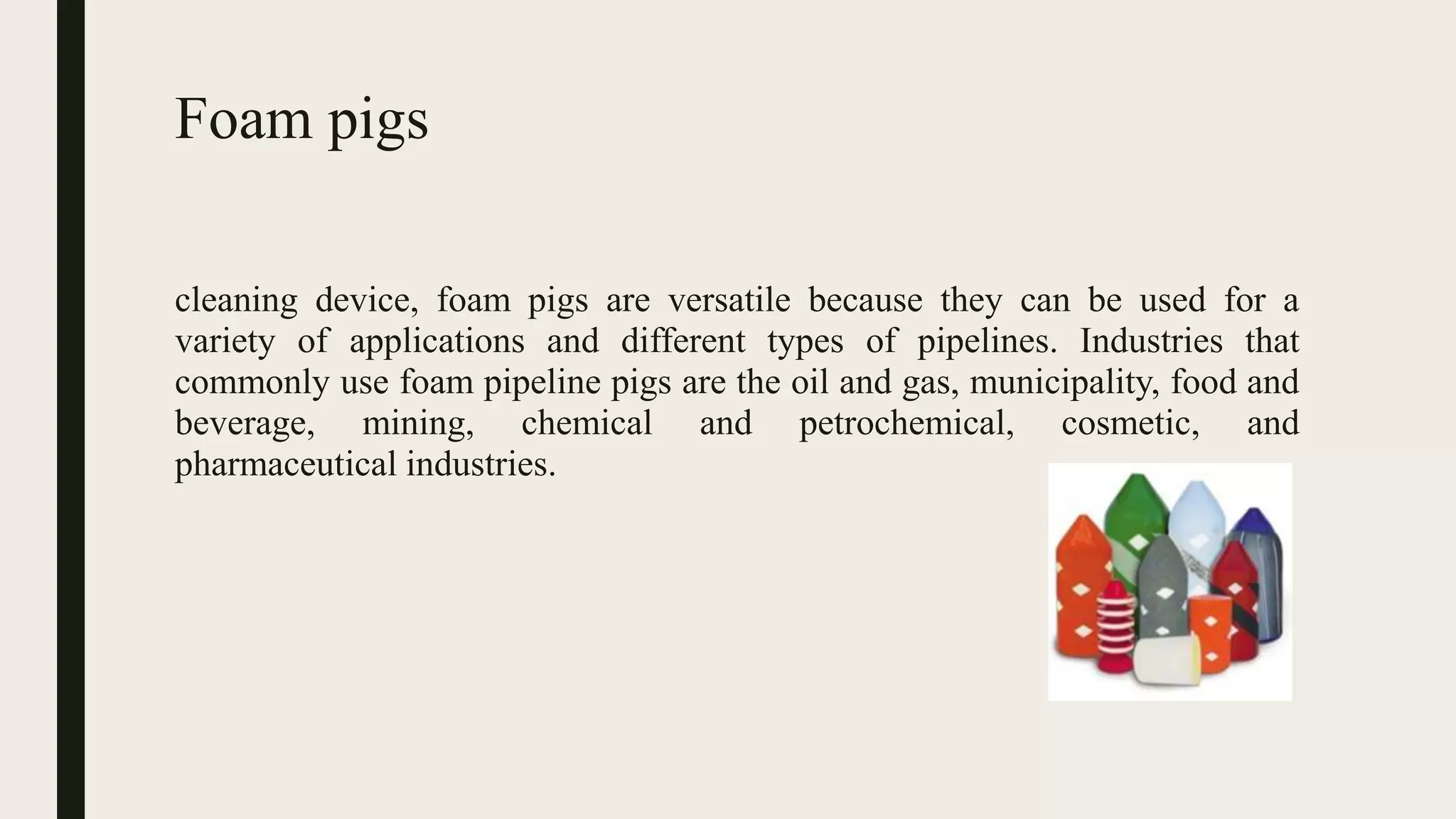
Foam pigs
cleaning device, foam pigs are versatile because they can be used for a
variety of applications and different types of pipelines. Industries that
commonly use foam pipeline pigs are the oil and gas, municipality, food and
beverage, mining, chemical and petrochemical, cosmetic, and
pharmaceutical industries.
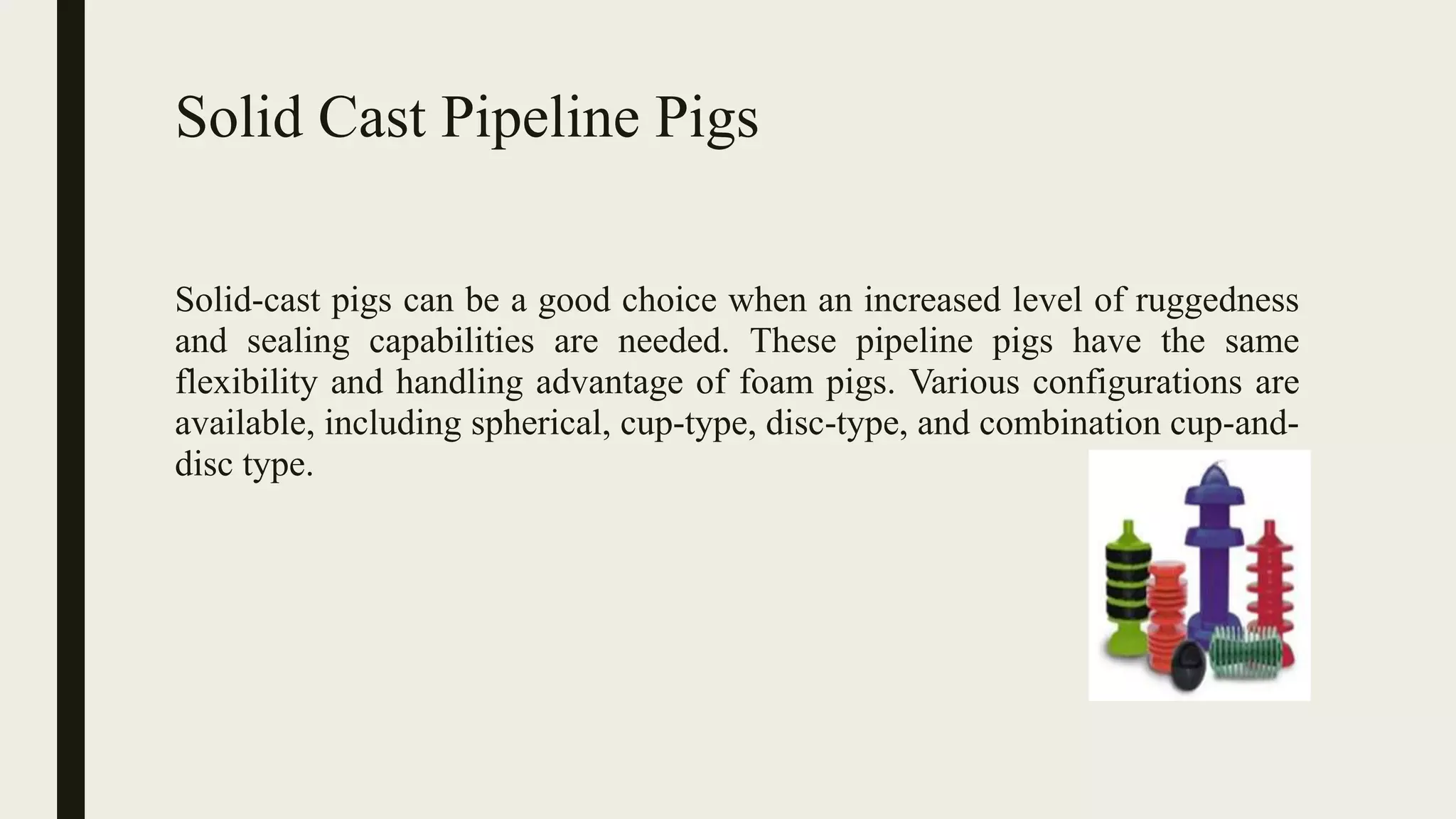
Solid Cast Pipeline Pigs
Solid-cast pigs can be a good choice when an increased level of ruggedness
and sealing capabilities are needed. These pipeline pigs have the same
flexibility and handling advantage of foam pigs. Various configurations are
available, including spherical, cup-type, disc-type, and combination cup-and-
disc type.
Steel Mandrel Pigs
Steel pipeline pigs are perfect for long-term use. They have a long-life and
can be maintained easily, being ready to serve in any application where a
pipeline pig is needed. They are made with a steel mandrel body that has
parts that can be replaced like cups and discs. The advantage of steel pipeline
pigs is the ability to replace the wearing components.
Utility Pigs
Utility pigs are used to clean the pipeline of debris or unwanted materials.
Debris can be accumulated during pipeline construction and during operating
phase. Types of utility pigs include mandrel pigs, foam pigs, solid cast pigs
and spherical pigs.
Inspection Pigs:
Inspection pigs, also known as smart pigs, gather information about the
pipeline from within. . The type of information gathered by inspection pigs
includes the temperature and pressure, corrosion, diameter, cracks,
deformation.
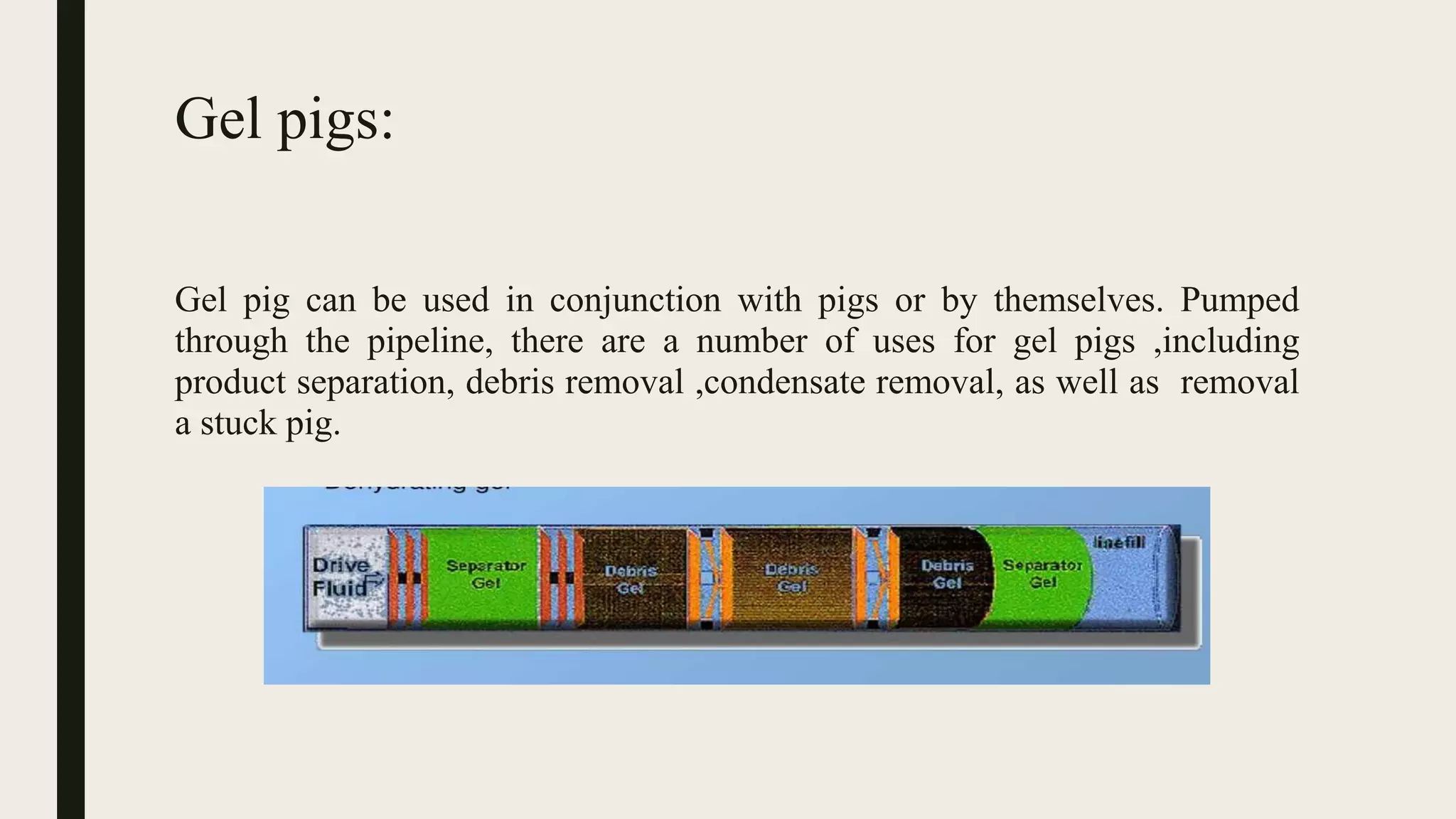
Gel pigs:
Gel pig can be used in conjunction with pigs or by themselves. Pumped
through the pipeline, there are a number of uses for gel pigs ,including
product separation, debris removal ,condensate removal, as well as removal
a stuck pig.
Intelligent Pig:
Modern intelligent pigs are highly sophisticated instruments that include
electronics and sensors that collect various forms of data during their trip
through the pipeline. They vary in technology and complexity depending on
the intended use and the manufacturer.
CRITERIA FOR PIG SELECTION
 The purpose
– Type, location, and volume.
– Type of morphological information.
– Objectives and goals for the pig run.
 The line contents
– The contents of the line while pigging.
– Available vs. required driving pressure.
 Velocity of the pig.
 Characteristics of the pipeline
– The minimum and maximum internal line sizes,
– Maximum distance pig must travel,
– Minimum bend radius, and bend angles,
– Additional features such as valve types, branch connections, and the
elevation profile
Why pig a pipeline?
Essentially there are two reasons-
– To maintain continuous and optimal operations
– To ensure the integrity of the pipe
Pigs help to maintain continuous operation by
■ Removing any substance which might damage the pipeline process
system
■ To prevent the formation of corrosion cells
■ Providing timely information of any developing problems
■ Providing an alternative to shutting down for statutory periodic testing
Pigs help to obtain and maintain maximum
efficiency by
■ Removing any debris or foreign matter in the line
■ Removing any deposits, either liquid or solid, which might otherwise
build up and restrict the flow
■ By monitoring the operating and /or physical conditions of the line
The Purpose of Pigging in Different Stages of
Operations:
During Construction:
1. Removing construction debris from the line
2. Acceptance testing (water filling, dewatering)
3. Commissioning
During Operation:
 Pipe wall cleaning
 Condensate removal
 Product separation (batching)
 Applying inhibitors
For Inspection:
 Pipe wall cleaning
 Condensate removal
 Product separation (batching)
 Applying inhibitors
FOR GENERAL MAINTENANCE AND REPAIR:
 Corrosion inhibition
 Pre-inspection cleaning
 Decommissioning
 Isolation
 Recommissioning
DURING RENOVATION/REHABILITATIONI)
 Gel pigging
 Applying in situ coatings
 Chemical cleaning
 Scale removal
 Cleaning for product conversion
DECOMMISSIONING
 Product removal
 Pipe wall cleaning
 Inspecting/testing
 Inerting
Typical Pipeline Pigging applications:
WATER PIPELINES
– Removal of Mud, Scale, Sediment, Calcium Carbonate, Manganese
Iron , Bio-Films, Bacteria and other contaminants
MINING & PROCESS SLURRY PIPELINES
– Removal of Calcium Carbonate, Manganese Iron, Particles, Scale,
Rust and other debris.
CRUDE OIL PIPELINES
– Removal of Wax, Sand, Bacterial Formations, Chemical Residues,
Scale, Rust and other impurities
NEW GAS TRANSMISSION PIPELINES:
- Removal of construction debris, water, rust, scale
EXISTING SALES GAS PIPELINES:
- Removal iron oxides, iron sulphides and iron carbonates (known as
Black Dust)
PROCESS PIPELINES:
- Removal of contaminants, product residues, product recovery and
other impurities
Purpose of Pipeline Pigging
■ Increase Pipeline Flow Efficiency: Pigs are run to maintain the line
efficiency. Any decrease in pipeline efficiency reduces the throughput of
a pipeline. It is impossible for a pipeline to be 100% efficient. Friction
and other factors obstruct flow.

■ Locate Obstructions and Inspections of the Line: After a new pipeline is
installed, it is necessary to ensure that the line has no objectionable
deformations or obstructions, and the most construction debris has been
removed.
Purpose of Pipeline Pigging
■ Separate Products: The commingling between two products in the region
of contact as they ar2.3 Separate Products. There are at least three sources
of contamination in a products pipeline. namely:
1. Pipeline design
2. Operating procedures
3. Interface of products
Purpose of Pipeline Pigging
■ Corrosion Control: Pigs are used to improve and maintain internal pipe
cleanliness by removing contaminates and deposits in the pipe. Periodic
line cleaning with pigs can be used in conjunction with corrosion
chemical inhibition or dehydration.
■ Air Purge and Water Removal: Hydrostatic testing involves purging a
section of pipeline of all air, filling it with water, and then pressuring the
line to a specified test pressure for some period of time. On completion of
the test, the water is removed so that the line can go on stream.
Purpose of Pipeline Pigging
■ Meter Proving: A meter prover is a special length of pipe of known
volume that is used to calibrate a flow meter using a pig. The pig is made
of elastomer and is spherical in shape to obtain a good seal.
■ Cleaning: Cleaning natural gas pipelines sometimes need pigging to
remove dust particle that are often procedure with the natural gas. This
dust along with oil that may come from the compressor may create an
internal coating that will reduce the efficiency of the gas flow.
Purpose of Pipeline Pigging
■ Water pipeline: Removal of mud , scale, sediment, calcium carbonate,
bio-films bacteria and others contaminants.
■ Crude oil pipeline: Removal of wax, sand, bacterial formations, chemical
residue, rust and other impurities.
■ New gas transmission pipelines: Removal of construction, debris, water,
rust, scale.
■ Process pipelines: Removal of contaminants, product residue, product
recovery and other impurities.
When to Stop pigging?
1. Monitor pressure drops when reading essentially level out.
2. Time pig runs ,if the volume is consistent pigging should stop when
cleaning time has leveled out.
3. When the number of seconds of receiving effluent is the same during
subsequent pig runs, pigging should be stopped.
4. Wire brush pig runs should be limited two or three.
5. By running swabs nearing the end of pigging operation, they will both
sweep the line of loose buildup as well as gauge the lines cleanliness. when a
swab is retrieved in good condition, pigging should stop.
Benefits of pigging
■ High Return on Investment (ROI)
■ Reduced Waste and Less Production Downtime.
■ Improved Sustainability and Lower Water Consumption.
■ Higher Profits, Productivity and Efficiency.
Disadvantages of Pigging
• Some types of pigging (such as ice pigging) use large amounts of water
and energy in comparison to conventional process pigging methods.
• some types of pigging (such as ice pigging) use large amounts of water
and energy in comparison to conventional process pigging methods.
THANKYOU

Purposes of pigging

  • 1.
  • 2.
    What is pigging? Piggingis a process of pushing a device (PIG) equipped with metal wire brushes to clean the deposits on the inner walls of the pipelines. – Clean deposits like carbonates ,sulphates, iron oxides on the inner walls of the pipe. – Decrease surface roughness. – Decrease friction factor.
  • 3.
  • 4.
    Foam pigs cleaning device,foam pigs are versatile because they can be used for a variety of applications and different types of pipelines. Industries that commonly use foam pipeline pigs are the oil and gas, municipality, food and beverage, mining, chemical and petrochemical, cosmetic, and pharmaceutical industries.
  • 5.
    Solid Cast PipelinePigs Solid-cast pigs can be a good choice when an increased level of ruggedness and sealing capabilities are needed. These pipeline pigs have the same flexibility and handling advantage of foam pigs. Various configurations are available, including spherical, cup-type, disc-type, and combination cup-and- disc type.
  • 6.
    Steel Mandrel Pigs Steelpipeline pigs are perfect for long-term use. They have a long-life and can be maintained easily, being ready to serve in any application where a pipeline pig is needed. They are made with a steel mandrel body that has parts that can be replaced like cups and discs. The advantage of steel pipeline pigs is the ability to replace the wearing components.
  • 7.
    Utility Pigs Utility pigsare used to clean the pipeline of debris or unwanted materials. Debris can be accumulated during pipeline construction and during operating phase. Types of utility pigs include mandrel pigs, foam pigs, solid cast pigs and spherical pigs.
  • 8.
    Inspection Pigs: Inspection pigs,also known as smart pigs, gather information about the pipeline from within. . The type of information gathered by inspection pigs includes the temperature and pressure, corrosion, diameter, cracks, deformation.
  • 9.
    Gel pigs: Gel pigcan be used in conjunction with pigs or by themselves. Pumped through the pipeline, there are a number of uses for gel pigs ,including product separation, debris removal ,condensate removal, as well as removal a stuck pig.
  • 10.
    Intelligent Pig: Modern intelligentpigs are highly sophisticated instruments that include electronics and sensors that collect various forms of data during their trip through the pipeline. They vary in technology and complexity depending on the intended use and the manufacturer.
  • 11.
    CRITERIA FOR PIGSELECTION  The purpose – Type, location, and volume. – Type of morphological information. – Objectives and goals for the pig run.  The line contents – The contents of the line while pigging. – Available vs. required driving pressure.
  • 12.
     Velocity ofthe pig.  Characteristics of the pipeline – The minimum and maximum internal line sizes, – Maximum distance pig must travel, – Minimum bend radius, and bend angles, – Additional features such as valve types, branch connections, and the elevation profile
  • 13.
    Why pig apipeline? Essentially there are two reasons- – To maintain continuous and optimal operations – To ensure the integrity of the pipe
  • 14.
    Pigs help tomaintain continuous operation by ■ Removing any substance which might damage the pipeline process system ■ To prevent the formation of corrosion cells ■ Providing timely information of any developing problems ■ Providing an alternative to shutting down for statutory periodic testing
  • 15.
    Pigs help toobtain and maintain maximum efficiency by ■ Removing any debris or foreign matter in the line ■ Removing any deposits, either liquid or solid, which might otherwise build up and restrict the flow ■ By monitoring the operating and /or physical conditions of the line
  • 16.
    The Purpose ofPigging in Different Stages of Operations: During Construction: 1. Removing construction debris from the line 2. Acceptance testing (water filling, dewatering) 3. Commissioning
  • 17.
    During Operation:  Pipewall cleaning  Condensate removal  Product separation (batching)  Applying inhibitors
  • 18.
    For Inspection:  Pipewall cleaning  Condensate removal  Product separation (batching)  Applying inhibitors
  • 19.
    FOR GENERAL MAINTENANCEAND REPAIR:  Corrosion inhibition  Pre-inspection cleaning  Decommissioning  Isolation  Recommissioning
  • 20.
    DURING RENOVATION/REHABILITATIONI)  Gelpigging  Applying in situ coatings  Chemical cleaning  Scale removal  Cleaning for product conversion
  • 21.
    DECOMMISSIONING  Product removal Pipe wall cleaning  Inspecting/testing  Inerting
  • 22.
    Typical Pipeline Piggingapplications: WATER PIPELINES – Removal of Mud, Scale, Sediment, Calcium Carbonate, Manganese Iron , Bio-Films, Bacteria and other contaminants MINING & PROCESS SLURRY PIPELINES – Removal of Calcium Carbonate, Manganese Iron, Particles, Scale, Rust and other debris. CRUDE OIL PIPELINES – Removal of Wax, Sand, Bacterial Formations, Chemical Residues, Scale, Rust and other impurities
  • 23.
    NEW GAS TRANSMISSIONPIPELINES: - Removal of construction debris, water, rust, scale EXISTING SALES GAS PIPELINES: - Removal iron oxides, iron sulphides and iron carbonates (known as Black Dust) PROCESS PIPELINES: - Removal of contaminants, product residues, product recovery and other impurities
  • 24.
    Purpose of PipelinePigging ■ Increase Pipeline Flow Efficiency: Pigs are run to maintain the line efficiency. Any decrease in pipeline efficiency reduces the throughput of a pipeline. It is impossible for a pipeline to be 100% efficient. Friction and other factors obstruct flow. ■ Locate Obstructions and Inspections of the Line: After a new pipeline is installed, it is necessary to ensure that the line has no objectionable deformations or obstructions, and the most construction debris has been removed.
  • 25.
    Purpose of PipelinePigging ■ Separate Products: The commingling between two products in the region of contact as they ar2.3 Separate Products. There are at least three sources of contamination in a products pipeline. namely: 1. Pipeline design 2. Operating procedures 3. Interface of products
  • 26.
    Purpose of PipelinePigging ■ Corrosion Control: Pigs are used to improve and maintain internal pipe cleanliness by removing contaminates and deposits in the pipe. Periodic line cleaning with pigs can be used in conjunction with corrosion chemical inhibition or dehydration. ■ Air Purge and Water Removal: Hydrostatic testing involves purging a section of pipeline of all air, filling it with water, and then pressuring the line to a specified test pressure for some period of time. On completion of the test, the water is removed so that the line can go on stream.
  • 27.
    Purpose of PipelinePigging ■ Meter Proving: A meter prover is a special length of pipe of known volume that is used to calibrate a flow meter using a pig. The pig is made of elastomer and is spherical in shape to obtain a good seal. ■ Cleaning: Cleaning natural gas pipelines sometimes need pigging to remove dust particle that are often procedure with the natural gas. This dust along with oil that may come from the compressor may create an internal coating that will reduce the efficiency of the gas flow.
  • 28.
    Purpose of PipelinePigging ■ Water pipeline: Removal of mud , scale, sediment, calcium carbonate, bio-films bacteria and others contaminants. ■ Crude oil pipeline: Removal of wax, sand, bacterial formations, chemical residue, rust and other impurities. ■ New gas transmission pipelines: Removal of construction, debris, water, rust, scale. ■ Process pipelines: Removal of contaminants, product residue, product recovery and other impurities.
  • 29.
    When to Stoppigging? 1. Monitor pressure drops when reading essentially level out. 2. Time pig runs ,if the volume is consistent pigging should stop when cleaning time has leveled out. 3. When the number of seconds of receiving effluent is the same during subsequent pig runs, pigging should be stopped. 4. Wire brush pig runs should be limited two or three. 5. By running swabs nearing the end of pigging operation, they will both sweep the line of loose buildup as well as gauge the lines cleanliness. when a swab is retrieved in good condition, pigging should stop.
  • 30.
    Benefits of pigging ■High Return on Investment (ROI) ■ Reduced Waste and Less Production Downtime. ■ Improved Sustainability and Lower Water Consumption. ■ Higher Profits, Productivity and Efficiency.
  • 31.
    Disadvantages of Pigging •Some types of pigging (such as ice pigging) use large amounts of water and energy in comparison to conventional process pigging methods. • some types of pigging (such as ice pigging) use large amounts of water and energy in comparison to conventional process pigging methods.
  • 32.