NDT SCOOP Inspection Newsletter BY NDT CORNER 20
www.ndtcorner.com /ndtcorner /ndt-corner
in
F
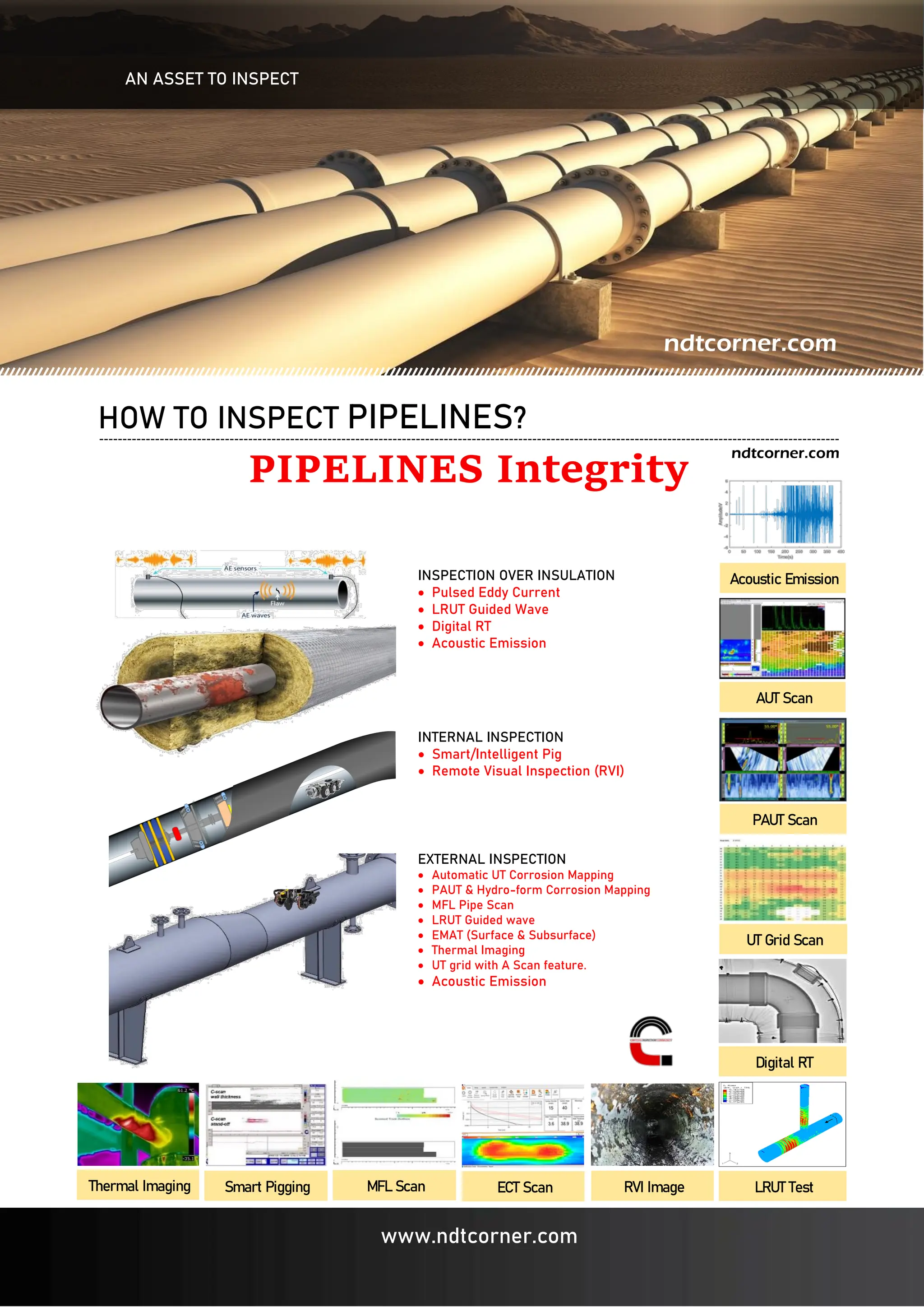
AN ASSET TO INSPECT
AUT Scan
PAUT Scan
UT Grid Scan
MFLScan ECT Scan
HOW TO INSPECT PIPELINES?
PIPELINES Integrity
www.ndtcorner.com
ndtcorner.com
Smart Pigging
Thermal Imaging
INSPECTION OVER INSULATION
• Pulsed Eddy Current
• LRUT Guided Wave
• Digital RT
• Acoustic Emission
EXTERNAL INSPECTION
• Automatic UT Corrosion Mapping
• PAUT & Hydro-form Corrosion Mapping
• MFL Pipe Scan
• LRUT Guided wave
• EMAT (Surface & Subsurface)
• Thermal Imaging
• UT grid with A Scan feature.
• Acoustic Emission
INTERNAL INSPECTION
• Smart/Intelligent Pig
• Remote Visual Inspection (RVI)
Digital RT
LRUT Test
RVI Image
Acoustic Emission
ndtcorner.com
NDT SCOOP Inspection Newsletter BY NDT CORNER 21
www.ndtcorner.com /ndtcorner /ndt-corner
in
F
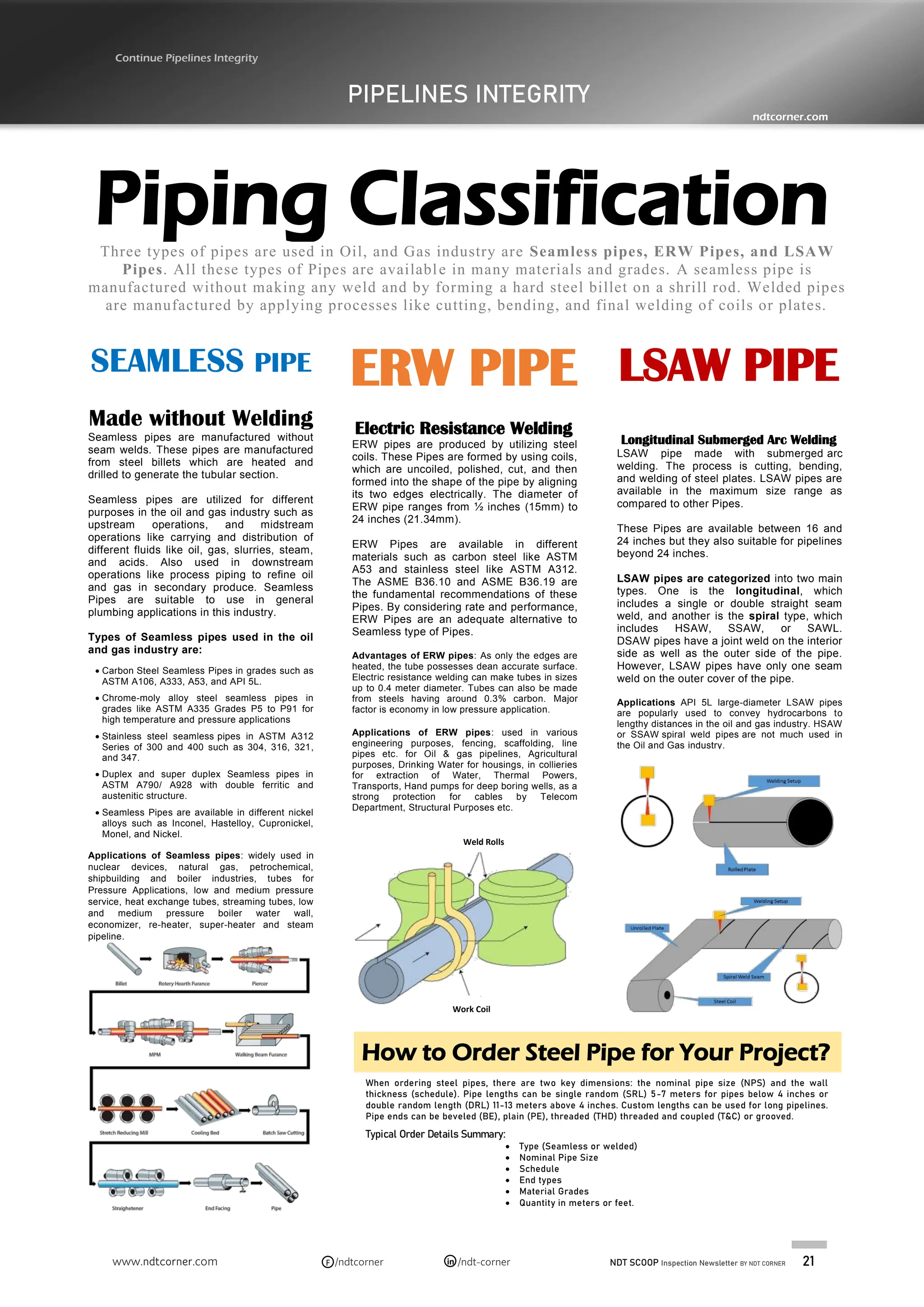
SEAMLESS PIPE
Made without Welding
Seamless pipes are manufactured without
seam welds. These pipes are manufactured
from steel billets which are heated and
drilled to generate the tubular section.
Seamless pipes are utilized for different
purposes in the oil and gas industry such as
upstream operations, and midstream
operations like carrying and distribution of
different fluids like oil, gas, slurries, steam,
and acids. Also used in downstream
operations like process piping to refine oil
and gas in secondary produce. Seamless
Pipes are suitable to use in general
plumbing applications in this industry.
Types of Seamless pipes used in the oil
and gas industry are:
• Carbon Steel Seamless Pipes in grades such as
ASTM A106, A333, A53, and API 5L.
• Chrome-moly alloy steel seamless pipes in
grades like ASTM A335 Grades P5 to P91 for
high temperature and pressure applications
• Stainless steel seamless pipes in ASTM A312
Series of 300 and 400 such as 304, 316, 321,
and 347.
• Duplex and super duplex Seamless pipes in
ASTM A790/ A928 with double ferritic and
austenitic structure.
• Seamless Pipes are available in different nickel
alloys such as Inconel, Hastelloy, Cupronickel,
Monel, and Nickel.
Applications of Seamless pipes: widely used in
nuclear devices, natural gas, petrochemical,
shipbuilding and boiler industries, tubes for
Pressure Applications, low and medium pressure
service, heat exchange tubes, streaming tubes, low
and medium pressure boiler water wall,
economizer, re-heater, super-heater and steam
pipeline.
Piping Classification
Three types of pipes are used in Oil, and Gas industry are Seamless pipes, ERW Pipes, and LSAW
Pipes. All these types of Pipes are available in many materials and grades. A seamless pipe is
manufactured without making any weld and by forming a hard steel billet on a shrill rod. Welded pipes
are manufactured by applying processes like cutting, bending, and final welding of coils or plates.
LSAW PIPE
Longitudinal Submerged Arc Welding
LSAW pipe made with submerged arc
welding. The process is cutting, bending,
and welding of steel plates. LSAW pipes are
available in the maximum size range as
compared to other Pipes.
These Pipes are available between 16 and
24 inches but they also suitable for pipelines
beyond 24 inches.
LSAW pipes are categorized into two main
types. One is the longitudinal, which
includes a single or double straight seam
weld, and another is the spiral type, which
includes HSAW, SSAW, or SAWL.
DSAW pipes have a joint weld on the interior
side as well as the outer side of the pipe.
However, LSAW pipes have only one seam
weld on the outer cover of the pipe.
Applications API 5L large-diameter LSAW pipes
are popularly used to convey hydrocarbons to
lengthy distances in the oil and gas industry. HSAW
or SSAW spiral weld pipes are not much used in
the Oil and Gas industry.
ERW PIPE
Electric Resistance Welding
ERW pipes are produced by utilizing steel
coils. These Pipes are formed by using coils,
which are uncoiled, polished, cut, and then
formed into the shape of the pipe by aligning
its two edges electrically. The diameter of
ERW pipe ranges from ½ inches (15mm) to
24 inches (21.34mm).
ERW Pipes are available in different
materials such as carbon steel like ASTM
A53 and stainless steel like ASTM A312.
The ASME B36.10 and ASME B36.19 are
the fundamental recommendations of these
Pipes. By considering rate and performance,
ERW Pipes are an adequate alternative to
Seamless type of Pipes.
Advantages of ERW pipes: As only the edges are
heated, the tube possesses dean accurate surface.
Electric resistance welding can make tubes in sizes
up to 0.4 meter diameter. Tubes can also be made
from steels having around 0.3% carbon. Major
factor is economy in low pressure application.
Applications of ERW pipes: used in various
engineering purposes, fencing, scaffolding, line
pipes etc. for Oil & gas pipelines, Agricultural
purposes, Drinking Water for housings, in collieries
for extraction of Water, Thermal Powers,
Transports, Hand pumps for deep boring wells, as a
strong protection for cables by Telecom
Department, Structural Purposes etc.
Weld Rolls
Work Coil
PIPELINES INTEGRITY
Continue Pipelines Integrity
ndtcorner.com
How to Order Steel Pipe for Your Project?
When ordering steel pipes, there are two key dimensions: the nominal pipe size (NPS) and the wall
thickness (schedule). Pipe lengths can be single random (SRL) 5-7 meters for pipes below 4 inches or
double random length (DRL) 11-13 meters above 4 inches. Custom lengths can be used for long pipelines.
Pipe ends can be beveled (BE), plain (PE), threaded (THD) threaded and coupled (T&C) or grooved.
Typical Order Details Summary:
• Type (Seamless or welded)
• Nominal Pipe Size
• Schedule
• End types
• Material Grades
• Quantity in meters or feet.
NDT SCOOP Inspection Newsletter BY NDT CORNER 22
www.ndtcorner.com /ndtcorner /ndt-corner
in
F
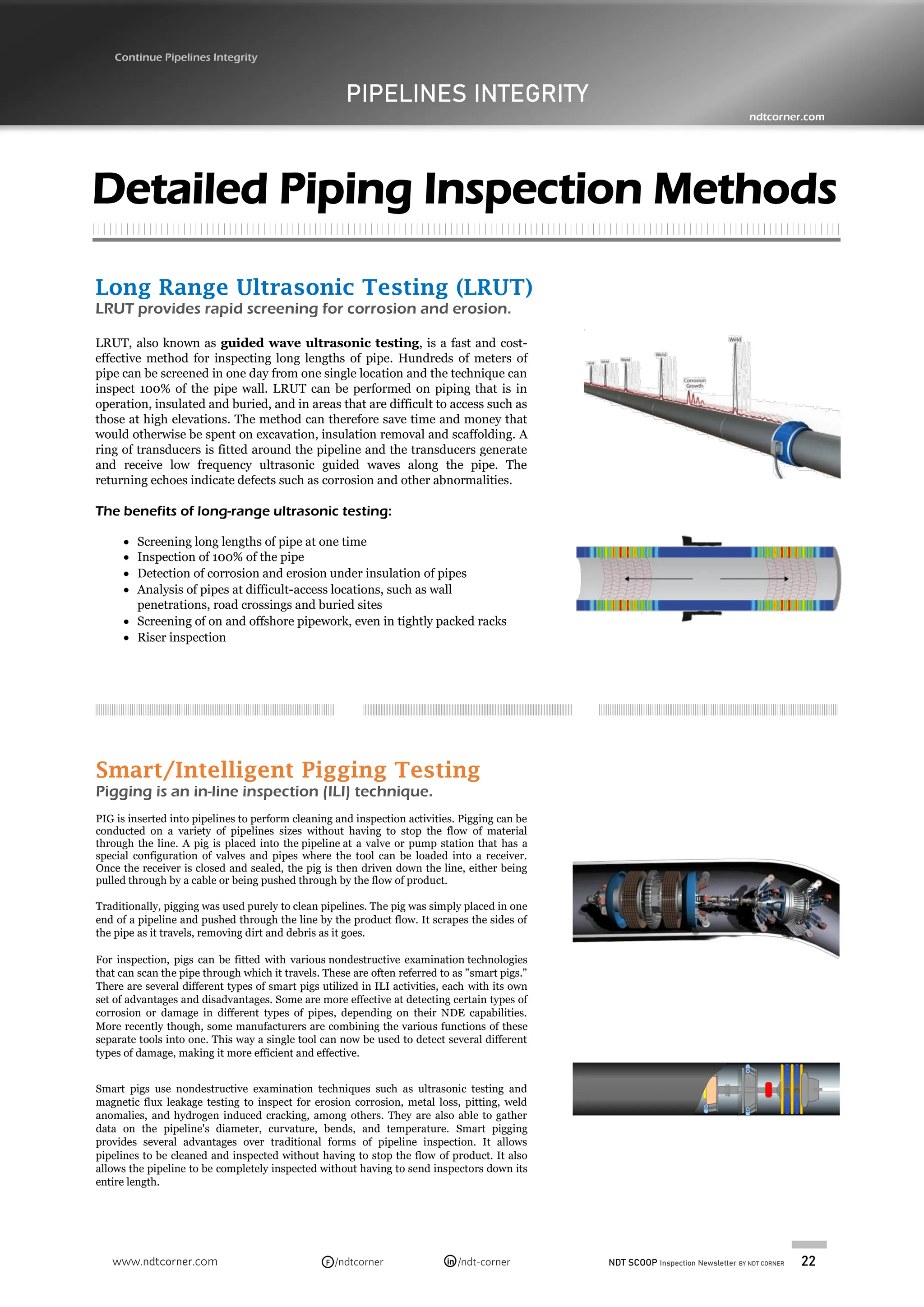
Long Range Ultrasonic Testing (LRUT)
LRUT provides rapid screening for corrosion and erosion.
LRUT, also known as guided wave ultrasonic testing, is a fast and cost-
effective method for inspecting long lengths of pipe. Hundreds of meters of
pipe can be screened in one day from one single location and the technique can
inspect 100% of the pipe wall. LRUT can be performed on piping that is in
operation, insulated and buried, and in areas that are difficult to access such as
those at high elevations. The method can therefore save time and money that
would otherwise be spent on excavation, insulation removal and scaffolding. A
ring of transducers is fitted around the pipeline and the transducers generate
and receive low frequency ultrasonic guided waves along the pipe. The
returning echoes indicate defects such as corrosion and other abnormalities.
The benefits of long-range ultrasonic testing:
• Screening long lengths of pipe at one time
• Inspection of 100% of the pipe
• Detection of corrosion and erosion under insulation of pipes
• Analysis of pipes at difficult-access locations, such as wall
penetrations, road crossings and buried sites
• Screening of on and offshore pipework, even in tightly packed racks
• Riser inspection
PIPELINES INTEGRITY
Continue Pipelines Integrity
ndtcorner.com
Detailed Piping Inspection Methods
Smart/Intelligent Pigging Testing
Pigging is an in-line inspection (ILI) technique.
PIG is inserted into pipelines to perform cleaning and inspection activities. Pigging can be
conducted on a variety of pipelines sizes without having to stop the flow of material
through the line. A pig is placed into the pipeline at a valve or pump station that has a
special configuration of valves and pipes where the tool can be loaded into a receiver.
Once the receiver is closed and sealed, the pig is then driven down the line, either being
pulled through by a cable or being pushed through by the flow of product.
Traditionally, pigging was used purely to clean pipelines. The pig was simply placed in one
end of a pipeline and pushed through the line by the product flow. It scrapes the sides of
the pipe as it travels, removing dirt and debris as it goes.
For inspection, pigs can be fitted with various nondestructive examination technologies
that can scan the pipe through which it travels. These are often referred to as "smart pigs."
There are several different types of smart pigs utilized in ILI activities, each with its own
set of advantages and disadvantages. Some are more effective at detecting certain types of
corrosion or damage in different types of pipes, depending on their NDE capabilities.
More recently though, some manufacturers are combining the various functions of these
separate tools into one. This way a single tool can now be used to detect several different
types of damage, making it more efficient and effective.
Smart pigs use nondestructive examination techniques such as ultrasonic testing and
magnetic flux leakage testing to inspect for erosion corrosion, metal loss, pitting, weld
anomalies, and hydrogen induced cracking, among others. They are also able to gather
data on the pipeline's diameter, curvature, bends, and temperature. Smart pigging
provides several advantages over traditional forms of pipeline inspection. It allows
pipelines to be cleaned and inspected without having to stop the flow of product. It also
allows the pipeline to be completely inspected without having to send inspectors down its
entire length.
NDT SCOOP Inspection Newsletter BY NDT CORNER 23
www.ndtcorner.com /ndtcorner /ndt-corner
in
F
PIPELINES INTEGRITY
Continue Pipelines Integrity
ndtcorner.com
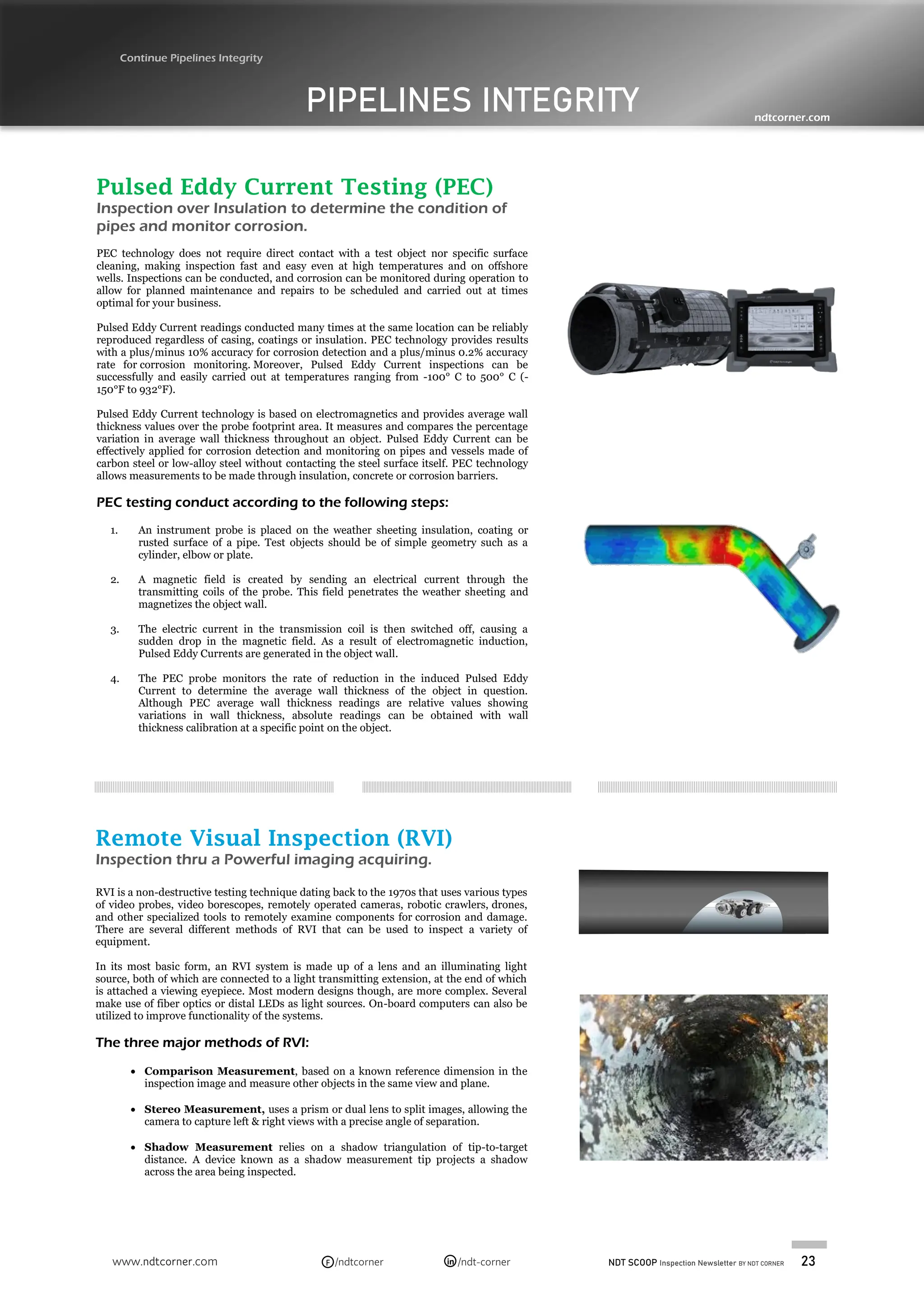
Pulsed Eddy Current Testing (PEC)
Inspection over Insulation to determine the condition of
pipes and monitor corrosion.
PEC technology does not require direct contact with a test object nor specific surface
cleaning, making inspection fast and easy even at high temperatures and on offshore
wells. Inspections can be conducted, and corrosion can be monitored during operation to
allow for planned maintenance and repairs to be scheduled and carried out at times
optimal for your business.
Pulsed Eddy Current readings conducted many times at the same location can be reliably
reproduced regardless of casing, coatings or insulation. PEC technology provides results
with a plus/minus 10% accuracy for corrosion detection and a plus/minus 0.2% accuracy
rate for corrosion monitoring. Moreover, Pulsed Eddy Current inspections can be
successfully and easily carried out at temperatures ranging from -100° C to 500° C (-
150°F to 932°F).
Pulsed Eddy Current technology is based on electromagnetics and provides average wall
thickness values over the probe footprint area. It measures and compares the percentage
variation in average wall thickness throughout an object. Pulsed Eddy Current can be
effectively applied for corrosion detection and monitoring on pipes and vessels made of
carbon steel or low-alloy steel without contacting the steel surface itself. PEC technology
allows measurements to be made through insulation, concrete or corrosion barriers.
PEC testing conduct according to the following steps:
1. An instrument probe is placed on the weather sheeting insulation, coating or
rusted surface of a pipe. Test objects should be of simple geometry such as a
cylinder, elbow or plate.
2. A magnetic field is created by sending an electrical current through the
transmitting coils of the probe. This field penetrates the weather sheeting and
magnetizes the object wall.
3. The electric current in the transmission coil is then switched off, causing a
sudden drop in the magnetic field. As a result of electromagnetic induction,
Pulsed Eddy Currents are generated in the object wall.
4. The PEC probe monitors the rate of reduction in the induced Pulsed Eddy
Current to determine the average wall thickness of the object in question.
Although PEC average wall thickness readings are relative values showing
variations in wall thickness, absolute readings can be obtained with wall
thickness calibration at a specific point on the object.
Remote Visual Inspection (RVI)
Inspection thru a Powerful imaging acquiring.
RVI is a non-destructive testing technique dating back to the 1970s that uses various types
of video probes, video borescopes, remotely operated cameras, robotic crawlers, drones,
and other specialized tools to remotely examine components for corrosion and damage.
There are several different methods of RVI that can be used to inspect a variety of
equipment.
In its most basic form, an RVI system is made up of a lens and an illuminating light
source, both of which are connected to a light transmitting extension, at the end of which
is attached a viewing eyepiece. Most modern designs though, are more complex. Several
make use of fiber optics or distal LEDs as light sources. On-board computers can also be
utilized to improve functionality of the systems.
The three major methods of RVI:
• Comparison Measurement, based on a known reference dimension in the
inspection image and measure other objects in the same view and plane.
• Stereo Measurement, uses a prism or dual lens to split images, allowing the
camera to capture left & right views with a precise angle of separation.
• Shadow Measurement relies on a shadow triangulation of tip-to-target
distance. A device known as a shadow measurement tip projects a shadow
across the area being inspected.
NDT SCOOP Inspection Newsletter BY NDT CORNER 24
www.ndtcorner.com /ndtcorner /ndt-corner
in
F
PIPELINES INTEGRITY
Continue Pipelines Integrity
ndtcorner.com
Thermal Imaging Method
A screening method for Pipes by Infrared Thermography.
Thermal imaging is the technique of using the heat given off by an object to produce an
image of it or to locate it. In essence, a thermal imaging camera measures variations in
heat, or infrared radiation, and represents the heat as different colors in an image.
This style of imaging is used by many industries from medical, law enforcement, to
plumbing and electrical. For instance, electricians use thermal imaging to detect hot spots
in electrical systems which can indicate dangerous faults.
This method is based on triage techniques employed in the medical field and uses the test
results obtained by an infrared thermographic camera and ultrasonic thickness gauge as
determination criteria. Aiming at evaluating the wall thinning caused by aqueous
corrosion due to sludge in pipes, an infrared thermographic camera was used to conduct
studies to find a method for detecting sludge inside a pipe and a method for measuring
the distribution of wall thinning. Testing conditions, signal processing, etc., were
developed and adapted for actual pipes, and their validity was confirmed.
Magnetic Flux Leakage Testing (MFL)
MFL provides rapid screening for corrosion and erosion.
The Magnetic Flux Leakage (MFL) is a Non-destructive testing (NDT) approach. It is used
on ferromagnetic material if lined or unlined.
MFL is a rapid, reliable, and robust corrosion screening technique that detects the volume
of missing magnetic material in a component under inspection.
MFL requires limited surface preparation and no couplant is needed. Users require
minimal training, and with scanning speeds up to 1m/s (3.2 ft/s), MFL is the ideal
solution for fast, cost-effective corrosion detection.
Automatic UT Corrosion Mapping
Ultrasonic technique using powered scanners.
AUT covers a range of ultrasonic inspection techniques using powered, mechanical
scanners with magnetic wheels to only adhering purposes to locate inherent defects
within a given material. AUT is the term used to describe corrosion mapping inspections,
pulse-echo weld inspection, Phased Array and Time of Flight Diffraction.
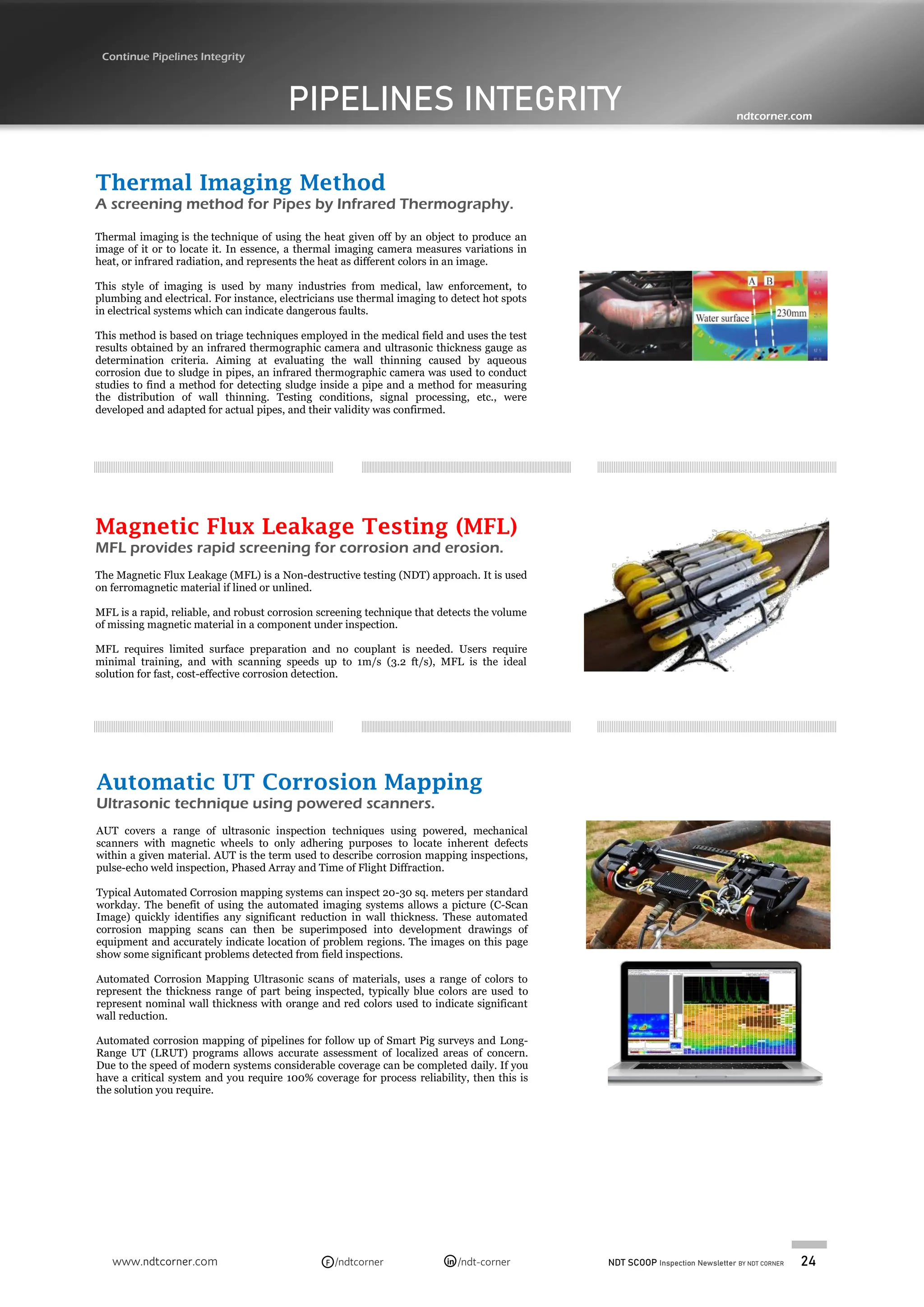
Typical Automated Corrosion mapping systems can inspect 20-30 sq. meters per standard
workday. The benefit of using the automated imaging systems allows a picture (C-Scan
Image) quickly identifies any significant reduction in wall thickness. These automated
corrosion mapping scans can then be superimposed into development drawings of
equipment and accurately indicate location of problem regions. The images on this page
show some significant problems detected from field inspections.
Automated Corrosion Mapping Ultrasonic scans of materials, uses a range of colors to
represent the thickness range of part being inspected, typically blue colors are used to
represent nominal wall thickness with orange and red colors used to indicate significant
wall reduction.
Automated corrosion mapping of pipelines for follow up of Smart Pig surveys and Long-
Range UT (LRUT) programs allows accurate assessment of localized areas of concern.
Due to the speed of modern systems considerable coverage can be completed daily. If you
have a critical system and you require 100% coverage for process reliability, then this is
the solution you require.
NDT SCOOP Inspection Newsletter BY NDT CORNER 25
www.ndtcorner.com /ndtcorner /ndt-corner
in
F
PIPELINES INTEGRITY
Continue Pipelines Integrity
ndtcorner.com
Digital Radiography Testing (DR)
A Computed Radiography to create an instant Image.
Digital Radiography (DR) is an advancement of traditional Film Radiography. This
technique utilizes a DDA (Digital Detector Array) instead of Film or CR (Computed
Radiography) to create an instant Image. Besides performing “standard” Radiography
work, DR opens new opportunities such as fast and accurate wall thickness measurements
and Corrosion monitoring.
The Radiation reaches the DDA, which has passed through the object, converted by a
Scintillator into visible light and then translated into a digital Image. The physics (Angles,
Penetration, technique etc.) remain similar and only mild changes are required to make
the transition to Digital Radiography.
The DR standard for Pipe Radiography, the main one being the European ISO 17636-2,
and the well-known ASME Section V (article 2) which permits the use of DR with mild
modifications to the inspection technique.
The DR Applications: Corrosion monitoring • Weld quality (detect Cracks, Gas
inclusions, Porosity, lack of penetration etc.) • Wall thickness (Wall thinning).
Ultrasonic Thickness Measurement
UT Grid scan with spot digital reading & A-scan.
An ultrasonic thickness gauge works by precisely measuring how long it takes for a sound
pulse that has been generated by a small probe called an ultrasonic transducer to travel
through a test piece and reflect from the inside surface or far wall. From this
measurement, the thickness of the test piece is calculated and displayed on a digital
screen.
The portability of the testing equipment allows for on-site inspection and results are
instant. If a problem has been detected by the technique, additional non-destructive
testing methods can be used to further investigate the findings.
Manual point thickness measurements using conventional ultrasound (UT) is a widely
used technique for monitoring corrosion in many infrastructure applications. Depending
upon the nature of the corrosion (e.g., localized, versus generalized and pitting), an
inspector typically records the minimum thickness reading within a small area (usually 1
in.2). This however can lead to inconclusive inspection data due to minimal coverage of
large areas, operator variability, lack of pitting or localized corrosion detection, and
inadequate data reporting and analysis.
Phased Array UT SCANNING
Inspect large surface areas quickly with high resolution.
The phased array instruments are now used to perform high-resolution corrosion
inspections in accordance with today’s demanding industry standards.
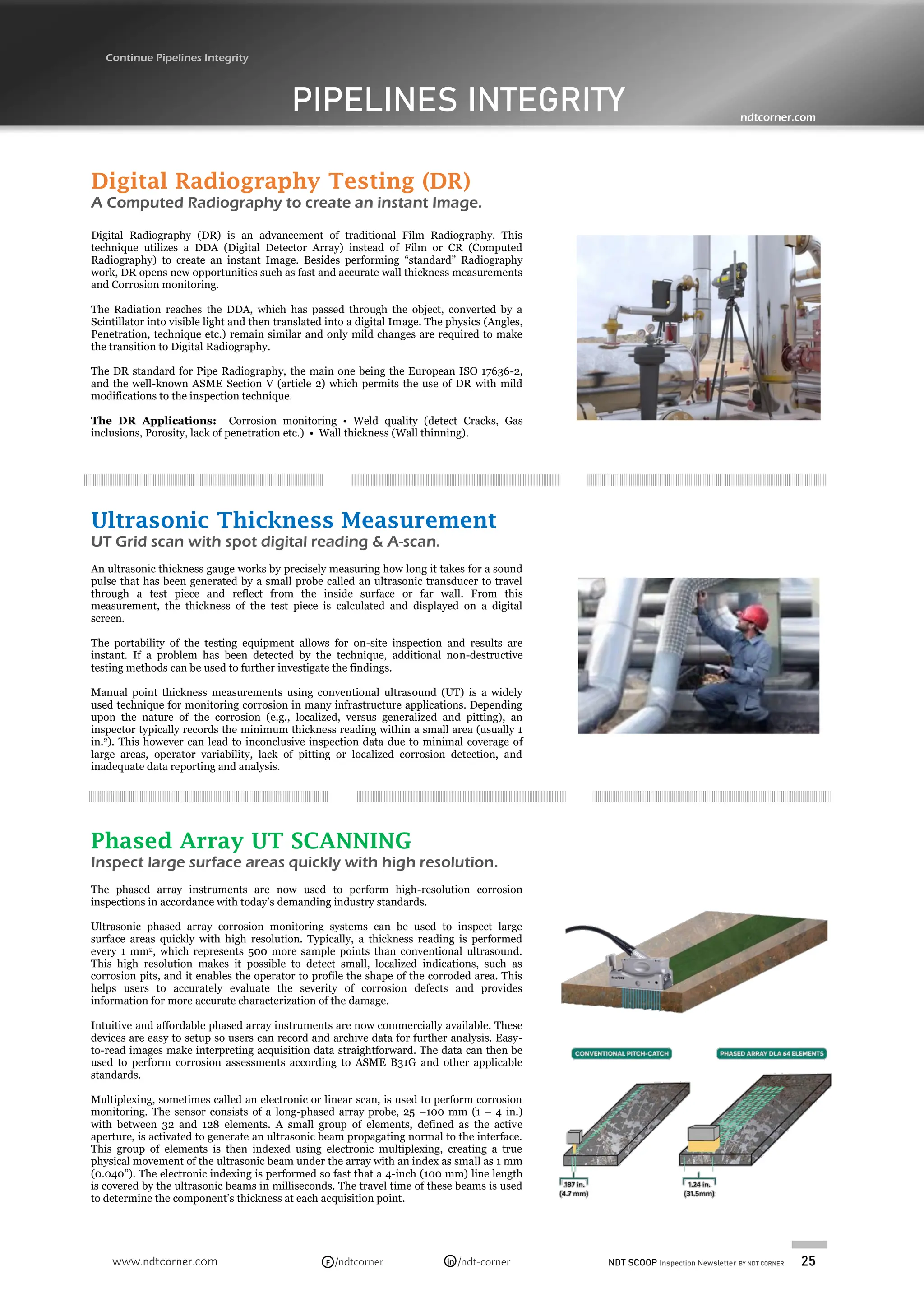
Ultrasonic phased array corrosion monitoring systems can be used to inspect large
surface areas quickly with high resolution. Typically, a thickness reading is performed
every 1 mm2, which represents 500 more sample points than conventional ultrasound.
This high resolution makes it possible to detect small, localized indications, such as
corrosion pits, and it enables the operator to profile the shape of the corroded area. This
helps users to accurately evaluate the severity of corrosion defects and provides
information for more accurate characterization of the damage.
Intuitive and affordable phased array instruments are now commercially available. These
devices are easy to setup so users can record and archive data for further analysis. Easy-
to-read images make interpreting acquisition data straightforward. The data can then be
used to perform corrosion assessments according to ASME B31G and other applicable
standards.
Multiplexing, sometimes called an electronic or linear scan, is used to perform corrosion
monitoring. The sensor consists of a long-phased array probe, 25 –100 mm (1 – 4 in.)
with between 32 and 128 elements. A small group of elements, defined as the active
aperture, is activated to generate an ultrasonic beam propagating normal to the interface.
This group of elements is then indexed using electronic multiplexing, creating a true
physical movement of the ultrasonic beam under the array with an index as small as 1 mm
(0.040”). The electronic indexing is performed so fast that a 4-inch (100 mm) line length
is covered by the ultrasonic beams in milliseconds. The travel time of these beams is used
to determine the component’s thickness at each acquisition point.

Dlamini Pipelines Integrity Solutions .pdf

  • 1.
    NDT SCOOP InspectionNewsletter BY NDT CORNER 20 www.ndtcorner.com /ndtcorner /ndt-corner in F AN ASSET TO INSPECT AUT Scan PAUT Scan UT Grid Scan MFLScan ECT Scan HOW TO INSPECT PIPELINES? PIPELINES Integrity www.ndtcorner.com ndtcorner.com Smart Pigging Thermal Imaging INSPECTION OVER INSULATION • Pulsed Eddy Current • LRUT Guided Wave • Digital RT • Acoustic Emission EXTERNAL INSPECTION • Automatic UT Corrosion Mapping • PAUT & Hydro-form Corrosion Mapping • MFL Pipe Scan • LRUT Guided wave • EMAT (Surface & Subsurface) • Thermal Imaging • UT grid with A Scan feature. • Acoustic Emission INTERNAL INSPECTION • Smart/Intelligent Pig • Remote Visual Inspection (RVI) Digital RT LRUT Test RVI Image Acoustic Emission ndtcorner.com
  • 2.
    NDT SCOOP InspectionNewsletter BY NDT CORNER 21 www.ndtcorner.com /ndtcorner /ndt-corner in F SEAMLESS PIPE Made without Welding Seamless pipes are manufactured without seam welds. These pipes are manufactured from steel billets which are heated and drilled to generate the tubular section. Seamless pipes are utilized for different purposes in the oil and gas industry such as upstream operations, and midstream operations like carrying and distribution of different fluids like oil, gas, slurries, steam, and acids. Also used in downstream operations like process piping to refine oil and gas in secondary produce. Seamless Pipes are suitable to use in general plumbing applications in this industry. Types of Seamless pipes used in the oil and gas industry are: • Carbon Steel Seamless Pipes in grades such as ASTM A106, A333, A53, and API 5L. • Chrome-moly alloy steel seamless pipes in grades like ASTM A335 Grades P5 to P91 for high temperature and pressure applications • Stainless steel seamless pipes in ASTM A312 Series of 300 and 400 such as 304, 316, 321, and 347. • Duplex and super duplex Seamless pipes in ASTM A790/ A928 with double ferritic and austenitic structure. • Seamless Pipes are available in different nickel alloys such as Inconel, Hastelloy, Cupronickel, Monel, and Nickel. Applications of Seamless pipes: widely used in nuclear devices, natural gas, petrochemical, shipbuilding and boiler industries, tubes for Pressure Applications, low and medium pressure service, heat exchange tubes, streaming tubes, low and medium pressure boiler water wall, economizer, re-heater, super-heater and steam pipeline. Piping Classification Three types of pipes are used in Oil, and Gas industry are Seamless pipes, ERW Pipes, and LSAW Pipes. All these types of Pipes are available in many materials and grades. A seamless pipe is manufactured without making any weld and by forming a hard steel billet on a shrill rod. Welded pipes are manufactured by applying processes like cutting, bending, and final welding of coils or plates. LSAW PIPE Longitudinal Submerged Arc Welding LSAW pipe made with submerged arc welding. The process is cutting, bending, and welding of steel plates. LSAW pipes are available in the maximum size range as compared to other Pipes. These Pipes are available between 16 and 24 inches but they also suitable for pipelines beyond 24 inches. LSAW pipes are categorized into two main types. One is the longitudinal, which includes a single or double straight seam weld, and another is the spiral type, which includes HSAW, SSAW, or SAWL. DSAW pipes have a joint weld on the interior side as well as the outer side of the pipe. However, LSAW pipes have only one seam weld on the outer cover of the pipe. Applications API 5L large-diameter LSAW pipes are popularly used to convey hydrocarbons to lengthy distances in the oil and gas industry. HSAW or SSAW spiral weld pipes are not much used in the Oil and Gas industry. ERW PIPE Electric Resistance Welding ERW pipes are produced by utilizing steel coils. These Pipes are formed by using coils, which are uncoiled, polished, cut, and then formed into the shape of the pipe by aligning its two edges electrically. The diameter of ERW pipe ranges from ½ inches (15mm) to 24 inches (21.34mm). ERW Pipes are available in different materials such as carbon steel like ASTM A53 and stainless steel like ASTM A312. The ASME B36.10 and ASME B36.19 are the fundamental recommendations of these Pipes. By considering rate and performance, ERW Pipes are an adequate alternative to Seamless type of Pipes. Advantages of ERW pipes: As only the edges are heated, the tube possesses dean accurate surface. Electric resistance welding can make tubes in sizes up to 0.4 meter diameter. Tubes can also be made from steels having around 0.3% carbon. Major factor is economy in low pressure application. Applications of ERW pipes: used in various engineering purposes, fencing, scaffolding, line pipes etc. for Oil & gas pipelines, Agricultural purposes, Drinking Water for housings, in collieries for extraction of Water, Thermal Powers, Transports, Hand pumps for deep boring wells, as a strong protection for cables by Telecom Department, Structural Purposes etc. Weld Rolls Work Coil PIPELINES INTEGRITY Continue Pipelines Integrity ndtcorner.com How to Order Steel Pipe for Your Project? When ordering steel pipes, there are two key dimensions: the nominal pipe size (NPS) and the wall thickness (schedule). Pipe lengths can be single random (SRL) 5-7 meters for pipes below 4 inches or double random length (DRL) 11-13 meters above 4 inches. Custom lengths can be used for long pipelines. Pipe ends can be beveled (BE), plain (PE), threaded (THD) threaded and coupled (T&C) or grooved. Typical Order Details Summary: • Type (Seamless or welded) • Nominal Pipe Size • Schedule • End types • Material Grades • Quantity in meters or feet.
  • 3.
    NDT SCOOP InspectionNewsletter BY NDT CORNER 22 www.ndtcorner.com /ndtcorner /ndt-corner in F Long Range Ultrasonic Testing (LRUT) LRUT provides rapid screening for corrosion and erosion. LRUT, also known as guided wave ultrasonic testing, is a fast and cost- effective method for inspecting long lengths of pipe. Hundreds of meters of pipe can be screened in one day from one single location and the technique can inspect 100% of the pipe wall. LRUT can be performed on piping that is in operation, insulated and buried, and in areas that are difficult to access such as those at high elevations. The method can therefore save time and money that would otherwise be spent on excavation, insulation removal and scaffolding. A ring of transducers is fitted around the pipeline and the transducers generate and receive low frequency ultrasonic guided waves along the pipe. The returning echoes indicate defects such as corrosion and other abnormalities. The benefits of long-range ultrasonic testing: • Screening long lengths of pipe at one time • Inspection of 100% of the pipe • Detection of corrosion and erosion under insulation of pipes • Analysis of pipes at difficult-access locations, such as wall penetrations, road crossings and buried sites • Screening of on and offshore pipework, even in tightly packed racks • Riser inspection PIPELINES INTEGRITY Continue Pipelines Integrity ndtcorner.com Detailed Piping Inspection Methods Smart/Intelligent Pigging Testing Pigging is an in-line inspection (ILI) technique. PIG is inserted into pipelines to perform cleaning and inspection activities. Pigging can be conducted on a variety of pipelines sizes without having to stop the flow of material through the line. A pig is placed into the pipeline at a valve or pump station that has a special configuration of valves and pipes where the tool can be loaded into a receiver. Once the receiver is closed and sealed, the pig is then driven down the line, either being pulled through by a cable or being pushed through by the flow of product. Traditionally, pigging was used purely to clean pipelines. The pig was simply placed in one end of a pipeline and pushed through the line by the product flow. It scrapes the sides of the pipe as it travels, removing dirt and debris as it goes. For inspection, pigs can be fitted with various nondestructive examination technologies that can scan the pipe through which it travels. These are often referred to as "smart pigs." There are several different types of smart pigs utilized in ILI activities, each with its own set of advantages and disadvantages. Some are more effective at detecting certain types of corrosion or damage in different types of pipes, depending on their NDE capabilities. More recently though, some manufacturers are combining the various functions of these separate tools into one. This way a single tool can now be used to detect several different types of damage, making it more efficient and effective. Smart pigs use nondestructive examination techniques such as ultrasonic testing and magnetic flux leakage testing to inspect for erosion corrosion, metal loss, pitting, weld anomalies, and hydrogen induced cracking, among others. They are also able to gather data on the pipeline's diameter, curvature, bends, and temperature. Smart pigging provides several advantages over traditional forms of pipeline inspection. It allows pipelines to be cleaned and inspected without having to stop the flow of product. It also allows the pipeline to be completely inspected without having to send inspectors down its entire length.
  • 4.
    NDT SCOOP InspectionNewsletter BY NDT CORNER 23 www.ndtcorner.com /ndtcorner /ndt-corner in F PIPELINES INTEGRITY Continue Pipelines Integrity ndtcorner.com Pulsed Eddy Current Testing (PEC) Inspection over Insulation to determine the condition of pipes and monitor corrosion. PEC technology does not require direct contact with a test object nor specific surface cleaning, making inspection fast and easy even at high temperatures and on offshore wells. Inspections can be conducted, and corrosion can be monitored during operation to allow for planned maintenance and repairs to be scheduled and carried out at times optimal for your business. Pulsed Eddy Current readings conducted many times at the same location can be reliably reproduced regardless of casing, coatings or insulation. PEC technology provides results with a plus/minus 10% accuracy for corrosion detection and a plus/minus 0.2% accuracy rate for corrosion monitoring. Moreover, Pulsed Eddy Current inspections can be successfully and easily carried out at temperatures ranging from -100° C to 500° C (- 150°F to 932°F). Pulsed Eddy Current technology is based on electromagnetics and provides average wall thickness values over the probe footprint area. It measures and compares the percentage variation in average wall thickness throughout an object. Pulsed Eddy Current can be effectively applied for corrosion detection and monitoring on pipes and vessels made of carbon steel or low-alloy steel without contacting the steel surface itself. PEC technology allows measurements to be made through insulation, concrete or corrosion barriers. PEC testing conduct according to the following steps: 1. An instrument probe is placed on the weather sheeting insulation, coating or rusted surface of a pipe. Test objects should be of simple geometry such as a cylinder, elbow or plate. 2. A magnetic field is created by sending an electrical current through the transmitting coils of the probe. This field penetrates the weather sheeting and magnetizes the object wall. 3. The electric current in the transmission coil is then switched off, causing a sudden drop in the magnetic field. As a result of electromagnetic induction, Pulsed Eddy Currents are generated in the object wall. 4. The PEC probe monitors the rate of reduction in the induced Pulsed Eddy Current to determine the average wall thickness of the object in question. Although PEC average wall thickness readings are relative values showing variations in wall thickness, absolute readings can be obtained with wall thickness calibration at a specific point on the object. Remote Visual Inspection (RVI) Inspection thru a Powerful imaging acquiring. RVI is a non-destructive testing technique dating back to the 1970s that uses various types of video probes, video borescopes, remotely operated cameras, robotic crawlers, drones, and other specialized tools to remotely examine components for corrosion and damage. There are several different methods of RVI that can be used to inspect a variety of equipment. In its most basic form, an RVI system is made up of a lens and an illuminating light source, both of which are connected to a light transmitting extension, at the end of which is attached a viewing eyepiece. Most modern designs though, are more complex. Several make use of fiber optics or distal LEDs as light sources. On-board computers can also be utilized to improve functionality of the systems. The three major methods of RVI: • Comparison Measurement, based on a known reference dimension in the inspection image and measure other objects in the same view and plane. • Stereo Measurement, uses a prism or dual lens to split images, allowing the camera to capture left & right views with a precise angle of separation. • Shadow Measurement relies on a shadow triangulation of tip-to-target distance. A device known as a shadow measurement tip projects a shadow across the area being inspected.
  • 5.
    NDT SCOOP InspectionNewsletter BY NDT CORNER 24 www.ndtcorner.com /ndtcorner /ndt-corner in F PIPELINES INTEGRITY Continue Pipelines Integrity ndtcorner.com Thermal Imaging Method A screening method for Pipes by Infrared Thermography. Thermal imaging is the technique of using the heat given off by an object to produce an image of it or to locate it. In essence, a thermal imaging camera measures variations in heat, or infrared radiation, and represents the heat as different colors in an image. This style of imaging is used by many industries from medical, law enforcement, to plumbing and electrical. For instance, electricians use thermal imaging to detect hot spots in electrical systems which can indicate dangerous faults. This method is based on triage techniques employed in the medical field and uses the test results obtained by an infrared thermographic camera and ultrasonic thickness gauge as determination criteria. Aiming at evaluating the wall thinning caused by aqueous corrosion due to sludge in pipes, an infrared thermographic camera was used to conduct studies to find a method for detecting sludge inside a pipe and a method for measuring the distribution of wall thinning. Testing conditions, signal processing, etc., were developed and adapted for actual pipes, and their validity was confirmed. Magnetic Flux Leakage Testing (MFL) MFL provides rapid screening for corrosion and erosion. The Magnetic Flux Leakage (MFL) is a Non-destructive testing (NDT) approach. It is used on ferromagnetic material if lined or unlined. MFL is a rapid, reliable, and robust corrosion screening technique that detects the volume of missing magnetic material in a component under inspection. MFL requires limited surface preparation and no couplant is needed. Users require minimal training, and with scanning speeds up to 1m/s (3.2 ft/s), MFL is the ideal solution for fast, cost-effective corrosion detection. Automatic UT Corrosion Mapping Ultrasonic technique using powered scanners. AUT covers a range of ultrasonic inspection techniques using powered, mechanical scanners with magnetic wheels to only adhering purposes to locate inherent defects within a given material. AUT is the term used to describe corrosion mapping inspections, pulse-echo weld inspection, Phased Array and Time of Flight Diffraction. Typical Automated Corrosion mapping systems can inspect 20-30 sq. meters per standard workday. The benefit of using the automated imaging systems allows a picture (C-Scan Image) quickly identifies any significant reduction in wall thickness. These automated corrosion mapping scans can then be superimposed into development drawings of equipment and accurately indicate location of problem regions. The images on this page show some significant problems detected from field inspections. Automated Corrosion Mapping Ultrasonic scans of materials, uses a range of colors to represent the thickness range of part being inspected, typically blue colors are used to represent nominal wall thickness with orange and red colors used to indicate significant wall reduction. Automated corrosion mapping of pipelines for follow up of Smart Pig surveys and Long- Range UT (LRUT) programs allows accurate assessment of localized areas of concern. Due to the speed of modern systems considerable coverage can be completed daily. If you have a critical system and you require 100% coverage for process reliability, then this is the solution you require.
  • 6.
    NDT SCOOP InspectionNewsletter BY NDT CORNER 25 www.ndtcorner.com /ndtcorner /ndt-corner in F PIPELINES INTEGRITY Continue Pipelines Integrity ndtcorner.com Digital Radiography Testing (DR) A Computed Radiography to create an instant Image. Digital Radiography (DR) is an advancement of traditional Film Radiography. This technique utilizes a DDA (Digital Detector Array) instead of Film or CR (Computed Radiography) to create an instant Image. Besides performing “standard” Radiography work, DR opens new opportunities such as fast and accurate wall thickness measurements and Corrosion monitoring. The Radiation reaches the DDA, which has passed through the object, converted by a Scintillator into visible light and then translated into a digital Image. The physics (Angles, Penetration, technique etc.) remain similar and only mild changes are required to make the transition to Digital Radiography. The DR standard for Pipe Radiography, the main one being the European ISO 17636-2, and the well-known ASME Section V (article 2) which permits the use of DR with mild modifications to the inspection technique. The DR Applications: Corrosion monitoring • Weld quality (detect Cracks, Gas inclusions, Porosity, lack of penetration etc.) • Wall thickness (Wall thinning). Ultrasonic Thickness Measurement UT Grid scan with spot digital reading & A-scan. An ultrasonic thickness gauge works by precisely measuring how long it takes for a sound pulse that has been generated by a small probe called an ultrasonic transducer to travel through a test piece and reflect from the inside surface or far wall. From this measurement, the thickness of the test piece is calculated and displayed on a digital screen. The portability of the testing equipment allows for on-site inspection and results are instant. If a problem has been detected by the technique, additional non-destructive testing methods can be used to further investigate the findings. Manual point thickness measurements using conventional ultrasound (UT) is a widely used technique for monitoring corrosion in many infrastructure applications. Depending upon the nature of the corrosion (e.g., localized, versus generalized and pitting), an inspector typically records the minimum thickness reading within a small area (usually 1 in.2). This however can lead to inconclusive inspection data due to minimal coverage of large areas, operator variability, lack of pitting or localized corrosion detection, and inadequate data reporting and analysis. Phased Array UT SCANNING Inspect large surface areas quickly with high resolution. The phased array instruments are now used to perform high-resolution corrosion inspections in accordance with today’s demanding industry standards. Ultrasonic phased array corrosion monitoring systems can be used to inspect large surface areas quickly with high resolution. Typically, a thickness reading is performed every 1 mm2, which represents 500 more sample points than conventional ultrasound. This high resolution makes it possible to detect small, localized indications, such as corrosion pits, and it enables the operator to profile the shape of the corroded area. This helps users to accurately evaluate the severity of corrosion defects and provides information for more accurate characterization of the damage. Intuitive and affordable phased array instruments are now commercially available. These devices are easy to setup so users can record and archive data for further analysis. Easy- to-read images make interpreting acquisition data straightforward. The data can then be used to perform corrosion assessments according to ASME B31G and other applicable standards. Multiplexing, sometimes called an electronic or linear scan, is used to perform corrosion monitoring. The sensor consists of a long-phased array probe, 25 –100 mm (1 – 4 in.) with between 32 and 128 elements. A small group of elements, defined as the active aperture, is activated to generate an ultrasonic beam propagating normal to the interface. This group of elements is then indexed using electronic multiplexing, creating a true physical movement of the ultrasonic beam under the array with an index as small as 1 mm (0.040”). The electronic indexing is performed so fast that a 4-inch (100 mm) line length is covered by the ultrasonic beams in milliseconds. The travel time of these beams is used to determine the component’s thickness at each acquisition point.