A Powerful and Practical Approach
PURPOSEFUL LEADERSHIP
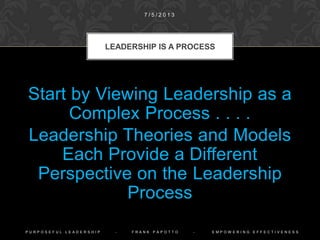
Start by Viewing Leadership as a
Complex Process . . . .
Leadership Theories and Models
Each Provide a Different
Perspective on the Leadership
Process
LEADERSHIP IS A PROCESS
1 0 / 9 / 2 0 1 4
P U R P O S E F U L L E A D E R S H I P - F R A N K P A P O T T O - E M P O W E R I N G E F F E C T I V E N E S S
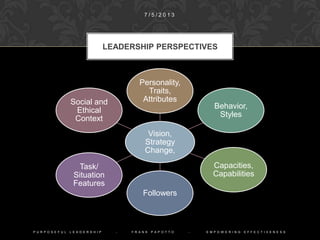
Vision, Strategy
Change,
Personality,
Traits, Attributes
Capacities,
Capabilities
Behavior, Styles
Followers
Social, Ethical,
Task Context
Exchange,
Interaction,
Contingency
LEADERSHIP PERSPECTIVES
1 0 / 9 / 2 0 1 4
P U R P O S E F U L L E A D E R S H I P - F R A N K P A P O T T O - E M P O W E R I N G E F F E C T I V E N E S S
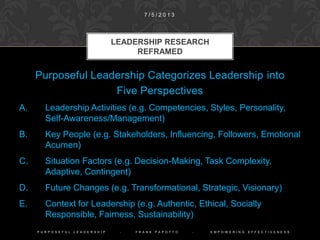
Purposeful Leadership Categorizes
Leadership into Five Perspectives
A. Leader Activities/Behaviors
B. Stakeholder Factors
C. Situational Factors
D. Future / Change Focus
E. Context for Leadership
LEADERSHIP RESEARCH
REFRAMED
1 0 / 9 / 2 0 1 4
P U R P O S E F U L L E A D E R S H I P - F R A N K P A P O T T O - E M P O W E R I N G E F F E C T I V E N E S S
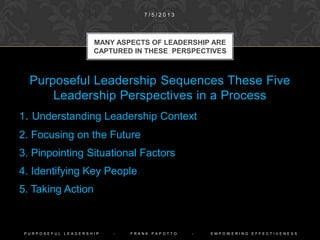
Purposeful Leadership Sequences These Five
Perspectives in a Process
1. Understand Leadership Context (Conditions/Constraints)
2. Focus on the Future (Envisioning /Planning Change)
3. Manage Situational Factors (Organizational Levers)
4. Stakeholders Influence (Motivating and Supporting)
5. Communicating and Direct Action (Leader Activities)
MANY ASPECTS OF LEADERSHIP ARE
CAPTURED IN THESE PERSPECTIVES
1 0 / 9 / 2 0 1 4
P U R P O S E F U L L E A D E R S H I P - F R A N K P A P O T T O - E M P O W E R I N G E F F E C T I V E N E S S
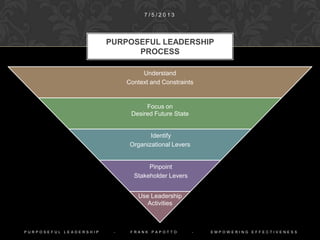
Understand
Context and Constraints
Focus on
Desired Future State
Manage
Organizational Levers
Employ
Stakeholder Levers
Use Leader
Activities
PURPOSEFUL LEADERSHIP
PROCESS
1 0 / 9 / 2 0 1 4
P U R P O S E F U L L E A D E R S H I P - F R A N K P A P O T T O - E M P O W E R I N G E F F E C T I V E N E S S
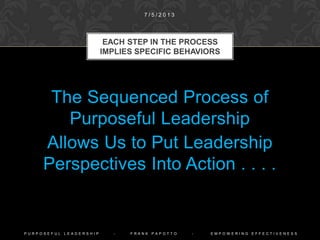
The Sequenced Process of
Purposeful Leadership
Allows Us to Put Leadership
Perspectives Into Action . . . .
EACH STEP IN THE PROCESS
IMPLIES SPECIFIC BEHAVIORS
1 0 / 9 / 2 0 1 4
P U R P O S E F U L L E A D E R S H I P - F R A N K P A P O T T O - E M P O W E R I N G E F F E C T I V E N E S S
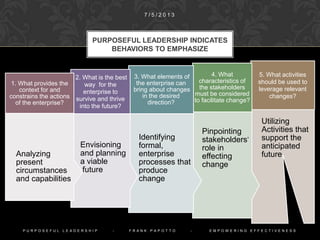
1. What provides
the context for and
constrains the
actions
of the enterprise?
Analyzing
present
circumstances
and
capabilities
2. What is the best
way for the
enterprise to
survive and thrive
into the future?
Envisioning
and planning a
viable future
3. What elements
of the enterprise
can
leverage changes
in the desired
direction?
Identifying
formal,
enterprise
processes that
produce
change
4. What
stakeholder
characteristics
must be
considered to
effect change?
Pinpointing
stakeholders’
role in
effecting
change
5. What activities
are effective for
bringing about
desired changes?
Focusing on
activities that
support the
anticipated
future
PURPOSEFUL LEADERSHIP
EMPHASIZES FIVE CATEGORIES OF
BEHAVIOR
1 0 / 9 / 2 0 1 4
P U R P O S E F U L L E A D E R S H I P - F R A N K P A P O T T O - E M P O W E R I N G E F F E C T I V E N E S S
Leadership Challenges Evolve
Because Leaders’ Activities and
Shifting Conditions Cause Changes in
the Context
PURPOSEFUL LEADERSHIP
ADDRESSES CHANGE
1 0 / 9 / 2 0 1 4
P U R P O S E F U L L E A D E R S H I P - F R A N K P A P O T T O - E M P O W E R I N G E F F E C T I V E N E S S
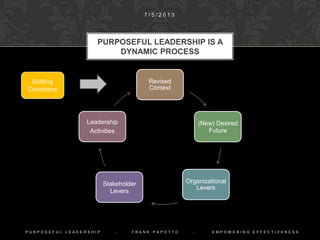
Revised
Context
(New) Desired
Future
Organizational
Levers
Stakeholder
Levers
Leadership
Activities
PURPOSEFUL LEADERSHIP IS A
DYNAMIC PROCESS
1 0 / 9 / 2 0 1 4
P U R P O S E F U L L E A D E R S H I P - F R A N K P A P O T T O - E M P O W E R I N G E F F E C T I V E N E S S
Shifting
Conditions
One Way to Map the Context for Leadership is
by Assessing the Circumstances and
Capabilities of Both the Enterprise and the
Individual Leaders.
This Will Provide a General Picture of What
Changes are Needed and Possible.
1. UNDERSTANDING THE CONTEXT
FOR LEADERSHIP
1 0 / 9 / 2 0 1 4
P U R P O S E F U L L E A D E R S H I P - F R A N K P A P O T T O - E M P O W E R I N G E F F E C T I V E N E S S
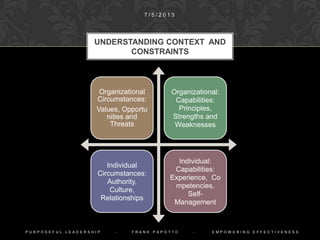
Organizational
Circumstances:
Values,
Opportunities and
Threats
Organizational:
Capabilities:
Principles,
Strengths and
Weaknesses
Individual
Circumstances:
Authority, Culture,
Relationships
Individual:
Capabilities:
Experience,
Competencies,
Self-Management
UNDERSTANDING CONTEXT AND
CONSTRAINTS
1 0 / 9 / 2 0 1 4
P U R P O S E F U L L E A D E R S H I P - F R A N K P A P O T T O - E M P O W E R I N G E F F E C T I V E N E S S
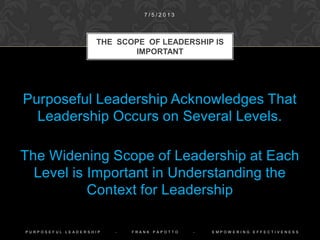
Purposeful Leadership Acknowledges That
Leadership Occurs on Several Levels.
The Widening Scope of Leadership at Each
Level is Important in Understanding the
Context for Leadership
THE SCOPE OF LEADERSHIP IS
IMPORTANT
1 0 / 9 / 2 0 1 4
P U R P O S E F U L L E A D E R S H I P - F R A N K P A P O T T O - E M P O W E R I N G E F F E C T I V E N E S S
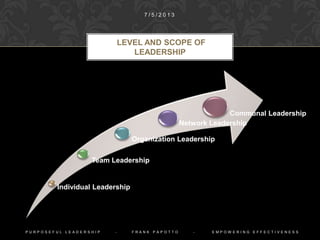
Individual Leadership
Team Leadership
Organization Leadership
Network Leadership
Communal Leadership
LEADERSHIP ROLES ARE PART OF
THE CONTEXT
1 0 / 9 / 2 0 1 4
P U R P O S E F U L L E A D E R S H I P - F R A N K P A P O T T O - E M P O W E R I N G E F F E C T I V E N E S S
Leadership Roles Affect Both Perspective
and Influence Leaders Have, so They are
Important in Understanding the Context for
Leadership
LEADERSHIP ROLES HELP DEFINE
THE CONTEXT
P U R P O S E F U L L E A D E R S H I P - F R A N K P A P O T T O - E M P O W E R I N G E F F E C T I V E N E S S
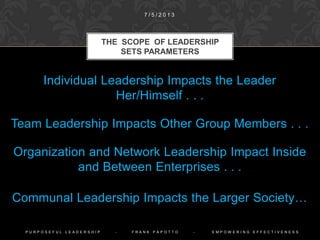
Communal Leadership: Government,
or the Larger Society
Network Leadership: Partner,
Alliance or Boundary-Crossing
Entities
Organization Leadership:
Business, Enterprise or Multi-
Group Systems
Team Leadership:
Departments, Functions or
Groups
Individual Leadership:
Proactive Self or Personal
Management
ROLES INFLUENCE LEADERS
POTENTIAL IMPACT
P U R P O S E F U L L E A D E R S H I P - F R A N K P A P O T T O - E M P O W E R I N G E F F E C T I V E N E S S
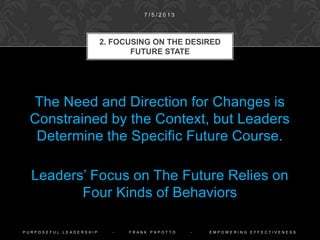
The Need and Direction for Changes is
Constrained by the Context, but Leaders
Determine the Specific Future Course.
Leaders’ Focus on The Future Can Most
Often be Classified into Four Desired
Results
2. FOCUS ON THE DESIRED
FUTURE STATE
1 0 / 9 / 2 0 1 4
P U R P O S E F U L L E A D E R S H I P - F R A N K P A P O T T O - E M P O W E R I N G E F F E C T I V E N E S S
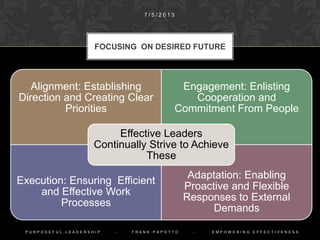
Alignment: Establishing Direction and
Creating Clear Priorities
Engagement: Enlisting Cooperation and
Commitment From People
Execution: Ensuring Efficient and High
Quality Work Processes
Adaptation: Enabling Proactive and
Flexible Responses to External
Demands
Effective Leaders Continually Strive to
Achieve These
FOUR KINDS OF DESIRED
RESULTS
1 0 / 9 / 2 0 1 4
P U R P O S E F U L L E A D E R S H I P - F R A N K P A P O T T O - E M P O W E R I N G E F F E C T I V E N E S S
Purposeful Leadership Relies on the Use of
Formal Organizational Tools to Exercise
Authority, Power and Influence.
The Most Useful of These Levers Can be
Organized into Four Categories
3. IDENTIFYING ORGANIZATIONAL
LEVERS
1 0 / 9 / 2 0 1 4
P U R P O S E F U L L E A D E R S H I P - F R A N K P A P O T T O - E M P O W E R I N G E F F E C T I V E N E S S
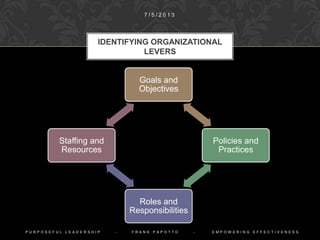
Goals and
Objectives
Policies and
Practices
Roles and
Responsibilities
Staffing and
Resources
IDENTIFYING ORGANIZATIONAL
LEVERS
1 0 / 9 / 2 0 1 4
P U R P O S E F U L L E A D E R S H I P - F R A N K P A P O T T O - E M P O W E R I N G E F F E C T I V E N E S S
The Most Useful Means of Exercising Authority and
Influence to Achieve Desired Results Through the Formal
Organization Involve:
• Establishing Goals and Objectives that Communicate
Expectations about Desired Results
• Instituting Policies and Procedures That Make Clear Means
and Methods for Achieving Desired Results
• Creating Roles and Assigning Responsibilities to Structure
Activities Needed to Attain Desired Results.
• Providing People and Other Resources That Reflect the
Priority of the Desired Results.
P U R P O S E F U L L E A D E R S H I P - F R A N K P A P O T T O - E M P O W E R I N G E F F E C T I V E N E S S
EFFECTIVE LEADERSHIP LEVERAGES
THE FORMAL ORGANIZATION
Using Organizational Levers Creates
Circumstances That Support the Desired
Future State by Communicating and
Creating Expectations for Changes in
Behavior.
Identifying How to Move Specific
Stakeholders in the Desired Direction is a
Critical Next Step.
4. PINPOINTING STAKEHOLDER
LEVERS
1 0 / 9 / 2 0 1 4
P U R P O S E F U L L E A D E R S H I P - F R A N K P A P O T T O - E M P O W E R I N G E F F E C T I V E N E S S
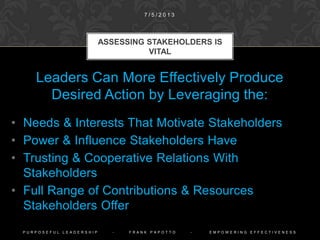
Leaders Can More Effectively Produce Desired
Action by Leveraging:
• Needs / Interests That Motivate Stakeholders
• Power / Influence Stakeholders Have
• Trusting / Cooperative Relations With Stakeholders
• The Assistance / Resources Stakeholders Offer
EFFECTIVE LEADERSHIP
ASSESSES STAKEHOLDERS
P U R P O S E F U L L E A D E R S H I P - F R A N K P A P O T T O - E M P O W E R I N G E F F E C T I V E N E S S
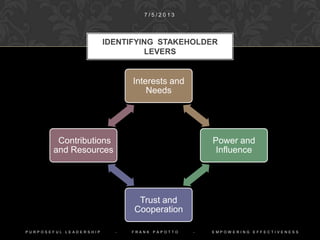
Interests and
Needs
Power and
Influence
Trust and
Cooperation
Contributions and
Resources
IDENTIFYING STAKEHOLDER
LEVERS
1 0 / 9 / 2 0 1 4
P U R P O S E F U L L E A D E R S H I P - F R A N K P A P O T T O - E M P O W E R I N G E F F E C T I V E N E S S
The Purposeful Leadership Process
Progresses From Understanding What
Changes are Needed and Possible, to
What Changes Are Best and Should be
Made, and Completes the Cycle by
Explaining How Changes Can be
Accomplished.
PURPOSEFUL LEADERS PROCEED
FROM BROAD TO SPECIFIC EFFORTS
1 0 / 9 / 2 0 1 4
P U R P O S E F U L L E A D E R S H I P - F R A N K P A P O T T O - E M P O W E R I N G E F F E C T I V E N E S S
Leadership Activities Are Based Upon the
Preceding Steps in the Purposeful
Leadership Process.
They Involve Using Organizational and
Stakeholder Levers in Directing and
Energizing Efforts Toward the Desired
Future.
5. USING LEADERSHIP ACTIVITIES
1 0 / 9 / 2 0 1 4
P U R P O S E F U L L E A D E R S H I P - F R A N K P A P O T T O - E M P O W E R I N G E F F E C T I V E N E S S
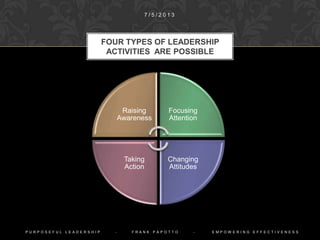
FOUR TYPES OF LEADERSHIP
ACTIVITIES ARE POSSIBLE
1 0 / 9 / 2 0 1 4
Raising
Awareness
Focusing
Attention
Changing
Attitudes
Taking
Action
P U R P O S E F U L L E A D E R S H I P - F R A N K P A P O T T O - E M P O W E R I N G E F F E C T I V E N E S S
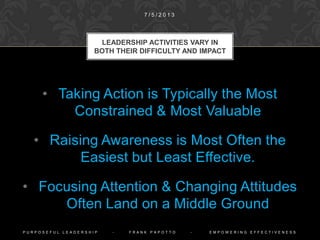
Purposeful Leaders Understand That Four Kinds
of Activities are Useful for Changing Behavior:
1. Raising Awareness of Behaviors that Support Desired
Changes
2. Focusing Attention on Behaviors that Support Desired
Changes
3. Countering Unproductive or Supporting Productive
Attitudes Through Persuasion and Consequences
4. Taking Symbolic or Direct Actions Whose Effects
Have a Positive Impact on Desired Changes
P U R P O S E F U L L E A D E R S H I P - F R A N K P A P O T T O - E M P O W E R I N G E F F E C T I V E N E S S
EFFECTIVE LEADERSHIP
FACILITATES BEHAVIOR CHANGE
SUMMARY AND IMPLICATIONS
Developing Purposeful Leadership
1 0 / 9 / 2 0 1 4
P U R P O S E F U L L E A D E R S H I P - F R A N K P A P O T T O - E M P O W E R I N G E F F E C T I V E N E S S
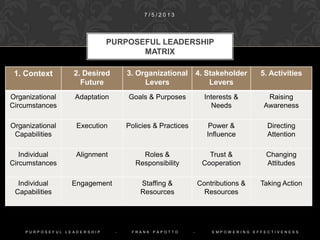
1. Context 2. Desired
Future
3. Organizational
Levers
4. Stakeholder
Levers
5. Activities
Organizational
Circumstances
Adaptation Goals & Purposes Interests &
Needs
Raising
Awareness
Organizational
Capabilities
Execution Policies & Practices Power &
Influence
Directing
Attention
Individual
Circumstances
Alignment Roles &
Responsibility
Trust &
Cooperation
Changing
Attitudes
Individual
Capabilities
Engagement Staffing &
Resources
Contributions &
Resources
Taking Action
PURPOSEFUL LEADERSHIP
MATRIX
1 0 / 9 / 2 0 1 4
P U R P O S E F U L L E A D E R S H I P - F R A N K P A P O T T O - E M P O W E R I N G E F F E C T I V E N E S S
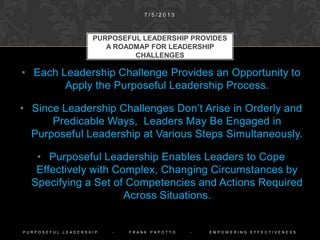
Leadership Challenges Don’t Arise
in Orderly and Predicable Ways.
Leaders May Be Engaged in
Purposeful Leadership at Various
Steps Simultaneously.
Each Leadership Challenge is an
Opportunity to Apply the Purposeful
Leadership Process in a Different
Way.
PURPOSEFUL LEADERSHIP CHANGES
WITH SHIFTING CONDITIONS
P U R P O S E F U L L E A D E R S H I P - F R A N K P A P O T T O - E M P O W E R I N G E F F E C T I V E N E S S
Purposeful
Leadership
Enables
Leaders to
Cope
Effectively
with Complex,
Changing
Circumstances
by
Specifying a
Set of
Competencies
That Can be
Flexibly Applied
Across
Situations.
P U R P O S E F U L L E A D E R S H I P - F R A N K P A P O T T O - E M P O W E R I N G E F F E C T I V E N E S S
EFFECTIVE LEADERSHIP REQUIRES
AGILITY TO MEET NEW CHALLENGES
1. What provides
the context for
and
constrains the
actions
of the
enterprise?
Analyzing
present
circumstances
and capabilities
2. What is the
best way for the
enterprise to
survive and
thrive into the
future?
Envisioning and
planning a viable
future
3. What
elements of the
enterprise can
leverage
changes
in the desired
direction?
Identifying
formal,
enterprise
processes that
produce change
4. What
stakeholder
characteristics
must be
considered to
positively effect
change?
Pinpointing
stakeholders’
role in effecting
change
5. What activities
are effective for
bringing about
desired
changes?
Focusing on
activities that
support the
anticipated
future
PURPOSEFUL LEADERSHIP
DEVELOPMENT FOCUSES ON FIVE
AREAS
1 0 / 9 / 2 0 1 4
P U R P O S E F U L L E A D E R S H I P - F R A N K P A P O T T O - E M P O W E R I N G E F F E C T I V E N E S S
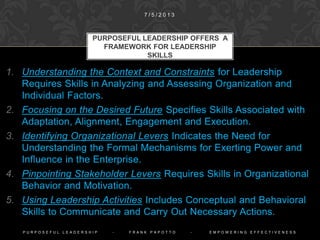
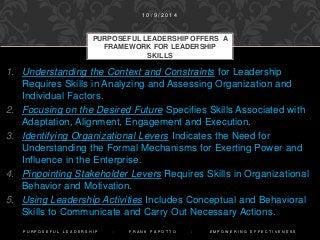
1. Understanding the Context and Constraints for Leadership
Requires Skills in Analyzing and Assessing Organization and
Individual Factors.
2. Focusing on the Desired Future Specifies Skills Associated with
Adaptation, Alignment, Engagement and Execution.
3. Identifying Organizational Levers Indicates the Need for
Understanding the Formal Mechanisms for Exerting Power and
Influence in the Enterprise.
4. Pinpointing Stakeholder Levers Requires Skills in Organizational
Behavior and Motivation.
5. Using Leadership Activities Includes Conceptual and Behavioral
Skills to Communicate and Carry Out Necessary Actions.
PURPOSEFUL LEADERSHIP OFFERS A
FRAMEWORK FOR LEADERSHIP
SKILLS
1 0 / 9 / 2 0 1 4
P U R P O S E F U L L E A D E R S H I P - F R A N K P A P O T T O - E M P O W E R I N G E F F E C T I V E N E S S
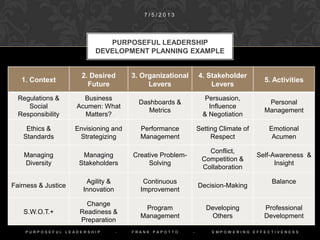
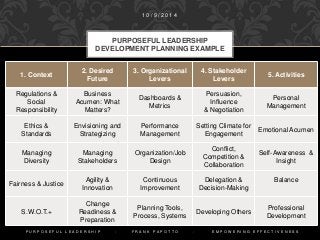
1. Context
2. Desired
Future
3. Organizational
Levers
4. Stakeholder
Levers
5. Activities
Regulations &
Social
Responsibility
Business
Acumen: What
Matters?
Dashboards &
Metrics
Persuasion,
Influence
& Negotiation
Personal
Management
Ethics &
Standards
Envisioning and
Strategizing
Performance
Management
Setting Climate for
Engagement
Emotional Acumen
Managing
Diversity
Managing
Stakeholders
Organization/Job
Design
Conflict,
Competition &
Collaboration
Self-Awareness &
Insight
Fairness & Justice
Agility &
Innovation
Continuous
Improvement
Delegation &
Decision-Making
Balance
S.W.O.T.+
Change
Readiness &
Preparation
Planning Tools,
Process, Systems
Developing Others
Professional
Development
PURPOSEFUL LEADERSHIP
DEVELOPMENT PLANNING EXAMPLE
1 0 / 9 / 2 0 1 4
P U R P O S E F U L L E A D E R S H I P - F R A N K P A P O T T O - E M P O W E R I N G E F F E C T I V E N E S S
Learn More About Developing Purposeful Leadership
 Explore How to Assess of Purposeful Leadership Competencies
 Move Beyond the Generic to an Approach Tailored to Your Needs
Find Out How Purposeful Leadership Supports Organizational Effectiveness
 Build Greater Agility to Facilitate Organizational Adaptation
 Go Beyond Employee Engagement to Enhance Stakeholder Engagement
 Uncover Opportunities to Build Alignment Across the Enterprise
 Focus & Improve Work Processes to Generate Great Execution
Frank Papotto’s Consulting Practice is
Empowering Effectiveness
Contact Frank at 404-932-3638
And See How You Can Be Empowered
WANT MORE?
1 0 / 9 / 2 0 1 4
P U R P O S E F U L L E A D E R S H I P - F R A N K P A P O T T O - E M P O W E R I N G E F F E C T I V E N E S S

Purposeful Leadership Framework

  • 1.
    A Powerful andPractical Approach PURPOSEFUL LEADERSHIP
  • 2.
    Start by ViewingLeadership as a Complex Process . . . . Leadership Theories and Models Each Provide a Different Perspective on the Leadership Process LEADERSHIP IS A PROCESS 1 0 / 9 / 2 0 1 4 P U R P O S E F U L L E A D E R S H I P - F R A N K P A P O T T O - E M P O W E R I N G E F F E C T I V E N E S S
  • 3.
    Vision, Strategy Change, Personality, Traits, Attributes Capacities, Capabilities Behavior,Styles Followers Social, Ethical, Task Context Exchange, Interaction, Contingency LEADERSHIP PERSPECTIVES 1 0 / 9 / 2 0 1 4 P U R P O S E F U L L E A D E R S H I P - F R A N K P A P O T T O - E M P O W E R I N G E F F E C T I V E N E S S
  • 4.
    Purposeful Leadership Categorizes Leadershipinto Five Perspectives A. Leader Activities/Behaviors B. Stakeholder Factors C. Situational Factors D. Future / Change Focus E. Context for Leadership LEADERSHIP RESEARCH REFRAMED 1 0 / 9 / 2 0 1 4 P U R P O S E F U L L E A D E R S H I P - F R A N K P A P O T T O - E M P O W E R I N G E F F E C T I V E N E S S
  • 5.
    Purposeful Leadership SequencesThese Five Perspectives in a Process 1. Understand Leadership Context (Conditions/Constraints) 2. Focus on the Future (Envisioning /Planning Change) 3. Manage Situational Factors (Organizational Levers) 4. Stakeholders Influence (Motivating and Supporting) 5. Communicating and Direct Action (Leader Activities) MANY ASPECTS OF LEADERSHIP ARE CAPTURED IN THESE PERSPECTIVES 1 0 / 9 / 2 0 1 4 P U R P O S E F U L L E A D E R S H I P - F R A N K P A P O T T O - E M P O W E R I N G E F F E C T I V E N E S S
  • 6.
    Understand Context and Constraints Focuson Desired Future State Manage Organizational Levers Employ Stakeholder Levers Use Leader Activities PURPOSEFUL LEADERSHIP PROCESS 1 0 / 9 / 2 0 1 4 P U R P O S E F U L L E A D E R S H I P - F R A N K P A P O T T O - E M P O W E R I N G E F F E C T I V E N E S S
  • 7.
    The Sequenced Processof Purposeful Leadership Allows Us to Put Leadership Perspectives Into Action . . . . EACH STEP IN THE PROCESS IMPLIES SPECIFIC BEHAVIORS 1 0 / 9 / 2 0 1 4 P U R P O S E F U L L E A D E R S H I P - F R A N K P A P O T T O - E M P O W E R I N G E F F E C T I V E N E S S
  • 8.
    1. What provides thecontext for and constrains the actions of the enterprise? Analyzing present circumstances and capabilities 2. What is the best way for the enterprise to survive and thrive into the future? Envisioning and planning a viable future 3. What elements of the enterprise can leverage changes in the desired direction? Identifying formal, enterprise processes that produce change 4. What stakeholder characteristics must be considered to effect change? Pinpointing stakeholders’ role in effecting change 5. What activities are effective for bringing about desired changes? Focusing on activities that support the anticipated future PURPOSEFUL LEADERSHIP EMPHASIZES FIVE CATEGORIES OF BEHAVIOR 1 0 / 9 / 2 0 1 4 P U R P O S E F U L L E A D E R S H I P - F R A N K P A P O T T O - E M P O W E R I N G E F F E C T I V E N E S S
  • 9.
    Leadership Challenges Evolve BecauseLeaders’ Activities and Shifting Conditions Cause Changes in the Context PURPOSEFUL LEADERSHIP ADDRESSES CHANGE 1 0 / 9 / 2 0 1 4 P U R P O S E F U L L E A D E R S H I P - F R A N K P A P O T T O - E M P O W E R I N G E F F E C T I V E N E S S
  • 10.
    Revised Context (New) Desired Future Organizational Levers Stakeholder Levers Leadership Activities PURPOSEFUL LEADERSHIPIS A DYNAMIC PROCESS 1 0 / 9 / 2 0 1 4 P U R P O S E F U L L E A D E R S H I P - F R A N K P A P O T T O - E M P O W E R I N G E F F E C T I V E N E S S Shifting Conditions
  • 11.
    One Way toMap the Context for Leadership is by Assessing the Circumstances and Capabilities of Both the Enterprise and the Individual Leaders. This Will Provide a General Picture of What Changes are Needed and Possible. 1. UNDERSTANDING THE CONTEXT FOR LEADERSHIP 1 0 / 9 / 2 0 1 4 P U R P O S E F U L L E A D E R S H I P - F R A N K P A P O T T O - E M P O W E R I N G E F F E C T I V E N E S S
  • 12.
    Organizational Circumstances: Values, Opportunities and Threats Organizational: Capabilities: Principles, Strengths and Weaknesses Individual Circumstances: Authority,Culture, Relationships Individual: Capabilities: Experience, Competencies, Self-Management UNDERSTANDING CONTEXT AND CONSTRAINTS 1 0 / 9 / 2 0 1 4 P U R P O S E F U L L E A D E R S H I P - F R A N K P A P O T T O - E M P O W E R I N G E F F E C T I V E N E S S
  • 13.
    Purposeful Leadership AcknowledgesThat Leadership Occurs on Several Levels. The Widening Scope of Leadership at Each Level is Important in Understanding the Context for Leadership THE SCOPE OF LEADERSHIP IS IMPORTANT 1 0 / 9 / 2 0 1 4 P U R P O S E F U L L E A D E R S H I P - F R A N K P A P O T T O - E M P O W E R I N G E F F E C T I V E N E S S
  • 14.
    Individual Leadership Team Leadership OrganizationLeadership Network Leadership Communal Leadership LEADERSHIP ROLES ARE PART OF THE CONTEXT 1 0 / 9 / 2 0 1 4 P U R P O S E F U L L E A D E R S H I P - F R A N K P A P O T T O - E M P O W E R I N G E F F E C T I V E N E S S
  • 15.
    Leadership Roles AffectBoth Perspective and Influence Leaders Have, so They are Important in Understanding the Context for Leadership LEADERSHIP ROLES HELP DEFINE THE CONTEXT P U R P O S E F U L L E A D E R S H I P - F R A N K P A P O T T O - E M P O W E R I N G E F F E C T I V E N E S S
  • 16.
    Communal Leadership: Government, orthe Larger Society Network Leadership: Partner, Alliance or Boundary-Crossing Entities Organization Leadership: Business, Enterprise or Multi- Group Systems Team Leadership: Departments, Functions or Groups Individual Leadership: Proactive Self or Personal Management ROLES INFLUENCE LEADERS POTENTIAL IMPACT P U R P O S E F U L L E A D E R S H I P - F R A N K P A P O T T O - E M P O W E R I N G E F F E C T I V E N E S S
  • 17.
    The Need andDirection for Changes is Constrained by the Context, but Leaders Determine the Specific Future Course. Leaders’ Focus on The Future Can Most Often be Classified into Four Desired Results 2. FOCUS ON THE DESIRED FUTURE STATE 1 0 / 9 / 2 0 1 4 P U R P O S E F U L L E A D E R S H I P - F R A N K P A P O T T O - E M P O W E R I N G E F F E C T I V E N E S S
  • 18.
    Alignment: Establishing Directionand Creating Clear Priorities Engagement: Enlisting Cooperation and Commitment From People Execution: Ensuring Efficient and High Quality Work Processes Adaptation: Enabling Proactive and Flexible Responses to External Demands Effective Leaders Continually Strive to Achieve These FOUR KINDS OF DESIRED RESULTS 1 0 / 9 / 2 0 1 4 P U R P O S E F U L L E A D E R S H I P - F R A N K P A P O T T O - E M P O W E R I N G E F F E C T I V E N E S S
  • 19.
    Purposeful Leadership Relieson the Use of Formal Organizational Tools to Exercise Authority, Power and Influence. The Most Useful of These Levers Can be Organized into Four Categories 3. IDENTIFYING ORGANIZATIONAL LEVERS 1 0 / 9 / 2 0 1 4 P U R P O S E F U L L E A D E R S H I P - F R A N K P A P O T T O - E M P O W E R I N G E F F E C T I V E N E S S
  • 20.
    Goals and Objectives Policies and Practices Rolesand Responsibilities Staffing and Resources IDENTIFYING ORGANIZATIONAL LEVERS 1 0 / 9 / 2 0 1 4 P U R P O S E F U L L E A D E R S H I P - F R A N K P A P O T T O - E M P O W E R I N G E F F E C T I V E N E S S
  • 21.
    The Most UsefulMeans of Exercising Authority and Influence to Achieve Desired Results Through the Formal Organization Involve: • Establishing Goals and Objectives that Communicate Expectations about Desired Results • Instituting Policies and Procedures That Make Clear Means and Methods for Achieving Desired Results • Creating Roles and Assigning Responsibilities to Structure Activities Needed to Attain Desired Results. • Providing People and Other Resources That Reflect the Priority of the Desired Results. P U R P O S E F U L L E A D E R S H I P - F R A N K P A P O T T O - E M P O W E R I N G E F F E C T I V E N E S S EFFECTIVE LEADERSHIP LEVERAGES THE FORMAL ORGANIZATION
  • 22.
    Using Organizational LeversCreates Circumstances That Support the Desired Future State by Communicating and Creating Expectations for Changes in Behavior. Identifying How to Move Specific Stakeholders in the Desired Direction is a Critical Next Step. 4. PINPOINTING STAKEHOLDER LEVERS 1 0 / 9 / 2 0 1 4 P U R P O S E F U L L E A D E R S H I P - F R A N K P A P O T T O - E M P O W E R I N G E F F E C T I V E N E S S
  • 23.
    Leaders Can MoreEffectively Produce Desired Action by Leveraging: • Needs / Interests That Motivate Stakeholders • Power / Influence Stakeholders Have • Trusting / Cooperative Relations With Stakeholders • The Assistance / Resources Stakeholders Offer EFFECTIVE LEADERSHIP ASSESSES STAKEHOLDERS P U R P O S E F U L L E A D E R S H I P - F R A N K P A P O T T O - E M P O W E R I N G E F F E C T I V E N E S S
  • 24.
    Interests and Needs Power and Influence Trustand Cooperation Contributions and Resources IDENTIFYING STAKEHOLDER LEVERS 1 0 / 9 / 2 0 1 4 P U R P O S E F U L L E A D E R S H I P - F R A N K P A P O T T O - E M P O W E R I N G E F F E C T I V E N E S S
  • 25.
    The Purposeful LeadershipProcess Progresses From Understanding What Changes are Needed and Possible, to What Changes Are Best and Should be Made, and Completes the Cycle by Explaining How Changes Can be Accomplished. PURPOSEFUL LEADERS PROCEED FROM BROAD TO SPECIFIC EFFORTS 1 0 / 9 / 2 0 1 4 P U R P O S E F U L L E A D E R S H I P - F R A N K P A P O T T O - E M P O W E R I N G E F F E C T I V E N E S S
  • 26.
    Leadership Activities AreBased Upon the Preceding Steps in the Purposeful Leadership Process. They Involve Using Organizational and Stakeholder Levers in Directing and Energizing Efforts Toward the Desired Future. 5. USING LEADERSHIP ACTIVITIES 1 0 / 9 / 2 0 1 4 P U R P O S E F U L L E A D E R S H I P - F R A N K P A P O T T O - E M P O W E R I N G E F F E C T I V E N E S S
  • 27.
    FOUR TYPES OFLEADERSHIP ACTIVITIES ARE POSSIBLE 1 0 / 9 / 2 0 1 4 Raising Awareness Focusing Attention Changing Attitudes Taking Action P U R P O S E F U L L E A D E R S H I P - F R A N K P A P O T T O - E M P O W E R I N G E F F E C T I V E N E S S
  • 28.
    Purposeful Leaders UnderstandThat Four Kinds of Activities are Useful for Changing Behavior: 1. Raising Awareness of Behaviors that Support Desired Changes 2. Focusing Attention on Behaviors that Support Desired Changes 3. Countering Unproductive or Supporting Productive Attitudes Through Persuasion and Consequences 4. Taking Symbolic or Direct Actions Whose Effects Have a Positive Impact on Desired Changes P U R P O S E F U L L E A D E R S H I P - F R A N K P A P O T T O - E M P O W E R I N G E F F E C T I V E N E S S EFFECTIVE LEADERSHIP FACILITATES BEHAVIOR CHANGE
  • 29.
    SUMMARY AND IMPLICATIONS DevelopingPurposeful Leadership 1 0 / 9 / 2 0 1 4 P U R P O S E F U L L E A D E R S H I P - F R A N K P A P O T T O - E M P O W E R I N G E F F E C T I V E N E S S
  • 30.
    1. Context 2.Desired Future 3. Organizational Levers 4. Stakeholder Levers 5. Activities Organizational Circumstances Adaptation Goals & Purposes Interests & Needs Raising Awareness Organizational Capabilities Execution Policies & Practices Power & Influence Directing Attention Individual Circumstances Alignment Roles & Responsibility Trust & Cooperation Changing Attitudes Individual Capabilities Engagement Staffing & Resources Contributions & Resources Taking Action PURPOSEFUL LEADERSHIP MATRIX 1 0 / 9 / 2 0 1 4 P U R P O S E F U L L E A D E R S H I P - F R A N K P A P O T T O - E M P O W E R I N G E F F E C T I V E N E S S
  • 31.
    Leadership Challenges Don’tArise in Orderly and Predicable Ways. Leaders May Be Engaged in Purposeful Leadership at Various Steps Simultaneously. Each Leadership Challenge is an Opportunity to Apply the Purposeful Leadership Process in a Different Way. PURPOSEFUL LEADERSHIP CHANGES WITH SHIFTING CONDITIONS P U R P O S E F U L L E A D E R S H I P - F R A N K P A P O T T O - E M P O W E R I N G E F F E C T I V E N E S S
  • 32.
    Purposeful Leadership Enables Leaders to Cope Effectively with Complex, Changing Circumstances by Specifyinga Set of Competencies That Can be Flexibly Applied Across Situations. P U R P O S E F U L L E A D E R S H I P - F R A N K P A P O T T O - E M P O W E R I N G E F F E C T I V E N E S S EFFECTIVE LEADERSHIP REQUIRES AGILITY TO MEET NEW CHALLENGES
  • 33.
    1. What provides thecontext for and constrains the actions of the enterprise? Analyzing present circumstances and capabilities 2. What is the best way for the enterprise to survive and thrive into the future? Envisioning and planning a viable future 3. What elements of the enterprise can leverage changes in the desired direction? Identifying formal, enterprise processes that produce change 4. What stakeholder characteristics must be considered to positively effect change? Pinpointing stakeholders’ role in effecting change 5. What activities are effective for bringing about desired changes? Focusing on activities that support the anticipated future PURPOSEFUL LEADERSHIP DEVELOPMENT FOCUSES ON FIVE AREAS 1 0 / 9 / 2 0 1 4 P U R P O S E F U L L E A D E R S H I P - F R A N K P A P O T T O - E M P O W E R I N G E F F E C T I V E N E S S
  • 34.
    1. Understanding theContext and Constraints for Leadership Requires Skills in Analyzing and Assessing Organization and Individual Factors. 2. Focusing on the Desired Future Specifies Skills Associated with Adaptation, Alignment, Engagement and Execution. 3. Identifying Organizational Levers Indicates the Need for Understanding the Formal Mechanisms for Exerting Power and Influence in the Enterprise. 4. Pinpointing Stakeholder Levers Requires Skills in Organizational Behavior and Motivation. 5. Using Leadership Activities Includes Conceptual and Behavioral Skills to Communicate and Carry Out Necessary Actions. PURPOSEFUL LEADERSHIP OFFERS A FRAMEWORK FOR LEADERSHIP SKILLS 1 0 / 9 / 2 0 1 4 P U R P O S E F U L L E A D E R S H I P - F R A N K P A P O T T O - E M P O W E R I N G E F F E C T I V E N E S S
  • 35.
    1. Context 2. Desired Future 3.Organizational Levers 4. Stakeholder Levers 5. Activities Regulations & Social Responsibility Business Acumen: What Matters? Dashboards & Metrics Persuasion, Influence & Negotiation Personal Management Ethics & Standards Envisioning and Strategizing Performance Management Setting Climate for Engagement Emotional Acumen Managing Diversity Managing Stakeholders Organization/Job Design Conflict, Competition & Collaboration Self-Awareness & Insight Fairness & Justice Agility & Innovation Continuous Improvement Delegation & Decision-Making Balance S.W.O.T.+ Change Readiness & Preparation Planning Tools, Process, Systems Developing Others Professional Development PURPOSEFUL LEADERSHIP DEVELOPMENT PLANNING EXAMPLE 1 0 / 9 / 2 0 1 4 P U R P O S E F U L L E A D E R S H I P - F R A N K P A P O T T O - E M P O W E R I N G E F F E C T I V E N E S S
  • 36.
    Learn More AboutDeveloping Purposeful Leadership  Explore How to Assess of Purposeful Leadership Competencies  Move Beyond the Generic to an Approach Tailored to Your Needs Find Out How Purposeful Leadership Supports Organizational Effectiveness  Build Greater Agility to Facilitate Organizational Adaptation  Go Beyond Employee Engagement to Enhance Stakeholder Engagement  Uncover Opportunities to Build Alignment Across the Enterprise  Focus & Improve Work Processes to Generate Great Execution Frank Papotto’s Consulting Practice is Empowering Effectiveness Contact Frank at 404-932-3638 And See How You Can Be Empowered WANT MORE? 1 0 / 9 / 2 0 1 4 P U R P O S E F U L L E A D E R S H I P - F R A N K P A P O T T O - E M P O W E R I N G E F F E C T I V E N E S S