

MultiMaster
scaling for multiple regions

      Greg Cockburn
        @gergnz
problem:


  How do we provide a
 Puppet Service Globally
 When WAN pipes suck
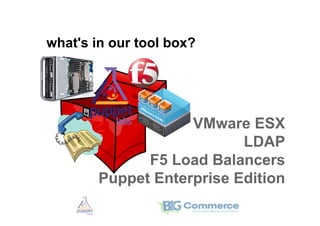
what's in our tool box?


                    VMware ESX
                           LDAP
              F5 Load Balancers
        Puppet Enterprise Edition
Items that need to be addressed
•  Puppet Certificate management
•  Node Classification and ENC replication
•  Master Replication
•  Master Availability
•  Master Scalability
•  Reporting and notifications
•  Change Control
One Solution that Worked
Build a Puppeteer:

•  This is a Puppet Master Master
•  No Client Access
•  Acts as a PuppetCA
•  Central Point of Entry for Code Updates
•  Ensures that the Puppet Masters are in sync
LDAP as an ENC:
•  Existing highly available UNIX/Linux backbone service
•  Already replicated to every region
•  Masters are configured to speak with their nearest LDAP
  replica

•  Provides an effective audit trail
•  Node definitions are abstracted away from the Puppet
  manifests
Replicating Puppet Configuration:
•  The Puppet Master is effective at syncing files
•  Use the Puppet Fileserver to replicate the masters
   o  manifests

   o  modules

   o  files

   o  templates

•  The Puppeteer can 'kick' the other masters to force a run
•  Create a puppet::master class to ensure, masters are
  fully controlled
F5 Global Traffic Management (GTM)
               & DNS:
•  Local Puppet Master addresses are returned to
  clients based on the DNS server the request
  came from

•  If a Master is down then next nearest is returned
•  Any Puppet Master globally can answer the
  client
F5 Local Traffic Management (LTM):

•  On sites with heavy loads this can be used to
  rapidly scale the local Puppet Master service

•  If a local Master is taken out of service F5 will
  automatically send you to the nearest local
  Master
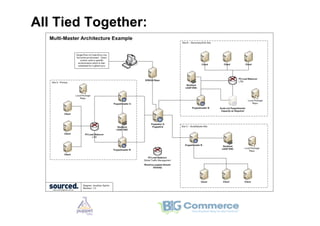
All Tied Together:
Workflow – Adding a New Server

•  Define the client characteristics in the LDAP ENC (eg.
  Datacentre, Environment, Server Flavour)

•  Configure the build tools
•  PXE boot then server, OS is installed and puppet
  bootstraps

•  Once the client certificate is signed the server is
  configured
Workflow (adding a master):
•  Build a 'standard' client
•  Redefine in ENC (LDAP) as a puppetmaster
•  Destroy local certificates
•  generate special certificates on puppetmaster using --
  dns_alt_names

•  rerun puppet and Master configurations will sync down
So What’s New:
Since this configuration was deployed Puppet Labs have
been busy:

•  Puppet Sites - Will soon be released and addresses a lot
  of the issues here

•  PuppetDB – The new standard for stored configs
Special thanks to Jon Spinks @ Sourced
                 Group


Sourced Group are a Puppet Labs partner
 providing integration services for Puppet
             Enterprise Edition
Q&A


 Please go and bother Jon Spinks to find out what Sourced
  have been doing with Puppet to automate Amazon Web
                        Services

PuppetCamp Sydney 2012 - Building a Multimaster Environment

  • 1.
    MultiMaster scaling for multipleregions Greg Cockburn @gergnz
  • 2.
    problem: Howdo we provide a Puppet Service Globally When WAN pipes suck
  • 3.
    what's in ourtool box? VMware ESX LDAP F5 Load Balancers Puppet Enterprise Edition
  • 4.
    Items that needto be addressed •  Puppet Certificate management •  Node Classification and ENC replication •  Master Replication •  Master Availability •  Master Scalability •  Reporting and notifications •  Change Control
  • 5.
  • 6.
    Build a Puppeteer: • This is a Puppet Master Master •  No Client Access •  Acts as a PuppetCA •  Central Point of Entry for Code Updates •  Ensures that the Puppet Masters are in sync
  • 7.
    LDAP as anENC: •  Existing highly available UNIX/Linux backbone service •  Already replicated to every region •  Masters are configured to speak with their nearest LDAP replica •  Provides an effective audit trail •  Node definitions are abstracted away from the Puppet manifests
  • 8.
    Replicating Puppet Configuration: • The Puppet Master is effective at syncing files •  Use the Puppet Fileserver to replicate the masters o  manifests o  modules o  files o  templates •  The Puppeteer can 'kick' the other masters to force a run •  Create a puppet::master class to ensure, masters are fully controlled
  • 9.
    F5 Global TrafficManagement (GTM) & DNS: •  Local Puppet Master addresses are returned to clients based on the DNS server the request came from •  If a Master is down then next nearest is returned •  Any Puppet Master globally can answer the client
  • 10.
    F5 Local TrafficManagement (LTM): •  On sites with heavy loads this can be used to rapidly scale the local Puppet Master service •  If a local Master is taken out of service F5 will automatically send you to the nearest local Master
  • 11.
  • 12.
    Workflow – Addinga New Server •  Define the client characteristics in the LDAP ENC (eg. Datacentre, Environment, Server Flavour) •  Configure the build tools •  PXE boot then server, OS is installed and puppet bootstraps •  Once the client certificate is signed the server is configured
  • 13.
    Workflow (adding amaster): •  Build a 'standard' client •  Redefine in ENC (LDAP) as a puppetmaster •  Destroy local certificates •  generate special certificates on puppetmaster using -- dns_alt_names •  rerun puppet and Master configurations will sync down
  • 14.
    So What’s New: Sincethis configuration was deployed Puppet Labs have been busy: •  Puppet Sites - Will soon be released and addresses a lot of the issues here •  PuppetDB – The new standard for stored configs
  • 15.
    Special thanks toJon Spinks @ Sourced Group Sourced Group are a Puppet Labs partner providing integration services for Puppet Enterprise Edition
  • 16.
    Q&A Please goand bother Jon Spinks to find out what Sourced have been doing with Puppet to automate Amazon Web Services