The following presentation was delivered at The Academies Show
Birmingham 2014 by Ian Abbot, David Middlewood & Sue Robinson,
The University of Warwick, Centre for Education
For more information on similar content please visit our website at:
http://www.academiesshow.london/agenda/
Pupil Premium Research Report
University of Warwick
Ian Abbott, David Middlewood & Sue Robinson
Purpose of the Research
To ascertain what factors could be identified in the effective
use of Pupil Premium in outstanding schools in a large urban
LA.
To share knowledge and understanding of effective practice
from outstanding settings.
Key aims:
• Establish how the Pupil Premium was utilised in the school
• Identify the specific strategies used to bring about positive
benefits for pupils and the range of initiatives
• Evaluate the effectiveness and impact of the Pupil Premium
• Make recommendations for the future development of the
utilisation of the Pupil Premium
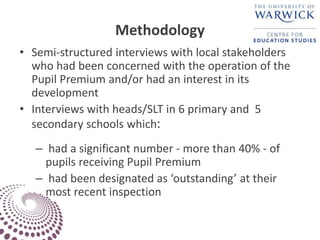
Methodology
• Semi-structured interviews with local stakeholders
who had been concerned with the operation of the
Pupil Premium and/or had an interest in its
development
• Interviews with heads/SLT in 6 primary and 5
secondary schools which:
– had a significant number - more than 40% - of
pupils receiving Pupil Premium
– had been designated as ‘outstanding’ at their
most recent inspection
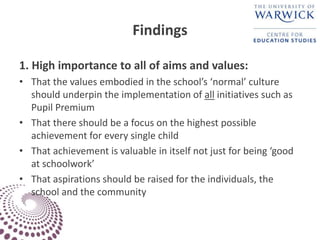
Findings
1. High importance to all of aims and values:
• That the values embodied in the school’s ‘normal’ culture
should underpin the implementation of all initiatives such as
Pupil Premium
• That there should be a focus on the highest possible
achievement for every single child
• That achievement is valuable in itself not just for being ‘good
at schoolwork’
• That aspirations should be raised for the individuals, the
school and the community
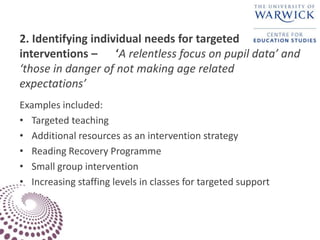
2. Identifying individual needs for targeted
interventions – ‘A relentless focus on pupil data’ and
‘those in danger of not making age related
expectations’
Examples included:
• Targeted teaching
• Additional resources as an intervention strategy
• Reading Recovery Programme
• Small group intervention
• Increasing staffing levels in classes for targeted support
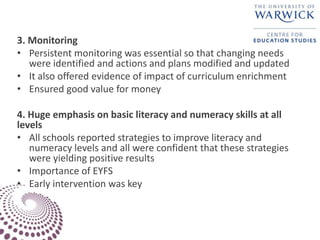
3. Monitoring
• Persistent monitoring was essential so that changing needs
were identified and actions and plans modified and updated
• It also offered evidence of impact of curriculum enrichment
• Ensured good value for money
4. Huge emphasis on basic literacy and numeracy skills at all
levels
• All schools reported strategies to improve literacy and
numeracy levels and all were confident that these strategies
were yielding positive results
• Importance of EYFS
• Early intervention was key
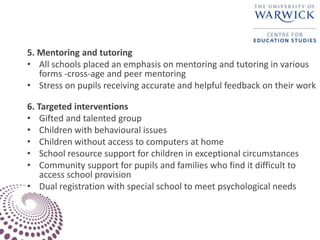
5. Mentoring and tutoring
• All schools placed an emphasis on mentoring and tutoring in various
forms -cross-age and peer mentoring
• Stress on pupils receiving accurate and helpful feedback on their work
6. Targeted interventions
• Gifted and talented group
• Children with behavioural issues
• Children without access to computers at home
• School resource support for children in exceptional circumstances
• Community support for pupils and families who find it difficult to
access school provision
• Dual registration with special school to meet psychological needs
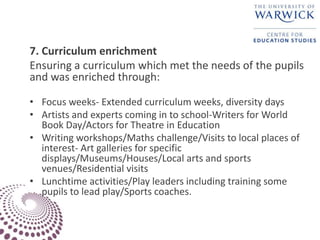
7. Curriculum enrichment
Ensuring a curriculum which met the needs of the pupils
and was enriched through:
• Focus weeks- Extended curriculum weeks, diversity days
• Artists and experts coming in to school-Writers for World
Book Day/Actors for Theatre in Education
• Writing workshops/Maths challenge/Visits to local places of
interest- Art galleries for specific
displays/Museums/Houses/Local arts and sports
venues/Residential visits
• Lunchtime activities/Play leaders including training some
pupils to lead play/Sports coaches.
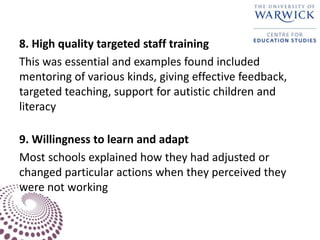
8. High quality targeted staff training
This was essential and examples found included
mentoring of various kinds, giving effective feedback,
targeted teaching, support for autistic children and
literacy
9. Willingness to learn and adapt
Most schools explained how they had adjusted or
changed particular actions when they perceived they
were not working
Recommendations
• Use of funding should build on the key aims or mission of the school - should not
be viewed as a separate activity
• Funding should be used to support ALL disadvantaged pupils
• Gifted and Talented pupils eligible for the Pupil Premium should receive similar
levels of support
• Effective communication with parents about the strategies that are being
developed
• There has to be clear identification of the specific needs of the school, their pupils
and their community context
• School leaders have to accept when initiatives are not working and be prepared to
implement the need for modification, whilst maintaining core values of the school
Reference
Abbott, I; Middlewood, D, Robinson, S (2013)
Pupil Premium Report, Centre for Education
Studies, University of Warwick
To find out more about Pupil Premium please register for The Academies
Show London 2015 and hear from industry leading speakers and senior
decision makers.
Register your Free place here
For more information on the show click here

The Academies Show Birmingham 2014 - Session on Pupil Premium

  • 1.
    The following presentationwas delivered at The Academies Show Birmingham 2014 by Ian Abbot, David Middlewood & Sue Robinson, The University of Warwick, Centre for Education For more information on similar content please visit our website at: http://www.academiesshow.london/agenda/
  • 2.
    Pupil Premium ResearchReport University of Warwick Ian Abbott, David Middlewood & Sue Robinson
  • 3.
    Purpose of theResearch To ascertain what factors could be identified in the effective use of Pupil Premium in outstanding schools in a large urban LA. To share knowledge and understanding of effective practice from outstanding settings. Key aims: • Establish how the Pupil Premium was utilised in the school • Identify the specific strategies used to bring about positive benefits for pupils and the range of initiatives • Evaluate the effectiveness and impact of the Pupil Premium • Make recommendations for the future development of the utilisation of the Pupil Premium
  • 4.
    Methodology • Semi-structured interviewswith local stakeholders who had been concerned with the operation of the Pupil Premium and/or had an interest in its development • Interviews with heads/SLT in 6 primary and 5 secondary schools which: – had a significant number - more than 40% - of pupils receiving Pupil Premium – had been designated as ‘outstanding’ at their most recent inspection
  • 5.
    Findings 1. High importanceto all of aims and values: • That the values embodied in the school’s ‘normal’ culture should underpin the implementation of all initiatives such as Pupil Premium • That there should be a focus on the highest possible achievement for every single child • That achievement is valuable in itself not just for being ‘good at schoolwork’ • That aspirations should be raised for the individuals, the school and the community
  • 6.
    2. Identifying individualneeds for targeted interventions – ‘A relentless focus on pupil data’ and ‘those in danger of not making age related expectations’ Examples included: • Targeted teaching • Additional resources as an intervention strategy • Reading Recovery Programme • Small group intervention • Increasing staffing levels in classes for targeted support
  • 7.
    3. Monitoring • Persistentmonitoring was essential so that changing needs were identified and actions and plans modified and updated • It also offered evidence of impact of curriculum enrichment • Ensured good value for money 4. Huge emphasis on basic literacy and numeracy skills at all levels • All schools reported strategies to improve literacy and numeracy levels and all were confident that these strategies were yielding positive results • Importance of EYFS • Early intervention was key
  • 8.
    5. Mentoring andtutoring • All schools placed an emphasis on mentoring and tutoring in various forms -cross-age and peer mentoring • Stress on pupils receiving accurate and helpful feedback on their work 6. Targeted interventions • Gifted and talented group • Children with behavioural issues • Children without access to computers at home • School resource support for children in exceptional circumstances • Community support for pupils and families who find it difficult to access school provision • Dual registration with special school to meet psychological needs
  • 9.
    7. Curriculum enrichment Ensuringa curriculum which met the needs of the pupils and was enriched through: • Focus weeks- Extended curriculum weeks, diversity days • Artists and experts coming in to school-Writers for World Book Day/Actors for Theatre in Education • Writing workshops/Maths challenge/Visits to local places of interest- Art galleries for specific displays/Museums/Houses/Local arts and sports venues/Residential visits • Lunchtime activities/Play leaders including training some pupils to lead play/Sports coaches.
  • 10.
    8. High qualitytargeted staff training This was essential and examples found included mentoring of various kinds, giving effective feedback, targeted teaching, support for autistic children and literacy 9. Willingness to learn and adapt Most schools explained how they had adjusted or changed particular actions when they perceived they were not working
  • 11.
    Recommendations • Use offunding should build on the key aims or mission of the school - should not be viewed as a separate activity • Funding should be used to support ALL disadvantaged pupils • Gifted and Talented pupils eligible for the Pupil Premium should receive similar levels of support • Effective communication with parents about the strategies that are being developed • There has to be clear identification of the specific needs of the school, their pupils and their community context • School leaders have to accept when initiatives are not working and be prepared to implement the need for modification, whilst maintaining core values of the school
  • 12.
    Reference Abbott, I; Middlewood,D, Robinson, S (2013) Pupil Premium Report, Centre for Education Studies, University of Warwick
  • 13.
    To find outmore about Pupil Premium please register for The Academies Show London 2015 and hear from industry leading speakers and senior decision makers. Register your Free place here For more information on the show click here