Evidence to Action Legislating for On-going Improvement Charters update Requirement to review Why any changes?
Informing Education Policy 2040 working age/parent population in our schools now World increasingly complex Knowledge doubles every 6-7 years Aotearoa/New Zealand increasingly diverse ~2040 demographic changeover
National Priorities Current NAGs : ‘Government priorities’ are  our  priorities Literacy and Numeracy: ‘haves’ and ‘have nots’ Over-representation of  Mäori  and Pasifika students in underachievement stats  ‘ Government priorities’ reflect societal imperatives
Continuous improvement vital By the time they leave school  all  young people must know more be more skilled be more resilient be better educated than any previous generation
School Development  = Self Review  = Strategic Planning About change and improvement Informed by externally referenced data Focused and deliberate
Thinking Strategically Where do we want to be ? What informs our expectation? Where are we now ? How do we know? What steps can we take towards improvement ? What is good practice?  How do we know?
Strategy is evidence driven Up-to-date externally referenced information Use data to identify strengths and weaknesses Analyse closely, continually monitoring progress towards targets Make adjustments as necessary
Strategy is deliberate We know where we’re going We’ve analysed what needs to be done This is how we plan to do it This is what our monitoring is showing These are the adjustments we need to make....
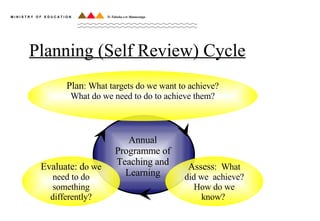
Planning (Self Review) Cycle Planning (Self Review) Cycle Plan : What targets do we want to achieve? What do we need to do to achieve them? Annual Programme of Teaching and Learning Assess :  What did we  achieve? How do we know?  Evaluate: d o we need to do something differently?
The legislation change (i) Student outcomes schools’ priority; Demands boards and principals are more explicit in their expectations; Culture of data-driven annual self-review; Requires transparent goal setting and reporting of student outcomes to engage families and communities.
The legislation change (ii)  New Charters Old charter  (vision, community values, mission ...) 3-5 year strategic improvement plan Schools set goals considering both local and national priorities Annually updated part:  this year’s improvement target.
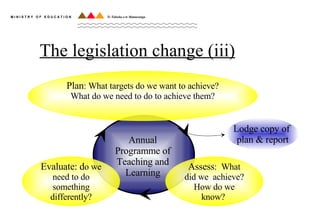
The legislation change (iii) Plan : What targets do we want to achieve? What do we need to do to achieve them? Lodge copy of  plan & report Annual Programme of Teaching and Learning Assess :  What did we  achieve? How do we know?  Evaluate: d o we need to do something differently?
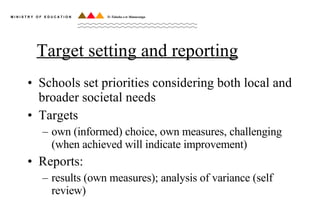
Target setting and reporting Schools set priorities considering both local and broader societal needs Targets own (informed) choice, own measures, challenging (when achieved will indicate improvement) Reports: results (own measures); analysis of variance (self review)
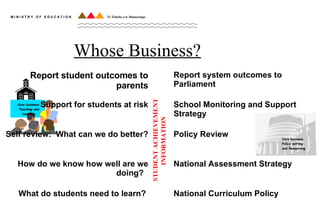
Whose Business? What do students need to learn?  Core business: Teaching and Learning School Monitoring and Support Strategy National Curriculum Policy  STUDENT ACHIEVEMENT INFORMATION   Core business Policy setting and Resourcing  Self review:  What can we do better? Policy Review How do we know how well are we doing?  National Assessment Strategy Report student outcomes to parents Report system outcomes to Parliament Support for students at risk
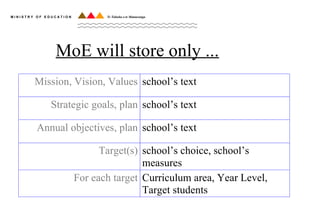
MoE will store only ...
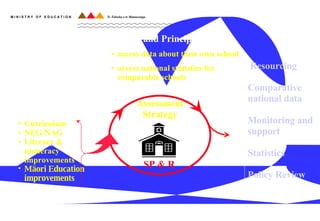
Assessment Strategy Society’s expectations: Curriculum NEG/NAG Literacy & numeracy improvements Mäori Education improvements SP & R Resourcing  Comparative national data Monitoring and support Statistics Policy Review Boards and Principals can: access data about their own school access national statistics for comparable schools MIR
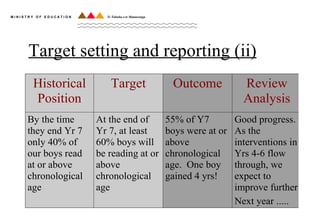
Target setting and reporting (ii)
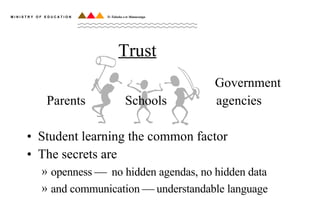
Government Parents  Schools  agencies Student learning the common factor The secrets are openness     no hidden agendas, no hidden data and communication    understandable language Trust
Role of ERO Reviews focus on  quality  of self-review what information lead school to its priorities? what is the quality of the monitoring? have national priorities been properly considered?
Improved outcomes for all students Schools to be explicit in their outcome expectations;  Quality evaluation of student learning;  A high trust professional environment;  Emphasis on quality educational outcomes rather than compliance; Openness and debate about achievement

Evidence in Action: Legislating for improvement

  • 1.
    Evidence to ActionLegislating for On-going Improvement Charters update Requirement to review Why any changes?
  • 2.
    Informing Education Policy2040 working age/parent population in our schools now World increasingly complex Knowledge doubles every 6-7 years Aotearoa/New Zealand increasingly diverse ~2040 demographic changeover
  • 3.
    National Priorities CurrentNAGs : ‘Government priorities’ are our priorities Literacy and Numeracy: ‘haves’ and ‘have nots’ Over-representation of Mäori and Pasifika students in underachievement stats ‘ Government priorities’ reflect societal imperatives
  • 4.
    Continuous improvement vitalBy the time they leave school all young people must know more be more skilled be more resilient be better educated than any previous generation
  • 5.
    School Development = Self Review = Strategic Planning About change and improvement Informed by externally referenced data Focused and deliberate
  • 6.
    Thinking Strategically Wheredo we want to be ? What informs our expectation? Where are we now ? How do we know? What steps can we take towards improvement ? What is good practice? How do we know?
  • 7.
    Strategy is evidencedriven Up-to-date externally referenced information Use data to identify strengths and weaknesses Analyse closely, continually monitoring progress towards targets Make adjustments as necessary
  • 8.
    Strategy is deliberateWe know where we’re going We’ve analysed what needs to be done This is how we plan to do it This is what our monitoring is showing These are the adjustments we need to make....
  • 9.
    Planning (Self Review)Cycle Planning (Self Review) Cycle Plan : What targets do we want to achieve? What do we need to do to achieve them? Annual Programme of Teaching and Learning Assess : What did we achieve? How do we know? Evaluate: d o we need to do something differently?
  • 10.
    The legislation change(i) Student outcomes schools’ priority; Demands boards and principals are more explicit in their expectations; Culture of data-driven annual self-review; Requires transparent goal setting and reporting of student outcomes to engage families and communities.
  • 11.
    The legislation change(ii) New Charters Old charter (vision, community values, mission ...) 3-5 year strategic improvement plan Schools set goals considering both local and national priorities Annually updated part: this year’s improvement target.
  • 12.
    The legislation change(iii) Plan : What targets do we want to achieve? What do we need to do to achieve them? Lodge copy of plan & report Annual Programme of Teaching and Learning Assess : What did we achieve? How do we know? Evaluate: d o we need to do something differently?
  • 13.
    Target setting andreporting Schools set priorities considering both local and broader societal needs Targets own (informed) choice, own measures, challenging (when achieved will indicate improvement) Reports: results (own measures); analysis of variance (self review)
  • 14.
    Whose Business? Whatdo students need to learn? Core business: Teaching and Learning School Monitoring and Support Strategy National Curriculum Policy STUDENT ACHIEVEMENT INFORMATION Core business Policy setting and Resourcing Self review: What can we do better? Policy Review How do we know how well are we doing? National Assessment Strategy Report student outcomes to parents Report system outcomes to Parliament Support for students at risk
  • 15.
  • 16.
    Assessment Strategy Society’sexpectations: Curriculum NEG/NAG Literacy & numeracy improvements Mäori Education improvements SP & R Resourcing Comparative national data Monitoring and support Statistics Policy Review Boards and Principals can: access data about their own school access national statistics for comparable schools MIR
  • 17.
    Target setting andreporting (ii)
  • 18.
    Government Parents Schools agencies Student learning the common factor The secrets are openness  no hidden agendas, no hidden data and communication  understandable language Trust
  • 19.
    Role of EROReviews focus on quality of self-review what information lead school to its priorities? what is the quality of the monitoring? have national priorities been properly considered?
  • 20.
    Improved outcomes forall students Schools to be explicit in their outcome expectations; Quality evaluation of student learning; A high trust professional environment; Emphasis on quality educational outcomes rather than compliance; Openness and debate about achievement