PUNE CITY









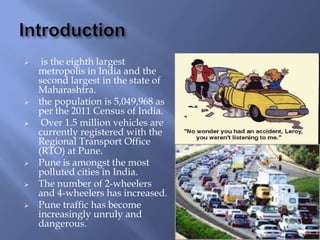
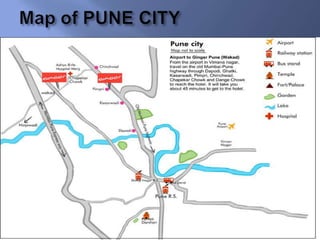
is the eighth largest
metropolis in India and the
second largest in the state of
Maharashtra.
the population is 5,049,968 as
per the 2011 Census of India.
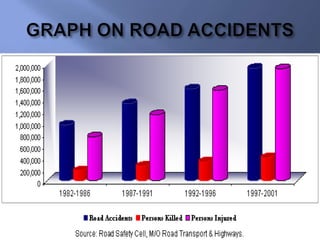
Over 1.5 million vehicles are
currently registered with the
Regional Transport Office
(RTO) at Pune.
Pune is amongst the most
polluted cities in India.
The number of 2-wheelers
and 4-wheelers has increased.
Pune traffic has become
increasingly unruly and
dangerous.
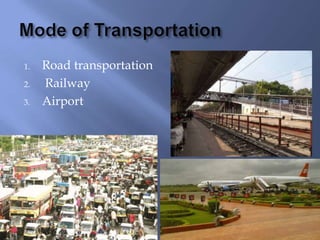
1.
2.
3.

Road transportation
Railway
Airport




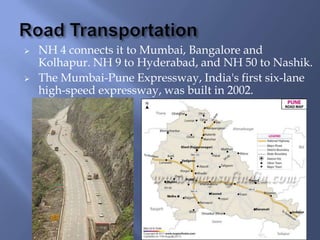
NH 4 connects it to Mumbai, Bangalore and
Kolhapur. NH 9 to Hyderabad, and NH 50 to Nashik.
The Mumbai-Pune Expressway, India's first six-lane
high-speed expressway, was built in 2002.






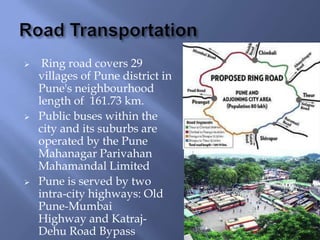
Ring road covers 29
villages of Pune district in
Pune's neighbourhood
length of 161.73 km.
Public buses within the
city and its suburbs are
operated by the Pune
Mahanagar Parivahan
Mahamandal Limited
Pune is served by two
intra-city highways: Old
Pune-Mumbai
Highway and KatrajDehu Road Bypass





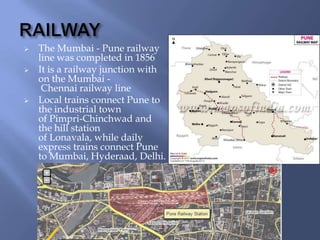
The Mumbai - Pune railway
line was completed in 1856
It is a railway junction with
on the Mumbai Chennai railway line
Local trains connect Pune to
the industrial town
of Pimpri-Chinchwad and
the hill station
of Lonavala, while daily
express trains connect Pune
to Mumbai, Hyderaad, Delhi.




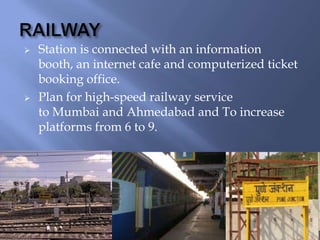
Station is connected with an information
booth, an internet cafe and computerized ticket
booking office.
Plan for high-speed railway service
to Mumbai and Ahmedabad and To increase
platforms from 6 to 9.






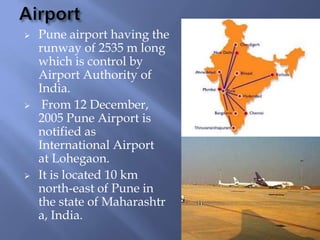
Pune airport having the
runway of 2535 m long
which is control by
Airport Authority of
India.
From 12 December,
2005 Pune Airport is
notified as
International Airport
at Lohegaon.
It is located 10 km
north-east of Pune in
the state of Maharashtr
a, India.






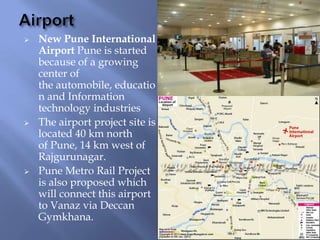
New Pune International
Airport Pune is started
because of a growing
center of
the automobile, educatio
n and Information
technology industries
The airport project site is
located 40 km north
of Pune, 14 km west of
Rajgurunagar.
Pune Metro Rail Project
is also proposed which
will connect this airport
to Vanaz via Deccan
Gymkhana.






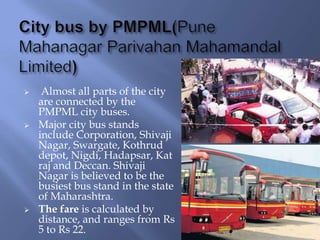
Almost all parts of the city
are connected by the
PMPML city buses.
Major city bus stands
include Corporation, Shivaji
Nagar, Swargate, Kothrud
depot, Nigdi, Hadapsar, Kat
raj and Deccan. Shivaji
Nagar is believed to be the
busiest bus stand in the state
of Maharashtra.
The fare is calculated by
distance, and ranges from Rs
5 to Rs 22.




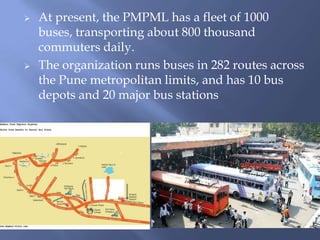
At present, the PMPML has a fleet of 1000
buses, transporting about 800 thousand
commuters daily.
The organization runs buses in 282 routes across
the Pune metropolitan limits, and has 10 bus
depots and 20 major bus stations






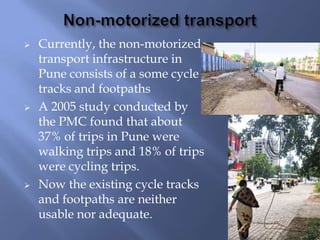
Currently, the non-motorized
transport infrastructure in
Pune consists of a some cycle
tracks and footpaths
A 2005 study conducted by
the PMC found that about
37% of trips in Pune were
walking trips and 18% of trips
were cycling trips.
Now the existing cycle tracks
and footpaths are neither
usable nor adequate.
Thanks

Pune city

  • 1.
  • 3.
          is the eighthlargest metropolis in India and the second largest in the state of Maharashtra. the population is 5,049,968 as per the 2011 Census of India. Over 1.5 million vehicles are currently registered with the Regional Transport Office (RTO) at Pune. Pune is amongst the most polluted cities in India. The number of 2-wheelers and 4-wheelers has increased. Pune traffic has become increasingly unruly and dangerous.
  • 4.
  • 5.
      NH 4 connectsit to Mumbai, Bangalore and Kolhapur. NH 9 to Hyderabad, and NH 50 to Nashik. The Mumbai-Pune Expressway, India's first six-lane high-speed expressway, was built in 2002.
  • 6.
       Ring road covers29 villages of Pune district in Pune's neighbourhood length of 161.73 km. Public buses within the city and its suburbs are operated by the Pune Mahanagar Parivahan Mahamandal Limited Pune is served by two intra-city highways: Old Pune-Mumbai Highway and KatrajDehu Road Bypass
  • 8.
       The Mumbai -Pune railway line was completed in 1856 It is a railway junction with on the Mumbai Chennai railway line Local trains connect Pune to the industrial town of Pimpri-Chinchwad and the hill station of Lonavala, while daily express trains connect Pune to Mumbai, Hyderaad, Delhi.
  • 9.
      Station is connectedwith an information booth, an internet cafe and computerized ticket booking office. Plan for high-speed railway service to Mumbai and Ahmedabad and To increase platforms from 6 to 9.
  • 10.
       Pune airport havingthe runway of 2535 m long which is control by Airport Authority of India. From 12 December, 2005 Pune Airport is notified as International Airport at Lohegaon. It is located 10 km north-east of Pune in the state of Maharashtr a, India.
  • 11.
       New Pune International AirportPune is started because of a growing center of the automobile, educatio n and Information technology industries The airport project site is located 40 km north of Pune, 14 km west of Rajgurunagar. Pune Metro Rail Project is also proposed which will connect this airport to Vanaz via Deccan Gymkhana.
  • 13.
       Almost all partsof the city are connected by the PMPML city buses. Major city bus stands include Corporation, Shivaji Nagar, Swargate, Kothrud depot, Nigdi, Hadapsar, Kat raj and Deccan. Shivaji Nagar is believed to be the busiest bus stand in the state of Maharashtra. The fare is calculated by distance, and ranges from Rs 5 to Rs 22.
  • 14.
      At present, thePMPML has a fleet of 1000 buses, transporting about 800 thousand commuters daily. The organization runs buses in 282 routes across the Pune metropolitan limits, and has 10 bus depots and 20 major bus stations
  • 15.
       Currently, the non-motorized transportinfrastructure in Pune consists of a some cycle tracks and footpaths A 2005 study conducted by the PMC found that about 37% of trips in Pune were walking trips and 18% of trips were cycling trips. Now the existing cycle tracks and footpaths are neither usable nor adequate.
  • 16.