PUMPS
A pump is used to pull/push a
liquid from lower level to higher
level or to pressurize it.
TYPES OF PUMPTYPES OF PUMP
 CENTRIFUGAL PUMPSCENTRIFUGAL PUMPS
 ROTARY PUMPSROTARY PUMPS
CENTRIFUGAL PUMPCENTRIFUGAL PUMP
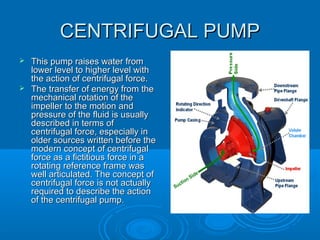
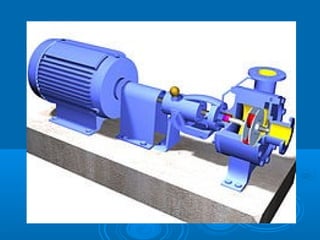
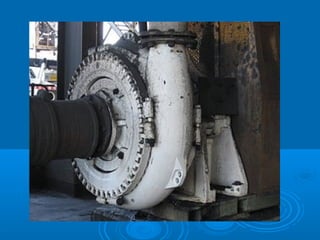
 This pump raises water fromThis pump raises water from
lower level to higher level withlower level to higher level with
the action of centrifugal force.the action of centrifugal force.
 The transfer of energy from theThe transfer of energy from the
mechanical rotation of themechanical rotation of the
impeller to the motion andimpeller to the motion and
pressure of the fluid is usuallypressure of the fluid is usually
described in terms ofdescribed in terms of
centrifugal force, especially incentrifugal force, especially in
older sources written before theolder sources written before the
modern concept of centrifugalmodern concept of centrifugal
force as a fictitious force in aforce as a fictitious force in a
rotating reference frame wasrotating reference frame was
well articulated. The concept ofwell articulated. The concept of
centrifugal force is not actuallycentrifugal force is not actually
required to describe the actionrequired to describe the action
of the centrifugal pumpof the centrifugal pump..
APPLICATIONSAPPLICATIONS
 Common uses include water, sewage,Common uses include water, sewage,
petroleum and petrochemical pumping.petroleum and petrochemical pumping.
 The reverse function of the centrifugalThe reverse function of the centrifugal
pump is a water turbine convertingpump is a water turbine converting
potential energy of water pressure intopotential energy of water pressure into
mechanical rotational energy.mechanical rotational energy.
ADVANTAGESADVANTAGES
 A centrifugal pump takes up little floor space relative toA centrifugal pump takes up little floor space relative to
say a plunger pump and weighs comparatively little sosay a plunger pump and weighs comparatively little so
minimal structural reinforcement is required for the loadminimal structural reinforcement is required for the load
bearing floor space.bearing floor space.
 It has a low initial cost as well as low maintainance costIt has a low initial cost as well as low maintainance cost
since all motion is rotary and there are no sensitive partssince all motion is rotary and there are no sensitive parts
such as the valves in a plunger pump.such as the valves in a plunger pump.
 No air vessels or alleviators are required.No air vessels or alleviators are required.
 It can be keyed directly to a power source as it generallyIt can be keyed directly to a power source as it generally
has high working speeds and hence needs no stepping.has high working speeds and hence needs no stepping.
ROTARY PUMPSROTARY PUMPS
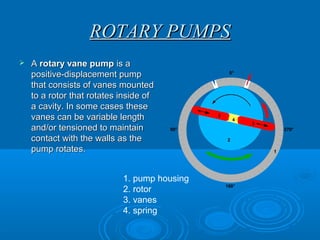
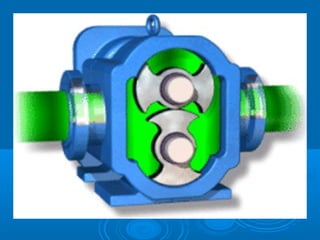
 AA rotary vane pumprotary vane pump is ais a
positive-displacement pumppositive-displacement pump
that consists of vanes mountedthat consists of vanes mounted
to a rotor that rotates inside ofto a rotor that rotates inside of
a cavity. In some cases thesea cavity. In some cases these
vanes can be variable lengthvanes can be variable length
and/or tensioned to maintainand/or tensioned to maintain
contact with the walls as thecontact with the walls as the
pump rotates.pump rotates.
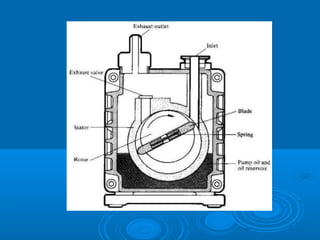
1. pump housing
2. rotor
3. vanes
4. spring
ROTARY PUMPROTARY PUMP
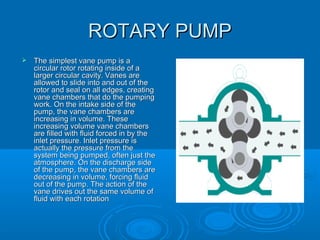
 The simplest vane pump is aThe simplest vane pump is a
circular rotor rotating inside of acircular rotor rotating inside of a
larger circular cavity. Vanes arelarger circular cavity. Vanes are
allowed to slide into and out of theallowed to slide into and out of the
rotor and seal on all edges, creatingrotor and seal on all edges, creating
vane chambers that do the pumpingvane chambers that do the pumping
work. On the intake side of thework. On the intake side of the
pump, the vane chambers arepump, the vane chambers are
increasing in volume. Theseincreasing in volume. These
increasing volume vane chambersincreasing volume vane chambers
are filled with fluid forced in by theare filled with fluid forced in by the
inlet pressure. Inlet pressure isinlet pressure. Inlet pressure is
actually the pressure from theactually the pressure from the
system being pumped, often just thesystem being pumped, often just the
atmosphere. On the discharge sideatmosphere. On the discharge side
of the pump, the vane chambers areof the pump, the vane chambers are
decreasing in volume, forcing fluiddecreasing in volume, forcing fluid
out of the pump. The action of theout of the pump. The action of the
vane drives out the same volume ofvane drives out the same volume of
fluid with each rotationfluid with each rotation
APPLICATIONSAPPLICATIONS
 Common uses of vane pumps include high pressure hydraulicCommon uses of vane pumps include high pressure hydraulic
pumps and automotive uses including, supercharging, powerpumps and automotive uses including, supercharging, power
steering and automatic transmission pumps.steering and automatic transmission pumps.
 Pumps for mid-range pressures include applications such asPumps for mid-range pressures include applications such as
carbonators for fountain soft drink dispensers and espresso coffeecarbonators for fountain soft drink dispensers and espresso coffee
machines.machines.
 Therefore the inlet and the outlet have a large chamber–maybe withTherefore the inlet and the outlet have a large chamber–maybe with
swirl–where the oil drops fall out of the gas. The inlet has a venetianswirl–where the oil drops fall out of the gas. The inlet has a venetian
blind cooled by the room air (the pump is usually 40 K hotter) toblind cooled by the room air (the pump is usually 40 K hotter) to
condense cracked pumping oil and water, and let it drop back intocondense cracked pumping oil and water, and let it drop back into
the inlet. It eventually exits through the outlet.the inlet. It eventually exits through the outlet.
 Variable displacement vane pump is used as an energy savingsVariable displacement vane pump is used as an energy savings
device, and have been used in many applications, includingdevice, and have been used in many applications, including
automotive transmissions, for over 30 years.automotive transmissions, for over 30 years.
ADVANTAGESADVANTAGES
 Flow is independent of pressure. You can change theFlow is independent of pressure. You can change the
flow without upsetting the pump's efficiency.flow without upsetting the pump's efficiency.
 The pump can handle high viscosity fluids efficiently.The pump can handle high viscosity fluids efficiently.
 The pump is self priming.The pump is self priming.
 You get a smooth pulse free flow of the liquid into theYou get a smooth pulse free flow of the liquid into the
system.system.
 You can get the desirable high head low flowYou can get the desirable high head low flow
combination that is need in many high pressurecombination that is need in many high pressure
applications.applications.
 They give you a non-shearing action that will notThey give you a non-shearing action that will not
degrade sensitive petrochemicals and polymers .degrade sensitive petrochemicals and polymers .
PREPARED BY…PREPARED BY…
 JANAMEJAY BRAHMBHATTJANAMEJAY BRAHMBHATT
(FIEG11101)(FIEG11101)
 HARSH GOSALIA (FIEG11107)HARSH GOSALIA (FIEG11107)
 CHIRAG PANCHAL (FIEG11116)CHIRAG PANCHAL (FIEG11116)
 SHYAM TRIVEDI (FIEG11129)SHYAM TRIVEDI (FIEG11129)
THANK YOUTHANK YOU

Pumps

  • 1.
  • 2.
    A pump isused to pull/push a liquid from lower level to higher level or to pressurize it.
  • 3.
    TYPES OF PUMPTYPESOF PUMP  CENTRIFUGAL PUMPSCENTRIFUGAL PUMPS  ROTARY PUMPSROTARY PUMPS
  • 4.
    CENTRIFUGAL PUMPCENTRIFUGAL PUMP This pump raises water fromThis pump raises water from lower level to higher level withlower level to higher level with the action of centrifugal force.the action of centrifugal force.  The transfer of energy from theThe transfer of energy from the mechanical rotation of themechanical rotation of the impeller to the motion andimpeller to the motion and pressure of the fluid is usuallypressure of the fluid is usually described in terms ofdescribed in terms of centrifugal force, especially incentrifugal force, especially in older sources written before theolder sources written before the modern concept of centrifugalmodern concept of centrifugal force as a fictitious force in aforce as a fictitious force in a rotating reference frame wasrotating reference frame was well articulated. The concept ofwell articulated. The concept of centrifugal force is not actuallycentrifugal force is not actually required to describe the actionrequired to describe the action of the centrifugal pumpof the centrifugal pump..
  • 6.
    APPLICATIONSAPPLICATIONS  Common usesinclude water, sewage,Common uses include water, sewage, petroleum and petrochemical pumping.petroleum and petrochemical pumping.  The reverse function of the centrifugalThe reverse function of the centrifugal pump is a water turbine convertingpump is a water turbine converting potential energy of water pressure intopotential energy of water pressure into mechanical rotational energy.mechanical rotational energy.
  • 8.
    ADVANTAGESADVANTAGES  A centrifugalpump takes up little floor space relative toA centrifugal pump takes up little floor space relative to say a plunger pump and weighs comparatively little sosay a plunger pump and weighs comparatively little so minimal structural reinforcement is required for the loadminimal structural reinforcement is required for the load bearing floor space.bearing floor space.  It has a low initial cost as well as low maintainance costIt has a low initial cost as well as low maintainance cost since all motion is rotary and there are no sensitive partssince all motion is rotary and there are no sensitive parts such as the valves in a plunger pump.such as the valves in a plunger pump.  No air vessels or alleviators are required.No air vessels or alleviators are required.  It can be keyed directly to a power source as it generallyIt can be keyed directly to a power source as it generally has high working speeds and hence needs no stepping.has high working speeds and hence needs no stepping.
  • 9.
    ROTARY PUMPSROTARY PUMPS AA rotary vane pumprotary vane pump is ais a positive-displacement pumppositive-displacement pump that consists of vanes mountedthat consists of vanes mounted to a rotor that rotates inside ofto a rotor that rotates inside of a cavity. In some cases thesea cavity. In some cases these vanes can be variable lengthvanes can be variable length and/or tensioned to maintainand/or tensioned to maintain contact with the walls as thecontact with the walls as the pump rotates.pump rotates. 1. pump housing 2. rotor 3. vanes 4. spring
  • 10.
    ROTARY PUMPROTARY PUMP The simplest vane pump is aThe simplest vane pump is a circular rotor rotating inside of acircular rotor rotating inside of a larger circular cavity. Vanes arelarger circular cavity. Vanes are allowed to slide into and out of theallowed to slide into and out of the rotor and seal on all edges, creatingrotor and seal on all edges, creating vane chambers that do the pumpingvane chambers that do the pumping work. On the intake side of thework. On the intake side of the pump, the vane chambers arepump, the vane chambers are increasing in volume. Theseincreasing in volume. These increasing volume vane chambersincreasing volume vane chambers are filled with fluid forced in by theare filled with fluid forced in by the inlet pressure. Inlet pressure isinlet pressure. Inlet pressure is actually the pressure from theactually the pressure from the system being pumped, often just thesystem being pumped, often just the atmosphere. On the discharge sideatmosphere. On the discharge side of the pump, the vane chambers areof the pump, the vane chambers are decreasing in volume, forcing fluiddecreasing in volume, forcing fluid out of the pump. The action of theout of the pump. The action of the vane drives out the same volume ofvane drives out the same volume of fluid with each rotationfluid with each rotation
  • 12.
    APPLICATIONSAPPLICATIONS  Common usesof vane pumps include high pressure hydraulicCommon uses of vane pumps include high pressure hydraulic pumps and automotive uses including, supercharging, powerpumps and automotive uses including, supercharging, power steering and automatic transmission pumps.steering and automatic transmission pumps.  Pumps for mid-range pressures include applications such asPumps for mid-range pressures include applications such as carbonators for fountain soft drink dispensers and espresso coffeecarbonators for fountain soft drink dispensers and espresso coffee machines.machines.  Therefore the inlet and the outlet have a large chamber–maybe withTherefore the inlet and the outlet have a large chamber–maybe with swirl–where the oil drops fall out of the gas. The inlet has a venetianswirl–where the oil drops fall out of the gas. The inlet has a venetian blind cooled by the room air (the pump is usually 40 K hotter) toblind cooled by the room air (the pump is usually 40 K hotter) to condense cracked pumping oil and water, and let it drop back intocondense cracked pumping oil and water, and let it drop back into the inlet. It eventually exits through the outlet.the inlet. It eventually exits through the outlet.  Variable displacement vane pump is used as an energy savingsVariable displacement vane pump is used as an energy savings device, and have been used in many applications, includingdevice, and have been used in many applications, including automotive transmissions, for over 30 years.automotive transmissions, for over 30 years.
  • 14.
    ADVANTAGESADVANTAGES  Flow isindependent of pressure. You can change theFlow is independent of pressure. You can change the flow without upsetting the pump's efficiency.flow without upsetting the pump's efficiency.  The pump can handle high viscosity fluids efficiently.The pump can handle high viscosity fluids efficiently.  The pump is self priming.The pump is self priming.  You get a smooth pulse free flow of the liquid into theYou get a smooth pulse free flow of the liquid into the system.system.  You can get the desirable high head low flowYou can get the desirable high head low flow combination that is need in many high pressurecombination that is need in many high pressure applications.applications.  They give you a non-shearing action that will notThey give you a non-shearing action that will not degrade sensitive petrochemicals and polymers .degrade sensitive petrochemicals and polymers .
  • 15.
    PREPARED BY…PREPARED BY… JANAMEJAY BRAHMBHATTJANAMEJAY BRAHMBHATT (FIEG11101)(FIEG11101)  HARSH GOSALIA (FIEG11107)HARSH GOSALIA (FIEG11107)  CHIRAG PANCHAL (FIEG11116)CHIRAG PANCHAL (FIEG11116)  SHYAM TRIVEDI (FIEG11129)SHYAM TRIVEDI (FIEG11129)
  • 16.