HYDRAULIC PUMPS
AND VALVES
BY
SANGAM
JAIN
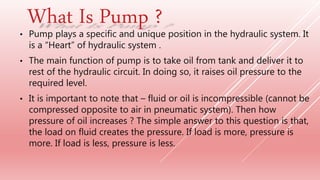
• Pump plays a specific and unique position in the hydraulic system. It
is a “Heart” of hydraulic system .
• The main function of pump is to take oil from tank and deliver it to
rest of the hydraulic circuit. In doing so, it raises oil pressure to the
required level.
• It is important to note that – fluid or oil is incompressible (cannot be
compressed opposite to air in pneumatic system). Then how
pressure of oil increases ? The simple answer to this question is that,
the load on fluid creates the pressure. If load is more, pressure is
more. If load is less, pressure is less.
What Is Pump ?
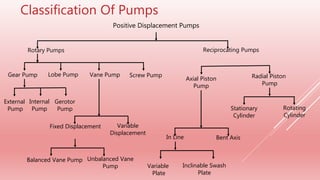
Positive Displacement Pumps
Classification Of Pumps
Rotary Pumps
Vane PumpGear Pump Screw Pump
External
Pump
Lobe Pump
Reciprocating Pumps
Fixed Displacement
Stationary
Cylinder
Gerotor
Pump
Balanced Vane Pump
Radial Piston
Pump
Axial Piston
Pump
Variable
Displacement
Unbalanced Vane
Pump
Internal
Pump
Variable
Plate
Inclinable Swash
Plate
Bent AxisIn Line
Rotating
Cylinder
WORKING OF RECIPROCATING PUMP
The working of the reciprocating pump is very simple and just like an I.C engine. First of all the piston has the
function of providing the suction force, so that the liquid can be lift up or can be sucked in with great force. After
that comes the compression part which will impart the required pressure energy to the fluids. In this part of the
phase the piston have to do a great work so that the liquid can be compressed properly and its pressure can
increased to the desired level. The inlet and the outlet valve open at a certain pressure which is set by the
manufacturer.
If the piston is of single acting type which means it can suck from one side and transmit to the same side only. But
we can have the double reciprocating pump too which have the function of the giving suction and discharge
simultaneously in each stroke. This pump can be used as the compressor also but for that we have to have a good
valve arrangement which can operate with good frequency.
Note: It is to be noted that the reciprocating pump is a positive displacements pump which means that the fluid can
only move in one direction and can never reverse back. So due to this the pump is always started with outlet valve
open otherwise the pressure will keep on building and this will lead to rupturing of the pipeline or even the pump
itself. But if relief valve is fitted then this pressure will come down.
WORKING OF CENTRIFUGAL PUMP
Centrifugal pumps are the most preferred hydraulic pumps used in domestic and industrial world. In this video we will
have a conceptual overview of the working of centrifugal pumps.
Centrifugal pumps are used to induce flow or raise pressure of a liquid. Its working is simple. At the heart of the system
lies impeller. It has a series of curved vanes fitted inside the shroud plates. The impeller is always immersed in the water.
When the impeller is made to rotate, it makes the fluid surrounding it also rotate. This imparts centrifugal force to the
water particles, and water moves radially out. In Fig.1 this process is illustrated.
Centrifugal pumps are used to induce flow or raise pressure of a liquid. Its working is simple. At the heart of the system
lies impeller. It has a series of curved vanes fitted inside the shroud plates. The impeller is always immersed in the water.
When the impeller is made to rotate, it makes the fluid surrounding it also rotate. This imparts centrifugal force to the
water particles, and water moves radially out. In Fig.1 this process is illustrated.
Since the rotational mechanical energy is transferred to the fluid, at the discharge side of the impeller, both the pressure
and kinetic energy of the water will rise. At the suction side, water is getting displaced, so a negative pressure will be
induced at the eye. Such a low pressure helps to suck fresh water stream into the system again, and this process
continues.
From foregoing discussions it is clear that, the negative pressure at the eye of the impeller helps to maintain the flow in
the system. If no water is present initially, the negative pressure developed by the rotating air, at the eye will be
negligibly small to suck fresh stream of water. As a result the impeller will rotate without sucking and discharging any
water content. So the pump should be initially filled with water before starting it. This process is known as priming.
The impeller is fitted inside a casing. As a result the water moves out will be collected inside it, and will move in the same
direction of rotation of the impeller, to the discharge nozzle
V
Considerations For Pump Selection
1)Pressure
2)Flow Of Pressurized Oil
3)Speed Of Pump
4)Efficiency Of The Pump
5)Oil Compatibility
6)Price Of The Pump
VALVES
What is valve ?
A valve is device that regulates, controls and direct the flow of flow
of fluid by opening, closing, or partially obstructing various
passageways.
Functions Of valve
• Stopping and starting fluid flow
• Varying the amount of fluid flow
• Controlling the direction of fluid flow
• Regulating downstream system or process pressure
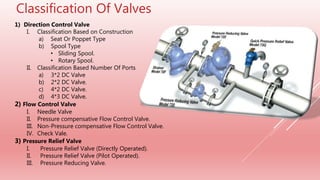
Classification Of Valves
1) Direction Control Valve
I. Classification Based on Construction
a) Seat Or Poppet Type
b) Spool Type
• Sliding Spool.
• Rotary Spool.
II. Classification Based Number Of Ports
a) 3*2 DC Valve
b) 2*2 DC Valve.
c) 4*2 DC Valve.
d) 4*3 DC Valve.
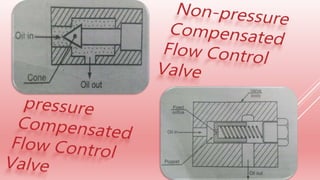
2) Flow Control Valve
I. Needle Valve
II. Pressure compensative Flow Control Valve.
III. Non-Pressure compensative Flow Control Valve.
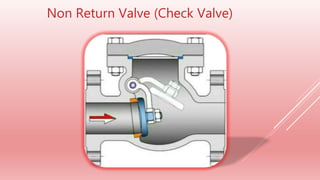
IV. Check Vale.
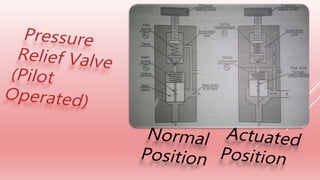
3) Pressure Relief Valve
I. Pressure Relief Valve (Directly Operated).
II. Pressure Relief Valve (Pilot Operated).
III. Pressure Reducing Valve.
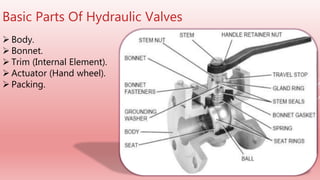
Basic Parts Of Hydraulic Valves
 Body.
 Bonnet.
 Trim (Internal Element).
 Actuator (Hand wheel).
 Packing.
Non Return Valve (Check Valve)
Valve Selection Consideration
1) Pressure.
2) Temperature.
3) Type Of Fluid.
a) Liquid.
b) Gas i.e., Steam Or Air.
c) Dirty Or Abrasive (Erosion).
d) Corrosive.
4) Flow Consideration.
a) On- Off Throttling.
b) Is The Valve Needed To Prevent
Backflow
c) Concern For Back Flow
d) Velocity
5) Operating Consideration.
a) Frequency Of Operation
b) Accessibility
c) Overall Space/Size Available
d) Manual Or Automatic Control
e) Need For Bubble Type Shut Off
f) Concern About Body Joint Leaks
g) Fire Safe Design
h) Speed Of Closer
THANKING
YOU

Pumps and valves

  • 1.
  • 2.
    • Pump playsa specific and unique position in the hydraulic system. It is a “Heart” of hydraulic system . • The main function of pump is to take oil from tank and deliver it to rest of the hydraulic circuit. In doing so, it raises oil pressure to the required level. • It is important to note that – fluid or oil is incompressible (cannot be compressed opposite to air in pneumatic system). Then how pressure of oil increases ? The simple answer to this question is that, the load on fluid creates the pressure. If load is more, pressure is more. If load is less, pressure is less. What Is Pump ?
  • 3.
    Positive Displacement Pumps ClassificationOf Pumps Rotary Pumps Vane PumpGear Pump Screw Pump External Pump Lobe Pump Reciprocating Pumps Fixed Displacement Stationary Cylinder Gerotor Pump Balanced Vane Pump Radial Piston Pump Axial Piston Pump Variable Displacement Unbalanced Vane Pump Internal Pump Variable Plate Inclinable Swash Plate Bent AxisIn Line Rotating Cylinder
  • 4.
    WORKING OF RECIPROCATINGPUMP The working of the reciprocating pump is very simple and just like an I.C engine. First of all the piston has the function of providing the suction force, so that the liquid can be lift up or can be sucked in with great force. After that comes the compression part which will impart the required pressure energy to the fluids. In this part of the phase the piston have to do a great work so that the liquid can be compressed properly and its pressure can increased to the desired level. The inlet and the outlet valve open at a certain pressure which is set by the manufacturer. If the piston is of single acting type which means it can suck from one side and transmit to the same side only. But we can have the double reciprocating pump too which have the function of the giving suction and discharge simultaneously in each stroke. This pump can be used as the compressor also but for that we have to have a good valve arrangement which can operate with good frequency. Note: It is to be noted that the reciprocating pump is a positive displacements pump which means that the fluid can only move in one direction and can never reverse back. So due to this the pump is always started with outlet valve open otherwise the pressure will keep on building and this will lead to rupturing of the pipeline or even the pump itself. But if relief valve is fitted then this pressure will come down.
  • 5.
    WORKING OF CENTRIFUGALPUMP Centrifugal pumps are the most preferred hydraulic pumps used in domestic and industrial world. In this video we will have a conceptual overview of the working of centrifugal pumps. Centrifugal pumps are used to induce flow or raise pressure of a liquid. Its working is simple. At the heart of the system lies impeller. It has a series of curved vanes fitted inside the shroud plates. The impeller is always immersed in the water. When the impeller is made to rotate, it makes the fluid surrounding it also rotate. This imparts centrifugal force to the water particles, and water moves radially out. In Fig.1 this process is illustrated. Centrifugal pumps are used to induce flow or raise pressure of a liquid. Its working is simple. At the heart of the system lies impeller. It has a series of curved vanes fitted inside the shroud plates. The impeller is always immersed in the water. When the impeller is made to rotate, it makes the fluid surrounding it also rotate. This imparts centrifugal force to the water particles, and water moves radially out. In Fig.1 this process is illustrated. Since the rotational mechanical energy is transferred to the fluid, at the discharge side of the impeller, both the pressure and kinetic energy of the water will rise. At the suction side, water is getting displaced, so a negative pressure will be induced at the eye. Such a low pressure helps to suck fresh water stream into the system again, and this process continues. From foregoing discussions it is clear that, the negative pressure at the eye of the impeller helps to maintain the flow in the system. If no water is present initially, the negative pressure developed by the rotating air, at the eye will be negligibly small to suck fresh stream of water. As a result the impeller will rotate without sucking and discharging any water content. So the pump should be initially filled with water before starting it. This process is known as priming. The impeller is fitted inside a casing. As a result the water moves out will be collected inside it, and will move in the same direction of rotation of the impeller, to the discharge nozzle
  • 6.
  • 8.
    Considerations For PumpSelection 1)Pressure 2)Flow Of Pressurized Oil 3)Speed Of Pump 4)Efficiency Of The Pump 5)Oil Compatibility 6)Price Of The Pump
  • 9.
    VALVES What is valve? A valve is device that regulates, controls and direct the flow of flow of fluid by opening, closing, or partially obstructing various passageways. Functions Of valve • Stopping and starting fluid flow • Varying the amount of fluid flow • Controlling the direction of fluid flow • Regulating downstream system or process pressure
  • 10.
    Classification Of Valves 1)Direction Control Valve I. Classification Based on Construction a) Seat Or Poppet Type b) Spool Type • Sliding Spool. • Rotary Spool. II. Classification Based Number Of Ports a) 3*2 DC Valve b) 2*2 DC Valve. c) 4*2 DC Valve. d) 4*3 DC Valve. 2) Flow Control Valve I. Needle Valve II. Pressure compensative Flow Control Valve. III. Non-Pressure compensative Flow Control Valve. IV. Check Vale. 3) Pressure Relief Valve I. Pressure Relief Valve (Directly Operated). II. Pressure Relief Valve (Pilot Operated). III. Pressure Reducing Valve.
  • 11.
    Basic Parts OfHydraulic Valves  Body.  Bonnet.  Trim (Internal Element).  Actuator (Hand wheel).  Packing.
  • 14.
    Non Return Valve(Check Valve)
  • 15.
    Valve Selection Consideration 1)Pressure. 2) Temperature. 3) Type Of Fluid. a) Liquid. b) Gas i.e., Steam Or Air. c) Dirty Or Abrasive (Erosion). d) Corrosive. 4) Flow Consideration. a) On- Off Throttling. b) Is The Valve Needed To Prevent Backflow c) Concern For Back Flow d) Velocity 5) Operating Consideration. a) Frequency Of Operation b) Accessibility c) Overall Space/Size Available d) Manual Or Automatic Control e) Need For Bubble Type Shut Off f) Concern About Body Joint Leaks g) Fire Safe Design h) Speed Of Closer
  • 16.