DAIRY AND FOOD ENGINEERING
TOPICS:- PUMPING SYSTEM
Presented By-
Aditya raj
Reg.No.- 223001170009
Guided By-
Dr. Ruby Pandey
Contents
★Introduction Of Pumps
★ Classification of Pumps
★ Dynamic pumps
★ Positive Displacement Pumps
★Conclusion
Introduction to Pumps
• A pump is a mechanical device used to move fluids (liquids or
gases) from one location to another by converting energy into fluid
motion. Pumps are an essential component of numerous industrial
and domestic applications, playing a critical role in systems such as
water supply, wastewater treatment, chemical processing, and
heating systems.
Classification of Pumps
Based on principle of operation:-
1. Dynamic Pumps
• Centrifugal Pumps
• Axial Flow Pumps
2. Positive Displacement Pumps
• Reciprocating Pumps
• Rotary Pumps
Dynamic Pumps
• Centrifugal Pumps:-
A centrifugal pump is one of the most commonly used types of
dynamic pumps, designed to move fluids by converting rotational
kinetic energy from a motor into hydrodynamic energy. It is widely used
due to its simple design, ease of operation, and ability to handle a wide
range of flow rates and pressures.
• Working Principle:-
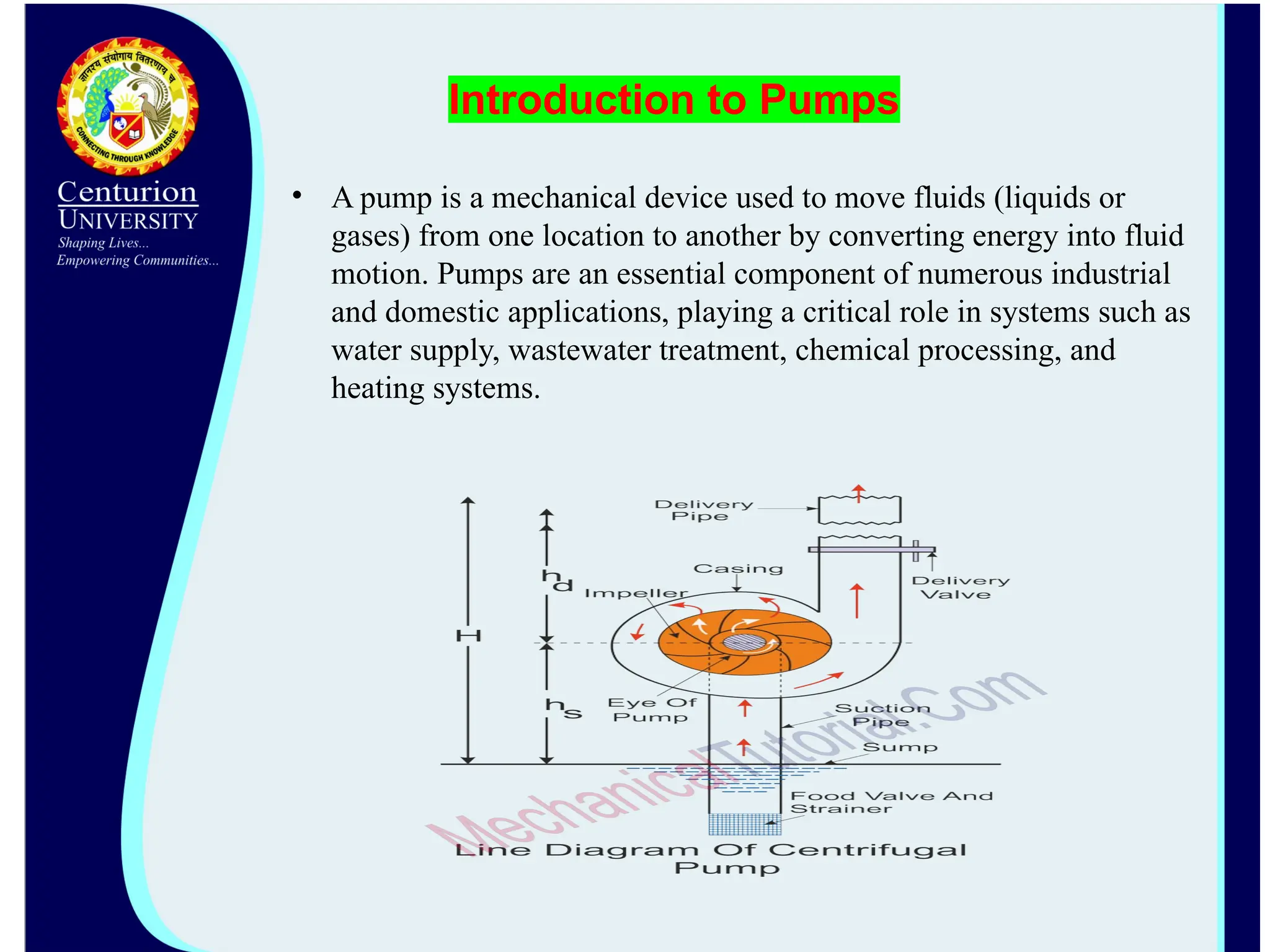
The centrifugal pump operates on the principle of centrifugal force. It
uses an impeller, a rotating disk with blades, to accelerate the fluid
outward from the center of rotation, increasing the fluid's velocity. This
velocity is then converted into pressure as the fluid exits the impeller
and enters the volute or diffuser casing.
1. Fluid enters the pump through the suction inlet, located at the center
of the impeller (also called the eye).
2. Impeller rotation creates centrifugal force, causing the fluid to move
outward from the impeller's center to its edges.
3. Kinetic energy from the high-speed rotation of the impeller is
imparted to the fluid.
4. The fluid's velocity is converted into pressure energy as it moves
through the volute casing or diffuser.
5. The pressurized fluid is discharged through the outlet.
• Applications:-
1. Water Supply Systems: Used in municipal water
distribution and irrigation.
2. HVAC Systems: Circulates water in heating, ventilation,
and cooling systems
3. Chemical Processing: Handles liquids in the chemical and
pharmaceutical industries.
4. Oil and Gas: Transfers fluids in refineries and oil extraction
processes.
• Axial Flow Pumps:-
An axial flow pump is a type of dynamic pump that moves fluid in a
direction parallel (axial) to the pump shaft. Unlike centrifugal pumps,
which use radial motion to transfer fluid, axial flow pumps rely on the
fluid moving along the axis of the impeller or rotor. These pumps are
ideal for applications requiring high flow rates and low head (pressure),
making them well-suited for large-scale fluid movement.
Working Principle:-
Axial flow pumps operate by lifting the fluid in the direction of the
pump’s axis, using a propeller or an axial rotor to generate fluid
motion. The rotating impeller blades push the fluid forward along the
shaft, increasing its velocity, which is then converted into pressure as
the fluid exits the pump.
1. Fluid enters the pump in a direction parallel to the pump shaft.
2. The rotating impeller or propeller imparts kinetic energy to the
fluid, pushing it along the axis.
3. The fluid velocity increases as it moves through the pump,
generating flow.
4. The fluid is then discharged along the same axis, typically at a
high flow rate but low pressure.
Applications:-
1. Flood Control: Used to pump large volumes of water during flood
situations.
2. Irrigation Systems: Ideal for agricultural irrigation due to their
ability to move water over large areas.
3. Water Circulation: Used in cooling water systems for power
plants, chemical plants, and industrial facilities.
4. Sewage Treatment: Utilized in systems where large volumes of
liquid need to be transported over relatively short distances.
Positive Displacement Pumps
Reciprocating Pumps:-
A reciprocating pump is a type of positive displacement pump
where fluid is moved by the back-and-forth (reciprocating)
motion of a piston or plunger within a cylinder. Unlike
centrifugal pumps, which rely on velocity to transfer fluids,
reciprocating pumps trap a fixed amount of fluid and force it
through the discharge pipe, delivering a constant and accurate
flow, even at high pressure.
Working Principle:-
The reciprocating pump operates by cyclically increasing and decreasing
the volume of a chamber to move fluid. The piston or plunger
reciprocates inside a cylinder, drawing fluid in during the suction stroke
and expelling it during the discharge stroke.
Suction Stroke:-
• As the piston moves backward (away from the discharge valve), the
volume of the cylinder increases.
• This creates a vacuum, causing the suction valve to open and
allowing fluid to be drawn into the pump.
Discharge Stroke:-
• The piston then moves forward, decreasing the volume of the
cylinder.
• The fluid is pressurized and forced out through the discharge valve,
while the suction valve closes to prevent backflow.
Applications:-
• Oil and Gas Industry: Used in high-pressure applications, such as
oil drilling and refining.
• Hydraulic Systems: Reciprocating pumps are commonly used to
generate hydraulic pressure.
• Chemical Processing: Suitable for handling corrosive and viscous
fluids in the chemical industry.
• Water Jetting: High-pressure water jets for cutting or cleaning use
reciprocating pumps to achieve the necessary pressure.
Rotary Pumps
A rotary pump is a type of positive displacement pump where fluid is
moved by the rotation of gears, vanes, or screws inside the pump
housing. Unlike reciprocating pumps, which use back-and-forth
motion, rotary pumps rely on the continuous rotation of their internal
components to trap and transport fluid. They are known for their
smooth, continuous flow and are commonly used in applications that
require handling viscous fluids like oils, chemicals, and slurries.
Working Principle:-
Rotary pumps operate by trapping fluid between rotating components
(e.g., gears, vanes, or screws) and the pump casing. As these
components rotate, they move the fluid from the suction side to the
discharge side.
1. Fluid enters the pump through the suction inlet.
2. As the internal components rotate, they trap the fluid between the
moving parts and the casing.
3. The rotating motion forces the fluid through the pump and out of
the discharge outlet, maintaining a continuous flow.
Applications:-
1. Oil Transfer: Widely used for moving lubricants, fuel oils, and
crude oil.
2. Chemical Processing: Suitable for handling viscous or corrosive
chemicals in controlled environments.
3. Food and Beverage Industry: Used for pumping high-viscosity
food products like syrups, sauces, and creams.
4. Pharmaceutical Industry: Ideal for handling sensitive and viscous
pharmaceutical products.
5. Lubrication Systems: Employed in machinery to circulate
lubricants.
Conclusion of Pumps
Pumps are essential devices used across a wide range of industries to
transfer fluids from one place to another. They are classified into
various types, including centrifugal, reciprocating, rotary, and axial flow
pumps, each designed for specific applications based on the nature of
the fluid, the required flow rate, and pressure conditions.
Centrifugal pumps are best for handling large volumes of fluids at
moderate pressure, making them ideal for water supply systems,
irrigation, and industrial fluid handling.
Reciprocating pumps are favored for high-pressure, low-flow
applications, such as oil and gas industries, hydraulic systems, and
chemical processing.
Rotary pumps excel at moving viscous fluids with a steady, continuous
flow, often used in food processing, lubrication systems, and handling
oils.
Axial flow pumps are designed for high-flow, low-pressure applications,
making them suitable for flood control and large-scale water circulation.
THANK YOU

PUMPING SYSTEM IN DAIRY AND FOOD ENGINEERING .pptx

  • 1.
    DAIRY AND FOODENGINEERING TOPICS:- PUMPING SYSTEM Presented By- Aditya raj Reg.No.- 223001170009 Guided By- Dr. Ruby Pandey
  • 2.
    Contents ★Introduction Of Pumps ★Classification of Pumps ★ Dynamic pumps ★ Positive Displacement Pumps ★Conclusion
  • 3.
    Introduction to Pumps •A pump is a mechanical device used to move fluids (liquids or gases) from one location to another by converting energy into fluid motion. Pumps are an essential component of numerous industrial and domestic applications, playing a critical role in systems such as water supply, wastewater treatment, chemical processing, and heating systems.
  • 4.
    Classification of Pumps Basedon principle of operation:- 1. Dynamic Pumps • Centrifugal Pumps • Axial Flow Pumps 2. Positive Displacement Pumps • Reciprocating Pumps • Rotary Pumps
  • 5.
    Dynamic Pumps • CentrifugalPumps:- A centrifugal pump is one of the most commonly used types of dynamic pumps, designed to move fluids by converting rotational kinetic energy from a motor into hydrodynamic energy. It is widely used due to its simple design, ease of operation, and ability to handle a wide range of flow rates and pressures.
  • 6.
    • Working Principle:- Thecentrifugal pump operates on the principle of centrifugal force. It uses an impeller, a rotating disk with blades, to accelerate the fluid outward from the center of rotation, increasing the fluid's velocity. This velocity is then converted into pressure as the fluid exits the impeller and enters the volute or diffuser casing. 1. Fluid enters the pump through the suction inlet, located at the center of the impeller (also called the eye). 2. Impeller rotation creates centrifugal force, causing the fluid to move outward from the impeller's center to its edges. 3. Kinetic energy from the high-speed rotation of the impeller is imparted to the fluid. 4. The fluid's velocity is converted into pressure energy as it moves through the volute casing or diffuser. 5. The pressurized fluid is discharged through the outlet.
  • 7.
    • Applications:- 1. WaterSupply Systems: Used in municipal water distribution and irrigation. 2. HVAC Systems: Circulates water in heating, ventilation, and cooling systems 3. Chemical Processing: Handles liquids in the chemical and pharmaceutical industries. 4. Oil and Gas: Transfers fluids in refineries and oil extraction processes.
  • 8.
    • Axial FlowPumps:- An axial flow pump is a type of dynamic pump that moves fluid in a direction parallel (axial) to the pump shaft. Unlike centrifugal pumps, which use radial motion to transfer fluid, axial flow pumps rely on the fluid moving along the axis of the impeller or rotor. These pumps are ideal for applications requiring high flow rates and low head (pressure), making them well-suited for large-scale fluid movement.
  • 9.
    Working Principle:- Axial flowpumps operate by lifting the fluid in the direction of the pump’s axis, using a propeller or an axial rotor to generate fluid motion. The rotating impeller blades push the fluid forward along the shaft, increasing its velocity, which is then converted into pressure as the fluid exits the pump. 1. Fluid enters the pump in a direction parallel to the pump shaft. 2. The rotating impeller or propeller imparts kinetic energy to the fluid, pushing it along the axis. 3. The fluid velocity increases as it moves through the pump, generating flow. 4. The fluid is then discharged along the same axis, typically at a high flow rate but low pressure.
  • 10.
    Applications:- 1. Flood Control:Used to pump large volumes of water during flood situations. 2. Irrigation Systems: Ideal for agricultural irrigation due to their ability to move water over large areas. 3. Water Circulation: Used in cooling water systems for power plants, chemical plants, and industrial facilities. 4. Sewage Treatment: Utilized in systems where large volumes of liquid need to be transported over relatively short distances.
  • 11.
    Positive Displacement Pumps ReciprocatingPumps:- A reciprocating pump is a type of positive displacement pump where fluid is moved by the back-and-forth (reciprocating) motion of a piston or plunger within a cylinder. Unlike centrifugal pumps, which rely on velocity to transfer fluids, reciprocating pumps trap a fixed amount of fluid and force it through the discharge pipe, delivering a constant and accurate flow, even at high pressure.
  • 12.
    Working Principle:- The reciprocatingpump operates by cyclically increasing and decreasing the volume of a chamber to move fluid. The piston or plunger reciprocates inside a cylinder, drawing fluid in during the suction stroke and expelling it during the discharge stroke. Suction Stroke:- • As the piston moves backward (away from the discharge valve), the volume of the cylinder increases. • This creates a vacuum, causing the suction valve to open and allowing fluid to be drawn into the pump. Discharge Stroke:- • The piston then moves forward, decreasing the volume of the cylinder. • The fluid is pressurized and forced out through the discharge valve, while the suction valve closes to prevent backflow.
  • 13.
    Applications:- • Oil andGas Industry: Used in high-pressure applications, such as oil drilling and refining. • Hydraulic Systems: Reciprocating pumps are commonly used to generate hydraulic pressure. • Chemical Processing: Suitable for handling corrosive and viscous fluids in the chemical industry. • Water Jetting: High-pressure water jets for cutting or cleaning use reciprocating pumps to achieve the necessary pressure.
  • 14.
    Rotary Pumps A rotarypump is a type of positive displacement pump where fluid is moved by the rotation of gears, vanes, or screws inside the pump housing. Unlike reciprocating pumps, which use back-and-forth motion, rotary pumps rely on the continuous rotation of their internal components to trap and transport fluid. They are known for their smooth, continuous flow and are commonly used in applications that require handling viscous fluids like oils, chemicals, and slurries.
  • 15.
    Working Principle:- Rotary pumpsoperate by trapping fluid between rotating components (e.g., gears, vanes, or screws) and the pump casing. As these components rotate, they move the fluid from the suction side to the discharge side. 1. Fluid enters the pump through the suction inlet. 2. As the internal components rotate, they trap the fluid between the moving parts and the casing. 3. The rotating motion forces the fluid through the pump and out of the discharge outlet, maintaining a continuous flow.
  • 16.
    Applications:- 1. Oil Transfer:Widely used for moving lubricants, fuel oils, and crude oil. 2. Chemical Processing: Suitable for handling viscous or corrosive chemicals in controlled environments. 3. Food and Beverage Industry: Used for pumping high-viscosity food products like syrups, sauces, and creams. 4. Pharmaceutical Industry: Ideal for handling sensitive and viscous pharmaceutical products. 5. Lubrication Systems: Employed in machinery to circulate lubricants.
  • 17.
    Conclusion of Pumps Pumpsare essential devices used across a wide range of industries to transfer fluids from one place to another. They are classified into various types, including centrifugal, reciprocating, rotary, and axial flow pumps, each designed for specific applications based on the nature of the fluid, the required flow rate, and pressure conditions. Centrifugal pumps are best for handling large volumes of fluids at moderate pressure, making them ideal for water supply systems, irrigation, and industrial fluid handling. Reciprocating pumps are favored for high-pressure, low-flow applications, such as oil and gas industries, hydraulic systems, and chemical processing. Rotary pumps excel at moving viscous fluids with a steady, continuous flow, often used in food processing, lubrication systems, and handling oils. Axial flow pumps are designed for high-flow, low-pressure applications, making them suitable for flood control and large-scale water circulation.
  • 18.