TYPES OF PUMPS
CREATED BY – MECHANICAL KNOWLEDGE
WHAT IS PUMP?
➢A Pump could be a device, which is used lifting a liquid from ground sources to
upper top surfaces or from one place to a another different place.
➢Pumps are operate by the mechanism of rotary. Reciprocating and it consumes
energy while performing mechanical work which is fluid moving one place to a
unique place.
➢This can be operated by many energy resources which include manual operation,
electricity, engine, wind generation and lots of more, day to day life to industrial
applications.
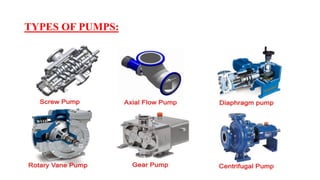
TYPES OF PUMPS:
TYPES OF PUMPS:
➢A pump can broadly be classified into two categories, and those are:
1. POSITIVE DISPLACEMENT PUMP
2. DYNAMIC PUMP
➢ Also there are two kinds of positive displacement pump, and those are:
1. ROTARY PUMP
2. RECIPROCATING PUMP
ROTARY PUMP:
➢These rotary pump classified into two different types, these are:
1. SINGLE ROTOR PUMP
2. MULTIPLE ROTOR PUMP
SINGLE ROTOR PUMP:
➢ Pumping and sealing is dependent on the elasticity of these flexible vanes.
➢ EXAMPLE : Piston pump, vane pump And screw pump
MULTIPLE ROTOR PUMP:
➢ Rotating pistons are used to move fluid and rotors are timed separately. More than one rotor is often
used with one or more pistons.
➢ EXAMPLE: Gear pump And Lube pump
RECIPROCATING PUMP:
➢A reciprocating pump could be a hydraulic machine which converts the energy into hydraulic
energy.
➢Here a particular volume of liquid is collected within the enclosed volume and is discharged using
pressure to the desired application.
➢Reciprocating pumps are more suitable for low volumes of flow at high pressures.
➢These reciprocating pump classified into two different types, these are:
1. SINGLE - ACTING RECIPROCATING PUMP
2. DOUBLE - ACTING RECIPROCATING PUMP
SINGLE - ACTING RECIPROCATING PUMP
➢Single-acting pumps discharge on either the forward or return stroke of the piston or plunger;
every cycle of the pump displaces only one volume of liquid. In double-acting pumps, liquid is
discharged on both the forward and return stroke of the piston.
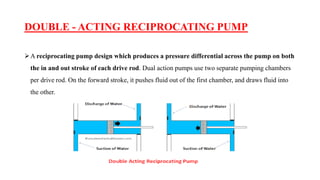
DOUBLE - ACTING RECIPROCATING PUMP
➢A reciprocating pump design which produces a pressure differential across the pump on both
the in and out stroke of each drive rod. Dual action pumps use two separate pumping chambers
per drive rod. On the forward stroke, it pushes fluid out of the first chamber, and draws fluid into
the other.
DYNAMIC PUMPS:
➢dynamic pumps are a type of velocity pump in which kinetic energy is added to the fluid by
increasing the flow velocity.
➢Dynamic pumps can be classified into two different types, these are:
1. CENTRIFUGAL PUMP
2. AXIAL PUMP
CENTRIFUGAL PUMPS:
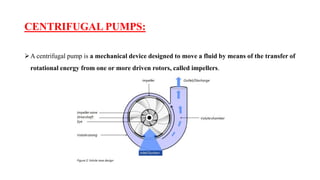
➢A centrifugal pump is a mechanical device designed to move a fluid by means of the transfer of
rotational energy from one or more driven rotors, called impellers.
AXIAL PUMPS:
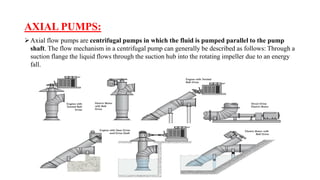
➢Axial flow pumps are centrifugal pumps in which the fluid is pumped parallel to the pump
shaft. The flow mechanism in a centrifugal pump can generally be described as follows: Through a
suction flange the liquid flows through the suction hub into the rotating impeller due to an energy
fall.
ADVANTAGES OF PUMPS:
These are some advantages of pump:
➢As there is no drive seal so there is not any leakage with in the pump.
➢There are very less frictional losses.
➢The construction of the pump is straight forward.
➢Almost no noise.
➢Minimum wear as compared to others.
DISADVANTAGES OF PUMPS:
These are some disadvantages of pump:
➢Produce cavitation
➢Corrosion
➢Cannot ready to work an high speed.
APPLICATIONS OF PUMPS:
The main applications of the pump are:
➢As we already discussed pumping water from one place to a special place.
➢Aquarium and pond filtering
➢This is also used for water cooling and fuel injection system in auto mobiles.
➢Pumping oil or gas and operating cooling towers within the energy industry.
➢Uses in waste water recycling, pulp, and paper industry and etc.,

PUMP TYPES-17.pdf

  • 1.
    TYPES OF PUMPS CREATEDBY – MECHANICAL KNOWLEDGE
  • 2.
    WHAT IS PUMP? ➢APump could be a device, which is used lifting a liquid from ground sources to upper top surfaces or from one place to a another different place. ➢Pumps are operate by the mechanism of rotary. Reciprocating and it consumes energy while performing mechanical work which is fluid moving one place to a unique place. ➢This can be operated by many energy resources which include manual operation, electricity, engine, wind generation and lots of more, day to day life to industrial applications.
  • 3.
  • 4.
    TYPES OF PUMPS: ➢Apump can broadly be classified into two categories, and those are: 1. POSITIVE DISPLACEMENT PUMP 2. DYNAMIC PUMP ➢ Also there are two kinds of positive displacement pump, and those are: 1. ROTARY PUMP 2. RECIPROCATING PUMP
  • 5.
    ROTARY PUMP: ➢These rotarypump classified into two different types, these are: 1. SINGLE ROTOR PUMP 2. MULTIPLE ROTOR PUMP SINGLE ROTOR PUMP: ➢ Pumping and sealing is dependent on the elasticity of these flexible vanes. ➢ EXAMPLE : Piston pump, vane pump And screw pump MULTIPLE ROTOR PUMP: ➢ Rotating pistons are used to move fluid and rotors are timed separately. More than one rotor is often used with one or more pistons. ➢ EXAMPLE: Gear pump And Lube pump
  • 6.
    RECIPROCATING PUMP: ➢A reciprocatingpump could be a hydraulic machine which converts the energy into hydraulic energy. ➢Here a particular volume of liquid is collected within the enclosed volume and is discharged using pressure to the desired application. ➢Reciprocating pumps are more suitable for low volumes of flow at high pressures. ➢These reciprocating pump classified into two different types, these are: 1. SINGLE - ACTING RECIPROCATING PUMP 2. DOUBLE - ACTING RECIPROCATING PUMP
  • 7.
    SINGLE - ACTINGRECIPROCATING PUMP ➢Single-acting pumps discharge on either the forward or return stroke of the piston or plunger; every cycle of the pump displaces only one volume of liquid. In double-acting pumps, liquid is discharged on both the forward and return stroke of the piston.
  • 8.
    DOUBLE - ACTINGRECIPROCATING PUMP ➢A reciprocating pump design which produces a pressure differential across the pump on both the in and out stroke of each drive rod. Dual action pumps use two separate pumping chambers per drive rod. On the forward stroke, it pushes fluid out of the first chamber, and draws fluid into the other.
  • 9.
    DYNAMIC PUMPS: ➢dynamic pumpsare a type of velocity pump in which kinetic energy is added to the fluid by increasing the flow velocity. ➢Dynamic pumps can be classified into two different types, these are: 1. CENTRIFUGAL PUMP 2. AXIAL PUMP
  • 10.
    CENTRIFUGAL PUMPS: ➢A centrifugalpump is a mechanical device designed to move a fluid by means of the transfer of rotational energy from one or more driven rotors, called impellers.
  • 11.
    AXIAL PUMPS: ➢Axial flowpumps are centrifugal pumps in which the fluid is pumped parallel to the pump shaft. The flow mechanism in a centrifugal pump can generally be described as follows: Through a suction flange the liquid flows through the suction hub into the rotating impeller due to an energy fall.
  • 12.
    ADVANTAGES OF PUMPS: Theseare some advantages of pump: ➢As there is no drive seal so there is not any leakage with in the pump. ➢There are very less frictional losses. ➢The construction of the pump is straight forward. ➢Almost no noise. ➢Minimum wear as compared to others.
  • 13.
    DISADVANTAGES OF PUMPS: Theseare some disadvantages of pump: ➢Produce cavitation ➢Corrosion ➢Cannot ready to work an high speed.
  • 14.
    APPLICATIONS OF PUMPS: Themain applications of the pump are: ➢As we already discussed pumping water from one place to a special place. ➢Aquarium and pond filtering ➢This is also used for water cooling and fuel injection system in auto mobiles. ➢Pumping oil or gas and operating cooling towers within the energy industry. ➢Uses in waste water recycling, pulp, and paper industry and etc.,