Public Health England hosts the UK National Screening Committee
Use of Pulse Oximetry in
Screening for Critical Congenital
Heart Disease in Newborns
Dr Graham Shortland
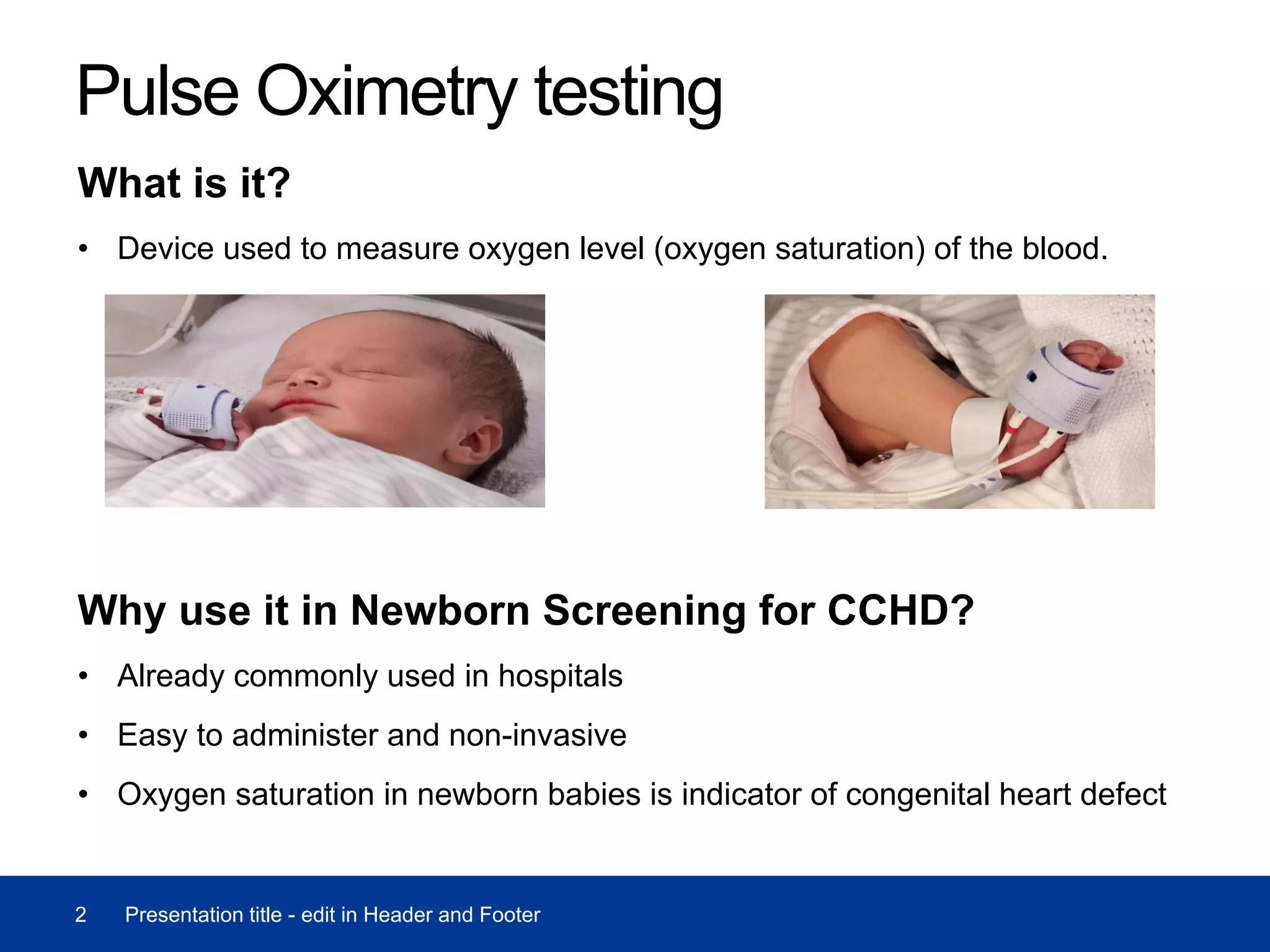
Pulse Oximetry testing
What is it?
• Device used to measure oxygen level (oxygen saturation) of the blood.
Why use it in Newborn Screening for CCHD?
• Already commonly used in hospitals
• Easy to administer and non-invasive
• Oxygen saturation in newborn babies is indicator of congenital heart defect
2 Presentation title - edit in Header and Footer
Background
• major trial published by Ewar et al. 2012 on Pulse oximetry screening.
Trial aimed to determine:
• accuracy,
• acceptability and
• cost-effectiveness
• 2013 UK NSC review:
“The UK NSC recommends piloting the use of pulse oximetry test
to evaluate the potential benefits of its use as a new screening test
for congenital heart disease”
3 Presentation title - edit in Header and Footer
Pulse Oximetry Pilot
Aims
• to evaluate the feasibility of implementing newborn PO screening
• establish effect of PO on clinical services
Design
• Two phases:
• Phase one: 27th February 2015 baseline assessment questionnaire +
retrospective data collection
• Phase two:
• Prospective ‘baseline’ data collection prior to change/ implementation of
PO screening pathway.
• Pilot PO screening undertaken 1st July – 31st December 2015:
4 Presentation title - edit in Header and Footer
Findings
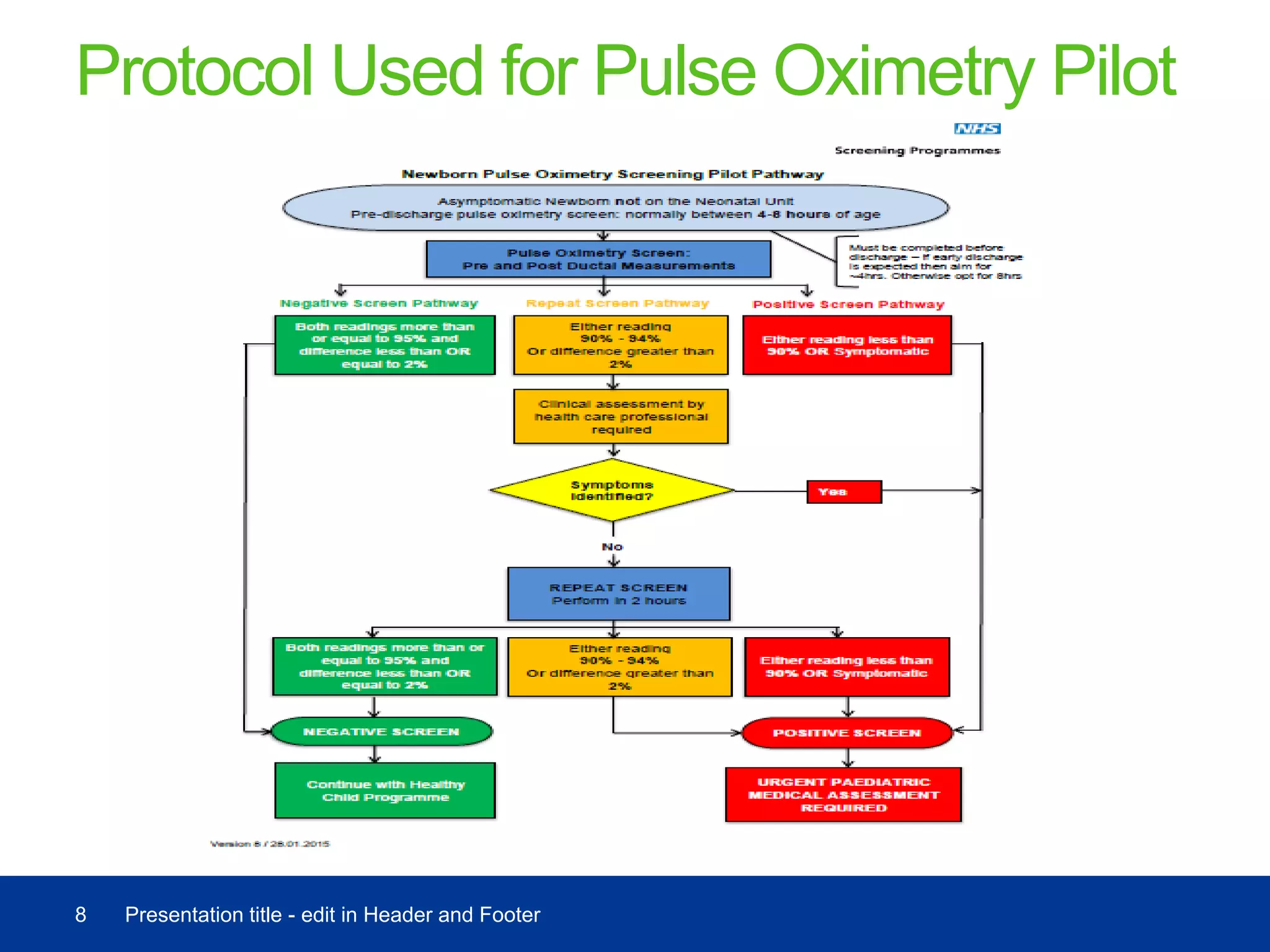
• Pulse ox protocol used
• 32,597 newborn babies screened for CCHD using pulse oximetry
• Total of 239 ‘screen positive’ cases (0.73% screen positive rate)
• Yield of 8 CCHD (true positive cases)
• 86 significant non-CCHD cases identified
• 2 CCHD cases missed (False negatives)
• No increase in NNU admissions or echocardiograms or cardiology
consultations as a result
• Feasibility/ burden not robustly captured
• Some trusts experienced staffing and time constraints
• Further cost-effectiveness analysis needed
5 Presentation title - edit in Header and Footer
UK National Screening Committee
• Discussed at June 2016 UK NSC meeting
Recommendation
‘The cost effectiveness of PO screening be examined taking into account all
screen positive babies.’
• Request that the findings from the cost effectiveness model be brought back
to the committee for discussion in due course
6 Presentation title - edit in Header and Footer
References
• Ewer AK et al. 2012 Pulse oximetry as a screening test for congenital heart defects in newborn
infants: a test accuracy study with evaluation of acceptability and cost-effectiveness. Health
Technology Assessment. 2012;16(2):v-xiii, 1-184. doi: 10.3310/hta16020.
• http://legacy.screening.nhs.uk/congenitalheartdisease
7 Presentation title - edit in Header and Footer
Protocol Used for Pulse Oximetry Pilot
8 Presentation title - edit in Header and Footer

Pulse oximetry

  • 1.
    Public Health Englandhosts the UK National Screening Committee Use of Pulse Oximetry in Screening for Critical Congenital Heart Disease in Newborns Dr Graham Shortland
  • 2.
    Pulse Oximetry testing Whatis it? • Device used to measure oxygen level (oxygen saturation) of the blood. Why use it in Newborn Screening for CCHD? • Already commonly used in hospitals • Easy to administer and non-invasive • Oxygen saturation in newborn babies is indicator of congenital heart defect 2 Presentation title - edit in Header and Footer
  • 3.
    Background • major trialpublished by Ewar et al. 2012 on Pulse oximetry screening. Trial aimed to determine: • accuracy, • acceptability and • cost-effectiveness • 2013 UK NSC review: “The UK NSC recommends piloting the use of pulse oximetry test to evaluate the potential benefits of its use as a new screening test for congenital heart disease” 3 Presentation title - edit in Header and Footer
  • 4.
    Pulse Oximetry Pilot Aims •to evaluate the feasibility of implementing newborn PO screening • establish effect of PO on clinical services Design • Two phases: • Phase one: 27th February 2015 baseline assessment questionnaire + retrospective data collection • Phase two: • Prospective ‘baseline’ data collection prior to change/ implementation of PO screening pathway. • Pilot PO screening undertaken 1st July – 31st December 2015: 4 Presentation title - edit in Header and Footer
  • 5.
    Findings • Pulse oxprotocol used • 32,597 newborn babies screened for CCHD using pulse oximetry • Total of 239 ‘screen positive’ cases (0.73% screen positive rate) • Yield of 8 CCHD (true positive cases) • 86 significant non-CCHD cases identified • 2 CCHD cases missed (False negatives) • No increase in NNU admissions or echocardiograms or cardiology consultations as a result • Feasibility/ burden not robustly captured • Some trusts experienced staffing and time constraints • Further cost-effectiveness analysis needed 5 Presentation title - edit in Header and Footer
  • 6.
    UK National ScreeningCommittee • Discussed at June 2016 UK NSC meeting Recommendation ‘The cost effectiveness of PO screening be examined taking into account all screen positive babies.’ • Request that the findings from the cost effectiveness model be brought back to the committee for discussion in due course 6 Presentation title - edit in Header and Footer
  • 7.
    References • Ewer AKet al. 2012 Pulse oximetry as a screening test for congenital heart defects in newborn infants: a test accuracy study with evaluation of acceptability and cost-effectiveness. Health Technology Assessment. 2012;16(2):v-xiii, 1-184. doi: 10.3310/hta16020. • http://legacy.screening.nhs.uk/congenitalheartdisease 7 Presentation title - edit in Header and Footer
  • 8.
    Protocol Used forPulse Oximetry Pilot 8 Presentation title - edit in Header and Footer