Infectious Diseases in Pregnancy
Screening Programme Update
National Laboratory Workshop 13 March 2019
Sharon Webb – National Programme Manager IDPS, PHE
The IDPS programme
The UK NSC assesses evidence and makes recommendations to the 4
UK governments about population screening programmes
2 IDPS Programme Update
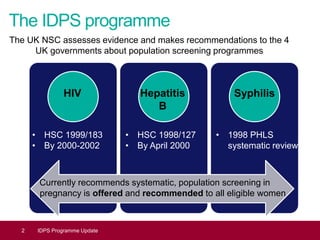
Currently recommends systematic, population screening in
pregnancy is offered and recommended to all eligible women
HIV Hepatitis
B
Syphilis
• HSC 1999/183
• By 2000-2002
• HSC 1998/127
• By April 2000
• 1998 PHLS
systematic review
Aims & objectives
To:
• enable early detection and treatment for infections in
pregnancy in order to significantly reduce the risk of vertical
(mother-to-child) transmission of infection and protect the
health of the woman and her family
• ensure equal access to uniform and quality assured screening
across England
• provide women with high quality information so they can make
an informed choice about their screening options and
pregnancy choices
• provide assurance that all women who screen positive for HIV,
hepatitis B or syphilis, or are already known to be positive for
HIV and hepatitis B, are seen by the IDPS MDT within
specified timescales
3 IDPS Programme Update
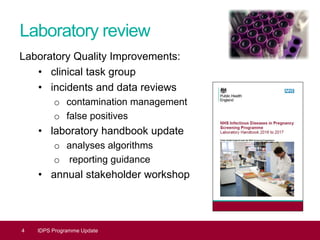
Laboratory review
Laboratory Quality Improvements:
• clinical task group
• incidents and data reviews
o contamination management
o false positives
• laboratory handbook update
o analyses algorithms
o reporting guidance
• annual stakeholder workshop
4 IDPS Programme Update
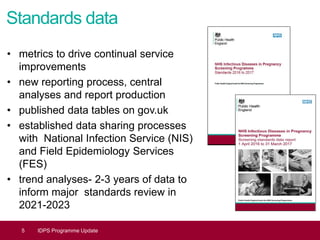
Standards data
• metrics to drive continual service
improvements
• new reporting process, central
analyses and report production
• published data tables on gov.uk
• established data sharing processes
with National Infection Service (NIS)
and Field Epidemiology Services
(FES)
• trend analyses- 2-3 years of data to
inform major standards review in
2021-2023
5 IDPS Programme Update
Screening activity
> 850,000 conceptions to women of all ages in England and Wales
(ONS conception data 2016)
2016-17 PHE screening standards data* :
• uptake of antenatal screening for HIV, hepatitis B and syphilis in England >99%
for all three infections
• between 1,100 to 1,628 decline screening (approx. 2.5 per 1000 women)
• 0.14% (788 / 544,219) of pregnant women screened positive for HIV (new and
known diagnoses), majority are known positive
• 0.47% (2,067 / 441,696) of pregnant women screened positive for hepatitis B
infection (new and known diagnoses) ), majority are known positive
• 0.19% (837 / 446,252) of woman were reported screen positive for syphilis, 252
requiring treatment
*Exclusions are applied for missing or incomplete data submissions
6 IDPS Programme Update
Screening outcomes
The Screening Surveillance team at Great Ormond Street
Institute of Child Health was awarded the PHE IDPS tender
to establish the Integrated Screening Outcomes
Surveillance Service (ISOSS) in September 2018.
The goal of the ISOSS is to collect, analyse and report
obstetric and paediatric data on HIV, syphilis and
hepatitis B in pregnant women and children in order to:
• assess key outcomes of the IDPS Programme
• assess the IDPS Programme’s impact on prevention of
vertically-acquired HIV, hepatitis B and syphilis
• protect the health of women with and infants exposed
to these infections
7 IDPS Programme Update
IDPS ISOSS
• new governance arrangements- part of
IDPS team
• Yr 1- HIV review; plan maternal and
neonatal syphilis / maintain congenital
rubella nd syphilis
• Yr 2- roll-out maternal and neonatal
syphilis service, plan hep B service /
maintain congenital rubella nd syphilis
• Yr 3- roll-out hep B and linkage with
Imms/BBV team on newborn outcomes
8 IDPS Programme Update
Education
9 IDPS Programme Update
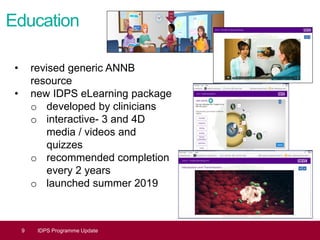
• revised generic ANNB
resource
• new IDPS eLearning package
o developed by clinicians
o interactive- 3 and 4D
media / videos and
quizzes
o recommended completion
every 2 years
o launched summer 2019
Information resources
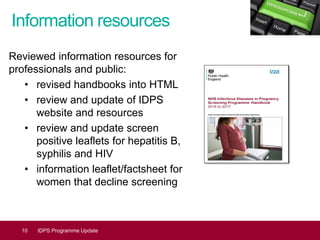
Reviewed information resources for
professionals and public:
• revised handbooks into HTML
• review and update of IDPS
website and resources
• review and update screen
positive leaflets for hepatitis B,
syphilis and HIV
• information leaflet/factsheet for
women that decline screening
10 IDPS Programme Update
HIV
• established multidisciplinary approach
• multiple agencies involved across primary and secondary care settings
• National Surveillance of HIV in Pregnancy and Childhood (NSHPC)
collects data on all pregnant women with HIV and their babies in the
UK
• Perinatal HIV audit on 108 vertically infected children born in UK
2006-2013 for IDPS programme
• Expert Review Panel of cases to inform programme
• enhanced data collection ongoing as part of NSHPC
• NSHPC now part of IDPS Integrated Screening Outcomes Surveillance
Service (IDPS ISOSS)
Syphilis
• not a ‘medieval’ occurrence
• noted rise in infectious syphilis across all parts of England
• no significant increase in numbers of positive pregnant
women (approx. 800 per annum)
• approx. 43% required treatment in pregnancy
• noted ‘rise’ in cases of congenital syphilis
• acquired infection later in pregnancy
• presented late in pregnancy
• missed diagnoses
• UK NSC evidence review on retesting in later pregnancy
• BASHH guidelines and birth plan
PHE syphilis action plan
• collaboration with the National Infection Service STI team on
congenital syphilis review, action plan and sexual health
issues
• PHE syphilis action plan- maternity strand
• ISOSS- will collate maternal and paediatric outcomes data
• linkage to BPSU congenital syphilis case notifications
• awareness raising of sexual health in pregnancy through
stakeholder engagement, communications and regional
workshops
13 IDPS Programme Update
Hepatitis B
• transmission is through contact with blood and body fluids
e.g. sexual contact, sharing contaminated needles, infected
blood and blood products and transmission from mother to
baby around the time of birth
• in areas of high HBV prevalence (>8% infected) e.g. sub-
Saharan Africa, most of Asia and the Pacific islands, vertical
(mother to baby) is the most common route transmission
• the risk of developing chronic hepatitis B infection depends on
the age at which infection is acquired
• chronic infection occurs in 90% of those infected perinatally
• around 20% to 25% of individuals with chronic HBV infection
worldwide have progressive liver disease, leading to cirrhosis
in some patients and increased risk of liver cancer
IDPS Programme Update
WHO global health strategy on viral
hepatitis 2016 - 2021
• an estimated 250 million people worldwide are
chronically infected with HBV WHO Global
Hepatitis Report 2017
https://www.who.int/hepatitis/publications/global-
hepatitis-report2017/en/
• international public health challenge comparable to
HIV, TB and malaria
• acknowledged largely ignored issue
• the first global health sector strategy on viral
hepatitis, 2030 Agenda for Sustainable
Development: Target 3
• specific action to combat viral hepatitis and aim to
eliminate it as a public health threat
15 IDPS Programme Update
Main points
• strategy addresses all five hepatitis viruses (hepatitis A,
B, C, D and E)
• a particular focus on hepatitis B and C, owing to the
relative public health burden they represent
• provides a vision of a world where:
• viral hepatitis transmission is halted
• everyone living with viral hepatitis has access to safe,
affordable and effective care and treatment;
• a goal of eliminating viral hepatitis as a major public
health threat by 2030
16 IDPS Programme Update
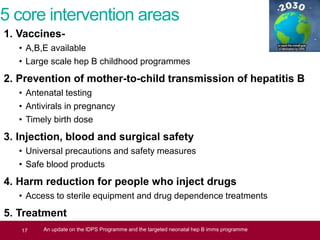
5 core intervention areas
1. Vaccines-
• A,B,E available
• Large scale hep B childhood programmes
2. Prevention of mother-to-child transmission of hepatitis B
• Antenatal testing
• Antivirals in pregnancy
• Timely birth dose
3. Injection, blood and surgical safety
• Universal precautions and safety measures
• Safe blood products
4. Harm reduction for people who inject drugs
• Access to sterile equipment and drug dependence treatments
5. Treatment
• Effective treatment and monitoring regimensIDPS Programme Update17 An update on the IDPS Programme and the targeted neonatal hep B imms programme
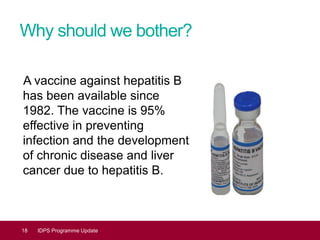
Why should we bother?
A vaccine against hepatitis B
has been available since
1982. The vaccine is 95%
effective in preventing
infection and the development
of chronic disease and liver
cancer due to hepatitis B.
18 IDPS Programme Update
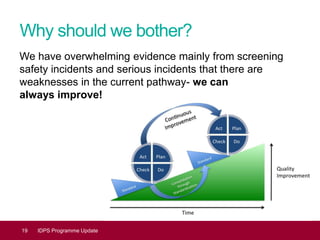
Why should we bother?
We have overwhelming evidence mainly from screening
safety incidents and serious incidents that there are
weaknesses in the current pathway- we can
always improve!
19 IDPS Programme Update
What can we do?
• PHE liver strategy
• PHE screening and immunisation quality improvement
initiative 2017-2020
• improved surveillance systems
• gold standard care in line with HIV
• increase public awareness and knowledge
• improve professional knowledge
• increase multidisciplinary working
20 IDPS Programme Update
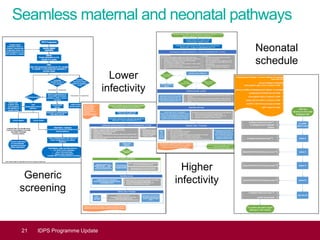
Seamless maternal and neonatal pathways
21 IDPS Programme Update
Generic
screening
Higher
infectivity
Lower
infectivity
Neonatal
schedule
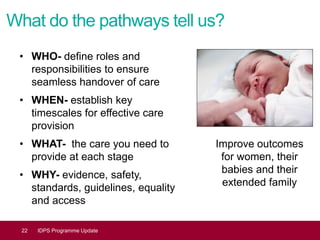
What do the pathways tell us?
• WHO- define roles and
responsibilities to ensure
seamless handover of care
• WHEN- establish key
timescales for effective care
provision
• WHAT- the care you need to
provide at each stage
• WHY- evidence, safety,
standards, guidelines, equality
and access
22 IDPS Programme Update
Improve outcomes
for women, their
babies and their
extended family
The HIV model
• long standing multidisciplinary approach
• resource rich area of health care
• multiple agencies involved across primary and
secondary care settings
• addresses complex physical, social and emotional needs
• collaborative working and care planning
23 IDPS Programme Update
Key messages- generic
Updated pathways referenced in the service specifications
2019/2020
updated version of screening and laboratory handbooks in
2019
➢ check all results at every contact
➢ management of women who decline in a timely manner
➢ care of women who miscarry after screening
- trust process in place
➢ triage into clinical care and multidisciplinary working
➢ work as a team- involve members of MDT
➢ support improvement of screening on delivery suites
24 IDPS Programme Update
Key messages- women with hepatitis B
Screening team co-ordinate care package from start to finish
➢ never presume known positive women understand their condition
and the care they will need to protect their babies
➢ information giving on data collection, disease notification and
national surveillance processes important
➢ all newly diagnosed women need clinical assessment for their new
diagnoses
➢ establish who orders the HBIG - work together
➢ third trimester review-
➢important to individualise care for each woman
➢check understanding of care at delivery and beyond
➢repeat info about schedule, registration of birth and with GP
25 IDPS Programme Update
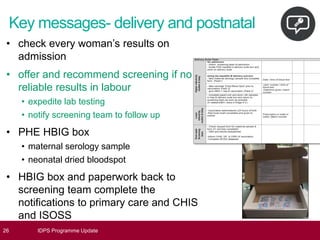
Key messages- delivery and postnatal
26 IDPS Programme Update
• check every woman’s results on
admission
• offer and recommend screening if no
reliable results in labour
• expedite lab testing
• notify screening team to follow up
• PHE HBIG box
• maternal serology sample
• neonatal dried bloodspot
• HBIG box and paperwork back to
screening team complete the
notifications to primary care and CHIS
and ISOSS
Investigating hepatitis B vaccine failures
In spite of vaccine/HBIG intervention, hepatitis B infected babies are still
seen, possibly due to:
• inter-uterine transfer of infection, or perinatal transmission
• important factors in vaccine/HBIG failure include maternal viral load and
mutant hepatitis B viruses that “escape” the vaccine
PHE surveillance process to collate data needed to inform interventions to
prevent transmission by:
• assessing maternal HBV DNA levels at 2 time points
1. Screening – HBV DNA levels at the early phase of pregnancy
2. Delivery - HBV DNA levels at time of birth
• assessing markers of HBV infection in baby at 2 time points
1. At birth – HBV DNA
2. 12 month – HBsAg, anti-HBc
27 IDPS Programme Update
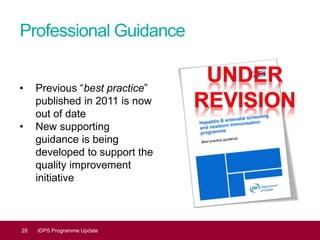
Professional Guidance
28 IDPS Programme Update
• Previous “best practice”
published in 2011 is now
out of date
• New supporting
guidance is being
developed to support the
quality improvement
initiative
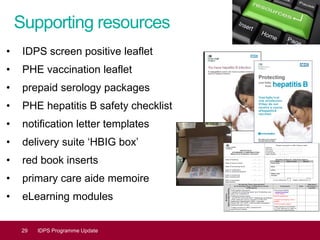
Supporting resources
• IDPS screen positive leaflet
• PHE vaccination leaflet
• prepaid serology packages
• PHE hepatitis B safety checklist
• notification letter templates
• delivery suite ‘HBIG box’
• red book inserts
• primary care aide memoire
• eLearning modules
29 IDPS Programme Update
Handing over the baton
30 IDPS Programme Update

IDPS programme update Sharon Webb

  • 1.
    Infectious Diseases inPregnancy Screening Programme Update National Laboratory Workshop 13 March 2019 Sharon Webb – National Programme Manager IDPS, PHE
  • 2.
    The IDPS programme TheUK NSC assesses evidence and makes recommendations to the 4 UK governments about population screening programmes 2 IDPS Programme Update Currently recommends systematic, population screening in pregnancy is offered and recommended to all eligible women HIV Hepatitis B Syphilis • HSC 1999/183 • By 2000-2002 • HSC 1998/127 • By April 2000 • 1998 PHLS systematic review
  • 3.
    Aims & objectives To: •enable early detection and treatment for infections in pregnancy in order to significantly reduce the risk of vertical (mother-to-child) transmission of infection and protect the health of the woman and her family • ensure equal access to uniform and quality assured screening across England • provide women with high quality information so they can make an informed choice about their screening options and pregnancy choices • provide assurance that all women who screen positive for HIV, hepatitis B or syphilis, or are already known to be positive for HIV and hepatitis B, are seen by the IDPS MDT within specified timescales 3 IDPS Programme Update
  • 4.
    Laboratory review Laboratory QualityImprovements: • clinical task group • incidents and data reviews o contamination management o false positives • laboratory handbook update o analyses algorithms o reporting guidance • annual stakeholder workshop 4 IDPS Programme Update
  • 5.
    Standards data • metricsto drive continual service improvements • new reporting process, central analyses and report production • published data tables on gov.uk • established data sharing processes with National Infection Service (NIS) and Field Epidemiology Services (FES) • trend analyses- 2-3 years of data to inform major standards review in 2021-2023 5 IDPS Programme Update
  • 6.
    Screening activity > 850,000conceptions to women of all ages in England and Wales (ONS conception data 2016) 2016-17 PHE screening standards data* : • uptake of antenatal screening for HIV, hepatitis B and syphilis in England >99% for all three infections • between 1,100 to 1,628 decline screening (approx. 2.5 per 1000 women) • 0.14% (788 / 544,219) of pregnant women screened positive for HIV (new and known diagnoses), majority are known positive • 0.47% (2,067 / 441,696) of pregnant women screened positive for hepatitis B infection (new and known diagnoses) ), majority are known positive • 0.19% (837 / 446,252) of woman were reported screen positive for syphilis, 252 requiring treatment *Exclusions are applied for missing or incomplete data submissions 6 IDPS Programme Update
  • 7.
    Screening outcomes The ScreeningSurveillance team at Great Ormond Street Institute of Child Health was awarded the PHE IDPS tender to establish the Integrated Screening Outcomes Surveillance Service (ISOSS) in September 2018. The goal of the ISOSS is to collect, analyse and report obstetric and paediatric data on HIV, syphilis and hepatitis B in pregnant women and children in order to: • assess key outcomes of the IDPS Programme • assess the IDPS Programme’s impact on prevention of vertically-acquired HIV, hepatitis B and syphilis • protect the health of women with and infants exposed to these infections 7 IDPS Programme Update
  • 8.
    IDPS ISOSS • newgovernance arrangements- part of IDPS team • Yr 1- HIV review; plan maternal and neonatal syphilis / maintain congenital rubella nd syphilis • Yr 2- roll-out maternal and neonatal syphilis service, plan hep B service / maintain congenital rubella nd syphilis • Yr 3- roll-out hep B and linkage with Imms/BBV team on newborn outcomes 8 IDPS Programme Update
  • 9.
    Education 9 IDPS ProgrammeUpdate • revised generic ANNB resource • new IDPS eLearning package o developed by clinicians o interactive- 3 and 4D media / videos and quizzes o recommended completion every 2 years o launched summer 2019
  • 10.
    Information resources Reviewed informationresources for professionals and public: • revised handbooks into HTML • review and update of IDPS website and resources • review and update screen positive leaflets for hepatitis B, syphilis and HIV • information leaflet/factsheet for women that decline screening 10 IDPS Programme Update
  • 11.
    HIV • established multidisciplinaryapproach • multiple agencies involved across primary and secondary care settings • National Surveillance of HIV in Pregnancy and Childhood (NSHPC) collects data on all pregnant women with HIV and their babies in the UK • Perinatal HIV audit on 108 vertically infected children born in UK 2006-2013 for IDPS programme • Expert Review Panel of cases to inform programme • enhanced data collection ongoing as part of NSHPC • NSHPC now part of IDPS Integrated Screening Outcomes Surveillance Service (IDPS ISOSS)
  • 12.
    Syphilis • not a‘medieval’ occurrence • noted rise in infectious syphilis across all parts of England • no significant increase in numbers of positive pregnant women (approx. 800 per annum) • approx. 43% required treatment in pregnancy • noted ‘rise’ in cases of congenital syphilis • acquired infection later in pregnancy • presented late in pregnancy • missed diagnoses • UK NSC evidence review on retesting in later pregnancy • BASHH guidelines and birth plan
  • 13.
    PHE syphilis actionplan • collaboration with the National Infection Service STI team on congenital syphilis review, action plan and sexual health issues • PHE syphilis action plan- maternity strand • ISOSS- will collate maternal and paediatric outcomes data • linkage to BPSU congenital syphilis case notifications • awareness raising of sexual health in pregnancy through stakeholder engagement, communications and regional workshops 13 IDPS Programme Update
  • 14.
    Hepatitis B • transmissionis through contact with blood and body fluids e.g. sexual contact, sharing contaminated needles, infected blood and blood products and transmission from mother to baby around the time of birth • in areas of high HBV prevalence (>8% infected) e.g. sub- Saharan Africa, most of Asia and the Pacific islands, vertical (mother to baby) is the most common route transmission • the risk of developing chronic hepatitis B infection depends on the age at which infection is acquired • chronic infection occurs in 90% of those infected perinatally • around 20% to 25% of individuals with chronic HBV infection worldwide have progressive liver disease, leading to cirrhosis in some patients and increased risk of liver cancer IDPS Programme Update
  • 15.
    WHO global healthstrategy on viral hepatitis 2016 - 2021 • an estimated 250 million people worldwide are chronically infected with HBV WHO Global Hepatitis Report 2017 https://www.who.int/hepatitis/publications/global- hepatitis-report2017/en/ • international public health challenge comparable to HIV, TB and malaria • acknowledged largely ignored issue • the first global health sector strategy on viral hepatitis, 2030 Agenda for Sustainable Development: Target 3 • specific action to combat viral hepatitis and aim to eliminate it as a public health threat 15 IDPS Programme Update
  • 16.
    Main points • strategyaddresses all five hepatitis viruses (hepatitis A, B, C, D and E) • a particular focus on hepatitis B and C, owing to the relative public health burden they represent • provides a vision of a world where: • viral hepatitis transmission is halted • everyone living with viral hepatitis has access to safe, affordable and effective care and treatment; • a goal of eliminating viral hepatitis as a major public health threat by 2030 16 IDPS Programme Update
  • 17.
    5 core interventionareas 1. Vaccines- • A,B,E available • Large scale hep B childhood programmes 2. Prevention of mother-to-child transmission of hepatitis B • Antenatal testing • Antivirals in pregnancy • Timely birth dose 3. Injection, blood and surgical safety • Universal precautions and safety measures • Safe blood products 4. Harm reduction for people who inject drugs • Access to sterile equipment and drug dependence treatments 5. Treatment • Effective treatment and monitoring regimensIDPS Programme Update17 An update on the IDPS Programme and the targeted neonatal hep B imms programme
  • 18.
    Why should webother? A vaccine against hepatitis B has been available since 1982. The vaccine is 95% effective in preventing infection and the development of chronic disease and liver cancer due to hepatitis B. 18 IDPS Programme Update
  • 19.
    Why should webother? We have overwhelming evidence mainly from screening safety incidents and serious incidents that there are weaknesses in the current pathway- we can always improve! 19 IDPS Programme Update
  • 20.
    What can wedo? • PHE liver strategy • PHE screening and immunisation quality improvement initiative 2017-2020 • improved surveillance systems • gold standard care in line with HIV • increase public awareness and knowledge • improve professional knowledge • increase multidisciplinary working 20 IDPS Programme Update
  • 21.
    Seamless maternal andneonatal pathways 21 IDPS Programme Update Generic screening Higher infectivity Lower infectivity Neonatal schedule
  • 22.
    What do thepathways tell us? • WHO- define roles and responsibilities to ensure seamless handover of care • WHEN- establish key timescales for effective care provision • WHAT- the care you need to provide at each stage • WHY- evidence, safety, standards, guidelines, equality and access 22 IDPS Programme Update Improve outcomes for women, their babies and their extended family
  • 23.
    The HIV model •long standing multidisciplinary approach • resource rich area of health care • multiple agencies involved across primary and secondary care settings • addresses complex physical, social and emotional needs • collaborative working and care planning 23 IDPS Programme Update
  • 24.
    Key messages- generic Updatedpathways referenced in the service specifications 2019/2020 updated version of screening and laboratory handbooks in 2019 ➢ check all results at every contact ➢ management of women who decline in a timely manner ➢ care of women who miscarry after screening - trust process in place ➢ triage into clinical care and multidisciplinary working ➢ work as a team- involve members of MDT ➢ support improvement of screening on delivery suites 24 IDPS Programme Update
  • 25.
    Key messages- womenwith hepatitis B Screening team co-ordinate care package from start to finish ➢ never presume known positive women understand their condition and the care they will need to protect their babies ➢ information giving on data collection, disease notification and national surveillance processes important ➢ all newly diagnosed women need clinical assessment for their new diagnoses ➢ establish who orders the HBIG - work together ➢ third trimester review- ➢important to individualise care for each woman ➢check understanding of care at delivery and beyond ➢repeat info about schedule, registration of birth and with GP 25 IDPS Programme Update
  • 26.
    Key messages- deliveryand postnatal 26 IDPS Programme Update • check every woman’s results on admission • offer and recommend screening if no reliable results in labour • expedite lab testing • notify screening team to follow up • PHE HBIG box • maternal serology sample • neonatal dried bloodspot • HBIG box and paperwork back to screening team complete the notifications to primary care and CHIS and ISOSS
  • 27.
    Investigating hepatitis Bvaccine failures In spite of vaccine/HBIG intervention, hepatitis B infected babies are still seen, possibly due to: • inter-uterine transfer of infection, or perinatal transmission • important factors in vaccine/HBIG failure include maternal viral load and mutant hepatitis B viruses that “escape” the vaccine PHE surveillance process to collate data needed to inform interventions to prevent transmission by: • assessing maternal HBV DNA levels at 2 time points 1. Screening – HBV DNA levels at the early phase of pregnancy 2. Delivery - HBV DNA levels at time of birth • assessing markers of HBV infection in baby at 2 time points 1. At birth – HBV DNA 2. 12 month – HBsAg, anti-HBc 27 IDPS Programme Update
  • 28.
    Professional Guidance 28 IDPSProgramme Update • Previous “best practice” published in 2011 is now out of date • New supporting guidance is being developed to support the quality improvement initiative
  • 29.
    Supporting resources • IDPSscreen positive leaflet • PHE vaccination leaflet • prepaid serology packages • PHE hepatitis B safety checklist • notification letter templates • delivery suite ‘HBIG box’ • red book inserts • primary care aide memoire • eLearning modules 29 IDPS Programme Update
  • 30.
    Handing over thebaton 30 IDPS Programme Update