JIS COLLEGE OF ENGINEERING
SUBMITTED BY:
SUBHASISH KARMAKAR
CONTENTS:
 HISTORY.
 INTRODUCTION.
 COMPONENTS.
 PROCEDURE.
 THE INSTRUMENT.
 WORKING PRINCIPLE.
 ABSORPTION SPECTRA.
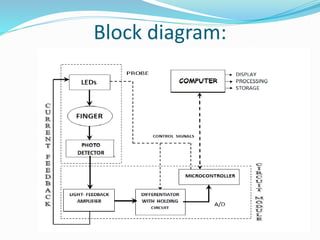
 BLOCK DIAGRAM.
 NORMAL READING.
 AREAS OF USE.
 ADVANTAGES.
 LIMITATIONS.
HISTORY
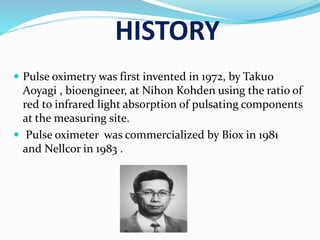
 Pulse oximetry was first invented in 1972, by Takuo
Aoyagi , bioengineer, at Nihon Kohden using the ratio of
red to infrared light absorption of pulsating components
at the measuring site.
 Pulse oximeter was commercialized by Biox in 1981
and Nellcor in 1983 .
INTRODUCTION
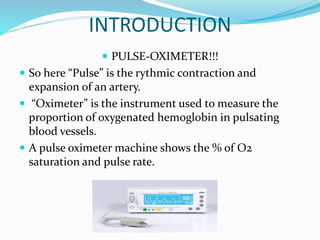
 PULSE-OXIMETER!!!
 So here “Pulse” is the rythmic contraction and
expansion of an artery.
 “Oximeter” is the instrument used to measure the
proportion of oxygenated hemoglobin in pulsating
blood vessels.
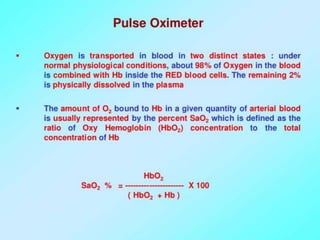
 A pulse oximeter machine shows the % of O2
saturation and pulse rate.
???
 What is pulse oximetry?
 Pulse oximetry is a non invasive method for determining
a patient’s O2 saturation.
 The process can be of two types;
 Transmittance type.
 Reflectance type
 Transmittance type is mainly used here.
 It measures that, what % of blood is loaded with O2.
Components :
 A pulse oximeter mainly consists of 3 units:
An optical probe.
A circuit module.
A display unit.
 Optical probe contain two LED’s,
 Red light(660 nm).
 Infrared light(940 nm).
 Circuit module is the analog part.
 A computer for data storage ,processing and display.
PROCEDURE:
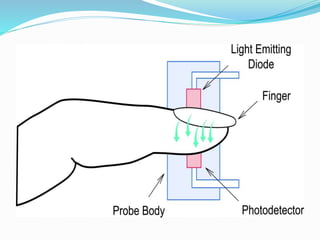
 In this method, a sensor is placed on a thin part of a
patient’s body.
 Then light of two wavelength is passed through the
patient to a photodetector .
 The changing absorbance at each wavelength is
measured in %.
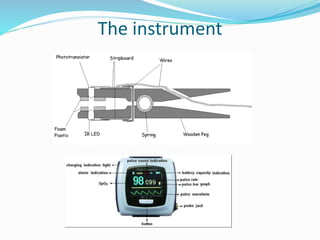
The instrument
working principle
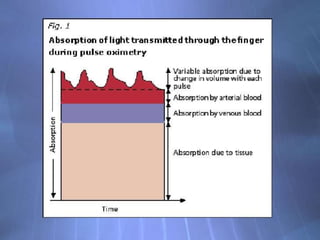
 Pulse oximeter measures the absorption of red and
infrared light by pulsatile blood.
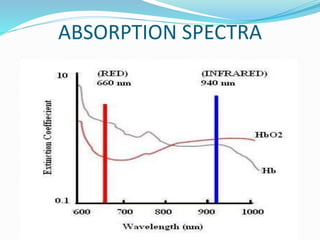
 Oxygenated blood absorbs light at 660 nm(red),
where as deoxygenated blood absorbs light at 940
nm(IR).
 It contains two LED’s and two light collecting sensors.
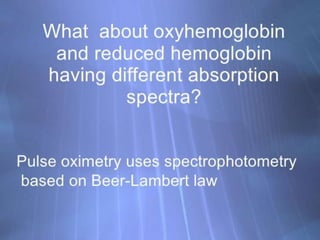
 The relative absorption of light by oxy-hemoglobin
and deoxy-hemoglobin is processed by the device and
an O2 saturation level is reported.
ABSORPTION SPECTRA
Block diagram:
Normal reading:
Advantages:
 Pulse oximetry is particularly convenient
for noninvasive continuous measurement of blood
oxygen saturation.
 It is possible that it can also be used to detect
abnormalities in ventilation.
 Portable battery-operated pulse oximeters are useful
for pilots operating in a non-pressurized aircraft above
10,000 feet.
Limitations:
 It is not a substitute for blood gases checked in a
laboratory.
 In severe anemia, the blood will carry less total
oxygen, despite the hemoglobin being 100% saturated.
 Since pulse oximetry only measures the percentage of
bound hemoglobin, a falsely high or low reading will
occur when hemoglobin binds to something other
than oxygen.
Pulse oximetry

Pulse oximetry

  • 1.
    JIS COLLEGE OFENGINEERING SUBMITTED BY: SUBHASISH KARMAKAR
  • 2.
    CONTENTS:  HISTORY.  INTRODUCTION. COMPONENTS.  PROCEDURE.  THE INSTRUMENT.  WORKING PRINCIPLE.  ABSORPTION SPECTRA.  BLOCK DIAGRAM.  NORMAL READING.  AREAS OF USE.  ADVANTAGES.  LIMITATIONS.
  • 3.
    HISTORY  Pulse oximetrywas first invented in 1972, by Takuo Aoyagi , bioengineer, at Nihon Kohden using the ratio of red to infrared light absorption of pulsating components at the measuring site.  Pulse oximeter was commercialized by Biox in 1981 and Nellcor in 1983 .
  • 4.
    INTRODUCTION  PULSE-OXIMETER!!!  Sohere “Pulse” is the rythmic contraction and expansion of an artery.  “Oximeter” is the instrument used to measure the proportion of oxygenated hemoglobin in pulsating blood vessels.  A pulse oximeter machine shows the % of O2 saturation and pulse rate.
  • 5.
    ???  What ispulse oximetry?  Pulse oximetry is a non invasive method for determining a patient’s O2 saturation.  The process can be of two types;  Transmittance type.  Reflectance type  Transmittance type is mainly used here.  It measures that, what % of blood is loaded with O2.
  • 6.
    Components :  Apulse oximeter mainly consists of 3 units: An optical probe. A circuit module. A display unit.  Optical probe contain two LED’s,  Red light(660 nm).  Infrared light(940 nm).  Circuit module is the analog part.  A computer for data storage ,processing and display.
  • 7.
    PROCEDURE:  In thismethod, a sensor is placed on a thin part of a patient’s body.  Then light of two wavelength is passed through the patient to a photodetector .  The changing absorbance at each wavelength is measured in %.
  • 8.
  • 9.
    working principle  Pulseoximeter measures the absorption of red and infrared light by pulsatile blood.  Oxygenated blood absorbs light at 660 nm(red), where as deoxygenated blood absorbs light at 940 nm(IR).  It contains two LED’s and two light collecting sensors.  The relative absorption of light by oxy-hemoglobin and deoxy-hemoglobin is processed by the device and an O2 saturation level is reported.
  • 12.
  • 17.
  • 18.
  • 20.
    Advantages:  Pulse oximetryis particularly convenient for noninvasive continuous measurement of blood oxygen saturation.  It is possible that it can also be used to detect abnormalities in ventilation.  Portable battery-operated pulse oximeters are useful for pilots operating in a non-pressurized aircraft above 10,000 feet.
  • 21.
    Limitations:  It isnot a substitute for blood gases checked in a laboratory.  In severe anemia, the blood will carry less total oxygen, despite the hemoglobin being 100% saturated.  Since pulse oximetry only measures the percentage of bound hemoglobin, a falsely high or low reading will occur when hemoglobin binds to something other than oxygen.