

PFT IPFT I 11
Pulmonary function testPulmonary function test
Part IPart I
HOSAM M ATEFHOSAM M ATEF
PFT IPFT I 22
Pulmonary function test :Pulmonary function test :
Group of procedures that measure the function of theGroup of procedures that measure the function of the
lungslungs
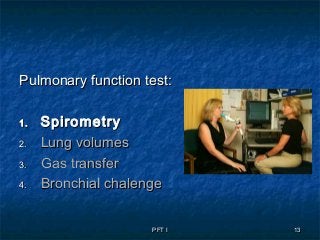
1.1. SpirometrySpirometry
2.2. Lung volumesLung volumes
3.3. Gas transferGas transfer
4.4. Bronchial chalengeBronchial chalenge
PFT IPFT I 33
IndicationsIndications
PFT IPFT I 44
A.DiagnosticA.Diagnostic
PFT IPFT I 55
Symptoms:Symptoms:
dyspnea, wheezing, orthopnea, cough, sputumdyspnea, wheezing, orthopnea, cough, sputum
productionproduction
Signs:Signs:
decreased breath sounds, overinflation,decreased breath sounds, overinflation,
expiratory slowing, cyanosis, chest deformitory,expiratory slowing, cyanosis, chest deformitory,
unexplained cracklesunexplained crackles
Abnormal laboratory tests:Abnormal laboratory tests:
hypoxemia, hypercapnia, polycythemia,hypoxemia, hypercapnia, polycythemia,
abnormal chest radiographsabnormal chest radiographs
 To measure the effect of disease on pulmonaryTo measure the effect of disease on pulmonary
functionfunction
PFT IPFT I 66
 To screen individuals at risk of having pulmonaryTo screen individuals at risk of having pulmonary
diseasesdiseases
1.1. SmokersSmokers
2.2. occupations with exposures to injuriousoccupations with exposures to injurious
substancessubstances
 To assess preoperative riskTo assess preoperative risk
 To assess prognosis (lung transplant, etc.)To assess prognosis (lung transplant, etc.)
PFT IPFT I 77
B. MonitoringB. Monitoring
PFT IPFT I 88
To assess therapeutic interventionsTo assess therapeutic interventions
 Bronchodilator therapyBronchodilator therapy
 Steroid treatment for asthma, interstitialSteroid treatment for asthma, interstitial
lung disease, etc.lung disease, etc.
 Other (antibiotics in cystic fibrosis, etc.)Other (antibiotics in cystic fibrosis, etc.)
 To monitor for adverse reactions to drugs withTo monitor for adverse reactions to drugs with
known pulmonary toxicityknown pulmonary toxicity
PFT IPFT I 99
C. Disability/Impairment EvaluationsC. Disability/Impairment Evaluations
PFT IPFT I 1010
To assess patients as part of a rehabilitationTo assess patients as part of a rehabilitation
programprogram
 MedicalMedical
PFT IPFT I 1111
ContraindicationsContraindications
PFT IPFT I 1212
 Hemoptysis of unknown originHemoptysis of unknown origin
 PneumothoraxPneumothorax
 Unstable angina pectorisUnstable angina pectoris
 Recent myocardial infarctionRecent myocardial infarction
 Thoracic aneurysmsThoracic aneurysms
 Abdominal aneurysmsAbdominal aneurysms
 Cerebral aneurysmsCerebral aneurysms
 Recent eye surgery (increased intraocular pressureRecent eye surgery (increased intraocular pressure
during forced expiration)during forced expiration)
 Recent abdominal or thoracic surgical proceduresRecent abdominal or thoracic surgical procedures
 History of syncope associated with forced exhalationHistory of syncope associated with forced exhalation
PFT IPFT I 1313
Pulmonary function test:Pulmonary function test:
1.1. SpirometrySpirometry
2.2. Lung volumesLung volumes
3.3. Gas transferGas transfer
4.4. Bronchial chalengeBronchial chalenge
PFT IPFT I 1414
What is a spirometry ??What is a spirometry ??
Spirometry is a measure of airflow andSpirometry is a measure of airflow and
lung volumes during a forced expiratorylung volumes during a forced expiratory
maneuver from full inspirationmaneuver from full inspiration
PFT IPFT I 1515
How to do it ??How to do it ??
PFT IPFT I 1616
1.1. Stand or sit up straight (The patient places aStand or sit up straight (The patient places a
clip over the nose )clip over the nose )
2.2. Inhale maximallyInhale maximally
3.3. Get a good seal around mouthpiece of theGet a good seal around mouthpiece of the
spirometerspirometer
4.4. Blow out as hard as fast as possible andBlow out as hard as fast as possible and
count for at least 6 seconds.count for at least 6 seconds.
5.5. Record the best of three trialRecord the best of three trial
*pt should hold bronchodilator few hrs before the test*pt should hold bronchodilator few hrs before the test
PFT IPFT I 1717
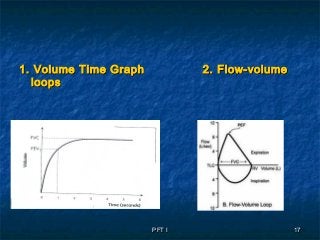
1. Volume Time Graph 2. Flow-volume1. Volume Time Graph 2. Flow-volume
loopsloops
PFT IPFT I 1818
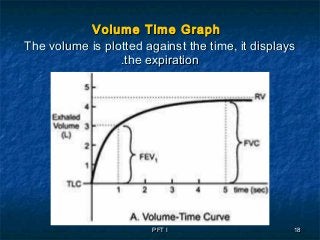
Volume Time GraphVolume Time Graph
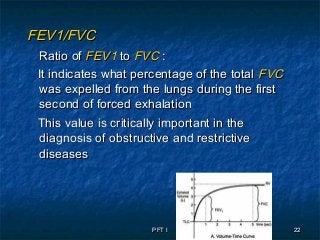
The volume is plotted against the time, it displaysThe volume is plotted against the time, it displays
the expirationthe expiration..
PFT IPFT I 1919
1.1. FVCFVC
2.2. FEV1FEV1
3.3. FEV1/FVCFEV1/FVC
4.4. FEF25%FEF25%
5.5. FEF75%FEF75%
PFT IPFT I 2020
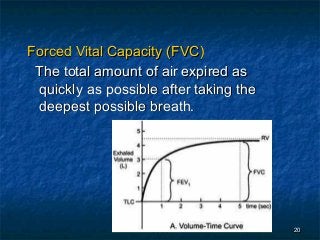
Forced Vital Capacity (FVC)Forced Vital Capacity (FVC)
The total amount of air expired asThe total amount of air expired as
quickly as possible after taking thequickly as possible after taking the
deepest possible breath.deepest possible breath.
PFT IPFT I 2121
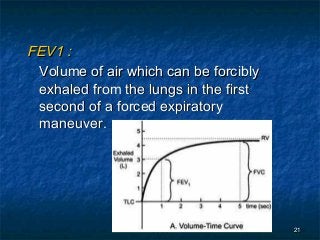
FEV1FEV1 ::
Volume of air which can be forciblyVolume of air which can be forcibly
exhaled from the lungs in the firstexhaled from the lungs in the first
second of a forced expiratorysecond of a forced expiratory
maneuver.maneuver.
PFT IPFT I 2222
FEV1/FVCFEV1/FVC
Ratio ofRatio of FEV1FEV1 toto FVCFVC ::
It indicates what percentage of the totalIt indicates what percentage of the total FVCFVC
was expelled from the lungs during the firstwas expelled from the lungs during the first
second of forced exhalationsecond of forced exhalation
This value is critically important in theThis value is critically important in the
diagnosis of obstructive and restrictivediagnosis of obstructive and restrictive
diseasesdiseases
PFT IPFT I 2323
FEF25%
Amount of air that was forcibly expelled in the firstAmount of air that was forcibly expelled in the first
25% of the total forced vital capacity test.25% of the total forced vital capacity test.
FEF75%FEF75%
The amount of air expelled from the lungs during theThe amount of air expelled from the lungs during the
first (75%) of the forced vital capacity test.first (75%) of the forced vital capacity test.
FEF25%-75%FEF25%-75%
The amount of air expelled from the lungs during theThe amount of air expelled from the lungs during the
middle half of the forced vital capacity test.middle half of the forced vital capacity test.
PFT IPFT I 2424
Flow-volume loopsFlow-volume loops
PFT IPFT I 2525
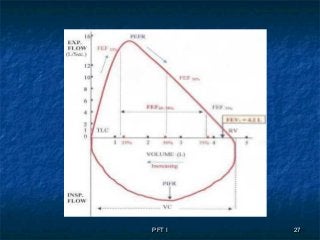
Flow-volume loopsFlow-volume loops
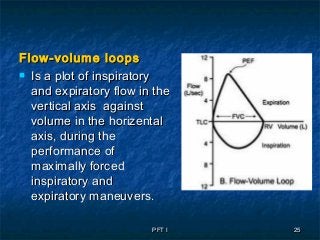
 Is a plot of inspiratoryIs a plot of inspiratory
and expiratory flow in theand expiratory flow in the
vertical axis againstvertical axis against
volume in the horizentalvolume in the horizental
axis, during theaxis, during the
performance ofperformance of
maximally forcedmaximally forced
inspiratory andinspiratory and
expiratory maneuvers.expiratory maneuvers.
PFT IPFT I 2626
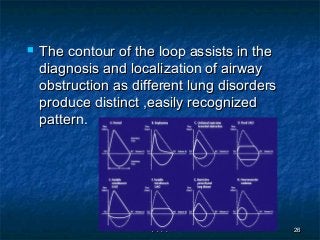
 The contour of the loop assists in theThe contour of the loop assists in the
diagnosis and localization of airwaydiagnosis and localization of airway
obstruction as different lung disordersobstruction as different lung disorders
produce distinct ,easily recognizedproduce distinct ,easily recognized
pattern.pattern.
PFT IPFT I 2727
PFT IPFT I 2828
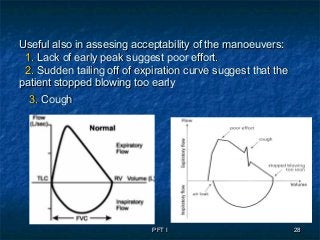
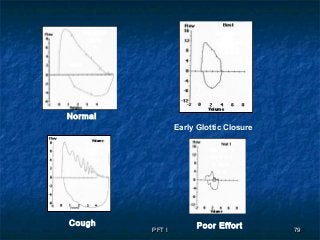
Useful also in assesing acceptability of the manoeuvers:Useful also in assesing acceptability of the manoeuvers:
1.1. Lack of early peak suggest poor effort.Lack of early peak suggest poor effort.
2.2. Sudden tailing off of expiration curve suggest that theSudden tailing off of expiration curve suggest that the
patient stopped blowing too earlypatient stopped blowing too early
3.3. CoughCough
PFT IPFT I 2929
Obstructive V/S restrictive lungObstructive V/S restrictive lung
disease ???disease ???
PFT IPFT I 3030
Obstructive Lung DiseasesObstructive Lung Diseases
PFT IPFT I 3131
Common Obstructive LungCommon Obstructive Lung
DiseasesDiseases
 AsthmaAsthma
 COPDCOPD (chronic bronchitis, emphysema and(chronic bronchitis, emphysema and
the overlap between them).the overlap between them).
 Cystic fibrosis.Cystic fibrosis.
PFT IPFT I 3232
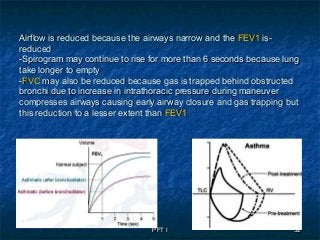
--Airflow is reduced because the airways narrow and theAirflow is reduced because the airways narrow and the FEV1FEV1 isis
reducedreduced
-Spirogram may continue to rise for more than 6 seconds because lung-Spirogram may continue to rise for more than 6 seconds because lung
take longer to emptytake longer to empty
--FVCFVC may also be reduced because gas is trapped behind obstructedmay also be reduced because gas is trapped behind obstructed
bronchi due to increase in intrathoracic pressure during maneuverbronchi due to increase in intrathoracic pressure during maneuver
compresses airways causing early airway closure and gas trapping butcompresses airways causing early airway closure and gas trapping but
this reduction to a lesser extent thanthis reduction to a lesser extent than FEV1FEV1
PFT IPFT I 3333
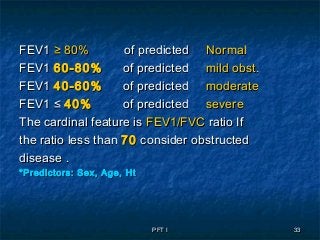
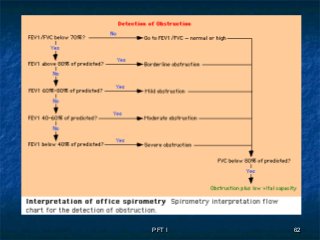
FEV1FEV1 ≥ 80%≥ 80% of predictedof predicted NormalNormal
FEV1FEV1 60-80%60-80% of predictedof predicted mild obst.mild obst.
FEV1FEV1 40-60%40-60% of predictedof predicted moderatemoderate
FEV1 ≤FEV1 ≤ 40%40% of predictedof predicted severesevere
The cardinal feature isThe cardinal feature is FEV1/FVCFEV1/FVC ratio Ifratio If
the ratio less thanthe ratio less than 7070 consider obstructedconsider obstructed
disease .disease .
*Predictors: Sex, Age, Ht*Predictors: Sex, Age, Ht
PFT IPFT I 3434
Predictors: Sex, Age, Ht ??Predictors: Sex, Age, Ht ??
The measurements are related to the following factors:The measurements are related to the following factors:
AgeAge ::
FVC and flow rates decline with age. The value of FVC increases up toFVC and flow rates decline with age. The value of FVC increases up to
24 years of age and remain stable to age 35.24 years of age and remain stable to age 35.
HeightHeight ::
All spirometric measurements increase with body weight. It is due to anAll spirometric measurements increase with body weight. It is due to an
increase in number and/or size of alveoli relative to airways, the largerincrease in number and/or size of alveoli relative to airways, the larger
lungs are likely to take longer than smaller one.lungs are likely to take longer than smaller one.
SexSex ::
Most pulmonary function values are lower in female than maleMost pulmonary function values are lower in female than male..
WeightWeight ::
A spirometric results are positively correlated with weight to the extentA spirometric results are positively correlated with weight to the extent
that increased weight means growth or muscle mass. Beyond this (inthat increased weight means growth or muscle mass. Beyond this (in
obesity) spirometric values (and lung values specially ERV) decreaseobesity) spirometric values (and lung values specially ERV) decrease
with greater weight.with greater weight.
PFT IPFT I 3535
Flow volume loop inFlow volume loop in
Obstructive lung diseaseObstructive lung disease
PFT IPFT I 3636
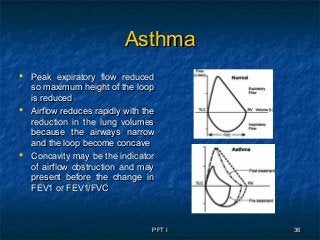
AsthmaAsthma
 Peak expiratory flow reducedPeak expiratory flow reduced
so maximum height of the loopso maximum height of the loop
is reducedis reduced
 Airflow reduces rapidly with theAirflow reduces rapidly with the
reduction in the lung volumesreduction in the lung volumes
because the airways narrowbecause the airways narrow
and the loop become concaveand the loop become concave
 Concavity may be the indicatorConcavity may be the indicator
of airflow obstruction and mayof airflow obstruction and may
present before the change inpresent before the change in
FEV1 or FEV1/FVCFEV1 or FEV1/FVC
PFT IPFT I 3737
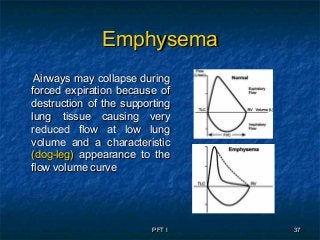
EmphysemaEmphysema
Airways may collapse duringAirways may collapse during
forced expiration because offorced expiration because of
destruction of the supportingdestruction of the supporting
lung tissue causing verylung tissue causing very
reduced flow at low lungreduced flow at low lung
volume and a characteristicvolume and a characteristic
(dog-leg)(dog-leg) appearance to theappearance to the
flow volume curveflow volume curve
PFT IPFT I 3838
ReversibilityReversibility
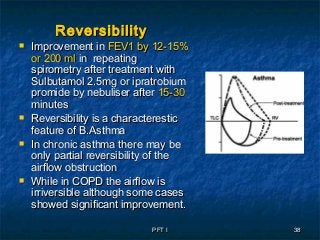
 Improvement inImprovement in FEV1 by 12-15%FEV1 by 12-15%
or 200 mlor 200 ml in repeatingin repeating
spirometry after treatment withspirometry after treatment with
Sulbutamol 2.5mg or ipratrobiumSulbutamol 2.5mg or ipratrobium
promide by nebuliser afterpromide by nebuliser after 15-3015-30
minutesminutes
 Reversibility is a characteresticReversibility is a characterestic
feature of B.Asthmafeature of B.Asthma
 In chronic asthma there may beIn chronic asthma there may be
only partial reversibility of theonly partial reversibility of the
airflow obstructionairflow obstruction
 While in COPD the airflow isWhile in COPD the airflow is
irriversible although some casesirriversible although some cases
showed significant improvement.showed significant improvement.
PFT IPFT I 3939
Interpretation of PFTsInterpretation of PFTs
Step 1.Step 1. Look at the Flow-Volume loop to determineLook at the Flow-Volume loop to determine
acceptability of the test, and look for upper airwayacceptability of the test, and look for upper airway
obstruction pattern.obstruction pattern.
Step 2.Step 2. Look at theLook at the FEV1FEV1 to determine if it is normalto determine if it is normal (≥(≥
80%80% predicted).predicted).
Step 3.Step 3. Look atLook at FVCFVC to determine if it is within normalto determine if it is within normal
limitslimits (≥ 80%).(≥ 80%).
Step 4.Step 4. Look atLook at thethe FEV1/FVCFEV1/FVC ratioratio to determine if itto determine if it
is within normal limitsis within normal limits (≥ 70%).(≥ 70%).
PFT IPFT I 4040
Step 5.Step 5. Look atLook at FEF25-75%FEF25-75% (Normal(Normal (≥ 60%)(≥ 60%)
 IfIf FEV1FEV1,, FEV1/FVCFEV1/FVC ratio, andratio, and FEF25-75%FEF25-75% all areall are
normal, the patient has anormal, the patient has a normalnormal PFT.PFT.
 If bothIf both FEV1FEV1 andand FEV1/FVCFEV1/FVC are normal, butare normal, but FEF25-FEF25-
75% is ≤ 60%75% is ≤ 60% ,then think about early obstruction or,then think about early obstruction or
small airways obstruction.small airways obstruction.
PFT IPFT I 4141
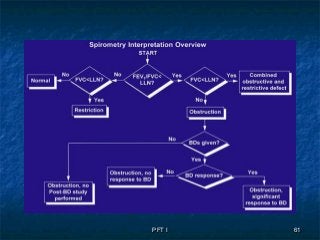
 IfIf FEV1FEV1 ≤ 80% and≤ 80% and FEV1/FVCFEV1/FVC ≤ 70%, there is≤ 70%, there is
obstructive defect, ifobstructive defect, if FVCFVC is normal, it is pureis normal, it is pure
obstruction. Ifobstruction. If FVCFVC ≤ 80% , possibility of additional≤ 80% , possibility of additional
restriction is there.restriction is there.
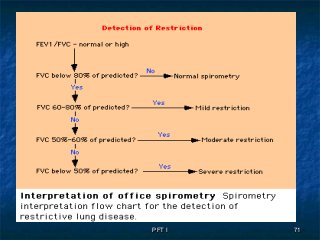
 IfIf FEV1FEV1 ≤ 80% ,≤ 80% , FVCFVC ≤ 80% and≤ 80% and FEV1/FVCFEV1/FVC ≥ 70%≥ 70% ,,
there is restrictive defect, get lung volumes to confirm.there is restrictive defect, get lung volumes to confirm.
PFT IPFT I 4242
ExamplesExamples
PFT IPFT I 4343
• Mild Obstructive Defect with good response toMild Obstructive Defect with good response to
bronchodilatorbronchodilator
Diagnosis:Diagnosis:
B.AsthmaB.Asthma
PFT IPFT I 4444
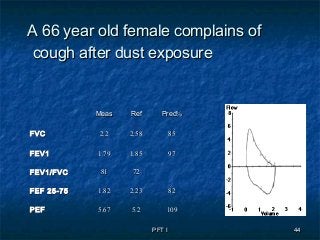
A 66 year old female complains ofA 66 year old female complains of
cough after dust exposurecough after dust exposure
MeasMeas RefRef %%PredPred
FVCFVC 2.22.2 2.582.58 8585
FEV1FEV1 1.791.79 1.851.85 9797
FEV1/FVCFEV1/FVC 8181 7272
FEF 25-75FEF 25-75 1.821.82 2.232.23 8282
PEFPEF 5.675.67 5.25.2 109109
PFT IPFT I 4545
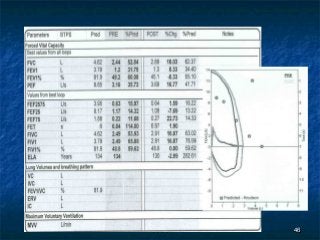
Normal SpirometryNormal Spirometry
PFT IPFT I 4646
PFT IPFT I 4747
• Flow volume loop suggestive of obstructive diseaseFlow volume loop suggestive of obstructive disease
• Spirometry showed Severe Obstructive defect with noSpirometry showed Severe Obstructive defect with no
response to bronchodilatorresponse to bronchodilator
• Increased FVC could be because of Airtrapping orIncreased FVC could be because of Airtrapping or
could be combined obstructive and restrictive defect tocould be combined obstructive and restrictive defect to
confirm need to do Lung Volumeconfirm need to do Lung Volume
diagnosis :diagnosis :
COPDCOPD
PFT IPFT I 4848
Mild Obstructive defectMild Obstructive defect
PFT IPFT I 4949
Large Airway ObstructionLarge Airway Obstruction
PFT IPFT I 5050
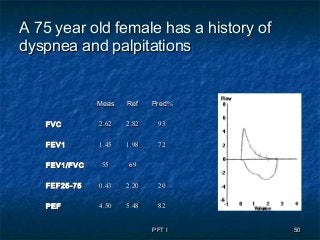
A 75 year old female has a history ofA 75 year old female has a history of
dyspnea and palpitationsdyspnea and palpitations
MeasMeas RefRef %%PredPred
FVCFVC 2.622.62 2.822.82 9393
FEV1FEV1 1.451.45 1.981.98 7272
FEV1/FVCFEV1/FVC 5555 6969
FEF25-75FEF25-75 0.430.43 2.202.20 2020
PEFPEF 4.504.50 5.485.48 8282
PFT IPFT I 5151
1.1. Fixed obstructionFixed obstruction
2.2. Variable extrathoracicVariable extrathoracic obstructionobstruction
3.3. Variable intrathoracic obstructionVariable intrathoracic obstruction
PFT IPFT I 5252
Flow Volume Loop inFlow Volume Loop in
Large Airway ObstructionLarge Airway Obstruction
PFT IPFT I 5353
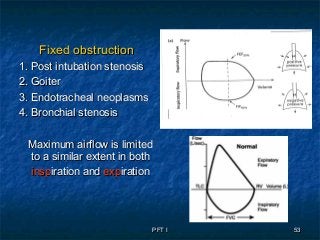
Fixed obstructionFixed obstruction
1. Post intubation stenosis1. Post intubation stenosis
2. Goiter2. Goiter
3. Endotracheal neoplasms3. Endotracheal neoplasms
4. Bronchial stenosis4. Bronchial stenosis
Maximum airflow is limitedMaximum airflow is limited
to a similar extent in bothto a similar extent in both
inspinspiration andiration and expexpirationiration
PFT IPFT I 5454
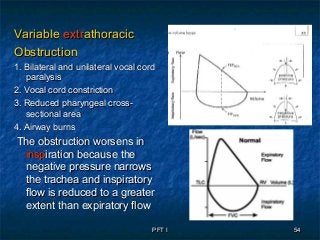
VariableVariable extrextrathoracicathoracic
ObstructionObstruction
1. Bilateral and unilateral vocal cord1. Bilateral and unilateral vocal cord
paralysisparalysis
2. Vocal cord constriction2. Vocal cord constriction
3. Reduced pharyngeal cross-3. Reduced pharyngeal cross-
sectional areasectional area
4. Airway burns4. Airway burns
The obstruction worsens inThe obstruction worsens in
inspinspiration because theiration because the
negative pressure narrowsnegative pressure narrows
the trachea and inspiratorythe trachea and inspiratory
flow is reduced to a greaterflow is reduced to a greater
extent than expiratory flowextent than expiratory flow
PFT IPFT I 5555
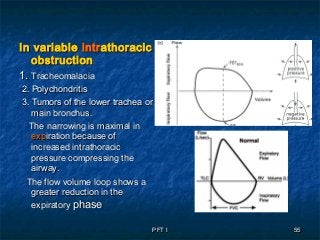
In variableIn variable intrintrathoracicathoracic
obstructionobstruction
1.1. TracheomalaciaTracheomalacia
2. Polychondritis2. Polychondritis
3. Tumors of the lower trachea or3. Tumors of the lower trachea or
main bronchus.main bronchus.
The narrowing is maximal inThe narrowing is maximal in
expexpiration because ofiration because of
increased intrathoracicincreased intrathoracic
pressure compressing thepressure compressing the
airway.airway.
The flow volume loop shows aThe flow volume loop shows a
greater reduction in thegreater reduction in the
expiratoryexpiratory phasephase
PFT IPFT I 5656
Small Airways obstructionSmall Airways obstruction
 Diseases affecting primarily the small (peripheral)Diseases affecting primarily the small (peripheral)
airways can be extensive yet not affect the FEV1(e.g.airways can be extensive yet not affect the FEV1(e.g.
early COPD, interstitial granulomatous disorders).early COPD, interstitial granulomatous disorders).
 Small airways status is reflected by the FEF25-75%Small airways status is reflected by the FEF25-75%
(mid-range flow), best determined from the flow-(mid-range flow), best determined from the flow-
volume loop.volume loop.
 Some patients have normal spirometry with theSome patients have normal spirometry with the
exception of a reduced FEF25-75%, this isexception of a reduced FEF25-75%, this is
suggestive of possible small airways dysfunction andsuggestive of possible small airways dysfunction and
potentially early obstruction.potentially early obstruction.
PFT IPFT I 5757
ExampleExample
PFT IPFT I 5858
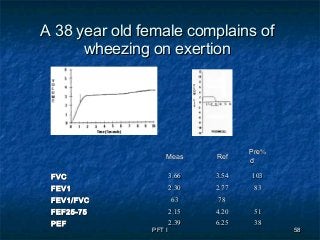
A 38 year old female complains ofA 38 year old female complains of
wheezing on exertionwheezing on exertion
MeasMeas RefRef
%%PrePre
dd
FVCFVC 3.663.66 3.543.54 103103
FEV1FEV1 2.302.30 2.772.77 8383
FEV1/FVCFEV1/FVC 6363 7878
FEF25-75FEF25-75 2.152.15 4.204.20 5151
PEFPEF 2.392.39 6.256.25 3838
PFT IPFT I 5959
 Flow volume loop suggests a fixed upperFlow volume loop suggests a fixed upper
airway obstructionairway obstruction
PFT IPFT I 6060
Effect of Smoking:Effect of Smoking:
 Smoking in patients with COPD is associatedSmoking in patients with COPD is associated
with decline inwith decline in FEV1 of 90-150 mL/yearFEV1 of 90-150 mL/year
 Smoking cessation is (associated withSmoking cessation is (associated with
increase inincrease in FEV1FEV1 for first year) followed with afor first year) followed with a
decline of only 30 mL/yeardecline of only 30 mL/year
PFT IPFT I 6161
PFT IPFT I 6262
PFT IPFT I 6363
Restrictive Lung DiseasesRestrictive Lung Diseases
PFT IPFT I 6464
A. Intrinsic Restrictive Lung DisordersA. Intrinsic Restrictive Lung Disorders
1.1. SarcoidosisSarcoidosis
2.2. Idiopathic pulmonary fibrosisIdiopathic pulmonary fibrosis
3.3. Interstitial pneumonitisInterstitial pneumonitis
4.4. TuberculosisTuberculosis
5.5. Pnuemonectomy (loss of lung)Pnuemonectomy (loss of lung)
6.6. PneumoniaPneumonia
PFT IPFT I 6565
B.B. Extrinsic Restrictive Lung DisordersExtrinsic Restrictive Lung Disorders
1.1. Scoliosis, KyphosisScoliosis, Kyphosis
2.2. Ankylosing SpondylitisAnkylosing Spondylitis
3.3. Pleural EffusionPleural Effusion
4.4. PregnancyPregnancy
5.5. Gross ObesityGross Obesity
6.6. TumorsTumors
7.7. AscitesAscites
8.8. Pain on inspiration - pleurisy, rib fracturesPain on inspiration - pleurisy, rib fractures
PFT IPFT I 6666
C.C. Neuromuscular Restrictive LungNeuromuscular Restrictive Lung
DisordersDisorders
1.1. Generalized WeaknessGeneralized Weakness –– malnutritionmalnutrition
2.2. Paralysis of the diaphragmParalysis of the diaphragm
3.3. Myasthenia GravisMyasthenia Gravis
4.4. Muscular DystrophyMuscular Dystrophy
5.5. PoliomyelitisPoliomyelitis
6.6. Amyotrophic Lateral SclerosisAmyotrophic Lateral Sclerosis
PFT IPFT I 6767
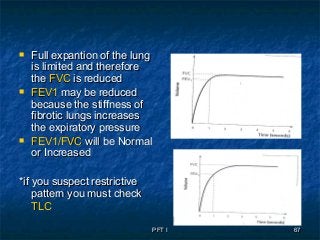
 Full expantion of the lungFull expantion of the lung
is limited and thereforeis limited and therefore
thethe FVCFVC is reducedis reduced
 FEV1FEV1 may be reducedmay be reduced
because the stiffness ofbecause the stiffness of
fibrotic lungs increasesfibrotic lungs increases
the expiratory pressurethe expiratory pressure
 FEV1/FVCFEV1/FVC will be Normalwill be Normal
or Increasedor Increased
*if you suspect restrictive*if you suspect restrictive
pattern you must checkpattern you must check
TLCTLC
PFT IPFT I 6868
Flow volume loop inFlow volume loop in
Restrictive lung diseaseRestrictive lung disease
PFT IPFT I 6969
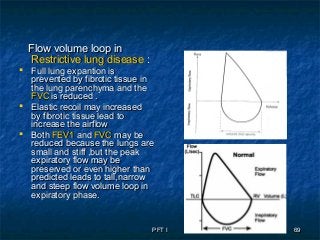
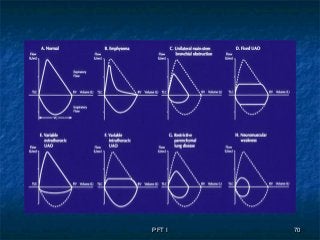
Flow volume loop inFlow volume loop in
Restrictive lung diseaseRestrictive lung disease ::
 Full lung expantion isFull lung expantion is
prevented by fibrotic tissue inprevented by fibrotic tissue in
the lung parenchyma and thethe lung parenchyma and the
FVCFVC is reduced .is reduced .
 Elastic recoil may increasedElastic recoil may increased
by fibrotic tissue lead toby fibrotic tissue lead to
increase the airflowincrease the airflow
 BothBoth FEV1FEV1 andand FVCFVC may bemay be
reduced because the lungs arereduced because the lungs are
small and stiff ,but the peaksmall and stiff ,but the peak
expiratory flow may beexpiratory flow may be
preserved or even higher thanpreserved or even higher than
predicted leads to tall,narrowpredicted leads to tall,narrow
and steep flow volume loop inand steep flow volume loop in
expiratory phase.expiratory phase.
PFT IPFT I 7070
PFT IPFT I 7171
PFT IPFT I 7272
ExampleExample
PFT IPFT I 7373
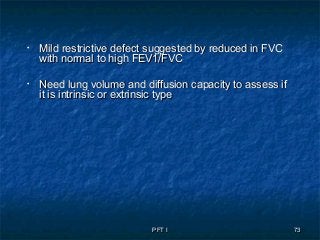
• Mild restrictive defect suggested by reduced in FVCMild restrictive defect suggested by reduced in FVC
with normal to high FEV1/FVCwith normal to high FEV1/FVC
• Need lung volume and diffusion capacity to assess ifNeed lung volume and diffusion capacity to assess if
it is intrinsic or extrinsic typeit is intrinsic or extrinsic type
PFT IPFT I 7474
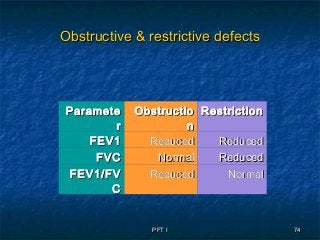
Obstructive & restrictive defectsObstructive & restrictive defects
ParameteParamete
rr
ObstructioObstructio
nn
RestrictionRestriction
FEV1FEV1 ReducedReduced ReducedReduced
FVCFVC NormalNormal ReducedReduced
FEV1/FVFEV1/FV
CC
ReducedReduced NormalNormal
PFT IPFT I 7575
Acceptability andAcceptability and
Reproducibility CriteriaReproducibility Criteria
PFT IPFT I 7676
Acceptability CriteriaAcceptability Criteria
free from artifacts:free from artifacts:
 Cough or glottis closure during the first second ofCough or glottis closure during the first second of
exhalationexhalation
 Eary termination or cutoffEary termination or cutoff
 Variable effortVariable effort
 LeakLeak
 Obstructed mouthpieceObstructed mouthpiece
 Have good startsHave good starts
 Have a satisfactory exhalationHave a satisfactory exhalation 6 s of exhalation6 s of exhalation
PFT IPFT I 7777
Reproducibility CriteriaReproducibility Criteria
After 3 acceptable spirograms been obtainedAfter 3 acceptable spirograms been obtained
 Are the two largest FVC within 0.2 L of each other?Are the two largest FVC within 0.2 L of each other?
 Are the two largest FEV1 within 0.2 L of each other?Are the two largest FEV1 within 0.2 L of each other?
If both of these criteria are met, the test session mayIf both of these criteria are met, the test session may
be concluded.be concluded.
If both of these criteria are not met, continue testingIf both of these criteria are not met, continue testing
until Both of the criteria are met with analysis ofuntil Both of the criteria are met with analysis of
additional acceptable spirograms; OR a total of eightadditional acceptable spirograms; OR a total of eight
tests have been performedtests have been performed
PFT IPFT I 7878
Acceptability of the testAcceptability of the test
PFT IPFT I 7979
Early Glottic Closure
Normal
Poor EffortCough
PFT IPFT I 8080
ExampleExample
PFT IPFT I 8181
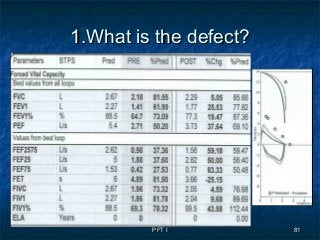
1.What is the defect?1.What is the defect?
PFT IPFT I 8282
Mild obstructive defect with good response toMild obstructive defect with good response to
bronchodilatorbronchodilator
DiagnosisDiagnosis
B.AsthmaB.Asthma

Pulmonary function test

  • 1.
    PFT IPFT I11 Pulmonary function testPulmonary function test Part IPart I HOSAM M ATEFHOSAM M ATEF
  • 2.
    PFT IPFT I22 Pulmonary function test :Pulmonary function test : Group of procedures that measure the function of theGroup of procedures that measure the function of the lungslungs 1.1. SpirometrySpirometry 2.2. Lung volumesLung volumes 3.3. Gas transferGas transfer 4.4. Bronchial chalengeBronchial chalenge
  • 3.
    PFT IPFT I33 IndicationsIndications
  • 4.
    PFT IPFT I44 A.DiagnosticA.Diagnostic
  • 5.
    PFT IPFT I55 Symptoms:Symptoms: dyspnea, wheezing, orthopnea, cough, sputumdyspnea, wheezing, orthopnea, cough, sputum productionproduction Signs:Signs: decreased breath sounds, overinflation,decreased breath sounds, overinflation, expiratory slowing, cyanosis, chest deformitory,expiratory slowing, cyanosis, chest deformitory, unexplained cracklesunexplained crackles Abnormal laboratory tests:Abnormal laboratory tests: hypoxemia, hypercapnia, polycythemia,hypoxemia, hypercapnia, polycythemia, abnormal chest radiographsabnormal chest radiographs  To measure the effect of disease on pulmonaryTo measure the effect of disease on pulmonary functionfunction
  • 6.
    PFT IPFT I66  To screen individuals at risk of having pulmonaryTo screen individuals at risk of having pulmonary diseasesdiseases 1.1. SmokersSmokers 2.2. occupations with exposures to injuriousoccupations with exposures to injurious substancessubstances  To assess preoperative riskTo assess preoperative risk  To assess prognosis (lung transplant, etc.)To assess prognosis (lung transplant, etc.)
  • 7.
    PFT IPFT I77 B. MonitoringB. Monitoring
  • 8.
    PFT IPFT I88 To assess therapeutic interventionsTo assess therapeutic interventions  Bronchodilator therapyBronchodilator therapy  Steroid treatment for asthma, interstitialSteroid treatment for asthma, interstitial lung disease, etc.lung disease, etc.  Other (antibiotics in cystic fibrosis, etc.)Other (antibiotics in cystic fibrosis, etc.)  To monitor for adverse reactions to drugs withTo monitor for adverse reactions to drugs with known pulmonary toxicityknown pulmonary toxicity
  • 9.
    PFT IPFT I99 C. Disability/Impairment EvaluationsC. Disability/Impairment Evaluations
  • 10.
    PFT IPFT I1010 To assess patients as part of a rehabilitationTo assess patients as part of a rehabilitation programprogram  MedicalMedical
  • 11.
    PFT IPFT I1111 ContraindicationsContraindications
  • 12.
    PFT IPFT I1212  Hemoptysis of unknown originHemoptysis of unknown origin  PneumothoraxPneumothorax  Unstable angina pectorisUnstable angina pectoris  Recent myocardial infarctionRecent myocardial infarction  Thoracic aneurysmsThoracic aneurysms  Abdominal aneurysmsAbdominal aneurysms  Cerebral aneurysmsCerebral aneurysms  Recent eye surgery (increased intraocular pressureRecent eye surgery (increased intraocular pressure during forced expiration)during forced expiration)  Recent abdominal or thoracic surgical proceduresRecent abdominal or thoracic surgical procedures  History of syncope associated with forced exhalationHistory of syncope associated with forced exhalation
  • 13.
    PFT IPFT I1313 Pulmonary function test:Pulmonary function test: 1.1. SpirometrySpirometry 2.2. Lung volumesLung volumes 3.3. Gas transferGas transfer 4.4. Bronchial chalengeBronchial chalenge
  • 14.
    PFT IPFT I1414 What is a spirometry ??What is a spirometry ?? Spirometry is a measure of airflow andSpirometry is a measure of airflow and lung volumes during a forced expiratorylung volumes during a forced expiratory maneuver from full inspirationmaneuver from full inspiration
  • 15.
    PFT IPFT I1515 How to do it ??How to do it ??
  • 16.
    PFT IPFT I1616 1.1. Stand or sit up straight (The patient places aStand or sit up straight (The patient places a clip over the nose )clip over the nose ) 2.2. Inhale maximallyInhale maximally 3.3. Get a good seal around mouthpiece of theGet a good seal around mouthpiece of the spirometerspirometer 4.4. Blow out as hard as fast as possible andBlow out as hard as fast as possible and count for at least 6 seconds.count for at least 6 seconds. 5.5. Record the best of three trialRecord the best of three trial *pt should hold bronchodilator few hrs before the test*pt should hold bronchodilator few hrs before the test
  • 17.
    PFT IPFT I1717 1. Volume Time Graph 2. Flow-volume1. Volume Time Graph 2. Flow-volume loopsloops
  • 18.
    PFT IPFT I1818 Volume Time GraphVolume Time Graph The volume is plotted against the time, it displaysThe volume is plotted against the time, it displays the expirationthe expiration..
  • 19.
    PFT IPFT I1919 1.1. FVCFVC 2.2. FEV1FEV1 3.3. FEV1/FVCFEV1/FVC 4.4. FEF25%FEF25% 5.5. FEF75%FEF75%
  • 20.
    PFT IPFT I2020 Forced Vital Capacity (FVC)Forced Vital Capacity (FVC) The total amount of air expired asThe total amount of air expired as quickly as possible after taking thequickly as possible after taking the deepest possible breath.deepest possible breath.
  • 21.
    PFT IPFT I2121 FEV1FEV1 :: Volume of air which can be forciblyVolume of air which can be forcibly exhaled from the lungs in the firstexhaled from the lungs in the first second of a forced expiratorysecond of a forced expiratory maneuver.maneuver.
  • 22.
    PFT IPFT I2222 FEV1/FVCFEV1/FVC Ratio ofRatio of FEV1FEV1 toto FVCFVC :: It indicates what percentage of the totalIt indicates what percentage of the total FVCFVC was expelled from the lungs during the firstwas expelled from the lungs during the first second of forced exhalationsecond of forced exhalation This value is critically important in theThis value is critically important in the diagnosis of obstructive and restrictivediagnosis of obstructive and restrictive diseasesdiseases
  • 23.
    PFT IPFT I2323 FEF25% Amount of air that was forcibly expelled in the firstAmount of air that was forcibly expelled in the first 25% of the total forced vital capacity test.25% of the total forced vital capacity test. FEF75%FEF75% The amount of air expelled from the lungs during theThe amount of air expelled from the lungs during the first (75%) of the forced vital capacity test.first (75%) of the forced vital capacity test. FEF25%-75%FEF25%-75% The amount of air expelled from the lungs during theThe amount of air expelled from the lungs during the middle half of the forced vital capacity test.middle half of the forced vital capacity test.
  • 24.
    PFT IPFT I2424 Flow-volume loopsFlow-volume loops
  • 25.
    PFT IPFT I2525 Flow-volume loopsFlow-volume loops  Is a plot of inspiratoryIs a plot of inspiratory and expiratory flow in theand expiratory flow in the vertical axis againstvertical axis against volume in the horizentalvolume in the horizental axis, during theaxis, during the performance ofperformance of maximally forcedmaximally forced inspiratory andinspiratory and expiratory maneuvers.expiratory maneuvers.
  • 26.
    PFT IPFT I2626  The contour of the loop assists in theThe contour of the loop assists in the diagnosis and localization of airwaydiagnosis and localization of airway obstruction as different lung disordersobstruction as different lung disorders produce distinct ,easily recognizedproduce distinct ,easily recognized pattern.pattern.
  • 27.
  • 28.
    PFT IPFT I2828 Useful also in assesing acceptability of the manoeuvers:Useful also in assesing acceptability of the manoeuvers: 1.1. Lack of early peak suggest poor effort.Lack of early peak suggest poor effort. 2.2. Sudden tailing off of expiration curve suggest that theSudden tailing off of expiration curve suggest that the patient stopped blowing too earlypatient stopped blowing too early 3.3. CoughCough
  • 29.
    PFT IPFT I2929 Obstructive V/S restrictive lungObstructive V/S restrictive lung disease ???disease ???
  • 30.
    PFT IPFT I3030 Obstructive Lung DiseasesObstructive Lung Diseases
  • 31.
    PFT IPFT I3131 Common Obstructive LungCommon Obstructive Lung DiseasesDiseases  AsthmaAsthma  COPDCOPD (chronic bronchitis, emphysema and(chronic bronchitis, emphysema and the overlap between them).the overlap between them).  Cystic fibrosis.Cystic fibrosis.
  • 32.
    PFT IPFT I3232 --Airflow is reduced because the airways narrow and theAirflow is reduced because the airways narrow and the FEV1FEV1 isis reducedreduced -Spirogram may continue to rise for more than 6 seconds because lung-Spirogram may continue to rise for more than 6 seconds because lung take longer to emptytake longer to empty --FVCFVC may also be reduced because gas is trapped behind obstructedmay also be reduced because gas is trapped behind obstructed bronchi due to increase in intrathoracic pressure during maneuverbronchi due to increase in intrathoracic pressure during maneuver compresses airways causing early airway closure and gas trapping butcompresses airways causing early airway closure and gas trapping but this reduction to a lesser extent thanthis reduction to a lesser extent than FEV1FEV1
  • 33.
    PFT IPFT I3333 FEV1FEV1 ≥ 80%≥ 80% of predictedof predicted NormalNormal FEV1FEV1 60-80%60-80% of predictedof predicted mild obst.mild obst. FEV1FEV1 40-60%40-60% of predictedof predicted moderatemoderate FEV1 ≤FEV1 ≤ 40%40% of predictedof predicted severesevere The cardinal feature isThe cardinal feature is FEV1/FVCFEV1/FVC ratio Ifratio If the ratio less thanthe ratio less than 7070 consider obstructedconsider obstructed disease .disease . *Predictors: Sex, Age, Ht*Predictors: Sex, Age, Ht
  • 34.
    PFT IPFT I3434 Predictors: Sex, Age, Ht ??Predictors: Sex, Age, Ht ?? The measurements are related to the following factors:The measurements are related to the following factors: AgeAge :: FVC and flow rates decline with age. The value of FVC increases up toFVC and flow rates decline with age. The value of FVC increases up to 24 years of age and remain stable to age 35.24 years of age and remain stable to age 35. HeightHeight :: All spirometric measurements increase with body weight. It is due to anAll spirometric measurements increase with body weight. It is due to an increase in number and/or size of alveoli relative to airways, the largerincrease in number and/or size of alveoli relative to airways, the larger lungs are likely to take longer than smaller one.lungs are likely to take longer than smaller one. SexSex :: Most pulmonary function values are lower in female than maleMost pulmonary function values are lower in female than male.. WeightWeight :: A spirometric results are positively correlated with weight to the extentA spirometric results are positively correlated with weight to the extent that increased weight means growth or muscle mass. Beyond this (inthat increased weight means growth or muscle mass. Beyond this (in obesity) spirometric values (and lung values specially ERV) decreaseobesity) spirometric values (and lung values specially ERV) decrease with greater weight.with greater weight.
  • 35.
    PFT IPFT I3535 Flow volume loop inFlow volume loop in Obstructive lung diseaseObstructive lung disease
  • 36.
    PFT IPFT I3636 AsthmaAsthma  Peak expiratory flow reducedPeak expiratory flow reduced so maximum height of the loopso maximum height of the loop is reducedis reduced  Airflow reduces rapidly with theAirflow reduces rapidly with the reduction in the lung volumesreduction in the lung volumes because the airways narrowbecause the airways narrow and the loop become concaveand the loop become concave  Concavity may be the indicatorConcavity may be the indicator of airflow obstruction and mayof airflow obstruction and may present before the change inpresent before the change in FEV1 or FEV1/FVCFEV1 or FEV1/FVC
  • 37.
    PFT IPFT I3737 EmphysemaEmphysema Airways may collapse duringAirways may collapse during forced expiration because offorced expiration because of destruction of the supportingdestruction of the supporting lung tissue causing verylung tissue causing very reduced flow at low lungreduced flow at low lung volume and a characteristicvolume and a characteristic (dog-leg)(dog-leg) appearance to theappearance to the flow volume curveflow volume curve
  • 38.
    PFT IPFT I3838 ReversibilityReversibility  Improvement inImprovement in FEV1 by 12-15%FEV1 by 12-15% or 200 mlor 200 ml in repeatingin repeating spirometry after treatment withspirometry after treatment with Sulbutamol 2.5mg or ipratrobiumSulbutamol 2.5mg or ipratrobium promide by nebuliser afterpromide by nebuliser after 15-3015-30 minutesminutes  Reversibility is a characteresticReversibility is a characterestic feature of B.Asthmafeature of B.Asthma  In chronic asthma there may beIn chronic asthma there may be only partial reversibility of theonly partial reversibility of the airflow obstructionairflow obstruction  While in COPD the airflow isWhile in COPD the airflow is irriversible although some casesirriversible although some cases showed significant improvement.showed significant improvement.
  • 39.
    PFT IPFT I3939 Interpretation of PFTsInterpretation of PFTs Step 1.Step 1. Look at the Flow-Volume loop to determineLook at the Flow-Volume loop to determine acceptability of the test, and look for upper airwayacceptability of the test, and look for upper airway obstruction pattern.obstruction pattern. Step 2.Step 2. Look at theLook at the FEV1FEV1 to determine if it is normalto determine if it is normal (≥(≥ 80%80% predicted).predicted). Step 3.Step 3. Look atLook at FVCFVC to determine if it is within normalto determine if it is within normal limitslimits (≥ 80%).(≥ 80%). Step 4.Step 4. Look atLook at thethe FEV1/FVCFEV1/FVC ratioratio to determine if itto determine if it is within normal limitsis within normal limits (≥ 70%).(≥ 70%).
  • 40.
    PFT IPFT I4040 Step 5.Step 5. Look atLook at FEF25-75%FEF25-75% (Normal(Normal (≥ 60%)(≥ 60%)  IfIf FEV1FEV1,, FEV1/FVCFEV1/FVC ratio, andratio, and FEF25-75%FEF25-75% all areall are normal, the patient has anormal, the patient has a normalnormal PFT.PFT.  If bothIf both FEV1FEV1 andand FEV1/FVCFEV1/FVC are normal, butare normal, but FEF25-FEF25- 75% is ≤ 60%75% is ≤ 60% ,then think about early obstruction or,then think about early obstruction or small airways obstruction.small airways obstruction.
  • 41.
    PFT IPFT I4141  IfIf FEV1FEV1 ≤ 80% and≤ 80% and FEV1/FVCFEV1/FVC ≤ 70%, there is≤ 70%, there is obstructive defect, ifobstructive defect, if FVCFVC is normal, it is pureis normal, it is pure obstruction. Ifobstruction. If FVCFVC ≤ 80% , possibility of additional≤ 80% , possibility of additional restriction is there.restriction is there.  IfIf FEV1FEV1 ≤ 80% ,≤ 80% , FVCFVC ≤ 80% and≤ 80% and FEV1/FVCFEV1/FVC ≥ 70%≥ 70% ,, there is restrictive defect, get lung volumes to confirm.there is restrictive defect, get lung volumes to confirm.
  • 42.
    PFT IPFT I4242 ExamplesExamples
  • 43.
    PFT IPFT I4343 • Mild Obstructive Defect with good response toMild Obstructive Defect with good response to bronchodilatorbronchodilator Diagnosis:Diagnosis: B.AsthmaB.Asthma
  • 44.
    PFT IPFT I4444 A 66 year old female complains ofA 66 year old female complains of cough after dust exposurecough after dust exposure MeasMeas RefRef %%PredPred FVCFVC 2.22.2 2.582.58 8585 FEV1FEV1 1.791.79 1.851.85 9797 FEV1/FVCFEV1/FVC 8181 7272 FEF 25-75FEF 25-75 1.821.82 2.232.23 8282 PEFPEF 5.675.67 5.25.2 109109
  • 45.
    PFT IPFT I4545 Normal SpirometryNormal Spirometry
  • 46.
  • 47.
    PFT IPFT I4747 • Flow volume loop suggestive of obstructive diseaseFlow volume loop suggestive of obstructive disease • Spirometry showed Severe Obstructive defect with noSpirometry showed Severe Obstructive defect with no response to bronchodilatorresponse to bronchodilator • Increased FVC could be because of Airtrapping orIncreased FVC could be because of Airtrapping or could be combined obstructive and restrictive defect tocould be combined obstructive and restrictive defect to confirm need to do Lung Volumeconfirm need to do Lung Volume diagnosis :diagnosis : COPDCOPD
  • 48.
    PFT IPFT I4848 Mild Obstructive defectMild Obstructive defect
  • 49.
    PFT IPFT I4949 Large Airway ObstructionLarge Airway Obstruction
  • 50.
    PFT IPFT I5050 A 75 year old female has a history ofA 75 year old female has a history of dyspnea and palpitationsdyspnea and palpitations MeasMeas RefRef %%PredPred FVCFVC 2.622.62 2.822.82 9393 FEV1FEV1 1.451.45 1.981.98 7272 FEV1/FVCFEV1/FVC 5555 6969 FEF25-75FEF25-75 0.430.43 2.202.20 2020 PEFPEF 4.504.50 5.485.48 8282
  • 51.
    PFT IPFT I5151 1.1. Fixed obstructionFixed obstruction 2.2. Variable extrathoracicVariable extrathoracic obstructionobstruction 3.3. Variable intrathoracic obstructionVariable intrathoracic obstruction
  • 52.
    PFT IPFT I5252 Flow Volume Loop inFlow Volume Loop in Large Airway ObstructionLarge Airway Obstruction
  • 53.
    PFT IPFT I5353 Fixed obstructionFixed obstruction 1. Post intubation stenosis1. Post intubation stenosis 2. Goiter2. Goiter 3. Endotracheal neoplasms3. Endotracheal neoplasms 4. Bronchial stenosis4. Bronchial stenosis Maximum airflow is limitedMaximum airflow is limited to a similar extent in bothto a similar extent in both inspinspiration andiration and expexpirationiration
  • 54.
    PFT IPFT I5454 VariableVariable extrextrathoracicathoracic ObstructionObstruction 1. Bilateral and unilateral vocal cord1. Bilateral and unilateral vocal cord paralysisparalysis 2. Vocal cord constriction2. Vocal cord constriction 3. Reduced pharyngeal cross-3. Reduced pharyngeal cross- sectional areasectional area 4. Airway burns4. Airway burns The obstruction worsens inThe obstruction worsens in inspinspiration because theiration because the negative pressure narrowsnegative pressure narrows the trachea and inspiratorythe trachea and inspiratory flow is reduced to a greaterflow is reduced to a greater extent than expiratory flowextent than expiratory flow
  • 55.
    PFT IPFT I5555 In variableIn variable intrintrathoracicathoracic obstructionobstruction 1.1. TracheomalaciaTracheomalacia 2. Polychondritis2. Polychondritis 3. Tumors of the lower trachea or3. Tumors of the lower trachea or main bronchus.main bronchus. The narrowing is maximal inThe narrowing is maximal in expexpiration because ofiration because of increased intrathoracicincreased intrathoracic pressure compressing thepressure compressing the airway.airway. The flow volume loop shows aThe flow volume loop shows a greater reduction in thegreater reduction in the expiratoryexpiratory phasephase
  • 56.
    PFT IPFT I5656 Small Airways obstructionSmall Airways obstruction  Diseases affecting primarily the small (peripheral)Diseases affecting primarily the small (peripheral) airways can be extensive yet not affect the FEV1(e.g.airways can be extensive yet not affect the FEV1(e.g. early COPD, interstitial granulomatous disorders).early COPD, interstitial granulomatous disorders).  Small airways status is reflected by the FEF25-75%Small airways status is reflected by the FEF25-75% (mid-range flow), best determined from the flow-(mid-range flow), best determined from the flow- volume loop.volume loop.  Some patients have normal spirometry with theSome patients have normal spirometry with the exception of a reduced FEF25-75%, this isexception of a reduced FEF25-75%, this is suggestive of possible small airways dysfunction andsuggestive of possible small airways dysfunction and potentially early obstruction.potentially early obstruction.
  • 57.
    PFT IPFT I5757 ExampleExample
  • 58.
    PFT IPFT I5858 A 38 year old female complains ofA 38 year old female complains of wheezing on exertionwheezing on exertion MeasMeas RefRef %%PrePre dd FVCFVC 3.663.66 3.543.54 103103 FEV1FEV1 2.302.30 2.772.77 8383 FEV1/FVCFEV1/FVC 6363 7878 FEF25-75FEF25-75 2.152.15 4.204.20 5151 PEFPEF 2.392.39 6.256.25 3838
  • 59.
    PFT IPFT I5959  Flow volume loop suggests a fixed upperFlow volume loop suggests a fixed upper airway obstructionairway obstruction
  • 60.
    PFT IPFT I6060 Effect of Smoking:Effect of Smoking:  Smoking in patients with COPD is associatedSmoking in patients with COPD is associated with decline inwith decline in FEV1 of 90-150 mL/yearFEV1 of 90-150 mL/year  Smoking cessation is (associated withSmoking cessation is (associated with increase inincrease in FEV1FEV1 for first year) followed with afor first year) followed with a decline of only 30 mL/yeardecline of only 30 mL/year
  • 61.
  • 62.
  • 63.
    PFT IPFT I6363 Restrictive Lung DiseasesRestrictive Lung Diseases
  • 64.
    PFT IPFT I6464 A. Intrinsic Restrictive Lung DisordersA. Intrinsic Restrictive Lung Disorders 1.1. SarcoidosisSarcoidosis 2.2. Idiopathic pulmonary fibrosisIdiopathic pulmonary fibrosis 3.3. Interstitial pneumonitisInterstitial pneumonitis 4.4. TuberculosisTuberculosis 5.5. Pnuemonectomy (loss of lung)Pnuemonectomy (loss of lung) 6.6. PneumoniaPneumonia
  • 65.
    PFT IPFT I6565 B.B. Extrinsic Restrictive Lung DisordersExtrinsic Restrictive Lung Disorders 1.1. Scoliosis, KyphosisScoliosis, Kyphosis 2.2. Ankylosing SpondylitisAnkylosing Spondylitis 3.3. Pleural EffusionPleural Effusion 4.4. PregnancyPregnancy 5.5. Gross ObesityGross Obesity 6.6. TumorsTumors 7.7. AscitesAscites 8.8. Pain on inspiration - pleurisy, rib fracturesPain on inspiration - pleurisy, rib fractures
  • 66.
    PFT IPFT I6666 C.C. Neuromuscular Restrictive LungNeuromuscular Restrictive Lung DisordersDisorders 1.1. Generalized WeaknessGeneralized Weakness –– malnutritionmalnutrition 2.2. Paralysis of the diaphragmParalysis of the diaphragm 3.3. Myasthenia GravisMyasthenia Gravis 4.4. Muscular DystrophyMuscular Dystrophy 5.5. PoliomyelitisPoliomyelitis 6.6. Amyotrophic Lateral SclerosisAmyotrophic Lateral Sclerosis
  • 67.
    PFT IPFT I6767  Full expantion of the lungFull expantion of the lung is limited and thereforeis limited and therefore thethe FVCFVC is reducedis reduced  FEV1FEV1 may be reducedmay be reduced because the stiffness ofbecause the stiffness of fibrotic lungs increasesfibrotic lungs increases the expiratory pressurethe expiratory pressure  FEV1/FVCFEV1/FVC will be Normalwill be Normal or Increasedor Increased *if you suspect restrictive*if you suspect restrictive pattern you must checkpattern you must check TLCTLC
  • 68.
    PFT IPFT I6868 Flow volume loop inFlow volume loop in Restrictive lung diseaseRestrictive lung disease
  • 69.
    PFT IPFT I6969 Flow volume loop inFlow volume loop in Restrictive lung diseaseRestrictive lung disease ::  Full lung expantion isFull lung expantion is prevented by fibrotic tissue inprevented by fibrotic tissue in the lung parenchyma and thethe lung parenchyma and the FVCFVC is reduced .is reduced .  Elastic recoil may increasedElastic recoil may increased by fibrotic tissue lead toby fibrotic tissue lead to increase the airflowincrease the airflow  BothBoth FEV1FEV1 andand FVCFVC may bemay be reduced because the lungs arereduced because the lungs are small and stiff ,but the peaksmall and stiff ,but the peak expiratory flow may beexpiratory flow may be preserved or even higher thanpreserved or even higher than predicted leads to tall,narrowpredicted leads to tall,narrow and steep flow volume loop inand steep flow volume loop in expiratory phase.expiratory phase.
  • 70.
  • 71.
  • 72.
    PFT IPFT I7272 ExampleExample
  • 73.
    PFT IPFT I7373 • Mild restrictive defect suggested by reduced in FVCMild restrictive defect suggested by reduced in FVC with normal to high FEV1/FVCwith normal to high FEV1/FVC • Need lung volume and diffusion capacity to assess ifNeed lung volume and diffusion capacity to assess if it is intrinsic or extrinsic typeit is intrinsic or extrinsic type
  • 74.
    PFT IPFT I7474 Obstructive & restrictive defectsObstructive & restrictive defects ParameteParamete rr ObstructioObstructio nn RestrictionRestriction FEV1FEV1 ReducedReduced ReducedReduced FVCFVC NormalNormal ReducedReduced FEV1/FVFEV1/FV CC ReducedReduced NormalNormal
  • 75.
    PFT IPFT I7575 Acceptability andAcceptability and Reproducibility CriteriaReproducibility Criteria
  • 76.
    PFT IPFT I7676 Acceptability CriteriaAcceptability Criteria free from artifacts:free from artifacts:  Cough or glottis closure during the first second ofCough or glottis closure during the first second of exhalationexhalation  Eary termination or cutoffEary termination or cutoff  Variable effortVariable effort  LeakLeak  Obstructed mouthpieceObstructed mouthpiece  Have good startsHave good starts  Have a satisfactory exhalationHave a satisfactory exhalation 6 s of exhalation6 s of exhalation
  • 77.
    PFT IPFT I7777 Reproducibility CriteriaReproducibility Criteria After 3 acceptable spirograms been obtainedAfter 3 acceptable spirograms been obtained  Are the two largest FVC within 0.2 L of each other?Are the two largest FVC within 0.2 L of each other?  Are the two largest FEV1 within 0.2 L of each other?Are the two largest FEV1 within 0.2 L of each other? If both of these criteria are met, the test session mayIf both of these criteria are met, the test session may be concluded.be concluded. If both of these criteria are not met, continue testingIf both of these criteria are not met, continue testing until Both of the criteria are met with analysis ofuntil Both of the criteria are met with analysis of additional acceptable spirograms; OR a total of eightadditional acceptable spirograms; OR a total of eight tests have been performedtests have been performed
  • 78.
    PFT IPFT I7878 Acceptability of the testAcceptability of the test
  • 79.
    PFT IPFT I7979 Early Glottic Closure Normal Poor EffortCough
  • 80.
    PFT IPFT I8080 ExampleExample
  • 81.
    PFT IPFT I8181 1.What is the defect?1.What is the defect?
  • 82.
    PFT IPFT I8282 Mild obstructive defect with good response toMild obstructive defect with good response to bronchodilatorbronchodilator DiagnosisDiagnosis B.AsthmaB.Asthma

Editor's Notes