Pulmonary Actinomycosis
D R . M D . S H A F I Q U L I S L A M D E WA N
R E S I D E N T ( P U L M O N O L O G Y )
D E PA RT M E N T O F R E S P I R ATO RY M E D I C I N E
D H A K A M E D I C A L C O L L E G E H O S P I TA L
Actinomyces
Actinomyces are gram-positive, non–spore-forming, anaerobic, branching
filamentous bacilli.
A. israelii is the commonest cause of actinomycosis.
Actinomyces are commensals in the oropharynx, gastrointestinal, and genital
tracts.
Actinomycosis most commonly affects the face and neck. The infection can
sometimes occur in the chest (pulmonary actinomycosis), abdomen, pelvis, or
other areas of the body.
DR. MD. SHAFIQUL ISLAM DEWAN, RESIDENT (PULMONOLOGY), DMCH 2
Pulmonary Actinomycosis
Pulmonary actinomycosis is a rare bacterial lung infection caused by A. israelii.
It’s also known as thoracic actinomycosis. It’s not contagious.
Mode of transmission: Aspiration of oropharyngeal material.
Risk factors include_
 Poor dental hygiene
 Smoking
 Alcohol abuse
 Chronic lung disease
DR. MD. SHAFIQUL ISLAM DEWAN, RESIDENT (PULMONOLOGY), DMCH 3
Clinical features
•History of chronic productive cough and chest pain.
•Haemoptysis has been reported in 30% of patients.
•Weight loss and malaise are common.
•Fever and night sweats are observed in only 20–30%.
•Chest wall lesions and draining sinuses are now uncommon.
•Presentation with a radiologic abnormality with some of the above features is
now more usual.
•Physical signs are nonspecific.
DR. MD. SHAFIQUL ISLAM DEWAN, RESIDENT (PULMONOLOGY), DMCH 4
Differential Diagnosis
•Lung abscess
•Malignancy
•Tuberculosis
•Other causes of chronic pneumonia.
DR. MD. SHAFIQUL ISLAM DEWAN, RESIDENT (PULMONOLOGY), DMCH 5
Investigation
Imaging: Chest x-ray, CT chest
Culture (Pus or tissue)
Biopsy & Histopathology (Transbronchial biopsies are usually not helpful, and
CT-guided needle biopsies are more often diagnostic)
PCR (Tissue)
Definitive diagnosis depends on demonstrating the characteristic
histopathology and culture from a sterile site or tissue biopsy.
Cultures are frequently negative or contain other organisms.
DR. MD. SHAFIQUL ISLAM DEWAN, RESIDENT (PULMONOLOGY), DMCH 6
Imaging
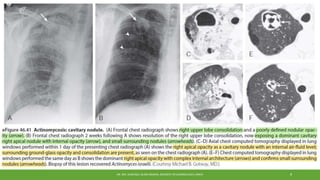
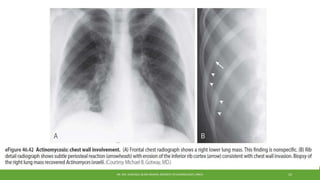
•Classic finding for actinomycosis is direct extension of a cavity or mass through
an interlobar fissure.
•Commonly, changes are confined to a single lobe with consolidation, nodules,
one or more small cavitary lesions.
•Pleural thickening or effusions are also encountered.
•Advanced cases, the findings may be more distinctive, with penetration
through the chest wall and/or destruction of adjacent bone tissue.
•CT imaging may reveal bone erosion.
DR. MD. SHAFIQUL ISLAM DEWAN, RESIDENT (PULMONOLOGY), DMCH 7
Histopathologic features
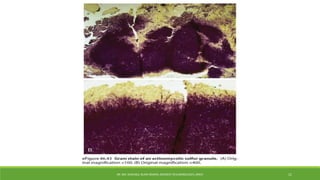
Supportive histopathologic features include identification of filamentous forms
on Gomori methenamine silver stain or modified Gram stain.
Identification of basophilic “sulfur granules” containing a mass of mycelial
elements in a protein and polysaccharide matrix, and granulomatous-like
reactions, although classic granulomata are rare.
DR. MD. SHAFIQUL ISLAM DEWAN, RESIDENT (PULMONOLOGY), DMCH 8
DR. MD. SHAFIQUL ISLAM DEWAN, RESIDENT (PULMONOLOGY), DMCH 9
DR. MD. SHAFIQUL ISLAM DEWAN, RESIDENT (PULMONOLOGY), DMCH 10
DR. MD. SHAFIQUL ISLAM DEWAN, RESIDENT (PULMONOLOGY), DMCH 11
Complications
•Empyema
•Cutaneous thoracic sinuses
•Mediastinitis
•Pericarditis
•Vertebral or rib osteomyelitis.
•Metastatic infection, including brain, skin, and bone, is now rare.
•With adequate therapy, death from actinomycosis is rare.
DR. MD. SHAFIQUL ISLAM DEWAN, RESIDENT (PULMONOLOGY), DMCH 12
Treatment
Treatment of choice: Penicillin G, IV
Doses & Duration: 18 to 24 million units/day IV in divided doses every 4 to 6
hours for 2 to 6 weeks
Followed by at least 6 to 12 months of oral penicillin V or ampicillin.
Doxycycline is the most often prescribed alternative as oral therapy.
DR. MD. SHAFIQUL ISLAM DEWAN, RESIDENT (PULMONOLOGY), DMCH 13
Shorter durations of therapy
•Shorter durations of therapy have been reported in selected patients without
abscesses or chest wall involvement.
•These patients had at least 3 months of total therapy, including 1 to 2 months
after clinical and radiologic resolution.
DR. MD. SHAFIQUL ISLAM DEWAN, RESIDENT (PULMONOLOGY), DMCH 14
Surgical treatment
•Rarely, surgical resection is required for cure.
•May be indicated to manage_
• Hemoptysis
• Fistulae
• Abscesses
• Empyema
•In cases where the diagnosis remains in doubt, to obtain surgical specimens.
DR. MD. SHAFIQUL ISLAM DEWAN, RESIDENT (PULMONOLOGY), DMCH 15
DR. MD. SHAFIQUL ISLAM DEWAN, RESIDENT (PULMONOLOGY), DMCH 16
Thank You

Pulmonary Actinomycosis.pptx

  • 1.
    Pulmonary Actinomycosis D R. M D . S H A F I Q U L I S L A M D E WA N R E S I D E N T ( P U L M O N O L O G Y ) D E PA RT M E N T O F R E S P I R ATO RY M E D I C I N E D H A K A M E D I C A L C O L L E G E H O S P I TA L
  • 2.
    Actinomyces Actinomyces are gram-positive,non–spore-forming, anaerobic, branching filamentous bacilli. A. israelii is the commonest cause of actinomycosis. Actinomyces are commensals in the oropharynx, gastrointestinal, and genital tracts. Actinomycosis most commonly affects the face and neck. The infection can sometimes occur in the chest (pulmonary actinomycosis), abdomen, pelvis, or other areas of the body. DR. MD. SHAFIQUL ISLAM DEWAN, RESIDENT (PULMONOLOGY), DMCH 2
  • 3.
    Pulmonary Actinomycosis Pulmonary actinomycosisis a rare bacterial lung infection caused by A. israelii. It’s also known as thoracic actinomycosis. It’s not contagious. Mode of transmission: Aspiration of oropharyngeal material. Risk factors include_  Poor dental hygiene  Smoking  Alcohol abuse  Chronic lung disease DR. MD. SHAFIQUL ISLAM DEWAN, RESIDENT (PULMONOLOGY), DMCH 3
  • 4.
    Clinical features •History ofchronic productive cough and chest pain. •Haemoptysis has been reported in 30% of patients. •Weight loss and malaise are common. •Fever and night sweats are observed in only 20–30%. •Chest wall lesions and draining sinuses are now uncommon. •Presentation with a radiologic abnormality with some of the above features is now more usual. •Physical signs are nonspecific. DR. MD. SHAFIQUL ISLAM DEWAN, RESIDENT (PULMONOLOGY), DMCH 4
  • 5.
    Differential Diagnosis •Lung abscess •Malignancy •Tuberculosis •Othercauses of chronic pneumonia. DR. MD. SHAFIQUL ISLAM DEWAN, RESIDENT (PULMONOLOGY), DMCH 5
  • 6.
    Investigation Imaging: Chest x-ray,CT chest Culture (Pus or tissue) Biopsy & Histopathology (Transbronchial biopsies are usually not helpful, and CT-guided needle biopsies are more often diagnostic) PCR (Tissue) Definitive diagnosis depends on demonstrating the characteristic histopathology and culture from a sterile site or tissue biopsy. Cultures are frequently negative or contain other organisms. DR. MD. SHAFIQUL ISLAM DEWAN, RESIDENT (PULMONOLOGY), DMCH 6
  • 7.
    Imaging •Classic finding foractinomycosis is direct extension of a cavity or mass through an interlobar fissure. •Commonly, changes are confined to a single lobe with consolidation, nodules, one or more small cavitary lesions. •Pleural thickening or effusions are also encountered. •Advanced cases, the findings may be more distinctive, with penetration through the chest wall and/or destruction of adjacent bone tissue. •CT imaging may reveal bone erosion. DR. MD. SHAFIQUL ISLAM DEWAN, RESIDENT (PULMONOLOGY), DMCH 7
  • 8.
    Histopathologic features Supportive histopathologicfeatures include identification of filamentous forms on Gomori methenamine silver stain or modified Gram stain. Identification of basophilic “sulfur granules” containing a mass of mycelial elements in a protein and polysaccharide matrix, and granulomatous-like reactions, although classic granulomata are rare. DR. MD. SHAFIQUL ISLAM DEWAN, RESIDENT (PULMONOLOGY), DMCH 8
  • 9.
    DR. MD. SHAFIQULISLAM DEWAN, RESIDENT (PULMONOLOGY), DMCH 9
  • 10.
    DR. MD. SHAFIQULISLAM DEWAN, RESIDENT (PULMONOLOGY), DMCH 10
  • 11.
    DR. MD. SHAFIQULISLAM DEWAN, RESIDENT (PULMONOLOGY), DMCH 11
  • 12.
    Complications •Empyema •Cutaneous thoracic sinuses •Mediastinitis •Pericarditis •Vertebralor rib osteomyelitis. •Metastatic infection, including brain, skin, and bone, is now rare. •With adequate therapy, death from actinomycosis is rare. DR. MD. SHAFIQUL ISLAM DEWAN, RESIDENT (PULMONOLOGY), DMCH 12
  • 13.
    Treatment Treatment of choice:Penicillin G, IV Doses & Duration: 18 to 24 million units/day IV in divided doses every 4 to 6 hours for 2 to 6 weeks Followed by at least 6 to 12 months of oral penicillin V or ampicillin. Doxycycline is the most often prescribed alternative as oral therapy. DR. MD. SHAFIQUL ISLAM DEWAN, RESIDENT (PULMONOLOGY), DMCH 13
  • 14.
    Shorter durations oftherapy •Shorter durations of therapy have been reported in selected patients without abscesses or chest wall involvement. •These patients had at least 3 months of total therapy, including 1 to 2 months after clinical and radiologic resolution. DR. MD. SHAFIQUL ISLAM DEWAN, RESIDENT (PULMONOLOGY), DMCH 14
  • 15.
    Surgical treatment •Rarely, surgicalresection is required for cure. •May be indicated to manage_ • Hemoptysis • Fistulae • Abscesses • Empyema •In cases where the diagnosis remains in doubt, to obtain surgical specimens. DR. MD. SHAFIQUL ISLAM DEWAN, RESIDENT (PULMONOLOGY), DMCH 15
  • 16.
    DR. MD. SHAFIQULISLAM DEWAN, RESIDENT (PULMONOLOGY), DMCH 16 Thank You