©drseshasai
Mucormycosis
DR.S.SESHA SAI
SENIOR RESIDENT
ST.JOHN’S NATIONAL ACADEMY OF HEALTH SCIENCES
©drseshasai
Overview
 Introduction
 Causes
 Clinical features
 Diagnosis
 Treatment
 Prophylaxis
 Prognosis
 Conclusion
©drseshasai
Introduction
 Mucormycosis (formerly Zygomycosis) – Ubiquitous in
soil and forms Sporangiospores.
 Important opportunistic mycosis in severely
immunocompromised with Hematological
malignancies and HSCT or SOT
 Necrotising Pneumonia is predominant feature of
pulmonary mucormycosis
©drseshasai
©drseshasai
Types
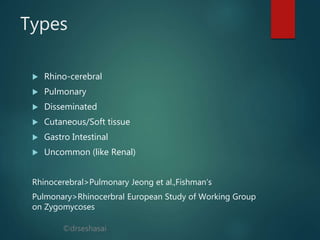
 Rhino-cerebral
 Pulmonary
 Disseminated
 Cutaneous/Soft tissue
 Gastro Intestinal
 Uncommon (like Renal)
Rhinocerebral>Pulmonary Jeong et al.,Fishman’s
Pulmonary>Rhinocerbral European Study of Working Group
on Zygomycoses
©drseshasai
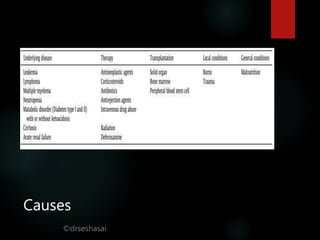
Causes
©drseshasai
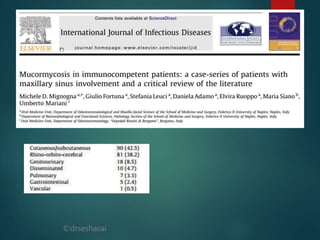
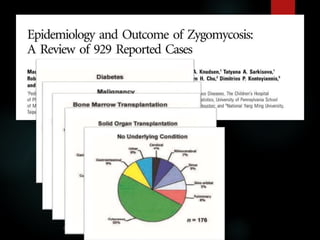
Causes
 Immunocompetent
 Cause not known
 A chronic insult of a well-defined and
localized body area might have resulted in a local
immunocompromise
 Pulmonary type is uncommon
©drseshasai
©drseshasai
©drseshasai
Causes
Patients on Anti-aspergillus drugs
 Increasing trend in pulmonary mucormycosis in
patients receiving antifungal agents with activity
against aspergillosis but not mucormycosis.
 Animal studies - increased virulence of Mucorales spp.
following voriconazole pre-exposure.
 Difficult to establish a causal relationship between
voriconazole use and development of mucormycosis
©drseshasai
Diagnosis – Clinical features
 Immunocompromised
 Indistinguishable from aspergillus
 Non productive Cough, fever, pleuritic chest pain, hemoptysis
 Favorable factors
 Severe sinusitis
 Rhino-orbital extension
 On Aspergillus-active antifungals
 Repeated absence of Asp GM/ ß-D glucan in serum
©drseshasai
Diagnosis-Radiology
 Endobronchial lesions in Diabetics
 Infiltrate, wedge-shaped consolidation, multiple
nodules (>10) , cavitation, mycetoma, lobar collapse
and, rarely pleural effusion
 Halo sign & Air Crescent sign (McAdams et al-12%)
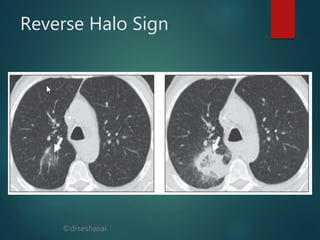
 Reverse Halo Sign
©drseshasai
Reverse Halo Sign
 Focal area of GGO surrounded by ring of consolidation
 ~20 to 90 % of pulmonary mucormycosis
 Legouge C et al- 15 of 16 pts leukemia with neutropenia
 Lee et al- 54% with mucor and 6% with IPA
 Even though these findings are not conclusive, they may be used as
indicators to start aggressive diagnostic laboratory tests
©drseshasai
Reverse Halo Sign
©drseshasai
Diagnosis
 Immunocompetent
 Pulmonary involvement is uncommon
 If occurs, chronic symptoms up to 4 months
 Uncommon
 Asymptomatic Mycetoma
 Multiple mycotic pulmonary artery aneurysms
 Pseudoaneurysms
 Asymptomatic solitary nodules
 Normal chest radiographs
 Ulcerative tracheobronchitis in lung transplants
 Hypersensitivity pneumonitis in farm workers & Scandinavian sawmill
workers (wood trimmer’s disease)
©drseshasai
Diagnosis
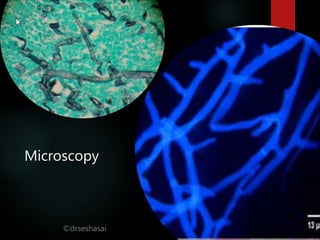
Microscopy
 Direct microscopy – optical brighteners like
Blankophor and Calcofluor White
 Hyphae are of variable width, non septate, irregular
ribbon like with wide angle bifurcations (90˚)
 Periodic acid-Schiff or Grocott Gomori’s methenamine
silver staining - highlight
fungal hyphae
©drseshasai
Microscopy
©drseshasai
Diagnosis
Culture
 Tissue swabs, sputum, or BAL cultures are usually nondiagnostic
 Direct microscopy of bronchoalveolar lavage & transbronchial
biopsy may increase the yield
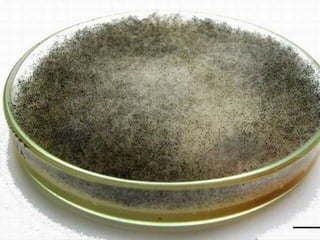
 Rapid growth (3 to 7 days) on Sabouraud agar
and potato dextrose agar incubated at 25◦C to 30◦C
 Aggressive vertical growth toward the lid of the Petri dish – Lid
lifters
 Specimens should be chopped not grounded
©drseshasai
Culture
©drseshasai
Diagnosis
Histopathology
 Hyphae will be seen
 Neutrophilic or granulomatous inflammation
 Absent in a few cases - immunosuppressed patients.
 Invasive disease is characterized by prominent infarcts
and angioinvasion.
 Perineural invasion may be present.
 Angioinvasion - extensive in neutropenic patients
©drseshasai
Diagnosis
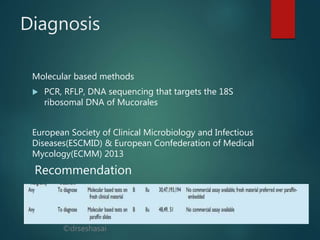
Molecular based methods
 PCR, RFLP, DNA sequencing that targets the 18S
ribosomal DNA of Mucorales
European Society of Clinical Microbiology and Infectious
Diseases(ESCMID) & European Confederation of Medical
Mycology(ECMM) 2013
Recommendation
©drseshasai
Diagnosis
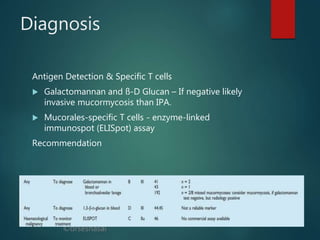
Antigen Detection & Specific T cells
 Galactomannan and ß-D Glucan – If negative likely
invasive mucormycosis than IPA.
 Mucorales-specific T cells - enzyme-linked
immunospot (ELISpot) assay
Recommendation
©drseshasai
Diagnosis
Genus & Species Identification
 No strong evidence that identification to the genus/species level
may be important to
guide treatment.
 Better epidemiological knowledge and investigation of outbreaks
 Sequencing of Internal Transcribed Spacer (ITS) of rRNA is the best
technique
©drseshasai
Genus &
Species
Identificatio
n
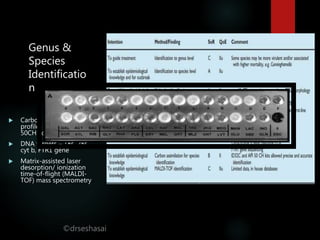
 Carbon assimilation
profiles – ID32C and API
50CH commercial kits
 DNA targets – 18s, 28s,
cyt b, FTR1 gene
 Matrix-assisted laser
desorption/ ionization
time-of-flight (MALDI-
TOF) mass spectrometry
©drseshasai
Diagnosis
Hamilos G, Samonis G, Kontoyiannis DP. Pulmonary
mucormycosis. Semin Respir Crit Care Med. 2011;32:693–702
Three-step analysis approach of CT guided biopsy specimens
of lung lesions to differentate pulmonary mucor and IPA:
1. Calcofluor-white staining - septated versus aseptae
hyphae
2. Aspergillus Galactomannan and PCR testing for rapid
identification
3. PCR testing of DNA in specimens where aseptate
hyphae were observed or Aspergillus markers were
negative
©drseshasai
Treatment
General principles
 Early diagnosis (Chamilos et al.)
 Early administration of active antifungal agents
 Reversal of underlying factors
 Complete removal of all infected tissues
 Use of various adjunctive therapies
©drseshasai
Treatment
Primary Antifungal Therapy
 Liposomal Amphotericin-B first line recommended
agent
 Fluconazole, Voriconazole – No reliable activity,
Itraconazole – Absidia species
 Posaconazole, Isuvaconazole can also be used as first
line therapy
©drseshasai
Treatment
Liposomal Amphotericin B
 2016 ECIL & ESCMID/ECMM liposomal form as first line
 Can be given as 5mg/kg/day to 10mg/kg/day, if CNS involved
 Surgery + Lip Amp B increases survival rates and cure rates
©drseshasai
 Use of Amphotericin Deoxycholate is discouraged
(ESCMID/ECMM)
 ABLC can also be used- if no CNS involvement (B)
 Alternate routes – ABLC aerolised with Respigard II
nebulizer, Direct instillation of Amphotericin B into
pulmonary cavities or pleural space
©drseshasai
Treatment
Azoles
 Posaconazole 800mg/day in 2 or 4 divided doses – first
line (ESCMID/ECMM), Salvage therapy (ECIL-6)
 Isuvaconazole (Cornely OA et al) – 200mg OD. But
VITAL study showed higher mortality rates and poor
response
©drseshasai
Treatment
Duration of Treatment
 Highly individualized
 Near normalization of radiograph, negative biopsy
specimens and cultures, recovery from
immunosuppression
©drseshasai
Treatment - Surgery
 Removal of necrotic tissue – Increases penetration of
antifungals
 Lobectomy, Pneumonectomy or wedge resection
 Surrounding infected healthy-looking tissues should
be removed
 Groll A et al. – Mortality reduced by 79%
©drseshasai
Treatment - Salvage Therapy
 If disease is refractory or intolerance towards previous
antifungal therapy.
 Posaconazole(A)
 Polyenes + Posaconazole(B)
 Lipid complex, liposomal, Colloidal dispersion (B)
 Polyenes + Caspofungin(C)
ESCMID/ECMM 2013
©drseshasai
Treatment – Adjunctive
Therapies
 Hyperbaric Oxygen – 100% O2 at 2atm pressure for 90
min twice a day (C)
 Cytokine therapy in hematological malignancy –
GCSF(A), Granulocyte transfusion +/- IFNγ (C)
 Lovastatin
 VT-1161(otesaconazole) – Inhibits fungal CYP51
 Nivolumumab and IFNγ
©drseshasai
Treatment – Adjunctive
Therapies
Iron chelators – Deferasirox
 Deferasirox-AmBisome Therapy for Mucormycosis (DEFEAT Mucor)
study
 First randomized trial for any treatment of mucormycosis
 45%(5) mortality at 30 days, 82%(9) mortality at 90 days
 Deferasirox cannot be recommended as part of an initial
combination regimen for the
treatment of mucormycosis.
©drseshasai
Iron chelators – Deferasirox
 Hematological malignancy – ECIL-6 and
ESCMID/ECMM recommended against its use.
 Other than hematological malignancy –
ESCMID/ECMM marginally supports its use(C)
©drseshasai
Prophylaxis
ESCMID/ECMM
 Neutropenic or GvHD with immunosuppressive
outbreaks – Posaconazole 600mg/day (C)
 Surgery and Past h/o mucormycosis – Strong
recommendation
©drseshasai
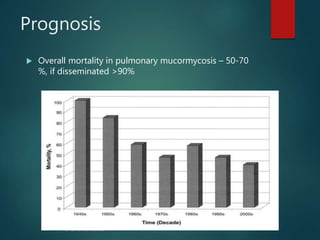
Prognosis
 Overall mortality in pulmonary mucormycosis – 50-70
%, if disseminated >90%
©drseshasai
Conclusion
 More common in immunocompromised
 Suspected in patients already on anti-aspergillus
treatment
 No specific clinical or radiological features making
diagnosis more difficult and challenging
 Diagnostic options are limited with variable results
 Invasive diagnostics have more yield which is not
possible in some patients
©drseshasai
Conclusion
 Early diagnosis means early treatment and leading to less mortality
rates
 Reversal of underlying factors, Surgery and Liposomal amphotericin
B increases cure rates
 Duration of treatment is highly individualized
 Posaconazole, Isuvaconazole can also be tried
 Salvage therapy in refractory or intolerant pts
 Adjunctive therapies need to proved in large trials and standardized
©drseshasai
References
 Fishman's Pulmonary Diseases and Disorders, 5th edition
 Pilmis B, Lanternier F. Recent advances in understanding and management of
mucormycosis 2018, F1000 research
 Challenges in the diagnosis and treatment of mucormycosis
A. Skiada. Medical Mycology, 2018
 ESCMID and ECMM joint clinical guidelines for the diagnosis and management
of mucormycosis 2013, Clin Microbiol Infect 2014
 Mucormycosis and entomophthoramycosis: a review of the clinical
manifestations, diagnosis and treatment, R. M. Prabhu and R. Patel,Mayo clinic of
medicine, Clin Microbiol Infect 2004

Mucormycosis

  • 1.
  • 2.
    ©drseshasai Overview  Introduction  Causes Clinical features  Diagnosis  Treatment  Prophylaxis  Prognosis  Conclusion
  • 3.
    ©drseshasai Introduction  Mucormycosis (formerlyZygomycosis) – Ubiquitous in soil and forms Sporangiospores.  Important opportunistic mycosis in severely immunocompromised with Hematological malignancies and HSCT or SOT  Necrotising Pneumonia is predominant feature of pulmonary mucormycosis
  • 4.
  • 5.
    ©drseshasai Types  Rhino-cerebral  Pulmonary Disseminated  Cutaneous/Soft tissue  Gastro Intestinal  Uncommon (like Renal) Rhinocerebral>Pulmonary Jeong et al.,Fishman’s Pulmonary>Rhinocerbral European Study of Working Group on Zygomycoses
  • 6.
  • 7.
    ©drseshasai Causes  Immunocompetent  Causenot known  A chronic insult of a well-defined and localized body area might have resulted in a local immunocompromise  Pulmonary type is uncommon
  • 8.
  • 9.
  • 10.
    ©drseshasai Causes Patients on Anti-aspergillusdrugs  Increasing trend in pulmonary mucormycosis in patients receiving antifungal agents with activity against aspergillosis but not mucormycosis.  Animal studies - increased virulence of Mucorales spp. following voriconazole pre-exposure.  Difficult to establish a causal relationship between voriconazole use and development of mucormycosis
  • 11.
    ©drseshasai Diagnosis – Clinicalfeatures  Immunocompromised  Indistinguishable from aspergillus  Non productive Cough, fever, pleuritic chest pain, hemoptysis  Favorable factors  Severe sinusitis  Rhino-orbital extension  On Aspergillus-active antifungals  Repeated absence of Asp GM/ ß-D glucan in serum
  • 12.
    ©drseshasai Diagnosis-Radiology  Endobronchial lesionsin Diabetics  Infiltrate, wedge-shaped consolidation, multiple nodules (>10) , cavitation, mycetoma, lobar collapse and, rarely pleural effusion  Halo sign & Air Crescent sign (McAdams et al-12%)  Reverse Halo Sign
  • 13.
    ©drseshasai Reverse Halo Sign Focal area of GGO surrounded by ring of consolidation  ~20 to 90 % of pulmonary mucormycosis  Legouge C et al- 15 of 16 pts leukemia with neutropenia  Lee et al- 54% with mucor and 6% with IPA  Even though these findings are not conclusive, they may be used as indicators to start aggressive diagnostic laboratory tests
  • 14.
  • 15.
    ©drseshasai Diagnosis  Immunocompetent  Pulmonaryinvolvement is uncommon  If occurs, chronic symptoms up to 4 months  Uncommon  Asymptomatic Mycetoma  Multiple mycotic pulmonary artery aneurysms  Pseudoaneurysms  Asymptomatic solitary nodules  Normal chest radiographs  Ulcerative tracheobronchitis in lung transplants  Hypersensitivity pneumonitis in farm workers & Scandinavian sawmill workers (wood trimmer’s disease)
  • 16.
    ©drseshasai Diagnosis Microscopy  Direct microscopy– optical brighteners like Blankophor and Calcofluor White  Hyphae are of variable width, non septate, irregular ribbon like with wide angle bifurcations (90˚)  Periodic acid-Schiff or Grocott Gomori’s methenamine silver staining - highlight fungal hyphae
  • 17.
  • 18.
    ©drseshasai Diagnosis Culture  Tissue swabs,sputum, or BAL cultures are usually nondiagnostic  Direct microscopy of bronchoalveolar lavage & transbronchial biopsy may increase the yield  Rapid growth (3 to 7 days) on Sabouraud agar and potato dextrose agar incubated at 25◦C to 30◦C  Aggressive vertical growth toward the lid of the Petri dish – Lid lifters  Specimens should be chopped not grounded
  • 19.
  • 20.
    ©drseshasai Diagnosis Histopathology  Hyphae willbe seen  Neutrophilic or granulomatous inflammation  Absent in a few cases - immunosuppressed patients.  Invasive disease is characterized by prominent infarcts and angioinvasion.  Perineural invasion may be present.  Angioinvasion - extensive in neutropenic patients
  • 21.
    ©drseshasai Diagnosis Molecular based methods PCR, RFLP, DNA sequencing that targets the 18S ribosomal DNA of Mucorales European Society of Clinical Microbiology and Infectious Diseases(ESCMID) & European Confederation of Medical Mycology(ECMM) 2013 Recommendation
  • 22.
    ©drseshasai Diagnosis Antigen Detection &Specific T cells  Galactomannan and ß-D Glucan – If negative likely invasive mucormycosis than IPA.  Mucorales-specific T cells - enzyme-linked immunospot (ELISpot) assay Recommendation
  • 23.
    ©drseshasai Diagnosis Genus & SpeciesIdentification  No strong evidence that identification to the genus/species level may be important to guide treatment.  Better epidemiological knowledge and investigation of outbreaks  Sequencing of Internal Transcribed Spacer (ITS) of rRNA is the best technique
  • 24.
    ©drseshasai Genus & Species Identificatio n  Carbonassimilation profiles – ID32C and API 50CH commercial kits  DNA targets – 18s, 28s, cyt b, FTR1 gene  Matrix-assisted laser desorption/ ionization time-of-flight (MALDI- TOF) mass spectrometry
  • 25.
    ©drseshasai Diagnosis Hamilos G, SamonisG, Kontoyiannis DP. Pulmonary mucormycosis. Semin Respir Crit Care Med. 2011;32:693–702 Three-step analysis approach of CT guided biopsy specimens of lung lesions to differentate pulmonary mucor and IPA: 1. Calcofluor-white staining - septated versus aseptae hyphae 2. Aspergillus Galactomannan and PCR testing for rapid identification 3. PCR testing of DNA in specimens where aseptate hyphae were observed or Aspergillus markers were negative
  • 26.
    ©drseshasai Treatment General principles  Earlydiagnosis (Chamilos et al.)  Early administration of active antifungal agents  Reversal of underlying factors  Complete removal of all infected tissues  Use of various adjunctive therapies
  • 27.
    ©drseshasai Treatment Primary Antifungal Therapy Liposomal Amphotericin-B first line recommended agent  Fluconazole, Voriconazole – No reliable activity, Itraconazole – Absidia species  Posaconazole, Isuvaconazole can also be used as first line therapy
  • 28.
    ©drseshasai Treatment Liposomal Amphotericin B 2016 ECIL & ESCMID/ECMM liposomal form as first line  Can be given as 5mg/kg/day to 10mg/kg/day, if CNS involved  Surgery + Lip Amp B increases survival rates and cure rates
  • 29.
    ©drseshasai  Use ofAmphotericin Deoxycholate is discouraged (ESCMID/ECMM)  ABLC can also be used- if no CNS involvement (B)  Alternate routes – ABLC aerolised with Respigard II nebulizer, Direct instillation of Amphotericin B into pulmonary cavities or pleural space
  • 30.
    ©drseshasai Treatment Azoles  Posaconazole 800mg/dayin 2 or 4 divided doses – first line (ESCMID/ECMM), Salvage therapy (ECIL-6)  Isuvaconazole (Cornely OA et al) – 200mg OD. But VITAL study showed higher mortality rates and poor response
  • 31.
    ©drseshasai Treatment Duration of Treatment Highly individualized  Near normalization of radiograph, negative biopsy specimens and cultures, recovery from immunosuppression
  • 32.
    ©drseshasai Treatment - Surgery Removal of necrotic tissue – Increases penetration of antifungals  Lobectomy, Pneumonectomy or wedge resection  Surrounding infected healthy-looking tissues should be removed  Groll A et al. – Mortality reduced by 79%
  • 33.
    ©drseshasai Treatment - SalvageTherapy  If disease is refractory or intolerance towards previous antifungal therapy.  Posaconazole(A)  Polyenes + Posaconazole(B)  Lipid complex, liposomal, Colloidal dispersion (B)  Polyenes + Caspofungin(C) ESCMID/ECMM 2013
  • 34.
    ©drseshasai Treatment – Adjunctive Therapies Hyperbaric Oxygen – 100% O2 at 2atm pressure for 90 min twice a day (C)  Cytokine therapy in hematological malignancy – GCSF(A), Granulocyte transfusion +/- IFNγ (C)  Lovastatin  VT-1161(otesaconazole) – Inhibits fungal CYP51  Nivolumumab and IFNγ
  • 35.
    ©drseshasai Treatment – Adjunctive Therapies Ironchelators – Deferasirox  Deferasirox-AmBisome Therapy for Mucormycosis (DEFEAT Mucor) study  First randomized trial for any treatment of mucormycosis  45%(5) mortality at 30 days, 82%(9) mortality at 90 days  Deferasirox cannot be recommended as part of an initial combination regimen for the treatment of mucormycosis.
  • 36.
    ©drseshasai Iron chelators –Deferasirox  Hematological malignancy – ECIL-6 and ESCMID/ECMM recommended against its use.  Other than hematological malignancy – ESCMID/ECMM marginally supports its use(C)
  • 37.
    ©drseshasai Prophylaxis ESCMID/ECMM  Neutropenic orGvHD with immunosuppressive outbreaks – Posaconazole 600mg/day (C)  Surgery and Past h/o mucormycosis – Strong recommendation
  • 38.
    ©drseshasai Prognosis  Overall mortalityin pulmonary mucormycosis – 50-70 %, if disseminated >90%
  • 39.
    ©drseshasai Conclusion  More commonin immunocompromised  Suspected in patients already on anti-aspergillus treatment  No specific clinical or radiological features making diagnosis more difficult and challenging  Diagnostic options are limited with variable results  Invasive diagnostics have more yield which is not possible in some patients
  • 40.
    ©drseshasai Conclusion  Early diagnosismeans early treatment and leading to less mortality rates  Reversal of underlying factors, Surgery and Liposomal amphotericin B increases cure rates  Duration of treatment is highly individualized  Posaconazole, Isuvaconazole can also be tried  Salvage therapy in refractory or intolerant pts  Adjunctive therapies need to proved in large trials and standardized
  • 41.
    ©drseshasai References  Fishman's PulmonaryDiseases and Disorders, 5th edition  Pilmis B, Lanternier F. Recent advances in understanding and management of mucormycosis 2018, F1000 research  Challenges in the diagnosis and treatment of mucormycosis A. Skiada. Medical Mycology, 2018  ESCMID and ECMM joint clinical guidelines for the diagnosis and management of mucormycosis 2013, Clin Microbiol Infect 2014  Mucormycosis and entomophthoramycosis: a review of the clinical manifestations, diagnosis and treatment, R. M. Prabhu and R. Patel,Mayo clinic of medicine, Clin Microbiol Infect 2004

Editor's Notes

  • #4 Grow on carbohydrate substrate…inhalation of fungal sporangiospores that have been released in the air or from direct inoculation of organisms into disrupted skin or gastrointestinal tract mucosa and causes different forms of disease
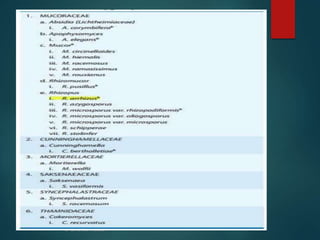
  • #5 Mucorales family is divided into 6 genus..Rhizopus oryzae is most common. Common organisms different across diff countries. Most common is Rhizopus even in india. 70-85%
  • #6 Decreasing order of frequency
  • #7 frequent blood transfusions in HM-iron overload-treat with Deferoxamine. Bcz of its siderophore property it can be used by mucor for utilization of iron for its growth DM/DKA- Rhinocerebral, HM,HSCT,SOT severe immunocomp-Pulmonary
  • #9 1978 to 2009, 212 from 35 countries. India(94)>usa>Australia climatic, socio-economic, scarce hygienic conditions, diagnostic delay – diabetics, malnourished Their 5 cases-chronic sinusitis-can be assumed that local insult Pulmonary less common in immunocompetent
  • #10 1885 to 2005-929 immunocomromised
  • #11 vori,echino active against asp but not mucor suspect mucor- fungal sinusitis if immunosupresed pts on antifungal drugs like Other studies increased mucor prior to voriconazole and recent RCT did not find higher incidence.
  • #12 Timely diag is crucial-as first line anti asp-vori not effecrive for mucor Hyphal invasion of blood vessels-necrosis of adj parenchyma Tissue necrosis is the hallmark of mucormycosis –but not specific asp, fusarium, tb
  • #14 24 mucor ct scans – 96 ipa Cop, Ipa, gpa, infarction, tb, pcp
  • #15 54 m aml allogenic stem cell transplant
  • #19 Sputum/BAL 25%, tissue specimens with abundant growth yield 50% in cultures Tblb hemaogolocal malignancies thrombocytopenic Hyphae are friable in nature and hence may be damaged during tissue manipulation
  • #20 Fullfy gray or brownish and later becomes pepper speckled appearance due to formation of sporangiospores
  • #21 No genus or species identification 60-100%
  • #22 Fresh tissue and paraffin Fresh-resp specimens & ct guided biopsy 61 of 61 culture neg 5 Formalin fixed Paraffin less yield recommended as valuable add on tools that complement conventional diagnostic procedures
  • #23 in three haematological patients developing invasive mucormycosis at diagnosis and throughout the entire course of the invasive disease but not for long after resolution of the infection
  • #24 varies from taxa to taxa, but stable in general in the same genus… set a similarity cutoff for identifying species Clsi-clinical & lab standard institute isham internat society for human & animal mycology
  • #25 Strips containing carbohydrate substrates and findings are compared to database. Drawback-new fungus cannot be detected which is not in database
  • #26 require validation in a wider range of patients before PCR becomes a standardized adjunctive diagnostic test for mucormycosis
  • #27 delay in rx for >5days in HM two fold rise in mortality 82vs48 Immunosuppressive medications, particularly corticosteroids , treatment of DKA Blood vessel thrombosis and resulting tissue necrosis –poor penetration of antifungals
  • #28 Polyenes, Azoles
  • #29 Europ confere infections in leukemia,
  • #31 steady-state plasma concentrations 1 week. Drug interactions RIF, PPI. Preferable to receive initial amb for several days Outcomes in the two groups were similar, and isavuconazole was thus deemed to be an alternative to amphotericin B, as first-line treatment of mucormycosis Limitatins-small study hence large trails are necessary to prove the same
  • #32 Indicatoors that pt is candisate for stopping antifungals
  • #33 as the speed of the extension of the infection by hyphae is enormous 230 cases Many studies surgical rx with medicl rx decreased mortality enormously
  • #35 promoting wound healing, phagocytic cell function, and ampb oxidative killing mechanisms, direct antifungal activity Vt1161 investigational drug proven benefit in animal model Lovastatin-inhibits mucor in vitro and animal models don’t know clinically menaingful Case report immunostimulating drug-benefit in unresponsive to conventional rx
  • #36 Iron utilized by fungus with help of deferoxamine which have siderophore activity Phase II, Improved survival in diabetic mice, to prove clinically. 20pts lamb+deferasriox, lamb+placebo Lamb thrice weekly,deferasirox 20mg/kg/day 14 days N=11, n=9, 5 withdrew within 3 days
  • #37 Several limitations to defeat mucor-more sick pts in deferasirox arm, mortality due to progression of infection and progression of underlying disease Diabetes-isolated risk factor-many case reports shown benefit
  • #38 Same drug and same dose used for treatment
  • #39 Shows how fatal is disease. even though mortality has come down from 100 to 47% in 1970 after introduction of amphb and almost unchanged since then