A linked project of
‘openDS’ – A New Standard for Digital Specimens
and Other Natural Science Digital Object Types
Alex R Hardisty, Cardiff University
Keping Ma, Institute of Botany, Chinese Academy of Sciences
Gil Nelson, Florida State University
Jose Fortes, University of Florida
Biodiversity_Next, ST74 37033 doi: 10.3897/biss.3.37033 Leiden, 22-25 October 2019
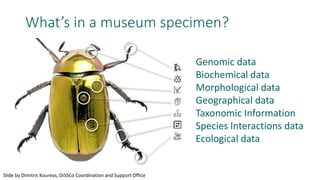
What’s in a museum specimen?
Genomic data
Biochemical data
Morphological data
Geographical data
Taxonomic Information
Species Interactions data
Ecological data
Slide by Dimitris Koureas, DiSSCo Coordination and Support Office
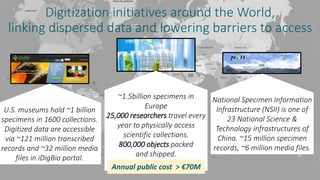
Digitization initiatives around the World,
linking dispersed data and lowering barriers to access
U.S. museums hold ~1 billion
specimens in 1600 collections.
Digitized data are accessible
via ~121 million transcribed
records and ~32 million media
files in iDigBio portal.
National Specimen Information
Infrastructure (NSII) is one of
23 National Science &
Technology infrastructures of
China. ~15 million specimen
records, ~6 million media files.
~1.5billion specimens in
Europe
25,000 researchers travel every
year to physically access
scientific collections.
800,000 objects packed
and shipped.
Annual public cost > €70M
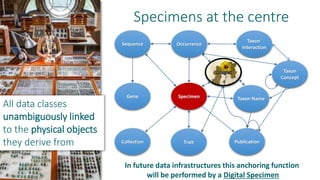
All data classes
unambiguously linked
to the physical objects
they derive from
Specimens at the centre
Occurrence
Specimen
Taxon
Concept
Taxon
Interaction
Taxon Name
PublicationTraitCollection
Sequence
Gene
In future data infrastructures this anchoring function
will be performed by a Digital Specimen
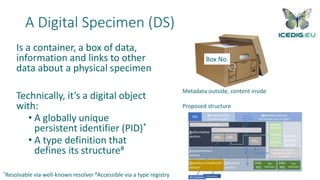
A Digital Specimen (DS)
Is a container, a box of data,
information and links to other
data about a physical specimen
Technically, it’s a digital object
with:
• A globally unique
persistent identifier (PID)*
• A type definition that
defines its structure#
Metadata outside, content inside
Proposed structure
*Resolvable via well-known resolver #Accessible via a type registry
Box No.
digitalSpecimen
id: 20.5000.1025/gqzdomzr (Nb. id is illustrative only.)
Bray, R.A., & Jean-Lou J. "Holorchis castex n. sp. … …" Zootaxa 1426.1 (2007): 51-56. doi: 10.11646/zootaxa.1426.1.3
A simple Digital Specimen
{"type":"DigitalSpecimen","attributes":{"content":{"id":"20.5000.1025/6e2b07784b8f608d9e37","
creationdatetime":"","creator":"","midslevel":2,"scientificName":"Holorchis castex Bray &
Justine","country":"New Caledonia","locality":"Rocher a la voile",
"decimalLat/Long":[-22.3,166.42],"recordedBy":"J L. Justine","collectionDate":"2006-06-01“,
"catalogNumber":"2006.12.6.40-41","otherCatalogNumbers":"NHMUK:ecatalogue:7072219",
"institutionCode":"NHMUK","collectionCode":"ZOO, Parasitic worms",
"stableIdentifier":"https://data.nhm.ac.uk/object/e90b81bc-1642-47ca-b587-
6aa8885cd6a0/1558569600000","physicalSpecimenId":"013258549","Annotations":"Type status
= paratype. Holotype = MNHN JNC 1848 –D
1","gbifId":"https://www.gbif.org/occurrence/1826086349","catOfLifeReference":"http://www.c
atalogueoflife.org/col/details/species/id/828cbc4eecaa2402b09cd9223754171e","literatureRefer
ence":"https://doi.org/10.5281/zenodo.175744","treatmentbank":"http://tb.plazi.org/GgServer/
html/03BA87825543FFBFD895FD27FAE1DDAD ","enaBiosample":"None
available","enaSequence":"https://www.ebi.ac.uk/ena/data/view/FJ788436","LiteratureReferenc
eRelated":"https://doi.org/10.2478/s11686-009-0045-z"}},"elements":[]}
serialized as JSON
http://www.catalogueoflife.org/col/
details/species/id/828cbc4eecaa24
02b09cd9223754171e
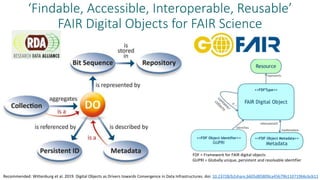
‘Findable, Accessible, Interoperable, Reusable’
FAIR Digital Objects for FAIR Science
Recommended: Wittenburg et al. 2019. Digital Objects as Drivers towards Convergence in Data Infrastructures. doi: 10.23728/b2share.b605d85809ca45679b110719b6c6cb11
FDF = Framework for FAIR digital objects
GUPRI = Globally unique, persistent and resolvable identifier
Seamlessly organise digital access across multiple
collections, indexing them globally and uniquely
• Virtual collection(s) offer possibilities for wider, more
flexible, and FAIR Science* for research/policy uses:
• Recognising curatorial work, as well as performing that in the
community
• Annotating with latest taxonomic treatments
• Understanding variations
• Working with linked information
• Such as images, DNA sequences, traits and chemical analyses
• Supporting regulatory processes
• Health, food, security, sustainability and environmental change
• Educational uses
*FAIR Science – enfolds open science, also addressing anxieties of sensitive data and free-gratis use of data
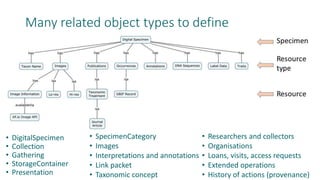
Many related object types to define
• DigitalSpecimen
• Collection
• Gathering
• StorageContainer
• Presentation
• SpecimenCategory
• Images
• Interpretations and annotations
• Link packet
• Taxonomic concept
• Researchers and collectors
• Organisations
• Loans, visits, access requests
• Extended operations
• History of actions (provenance)
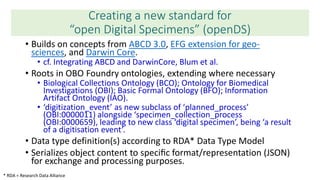
Creating a new standard for
“open Digital Specimens” (openDS)
• Builds on concepts from ABCD 3.0, EFG extension for geo-
sciences, and Darwin Core.
• cf. Integrating ABCD and DarwinCore, Blum et al.
• Roots in OBO Foundry ontologies, extending where necessary
• Biological Collections Ontology (BCO); Ontology for Biomedical
Investigations (OBI); Basic Formal Ontology (BFO); Information
Artifact Ontology (IAO).
• ‘digitization_event’ as new subclass of ‘planned_process’
(OBI:0000011) alongside ‘specimen_collection_process
(OBI:0000659), leading to new class ‘digital specimen’, being ‘a result
of a digitisation event’.
• Data type definition(s) according to RDA* Data Type Model
• Serializes object content to specific format/representation (JSON)
for exchange and processing purposes.
* RDA = Research Data Alliance
Summary
• Specimens in natural science collections are rich sources of
and anchors for a wide variety of associated data types.
• DiSSCo, iDigBio and NSII are typical digitization initiatives.
• Digital Specimens (DS) represent specimens in cyberspace,
acting as surrogates for physical specimens.
• DS can be created, processed and moved between
information systems in the new world of ‘FAIR Science’.
• DS must be standardized for exchange between systems.
• We propose the creation of a new TDWG standard for open
Digital Specimens that we name as openDS.
THANK YOU FOR YOUR ATTENTION!

openDS - A new standard for digital specimens

  • 1.
    A linked projectof ‘openDS’ – A New Standard for Digital Specimens and Other Natural Science Digital Object Types Alex R Hardisty, Cardiff University Keping Ma, Institute of Botany, Chinese Academy of Sciences Gil Nelson, Florida State University Jose Fortes, University of Florida Biodiversity_Next, ST74 37033 doi: 10.3897/biss.3.37033 Leiden, 22-25 October 2019
  • 2.
    What’s in amuseum specimen? Genomic data Biochemical data Morphological data Geographical data Taxonomic Information Species Interactions data Ecological data Slide by Dimitris Koureas, DiSSCo Coordination and Support Office
  • 3.
    Digitization initiatives aroundthe World, linking dispersed data and lowering barriers to access U.S. museums hold ~1 billion specimens in 1600 collections. Digitized data are accessible via ~121 million transcribed records and ~32 million media files in iDigBio portal. National Specimen Information Infrastructure (NSII) is one of 23 National Science & Technology infrastructures of China. ~15 million specimen records, ~6 million media files. ~1.5billion specimens in Europe 25,000 researchers travel every year to physically access scientific collections. 800,000 objects packed and shipped. Annual public cost > €70M
  • 4.
    All data classes unambiguouslylinked to the physical objects they derive from Specimens at the centre Occurrence Specimen Taxon Concept Taxon Interaction Taxon Name PublicationTraitCollection Sequence Gene In future data infrastructures this anchoring function will be performed by a Digital Specimen
  • 5.
    A Digital Specimen(DS) Is a container, a box of data, information and links to other data about a physical specimen Technically, it’s a digital object with: • A globally unique persistent identifier (PID)* • A type definition that defines its structure# Metadata outside, content inside Proposed structure *Resolvable via well-known resolver #Accessible via a type registry Box No.
  • 6.
    digitalSpecimen id: 20.5000.1025/gqzdomzr (Nb.id is illustrative only.) Bray, R.A., & Jean-Lou J. "Holorchis castex n. sp. … …" Zootaxa 1426.1 (2007): 51-56. doi: 10.11646/zootaxa.1426.1.3 A simple Digital Specimen {"type":"DigitalSpecimen","attributes":{"content":{"id":"20.5000.1025/6e2b07784b8f608d9e37"," creationdatetime":"","creator":"","midslevel":2,"scientificName":"Holorchis castex Bray & Justine","country":"New Caledonia","locality":"Rocher a la voile", "decimalLat/Long":[-22.3,166.42],"recordedBy":"J L. Justine","collectionDate":"2006-06-01“, "catalogNumber":"2006.12.6.40-41","otherCatalogNumbers":"NHMUK:ecatalogue:7072219", "institutionCode":"NHMUK","collectionCode":"ZOO, Parasitic worms", "stableIdentifier":"https://data.nhm.ac.uk/object/e90b81bc-1642-47ca-b587- 6aa8885cd6a0/1558569600000","physicalSpecimenId":"013258549","Annotations":"Type status = paratype. Holotype = MNHN JNC 1848 –D 1","gbifId":"https://www.gbif.org/occurrence/1826086349","catOfLifeReference":"http://www.c atalogueoflife.org/col/details/species/id/828cbc4eecaa2402b09cd9223754171e","literatureRefer ence":"https://doi.org/10.5281/zenodo.175744","treatmentbank":"http://tb.plazi.org/GgServer/ html/03BA87825543FFBFD895FD27FAE1DDAD ","enaBiosample":"None available","enaSequence":"https://www.ebi.ac.uk/ena/data/view/FJ788436","LiteratureReferenc eRelated":"https://doi.org/10.2478/s11686-009-0045-z"}},"elements":[]} serialized as JSON http://www.catalogueoflife.org/col/ details/species/id/828cbc4eecaa24 02b09cd9223754171e
  • 7.
    ‘Findable, Accessible, Interoperable,Reusable’ FAIR Digital Objects for FAIR Science Recommended: Wittenburg et al. 2019. Digital Objects as Drivers towards Convergence in Data Infrastructures. doi: 10.23728/b2share.b605d85809ca45679b110719b6c6cb11 FDF = Framework for FAIR digital objects GUPRI = Globally unique, persistent and resolvable identifier
  • 8.
    Seamlessly organise digitalaccess across multiple collections, indexing them globally and uniquely • Virtual collection(s) offer possibilities for wider, more flexible, and FAIR Science* for research/policy uses: • Recognising curatorial work, as well as performing that in the community • Annotating with latest taxonomic treatments • Understanding variations • Working with linked information • Such as images, DNA sequences, traits and chemical analyses • Supporting regulatory processes • Health, food, security, sustainability and environmental change • Educational uses *FAIR Science – enfolds open science, also addressing anxieties of sensitive data and free-gratis use of data
  • 9.
    Many related objecttypes to define • DigitalSpecimen • Collection • Gathering • StorageContainer • Presentation • SpecimenCategory • Images • Interpretations and annotations • Link packet • Taxonomic concept • Researchers and collectors • Organisations • Loans, visits, access requests • Extended operations • History of actions (provenance)
  • 10.
    Creating a newstandard for “open Digital Specimens” (openDS) • Builds on concepts from ABCD 3.0, EFG extension for geo- sciences, and Darwin Core. • cf. Integrating ABCD and DarwinCore, Blum et al. • Roots in OBO Foundry ontologies, extending where necessary • Biological Collections Ontology (BCO); Ontology for Biomedical Investigations (OBI); Basic Formal Ontology (BFO); Information Artifact Ontology (IAO). • ‘digitization_event’ as new subclass of ‘planned_process’ (OBI:0000011) alongside ‘specimen_collection_process (OBI:0000659), leading to new class ‘digital specimen’, being ‘a result of a digitisation event’. • Data type definition(s) according to RDA* Data Type Model • Serializes object content to specific format/representation (JSON) for exchange and processing purposes. * RDA = Research Data Alliance
  • 11.
    Summary • Specimens innatural science collections are rich sources of and anchors for a wide variety of associated data types. • DiSSCo, iDigBio and NSII are typical digitization initiatives. • Digital Specimens (DS) represent specimens in cyberspace, acting as surrogates for physical specimens. • DS can be created, processed and moved between information systems in the new world of ‘FAIR Science’. • DS must be standardized for exchange between systems. • We propose the creation of a new TDWG standard for open Digital Specimens that we name as openDS.
  • 12.
    THANK YOU FORYOUR ATTENTION!

Editor's Notes

  • #3 Museum specimens are rich sources for many kinds of data.
  • #4 There are multiple initiatives around the world tackling digitization of specimens in collections. Here are three examples; there are others too. Less than 10% digitized so far. Whichever currency you choose, the public cost of loans and visits is hundreds of millions per year and the system is slow and inefficient. Digitization aims to widen access and change working practice.
  • #5 Specimens are the carefully curated hard evidence about our natural world, often surrounded by other data derived from them. In future data infrastructures, digital specimens will perform an anchoring function for all this data. This is key to notions of extended specimens and next generation collections.
  • #7 A simple example – a parasitic worm in fish - that contains data about the actual specimen, as well as links to other data about it, which can be represented as JSON for transfer between systems, as well as for application processing and entry into databases.
  • #8 Digital Specimens are implicitly ‘FAIR digital objects’ – that is, with persistent identifier, metadata and a type definition they are findable, accessible, interoperable and reusable. We need a type definition for Digital Specimens.
  • #9 Why is this useful? Because it allows us to …
  • #10 There are many different object types to define, as illustrated by the examples here, which leads us to the need for …
  • #11 … creating a new standard, openDS to provide the type definitions we need. There are questions about how to precisely situate new classes in existing ontologies but these are resolvable.