Global Powers of
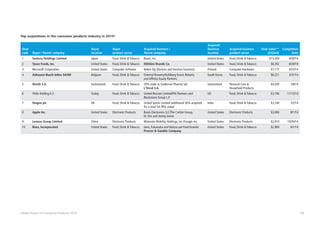
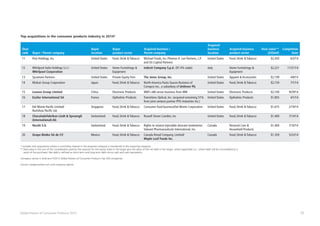
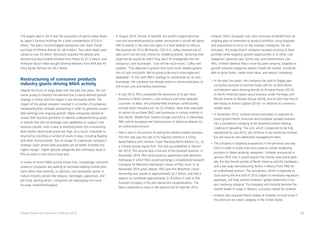
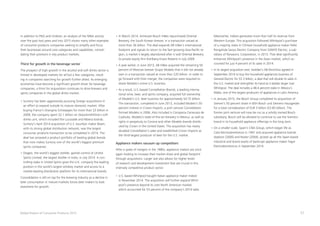
Consumer Products 2015
Connecting with the
connected consumer
2Global Powers of Consumer Products 2015
Contents
Welcome	1
Global economic outlook	 2
Connecting with the connected consumer	 6
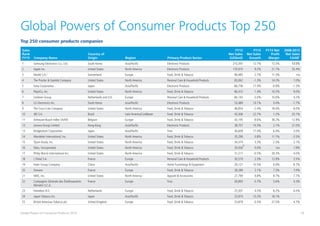
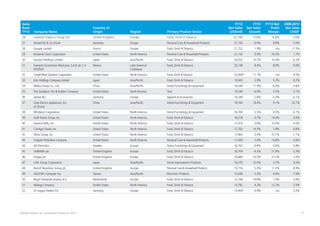
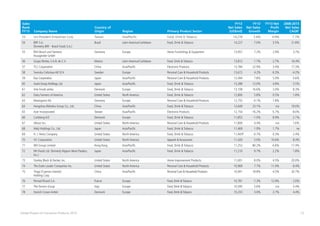
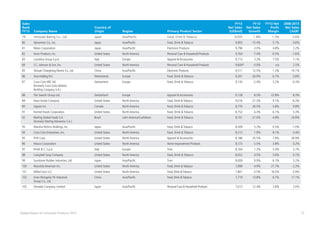
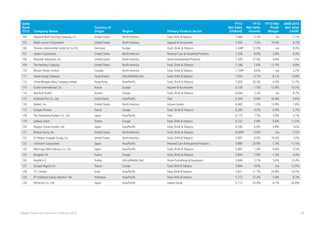
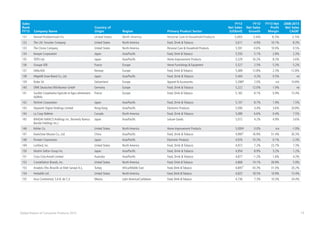
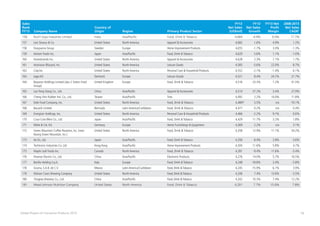
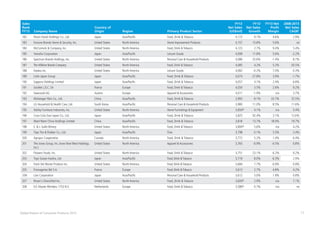
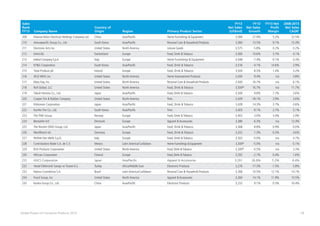
Global Powers of Consumer Products Top 250	 10
Top 250 highlights	 23
Top 10	 25
Geographic analysis	 27
Product sector analysis	 35
Top 250 newcomers	 46
Fastest 50	 47
M&A activity	 50
Q ratio analysis	 59
Study methodology and data sources	 66
Contacts	67
1Global Powers of Consumer Products 2015
Deloitte Touche Tohmatsu Limited (DTTL) is pleased to present
the eighth annual Global Powers of Consumer Products.
This report identifies the 250 largest consumer products
companies around the world based on publicly available
data for the fiscal year 2013 (encompassing companies’
fiscal years ended through June 2014).
The report also provides an outlook on the global economy;
an analysis of market capitalization in the industry; a look at
merger & acquisition activity in the consumer products industry;
and a discussion on the importance of connecting with the
connected consumer.
2Global Powers of Consumer Products 2015
Big global issues
Falling oil price
As of this writing, the global price of oil has declined more than
50 percent from where it was in the first half of 2014. Oil has
fallen due to weak global demand combined with a considerable
increase in oil production in the U.S., Canada, Iraq, and Libya. Yet
the U.S. is the main story, with oil production through fracking in
North Dakota and Texas having transformed the global industry
(hydraulic fracturing, called “fracking,” injects pressurized liquid
into rock to extract oil or gas). The other big part of the story is
the decision by Saudi Arabia not to cut production in order to
boost prices. Rather, the Saudis are content to allow the price to
sink in the hope that they will gain market share at the expense
of frackers.
The drop in the price of oil is having a considerable impact on the
global economy. It is creating disinflationary pressures, especially in
developed markets such as the U.S., Europe, and Japan; it is boost-
ing consumer purchasing power in oil-consuming nations such as
Japan, India, the U.S., and much of Europe, and contributing to
faster economic growth than would otherwise be the case; and it
is wreaking havoc for oil exporters such as Russia, Iran, Venezuela,
and Nigeria. Most importantly it has contributed to the stunning
rise in the value of the U.S. dollar. Oil exporters are paid in dollars
and then recycle those dollars by purchasing goods or assets from
the rest of the world. With a lower oil price, the supply of dollars
available for such purchases has declined. This paucity of dollars
has caused the price of dollars to rise.
Global economic outlook
What can we expect going forward? In the short term, it is likely
that the price of oil will fall further. There is a considerable amount
of new oil production already in the pipeline in the U.S. that is
expected to come on line in 2015, and crude inventories continue
to pile up. Longer term, however, a low price is likely to retard
investment in fracking. Indeed we’re already seeing a cutback in
drilling permits and a drop in oil company capital expenditures. A
reduction in U.S. production could, therefore, happen right when
global demand starts to pick up speed. If this happens, the price
will surely rebound, perhaps in the next one to two years. A rising
price will be inflationary for consuming nations, will put pressure
on external debt service for consuming nations, and will probably
force tighter monetary policy at least in the U.S. For oil exporters, it
would be beneficial – especially for such countries as Russia, Iran,
Venezuela, and Mexico.
Rising U.S. dollar
One of the big stories in 2014 and early 2015 has been the sharp
rise in the value of the U.S. dollar against most other major cur-
rencies. There were several reasons for this. Among them were
the decline in the price of oil; faster economic growth in the U.S.;
expectations of higher U.S. interest rates; and weak growth com-
bined with more aggressive monetary policy in Europe, China, and
Japan. The rising dollar has many effects. First, it is disinflationary
in the U.S. by reducing import prices. This will provide the Federal
Reserve with more time before it must raise short term interest
rates. Second, a rising dollar is inflationary for everyone else. That
will be good for Europe and Japan, where inflation is way too low.
It will be a problem in many emerging markets. Indeed several
have raised short term interest rates in order to stabilize their cur-
rencies and fight inflation, leading to slower growth. Third, a rising
dollar could be problematic for companies in emerging countries
that have dollar-denominated debts. The volume of such debt has
quadrupled in the last seven years. Going forward, while it is nearly
impossible to accurately predict exchange rates, it does seem likely
that the dollar will continue to face upward pressures, at least in
early 2015.
Major markets
China
China’s economy has slowed down and continues to show signs
of weakness despite government efforts to reverse the slowdown.
The Chinese economy grew 7.4 percent in 2014, the slowest rate
since 1990. The government expects growth of only 7.0 percent
this year. Low growth could mean an inability to absorb workers
migrating from rural to urban areas. The result would be high un-
employment and social unrest. And, if the workers didn’t migrate,
China wouldn’t grow since there would be zero productivity gains
that come from switching workers from farms to factories. Thus,
China can ill afford to grow much more slowly.
Why is China decelerating? First, export markets such as Europe
have been dormant. Even the U.S. market isn’t what it used to
be for China. Plus, China’s wages and currency have increased
in recent years, thereby reducing the competitiveness of Chinese
exports. The result has been that some manufacturing capacity
has moved outside of China. Companies are looking elsewhere to
produce goods for export. Basic assembly is moving from China to
Vietnam, Indonesia, and elsewhere.
3Global Powers of Consumer Products 2015
Second, the government has attempted to limit the growth of the
shadow banking system. Lending outside traditional banking chan-
nels has resulted in excess investment in property, infrastructure,
and heavy industry. The result is a growing volume of non-per-
forming assets which threatens the stability of the financial system.
Indeed the government has recently estimated that, in the past
five years, $6.8 trillion in investment has been wasted. Yet efforts
to limit this activity have contributed to the slowdown in growth.
The government is torn between a desire to limit financial risk and
a desire to avoid a sharp slowdown. It has taken measures to limit
the growth of shadow banking while, at the same time, attempted
to stimulate more traditional forms of credit through easing of
monetary policy. Indeed interest rates have been cut and the
required reserve ratio of banks has been reduced. The problem is
that, with considerable excess capacity in property and industry, it
is not clear that easier monetary policy will necessarily lead to more
credit market activity. Moreover, it is not clear if such an increase
would be beneficial. It could exacerbate the problem of excess
capacity, exacerbate wholesale price deflation, and ultimately lead
to financial losses.
USA
The U.S. economy has accelerated and will likely grow faster
in 2015 than at any time since 2005. While there are signs of
strength, there have also been signs of weakness in the first
quarter of 2015. In part this may reflect bad weather in much of
the country. But it may also reflect the impact of a weak overseas
economy as well as the negative effect of a high-valued dollar. The
most important positive sign, however, is a very strong job market.
Also, there are indications that a pickup in business investment
is imminent. The major weak component of the U.S. economy is
housing. Data have bounced around in the past year due to higher
mortgage interest rates, higher house prices, and the fact that
first-time buyers are often plagued by student debt. However, the
medium-term outlook for housing is good given that prices appear
to be stabilizing, mortgage rates are down, job growth is strong,
and there is considerable pent up demand. A disproportionate
share of the activity is now in multi-unit housing rather than single
family housing.
Moreover, in part due to the dramatic decline in oil prices, inflation
remains well below the Federal Reserve’s target of 2.0 percent. As
such, it is likely that the Fed will wait at least until the end of 2015
before raising short term interest rates for the first time in eight
years. Plus, low inflation and lower energy prices are helping to
boost consumer purchasing power. In addition, unlike in the recent
past, there is no fiscal consolidation taking place. Due to a strong
economy, the budget deficit has fallen dramatically, thereby nearly
eliminating the political pressure to do something about the deficit.
The absence of spending cuts and tax increases removes a factor
that held back growth in 2012-13.
In the longer term, the U.S. faces troubles emanating from de-
mographics. As labor force growth lags behind the growth of the
retired population, there will be negative consequences. These
include slower economic growth, rising budget deficits starting
in the middle of the next decade, and challenges for the private
sector and state/local governments in funding pensions. Among
the possible solutions to the demographic problem are to boost
immigration, raise the average retirement age, increase taxes to
fund government programs that support the elderly, and create
incentives for people to save more for their retirement.
Europe
The Eurozone economy has been in very poor shape and prices are
declining as of this writing. And although growth has been disap-
pointing, there are some early signs of improvement. These include
stronger job growth, rising retail sales, improved manufacturing
performance, and some improvement in credit market conditions.
Still, more is needed. The principal problem has been weakness in
credit markets resulting in a paucity of business investment. The
end result is weak hiring and high unemployment. Credit market
weakness stems from several factors. These include weak banks
that are struggling to recapitalize by selling risky assets and avoid-
ing new ones, high risk spreads in Europe’s periphery due to fears
about sovereign risk, and the fear of deflation. Despite a moder-
ately aggressive monetary policy, which has led to growth of the
broad money supply, bank credit to the private sector continues
to decline.
To counter the problems in credit markets, the European Central
Bank (ECB) has lately engaged in a far more aggressive monetary
policy. This entails very low interest rates, direct low-interest loans
to banks on the condition that the money is then loaned to the
private sector, and most importantly, purchases of government
bonds – better known as quantitative easing. The early signs are
good. Yet quantitative easing alone may not be sufficient to restore
strong growth. Europe still needs an easier fiscal policy, more
economic restructuring within key countries, and more financial
integration within the Eurozone.
4Global Powers of Consumer Products 2015
Here are some comments on specific countries in Europe:
France
The French economy is teetering on the edge of recession. The
economy has stalled, unemployment remains high, business con-
fidence is low, and there is a risk of deflation. The main problem
is declining business investment. The big issue in France is the
failure of the current government to address structural problems
in the economy. France has lost competitiveness due to stagnant
productivity, high labor costs, restrictive labor market rules, and
high taxes. These factors have contributed to business unwilling-
ness to boost investment. Recently, President Hollande, under
pressure from Germany and the International Monetary Fund (IMF),
appointed a reform-minded Prime Minister, Manuel Valls, who has
a background in financial services, and is expected to implement
more market-oriented policies. Yet he faces considerable resistance
from Hollande’s own Socialist Party. If a credible reform agenda is
implemented it could have a very positive impact on investment.
Germany
The German economy is improving. Business confidence has
rebounded, in part due to continued strength of consumer de-
mand which appears to be driving growth. Indeed Germany has
an unusually low unemployment rate. This is good as Germany’s
export engine has faced obstacles from weak overseas growth.
With respect to the Eurozone, Germany continues to put pressure
on France and Italy to enact structural reforms, and resists pressure
to boost monetary and fiscal stimulus – although the government
does concede that more infrastructure investment is needed.
Italy
Italy was the worst-performing European economy in the past
fifteen years. Its economy barely grew. Combined with fiscal profli-
gacy, this resulted in a huge debt/GDP ratio. Yet Italy never had any
difficulty in servicing this debt as it had a high savings rate. This
changed when the contagion effects of the Greek debt drama led
to a huge increase in Italian bond yields. However, when the ECB
promised to “do whatever it takes” to save the euro, bond yields
declined. Fiscal austerity also convinced bond investors that Italy
was on a path to recovery. Still, austerity hurt growth. The failure
of Italy’s governments to implement serious reforms also hurt
business confidence. The result is that Italy is not growing, largely
due to a sharp decline in investment. Italy suffers from poor con-
fidence, deflation, and high risk spreads which make the cost of
capital relatively high. Prime Minister Matteo Renzi excited voters
with the promise of reform. Yet he has faced obstacles, including
massive labor protests.
Spain
Spain has been the surprise star performer among large Eurozone
economies. A few other smaller Eurozone economies have done
very well, especially Ireland but also Portugal. In the case of Spain,
what sets it apart is that in the last few years its labor cost of
doing business has declined relative to the other major European
economies. In other words, it has gained competitiveness through
a combination of wage restraint, labor market liberalization, and
productivity gains. The result is that Spain’s exports have per-
formed very well. In addition, unlike the other Eurozone econo-
mies, Spain’s business investment has been expanding, reflecting
increased business confidence. Plus, unemployment has come
down considerably – although it still remains quite high at 23 per-
cent. This, combined with lower energy prices, has contributed to
moderate growth of consumer spending. On the other hand, Spain
suffers from deflation. Unless this is reversed, it could undermine
the progress that Spain has made.
UK
Of the major industrial nations, Britain now has the fastest growing
economy. This follows an extended period of weak economic per-
formance, exacerbated by deep fiscal austerity on the part of the
government. But now, a combination of positive factors appears to
be boosting the British economy. These include a very aggressive
program of quantitative easing, government support for housing,
an improvement in the international competitiveness of British
industry (following wage restraint and productivity gains), declining
unemployment, and considerable pent-up demand. On the other
hand, the weakness of the neighboring Eurozone economy is a
drag on Britain. Still, the medium-term outlook is good for several
reasons. These include much lower inflation (which gives the Bank
of England reason to avoid tight monetary policy), a rising pound
(which is disinflationary and boosts consumer purchasing power),
and lower energy prices.
Japan
Japan went into recession in 2014 following a big tax increase,
with declining consumer spending and business investment. This
was not meant to be. When Shinzo Abe took office roughly two
years ago, he offered a radical departure in policy characterized
by the three “arrows” of “Abenomics.” These were fiscal stimu-
lus, aggressive monetary policy, and structural reform (basically
deregulation and free trade). Of the three arrows, only one was
implemented. This was monetary policy in which the Bank of Japan
(BOJ) engaged in unlimited quantitative easing with the goal of
ultimately achieving 2.0 percent inflation. The effect of this policy
was to suppress the yen, boost equity prices, boost inflation, and
suppress real interest rates. Initially it had a positive impact on
growth. Then, things changed. Wages failed to respond and real
consumer purchasing power declined, having a negative impact on
consumer spending. The rest of the world failed to cooperate and
weak external demand hurt exports. But the worst problem was
implementation of a massive tax increase in April 2014, a policy
5Global Powers of Consumer Products 2015
that had already been in the pipeline when Abe took office. This
had a devastating impact and led to the current recession.
In November 2014, Abe announced that the second round of the
tax increase, scheduled for October 2015, would be postponed
by 18 months. Now the question remains as to what Abe will do
regarding the third arrow of Abenomics. Will he finally implement
the politically difficult reforms that he initially promised? These
include labor market liberalization, product market deregulation,
freer trade, changes in corporate governance, and incentives for
greater female participation in the labor force. He has already
taken some action on the latter two issues. Supporters of Abenom-
ics now hope that he will address all of these issues. If he does, it
could have a positive impact on business productivity. It would also
likely boost business confidence and, therefore, investment.
As for the Bank of Japan’s monetary policy, it is now extremely
aggressive compared to what happened in the U.S. (see chart).
Moreover, based on the current trajectory, it is expected to result in
a massive increase in BOJ assets relative to GDP. Will this ultimately
result in boosting inflation to the required level? It is hard to say.
The deflationary psychology is very strong in Japan and will be hard
to break. So far, the policy has had more of an impact on Japanese
asset prices than on inflation, and this could continue.
Brazil
As of early 2015, Brazil’s economy is in recession. This is due to
a sharp drop in commodity prices (due to China’s slowdown); a
central bank policy of high interest rates to fight inflation and to
stabilize the currency; and business lack of confidence due to a
government policy of high regulation and protectionism. In addi-
tion, Brazil has suffered from the rise in the U.S. dollar, which is
one of the reasons that the central bank has been compelled to
tighten monetary policy. The election in late 2014 resulted in a
second term for President Dilma Rousseff. Although she has since
appointed a very market-oriented Finance Minister, there remains
uncertainty as to whether she will be able to implement the fiscal
austerity and economic reforms she promises. Among the policies
that investors want are a reduction in government social spending
and subsidies (in order to cut the deficit and free up resources for
investment in infrastructure); deregulation of labor and product
markets; and freer trade. As for trade, Brazil remains a relatively
protectionist economy. Trade is a much smaller share of GDP than
is the case in China or India. The range of reform ideas is meant
to boost productivity and improve Brazil’s competitiveness. This is
important as domestic demand is not likely to be a major source
of growth in the near future. Consumer debt is already quite high,
so consumer spending will necessarily be constrained. Until now,
Rousseff’s major platform has been an effort to boost the spending
power of the poor through government transfers.
India
India had a highly significant election in 2014, resulting in the
election of Narendra Modi as Prime Minister. For the first time in
more than 30 years, a prime minister’s party has a majority in the
Parliament, thus boosting prospects for enacting reform legislation.
Yet in his first six months in office not much reform legislation was
proposed, thus disappointing supporters who were euphoric fol-
lowing Modi’s victory. They are hoping he will deregulate industry
and labor markets, reduce costly subsidies, boost infrastructure
investment, negotiate freer trade, and ease restrictions on foreign
investment. If he does these things, India’s growth outlook will
likely improve dramatically. Meanwhile, growth is recovering from
its doldrums but remains below potential. The central bank has
managed to reduce inflationary expectations, which should have a
positive impact on growth. Plus, lower oil prices are having a posi-
tive impact both on inflation and growth.
Russia
Russia’s economy is in bad shape. Following the crisis in Ukraine
and the implementation of sanctions, there was massive capital
flight from Russia resulting in a sharp drop in the currency. This,
in turn, led the central bank to severely raise interest rates several
times. The result was that investment dried up, including for-
eign investment. Moreover, the declining global price of oil also
contributed to downward pressure on the currency and concerns
about the ability of Russian debtors to service their external debts.
The sanctions that have been imposed mean that some big Russian
companies will have trouble rolling over foreign debts due to lim-
ited access to foreign financial markets. Already risk spreads have
increased dramatically. Some energy companies will lack access
to technologies that are needed to tap into Arctic reserves. This
means that oil production is likely to decline absent an end to sanc-
tions. By early 2015, the central bank had stopped intervening in
currency markets and had started to cut interest rates. With oil col-
lapsing, the ruble continues to fall, contributing to rising inflation
and deeper problems for Russian debtors. Indeed the government
is already providing financial support to some Russian companies
hurt by sanctions.
South Africa
Economic growth has decelerated steadily over the last few years
and is now only slightly above 1 percent per year. Inflation has
been high, but has come down due to lower energy prices. The
country has been hurt by labor unrest, declining commodity prices,
shortages of electricity, and under-investment. On the other hand,
the decline in the price of oil should boost consumer spending
power in 2015. Still, the currency (rand) has been under pressure,
thus contributing to inflation and limiting the flexibility of the
central bank. While growth is expected to pick up in 2015 and
beyond, most analysts see South Africa as having limited poten-
tial. Growth is expected to recover to a level of 3 to 4 percent, far
below that of many other African economies. However, due to
South Africa’s sophisticated business environment, it is expected to
remain a major center of business and finance for the continent.
6Global Powers of Consumer Products 2015
Connecting with the connected consumer
Engaging in the consumer conversation
More than ever, consumer products companies must
directly engage with consumers
Consumers are talking – all the time, everywhere – and it is they,
not companies, who increasingly own the conversation about
products and services. The supply-driven world has become a
demand-driven world where the consumer is in charge. Today’s
consumers are not only critics and curators, but, increasingly,
creators. Yesterday’s consumer purchased from a limited set of
offerings, and the communication was one-way, under complete
control of marketing and advertising agencies. Today, individual
consumers can start with an idea, a need, or an inspiration and
browse online to find what they want, and, if they can’t find it,
create it themselves by working with companies that provide this
capability. Today, the consumer is in charge.
Consumer product companies could view this defensively as a loss
of control. However, to view this challenge solely as a negative, a
risk so to speak, is to miss the broader opportunity. More than ever,
it is important that consumer products companies be an active part
of the conversation. Direct conversations with consumers can drive
growth and innovation. Indeed, such dialogue can lead companies
into areas of consumer need that they might otherwise overlook or
ignore. To seize this sizeable opportunity, the critical challenge for
consumer product companies is to create the right experience, the
right engagement, for consumers and to do it at scale.
Companies such as Shapeways are working directly with consumers
in just this way. What will your company do to engage consumers?
•	Deciding on the appropriate engagement approach – wheth-
er it is being actively engaged in the conversation, monitoring it
or simply ignoring it, a well thought out strategy, based on brand
positioning, will pay dividends. Typically, consumers tend to be
highly engaged with more expensive items and will limit interac-
tion with providers of commodities.
•	Developing content creation and content management
capabilities – focus on informing and educating consumers
rather than just selling to them. Arming consumers with the right
information helps them move independently through the shop-
ping journey, creates trust, and increases their loyalty.
•	Investing in technology and developing analytics capabilities
– integrate and track, across all channels and touchpoints, every
individual journey to offer targeted responses in real time
•	Ensuring staff at each level of the organization understand
the role they play – empower staff to make appropriate deci-
sions, whether this means directing consumers toward alternative
products or providing compensation to dissatisfied consumers
•	Managing the reputational risks associated with social
platforms – establish social command centers to listen to
conversations, engage with consumers, and proactively share
positive stories
Consumer engagement – much more than marketing
One function or one department cannot engage consumers, nor
can it be viewed as a one-off campaign. Consumer engagement
requires long-term commitment and collaboration across the entire
company to manage multiple consumer touchpoints and to sustain
the relationship as consumer expectations evolve. If not, the busi-
ness will constantly be playing “catch-up”.
Businesses that commit to making engagement as easy as possible
for consumers are positioning themselves in the center of the
conversation and are better positioned to succeed. Such position-
ing will likely involve:
Case study—Shapeways
Shapeways is a 3D printing company where consumers
can design the products they seek. Customers upload
their designs to the Shapeway website for price quotes
based on the materials involved. Users can also refine their
designs with help from “experts” on the Shapeway forum,
or opt for preexisting designs and make minor changes to
them before ordering.
Source: A billion to one: The crowd gets personal, Deloitte
University Press, January 26, 2015
7Global Powers of Consumer Products 2015
Leveraging the crowd
Empowered consumers are a significant driver of growth,
as their behavior intensifies competition and drives
innovation
The ability of like-minded people to compare experiences and
promote their collective voice has become a force in the consumer
market, moving beyond reviews and recommendations into
co-creation.
Companies are learning to incorporate the contributions of indi-
vidual consumers, as well as communities, into their value chain.
Many are using sensors, digital data, and smartphone interactions
to innovate with their products and services.
Some companies, such as Lego and Quirky, are using the power
of the crowd to help them develop their products, and others
such as Coca-Cola are drawing on customer input to develop
marketing campaigns.
Businesses can take specific consumer characteristics and behavior
and contextualize them with data on thousands or millions of other
individuals. This enables designers to deliver products and services
that are unique or closely tailored to consumer needs.
Deloitte calls this creation of unique customer products and
services derived from crowd-based insights the “billion-to-one”
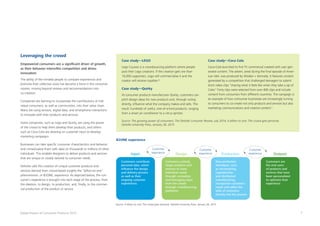
phenomenon, or B2ONE, experience. As depicted below, the con-
sumer’s experience is brought into each stage of the process, from
the ideation, to design, to production, and, finally, to the commer-
cial production of the product or service.
Case study—LEGO
Lego Cuusoo is a crowdsourcing platform where people
post their Lego creations. If the creation gets ore than
10,000 supporters, Lego will commercialise it and the
creator will receive royalties.6
Case study—Quirky
At consumer products manufacturer Quirky, customers can
pitch design ideas for new products and, through voting
directly, influence what the company makes and sells. The
result: hundreds of useful, one-of-a-kind products, ranging
from a smart air conditioner to a citrus spritzer.
Case study—Coca Cola
Coca-Cola launched its first TV commercial created with user gen-
erated content. The advert, aired during the final episode of Amer-
ican Idol, was produced by Wieden + Kennedy. It features content
generated by a competition that challenged teenagers to submit
short video clips “sharing what it feels like when they take a sip of
Coke.” Forty clips were selected from over 400 clips and include
content from consumers from different countries. The campaign is
an example of how comsumer businesses are increasingly turning
to consumers to co-create not only products and services but also
marketing communications and creative content.2
Source: A billion to one: The crowd gets personal, Deloitte University Press, January 26, 2015
Input
Customers contribute
personal data, which
influence the design
and delivery process
as well as their
ongoing customer
experiences.
Customers actively
shape products and
services to meet
individual needs
through cocreation
and leveraging input
from the crowd
through crowdsourcing
platforms.
Customers are
the end users
of products and
services that have
been personalized
to optimize their
experience.
New production
techniques, such
as microtasking,
coproduction,
and distributed
manufacturing,
incorporate customers
needs and utilize the
skills of customers
directly into the process.
Design Production
Customer
experience
Customer
experience
Customer
experience Outputs
B2ONE experience
Source: The growing power of consumers, The Deloitte Consumer Review, July 2014; A billion to one: The crowd gets personal,
Deloitte University Press, January 26, 2015
8Global Powers of Consumer Products 2015
What will it require?
Harnessing crowd-based insights will require companies to change
their approach and processes in a number of ways:
•	Shifting organizational focus from simply providing products
and services to solving a problem and creating an experi-
ence for the customer – indeed, a business that solves a daily
problem for consumers better than anyone else gives consumers
a compelling reason to become engaged with the company
•	Treating consumers as potential designers – use consumer
satisfaction data in which consumers critique and assess the
goods and services they receive
•	Moving away from broad-scale product testing – follow the
model of entrepreneurs and small companies that are very close
to the ultimate consumer, possibly including marketing teams in
the new product development process.
•	Creating better and faster feedback loops – continuously
collect and analyze the steady stream of consumer feedback at
a fairly granular level. Apply the resulting insights from this to
improve and redesign offerings and to personalize products for
different kinds of consumers. This could include faster prototyp-
ing to get something tangible in front of the consumer.
Finally, all of these processes must have a solid foundation of
consumer trust, without which none of these conversations and
collaborations can occur.
Fostering and sustaining trust
Trust as a competitive advantage
While consumers have unprecedented access to product infor-
mation and online expertise to guide their purchasing decisions,
recent research from Deloitte shows that, surprisingly, consumers
are talking far less to product or service experts than they are to
families, friends, and other consumers.
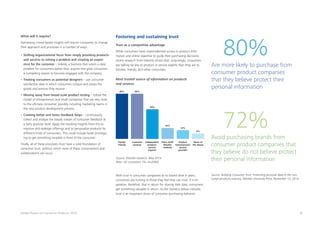
Most trusted source of information on products
and services
With trust in consumer companies at its lowest level in years,
consumers are turning to those they feel they can trust. It is im-
perative, therefore, that in return for sharing their data, consumers
get something valuable in return. As the statistics below indicate,
trust is an important driver of consumer purchasing behavior.
80%
72%
Are more likely to purchase from
consumer product companies
that they believe protect their
personal information
Avoid purchasing brands from
consumer product companies that
they believe do not believe protect
their personal information
Source: Building Consumer Trust: Protecting personal data in the con-
sumer products industry, Deloitte University Press, November 13, 2014
Source: Deloitte research, May 2014
Base: UK consumers 16+ (n=2000)
Family/
Friends
60% 60%
43%
16%
12%
9%
Customer
reviews
None of
the above
Independent
product/
service
experts
Store staff/
Retailer
website
Product
manufacturer/
service
provider
9Global Powers of Consumer Products 2015
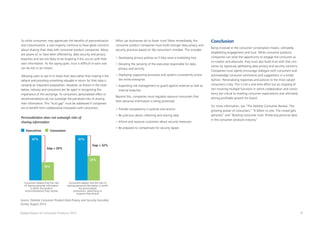
Consumers believe that the risks
of sharing personal information
is worth the product
recommendations they receive
Executives
47%
18%
25%
47%
Gap = 29%
Gap = 22%
Consumers
Consumers believe that the risks of
sharing personal information is worth
the personalized
promotions, advertising or
coupons they receive
So while consumers may appreciate the benefits of personalization
and customization, a vast majority continue to have great concerns
about sharing their data with consumer product companies. Many
are aware of, or have been affected by, data security and privacy
breaches and are not likely to be forgiving if this occurs with their
own information. As the saying goes, trust is difficult to earn and
can be lost in an instant.
Allowing users to opt in to share their data rather than making it the
default and providing something valuable in return for their data is
certainly an important proposition. However, as shown in the chart
below, industry and consumers are far apart in recognizing the
importance of this exchange. To consumers, personalized offers or
recommendations do not outweigh the perceived risks of sharing
their information. This “trust gap” must be addressed if companies
are to benefit from collaborative innovation with consumers.
Personalization does not outweigh risks of
sharing information
What can businesses do to foster trust? Most immediately, the
consumer product companies must build stronger data privacy and
security practices based on the consumer’s mindset. This includes:
•	Developing privacy policies as if they were a marketing tool
•	Elevating the seniority of the executive responsible for data
privacy and security
•	Deploying supporting processes and systems consistently across
the entire enterprise
•	Expanding risk management to guard against external as well as
internal breaches
Beyond this, companies must regularly reassure consumers that
their personal information is being protected:
•	Provide transparency in policies and actions
•	Be judicious about collecting and sharing data
•	Inform and reassure customers about security measures
•	Be prepared to compensate for security lapses
Conclusion
Being involved in the consumer conversation means, ultimately,
establishing engagement and trust. While consumer products
companies can seize the opportunity to engage the consumer as
co-creator and advocate, they must also build trust with that con-
sumer by rigorously addressing data privacy and security concerns.
Companies must openly encourage dialogue with consumers and
acknowledge consumer sentiments and suggestions in a timely
fashion. Personalizing responses and policies to the most valued
consumers is key. This is not a one-time effort but an ongoing ef-
fort involving multiple functions in which collaboration and consis-
tency are critical to meeting consumer expectations and ultimately
driving profitable growth for brand.
For more information, see “The Deloitte Consumer Review: The
growing power of consumers,” “A billion to one: The crowd gets
personal,” and “Building consumer trust: Protecting personal data
in the consumer products industry.”
Source: Deloitte Consumer Product Data Privacy and Security Executive
Survey, August 2014
10Global Powers of Consumer Products 2015
Sales
Rank
FY13 Company Name
Country of
Origin Region Primary Product Sector
FY13
Net Sales
(US$mil)
FY13
Net Sales
Growth
FY13 Net
Profit
Margin
2008-2013
Net Sales
CAGR1
1 Samsung Electronics Co., Ltd. South Korea Asia/Pacific Electronic Products 210,397 13.7% 13.3% 13.5%
2 Apple Inc. United States North America Electronic Products 170,910 9.2% 21.7% 35.4%
3 Nestlé S.A.² Switzerland Europe Food, Drink & Tobacco 99,485 2.7% 11.3% n/a
4 The Procter & Gamble Company United States North America Personal Care & Household Products 83,062 -1.3% 14.2% 1.0%
5 Sony Corporation Japan Asia/Pacific Electronic Products 66,756 17.4% -0.9% -1.2%
6 PepsiCo, Inc. United States North America Food, Drink & Tobacco 66,415 1.4% 10.2% 9.0%
7 Unilever Group Netherlands and U.K. Europe Personal Care & Household Products 66,143 -3.0% 10.6% 4.2%
8 LG Electronics Inc. South Korea Asia/Pacific Electronic Products 53,489 14.1% 0.4% -1.7%
9 The Coca-Cola Company United States North America Food, Drink & Tobacco 46,854 -2.4% 18.4% 8.0%
10 JBS S.A. Brazil Latin America/Caribbean Food, Drink & Tobacco 43,306 22.7% 1.2% 25.1%
11 Anheuser-Busch InBev SA/NV Belgium Europe Food, Drink & Tobacco 43,195 8.6% 38.2% 12.9%
12 Lenovo Group Limited Hong Kong Asia/Pacific Electronic Products 38,707 14.3% 2.1% 21.0%
13 Bridgestone Corporation Japan Asia/Pacific Tires 36,609 17.4% 6.0% 2.0%
14 Mondelez International, Inc. United States North America Food, Drink & Tobacco 35,299 0.8% 11.1% -3.5%
15 Tyson Foods, Inc. United States North America Food, Drink & Tobacco 34,374 3.3% 2.3% 5.1%
16 Mars, Incorporated United States North America Food, Drink & Tobacco 33,000 0.0% n/a 1.9%
17 Philip Morris International Inc. United States North America Food, Drink & Tobacco 31,217 -0.5% 28.3% 4.0%
18 L'Oréal S.A. France Europe Personal Care & Household Products 30,519 2.3% 12.9% 5.5%
19 Haier Group Company China Asia/Pacific Home Furnishings & Equipment 29,127 10.5% 6.0% 8.7%
20 Danone France Europe Food, Drink & Tobacco 28,289 2.1% 7.3% 7.0%
21 NIKE, Inc. United States North America Apparel & Accessories 27,799 9.8% 9.7% 7.7%
22 Compagnie Générale des Établissements
Michelin S.C.A.
France Europe Tires 26,893 -5.7% 5.6% 4.3%
23 Heineken N.V. Netherlands Europe Food, Drink & Tobacco 25,507 4.5% 8.2% 6.0%
24 Japan Tobacco Inc. Japan Asia/Pacific Food, Drink & Tobacco 23,974 13.2% 18.1%
25 British American Tobacco plc United Kingdom Europe Food, Drink & Tobacco 23,879 0.5% 27.5% 4.7%
Global Powers of Consumer Products Top 250
Top 250 consumer products companies
e
11Global Powers of Consumer Products 2015
Sales
Rank
FY13 Company Name
Country of
Origin Region Primary Product Sector
FY13
Net Sales
(US$mil)
FY13
Net Sales
Growth
FY13 Net
Profit
Margin
2008-2013
Net Sales
CAGR1
26 Imperial Tobacco Group PLC United Kingdom Europe Food, Drink & Tobacco 22,780 -0.6% 6.6% 7.6%
27 Henkel AG & Co. KGaA Germany Europe Personal Care & Household Products 21,724 -0.9% 9.9% 3.0%
28 Groupe Lactalis France Europe Food, Drink & Tobacco 21,252 1.9% n/a 11.5%
29 Kimberly-Clark Corporation United States North America Personal Care & Household Products 21,152 0.4% 10.5% 1.7%
30 Suntory Holdings Limited Japan Asia/Pacific Food, Drink & Tobacco 20,932 10.2% 10.4% 6.2%
31 Fomento Económico Mexicano, S.A.B. de C.V.
(FEMSA)
Mexico Latin America/
Caribbean
Food, Drink & Tobacco 20,149 8.4% 8.6% 9.0%
32 Cargill Meat Solutions Corporation United States North America Food, Drink & Tobacco 20,000 11.1% n/a 8.5%
33 Kirin Holdings Company, Limited Japan Asia/Pacific Food, Drink & Tobacco 19,943 3.9% 5.3% 0.2%
34 Midea Group Co., Ltd. China Asia/Pacific Home Furnishings & Equipment 19,544 17.9% 6.9% 5.6%
35 The Goodyear Tire & Rubber Company United States North America Tires 19,540 -6.9% 3.5% 0.1%
36 adidas AG Germany Europe Apparel & Accessories 19,249 -2.6% 5.5% 6.1%
37 Gree Electric Appliances, Inc.
of Zhuhai
China Asia/Pacific Home Furnishings & Equipment 19,164 19.4% 9.1% 23.1%
38 Whirlpool Corporation United States North America Home Furnishings & Equipment 18,769 3.5% 4.5% -0.1%
39 Kraft Foods Group, Inc. United States North America Food, Drink & Tobacco 18,218 -0.7% 14.9% 0.6%
40 General Mills, Inc. United States North America Food, Drink & Tobacco 17,910 0.8% 10.4% 4.0%
41 ConAgra Foods, Inc. United States North America Food, Drink & Tobacco 17,703 14.3% 1.8% 6.8%
42 Altria Group, Inc. United States North America Food, Drink & Tobacco 17,663 0.9% 25.7% 2.1%
43 Colgate-Palmolive Company United States North America Personal Care & Household Products 17,420 2.0% 13.8% 2.6%
44 AB Electrolux Sweden Europe Home Furnishings & Equipment 16,763 -0.8% 0.6% 0.8%
45 SABMiller plc United Kingdom Europe Food, Drink & Tobacco 16,704 -4.3% 21.9% 2.3%
46 Diageo plc United Kingdom Europe Food, Drink & Tobacco 16,684 -10.3% 21.3% 2.0%
47 LIXIL Group Corporation Japan Asia/Pacific Home Improvement Products 16,270 13.4% 2.7% 9.2%
48 Reckitt Benckiser Group plc United Kingdom Europe Personal Care & Household Products 15,716 5.0% 17.3% 8.9%
49 ASUSTeK Computer Inc. Taiwan Asia/Pacific Electronic Products 15,636 3.3% 4.6% -7.0%
50 Royal FrieslandCampina N.V. Netherlands Europe Food, Drink & Tobacco 15,166 10.8% 1.4% 3.8%
51 Kellogg Company United States North America Food, Drink & Tobacco 14,792 4.2% 12.2% 2.9%
52 Dr.August Oetker KG Germany Europe Food, Drink & Tobacco 14,404 -0.9% n/a 3.2%
e
*
12Global Powers of Consumer Products 2015
Sales
Rank
FY13 Company Name
Country of
Origin Region Primary Product Sector
FY13
Net Sales
(US$mil)
FY13
Net Sales
Growth
FY13 Net
Profit
Margin
2008-2013
Net Sales
CAGR1
53 Uni-President Enterprises Corp. Taiwan Asia/Pacific Food, Drink & Tobacco 14,278 3.6% 4.9% 7.7%
54 BRF S.A.
(formerly BRF - Brasil Foods S.A.)
Brazil Latin America/Caribbean Food, Drink & Tobacco 14,227 7.0% 3.5% 21.8%
55 BSH Bosch und Siemens
Hausgeräte GmbH
Germany Europe Home Furnishings & Equipment 13,957 7.2% 2.9% 3.7%
56 Grupo Bimbo, S.A.B. de C.V. Mexico Latin America/Caribbean Food, Drink & Tobacco 13,812 1.7% 2.7% 16.4%
57 TCL Corporation China Asia/Pacific Electronic Products 13,784 22.9% 3.4% 17.3%
58 Svenska Cellulosa AB SCA Sweden Europe Personal Care & Household Products 13,672 4.2% 6.3% -4.2%
59 Kao Corporation Japan Asia/Pacific Personal Care & Household Products 13,494 7.8% 5.0% 0.6%
60 Asahi Group Holdings, Ltd. Japan Asia/Pacific Food, Drink & Tobacco 13,288 12.0% 4.8% 5.5%
61 Arla Foods amba Denmark Europe Food, Drink & Tobacco 13,108 16.6% 3.0% 8.3%
62 Dairy Farmers of America United States North America Food, Drink & Tobacco 12,800 5.8% 0.5% 1.8%
63 Maxingvest AG Germany Europe Personal Care & Household Products 12,755 -0.1% 7.8%
64 Hangzhou Wahaha Group Co., Ltd. China Asia/Pacific Food, Drink & Tobacco 12,649 23.1% n/a 19.0%
65 Acer Incorporated Taiwan Asia/Pacific Electronic Products 12,154 -16.2% -5.7% -8.0%
66 Carlsberg A/S Denmark Europe Food, Drink & Tobacco 11,853 -1.0% 8.9% 2.1%
67 Alticor Inc. United States North America Personal Care & Household Products 11,800 4.4% n/a 7.6%
68 Meiji Holdings Co., Ltd. Japan Asia/Pacific Food, Drink & Tobacco 11,469 1.9% 1.7% ne
69 H. J. Heinz Company United States North America Food, Drink & Tobacco 11,443 -0.7% 0.3% 2.4%
70 V.F. Corporation United States North America Apparel & Accessories 11,420 5.0% 10.6% 8.4%
71 WH Group Limited Hong Kong Asia/Pacific Food, Drink & Tobacco 11,253 80.2% -0.6% 17.4%
72 NH Foods Ltd. (formerly Nippon Meat Packers,
Inc.)
Japan Asia/Pacific Food, Drink & Tobacco 11,210 9.7% 2.2% 1.8%
73 Stanley Black & Decker, Inc. United States North America Home Improvement Products 11,001 8.0% 4.5% 20.0%
74 The Estée Lauder Companies Inc. United States North America Personal Care & Household Products 10,969 7.7% 11.0% 8.4%
75 Tingyi (Cayman Islands)
Holding Corp.
China Asia/Pacific Personal Care & Household Products 10,941 18.8% 4.5% 20.7%
76 Pernod Ricard S.A. France Europe Food, Drink &Tobacco 10,781 -7.3% 12.9% 2.0%
77 The Ferrero Group Italy Europe Food, Drink &Tobacco 10,595 5.6% n/a 5.4%
78 Danish Crown AmbA Denmark Europe Food, Drink &Tobacco 10,233 3.0% 2.7% 4.4%
e
13Global Powers of Consumer Products 2015
Sales
Rank
FY13 Company Name
Country of
Origin Region Primary Product Sector
FY13
Net Sales
(US$mil)
FY13
Net Sales
Growth
FY13 Net
Profit
Margin
2008-2013
Net Sales
CAGR1
79 Yamazaki Baking Co., Ltd. Japan Asia/Pacific Food, Drink & Tobacco 9,935 1.8% 1.3% 3.6%
80 Ajinomoto Co., Inc. Japan Asia/Pacific Food, Drink & Tobacco 9,903 -15.4% 5.1% -3.6%
81 Nikon Corporation Japan Asia/Pacific Electronic Products 9,796 -3.0% 4.8% 2.2%
82 Avon Products, Inc. United States North America Personal Care & Household Products 9,764 -7.4% -0.5% -1.6%
83 Luxottica Group S.p.A. Italy Europe Apparel & Accessories 9,713 3.2% 7.5% 7.1%
84 S.C. Johnson & Son, Inc. United States North America Personal Care & Household Products 9,600 0.0% n/a 2.5%
85 Sichuan Changhong Electric Co., Ltd China Asia/Pacific Electronic Products 9,511 12.5% 1.3% 16.1%
86 Vion Holding N.V. Netherlands Europe Food, Drink & Tobacco 9,341 -26.9% 6.7% -3.8%
87 Coca-Cola HBC AG
(formerly Coca-Cola Hellenic
Bottling Company S.A.)
Switzerland Europe Food, Drink & Tobacco 9,130 -2.4% 3.2% -0.3%
88 The Swatch Group Ltd. Switzerland Europe Apparel & Accessories 9,128 8.5% 22.8% 8.3%
89 Dean Foods Company United States North America Food, Drink & Tobacco 9,016 -21.3% 9.1% -6.3%
90 Saputo Inc. Canada North America Food, Drink & Tobacco 8,776 26.5% 5.8% 9.8%
91 Hormel Foods Corporation United States North America Food, Drink & Tobacco 8,752 6.3% 6.1% 5.3%
92 Marfrig Global Foods S.A.
(formerly Marfrig Alimentos S.A.)
Brazil Latin America/Caribbean Food, Drink & Tobacco 8,741 -21.0% -4.8% 24.8%
93 Maruha Nichiro Holdings, Inc. Japan Asia/Pacific Food, Drink & Tobacco 8,509 5.2% 0.5% -1.0%
94 Coca-Cola Enterprises, Inc. United States North America Food, Drink & Tobacco 8,212 1.9% 8.1% 4.4%
95 PVH Corp. United States North America Apparel & Accessories 8,186 35.5% 1.8% 26.9%
96 Masco Corporation United States North America Home Improvement Products 8,173 5.5% 3.8% -3.2%
97 Pirelli & C. S.p.A. Italy Europe Tires 8,164 1.2% 5.0% 5.7%
98 Campbell Soup Company United States North America Food, Drink & Tobacco 8,052 4.5% 5.6% 0.1%
99 Sumitomo Rubber Industries, Ltd. Japan Asia/Pacific Tires 8,009 9.9% 6.1% 5.2%
100 Reynolds American Inc. United States North America Food, Drink & Tobacco 7,899 -4.9% 21.7% -2.2%
101 MillerCoors LLC United States North America Food, Drink &Tobacco 7,801 0.5% 16.5% 0.9%
102 Inner Mongolia Yili Industrial
Group Co., Ltd.
China Asia/Pacific Food, Drink &Tobacco 7,719 13.8% 6.7% 17.1%
103 Shiseido Company, Limited Japan Asia/Pacific Personal Care & Household Products 7,613 12.4% 3.8% 2.0%
e
14Global Powers of Consumer Products 2015
Sales
Rank
FY13 Company Name
Country of
Origin Region Primary Product Sector
FY13
Net Sales
(US$mil)
FY13
Net Sales
Growth
FY13 Net
Profit
Margin
2008-2013
Net Sales
CAGR1
104 National Beef Packing Company, LLC United States North America Food, Drink &Tobacco 7,486 0.1% n/a 5.1%
105 Ralph Lauren Corporation United States North America Apparel & Accessories 7,450 7.3% 10.4% 8.2%
106 Tönnies Lebensmittel GmbH & Co. KG Germany Europe Food, Drink & Tobacco 7,438 12.0% n/a 8.0%
107 Jarden Corporation United States North America Personal Care & Household Products 7,356 9.9% 2.8% 6.4%
108 Mohawk Industries, Inc. United States North America Home Improvement Products 7,349 27.0% 4.8% 1.5%
109 The Hershey Company United States North America Food, Drink & Tobacco 7,146 7.6% 11.5% 6.8%
110 Mccain Foods Limited Canada North America Food, Drink & Tobacco 7,109 8.6% n/a 3.2%
111 Savola Group Company Saudi Arabia Africa/Middle East Food, Drink & Tobacco 7,034 -3.7% 8.1% 13.8%
112 China Mengniu Dairy Company Limited Hong Kong Asia/Pacific Food, Drink & Tobacco 7,004 20.2% 4.3% 12.7%
113 Essilor International S.A. France Europe Apparel & Accessories 6,728 1.5% 12.8% 10.5%
114 Red Bull GmbH Austria Europe Food, Drink & Tobacco 6,694 2.2% n/a 8.7%
115 Hankook Tire Co., Ltd. South Korea Asia/Pacific Tires 6,504 0.4% 10.4% 9.6%
116 Mattel, Inc. United States North America Leisure Goods 6,485 1.0% 13.9% 1.8%
117 Groupe Terrena France Europe Food, Drink & Tobacco 6,200 4.2% 0.4% 3.7%
118 The Yokohama Rubber Co., Ltd. Japan Asia/Pacific Tires 6,173 7.5% 5.8% 3.1%
119 Sodiaal Union France Europe Food, Drink & Tobacco 6,132 5.9% 0.6% 11.0%
120 Nippon Suisan Kaisha, Ltd. Japan Asia/Pacific Food, Drink & Tobacco 6,036 6.6% 0.8% 3.6%
121 Perdue Farms, Inc. United States North America Food, Drink & Tobacco 6,000 0.0% n/a 5.5%
122 Dr Pepper Snapple Group, Inc. United States North America Food, Drink & Tobacco 5,997 0.0% 10.4% 1.0%
123 Unicharm Corporation Japan Asia/Pacific Personal Care & Household Products 5,989 20.9% 7.3% 11.5%
124 Morinaga Milk Industry Co., Ltd. Japan Asia/Pacific Food, Drink & Tobacco 5,987 1.4% 0.8% 0.5%
125 Bongrain SA France Europe Food, Drink & Tobacco 5,854 7.9% 1.3% 4.4%
126 Arçelik A.Ş. Turkey Africa/Middle East Home Furnishings & Equipment 5,846 5.1% 5.6% 10.4%
127 Groupe Bigard S.A. France Europe Food, Drink &Tobacco 5,844 0.0% n/a 12.0%
128 ITC Limited India Asia/Pacific Food, Drink &Tobacco 5,821 11.7% 24.8% 16.5%
129 PT Indofood Sukses Makmur Tbk Indonesia Asia/Pacific Food, Drink &Tobacco 5,773 15.3% 5.9% 8.3%
130 Nintendo Co., Ltd. Japan Asia/Pacific Leisure Goods 5,712 -10.0% -4.1% -20.8%
e
e
e
15Global Powers of Consumer Products 2015
Sales
Rank
FY13 Company Name
Country of
Origin Region Primary Product Sector
FY13
Net Sales
(US$mil)
FY13
Net Sales
Growth
FY13 Net
Profit
Margin
2008-2013
Net Sales
CAGR1
131 Newell Rubbermaid Inc. United States North America Personal Care & Household Products 5,693 -3.6% 8.3% -2.5%
132 The J.M. Smucker Company United States North America Food, Drink & Tobacco 5,611 -4.9% 10.1% 8.3%
133 The Clorox Company United States North America Personal Care & Household Products 5,591 -0.6% 10.0% 0.5%
134 Kewpie Corporation Japan Asia/Pacific Food, Drink & Tobacco 5,550 5.1% 2.8% 2.3%
135 TOTO Ltd. Japan Asia/Pacific Home Improvement Products 5,529 16.2% 8.2% 3.6%
136 Groupe SEB France Europe Home Furnishings & Equipment 5,527 2.5% 5.3% 5.2%
137 OrklaASA Norway Europe Food, Drink & Tobacco 5,489 12.8% 2.3% -12.8%
138 Megmilk Snow Brand Co., Ltd. Japan Asia/Pacific Food, Drink & Tobacco 5,444 4.2% 0.5% ne
139 Rolex SA Switzerland Europe Apparel & Accessories 5,398 2.0% n/a 10.8%
140 DMK Deutsches Milchkontor GmbH Germany Europe Food, Drink & Tobacco 5,222 12.0% 1.0% ne
141 Société Coopérative Agricole et Agro-alimentaire
AGRIAL
France Europe Food, Drink & Tobacco 5,182 8.1% 0.9% 15.4%
142 Nichirei Corporation Japan Asia/Pacific Food, Drink & Tobacco 5,107 8.7% 1.9% 1.5%
143 Skyworth Digital Holdings Limited Hong Kong Asia/Pacific Electronic Products 5,090 4.4% 3.6% 20.8%
144 La Coop fédérée Canada North America Food, Drink & Tobacco 5,089 6.6% 0.4% 7.5%
145 BANDAI NAMCO Holdings Inc. (formerly Namco
Bandai Holdings Inc.)
Japan Asia/Pacific Leisure Goods 5,072 4.2% 4.9% 3.6%
146 Kohler Co. United States North America Home Improvement Products 5,000 0.0% n/a -1.9%
147 Kweichow Moutai Co., Ltd. China Asia/Pacific Food, Drink & Tobacco 4,995 16.9% 51.4% 30.3%
148 Pioneer Corporation Japan Asia/Pacific Electronic Products 4,976 10.2% 0.1% -2.3%
149 Lorillard, Inc. United States North America Food, Drink & Tobacco 4,972 7.2% 23.7% 7.3%
150 Nisshin Seifun Group Inc. Japan Asia/Pacific Food, Drink & Tobacco 4,954 8.9% 3.2% 1.2%
151 Coca-Cola Amatil Limited Australia Asia/Pacific Food, Drink & Tobacco 4,877 -1.2% 1.6% 4.2%
152 Constellation Brands, Inc. United States North America Food, Drink & Tobacco 4,868 74.1% 39.9% 5.9%
153 Anadolu Efes Biracilik ve Malt Sanayii A.Ş. Turkey Africa/Middle East Food, Drink &Tobacco 4,845 43.3% 31.0% 20.2%
154 Herbalife Ltd. United States North America Food, Drink &Tobacco 4,825 18.5% 10.9% 15.4%
155 Arca Continental, S.A.B. de C.V. Mexico Latin America/Caribbean Food, Drink &Tobacco 4,736 7.3% 10.3% 24.4%
*
e
*
e
16Global Powers of Consumer Products 2015
Sales
Rank
FY13 Company Name
Country of
Origin Region Primary Product Sector
FY13
Net Sales
(US$mil)
FY13
Net Sales
Growth
FY13 Net
Profit
Margin
2008-2013
Net Sales
CAGR1
156 Ruchi Soya Industries Limited India Asia/Pacific Food, Drink & Tobacco 4,684 -4.9% 0.0% 17.7%
157 Levi Strauss & Co. United States North America Apparel & Accessories 4,682 1.6% 4.9% 1.2%
158 Husqvarna Group Sweden Europe Home Improvement Products 4,655 -1.7% 3.0% -1.3%
159 Itoham Foods Inc. Japan Asia/Pacific Food, Drink & Tobacco 4,629 5.6% 1.1% -1.0%
160 Hanesbrands Inc. United States North America Apparel & Accessories 4,628 2.3% 7.1% 1.7%
161 Activision Blizzard, Inc. United States North America Leisure Goods 4,583 -5.6% 22.0% 8.7%
162 Coty Inc. United States North America Personal Care & Household Products 4,552 -2.1% -1.4% 6.1%
163 LegoA/S Denmark Europe Leisure Goods 4,521 8.4% 24.1% 21.7%
164 Boparan Holdings Limited (aka 2 Sisters Food
Group)
United Kingdom Europe Food, Drink & Tobacco 4,516 23.3% 1.2% 41.5%
165 Lao Feng Xiang Co., Ltd. China Asia/Pacific Apparel & Accessories 4,514 27.2% 3.4% 27.9%
166 Cheng Shin Rubber Ind. Co., Ltd. Taiwan Asia/Pacific Tires 4,492 2.2% 14.0% 11.8%
167 Dole Food Company, Inc. United States North America Food, Drink & Tobacco 4,480 5.5% n/a -10.1%
168 Bacardi Limited Bermuda Latin America/Caribbean Food, Drink & Tobacco 4,477 0.2% n/a 0.4%
169 Energizer Holdings, Inc. United States North America Personal Care & Household Products 4,466 -2.2% 9.1% 0.6%
170 Coca-Cola West Co., Ltd. Japan Asia/Pacific Food, Drink & Tobacco 4,429 11.7% 3.2% 1.8%
171 Miele & Cie. KG Germany Europe Home Furnishings & Equipment 4,369 2.2% n/a 3.1%
172 Green Mountain Coffee Roasters, Inc. (now
Keurig Green Mountain, Inc.)
United States North America Food, Drink & Tobacco 4,358 12.9% 11.1% 54.2%
173 Ito En, Ltd. Japan Asia/Pacific Food, Drink & Tobacco 4,356 8.4% 2.8% 5.6%
174 Techtronic Industries Co. Ltd. Hong Kong Asia/Pacific Home Improvement Products 4,300 11.6% 5.8% 4.7%
175 Maple Leaf Foods Inc. Canada North America Food, Drink & Tobacco 4,281 -9.4% 11.6% -3.4%
176 Hisense Electric Co., Ltd. China Asia/Pacific Electronic Products 4,276 14.0% 5.7% 16.5%
177 Barilla Holding S.p.A. Italy Europe Food, Drink & Tobacco 4,248 -18.8% 3.4% -5.8%
178 Gruma, S.A.B. de C.V. Mexico Latin America/Caribbean Food, Drink &Tobacco 4,245 -15.9% 6.1% 3.9%
179 Molson Coors Brewing Company United States North America Food, Drink &Tobacco 4,206 7.4% 13.6% -2.5%
180 Tsingtao Brewery Co., Ltd. China Asia/Pacific Food, Drink &Tobacco 4,202 10.3% 7.4% 12.2%
181 Mead Johnson Nutrition Company United States North America Food, Drink & Tobacco 4,201 7.7% 15.6% 7.8%
e
17Global Powers of Consumer Products 2015
Sales
Rank
FY13 Company Name
Country of
Origin Region Primary Product Sector
FY13
Net Sales
(US$mil)
FY13
Net Sales
Growth
FY13 Net
Profit
Margin
2008-2013
Net Sales
CAGR1
182 Nissin Foods Holdings Co., Ltd. Japan Asia/Pacific Food, Drink & Tobacco 4,172 9.1% 4.6% 2.9%
183 Fortune Brands Home & Security, Inc. United States North America Home Improvement Products 4,157 15.8% 5.6% ne
184 McCormick & Company, Inc. United States North America Food, Drink & Tobacco 4,123 2.7% 9.4% 5.4%
185 Yamaha Corporation Japan Asia/Pacific Leisure Goods 4,099 11.8% 5.6% -2.2%
186 Spectrum Brands Holdings, Inc. United States North America Personal Care & Household Products 4,086 25.6% -1.4% 8.7%
187 The Hillshire Brands Company United States North America Food, Drink & Tobacco 4,085 4.2% 5.2% -20.5%
188 Hasbro, Inc. United States North America Leisure Goods 4,082 -0.2% 7.0% 0.3%
189 Lotte Japan Group Japan Asia/Pacific Food, Drink & Tobacco 4,074 -27.8% 3.9% -1.7%
190 Sapporo Holdings Limited Japan Asia/Pacific Food, Drink & Tobacco 4,057 4.1% 2.4% 6.8%
191 Société L.D.C. SA France Europe Food, Drink & Tobacco 4,034 3.5% 2.6% 9.2%
192 Swarovski AG Austria Europe Apparel & Accessories 4,011 -1.9% n/a 3.7%
193 Wuliangye Yibin Co., Ltd. China Asia/Pacific Food, Drink & Tobacco 3,993 -9.1% 33.7% 25.5%
194 LG Household & Health Care, Ltd. South Korea Asia/Pacific Personal Care & Household Products 3,980 11.0% 8.5% 11.6%
195 Ashley Furniture Industries, Inc. United States North America Home Furnishings & Equipment 3,850 4.1% n/a 5.4%
196 Coca-Cola East Japan Co., Ltd. Japan Asia/Pacific Food, Drink & Tobacco 3,825 92.4% 3.1% 12.6%
197 Want Want China Holdings Limited China Asia/Pacific Food, Drink & Tobacco 3,818 13.7% 18.0% 19.7%
198 E. & J. Gallo Winery United States North America Food, Drink & Tobacco 3,800 5.6% n/a 4.2%
199 Toyo Tire & Rubber Co., Ltd. Japan Asia/Pacific Tires 3,798 0.1% 3.3% 2.4%
200 Agropur Cooperative Canada North America Food, Drink & Tobacco 3,772 5.2% 1.4% 6.4%
201 The Jones Group, Inc. (now Nine West Holdings,
Inc.)
United States North America Apparel & Accessories 3,765 -0.9% -0.5% 0.8%
202 Flowers Foods, Inc. United States North America Food, Drink & Tobacco 3,751 23.1% 6.2% 9.2%
203 Toyo Suisan Kaisha, Ltd. Japan Asia/Pacific Food, Drink &Tobacco 3,719 8.0% 6.3% 2.9%
204 Fresh Del Monte Produce Inc. United States North America Food, Drink &Tobacco 3,684 7.7% -0.9% 0.9%
205 Fromageries Bel S.A. France Europe Food, Drink &Tobacco 3,613 2.7% 4.8% 4.2%
206 Lion Corporation Japan Asia/Pacific Personal Care & Household Products 3,612 5.0% 1.9% 0.8%
207 Rosen's Diversified Inc. United States North America Food, Drink & Tobacco 3,600 2.9% n/a 7.1%
208 D.E Master Blenders 1753 B.V. Netherlands Europe Food, Drink & Tobacco 3,586 0.7% n/a ne
e
e
e
e
18Global Powers of Consumer Products 2015
Sales
Rank
FY13 Company Name
Country of
Origin Region Primary Product Sector
FY13
Net Sales
(US$mil)
FY13
Net Sales
Growth
FY13 Net
Profit
Margin
2008-2013
Net Sales
CAGR1
209 Hisense Kelon Electrical Holdings Company Ltd. China Asia/Pacific Home Furnishings & Equipment 3,584 27.9% 5.2% 22.5%
210 Amorepacific Group Co., Ltd. South Korea Asia/Pacific Personal Care & Household Products 3,584 13.5% 9.1% 15.4%
211 Electronic Arts Inc. United States North America Leisure Goods 3,575 -5.8% 0.2% -3.2%
212 EmmiAG Switzerland Europe Food, Drink & Tobacco 3,560 10.6% 3.7% 4.1%
213 Indesit Company S.p.A. Italy Europe Home Furnishings & Equipment 3,548 -7.4% 0.1% -3.3%
214 KT&G Corporation South Korea Asia/Pacific Food, Drink & Tobacco 3,516 -4.1% 14.6% 2.9%
215 Total Produce plc Ireland Europe Food, Drink & Tobacco 3,504 8.5% 1.4% 3.2%
216 JELD-WEN, Inc. United States North America Home Improvement Products 3,500 9.4% n/a 3.8%
217 Mary Kay, Inc. United States North America Personal Care & Household Products 3,500 16.7% n/a 6.1%
218 Roll Global, LLC United States North America Food, Drink & Tobacco 3,500 16.7% n/a 11.7%
219 Yakult Honsha Co., Ltd. Japan Asia/Pacific Food, Drink & Tobacco 3,500 9.8% 7.7% 3.6%
220 Cooper Tire & Rubber Company United States North America Tires 3,439 -18.1% 3.9% 3.6%
221 Kikkoman Corporation Japan Asia/Pacific Food, Drink & Tobacco 3,428 14.3% 3.7% -3.6%
222 Kumho Tire Co., Ltd. South Korea Asia/Pacific Tires 3,403 -9.1% 2.7% 5.1%
223 The TINE Group Norway Europe Food, Drink & Tobacco 3,402 3.0% 3.4% 2.9%
224 Bestseller A/S Denmark Europe Apparel & Accessories 3,380 6.3% n/a 12.4%
225 The Nisshin OilliO Group, Ltd. Japan Asia/Pacific Food, Drink & Tobacco 3,368 8.8% 0.9% 0.0%
226 Westfleisch eG Germany Europe Food, Drink & Tobacco 3,332 1.3% 0.3% 4.6%
227 Perfetti Van Melle S.p.A. Italy Europe Food, Drink & Tobacco 3,303 0.0% n/a 4.7%
228 Controladora Mabe S.A. de C.V. Mexico Latin America/Caribbean Home Furnishings & Equipment 3,300 -5.0% n/a -5.1%
229 Rich Products Corporation United States North America Food, Drink &Tobacco 3,300 6.5% n/a 3.3%
230 HKScan Corporation Finland Europe Food, Drink &Tobacco 3,292 -2.7% 0.4% 1.6%
231 ASICS Corporation Japan Asia/Pacific Apparel & Accessories 3,291 26.6% 5.2% 6.4%
232 Vestel Elektronik Sanayi ve Ticaret A.S. Turkey Africa/Middle East Electronic Products 3,276 -17.3% -1.5% 5.8%
233 Natura Cosméticos S.A. Brazil Latin America/Caribbean Personal Care & Household Products 3,268 10.5% 12.1% 14.1%
234 Fossil Group, Inc. United States North America Apparel & Accessories 3,260 14.1% 11.9% 15.5%
235 Konka Group Co., Ltd. China Asia/Pacific Electronic Products 3,232 9.1% 0.3% 10.4%
e
e
e
19Global Powers of Consumer Products 2015
Sales
Rank
FY13 Company Name
Country of
Origin Region Primary Product Sector
FY13
Net Sales
(US$mil)
FY13
Net Sales
Growth
FY13 Net
Profit
Margin
2008-2013
Net Sales
CAGR1
236 Casio Computer Co., Ltd. Japan Asia/Pacific Electronic Products 3,214 8.1% 5.0% -9.1%
237 The Schwan Food Company United States North America Food, Drink & Tobacco 3,200 1.6% n/a -1.9%
238 Church & Dwight Co., Inc. United States North America Personal Care & Household Products 3,194 9.3% 12.3% 5.7%
239 World Co., Ltd. Japan Asia/Pacific Apparel & Accessories 3,170 -5.7% -0.5% -1.5%
240 NBTY, Inc. United States North America Food, Drink & Tobacco 3,163 5.4% 4.1% 7.7%
241 JVCKENWOOD Corporation Japan Asia/Pacific Electronic Products 3,160 3.2% -1.9% 0.4%
242 Ezaki Glico Co., Ltd. Japan Asia/Pacific Food, Drink & Tobacco 3,151 7.6% 3.8% 1.8%
243 Industrias Bachoco, S.A.B. de C.V. Mexico Latin America/Caribbean Food, Drink & Tobacco 3,116 0.9% 5.1% 14.6%
244 Chocoladefabriken Lindt & Sprüngli AG Switzerland Europe Food, Drink & Tobacco 3,112 8.0% 10.5% -0.4%
245 Vizio, Inc. United States North America Electronic Products 3,100 0.0% n/a 9.1%
246 Citizen Holdings Co., Ltd. Japan Asia/Pacific Apparel & Accessories 3,097 13.9% 5.7% 0.9%
247 Seiko Holdings Corporation Japan Asia/Pacific Apparel & Accessories 3,080 8.6% 2.5% 12.1%
248 Chiquita Brands International, Inc. United States North America Food, Drink & Tobacco 3,057 -0.7% -0.5% -3.3%
249 Prima Meat Packers, Ltd. Japan Asia/Pacific Food, Drink & Tobacco 3,033 10.1% 1.7% 1.9%
250 Nortura SA Norway Europe Food, Drink & Tobacco 3,001 7.5% 0.6% 3.5%
¹ Compound annual growth rate
² Nestlé’s sales for 2010 - 2013 reflect an accounting change. Comparable sales
figures for years prior to 2010 are not available.
n/a = not available
ne = not in existence (created by merger or divestiture)
e = estimate
* Unable to determine if company’s reported sales exclude excise taxes
Source: Published company data
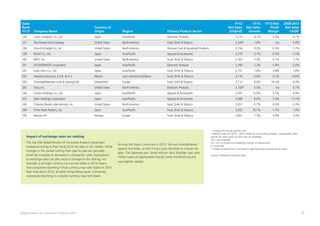
Impact of exchange rates on ranking
The Top 250 Global Powers of Consumer Products have been
ranked according to their fiscal 2013 net sales in U.S. dollars. While
changes in the overall ranking from year-to-year are generally
driven by increases or decreases in companies’ sales, fluctuations
in exchange rates can also result in changes in the ranking. For
example, a stronger currency vis-à-vis the dollar in 2013 means
that companies reporting in that currency may rank higher in 2013
than they did in 2012, all other things being equal. Conversely,
companies reporting in a weaker currency may rank lower.
Among the major currencies in 2013, the euro strengthened
against the dollar, as did China’s yuan renminbi to a lesser de-
gree. The Japanese yen, South African rand, Brazilian real, and
Indian rupee all depreciated sharply while the British pound
was slightly weaker.
e
e
20Global Powers of Consumer Products 2015
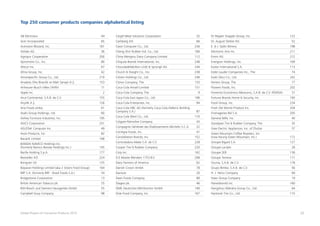
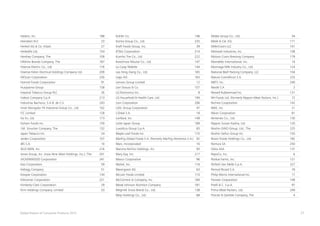
Top 250 consumer products companies alphabetical listing
AB Electrolux	 44
Acer Incorporated	 65
Activision Blizzard, Inc.	 161
Adidas AG	 36
Agropur Cooperative	 200
Ajinomoto Co., Inc.	 80
Alticor Inc.	 67
Altria Group, Inc.	 42
Amorepacific Group Co., Ltd.	 210
Anadolu Efes Biracilik ve Malt Sanayii A.Ş. 	 153
Anheuser-Busch InBev SA/NV	 11
Apple Inc.	 2
Arca Continental, S.A.B. de C.V.	 155
Arçelik A.Ş.	 126
Arla Foods amba	 61
Asahi Group Holdings, Ltd.	 60
Ashley Furniture Industries, Inc.	 195
ASICS Corporation	 231
ASUSTeK Computer Inc.	 49
Avon Products, Inc.	 82
Bacardi Limited	 168
BANDAI NAMCO Holdings Inc.
(formerly Namco Bandai Holdings Inc.)	 145
Barilla Holding S.p.A.	 177
Bestseller A/S	 224
Bongrain SA	 125
Boparan Holdings Limited (aka 2 Sisters Food Group)	 164
BRF S.A. (formerly BRF - Brasil Foods S.A.)	 54
Bridgestone Corporation	 13
British American Tobacco plc	 25
BSH Bosch und Siemens Hausgeräte GmbH	 55
Campbell Soup Company	 98
Cargill Meat Solutions Corporation	 32
Carlsberg A/S	 66
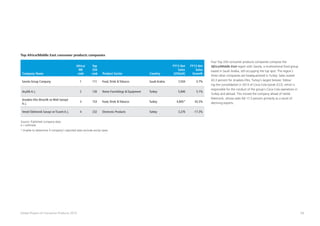
Casio Computer Co., Ltd.	 236
Cheng Shin Rubber Ind. Co., Ltd.	 166
China Mengniu Dairy Company Limited	 112
Chiquita Brands International, Inc.	 248
Chocoladefabriken Lindt & Sprüngli AG	 244
Church & Dwight Co., Inc.	 238
Citizen Holdings Co., Ltd.	 246
Clorox Company, The	 133
Coca-Cola Amatil Limited	 151
Coca-Cola Company, The	 9
Coca-Cola East Japan Co., Ltd.	 196
Coca-Cola Enterprises, Inc.	 94
Coca-Cola HBC AG (formerly Coca-Cola Hellenic Bottling
Company S.A.)	 87
Coca-Cola West Co., Ltd.	 170
Colgate-Palmolive Company	 43
Compagnie Générale des Établissements Michelin S.C.A.	 22
ConAgra Foods, Inc.	 41
Constellation Brands, Inc.	 152
Controladora Mabe S.A. de C.V.	 228
Cooper Tire & Rubber Company	 220
Coty Inc.	 162
D.E Master Blenders 1753 B.V.	 208
Dairy Farmers of America	 62
Danish Crown AmbA	 78
Danone	20
Dean Foods Company	 89
Diageo plc	 46
DMK Deutsches Milchkontor GmbH	 140
Dole Food Company, Inc.	 167
Dr Pepper Snapple Group, Inc.	 122
Dr. August Oetker KG	 52
E. & J. Gallo Winery	 198
Electronic Arts Inc.	 211
Emmi AG	 212
Energizer Holdings, Inc.	 169
Essilor International S.A.	 113
Estée Lauder Companies Inc., The 	 74
Ezaki Glico Co., Ltd.	 242
Ferrero Group, The	 77
Flowers Foods, Inc.	 202
Fomento Económico Mexicano, S.A.B. de C.V. (FEMSA)	 31
Fortune Brands Home & Security, Inc.	 183
Fossil Group, Inc.	 234
Fresh Del Monte Produce Inc.	 204
Fromageries Bel S.A.	 205
General Mills, Inc.	 40
Goodyear Tire & Rubber Company, The	 35
Gree Electric Appliances, Inc. of Zhuhai	 37
Green Mountain Coffee Roasters, Inc.
(now Keurig Green Mountain, Inc.)	 172
Groupe Bigard S.A.	 127
Groupe Lactalis	 28
Groupe SEB	 136
Groupe Terrena	 117
Gruma, S.A.B. de C.V.	 178
Grupo Bimbo, S.A.B. de C.V.	 56
H. J. Heinz Company	 69
Haier Group Company	 19
Hanesbrands Inc.	 160
Hangzhou Wahaha Group Co., Ltd. 	 64
Hankook Tire Co., Ltd.	 115
21Global Powers of Consumer Products 2015
Hasbro, Inc.	 188
Heineken N.V.	 23
Henkel AG & Co. KGaA	 27
Herbalife Ltd.	 154
Hershey Company, The	 109
Hillshire Brands Company, The	 187
Hisense Electric Co., Ltd.	 176
Hisense Kelon Electrical Holdings Company Ltd.	 209
HKScan Corporation	 230
Hormel Foods Corporation	 91
Husqvarna Group	 158
Imperial Tobacco Group PLC	 26
Indesit Company S.p.A.	 213
Industrias Bachoco, S.A.B. de C.V.	 243
Inner Mongolia Yili Industrial Group Co., Ltd.	 102
ITC Limited	 128
Ito En, Ltd.	 173
Itoham Foods Inc.	 159
J.M. Smucker Company, The	 132
Japan Tobacco Inc.	 24
Jarden Corporation	 107
JBS S.A.	 10
JELD-WEN, Inc.	 216
Jones Group, Inc. (now Nine West Holdings, Inc.), The	 201
JVCKENWOOD Corporation	 241
Kao Corporation	 59
Kellogg Company	 51
Kewpie Corporation	 134
Kikkoman Corporation	 221
Kimberly-Clark Corporation	 29
Kirin Holdings Company, Limited	 33
Kohler Co.	 146
Konka Group Co., Ltd.	 235
Kraft Foods Group, Inc.	 39
KT&G Corporation	 214
Kumho Tire Co., Ltd.	 222
Kweichow Moutai Co., Ltd.	 147
La Coop fédérée	 144
Lao Feng Xiang Co., Ltd. 	 165
Lego A/S	 163
Lenovo Group Limited	 12
Levi Strauss & Co.	 157
LG Electronics Inc.	 8
LG Household & Health Care, Ltd.	 194
Lion Corporation	 206
LIXIL Group Corporation	 47
L’Oréal S.A.	 18
Lorillard, Inc. 	 149
Lotte Japan Group	 189
Luxottica Group S.p.A.	 83
Maple Leaf Foods Inc.	 175
Marfrig Global Foods S.A. (formerly Marfrig Alimentos S.A.)	 92
Mars, Incorporated	 16
Maruha Nichiro Holdings, Inc.	 93
Mary Kay, Inc.	 217
Masco Corporation	 96
Mattel, Inc.	 116
Maxingvest AG	 63
Mccain Foods Limited	 110
McCormick & Company, Inc.	 184
Mead Johnson Nutrition Company	 181
Megmilk Snow Brand Co., Ltd.	 138
Meiji Holdings Co., Ltd.	 68
Midea Group Co., Ltd.	 34
Miele & Cie. KG	 171
MillerCoors LLC	 101
Mohawk Industries, Inc.	 108
Molson Coors Brewing Company	 179
Mondelēz International, Inc.	 14
Morinaga Milk Industry Co., Ltd.	 124
National Beef Packing Company, LLC	 104
Natura Cosméticos S.A.	 233
NBTY, Inc. 	 240
Nestlé S.A	 3
Newell Rubbermaid Inc.	 131
NH Foods Ltd. (formerly Nippon Meat Packers, Inc.)	 72
Nichirei Corporation	 142
NIKE, Inc.	 21
Nikon Corporation	 81
Nintendo Co., Ltd.	 130
Nippon Suisan Kaisha, Ltd.	 120
Nisshin OilliO Group, Ltd., The	 225
Nisshin Seifun Group Inc.	 150
Nissin Foods Holdings Co., Ltd.	 182
Nortura SA	 250
Orkla ASA	 137
PepsiCo, Inc.	 6
Perdue Farms, Inc.	 121
Perfetti Van Melle S.p.A.	 227
Pernod Ricard S.A.	 76
Philip Morris International Inc.	 17
Pioneer Corporation	 148
Pirelli & C. S.p.A.	 97
Prima Meat Packers, Ltd.	 249
Procter & Gamble Company, The	 4
22Global Powers of Consumer Products 2015
PT Indofood Sukses Makmur Tbk	 129
PVH Corp.	 95
Ralph Lauren Corporation	 105
Reckitt Benckiser Group plc	 48
Red Bull GmbH	 114
Reynolds American Inc.	 100
Rich Products Corporation	 229
Rolex SA	 139
Roll Global, LLC	 218
Rosen’s Diversified Inc.	 207
Royal FrieslandCampina N.V.	 50
Ruchi Soya Industries Limited	 156
S.C. Johnson & Son, Inc.	 84
SABMiller plc	 45
Samsung Electronics Co., Ltd.	 1
Sapporo Holdings Limited	 190
Saputo Inc.	 90
Savola Group Company	 111
Schwan Food Company, The	 237
Seiko Holdings Corporation	 247
Shiseido Company, Limited	 103
Sichuan Changhong Electric Co., Ltd	 85
Skyworth Digital Holdings Limited	 143
Société Coopérative Agricole et Agro-alimentaire AGRIAL	 141
Société L.D.C. SA	 191
Sodiaal Union	 119
Sony Corporation	 5
Spectrum Brands Holdings, Inc.	 186
Stanley Black & Decker, Inc.	 73
Sumitomo Rubber Industries, Ltd.	 99
Suntory Holdings Limited	 30
Svenska Cellulosa AB SCA	 58
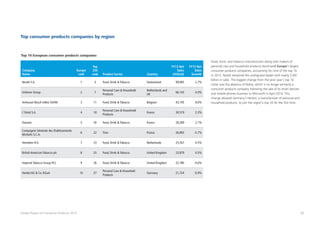
Swarovski AG	 192
Swatch Group Ltd., The	 88
TCL Corporation	 57
Techtronic Industries Co. Ltd.	 174
TINE Group, The	 223
Tingyi (Cayman Islands) Holding Corp.	 75
Tönnies Lebensmittel GmbH & Co. KG	 106
Total Produce plc	 215
TOTO Ltd.	 135
Toyo Suisan Kaisha, Ltd.	 203
Toyo Tire & Rubber Co., Ltd.	 199
Tsingtao Brewery Co., Ltd.	 180
Tyson Foods, Inc.	 15
Unicharm Corporation	 123
Unilever Group	 7
Uni-President Enterprises Corp.	 53
V.F. Corporation	 70
Vestel Elektronik Sanayi ve Ticaret A.Ş.	 232
Vion Holding N.V.	 86
Vizio, Inc.	 245
Want Want China Holdings Limited	 197
Westfleisch eG	 226
WH Group Limited	 71
Whirlpool Corporation	 38
World Co., Ltd.	 239
Wuliangye Yibin Co., Ltd.	 193
Yakult Honsha Co., Ltd.	 219
Yamaha Corporation	 185
Yamazaki Baking Co., Ltd.	 79
Yokohama Rubber Co., Ltd., The	 118
23Global Powers of Consumer Products 2015
Top 250 highlights
Consumer products industry rides out another year of global economic recalibration in 2013
On the bottom line, profitability strengthened in 2013 for the
second year in a row. The composite net profit margin rose to 9.6
percent (based on 217 companies that reported their net profits),
exceeding for the first time the 8.5 percent result achieved in 2010
when the industry began its post-recession rebound. The vast
majority of reporting companies operated profitably in 2013 (202
companies); only 15 of the 217 reporting companies generated a
net loss. In addition, net profit margins improved for the major-
ity of reporting companies. Although asset turnover fell slightly
in 2013, the improvement in profitability generated a higher 8.2
percent return on assets.
With an average size of US$12.3 billion, the Top 250 consumer
products companies generated sales of nearly US$3.1 trillion in
2013. This is down slightly from 2012’s Top 250 sales total due
to changes in the composition of the group. In 2013, Panasonic,
Nokia, and Blackberry (formerly Research In Motion) were excluded
from the Top 250 because consumer products no longer make up
the majority of their sales.
Net sales of at least US$3 billion were necessary to rank in the Top
250 in 2013. Nearly 70 percent of the companies generated sales
of less than US$10 billion: 104 companies had sales between US$3
billion and US$5 billion, while 68 companies achieved sales be-
tween US$5 billion and US$10 billion. Less than 10 percent of the
Top 250 reported sales of more than US$25 billion (23 companies).
As a whole, 2013 was another challenging year for the global
economy as it tried to gain a surer footing. Europe remained in
recession during most of 2013, although it began to recover mod-
estly by the end of the year and heading into 2014—but growth
remained poor. The U.S. economy grew slowly in 2013 largely due
to a tightening of fiscal policy. While the economy strengthened
in Japan, supported by improved exports and the government’s
massive economic stimulus measures, the Chinese economy
decelerated in 2013, and similar slow growth continued into 2014.
Economic growth also cooled in several Latin American countries
as they faced the end of China’s commodity boom, weaker domes-
tic demand, social unrest, and other downward pressures. Overall,
recovery by many economies around the globe continued to be
jagged and weak.
Although the global economy once again grew at a slower rate
than had been expected, composite, currency-adjusted net sales
rose 5.6 percent in 2013 for the Global Powers of Consumer
Products—the world’s 250 largest consumer products companies.
Three-quarters of the Top 250 reported a sales increase in 2013,
and half (125 companies) reported faster growth in 2013 com-
pared with 2012. Accelerating growth, however, was not a trend
seen across all geographic regions or product sectors.
24Global Powers of Consumer Products 2015
8.2% 0.8x
$12.3
billion
9.6%
compound annual
growth rate in net
sales, 2008-2013
composite
return on assets
composite
asset turnover
average size of
Top 250 consumer
products
companies
composite
year-over-year
sales growth
Minimum sales
required to be on
Top 250 list
aggregate net sales of
Top 250 in US$
economic
concentration
of top 10
composite net
profit margin
6.0%
$3.07
trillion
29.5%
5.6%
Top 250 quick stats
$3.0
billion
25Global Powers of Consumer Products 2015
Top 10
Top 10 consumer products companies
Sales
Rank
FY13 Company Name Country of Origin Region Primary Product Sector
FY13
Net Sales
(US$mil)
FY13
Net Sales
Growth*
FY13 Net
Profit
Margin**
FY13
Return on
Assets**
2008-2013
Net Sales
CAGR* ***
1 Samsung Electronics Co., Ltd. South Korea Asia/Pacific Electronic Products 210,397 13.7% 13.3% 14.2% 13.5%
2 Apple Inc. United States North America Electronic Products 170,910 9.2% 21.7% 17.9% 35.4%
3 Nestlé S.A.1
Switzerland Europe Food, Drink & Tobacco 99,485 2.7% 11.3% 8.7% n/a
4 The Procter & Gamble Company United States North America Personal Care & Household Products 83,062 -1.3% 14.2% 8.2% 1.0%
5 Sony Corporation Japan Asia/Pacific Electronic Products 66,756 17.4% -0.9% -0.4% -1.2%
6 PepsiCo, Inc. United States North America Food, Drink & Tobacco 66,415 1.4% 10.2% 8.8% 9.0%
7 Unilever Group
Netherlands
and U.K.
Europe Personal Care & Household Products 66,143 -3.0% 10.6% 11.6% 4.2%
8 LG Electronics Inc. South Korea Asia/Pacific Electronic Products 53,489 14.1% 0.4% 0.6% -1.7%
9 The Coca-Cola Company United States North America Food, Drink & Tobacco 46,854 -2.4% 18.4% 9.6% 8.0%
10 JBS S.A. Brazil
Latin America/
Caribbean
Food, Drink & Tobacco 43,306 22.7% 1.2% 1.6% 25.1%
Top 10 $906,818 7.7% 12.0% 9.8% 10.1%
Top 250 $3,073,118 5.6% 9.6% 8.2% 6.0%
Economic Concentration of Top 10 29.5%
Source: Published company data	
* Top 10 and Top 250 sales growth figures are sales-weighted, currency-adjusted composites	
** Top 10 and Top 250 figures are sales-weighted composites	
*** Compound annual growth rate	
¹Nestlé’s sales for 2010 - 2013 reflect an accounting change. Comparable sales figures for years prior to 2010 are not available.
26Global Powers of Consumer Products 2015
In 2013, JBS, the world’s biggest meat processor, moved into the
Global Powers of Consumer Products top 10 for the first time. The
company’s acquisition-driven growth has propelled it rapidly up
the ranking since it first joined the Top 250 in 2007 at #103 after
acquiring Swift & Company. This was followed by the purchase of
the Smithfield Beef Group from Smithfield Foods in 2008, a major-
ity stake in Pilgrim’s Pride in 2009, a merger with Grupo Bertin in
2009, as well as numerous smaller deals. In September 2013, the
company completed the acquisition of Grupo Zenda and Seara Ali-
mentos from Marfrig Alimentos for a total consideration of R$5.85
billion (US$2.76 billion).
Despite the acquisition spree, the company’s entry into the top
10 was made possible only because Panasonic Corporation (#4 in
2012) was excluded from consideration in 2013, making room for
JBS to join the leader board. More than 70 percent of Panasonic’s
total sales were derived from areas outside consumer electronics
during the fiscal year ended 31 March 2014, and less than half
came from the sale of consumer products as the scope of the com-
pany’s activities has expanded into wide-ranging B2B sectors.
The other top 10 consumer products companies remained the same
as in the prior year. However PepsiCo moved ahead of Unilever into
sixth place and LG surpassed Coca-Cola to take eighth place.
The top 10 accounted for nearly 30 percent of total Top 250 net
sales in 2013 as the leaders’ composite growth rate continued
to outpace the group as a whole, reaching the highest level of
economic concentration since Deloitte began tracking the indus-
try’s Global Powers in 2006. On a composite basis, the world’s 10
largest consumer products companies grew 7.7 percent compared
with 5.6 percent for the Top 250 companies as a whole.
Still, three top 10 companies saw their sales decline in 2013. While
sales from continuing operations grew modestly for P&G and Uni-
lever—the two personal care and household products companies
in the top 10—their total sales fell as the companies continued to
divest non-core brands and businesses. In July 2013, P&G com-
pleted the divestiture of its Pet Care operations to Mars, Inc. for
US$2.9 billion. During 2013, Unilever sold its global Skippy peanut
butter business to Hormel Foods and its Wish-Bone and Western
salad dressing brands to Pinnacle Foods, among other disposals.
Coca-Cola’s sales decline can be attributed to a mature soft-drinks
industry in North America and Europe as well as the deconsolida-
tion of the company’s Brazilian and Philippine bottling operations
in 2013.
On the bottom line, the top 10 also outperformed the Top 250
with a composite net profit margin of 12.0 percent versus 9.6
percent for the entire group. Seven top 10 companies posted a
double-digit net profit margin while only Sony operated at a loss.
World’s largest meat processor JBS joins top 10
27Global Powers of Consumer Products 2015
Geographic analysis
For purposes of geographical analysis, companies are assigned to
a region based on their headquarters location, which may not coin-
cide with where they derive the majority of their sales. Although
many companies derive sales from outside their region, 100 per-
cent of each company’s sales are accounted for in that company’s
region. Five regions are used for analysis:
•	Africa/Middle East
•	Asia/Pacific
•	Europe
•	Latin America/Caribbean
•	North America
Region/country profiles
Source: Deloitte analysis of published company data
¹ Excludes Japan; includes China/Hong Kong
² Includes Unilever, a dual-listed company consisting of Unilever PLC, based in London, and Unilever N.V., based in Rotterdam, Netherlands. The companies operate as a
single business.
Number of
companies
Average size
(US$mil)
Share of Top 250
companies
Share of Top 250
sales
Africa/Middle East 4 $5,250 1.6% 0.7%
Asia/Pacific 86 $11,727 34.4% 32.8%
Japan 50 $8,690 20.0% 14.1%
Other Asia/Pac¹ 36 $15,944 14.4% 18.7%
China/Hong Kong 21 $10,543 8.4% 7.2%
Europe 62 $13,056 24.8% 26.3%
France 14 $11,918 5.6% 5.4%
Germany 9 $11,383 3.6% 3.3%
UK² 7 $23,775 2.8% 5.4%
Latin America/Caribbean 11 $11,216 4.4% 4.0%
North America 87 $12,767 34.8% 36.1%
US 82 $13,192 32.8% 35.2%
Top 250 250 $12,292 100.0% 100.0%
28Global Powers of Consumer Products 2015
Europe’s growth gap with other regions continues to widen
European consumer products companies continued to struggle in
2013 as top-line growth decelerated amid weak domestic markets
and a slowdown in some emerging markets—particularly Latin
America and Africa/Middle East. Composite sales grew a meager
1.2 percent for the region’s companies, down from 4.0 percent
in 2012. Companies based in Europe’s big three economies fared
even worse. French companies eked out a 0.6 percent increase,
while German companies fared only slightly better with 1.6 percent
growth. This compares with prior-year growth rates of 6+ percent
for both countries. Top-line growth for the UK companies turned
negative in 2013 following a 4.8 percent gain in 2012.
Despite deteriorating sales growth, profitability improved from an
already-healthy level. On a composite basis, the region posted an
11.0 percent net profit margin, up two percentage points from
the prior year. Strong profitability can be attributed, in part, to
the number of high-margin drinks, tobacco, and personal care
products companies headquartered in the region. This is especially
evident in the UK where British companies led the way with a
composite 15.0 percent profit margin.
After back-to-back years of double-digit sales increases in 2010
and 2011, composite sales growth for the North American com-
panies remained modest in 2013, dipping slightly to 3.6 percent
from 4.0 percent the year before. For the third year in a row,
however, the region’s profit margin expanded. The composite net
profit margin was a robust 12.6 percent, the highest of the five
geographic regions.
In 2013, sales growth nearly doubled to 10.9 percent for compa-
nies based in the Asia/Pacific region. The group’s overall result
was propelled by strong growth among the Japanese companies.
With a composite growth rate of 9.1 percent in 2013, Japan’s Top
250 consumer products companies finally exceeded the sales level
reached in 2008, as demonstrated by the region’s positive com-
pound annual growth rate over the 2008-2013 period of 0.9 per-
cent. Sales growth for the Asia/Pacific region was also given a boost
by a rebound in 2013 among the Chinese companies following a
much softer pace of growth in 2012. China’s composite growth
rate of 17.5 percent outperformed all other geographic groups.
Profitability also increased in the region, aided by an improvement
in Japan’s bottom line. Nevertheless, the composite net profit mar-
gin of 6.4 percent remained well below average compared with
the Top 250 as a whole.
Sales for consumer products companies based in Latin America
experienced a significant slowdown in 2013. The composite growth
rate cooled to 7.3 percent—less than half the rate of growth in
2012. While it exceeded the Top 250’s 5.6 percent increase, the
region’s growth was way off the pace of recent years as illustrated
by its 5-year compound annual growth rate of 16.3 percent.
Profitability for the 11 Latin American companies that compose
the region also was subpar. The composite net profit margin of 3.5
percent in 2013 was down one percentage point from the year
before. This reflects the loss of Grupo Modelo from the region’s re-
sults. In June 2013, Anheuser-Busch InBev completed the purchase
of the high-margin Mexican brewer.
In 2013, the composite growth rate for companies based in the
Africa/Middle East region slowed sharply. At 4.1 percent, this
compares unfavorably with the prior-year result of 16.9 percent
as well as the region’s five-year compound annual growth rate of
12.3 percent. This should be interpreted with caution, however, as
only four companies compose the region’s results. Sales declined
for two of the companies and slowed considerably for another.
Only Anadolu Efes, Turkey’s largest beverage company, enjoyed
brisk growth in 2013 along with surging profits, which boosted the
group’s composite net profit margin to 11.2 percent.
29Global Powers of Consumer Products 2015
Performance by region/country
20%
5.6%
9.6%
8.2%
6.0%
4.1%
11.2%
8.6%
12.3%
10.9%
6.4%
6.3%
5.7%
9.1%
12.7%
17.5%
8.3%
9.7%
10.0%
6.4%
7.6%
15.8%
11.0%
1.2%
8.0%
4.9%
0.6%
7.5%
5.9%
6.7%
1.6%
6.1%
6.4%
4.3%
15.0%
16.3%
12.6%
10.6%
5.8%
3.4%
12.8%
10.6%
5.9%
9.5%
5.3%
7.3%
3.5%
3.7%
3.6%
-1.8%
4.0%
3.3%
0.9%
2013 net sales growth*
Source: Deloitte analysis of published company data				
* Sales-weighted, currency-adjusted composite growth rates				
** Sales-weighted composites				
*** Compound annual growth rate				
				
¹ Excludes Japan; includes China/Hong Kong				
² Includes Unilever, a dual-listed company consisting of Unilever PLC, based in London, and Unilever N.V., based in Rotterdam, Netherlands. The companies operate as a single business.			
	
2013 net profit margin** 2013 return on assets** 2008-2013 net sales CAGR* ***
15%
10%
5%
-5%
0%
Top 250 Africa/
Middle East
Asia/
Pacific
Japan Other
Asia/Pac¹
China/
Hong Kong
Europe France Germany Latin
America/
Caribbean
North
America
USUK2
30Global Powers of Consumer Products 2015
Top consumer products companies by region
Company
Name
Europe
rank
Top
250
rank Product Sector Country
FY13 Net
Sales
(US$mil)
FY13 Net
Sales
Growth
Nestlé S.A. 1 3 Food, Drink  Tobacco Switzerland 99,485 2.7%
Unilever Group 2 7
Personal Care  Household
Products
Netherlands and
UK
66,143 -3.0%
Anheuser-Busch InBev SA/NV 3 11 Food, Drink  Tobacco Belgium 43,195 8.6%
L'Oréal S.A. 4 18
Personal Care  Household
Products
France 30,519 2.3%
Danone 5 20 Food, Drink  Tobacco France 28,289 2.1%
Compagnie Générale des Établissements
Michelin S.C.A.
6 22 Tires France 26,893 -5.7%
Heineken N.V. 7 23 Food, Drink  Tobacco Netherlands 25,507 4.5%
British American Tobacco plc 8 25 Food, Drink  Tobacco United Kingdom 23,879 0.5%
Imperial Tobacco Group PLC 9 26 Food, Drink  Tobacco United Kingdom 22,780 -0.6%
Henkel AG  Co. KGaA 10 27
Personal Care  Household
Products
Germany 21,724 -0.9%
Top 10 European consumer products companies
Food, drink, and tobacco manufacturers along with makers of
personal care and household products dominated Europe’s largest
consumer products companies, accounting for nine of the top 10
in 2013. Nestlé remained the undisputed leader with nearly $100
billion in sales. The biggest change from the prior year’s top 10
roster was the absence of Nokia, which is no longer primarily a
consumer products company following the sale of its smart devices
and mobile phones business to Microsoft in April 2014. This
change allowed Germany’s Henkel, a manufacturer of personal and
household products, to join the region’s top 10 for the first time.
31Global Powers of Consumer Products 2015
Company
Name
North
America
rank
Top
250
rank Product Sector Country
FY13 Net
Sales
(US$mil)
FY13 Net
Sales
Growth
Apple Inc. 1 2 Electronic Products United States 170,910 9.2%
The Procter  Gamble Company 2 4
Personal Care  Household
Products
United States 83,062 -1.3%
PepsiCo, Inc. 3 6 Food, Drink  Tobacco United States 66,415 1.4%
The Coca-Cola Company 4 9 Food, Drink  Tobacco United States 46,854 -2.4%
Mondelez International, Inc. 5 14 Food, Drink  Tobacco United States 35,299 0.8%
Tyson Foods, Inc. 6 15 Food, Drink  Tobacco United States 34,374 3.3%
Mars, Incorporated 7 16 Food, Drink  Tobacco United States 33,000e
0.0%
Philip Morris International Inc. 8 17 Food, Drink  Tobacco United States 31,217 -0.5%
NIKE, Inc. 9 21 Apparel  Accessories United States 27,799 9.8%
Kimberly-Clark Corporation 10 29 Personal Care  Household Products United States 21,152 0.4%
Top 10 North American consumer products companies
In 2013, North America’s top 10 remained the same in name and
order as the year before. However, top-ranked Apple continued
to increase its lead over the region’s other consumer products
manufacturers and is now more than twice the size of second-
place PG. North America’s top 10 are all U.S.-based companies.
Canada’s largest consumer products company is Saputo, a dairy
processor with sales approaching US$8.8 billion in 2013.
32Global Powers of Consumer Products 2015
Company
Name
Asia/
Pacific
rank
Top 250
rank Product Sector Country
FY13 Net
Sales
(US$mil)
FY13 Net
Sales
Growth
Samsung Electronics Co., Ltd. 1 1 Electronic Products South Korea 210,397 13.7%
Sony Corporation 2 5 Electronic Products Japan 66,756 17.4%
LG Electronics Inc. 3 8 Electronic Products South Korea 53,489 14.1%
Lenovo Group Limited 4 12 Electronic Products Hong Kong 38,707 14.3%
Bridgestone Corporation 5 13 Tires Japan 36,609 17.4%
Haier Group Company 6 19 Home Furnishings  Equipment China 29,127 10.5%
Japan Tobacco Inc. 7 24 Food, Drink  Tobacco Japan 23,974 13.2%
Suntory Holdings Limited 8 30 Food, Drink  Tobacco Japan 20,932 10.2%
Kirin Holdings Company, Limited 9 33 Food, Drink  Tobacco Japan 19,943 3.9%
Midea Group Co., Ltd. 10 34 Home Furnishings  Equipment China 19,544 17.9%
Top 10 Asia/Pacific consumer products companies
Electronics companies occupy the first four places in the
Asia/Pacific top 10. However, there is one fewer electron-
ics company on the list in 2013 with the exclusion of Panasonic
Corporation. As with Europe’s Nokia, consumer products no longer
account for the majority of either company’s sales. The elimination
of Panasonic made room at the bottom of the list for a new top
10 company, Chinese appliance maker Midea Group. Meanwhile,
Lenovo Group continued to move up in the ranking overtaking
Bridgestone in 2013. With the acquisitions of Motorola Mobility
from Google and IBM’s x86 server business in 2014, Lenovo may
become one of the 10 largest consumer products companies in the
world in the near future.
33Global Powers of Consumer Products 2015
Company
Name
Latin
America/
Caribbean
rank
Top
250
rank Product Sector Country
FY13 Net
Sales
(US$mil)
FY13 Net
Sales
Growth
JBS S.A. 1 10 Food, Drink  Tobacco Brazil 43,306 22.7%
Fomento Económico Mexicano, S.A.B. de
C.V. (FEMSA)
2 31 Food, Drink  Tobacco Mexico 20,149 8.4%
BRF S.A. (formerly BRF - Brasil Foods S.A.) 3 54 Food, Drink  Tobacco Brazil 14,227 7.0%
Grupo Bimbo, S.A.B. de C.V. 4 56 Food, Drink  Tobacco Mexico 13,812 1.7%
Marfrig Global Foods S.A.
(formerly Marfrig Alimentos S.A.)
5 92 Food, Drink  Tobacco Brazil 8,741 -21.0%
Arca Continental, S.A.B. de C.V. 6 155 Food, Drink  Tobacco Mexico 4,736 7.3%
Bacardi Limited 7 168 Food, Drink  Tobacco Bermuda 4,477 0.2%
Gruma, S.A.B. de C.V. 8 178 Food, Drink  Tobacco Mexico 4,245 -15.9%
Controladora Mabe S.A. de C.V. 9 228 Home Furnishings  Equipment Mexico 3,300e
-5.0%
Natura
Cosméticos S.A.
10 233 Personal Care  Household Products Brazil 3,268 10.5%
Top 10 Latin American/Caribbean consumer products companies
All but two of Latin America’s Top 250 companies are food pro-
cessors or beverage makers. Top-ranked JBS became the world’s
tenth-largest consumer products company in 2013 as noted in
the global top 10 discussion above (see: World’s largest meat
processor JBS joins top 10). Grupo Modelo, which ranked sixth in
the region in 2012, was acquired by Anheuser-Busch InBev in June
2013, and its results are now consolidated under its new parent
company. This allowed Brazilian cosmetics and skin care manu-
facturer Natura Cosméticos to rejoin the region’s top 10. Arca
Continental, the second-largest bottler of Coca-Cola products in
Latin America (behind Coca-Cola FEMSA), surpassed both Bacardi
and Gruma, moving into sixth place in 2013.
34Global Powers of Consumer Products 2015
Company Name
Africa/
ME
rank
Top
250
rank Product Sector Country
FY13 Net
Sales
(US$mil)
FY13 Net
Sales
Growth
Savola Group Company 1 111 Food, Drink  Tobacco Saudi Arabia 7,034 -3.7%
Arçelik A.Ş. 2 126 Home Furnishings  Equipment Turkey 5,846 5.1%
Anadolu Efes Biracilik ve Malt Sanayii
A.Ş.
3 153 Food, Drink  Tobacco Turkey 4,845* 43.3%
Vestel Elektronik Sanayi ve Ticaret A.Ş. 4 232 Electronic Products Turkey 3,276 -17.3%
Top Africa/Middle East consumer products companies
Source: Published company data
e = estimate		
* Unable to determine if company’s reported sales exclude excise taxes	
Four Top 250 consumer products companies compose the
Africa/Middle East region with Savola, a multinational food group
based in Saudi Arabia, still occupying the top spot. The region’s
three other companies are headquartered in Turkey. Sales soared
43.3 percent for Anadolu Efes, Turkey’s largest brewer, follow-
ing the consolidation in 2013 of Coca-Cola İçecek (CCİ), which is
responsible for the conduct of the group’s Coca-Cola operations in
Turkey and abroad. This moved the company ahead of Vestel
Elektronik, whose sales fell 17.3 percent primarily as a result of
declining exports.
35Global Powers of Consumer Products 2015
Product sector analysis
For analytical purposes, the Top 250 companies have been orga-
nized into eight major product sectors:
•	Apparel  accessories
•	Electronic products
•	Food, drink, and tobacco
•	Home furnishings and equipment
•	Home improvement products
•	Leisure goods
•	Personal care and household products
•	Tires
Product sector profiles
Source: Deloitte analysis of published company data
Number of
companies
Average size
(US$mil)
Share of Top 250
companies
Share of Top 250
sales
Apparel  accessories 20 $7,297 8.0% 4.7%
Electronic products 18 $35,081 7.2% 20.5%
Food, drink  tobacco 142 $10,627 56.8% 49.1%
Home furnishings  equipment 13 $11,335 5.2% 4.8%
Home improvement products 10 $6,993 4.0% 2.3%
Leisure goods 8 $4,766 3.2% 1.2%
Personal care  household products 28 $14,438 11.2% 13.2%
Tires 11 $11,548 4.4% 4.1%
Top 250 250 $12,292 100.0% 100.0%
Demand up for home-related products
in 2013
The apparel and accessories sector, which had a strong post-
recession rally in 2010 and 2011, continued to lose steam in 2013.
Composite net sales grew 6.8 percent in 2013, down from 7.3 percent
in 2012. While still a solid result compared with most other industry
sectors, the pace of growth is less than half what it was in 2010. Profit-
ability for the group improved slightly compared with the prior year.
The sector posted a composite net profit margin of 8.3 percent, below
average compared with the Top 250 as a whole, but a one percentage
point improvement from 2012’s result.
Personal care and household products has been one of the slowest-
growing product sectors in recent years, and 2013 was no exception.
The combination of weak demand in Western markets and increasing
competition resulted in composite sales growth of just 1.6 percent for
the 28 Top 250 companies that made up this sector. Although organic
sales rose modestly for PG and Unilever—the industry’s top two
players—their total sales declined in 2013 as they continued to shed
non-core brands and businesses. Given a boost by ever more granular
market segmentation, however, the sector remained highly profitable,
enjoying a composite net profit margin of 10.5 percent.
Sales grew at a moderate 4.2 percent pace in 2013 for manufacturers
of food, drink, and tobacco products, an uptick from 3.8 percent
growth in 2012. Despite modest growth, the group remained highly
profitable, posting a composite net profit margin of 10.2 percent.
However, results varied considerably by subsector, especially on the
bottom line.
Although the beverage group continued to perform better on the top
line than its food and tobacco counterparts—as has historically been
the case—composite sales growth fell to 5.2 percent in 2013 from 6.6
percent in 2012. Soft drinks manufacturers, facing softer demand in
developed markets, acted as a drag on growth. Nevertheless, profitabil-
ity for the alcoholic and non-alcoholic drinks makers remained robust.
With a composite net profit margin of 16.1 percent, this group’s bot-
tom line result was second only to the tobacco companies.
Sales growth recovered a bit for both the food and tobacco
subsectors in 2013. Food processors reported composite sales
growth of 4.1 percent, an increase of one percentage point over
the prior year. The group’s bottom line also continued to strength-
en—posting a composite net profit margin of 5.8 percent. How-
ever, food processing is by far a lower-margin business compared
with drinks and tobacco companies.
As the sale of cigarettes continues to fall in developed markets and
the industry scrambles to take advantage of the booming e-cigarette
business, tobacco companies faced a slow-growth market again in
2013. Sales rose 2.7 percent for the nine companies the made up this
subsector. Still, the industry continued to be highly profitable, reporting
a net profit margin of 21.6 percent in 2013.
36Global Powers of Consumer Products 2015
Food, drink  tobacco: performance by subsector
Source: Deloitte analysis of published company data
* Sales-weighted, currency-adjusted composite growth rates
** Sales-weighted composites
*** Compound annual growth rate
Number of
companies
Average size
(US$mil)
FY13
Net Sales
Growth*
FY13
Net Profit
Margin**
FY13
Return on
Assets**
2008-2013
net sales
CAGR* ***
Beverages 32 $11,531 5.2% 16.1% 8.2% 6.7%
Food processing 101 $9,884 4.1% 5.8% 6.3% 5.2%
Tobacco 9 $15,747 2.7% 21.6% 12.9% 4.8%
Food, drink  tobacco 142 $10,627 4.2% 10.2% 8.0% 5.5%
As a group, the consumer electronics product sector had another
good year in 2013 with sales up 11.2 percent on a composite basis
coupled with strong profitability. However, if Panasonic and Nokia—ex-
cluded from the Top 250 in 2013—are factored out of the prior-year’s
results, the rate of growth slowed considerably compared with 2012.
Sales for industry leader Samsung grew 13.7 percent in 2013, down
from 21.9 percent in 2012. The sector’s second-largest player, Apple,
was unable to sustain the dramatic 40+ percent growth it achieved in
each of the preceding five years as its sales cooled to just 9.2 percent in
2013. The 18 companies that composed the sector posted a compos-
ite net profit margin of 10.5 percent.
The pace of growth was nearly three times stronger for manufacturers
of home furnishings and equipment in 2013 as composite sales rose
8.3 percent. This was driven largely by the double-digit growth rates of
four Chinese companies: Haier, Midea, Gree, and Hisense. The sector’s
composite net profit margin remained fairly modest at 5.2 percent of
revenue, as is typical for this group made up primarily of household
appliance manufacturers.
Home improvement companies also rebounded in 2013. Sales grew
10.9 percent, more than double the rate of growth in 2012. Growth
accelerated for eight of the sector’s ten companies. The group’s bot-
tom line also continued to improve. However, it remained the least
profitable of all the product sectors with a composite net profit margin
of 4.3 percent.
Top-line growth for the struggling leisure goods sector was back in
negative territory in 2013 after a brief respite in 2012. Sales for the
eight companies that make up the group fell 0.2 percent, dragged
down primarily by Nintendo, which suffered declining sales for the fifth
year in a row. Including Nintendo, half of the sector’s players reported
lower sales in 2013. On the other hand, with the exception of Nin-
tendo and Electronic Arts, profits held up quite well. The group posted
a composite net profit margin of 9.3 percent.
The tire sector continued to lag in 2013. Sales fell for four of the eleven
tire manufacturers while growth slowed considerably for another four.
Overall, sales rose 3.1 percent in 2013, an improvement over the slug-
gish 1.8 percent increase the prior year. Once again, all 11 companies
turned a profit.
37Global Powers of Consumer Products 2015
Performance by product sector
Source: Deloitte analysis of published company data
* Sales-weighted, currency-adjusted composite growth rates
** Sales-weighted composites
*** Compound annual growth rate
12%
5.6%
9.6%
8.2%
6.0%
6.8%
8.3%
9.1%
7.8%
11.2%
10.5%
9.9%
10.8%
4.2%
10.2%
8.0%
5.5%
8.3%
5.2%
5.8%
5.4%
10.9%
4.3%
4.0%
4.5%
9.3%
6.4%
10.5%
8.5%
1.6%
3.1%
3.1%
5.7%
5.5%
3.4%
-0.2%
-3.6%
2013 net sales growth* 2013 net profit margin** 2013 return on assets** 2008-2013 net sales CAGR* ***
10%
6%
8%
4%
2%
-2%
0%
Top 250 Apparel 
accessories
Electronic
products
Food, drink
 tobacco
Home
furnushings
 equipment
Home
improvement
products
Personal care
 household
products
TiresLeisure
goods
38Global Powers of Consumer Products 2015
Top consumer products companies by product sector
Company Name
Product
sector
rank
Top
250
rank Country Region
FY13 Net
Sales
(US$mil)
FY13 Net
Sales
Growth
NIKE, Inc. 1 21 United States North America 27,799 9.8%
adidas AG 2 36 Germany Europe 19,249 -2.6%
V.F. Corporation 3 70 United States North America 11,420 5.0%
Luxottica Group S.p.A. 4 83 Italy Europe 9,713 3.2%
The Swatch Group Ltd. 5 88 Switzerland Europe 9,128 8.5%
PVH Corp. 6 95 United States North America 8,186 35.5%
Ralph Lauren Corporation 7 105 United States North America 7,450 7.3%
Essilor International S.A. 8 113 France Europe 6,728 1.5%
Rolex SA 9 139 Switzerland Europe 5,398e
2.0%
Levi Strauss  Co. 10 157 United States North America 4,682 1.6%
Top 10 apparel  accessories companies
The composition of the apparel and accessories top 10 did
not change in 2013, with Nike at the top. However, PVH rose
two places in the ranking to sixth place following the acquisition
of The Warnaco Group in February 2013. Otherwise, the rank
order remained the same as the year before. All companies on
the roster are American or European, and most represent iconic
consumer brands.
39Global Powers of Consumer Products 2015
Company Name
Product
sector
rank
Top
250
rank Country Region
FY13 Net
Sales
(US$mil)
FY13 Net
Sales
Growth
Samsung Electronics Co., Ltd. 1 1 South Korea Asia/Pacific 210,397 13.7%
Apple Inc. 2 2 United States North America 170,910 9.2%
Sony Corporation 3 5 Japan Asia/Pacific 66,756 17.4%
LG Electronics Inc. 4 8 South Korea Asia/Pacific 53,489 14.1%
Lenovo Group Limited 5 12 Hong Kong Asia/Pacific 38,707 14.3%
ASUSTeK
Computer Inc.
6 49 Taiwan Asia/Pacific 15,636 3.3%
TCL Corporation 7 57 China Asia/Pacific 13,784 22.9%
Acer Incorporated 8 65 Taiwan Asia/Pacific 12,154 -16.2%
Nikon Corporation 9 81 Japan Asia/Pacific 9,796 -3.0%
Sichuan Changhong Electric Co., Ltd 10 85 China Asia/Pacific 9,511 12.5%
Top 10 electronic products companies
Samsung and Apple, the world’s two largest consumer electronics
companies, stand apart from the sector’s other top 10 companies,
being several times the size of their nearest competitors. Samsung,
with US$210 billion in sales in 2013, and Apple, with sales of
US$171 billion, also have the distinction of being the two largest
consumer products companies in the world. In addition, Apple
is noteworthy for being the only top 10 consumer electronics
company that is not based in Asia. However it is also worth not-
ing that Apple’s 9.2 percent sales growth in 2013 is its slowest in
more than a decade as strong growth for most of the company’s
products was partially offset by a decline in sales of Mac and iPod
and much slower growth of iPad.
As already noted, Panasonic and Nokia—both ranked among the
electronic products sector’s top 10 in the past—were removed
from the Top 250 in 2013 as these companies no longer derive the
majority of their sales from consumer products. TCL, one of China’s
leading makers of cell phones, and Changhong, one of the largest
manufacturers of televisions in China, filled the vacated positions
on the roster in seventh and tenth place, respectively.
40Global Powers of Consumer Products 2015
Company
Name
Product
sector
rank
Top
250
rank Country Region
FY13 Net
Sales
(US$mil)
FY13 Net
Sales
Growth
Nestlé S.A. 1 3 Switzerland Europe 99,485 2.7%
PepsiCo, Inc. 2 6 United States North America 66,415 1.4%
The Coca-Cola Company 3 9 United States North America 46,854 -2.4%
JBS S.A. 4 10 Brazil Latin America 43,306 22.7%
Anheuser-Busch InBev SA/NV 5 11 Belgium Europe 43,195 8.6%
Mondelez
International, Inc.
6 14 United States North America 35,299 0.8%
Tyson Foods, Inc. 7 15 United States North America 34,374 3.3%
Mars, Incorporated 8 16 United States North America 33,000e
0.0%
Philip Morris
International Inc.
9 17 United States North America 31,217 -0.5%
Danone 10 20 France Europe 28,289 2.1%
Top 10 food, drink  tobacco companies
The 10 largest food, drink, and tobacco companies also are dom-
inated by European and American companies, with the list again
headed by Nestlé. The names remained the same as in 2012. The
only change among the sector’s top 10 in 2013 involved the lone
Latin American company, JBS, which continues to drive growth
primarily through acquisitions. As a result, the Brazil-based meat
processor moved ahead of AB InBev in the ranking and became
the tenth-largest consumer products company in the world. With
the exceptions of these two companies, the top 10 group reported
generally weak sales growth.
41Global Powers of Consumer Products 2015
Company
Name
Product
sector
rank
Top
250
rank Country Region
FY13 Net
Sales
(US$mil)
FY13 Net
Sales
Growth
Haier Group Company 1 19 China Asia/Pacific 29,127 10.5%
Midea Group Co., Ltd. 2 34 China Asia/Pacific 19,544 17.9%
Gree Electric Appliances, Inc. of Zhuhai 3 37 China Asia/Pacific 19,164 19.4%
Whirlpool Corporation 4 38 United States North America 18,769 3.5%
AB Electrolux 5 44 Sweden Europe 16,763 -0.8%
BSH Bosch und Siemens Hausgeräte GmbH 6 55 Germany Europe 13,957 7.2%
Arçelik A.Ş. 7 126 Turkey Africa/Middle East 5,846 5.1%
Groupe SEB 8 136 France Europe 5,527 2.5%
Miele  Cie. KG 9 171 Germany Europe 4,369 2.2%
Ashley Furniture Industries, Inc. 10 195 United States North America 3,850e
4.1%
Top 10 home furnishings  equipment companies
For the first time in 2013, three Chinese companies topped the list
of home furnishings and equipment manufacturers, all propelled
by double-digit growth rates. All three are makers of household
appliances, as are all companies in the top 10 except for Ashley
Furniture Industries, which joined the sector’s leaderboard in 2013
in tenth place. Ashley Furniture replaced Italy’s Indesit Company,
whose 2013 sales declined as demand in Europe fell and its Nor-
wegian operation was liquidated. In 2014, Whirlpool acquired con-
trol of Indesit, expanding the U.S. company’s presence in Europe.
42Global Powers of Consumer Products 2015
Company
Name
Product
sector
rank
Top
250
rank Country Region
FY13 Net
Sales
(US$mil)
FY13 Net
Sales
Growth
LIXIL Group Corporation 1 47 Japan Asia/Pacific 16,270 13.4%
Stanley Black  Decker, Inc. 2 73 United States North America 11,001 8.0%
Masco Corporation 3 96 United States North America 8,173 5.5%
Mohawk Industries, Inc. 4 108 United States North America 7,349 27.0%
TOTO Ltd. 5 135 Japan Asia/Pacific 5,529 16.2%
Kohler Co. 6 146 United States North America 5,000e
0.0%
Husqvarna Group 7 158 Sweden Europe 4,655 -1.7%
Techtronic Industries Co. Ltd. 8 174 Hong Kong Asia/Pacific 4,300 11.6%
Fortune Brands Home  Security, Inc. 9 183 United States North America 4,157 15.8%
JELD-WEN, Inc. 10 216 United States North America 3,500 9.4%
Top 10 home improvement products companies
The top 10 home improvement companies remained a stable
group once again in 2013 with no changes to the companies or
to their ranking. The list is dominated by U.S. manufacturers, but
it is headed by LIXIL Group, a Japanese supplier of housing and
building materials including doors, windows, shutters, kitchen and
bathroom fixtures, and tile, among other products.
43Global Powers of Consumer Products 2015
Company
Name
Product
sector
rank
Top 250
rank Country Region
FY13 Net
Sales
(US$mil)
FY13 Net
Sales
Growth
Mattel, Inc. 1 116 United States North America 6,485 1.0%
Nintendo Co., Ltd. 2 130 Japan Asia/Pacific 5,712 -10.0%
BANDAI NAMCO Holdings Inc. 3 145 Japan Asia/Pacific 5,072 4.2%
Activision Blizzard, Inc. 4 161 United States North America 4,583 -5.6%
Lego A/S 5 163 Denmark Europe 4,521 8.4%
Yamaha Corporation 6 185 Japan Asia/Pacific 4,099 11.8%
Hasbro, Inc. 7 188 United States North America 4,082 -0.2%
Electronic Arts Inc. 8 211 United States North America 3,575 -5.8%
Top leisure goods companies
The leisure goods sector continued to be represented by eight
Top 250 companies in 2013. Mattel became the sector’s largest
company in 2013, finally surpassing Nintendo. Since 2008, the last
year that Nintendo saw a sales increase, the company has dropped
from 43rd place among the Top 250 to 130th in 2013. Lego
Group, which surpassed videogame maker Electronic Arts in 2012,
continued to move up in the ranking. Now in fifth place, Lego
ranked ahead of Yamaha and Hasbro in 2013.
44Global Powers of Consumer Products 2015
Company
Name
Product
sector
rank
Top
250
rank Country Region
FY13 Net
Sales
(US$mil)
FY13 Net
Sales Growth
The Procter  Gamble Company 1 4 United States North America 83,062 -1.3%
Unilever Group 2 7
Netherlands and
United Kingdom
Europe 66,143 -3.0%
L'Oréal S.A. 3 18 France Europe 30,519 2.3%
Henkel AG  Co. KGaA 4 27 Germany Europe 21,724 -0.9%
Kimberly-Clark Corporation 5 29 United States North America 21,152 0.4%
Colgate-Palmolive Company 6 43 United States North America 17,420 2.0%
Reckitt Benckiser Group plc 7 48 United Kingdom Europe 15,716 5.0%
Svenska Cellulosa AB SCA 8 58 Sweden Europe 13,672 4.2%
Kao Corporation 9 59 Japan Asia/Pacific 13,494 7.8%
Maxingvest AG 10 63 Germany Europe 12,755 -0.1%
Top 10 personal care  household products companies
The top 10 roster in the personal care and household
products sector has been fairly stable for several years. The
composition of the top 10 remained the same in 2013 as it was in
2012 and 2011, with PG as the frontrunner. The only change
involved the order: Kao Corporation fell from seventh place to
ninth as the yen continued to depreciate against the U.S. dollar,
which allowed Reckitt Benckiser and SCA to move up. U.S. and
European companies accounted for nine of this sector’s top 10,
Japan’s Kao being the only exception.
45Global Powers of Consumer Products 2015
Company
Name
Product
sector
rank
Top 250
rank Country Region
FY13 Net
Sales
(US$mil)
FY13 Net
Sales
Growth
Bridgestone
Corporation
1 13 Japan
Asia/
Pacific
36,609 17.4%
Compagnie Générale des Établissements
Michelin S.C.A.
2 22 France Europe 26,893 -5.7%
The Goodyear Tire  Rubber Company 3 35 United States North America 19,540 -6.9%
Pirelli  C. S.p.A. 4 97 Italy Europe 8,164 1.2%
Sumitomo Rubber Industries, Ltd. 5 99 Japan
Asia/
Pacific
8,009 9.9%
Hankook Tire Co., Ltd. 6 115 South Korea
Asia/
Pacific
6,504 0.4%
The Yokohama Rubber Co., Ltd. 7 118 Japan
Asia/
Pacific
6,173 7.5%
Cheng Shin Rubber Ind. Co., Ltd. 8 166 Taiwan
Asia/
Pacific
4,492 2.2%
Toyo Tire  Rubber Co., Ltd. 9 199 Japan
Asia/
Pacific
3,798 0.1%
Cooper Tire  Rubber Company 10 220 United States North America 3,439 -18.1%
Top 10 tire companies
Source: Published company data
e = estimate		
Eleven companies comprise the Top 250 tire sector. In addition
to the top 10 shown here is South Korea’s Kumho Tire. Although
Asian companies accounted for six of the top 10 (and seven of
the 11 total companies), the three largest tire manufacturers paint
a more global picture: Japan’s Bridgestone retained the top spot,
followed by France’s Michelin and U.S.-based Goodyear. The other
tire companies are considerably smaller than the three leaders.
Several changes in the order occurred in 2013, all the result of
the weak Japanese yen, which caused Pirelli to move ahead of
Sumitomo, Hankook to overtake Yokohama, and Cheng Shin to
surpass Toyo.
46Global Powers of Consumer Products 2015
Top 250 newcomers
Top
250
rank
Company
Name
Country
of origin
Dominant
format
FY13 Net
Sales
Growth
34 Midea Group Co., Ltd. China
Home
Furnishings
 Equipment
17.9%
71 WH Group Limited
Hong
Kong
Food, Drink
 Tobacco
80.2%
165
Lao Feng Xiang Co.,
Ltd.
China
Apparel 
Accessories
27.2%
196
Coca-Cola East Japan
Co., Ltd.
Japan
Food, Drink
 Tobacco
92.4%
209
Hisense Kelon Electri-
cal
Holdings
Company Ltd.
China
Home
Furnishings
 Equipment
27.9%
218 Roll Global, LLC
United
States
Food, Drink
 Tobacco
16.7%
234 Fossil Group, Inc.
United
States
Apparel 
Accessories
14.1%
235 Konka Group Co., Ltd. China
Electronic
Products
9.1%
243
Industrias Bachoco,
S.A.B. de C.V.
Mexico
Food, Drink
 Tobacco
0.9%Source: Published company data		
Nine companies joined the Top 250 for the first time in 2013, five of which are Chinese
China’s Midea Group is the highest-ranking newcomer at #34. In
September 2013, Midea Group acquired the remaining 58.8 per-
cent stake in GD Midea Holding Co. that it did not already own. As
a result, GD Midea (ranked #80 among the Top 250 in 2012) was
no longer a separate entity in 2013. It was replaced by the newly
consolidated Midea Group, which debuted on the Shenzhen Stock
Exchange on 18 September 2013, making it a fully public company.
Based in Hong Kong, WH Group is the largest pork company in
the world, with number one positions in China, the United States,
and key markets in Europe. The company is a majority shareholder
in Henan Shuanghui Investment  Development Co., China’s
largest meat processing business, and owns Smithfield Foods, a
global food company that it acquired in September 2013. It also
has a 37% shareholding in Campofrio Food Group, the largest
pan-European packaged meat products company. WH Group was
formerly known as Shuanghui International and renamed itself in
January 2014.
Lao Feng Xiang is a Chinese jewelry company engaged in the pro-
cessing and trading, wholesaling and retailing, and importing and
exporting of gold and silver jewelry and related products. The com-
pany is accelerating the development pace of its franchise stores.
Coca-Cola East Japan is the largest Coca-Cola bottler in Japan
and the fifth largest bottler within the global Coca-Cola system.
The company produces, markets, and distributes non-alcoholic,
ready-to-drink beverages under the Coca-Cola trademark, as well
as a variety of sparkling beverages, ready-to-drink coffees and teas,
sports drinks, water, juices and juice drinks, and energy drinks. In
July 2013, Coca-Cola Central Japan, Mikuni Coca-Cola Bottling,
Tokyo Coca-Cola Bottling, and Tone Coca-Cola Bottling merged to
form Coca-Cola East Japan.
Hisense Kelon Electrical Holdings Company is a Chinese manu-
facturer of refrigerators, freezers, air conditioners, and other
household appliances. Qingdao Hisense Air-conditioning Company
Limited (Hisense Group) is the company’s largest shareholder. At 31
December 2013, it owned 45.22% of Kelon.
Roll Global, a U.S. company, is focused on healthy brands for
healthy lifestyles. Products include fresh fruit and tree nuts; floral
delivery; and premium beverages such as artesian water, California
wines, and pure pomegranate juices and teas. Brands include POM
Wonderful, FIJI Water, and Wonderful Pistachios. Wine holdings
include JUSTIN Vineyards  Winery and Landmark Vineyards.
Fossil Group is a global design, marketing, and distribution com-
pany that specializes in fashion accessories including men’s and
women’s fashion watches and jewelry, handbags and small leather
goods, belts, sunglasses, and clothing. The company has devel-
oped a multi-brand portfolio of owned and licensed brand names
under which it markets its products.
Konka Group is a Chinese manufacturer of consumer electronics
and appliances. Its portfolio of products includes televisions, mobile
phones, satellite set-top boxes, refrigerators, washing machines,
portable speakers, soundbars, and other digital products under the
Konka brand.
Industrias Bachoco is Mexico’s leading chicken processor. It also
produces and distributes eggs, swine, and animal feed and offers
turkey and selected value-added beef products.
47Global Powers of Consumer Products 2015
Fastest 50
The Fastest 50 is based on compound annual sales growth over
a five-year period. Between 2008 and 2013, sales grew at a
compound rate of 19.3 percent for the world’s 50 fastest-growing
consumer products manufacturers—more than three times faster
than for the Top 250 group as a whole. Just over half (26 compa-
nies) were also among the 50 fastest-growing companies in 2013,
which required year-over-year growth of at least 12.0 percent.
Green Mountain Coffee Roasters retained its position at the top
of the list in 2013, posting a five-year compound annual growth
rate of 54.2 percent. In 2006, Green Mountain acquired Keurig, a
business specializing in single-cup brewing systems that revolu-
tionized beverage preparation at home and in the workplace and
is responsible for much of the company’s stellar growth. The ac-
quisition of several coffee roasting companies over the years also
contributed to its position as the leader of the Fastest 50 for two
years running. In March 2014, the company changed its name to
Keurig Green Mountain, creating a single corporate identity for its
two strongest brands.
Acquisitions also served as the primary growth driver for Boparan
Holdings Limited (aka 2 Sisters Food Group), which ranked second
among the Fastest 50. Most notably, the UK food processor
bought Northern Foods, a UK convenience foods manufacturer, in
2011. More recently, in April 2013, the company acquired Vion’s
poultry and red-meat business in the UK.
Not surprisingly, the majority of the Fastest 50 (31 companies) are
based in emerging markets, including 17 of the 21 Top 250 com-
panies from mainland China and Hong Kong. Seven of the Top 250
newcomers rank among the Fastest 50.
48Global Powers of Consumer Products 2015
Source: Published company data		
CAGR1
Rank
Top
250
Rank Company Name Country
FY13
Net Sales
(US$mil) Product Sector
2008-2013
Net Sales
CAGR1
FY13 Net
Sales
Growth
FY13 Net
Profit
Margin
1 172 Green Mountain Coffee Roasters, Inc. (now Keurig Green Mountain, Inc.) United States 4,358 Food, Drink  Tobacco 54.2% 12.9% 11.1%
2 164 Boparan Holdings Limited (aka 2 Sisters Food Group) United Kingdom 4,516 Food, Drink  Tobacco 41.5% 23.3% 1.2%
3 2 Apple Inc. United States 170,910 Electronic Products 35.4% 9.2% 21.7%
4 147 Kweichow Moutai Co., Ltd. China 4,995* Food, Drink  Tobacco 30.3% 16.9% 51.4%
5 165 Lao Feng Xiang Co., Ltd. China 4,514 Apparel  Accessories 27.9% 27.2% 3.4%
6 95 PVH Corp. United States 8,186 Apparel  Accessories 26.9% 35.5% 1.8%
7 193 Wuliangye Yibin Co., Ltd. China 3,993 Food, Drink  Tobacco 25.5% -9.1% 33.7%
8 10 JBS S.A. Brazil 43,306 Food, Drink  Tobacco 25.1% 22.7% 1.2%
9 92 Marfrig Global Foods S.A. (formerly Marfrig Alimentos S.A.) Brazil 8,741 Food, Drink  Tobacco 24.8% -21.0% -4.8%
10 155 Arca Continental, S.A.B. de C.V. Mexico 4,736 Food, Drink  Tobacco 24.4% 7.3% 10.3%
11 37 Gree Electric Appliances, Inc. of Zhuhai China 19,164 Home Furnishings  Equipment 23.1% 19.4% 9.1%
12 209 Hisense Kelon Electrical Holdings Company Ltd. China 3,584 Home Furnishings  Equipment 22.5% 27.9% 5.2%
13 54 BRF S.A. (formerly BRF - Brasil Foods S.A.) Brazil 14,227 Food, Drink  Tobacco 21.8% 7.0% 3.5%
14 163 Lego A/S Denmark 4,521 Leisure Goods 21.7% 8.4% 24.1%
15 12 Lenovo Group Limited Hong Kong 38,707 Electronic Products 21.0% 14.3% 2.1%
16 143 Skyworth Digital Holdings Limited Hong Kong 5,090 Electronic Products 20.8% 4.4% 3.6%
17 75 Tingyi (Cayman Islands) Holding Corp. China 10,941 Food, Drink  Tobacco 20.7% 18.8% 4.5%
18 153 Anadolu Efes Biracilik ve Malt Sanayii A.Ş. Turkey 4,845 Food, Drink  Tobacco 20.2% 43.3% 31.0%
19 73 Stanley Black  Decker, Inc. United States 11,001 Home Improvement Products 20.0% 8.0% 4.5%
20 197 Want Want China Holdings Limited China 3,818 Food, Drink  Tobacco 19.7% 13.7% 18.0%
21 64 Hangzhou Wahaha Group Co., Ltd. China 12,649 Food, Drink  Tobacco 19.0% 23.1% n/a
22 156 Ruchi Soya Industries Limited India 4,684 Food, Drink  Tobacco 17.7% -4.9% 0.0%
23 71 WH Group Limited Hong Kong 11,253 Food, Drink  Tobacco 17.4% 80.2% -0.6%
24 57 TCL Corporation China 13,784 Electronic Products 17.3% 22.9% 3.4%
25 102 Inner Mongolia Yili Industrial Group Co., Ltd. China 7,719 Food, Drink  Tobacco 17.1% 13.8% 6.7%
50 fastest-growing consumer products companies, 2008-2013 CAGR1
*
49Global Powers of Consumer Products 2015
CAGR1
Rank
Top
250
Rank Company Name Country
FY13
Net Sales
(US$mil) Product Sector
200782013
Net Sales
CAGR1
FY13 Net
Sales
Growth
FY13 Net
Profit
Margin
26 176 Hisense Electric Co., Ltd. China 4,276 Electronic Products 16.5% 14.0% 5.7%
27 128 ITC Limited India 5,821 Food, Drink  Tobacco 16.5% 11.7% 24.8%
28 56 Grupo Bimbo, S.A.B. de C.V. Mexico 13,812 Food, Drink  Tobacco 16.4% 1.7% 2.7%
29 85 Sichuan Changhong Electric Co., Ltd China 9,511 Electronic Products 16.1% 12.5% 1.3%
30 234 Fossil Group, Inc. United States 3,260 Apparel  Accessories 15.5% 14.1% 11.9%
31 154 Herbalife Ltd. United States 4,825 Food, Drink  Tobacco 15.4% 18.5% 10.9%
32 210 Amorepacific Group Co., Ltd. South Korea 3,584 Personal Care  Household Products 15.4% 13.5% 9.1%
33 141 Société Coopérative Agricole et Agro-alimentaire AGRIAL France 5,182 Food, Drink  Tobacco 15.4% 8.1% 0.9%
34 243 Industrias Bachoco, S.A.B. de C.V. Mexico 3,116 Food, Drink  Tobacco 14.6% 0.9% 5.1%
35 233 Natura Cosméticos S.A. Brazil 3,268 Personal Care  Household Products 14.1% 10.5% 12.1%
36 111 Savola Group Company Saudi Arabia 7,034 Food, Drink  Tobacco 13.8% -3.7% 8.1%
37 1 Samsung Electronics Co., Ltd. South Korea 210,397 Electronic Products 13.5% 13.7% 13.3%
38 11 Anheuser-Busch InBev SA/NV Belgium 43,195 Food, Drink  Tobacco 12.9% 8.6% 38.2%
39 112 China Mengniu Dairy Company Limited Hong Kong 7,004 Food, Drink  Tobacco 12.7% 20.2% 4.3%
40 196 Coca-Cola East Japan Co., Ltd. Japan 3,825 Food, Drink  Tobacco 12.6% 92.4% 3.1%
41 224 Bestseller A/S Denmark 3,380 Apparel  Accessories 12.4% 6.3% n/a
42 180 Tsingtao Brewery Co., Ltd. China 4,202 Food, Drink  Tobacco 12.2% 10.3% 7.4%
43 247 Seiko Holdings Corporation Japan 3,080 Apparel  Accessories 12.1% 8.6% 2.5%
44 127 Groupe Bigard S.A. France 5,844 Food, Drink  Tobacco 12.0% 0.0% n/a
45 166 Cheng Shin Rubber Ind. Co., Ltd. Taiwan 4,492 Tires 11.8% 2.2% 14.0%
46 218 Roll Global, LLC United States 3,500 Food, Drink  Tobacco 11.7% 16.7% n/a
47 194 LG Household  Health Care, Ltd. South Korea 3,980 Personal Care  Household Products 11.6% 11.0% 8.5%
48 123 Unicharm Corporation Japan 5,989 Personal Care  Household Products 11.5% 20.9% 7.3%
49 28 Groupe Lactalis France 21,252 Food, Drink  Tobacco 11.5% 1.9% n/a
50 119 Sodiaal Union France 6,132 Food, Drink  Tobacco 11.0% 5.9% 0.6%
Fastest 50** *** 19.3% 12.5% 13.3%
Top 250** *** 6.0% 5.6% 9.6%
*Unable to determine if company’s reported sales exclude excise taxes
**Fastest 50 and Top 250 growth rates are sales-weighted, currency-adjusted composites
***Fastest 50 and Top 250 net profit margins are sales-weighted composites
¹Compound annual growth rate
e = estimate
Source: Published company data
e
50Global Powers of Consumer Products 2015
MA activity
MA deal volume in consumer products
industry on track to set record in 2014
The consumer products industry experienced another strong year
of merger and acquisition activity in 2014 that likely will rival or
exceed 2013 deal volume once all activity is accounted for. Since
bottoming out in 2009, the number of deals has picked up every
year, with 1,421 total deals completed by consumer products
companies in 2013.
In 2014, 1,295 deals had been reported as of the end of February
2015. However, completed deal trends tend to lag actual MA
activity levels as it can take up to six months for completed deals
to be formally reported. As more deals are accounted for and
the historical data continues to be updated, the trend line will be
revised upward, especially in more recent quarters and for 2014 as
a whole. Based on the numbers to date, 2014 is on track to reach
or surpass 2013’s deal volume.
Unlike deal volume, however, deal values have trended down
since 2009—that is until 2013 when the average value rebounded
sharply. The decline in deal values through 2012 may be account-
ed for, at least in part, by bargain hunting opportunities coming
out of the global economic slowdown that allowed companies
to pick up assets at distressed prices. In 2013, deal values were
disclosed for 694 transactions, or nearly half the completed deals
reported. With a total deal value for these transactions of almost
$223 billion, the average value was $321 million. While still down
from $380 million in 2009, average deal value was up nearly 40
percent from 2012. Based on preliminary results for 2014, the
average value of reported deals was $296 million and subject to
revision as the data is updated.
Results reflect deals completed during the calendar year by consumer products companies; acquired companies may be in any industry
* Results for 2014 are preliminary and subject to upward revision
Source: mergermarket.com; accessed February 28, 2015
Year
Total
# deals
# deals
with
disclosed
value
Total value of
disclosed-value
deals (US$mil)
Average value
of disclosed-
value deals
(US$ mil)
# deals with
undisclosed
value
# deals
with value
$100+ mil
Total value
of deals
$100+ mil
(US$mil)
Average
value
of deals
$100+ mil
(US$mil)
2014* 1295 612 $181,219 $296 683 194 $169,831 $875
2013 1421 694 $222,590 $321 727 228 $208,358 $914
2012 1320 636 $147,096 $231 684 205 $133,999 $654
2011 1281 687 $163,856 $239 594 217 $149,348 $688
2010 1123 585 $177,845 $304 538 184 $164,478 $894
2009 964 479 $182,203 $380 485 125 $172,100 $1,377
2008 1255 703 $253,989 $361 552 211 $238,644 $1,131
2007 1360 855 $221,662 $259 505 261 $204,229 $782
2006 1319 831 $137,068 $165 488 204 $118,929 $583
2005 1116 696 $204,459 $294 420 195 $190,425 $977
MA activity in the consumer products industry, 2005-2014*
51Global Powers of Consumer Products 2015
350
70
400
80
90
110
Value (US$ bil)# deals
100
Q1
2008
Q1
2010
Q1
2012
Q1
2009
Q1
2011
Q1
2013
Q1
2014
Q2
2008
Q2
2010
Q2
2012
Q2
2009
Q2
2011
Q2
2013
Q2
2014
Q3
2008
Q3
2010
Q3
2012
Q3
2009
Q3
2011
Q3
2013
Q3
2014
Q4
2008
Q4
2010
Q4
2012
Q4
2009
Q4
2011
Q4
2013
Q4
2014
250
50
300
60
200
40150
30
50
10
0 0
100
20
MA activity in the consumer products industry, Q1 2008 – Q4 2014
# deals with disclosed value # deals with undisclosed value Total value of disclosed-value deals (US$bil)
Results reflect deals completed during each quarter by consumer products companies; acquired companies may be in any industry
Results for 2014 are preliminary and subject to upward revision
Source: mergermarket.com; accessed February 28, 2015
Looking only at deals valued at $100 million or more, the trends are
much the same. In 2009, there were only 125 large deals, the fewest
over the last 10 years. Since then, the number has increased with
228 significant transactions completed in 2013. Again, 2014 is on
pace to match, if not beat that number. It is unlikely, however, that
2014’s result will reach the volume of transactions achieved in 2007
(261 deals of $100+ million), just prior to the global economic crisis.
As with all deals with a disclosed value, the average value of the
$100+ million deals also peaked in 2009 before dropping through
2012. The strong rebound in the value of these larger deals in
2013 appears to have continued in 2014 but remains well shy of
2009’s $1,377 million average valuation.
In 2014, 20 deals of at least $1 billion were completed in the con-
sumer products industry. While this is down from 27 mega deals
completed in 2013, it does not take into account 12 additional
billion-dollar-plus deals that were announced in 2014 but were
closed in 2015 or still pending as of the end of February.
52Global Powers of Consumer Products 2015
Top acquisitions in the consumer products industry in 2013*
Deal
rank Buyer / Parent company
Buyer
location
Buyer
product sector
Acquired business /
Parent company
Acquired
business
location
Acquired business
product sector
Deal value**
(US$mil)
Completion
Date
1 Consortium led by Berkshire Hathaway
and 3G Capital
United States Investment Firm/Private
Equity Firm
H.J. Heinz Company United States Food, Drink  Tobacco $27,362 6/7/13
2 Anheuser-Busch InBev SA/NV Belgium Food, Drink  Tobacco Grupo Modelo, S.A.B. de C.V. (remaining
50% stake)
Mexico Food, Drink  Tobacco $20,100 6/4/13
3 Thai Charoen Corporation Group
(TCC Assets and Thai Beverage PCL)
Thailand Food, Drink  Tobacco Fraser  Neave Limited (additional shares
acquired for a total 90.32% stake)
Singapore Food, Drink  Tobacco $12,932 1/30/13
4 Nestlé S.A. Switzerland Food, Drink  Tobacco Pfizer Nutrition/Pfizer Inc. United States Food, Drink  Tobacco $11,850 4/15/13
5 JAB Holdings B.V. Netherlands Food, Drink  Tobacco D.E Master Blenders 1753 N.V. (84.95%
stake)
Netherlands Food, Drink  Tobacco $8,623 9/18/13
6 Coca-Cola HBC AG (holding company formed
by Kar-Tess Holding S.A. for the acquisition of
Coca-Cola Hellenic Bottling Company)
Switzerland Food, Drink  Tobacco Coca-Cola Hellenic Bottling Company S.A.
(remaining 76.7% stake)
Greece Food, Drink  Tobacco $8,073 6/18/12
7 WH Group Limited (formerly Shuanghui
International Holdings Limited)
China Food, Drink  Tobacco Smithfield Foods, Inc. United States Food, Drink  Tobacco $6,949 9/26/13
8 ConAgra Foods, Inc. United States Food, Drink  Tobacco Ralcorp Holdings Inc. United States Food, Drink  Tobacco $6,740 1/29/13
9 Heineken N.V. Netherlands Food, Drink  Tobacco Asia Pacific Breweries Ltd./Fraser  Neave Singapore Food, Drink  Tobacco $6,593 1/31/13
10 Midea Group Co., Ltd. China Home Furnishings 
Equipment
GD Midea Holding Co., Ltd. (remaining
58.83% stake that it does not already own)
China Home Furnishings 
Equipment
$4,923 9/18/13
11 Constellation Brands, Inc United States Food, Drink  Tobacco Compania Cervecera de Coahuila/
Anheuser-Busch InBev SA/NV
Mexico Food, Drink  Tobacco $2,900 6/7/13
12 LVMH Moet Hennessy Louis Vuitton SA France Apparel  Accessories Loro Piana S.p.a. (80% stake) Italy Apparel  Accessories $2,831 12/5/13
13 PVH Corp. United States Apparel  Accessories The Warnaco Group, Inc. United States Apparel  Accessories $2,787 2/13/13
14 JBS S.A. Brazil Food, Drink  Tobacco Seara Alimentos S.A. and Grupo Zenda/
Marfrig Alimentos S.A.
Brazil and
Uruguay
Food, Drink  Tobacco $2,762 10/1/13
53Global Powers of Consumer Products 2015
Deal
rank Buyer / Parent company
Buyer
location
Buyer
product sector
Acquired business /
Parent company
Acquired
business
location
Acquired business
product sector
Deal value**
(US$mil)
Completion
Date
15 Suntory Holdings Limited Japan Food, Drink  Tobacco Lucozade and Ribena non-alcoholic brands/
GlaxoSmithKline Plc
UK Food, Drink  Tobacco $2,120 12/31/13
16 Fomento Económico Mexicano,
S.A.B. de C.V. (Coca-Cola FEMSA)
Mexico Food, Drink  Tobacco Spaipa SA Industria Brasileira de Bebidas Brazil Food, Drink  Tobacco $1,855 10/29/13
17 Constellation Brands, Inc. United States Food, Drink  Tobacco Crown Imports LLC (remaining 50% stake in
JV formed with Grupo Modelo SAB de CV)/
Anheuser-Busch InBev SA/NV
United States Food, Drink  Tobacco $1,850
18 Jarden Corporation United States Personal Care 
Household Products
The Yankee Candle Company, Inc./
Madison Dearborn Partners LLC
United States Personal Care 
Household Products
$1,750 10/3/13
19 Itochu Corporation Japan Conglomerate Packaged food and Asia fresh produce
business/Dole Food Company, Inc.
United States Food, Drink  Tobacco $1,685 1/24/13
20 Cobega, S.A. Spain Food, Drink  Tobacco Rendelsur SA Spain Food, Drink  Tobacco $1,553 2/18/13
21 Saputo, Inc. Canada Food, Drink  Tobacco Morningstar Foods, LLC/
Dean Foods Company
United States Food, Drink  Tobacco $1,450 1/3/13
22 China Mengniu Dairy Company Limited Hong Kong Food, Drink  Tobacco Yashili International Holdings Ltd. (89.82%
stake)/The Carlyle Group, LLC
China Food, Drink  Tobacco $1,260 7/24/13
23 Cobega, S.A. Spain Food, Drink  Tobacco Compania Castellana De Bebidas Gaseosas,
S.L.
Spain Food, Drink  Tobacco $1,125 2/18/13
24 Orkla ASA Norway Food, Drink  Tobacco Rieber  Son ASA Norway Food, Drink  Tobacco $1,033 4/30/13
25 TPG Capital, L.P. United States Private Equity Firm Inghams Enterprises Pty Limited Australia Food, Drink  Tobacco $1,027 3/11/13
26 PAI Partners and Omnes Capital France Private Equity Firm RR Ice Cream Plc/Oaktree Capital Group,
LLC
UK Food, Drink  Tobacco $1,107 7/16/13
27 The Swatch Group Ltd. Switzerland Apparel  Accessories Harry Winston Inc./Dominion Diamond
Corporation
United States Apparel  Accessories $1,000 3/26/13
Top acquisitions in the consumer products industry in 2013*
* Includes only acquisitions where a controlling interest in the acquired company is transferred to the acquiring company.
** Deal value is the sum of the consideration paid by the acquirer for the equity stake in the target plus the value of the net debt in the target, where applicable (i.e., where debt will be consolidated as a
result of the purchase). Net debt is defined as short-term and long-term debt minus cash and cash equivalents.
Company names in bold are FY2013 Global Powers of Consumer Products Top 250 companies
Source: mergermarket.com and company reports
54Global Powers of Consumer Products 2015
Top acquisitions in the consumer products industry in 2014*
Deal
rank Buyer / Parent company
Buyer
location
Buyer
product sector
Acquired business /
Parent company
Acquired
business
location
Acquired business
product sector
Deal value**
(US$mil)
Completion
Date
1 Suntory Holdings Limited Japan Food, Drink  Tobacco Beam, Inc. United States Food, Drink  Tobacco $15,428 4/30/14
2 Tyson Foods, Inc. United States Food, Drink  Tobacco Hillshire Brands Co. United States Food, Drink  Tobacco $8,392 8/28/14
3 Microsoft Corporation United States Computer Software Nokia Oyj (Devices and Services business) Finland Computer Hardware $7,177 4/25/14
4 Anheuser-Busch InBev SA/NV Belgium Food, Drink  Tobacco Oriental Brewery/Kohlberg Kravis Roberts
and Affinity Equity Partners
South Korea Food, Drink  Tobacco $6,221 3/31/14
5 Nestlé S.A. Switzerland Food, Drink  Tobacco 50% stake in Galderma Pharma SA/
L'Oreal S.A.
Switzerland Personal Care 
Household Products
$4,200 7/8/14
6 Yildiz Holding A.S. Turkey Food, Drink  Tobacco United Biscuits Limited/PAI Partners and
Blackstone Group L.P.
UK Food, Drink  Tobacco $3,196 11/12/14
7 Diageo plc UK Food, Drink  Tobacco United Spirits Limited (additional 26% acquired
for a total 54.78% stake)
India Food, Drink  Tobacco $3,140 7/2/14
8 Apple Inc. United States Electronic Products Beats Electronics LLC/The Carlyle Group,
Dr. Dre and Jimmy Iovine
United States Electronic Products $3,000 8/1/14
9 Lenovo Group Limited China Electronic Products Motorola Mobility Holdings, Inc./Google Inc. United States Electronic Products $2,910 10/30/14
10 Mars, Incorporated United States Food, Drink  Tobacco Iams, Eukanuba and Natura pet-food brands/
Procter  Gamble Company
United States Food, Drink  Tobacco $2,900 8/1/14
55Global Powers of Consumer Products 2015
Deal
rank Buyer / Parent company
Buyer
location
Buyer
product sector
Acquired business /
Parent company
Acquired
business
location
Acquired business
product sector
Deal value**
(US$mil)
Completion
Date
11 Post Holdings, Inc. United States Food, Drink  Tobacco Michael Foods, Inc./Thomas H. Lee Partners, L.P.
and GS Capital Partners
United States Food, Drink  Tobacco $2,450 6/2/14
12 Whirlpool Italia Holdings S.r.l./
Whirlpool Corporation
United States Home Furnishings 
Equipment
Indesit Company S.p.A. (97.4% stake) Italy Home Furnishings 
Equipment
$2,221 11/21/14
13 Sycamore Partners United States Private Equity Firm The Jones Group, Inc. United States Apparel  Accessories $2,199 4/8/14
14 Mizkan Group Corporation Japan Food, Drink  Tobacco North America Pasta Sauces Business of
Conopco Inc., a subsidiary of Unilever Plc
United States Food, Drink  Tobacco $2,150 7/1/14
15 Lenovo Group Limited China Electronic Products IBM’s x86 server business from IBM United States Electronic Products $2,100 9/29/14
16 Essilor International SA France Opthalmic Products Transitions Optical, Inc. (acquired remaining 51%
from joint venture partner PPG Industries Inc.)
United States Opthalmic Products $1,855 4/1/14
17 Del Monte Pacific Limited/
NutriAsia Pacific Ltd.
Singapore Food, Drink  Tobacco Consumer food business/Del Monte Corporation United States Food, Drink  Tobacco $1,675 2/19/14
18 Chocoladefabriken Lindt  Spruengli
(International) AG
Switzerland Food, Drink  Tobacco Russell Stover Candies, Inc United States Food, Drink  Tobacco $1,400 7/14/14
19 Nestlé S.A. Switzerland Food, Drink  Tobacco Rights to several injectable skincare treatments/
Valeant Pharmaceuticals International, Inc.
Canada Personal Care 
Household Products
$1,400 7/10/14
20 Grupo Bimbo SA de CV Mexico Food, Drink  Tobacco Canada Bread Company, Limited/
Maple Leaf Foods Inc.
Canada Food, Drink  Tobacco $1,359 5/23/14
Top acquisitions in the consumer products industry in 2014*
* Includes only acquisitions where a controlling interest in the acquired company is transferred to the acquiring company.
** Deal value is the sum of the consideration paid by the acquirer for the equity stake in the target plus the value of the net debt in the target, where applicable (i.e., where debt will be consolidated as a
result of the purchase). Net debt is defined as short-term and long-term debt minus cash and cash equivalents.
Company names in bold are FY2013 Global Powers of Consumer Products Top 250 companies
Source: mergermarket.com and company reports
56Global Powers of Consumer Products 2015
The largest deal in 2014 was the acquisition of spirits-maker Beam
by Japan’s Suntory Holdings for a total consideration of $15.4
billion. The year’s second biggest transaction was Tyson Foods’
purchase of Hillshire Brands for $8.4 billion. Two other deals were
valued at over $5 billion: Microsoft acquired the devices and
services business (mobile phones) from Nokia for $7.2 billion, and
Anheuser-Busch InBev bought Oriental Brewery from KKR and Af-
finity Equity Partners for $6.2 billion.
Restructuring of consumer products
industry giants driving MA activity
Despite the flurry of mega deals over the past two years, the con-
sumer products industry has learned that a clearly defined growth
strategy is critical and that bigger is not necessarily better. The
impact of the global recession resulted in a number of companies
reevaluating their strategic positioning in order to generate sustain-
able earnings and ongoing growth. Many companies started to
review their business portfolios to identify underperforming assets
or brands that did not leverage core capabilities or support core
business growth, with a view to divesting them into a recovering
deal market where asset prices are high. As a result, corporate re-
structuring is putting a number of assets in play, including flagship
and other strong brands, that no longer fit a particular company’s
strategic vision where sales proceeds can be better invested into
higher-margin , higher-growth categories that ultimately result in
EPS accretion in the mid to long term.
A review of recent MA activity shows that, increasingly, consumer
products companies are seeking to dominate leading market posi-
tions rather than diversify; to rightsize, not necessarily upsize. In
mature industry sectors like tobacco, beverages, appliances, and
pet food, among others, companies are regrouping into more
focused, streamlined players.
In August 2014, Procter  Gamble, the world’s largest personal
care and household products maker, announced it would sell about
half its brands in the next two years in a bold attempt to refocus
the business on 70 to 80 brands. CEO A.G. Lafley stressed size of
sales won’t be the only criteria for shedding brands, declaring even
large brands would be sold if they don’t fit strategically into the
company’s core businesses. “Less will be much more,” Lafley told
analysts. “The objective is growth and much more reliable genera-
tion of cash and profit. We’re going to be much more agile and
adaptable.” In line with PG’s strategy to concentrate on its core
businesses, the company has already exited or announced plans to
exit its pet care and battery businesses.
•	In July 2014, PG completed the divestiture of its pet food
business in North America, Latin America and other selected
countries to Mars, the privately-held American confectionery
and pet food manufacturer, for $2.9 billion. Mars then exercised
its option to purchase PG’s pet businesses in certain markets in
Asia Pacific, Middle East, Eastern Europe and Africa. In December,
PG sold its European pet food business to Spectrum Brands for
an undisclosed amount.
•	PG is also in the process of exiting the alkaline battery business.
The first step was the sale of its majority interest in a China-
based battery joint venture, Fujian Nanping Nanfu Battery Co., to
a Chinese private equity firm. This was accomplished in Decem-
ber 2014. The second step is the exit of the Duracell business. In
November 2014, PG announced an agreement with Berkshire
Hathaway in which PG would exchange a recapitalized Duracell
Company for Berkshire Hathaway’s shares of PG stock. In its
November 2014 press release, PG said that Berkshire’s stock
ownership was valued at approximately $4.7 billion, and that it
expects to contribute approximately $1.8 billion in cash to the
Duracell Company in the pre-transaction recapitalization. The
deal is expected to close in the second half of calendar 2015.
Unilever, PG’s European rival, also continues to benefit from an
ongoing plan to streamline its product portfolio, using disposals
and acquisitions to focus on key strategic categories. For sev-
eral years, the Anglo-Dutch company has been pruning its food
portfolio while targeting growth opportunities in its other core
categories: personal care, home care, and refreshments. Like
PG, Unilever believes that a more focused company, targeted at
growth-oriented categories where it leads the market, should be
able to grow faster, create more value, and reduce complexity.
•	In the past two years, the company has sold its Skippy pea-
nut butter business to Hormel Foods (2013); its Wish-Bone
and Western salad dressing brands to Pinnacle Foods (2013);
its North American pasta sauce business under the Ragu and
Bertolli brands to Mizkan Group (2014); and its Slim-Fast line of
diet foods to Kainos Capital (2014)—in addition to numerous
smaller deals.
•	In December 2014, Unilever announced plans to separate its
lower-growth North American and European spreads business
into a standalone company to be renamed Unilever Baking,
Cooking  Spreading. The unit, which is expected to be fully
operational by July 2015, will continue to be owned by Unilever
but will have its own dedicated management team.
•	The company is targeting acquisitions in the personal care seg-
ment in order to build scale and create or sustain leadership
positions in faster-growing categories. Unilever announced in
January 2015 that it would acquire the Camay soap brand glob-
ally, the Zest brand outside of North America and the Caribbean,
and a bar soap manufacturing facility in Mexico from PG for
an undisclosed amount. The transaction, which is expected to
close during the first half of 2015 subject to necessary regulatory
approvals, will help cement Unilever’s global leadership in the
skin cleansing category. The company will instantly become the
market leader in soaps in Mexico, a priority market for Unilever.
•	Unilever also acquired Talenti Gelato  Sorbetto to build scale in
the premium ice cream category in the United States.
57Global Powers of Consumer Products 2015
In addition to PG and Unilever, an analysis of the MA activity
over the past two years and into 2015 shows many other examples
of consumer products companies seeking to simplify and focus
their businesses around core categories and capabilities, consoli-
dating their positions in key product markets.
Thirst for growth in the beverage sector
The prospect of high growth in the alcohol and soft drinks sector is
limited in developed markets for all but a few categories, result-
ing in companies searching for growth further afield. As emerging
economies have become a significant growth driver for beverage
companies, a thirst for acquisitions continues to drive brewers and
spirits companies in the global drinks market.
•	Suntory has been aggressively pursuing foreign acquisitions in
an effort to expand outside its mature domestic market. After
buying France’s Orangina Schweppes for more than $3 billion in
2009, the company spent $2.1 billion on GlaxoSmithKline’s soft
drinks unit, which included the Lucozade and Ribena brands.
Suntory’s April 2014 acquisition of U.S. bourbon maker Beam,
with its strong global distribution network, was the largest
consumer products transaction to be completed in 2014. The
deal has amassed a product portfolio of leading global brands
that now makes Suntory one of the world’s biggest premium
spirits companies.
•	Diageo, the world’s biggest distiller, gained control of United
Spirits Limited, the largest distiller in India, in July 2014. A con-
trolling stake in United Spirits gives the U.K. company the leading
position in the world’s largest whiskey market and access to a
market-leading distribution platform for its international brands.
Consolidation is still on tap for the brewing industry as a decline in
beer consumption in mature markets forces beer makers to look
elsewhere for growth.
•	In March 2014, Anheuser-Busch InBev repurchased Oriental
Brewery, the South Korean brewer, in a transaction valued at
more than $6 billion. The deal expands AB InBev’s international
footprint and signals its return to the fast-growing Asia-Pacific re-
gion, a market it largely abandoned after it sold Oriental Brewery
to private equity firm Kohlberg Kravis Roberts in July 2009.
•	A year earlier, in June 2013, AB InBev acquired the remaining 50
percent of Mexican brewer Grupo Modelo that it did not already
own in a transaction valued at more than $20 billion. In order to
go forward with their merger, the companies were required to
divest Modelo’s entire U.S. business.
•	As a result, U.S.-based Constellation Brands, a leading interna-
tional wine, beer, and spirits company, acquired full ownership
of Modelo’s U.S. beer business for approximately $4.75 billion.
The transaction, completed in June 2013, included Modelo’s 50
percent interest in Crown Imports, a joint venture Constellation
formed Modelo in 2006. Also included is Compania Cervecera de
Coahuila, Modelo’s state-of-the-art brewery in Mexico, as well as
rights in perpetuity to Corona and other Modelo brands distrib-
uted by Crown in the United States. The acquisition has nearly
doubled Constellation’s sales and established Crown Imports as
the third-largest producer of beer for the U.S. market.
Appliance makers vacuum up competitors
After a spate of mergers in the 1980s, appliance makers are once
again looking to increase their market share and global footprint
through acquisitions. Larger size also allows for higher levels
of research and development investment that are crucial in this
intensely competitive product sector.
•	U.S.-based Whirlpool bought Italian appliance maker Indesit
in November 2014. The acquisition will further expand Whirl-
pool’s presence beyond its core North American market,
which accounted for 53 percent of the company’s 2014 sales.
Meanwhile, Indesit generates more than half its revenue from
Western Europe. This acquisition followed Whirlpool’s purchase
of a majority stake in Chinese household appliance maker Hefei
Rongshida Sanyo Electric Company from SANYO Electric, a sub-
sidiary of Panasonic Corporation, in 2013. That deal significantly
enhances Whirlpool’s presence in the Asian market, which ac-
counted for just 4 percent of its sales in 2014.
•	In its largest acquisition ever, Sweden’s AB Electrolux agreed in
September 2014 to buy the household appliances business of
General Electric for $3.3 billion, a deal that will double its sales in
the U.S. market and strengthen its hand as it battles larger rival
Whirlpool. The deal includes a 48.4 percent stake in Mexico’s
Mabe, one of the largest producers of appliances in Latin America.
•	In January 2015, the Bosch Group completed its acquisition of
Siemen’s 50 percent share in BSH Bosch und Siemens Hausgeräte
for a total consideration of EUR 3 billion ($3.85 billion). The
former joint venture will now be run as a wholly owned Bosch
subsidiary. Bosch will be allowed to continue to use the Siemens
brand in its household appliance offerings in the long term.
•	On a smaller scale, Spain’s CNA Group, which began life as
Cata Electrodomésticos in 1947 and acquired appliance brands
Apelson (2000) and Nodor (2004), picked up all the Spain-based
industrial and brand assets of bankrupt appliance maker Fagor
Electrodomésticos in September 2014.
58Global Powers of Consumer Products 2015
Big food companies gobble up pet food brands
The relatively recession-resistant pet food market is one of the
fastest-growing segments in the food industry. Interest in the
health and nutrition of pets is increasing demand for premium
products, contributing to market growth—and big food companies
have taken notice.
•	Big Heart Pet Brands, previously known as Del Monte Foods Pet
Products, became the United States’ largest standalone pet food
and pet treats company—albeit briefly. The creation of the new
brand followed Del Monte Corporation’s $1.67 billion sale of its
Consumer Food division to Del Monte Pacific Limited in February
2014. However, Big Heart Pet Brand’s status as an independent
company was short-lived. In February 2015, J.M. Smucker, known
for its namesake jam, along with Folgers coffee, Jif peanut butter,
and other iconic food brands—announced that it would pay
about $5.8 billion to buy Big Heart Pet Brands, maker of Meow
Mix, Milk-Bone, and a host of other well-known brands.
•	That deal follows Mars’ $2.9 billion acquisition of pet-food
brands Iams, Eukanuba, and Natura in North America, Latin
America, and certain other countries from PG in August 2014.
The deal strengthens Mars’ already large and growing pet care
business, which includes billion-dollar pet food brands Pedigree,
Whiskas, and Royal Canin, as well as veterinary care provider
Banfield Pet Hospital. In November, Mars exercised its option
to buy PG’s pet food businesses in Australia, New Zealand,
Taiwan, Singapore, Malaysia, and Brunei.
•	In December 2014, Spectrum Brands bought PG’s European
Iams and Eukanuba pet food business for an undisclosed amount.
The acquisition will help the company’s United Pet Group expand
its existing aquatics and companion animal supplies business into
an adjacent category—the dog and cat food market.
Deal activity reignites in tobacco sector
Despite the growth of the electronic cigarette market, which has
triggered a flurry of MA activity in the tobacco industry over the
past three years, the shrinking market for traditional cigarettes is
forcing big tobacco companies to look elsewhere to counter sagging
growth. To offset dwindling sales in developed markets, companies
have been acquiring smaller, regional cigarette producers and dis-
tributors around the globe. The last blockbuster deal in the tobacco
industry was Japan Tobacco’s acquisition of Britain’s Gallaher Group
for $15 billion in 2007. All that is about to change, however, as the
industry is set to experience a major upheaval in 2015.
•	In July 2014, Reynolds American agreed to acquire Lorillard in a
complex transaction that will result in the biggest industry shake-
up since R.J. Reynolds merged with British American Tobacco
subsidiary Brown  Williamson more than a decade ago to form
Reynolds American. That deal gave BAT a 42 percent stake in its
American rival. The new mega deal, valued at more than $27
billion, is anticipated to be completed in the first half of 2015.
•	Concurrently, as a result of competition concerns over the tie-up
between the number two and three players in the U.S. market
(behind Altria), the UK’s Imperial Tobacco Group was given the
opportunity to pick up brands and assets. The company agreed
to acquire the Winston, Maverick, Kool, Salem, and blu cigarette
brands of Reynolds American for $7.1 billion, plus the national
sales force, offices, and production facilities owned by Lorillard.
The deal, which will greatly enhance Imperial’s footprint in the
U.S. market, is conditional upon completion of the acquisition of
Lorillard by Reynolds.
•	Additionally, BAT has agreed to invest $4.7 billion as part of
Reynolds’ proposed acquisition of Lorillard, enabling the
company to maintain its 42 percent equity position in the
enlarged business.
MA Outlook
As 2015 unfolds, organic growth remains a challenge for many
consumer products companies. As a result, companies will con-
tinue to view strategic acquisitions as a fast-track method to:
•	establish or reinforce a leadership position in core product cat-
egories, particularly with premium brands;
•	move into adjacent product categories;
•	expand into faster-growing geographic markets;
•	secure well-established brands in developed markets;
•	capitalize quickly on high-growth emerging market trends; and
•	drive out costs by achieving economies of scale through
consolidation.
Bolstered by a favorable financing environment, the pace of MA
activity has accelerated over the past two years as companies
reposition their businesses to support sustainable growth, both in
sales and earnings, and create long-term value. Over the next few
years, we expect consumer products companies to continue to use
acquisitions and disposals to streamline and focus their product
portfolios, making their organizations more agile and responsive
in an effort to drive underlying growth. The industry has learned
that success requires purposeful, profitable growth. Economies of
scale and operational efficiencies are worthy goals of a successful
acquisition, but only if coupled with a company’s specific, strategic
growth objectives.
For more information on MA activity and trends in the consumer
products industry, see the “Deloitte Consumer Products MA
Insights: Summer 2014.”
59Global Powers of Consumer Products 2015
Q ratio analysis
In this report, we rank the world’s largest consumer products com-
panies by revenue. While the size of a company is interesting, it does
not necessarily tell us anything about the prospects for future perfor-
mance. Large size simply demonstrates that a company performed
well in the past and has, consequently, achieved scale. Moreover,
the market capitalization of a publicly traded consumer products
company, examined alone, says something about past performance
– even if only recently – but not necessarily about the future.
However, we can examine financial information in order to learn
something about possible future performance. With that goal in
mind, we have analyzed the Q ratio of consumer products com-
panies over the last seven years. Our goal has been to learn how
financial markets are evaluating the future prospects of the world’s
largest publicly traded consumer products companies. The Q ratio
enables us to infer whether companies are strong in such areas as
brand, differentiation, and innovation.
What is the Q ratio?
The Q ratio is the ratio of a publicly traded company’s market capi-
talization to the value of its tangible assets. If this ratio is greater
than one, it means that financial market participants believe that
a company’s non-tangible assets have value. These include such
things as brand equity, differentiation, innovation, customer experi-
ence, market dominance, customer loyalty, and skillful execution.
The higher the Q ratio, the greater share of a company’s value
that stems from such intangibles. A Q ratio of less than one, on
the other hand, indicates failure to generate value on the basis of
even tangible assets. It indicates that the financial markets view
a consumer products company’s strategy as unable to generate a
sufficient return on physical assets. Indeed, it suggests an arbitrage
opportunity. That is, if a company’s Q ratio is less than one, a com-
pany could, theoretically, be purchased through equity markets and
the tangible assets could then be sold at a profit.
Why do we care about the Q ratio?
In recent years, one of the biggest challenges facing consumer
products companies has been the squeezing of margins due to
commoditization. That is, consumers often view the brands pro-
duced by these companies as undifferentiated from one another
except on the basis of price. This trend has been exacerbated by
the ability of consumers to use the Internet, and especially mobile
devices, to compare prices and products. In addition, the rise of
popular private labels at major retailers has provided consumer
product companies with serious competition and has exacerbated
the trend toward commoditization. This has driven down prices
and, therefore, margins. Only the lowest cost leaders in any prod-
uct segment can compete primarily on the basis of price. All others
must do something else. The antidote to commoditization, of
course, is to differentiate through better customer experience and
innovation, and to communicate this differentiation to consumers
through good brand management. Consequently, a high Q ratio
suggests that the financial markets believe a company is doing the
right things to succeed in a business environment characterized
by commoditization. A Q ratio less than one may indicate that the
financial markets believe a company is failing to use its physical
assets in a profitable manner.
What do the numbers show?
This year we calculated the Q ratio for 186 publicly traded consum-
er products companies. The composite Q ratio (calculated by taking
the sum of all companies’ market capitalization and dividing by the
sum of all companies’ asset values) is 1.467 versus a composite Q
ratio of 1.302 last year. Given the recovery in the global economy
and the rise in equity prices in many markets, it is not surprising
that the composite Q ratio has risen. The average Q ratio is 1.656.
Here are some of the highlights of our analysis:
•	The companies on the list with the highest Q ratios come from
a mix of industries, but come mostly from the United States. Of
the 20 top companies on the list, 15 are from the United States,
up from 10 last year. Four of the remaining five come from Asia.
First on the list once again is ITC Limited from India. It is one of
India’s large conglomerates producing a wide range of fast mov-
ing consumer goods. Among the top 20 companies by Q ratio
are such iconic brand names as Apple, Nike, Hershey, and Estee
Lauder. The relatively high Q ratios that characterize these com-
panies reflect financial market confidence in their future ability to
generate profits based on strong brands. Yet no company should
ever rest on its laurels. The bottom of our list (which we do not
publish) includes many names that once dominated their indus-
tries, only to be eclipsed by innovative upstarts. Hence, a high
Q ratio is no guarantee of future success. But it does suggest
financial market confidence that the brand has legs on which to
stand. Also notable is that of the 20 companies at the bottom of
our Q ratio list, 10 come from Japan.
60Global Powers of Consumer Products 2015
•	Composite Q ratios were calculated by country and region. We
calculated a country composite Q ratio only if a country has
three or more publicly traded companies on our top 250 list. The
country with the highest composite Q ratio is the United States
followed by the UK, Switzerland, and China. While in the last few
years Japan had the lowest Q ratio, in this year Turkey has the
lowest composite Q ratio. Low Q ratios are also found in Japan,
Brazil, Taiwan, and Sweden.
•	We also looked at the composite Q ratio by region. Not surprising-
ly, the region with the highest Q ratio is North America followed
by Europe. The lowest Q ratios are found in the Africa/Middle
East region and in the Asia Pacific region. However, when Japan is
excluded from the latter, the composite Q ratio is much higher.
•	Composite Q ratios were also calculated based on a company’s
primary product sector. Not surprisingly, the industry with the
highest composite Q ratio is apparel and accessories. Success
in fashion usually requires strong brand identity, so this is to be
expected. The other industries with relatively high composite Q
ratios were personal and household products; electronic prod-
ucts; and food, drink, and tobacco. However, it should be noted
that the electronic products category is dominated by Apple.
When this very large company is excluded, the composite Q ratio
for the electronic products sector is the lowest among industries.
The other industries with low composite Q ratios are tires, home
furnishing, and home improvement.
•	This year, for the second time, we ask the question whether the
size of a company, either in terms of revenue or market capital-
ization, influences the Q ratio. We found that the top 20 com-
panies ranked by revenue had a considerably higher composite
Q ratio than the bottom 20. However, market capitalization
appears to be of even greater importance. The top 20 companies
ranked by market capitalization had a far higher composite Q
ratio than the bottom 20. Evidently, the value that the financial
markets assign to a company is closely correlated with whether
the company makes good use of its value.
61Global Powers of Consumer Products 2015
Top 20 consumer products companies by Q ratio
ITC Limited
Lorillard, Inc.
Mead Johnson Nutrition Company
Green Mountain Coffee Roasters, Inc.
Colgate-Palmolive Company
The Hershey Company
NIKE, Inc.
The Estée Lauder Companies Inc.
Kweichow Moutai Co., Ltd.
Apple Inc.
Want Want China Holdings Limited
Philip Morris International Inc.
The Clorox Company
Chocoladefabriken Lindt  Sprüngli AG
V.F. Corporation
LG Household  Health Care, Ltd.
Altria Group, Inc.
Electronic Arts Inc.
Hormel Foods Corporation
Hanesbrands Inc.
						 7.158
					 6.853
			 5.925
5.095
4.603
4.371
4.276
3.963
3.728
3.576
3.502
3.373
3.358
3.289
3.151
3.146
3.105
3.059
2.989
2.918
62Global Powers of Consumer Products 2015
Q ratio by country
USA
2.120
France
1.137
Taiwan
0.785
UK
1.826
Hong Kong
0.909
Brazil
0.632
Switzerland
1.808
South Korea
0.894
Japan
0.610
China
1.471
Sweden
0.805
Turkey
0.479
Mexico
1.170
63Global Powers of Consumer Products 2015
Q ratio by region
North America
2.109
Latin America
0.881
Asia Pacific
0.801
Africa/Middle East
0.768
Europe
1.512
Asia Pacific less Japan
1.008
64Global Powers of Consumer Products 2015
Q ratio by primary product sector
Apparel  Accessories
2.222
Personal Care 
Household Products
1.901
Electronic Products
1.449
Food, Drink  Tobacco
1.438
Leisure Goods
1.189
Home Improvement
Products
0.948
Home Furnishings
 Equipment
0.871
Tires
0.654
Electronics less Apple
0.562
65Global Powers of Consumer Products 2015
Q ratio by size
1.638 2.0481.055 0.229
Largest 20
by revenue
Largest 20
by market cap
Smallest 20
by revenue
Smallest 20
by market cap
Composite Q
1.467
Average Q
1.656
66Global Powers of Consumer Products 2015
Study methodology and data sources
To be considered for the Top 250 Global Powers of Consumer
Products, a company must first be designated as a manufacturer
(primary SIC code 20-39). Each company is then analyzed in an
attempt to determine if the majority of its sales are derived from
consumer products versus commercial or industrial products.
Broadly defined, these are products produced for and purchased
by the ultimate consumer. Generally, these products are marketed
under well-known consumer brands. We have excluded contract
manufacturers—organizations that make products primarily under
contract for other companies—and included only companies
whose brands are on the final products. Motor vehicle manufac-
turers and pharmaceutical companies are also excluded, as these
industries are not relevant to the vast majority of the target
audience for this analysis.
Companies whose primary business was the sale of consumer
products were included among the Top 250 based on their total
fiscal 2013 net sales, which may include sales of commercial and
industrial products as well as consumer products. Net sales also
include licensing revenue and royalty income where applicable.
Excise taxes were excluded from the sales of tobacco and drinks
companies where possible. Our fiscal 2013 definition encompasses
companies’ fiscal years ended through June 2014.
A number of sources were consulted to develop the Top 250 list.
The principal data sources for financial information were annual
reports, SEC filings, and information found in companies’ press re-
leases, fact sheets, or websites. If company-issued information was
not available, other public-domain sources were used, including
industry analyst reports, various business information databases,
and trade journal estimates.
In order to provide a common base from which to rank the com-
panies, net sales for non-U.S. companies were converted to U.S.
dollars. Exchange rates, therefore, have an impact on the results.
OANDA.com was the source used for the exchange rates. The
average daily exchange rate corresponding to each company’s fis-
cal year was used to convert that company’s results to U.S. dollars.
However, the growth rates and profit margin reported for indi-
vidual companies are calculated in each company’s local currency.
Group financial results
Sales-weighted, currency-adjusted composites are used to report
the financial results of groups of companies. This means the results
of larger companies contribute more to the composite than do
results of smaller companies. To calculate results for groups of
companies that may report in a variety of currencies, and to facili-
tate comparison among groups, it also means that data must first
be converted to U.S. dollars. In order to eliminate the impact of
fluctuations in exchange rates over time, composite growth rates
also are adjusted to correct for currency movement.
Composites and averages for each group were based only on
companies with data. Not all data elements were available for
all companies.
It should also be noted that the financial information used for
each company in a given year is as originally reported. Although a
company may have restated prior-year results to reflect a change
in its operations (e.g., the divestiture of a business unit), such
restatements are not reflected in this data. This study is intended to
provide a snapshot of the consumer products industry at a point in
time. It is also intended to reflect market dynamics and their impact
on the structure of the industry over a period of time. As a result of
these factors, the growth rates reported for individual companies
may not correspond to other published results.
67Global Powers of Consumer Products 2015
Contacts
Global (DTTL)
Global Industry Leader, Consumer Business
Antoine de Riedmatten
aderiedmatten@deloitte.fr
Global Sector Leader, Consumer Products
Jack Ringquist
jringquist@deloitte.com
Chief Global Economist
Ira Kalish
ikalish@deloitte.com
Consumer Business Marketing
Kathryn Cordes
kcordes@deloitte.com
North America
Canada
Ryan Brain
rbrain@deloitte.ca
United States
Pat Conroy
Deloitte LLP
pconroy@deloitte.com
Europe, Middle East and Africa (EMEA)
Belgium
Eric Desomer
edesomer@deloitte.com
Consumer products contacts for Deloitte Touche Tohmatsu Limited (DTTL) and its member firms
Central Europe
Aaron Martin
aamartin@deloittece.com
Czech Republic
Martin Tesař
mtesar@deloittece.com
Denmark
Jesper Povlsen
jepovlsen@deloitte.dk
East Africa
John Kiarie
jkiarie@deloitte.co.ke
Finland
Jussi Sairanen
jussi.sairanen@deloitte.fi
France
Stéphane Rimbeuf
srimbeuf@deloitte.fr
Germany
Karsten Hollasch
khollasch@deloitte.de
Greece
Dimitris Koutsopoulos
dkoutsopoulos@deloitte.gr
Ireland
Kevin Sheehan
kesheehan@deloitte.ie
Israel
Israel Nakel
inakel@deloitte.co.il
Italy
Dario Righetti
drighetti@deloitte.it
Middle East
Herve Ballantyne
hballantyne@deloitte.com
Netherlands
Erik Nanninga
enanninga@deloitte.nl
Norway
Jonathan Farnell
jfarnell@deloitte.no
Poland
Dariusz Kraszewski
dkraszewski@deloittece.com
Portugal
Luís Belo
lbelo@deloitte.pt
Russia/CIS
Egor Metelkin
emetelkin@deloitte.ru
South Africa
Andre Dennis
adennis@deloitte.co.za
68Global Powers of Consumer Products 2015
Spain
Fernando Pasamon
fpasamon@deloitte.es
Sweden
Joakim Torbjorn
jtorbjorn@deloitte.se
Switzerland
Howard da Silva
hdasilva@deloitte.ch
Turkey
Ozgur Yalta
oyalta@deloitte.com
United Kingdom
Nigel Wixcey
nigelwixcey@deloitte.co.uk
West Africa
Alain Penanguer
apenanguer@deloitte.fr
Latin America
Latin America Consumer Business Leader
Reynaldo Saad
rsaad@deloitte.com
Argentina
Daniel Varde
dvarde@deloitte.com
Brazil
Reynaldo Saad
rsaad@deloitte.com
Chile
Cristian Alvarez
cralvarez@deloitte.com
Colombia
Juan Sanchez
jsancheznino@deloitte.com
Mexico
Luis Castañeda
lcastaneda@deloittemx.com
Omar Camacho
ocamacho@deloittemx.com
Peru
Francisco Revelo
frevelo@deloitte.com
Venezuela
Ignacio Rodriguez
igrodriguez@deloitte.com
Asia Pacific
Asia Pacific Consumer Business Leader
Yoshio Matsushita
yomatsushita@tohmatsu.co.jp
Australia
Katie McNamara
katiemcnamara@deloitte.com.au
China
David Lung
dalung@deloitte.com.cn
India
Shyamak Tata
shyamaktata@deloitte.com
Indonesia
Jose Sabater
josabater@deloitte.com
Japan
Yoshio Matsushita
yomatsushita@tohmatsu.co.jp
Korea
Jae Hoon Lee
jaehoolee@deloitte.com
Malaysia
Jeffrey Soo
jefsoo@deloitte.com
Philippines
Bonifacio Lumacang
blumacang@deloitte.com
SEA  Singapore
Eugene Ho
eugeneho@deloitte.com
Taiwan
Jason Ke
jasonke@deloitte.com.tw
Thailand
Manoon Manusook
mmanusook@deloitte.com
Vietnam
Nguyen Vu Duc
nguyenvu@deloitte.com
69Global Powers of Consumer Products 2015
About Deloitte
Deloitte refers to one or more of Deloitte Touche Tohmatsu Limited, a UK private company limited by guarantee (“DTTL”), its network of member firms, and their related entities.
DTTL and each of its member firms are legally separate and independent entities. DTTL (also referred to as “Deloitte Global”) does not provide services to clients. Please see
www.deloitte.com/about for a more detailed description of DTTL and its member firms.
Deloitte provides audit, consulting, financial advisory, risk management, tax and related services to public and private clients spanning multiple industries. With a globally connected
network of member firms in more than 150 countries, Deloitte brings world-class capabilities and high-quality service to clients, delivering the insights they need to address their
most complex business challenges. Deloitte’s more than 210,000 professionals are committed to becoming the standard of excellence.
This publication contains general information only, and none of Deloitte Touche Tohmatsu Limited, its member firms, or their related entities (collectively, the “Deloitte Network”) is,
by means of this publication, rendering professional advice or services. Before making any decision or taking any action that may affect your finances or your business, you should
consult a qualified professional adviser. No entity in the Deloitte Network shall be responsible for any loss whatsoever sustained by any person who relies on this publication.
© 2015. For information, contact Deloitte Touche Tohmatsu Limited.

pl_global-powers-cons-products-2015

  • 1.
    Global Powers of ConsumerProducts 2015 Connecting with the connected consumer
  • 2.
    2Global Powers ofConsumer Products 2015 Contents Welcome 1 Global economic outlook 2 Connecting with the connected consumer 6 Global Powers of Consumer Products Top 250 10 Top 250 highlights 23 Top 10 25 Geographic analysis 27 Product sector analysis 35 Top 250 newcomers 46 Fastest 50 47 M&A activity 50 Q ratio analysis 59 Study methodology and data sources 66 Contacts 67
  • 3.
    1Global Powers ofConsumer Products 2015 Deloitte Touche Tohmatsu Limited (DTTL) is pleased to present the eighth annual Global Powers of Consumer Products. This report identifies the 250 largest consumer products companies around the world based on publicly available data for the fiscal year 2013 (encompassing companies’ fiscal years ended through June 2014). The report also provides an outlook on the global economy; an analysis of market capitalization in the industry; a look at merger & acquisition activity in the consumer products industry; and a discussion on the importance of connecting with the connected consumer.
  • 4.
    2Global Powers ofConsumer Products 2015 Big global issues Falling oil price As of this writing, the global price of oil has declined more than 50 percent from where it was in the first half of 2014. Oil has fallen due to weak global demand combined with a considerable increase in oil production in the U.S., Canada, Iraq, and Libya. Yet the U.S. is the main story, with oil production through fracking in North Dakota and Texas having transformed the global industry (hydraulic fracturing, called “fracking,” injects pressurized liquid into rock to extract oil or gas). The other big part of the story is the decision by Saudi Arabia not to cut production in order to boost prices. Rather, the Saudis are content to allow the price to sink in the hope that they will gain market share at the expense of frackers. The drop in the price of oil is having a considerable impact on the global economy. It is creating disinflationary pressures, especially in developed markets such as the U.S., Europe, and Japan; it is boost- ing consumer purchasing power in oil-consuming nations such as Japan, India, the U.S., and much of Europe, and contributing to faster economic growth than would otherwise be the case; and it is wreaking havoc for oil exporters such as Russia, Iran, Venezuela, and Nigeria. Most importantly it has contributed to the stunning rise in the value of the U.S. dollar. Oil exporters are paid in dollars and then recycle those dollars by purchasing goods or assets from the rest of the world. With a lower oil price, the supply of dollars available for such purchases has declined. This paucity of dollars has caused the price of dollars to rise. Global economic outlook What can we expect going forward? In the short term, it is likely that the price of oil will fall further. There is a considerable amount of new oil production already in the pipeline in the U.S. that is expected to come on line in 2015, and crude inventories continue to pile up. Longer term, however, a low price is likely to retard investment in fracking. Indeed we’re already seeing a cutback in drilling permits and a drop in oil company capital expenditures. A reduction in U.S. production could, therefore, happen right when global demand starts to pick up speed. If this happens, the price will surely rebound, perhaps in the next one to two years. A rising price will be inflationary for consuming nations, will put pressure on external debt service for consuming nations, and will probably force tighter monetary policy at least in the U.S. For oil exporters, it would be beneficial – especially for such countries as Russia, Iran, Venezuela, and Mexico. Rising U.S. dollar One of the big stories in 2014 and early 2015 has been the sharp rise in the value of the U.S. dollar against most other major cur- rencies. There were several reasons for this. Among them were the decline in the price of oil; faster economic growth in the U.S.; expectations of higher U.S. interest rates; and weak growth com- bined with more aggressive monetary policy in Europe, China, and Japan. The rising dollar has many effects. First, it is disinflationary in the U.S. by reducing import prices. This will provide the Federal Reserve with more time before it must raise short term interest rates. Second, a rising dollar is inflationary for everyone else. That will be good for Europe and Japan, where inflation is way too low. It will be a problem in many emerging markets. Indeed several have raised short term interest rates in order to stabilize their cur- rencies and fight inflation, leading to slower growth. Third, a rising dollar could be problematic for companies in emerging countries that have dollar-denominated debts. The volume of such debt has quadrupled in the last seven years. Going forward, while it is nearly impossible to accurately predict exchange rates, it does seem likely that the dollar will continue to face upward pressures, at least in early 2015. Major markets China China’s economy has slowed down and continues to show signs of weakness despite government efforts to reverse the slowdown. The Chinese economy grew 7.4 percent in 2014, the slowest rate since 1990. The government expects growth of only 7.0 percent this year. Low growth could mean an inability to absorb workers migrating from rural to urban areas. The result would be high un- employment and social unrest. And, if the workers didn’t migrate, China wouldn’t grow since there would be zero productivity gains that come from switching workers from farms to factories. Thus, China can ill afford to grow much more slowly. Why is China decelerating? First, export markets such as Europe have been dormant. Even the U.S. market isn’t what it used to be for China. Plus, China’s wages and currency have increased in recent years, thereby reducing the competitiveness of Chinese exports. The result has been that some manufacturing capacity has moved outside of China. Companies are looking elsewhere to produce goods for export. Basic assembly is moving from China to Vietnam, Indonesia, and elsewhere.
  • 5.
    3Global Powers ofConsumer Products 2015 Second, the government has attempted to limit the growth of the shadow banking system. Lending outside traditional banking chan- nels has resulted in excess investment in property, infrastructure, and heavy industry. The result is a growing volume of non-per- forming assets which threatens the stability of the financial system. Indeed the government has recently estimated that, in the past five years, $6.8 trillion in investment has been wasted. Yet efforts to limit this activity have contributed to the slowdown in growth. The government is torn between a desire to limit financial risk and a desire to avoid a sharp slowdown. It has taken measures to limit the growth of shadow banking while, at the same time, attempted to stimulate more traditional forms of credit through easing of monetary policy. Indeed interest rates have been cut and the required reserve ratio of banks has been reduced. The problem is that, with considerable excess capacity in property and industry, it is not clear that easier monetary policy will necessarily lead to more credit market activity. Moreover, it is not clear if such an increase would be beneficial. It could exacerbate the problem of excess capacity, exacerbate wholesale price deflation, and ultimately lead to financial losses. USA The U.S. economy has accelerated and will likely grow faster in 2015 than at any time since 2005. While there are signs of strength, there have also been signs of weakness in the first quarter of 2015. In part this may reflect bad weather in much of the country. But it may also reflect the impact of a weak overseas economy as well as the negative effect of a high-valued dollar. The most important positive sign, however, is a very strong job market. Also, there are indications that a pickup in business investment is imminent. The major weak component of the U.S. economy is housing. Data have bounced around in the past year due to higher mortgage interest rates, higher house prices, and the fact that first-time buyers are often plagued by student debt. However, the medium-term outlook for housing is good given that prices appear to be stabilizing, mortgage rates are down, job growth is strong, and there is considerable pent up demand. A disproportionate share of the activity is now in multi-unit housing rather than single family housing. Moreover, in part due to the dramatic decline in oil prices, inflation remains well below the Federal Reserve’s target of 2.0 percent. As such, it is likely that the Fed will wait at least until the end of 2015 before raising short term interest rates for the first time in eight years. Plus, low inflation and lower energy prices are helping to boost consumer purchasing power. In addition, unlike in the recent past, there is no fiscal consolidation taking place. Due to a strong economy, the budget deficit has fallen dramatically, thereby nearly eliminating the political pressure to do something about the deficit. The absence of spending cuts and tax increases removes a factor that held back growth in 2012-13. In the longer term, the U.S. faces troubles emanating from de- mographics. As labor force growth lags behind the growth of the retired population, there will be negative consequences. These include slower economic growth, rising budget deficits starting in the middle of the next decade, and challenges for the private sector and state/local governments in funding pensions. Among the possible solutions to the demographic problem are to boost immigration, raise the average retirement age, increase taxes to fund government programs that support the elderly, and create incentives for people to save more for their retirement. Europe The Eurozone economy has been in very poor shape and prices are declining as of this writing. And although growth has been disap- pointing, there are some early signs of improvement. These include stronger job growth, rising retail sales, improved manufacturing performance, and some improvement in credit market conditions. Still, more is needed. The principal problem has been weakness in credit markets resulting in a paucity of business investment. The end result is weak hiring and high unemployment. Credit market weakness stems from several factors. These include weak banks that are struggling to recapitalize by selling risky assets and avoid- ing new ones, high risk spreads in Europe’s periphery due to fears about sovereign risk, and the fear of deflation. Despite a moder- ately aggressive monetary policy, which has led to growth of the broad money supply, bank credit to the private sector continues to decline. To counter the problems in credit markets, the European Central Bank (ECB) has lately engaged in a far more aggressive monetary policy. This entails very low interest rates, direct low-interest loans to banks on the condition that the money is then loaned to the private sector, and most importantly, purchases of government bonds – better known as quantitative easing. The early signs are good. Yet quantitative easing alone may not be sufficient to restore strong growth. Europe still needs an easier fiscal policy, more economic restructuring within key countries, and more financial integration within the Eurozone.
  • 6.
    4Global Powers ofConsumer Products 2015 Here are some comments on specific countries in Europe: France The French economy is teetering on the edge of recession. The economy has stalled, unemployment remains high, business con- fidence is low, and there is a risk of deflation. The main problem is declining business investment. The big issue in France is the failure of the current government to address structural problems in the economy. France has lost competitiveness due to stagnant productivity, high labor costs, restrictive labor market rules, and high taxes. These factors have contributed to business unwilling- ness to boost investment. Recently, President Hollande, under pressure from Germany and the International Monetary Fund (IMF), appointed a reform-minded Prime Minister, Manuel Valls, who has a background in financial services, and is expected to implement more market-oriented policies. Yet he faces considerable resistance from Hollande’s own Socialist Party. If a credible reform agenda is implemented it could have a very positive impact on investment. Germany The German economy is improving. Business confidence has rebounded, in part due to continued strength of consumer de- mand which appears to be driving growth. Indeed Germany has an unusually low unemployment rate. This is good as Germany’s export engine has faced obstacles from weak overseas growth. With respect to the Eurozone, Germany continues to put pressure on France and Italy to enact structural reforms, and resists pressure to boost monetary and fiscal stimulus – although the government does concede that more infrastructure investment is needed. Italy Italy was the worst-performing European economy in the past fifteen years. Its economy barely grew. Combined with fiscal profli- gacy, this resulted in a huge debt/GDP ratio. Yet Italy never had any difficulty in servicing this debt as it had a high savings rate. This changed when the contagion effects of the Greek debt drama led to a huge increase in Italian bond yields. However, when the ECB promised to “do whatever it takes” to save the euro, bond yields declined. Fiscal austerity also convinced bond investors that Italy was on a path to recovery. Still, austerity hurt growth. The failure of Italy’s governments to implement serious reforms also hurt business confidence. The result is that Italy is not growing, largely due to a sharp decline in investment. Italy suffers from poor con- fidence, deflation, and high risk spreads which make the cost of capital relatively high. Prime Minister Matteo Renzi excited voters with the promise of reform. Yet he has faced obstacles, including massive labor protests. Spain Spain has been the surprise star performer among large Eurozone economies. A few other smaller Eurozone economies have done very well, especially Ireland but also Portugal. In the case of Spain, what sets it apart is that in the last few years its labor cost of doing business has declined relative to the other major European economies. In other words, it has gained competitiveness through a combination of wage restraint, labor market liberalization, and productivity gains. The result is that Spain’s exports have per- formed very well. In addition, unlike the other Eurozone econo- mies, Spain’s business investment has been expanding, reflecting increased business confidence. Plus, unemployment has come down considerably – although it still remains quite high at 23 per- cent. This, combined with lower energy prices, has contributed to moderate growth of consumer spending. On the other hand, Spain suffers from deflation. Unless this is reversed, it could undermine the progress that Spain has made. UK Of the major industrial nations, Britain now has the fastest growing economy. This follows an extended period of weak economic per- formance, exacerbated by deep fiscal austerity on the part of the government. But now, a combination of positive factors appears to be boosting the British economy. These include a very aggressive program of quantitative easing, government support for housing, an improvement in the international competitiveness of British industry (following wage restraint and productivity gains), declining unemployment, and considerable pent-up demand. On the other hand, the weakness of the neighboring Eurozone economy is a drag on Britain. Still, the medium-term outlook is good for several reasons. These include much lower inflation (which gives the Bank of England reason to avoid tight monetary policy), a rising pound (which is disinflationary and boosts consumer purchasing power), and lower energy prices. Japan Japan went into recession in 2014 following a big tax increase, with declining consumer spending and business investment. This was not meant to be. When Shinzo Abe took office roughly two years ago, he offered a radical departure in policy characterized by the three “arrows” of “Abenomics.” These were fiscal stimu- lus, aggressive monetary policy, and structural reform (basically deregulation and free trade). Of the three arrows, only one was implemented. This was monetary policy in which the Bank of Japan (BOJ) engaged in unlimited quantitative easing with the goal of ultimately achieving 2.0 percent inflation. The effect of this policy was to suppress the yen, boost equity prices, boost inflation, and suppress real interest rates. Initially it had a positive impact on growth. Then, things changed. Wages failed to respond and real consumer purchasing power declined, having a negative impact on consumer spending. The rest of the world failed to cooperate and weak external demand hurt exports. But the worst problem was implementation of a massive tax increase in April 2014, a policy
  • 7.
    5Global Powers ofConsumer Products 2015 that had already been in the pipeline when Abe took office. This had a devastating impact and led to the current recession. In November 2014, Abe announced that the second round of the tax increase, scheduled for October 2015, would be postponed by 18 months. Now the question remains as to what Abe will do regarding the third arrow of Abenomics. Will he finally implement the politically difficult reforms that he initially promised? These include labor market liberalization, product market deregulation, freer trade, changes in corporate governance, and incentives for greater female participation in the labor force. He has already taken some action on the latter two issues. Supporters of Abenom- ics now hope that he will address all of these issues. If he does, it could have a positive impact on business productivity. It would also likely boost business confidence and, therefore, investment. As for the Bank of Japan’s monetary policy, it is now extremely aggressive compared to what happened in the U.S. (see chart). Moreover, based on the current trajectory, it is expected to result in a massive increase in BOJ assets relative to GDP. Will this ultimately result in boosting inflation to the required level? It is hard to say. The deflationary psychology is very strong in Japan and will be hard to break. So far, the policy has had more of an impact on Japanese asset prices than on inflation, and this could continue. Brazil As of early 2015, Brazil’s economy is in recession. This is due to a sharp drop in commodity prices (due to China’s slowdown); a central bank policy of high interest rates to fight inflation and to stabilize the currency; and business lack of confidence due to a government policy of high regulation and protectionism. In addi- tion, Brazil has suffered from the rise in the U.S. dollar, which is one of the reasons that the central bank has been compelled to tighten monetary policy. The election in late 2014 resulted in a second term for President Dilma Rousseff. Although she has since appointed a very market-oriented Finance Minister, there remains uncertainty as to whether she will be able to implement the fiscal austerity and economic reforms she promises. Among the policies that investors want are a reduction in government social spending and subsidies (in order to cut the deficit and free up resources for investment in infrastructure); deregulation of labor and product markets; and freer trade. As for trade, Brazil remains a relatively protectionist economy. Trade is a much smaller share of GDP than is the case in China or India. The range of reform ideas is meant to boost productivity and improve Brazil’s competitiveness. This is important as domestic demand is not likely to be a major source of growth in the near future. Consumer debt is already quite high, so consumer spending will necessarily be constrained. Until now, Rousseff’s major platform has been an effort to boost the spending power of the poor through government transfers. India India had a highly significant election in 2014, resulting in the election of Narendra Modi as Prime Minister. For the first time in more than 30 years, a prime minister’s party has a majority in the Parliament, thus boosting prospects for enacting reform legislation. Yet in his first six months in office not much reform legislation was proposed, thus disappointing supporters who were euphoric fol- lowing Modi’s victory. They are hoping he will deregulate industry and labor markets, reduce costly subsidies, boost infrastructure investment, negotiate freer trade, and ease restrictions on foreign investment. If he does these things, India’s growth outlook will likely improve dramatically. Meanwhile, growth is recovering from its doldrums but remains below potential. The central bank has managed to reduce inflationary expectations, which should have a positive impact on growth. Plus, lower oil prices are having a posi- tive impact both on inflation and growth. Russia Russia’s economy is in bad shape. Following the crisis in Ukraine and the implementation of sanctions, there was massive capital flight from Russia resulting in a sharp drop in the currency. This, in turn, led the central bank to severely raise interest rates several times. The result was that investment dried up, including for- eign investment. Moreover, the declining global price of oil also contributed to downward pressure on the currency and concerns about the ability of Russian debtors to service their external debts. The sanctions that have been imposed mean that some big Russian companies will have trouble rolling over foreign debts due to lim- ited access to foreign financial markets. Already risk spreads have increased dramatically. Some energy companies will lack access to technologies that are needed to tap into Arctic reserves. This means that oil production is likely to decline absent an end to sanc- tions. By early 2015, the central bank had stopped intervening in currency markets and had started to cut interest rates. With oil col- lapsing, the ruble continues to fall, contributing to rising inflation and deeper problems for Russian debtors. Indeed the government is already providing financial support to some Russian companies hurt by sanctions. South Africa Economic growth has decelerated steadily over the last few years and is now only slightly above 1 percent per year. Inflation has been high, but has come down due to lower energy prices. The country has been hurt by labor unrest, declining commodity prices, shortages of electricity, and under-investment. On the other hand, the decline in the price of oil should boost consumer spending power in 2015. Still, the currency (rand) has been under pressure, thus contributing to inflation and limiting the flexibility of the central bank. While growth is expected to pick up in 2015 and beyond, most analysts see South Africa as having limited poten- tial. Growth is expected to recover to a level of 3 to 4 percent, far below that of many other African economies. However, due to South Africa’s sophisticated business environment, it is expected to remain a major center of business and finance for the continent.
  • 8.
    6Global Powers ofConsumer Products 2015 Connecting with the connected consumer Engaging in the consumer conversation More than ever, consumer products companies must directly engage with consumers Consumers are talking – all the time, everywhere – and it is they, not companies, who increasingly own the conversation about products and services. The supply-driven world has become a demand-driven world where the consumer is in charge. Today’s consumers are not only critics and curators, but, increasingly, creators. Yesterday’s consumer purchased from a limited set of offerings, and the communication was one-way, under complete control of marketing and advertising agencies. Today, individual consumers can start with an idea, a need, or an inspiration and browse online to find what they want, and, if they can’t find it, create it themselves by working with companies that provide this capability. Today, the consumer is in charge. Consumer product companies could view this defensively as a loss of control. However, to view this challenge solely as a negative, a risk so to speak, is to miss the broader opportunity. More than ever, it is important that consumer products companies be an active part of the conversation. Direct conversations with consumers can drive growth and innovation. Indeed, such dialogue can lead companies into areas of consumer need that they might otherwise overlook or ignore. To seize this sizeable opportunity, the critical challenge for consumer product companies is to create the right experience, the right engagement, for consumers and to do it at scale. Companies such as Shapeways are working directly with consumers in just this way. What will your company do to engage consumers? • Deciding on the appropriate engagement approach – wheth- er it is being actively engaged in the conversation, monitoring it or simply ignoring it, a well thought out strategy, based on brand positioning, will pay dividends. Typically, consumers tend to be highly engaged with more expensive items and will limit interac- tion with providers of commodities. • Developing content creation and content management capabilities – focus on informing and educating consumers rather than just selling to them. Arming consumers with the right information helps them move independently through the shop- ping journey, creates trust, and increases their loyalty. • Investing in technology and developing analytics capabilities – integrate and track, across all channels and touchpoints, every individual journey to offer targeted responses in real time • Ensuring staff at each level of the organization understand the role they play – empower staff to make appropriate deci- sions, whether this means directing consumers toward alternative products or providing compensation to dissatisfied consumers • Managing the reputational risks associated with social platforms – establish social command centers to listen to conversations, engage with consumers, and proactively share positive stories Consumer engagement – much more than marketing One function or one department cannot engage consumers, nor can it be viewed as a one-off campaign. Consumer engagement requires long-term commitment and collaboration across the entire company to manage multiple consumer touchpoints and to sustain the relationship as consumer expectations evolve. If not, the busi- ness will constantly be playing “catch-up”. Businesses that commit to making engagement as easy as possible for consumers are positioning themselves in the center of the conversation and are better positioned to succeed. Such position- ing will likely involve: Case study—Shapeways Shapeways is a 3D printing company where consumers can design the products they seek. Customers upload their designs to the Shapeway website for price quotes based on the materials involved. Users can also refine their designs with help from “experts” on the Shapeway forum, or opt for preexisting designs and make minor changes to them before ordering. Source: A billion to one: The crowd gets personal, Deloitte University Press, January 26, 2015
  • 9.
    7Global Powers ofConsumer Products 2015 Leveraging the crowd Empowered consumers are a significant driver of growth, as their behavior intensifies competition and drives innovation The ability of like-minded people to compare experiences and promote their collective voice has become a force in the consumer market, moving beyond reviews and recommendations into co-creation. Companies are learning to incorporate the contributions of indi- vidual consumers, as well as communities, into their value chain. Many are using sensors, digital data, and smartphone interactions to innovate with their products and services. Some companies, such as Lego and Quirky, are using the power of the crowd to help them develop their products, and others such as Coca-Cola are drawing on customer input to develop marketing campaigns. Businesses can take specific consumer characteristics and behavior and contextualize them with data on thousands or millions of other individuals. This enables designers to deliver products and services that are unique or closely tailored to consumer needs. Deloitte calls this creation of unique customer products and services derived from crowd-based insights the “billion-to-one” phenomenon, or B2ONE, experience. As depicted below, the con- sumer’s experience is brought into each stage of the process, from the ideation, to design, to production, and, finally, to the commer- cial production of the product or service. Case study—LEGO Lego Cuusoo is a crowdsourcing platform where people post their Lego creations. If the creation gets ore than 10,000 supporters, Lego will commercialise it and the creator will receive royalties.6 Case study—Quirky At consumer products manufacturer Quirky, customers can pitch design ideas for new products and, through voting directly, influence what the company makes and sells. The result: hundreds of useful, one-of-a-kind products, ranging from a smart air conditioner to a citrus spritzer. Case study—Coca Cola Coca-Cola launched its first TV commercial created with user gen- erated content. The advert, aired during the final episode of Amer- ican Idol, was produced by Wieden + Kennedy. It features content generated by a competition that challenged teenagers to submit short video clips “sharing what it feels like when they take a sip of Coke.” Forty clips were selected from over 400 clips and include content from consumers from different countries. The campaign is an example of how comsumer businesses are increasingly turning to consumers to co-create not only products and services but also marketing communications and creative content.2 Source: A billion to one: The crowd gets personal, Deloitte University Press, January 26, 2015 Input Customers contribute personal data, which influence the design and delivery process as well as their ongoing customer experiences. Customers actively shape products and services to meet individual needs through cocreation and leveraging input from the crowd through crowdsourcing platforms. Customers are the end users of products and services that have been personalized to optimize their experience. New production techniques, such as microtasking, coproduction, and distributed manufacturing, incorporate customers needs and utilize the skills of customers directly into the process. Design Production Customer experience Customer experience Customer experience Outputs B2ONE experience Source: The growing power of consumers, The Deloitte Consumer Review, July 2014; A billion to one: The crowd gets personal, Deloitte University Press, January 26, 2015
  • 10.
    8Global Powers ofConsumer Products 2015 What will it require? Harnessing crowd-based insights will require companies to change their approach and processes in a number of ways: • Shifting organizational focus from simply providing products and services to solving a problem and creating an experi- ence for the customer – indeed, a business that solves a daily problem for consumers better than anyone else gives consumers a compelling reason to become engaged with the company • Treating consumers as potential designers – use consumer satisfaction data in which consumers critique and assess the goods and services they receive • Moving away from broad-scale product testing – follow the model of entrepreneurs and small companies that are very close to the ultimate consumer, possibly including marketing teams in the new product development process. • Creating better and faster feedback loops – continuously collect and analyze the steady stream of consumer feedback at a fairly granular level. Apply the resulting insights from this to improve and redesign offerings and to personalize products for different kinds of consumers. This could include faster prototyp- ing to get something tangible in front of the consumer. Finally, all of these processes must have a solid foundation of consumer trust, without which none of these conversations and collaborations can occur. Fostering and sustaining trust Trust as a competitive advantage While consumers have unprecedented access to product infor- mation and online expertise to guide their purchasing decisions, recent research from Deloitte shows that, surprisingly, consumers are talking far less to product or service experts than they are to families, friends, and other consumers. Most trusted source of information on products and services With trust in consumer companies at its lowest level in years, consumers are turning to those they feel they can trust. It is im- perative, therefore, that in return for sharing their data, consumers get something valuable in return. As the statistics below indicate, trust is an important driver of consumer purchasing behavior. 80% 72% Are more likely to purchase from consumer product companies that they believe protect their personal information Avoid purchasing brands from consumer product companies that they believe do not believe protect their personal information Source: Building Consumer Trust: Protecting personal data in the con- sumer products industry, Deloitte University Press, November 13, 2014 Source: Deloitte research, May 2014 Base: UK consumers 16+ (n=2000) Family/ Friends 60% 60% 43% 16% 12% 9% Customer reviews None of the above Independent product/ service experts Store staff/ Retailer website Product manufacturer/ service provider
  • 11.
    9Global Powers ofConsumer Products 2015 Consumers believe that the risks of sharing personal information is worth the product recommendations they receive Executives 47% 18% 25% 47% Gap = 29% Gap = 22% Consumers Consumers believe that the risks of sharing personal information is worth the personalized promotions, advertising or coupons they receive So while consumers may appreciate the benefits of personalization and customization, a vast majority continue to have great concerns about sharing their data with consumer product companies. Many are aware of, or have been affected by, data security and privacy breaches and are not likely to be forgiving if this occurs with their own information. As the saying goes, trust is difficult to earn and can be lost in an instant. Allowing users to opt in to share their data rather than making it the default and providing something valuable in return for their data is certainly an important proposition. However, as shown in the chart below, industry and consumers are far apart in recognizing the importance of this exchange. To consumers, personalized offers or recommendations do not outweigh the perceived risks of sharing their information. This “trust gap” must be addressed if companies are to benefit from collaborative innovation with consumers. Personalization does not outweigh risks of sharing information What can businesses do to foster trust? Most immediately, the consumer product companies must build stronger data privacy and security practices based on the consumer’s mindset. This includes: • Developing privacy policies as if they were a marketing tool • Elevating the seniority of the executive responsible for data privacy and security • Deploying supporting processes and systems consistently across the entire enterprise • Expanding risk management to guard against external as well as internal breaches Beyond this, companies must regularly reassure consumers that their personal information is being protected: • Provide transparency in policies and actions • Be judicious about collecting and sharing data • Inform and reassure customers about security measures • Be prepared to compensate for security lapses Conclusion Being involved in the consumer conversation means, ultimately, establishing engagement and trust. While consumer products companies can seize the opportunity to engage the consumer as co-creator and advocate, they must also build trust with that con- sumer by rigorously addressing data privacy and security concerns. Companies must openly encourage dialogue with consumers and acknowledge consumer sentiments and suggestions in a timely fashion. Personalizing responses and policies to the most valued consumers is key. This is not a one-time effort but an ongoing ef- fort involving multiple functions in which collaboration and consis- tency are critical to meeting consumer expectations and ultimately driving profitable growth for brand. For more information, see “The Deloitte Consumer Review: The growing power of consumers,” “A billion to one: The crowd gets personal,” and “Building consumer trust: Protecting personal data in the consumer products industry.” Source: Deloitte Consumer Product Data Privacy and Security Executive Survey, August 2014
  • 12.
    10Global Powers ofConsumer Products 2015 Sales Rank FY13 Company Name Country of Origin Region Primary Product Sector FY13 Net Sales (US$mil) FY13 Net Sales Growth FY13 Net Profit Margin 2008-2013 Net Sales CAGR1 1 Samsung Electronics Co., Ltd. South Korea Asia/Pacific Electronic Products 210,397 13.7% 13.3% 13.5% 2 Apple Inc. United States North America Electronic Products 170,910 9.2% 21.7% 35.4% 3 Nestlé S.A.² Switzerland Europe Food, Drink & Tobacco 99,485 2.7% 11.3% n/a 4 The Procter & Gamble Company United States North America Personal Care & Household Products 83,062 -1.3% 14.2% 1.0% 5 Sony Corporation Japan Asia/Pacific Electronic Products 66,756 17.4% -0.9% -1.2% 6 PepsiCo, Inc. United States North America Food, Drink & Tobacco 66,415 1.4% 10.2% 9.0% 7 Unilever Group Netherlands and U.K. Europe Personal Care & Household Products 66,143 -3.0% 10.6% 4.2% 8 LG Electronics Inc. South Korea Asia/Pacific Electronic Products 53,489 14.1% 0.4% -1.7% 9 The Coca-Cola Company United States North America Food, Drink & Tobacco 46,854 -2.4% 18.4% 8.0% 10 JBS S.A. Brazil Latin America/Caribbean Food, Drink & Tobacco 43,306 22.7% 1.2% 25.1% 11 Anheuser-Busch InBev SA/NV Belgium Europe Food, Drink & Tobacco 43,195 8.6% 38.2% 12.9% 12 Lenovo Group Limited Hong Kong Asia/Pacific Electronic Products 38,707 14.3% 2.1% 21.0% 13 Bridgestone Corporation Japan Asia/Pacific Tires 36,609 17.4% 6.0% 2.0% 14 Mondelez International, Inc. United States North America Food, Drink & Tobacco 35,299 0.8% 11.1% -3.5% 15 Tyson Foods, Inc. United States North America Food, Drink & Tobacco 34,374 3.3% 2.3% 5.1% 16 Mars, Incorporated United States North America Food, Drink & Tobacco 33,000 0.0% n/a 1.9% 17 Philip Morris International Inc. United States North America Food, Drink & Tobacco 31,217 -0.5% 28.3% 4.0% 18 L'Oréal S.A. France Europe Personal Care & Household Products 30,519 2.3% 12.9% 5.5% 19 Haier Group Company China Asia/Pacific Home Furnishings & Equipment 29,127 10.5% 6.0% 8.7% 20 Danone France Europe Food, Drink & Tobacco 28,289 2.1% 7.3% 7.0% 21 NIKE, Inc. United States North America Apparel & Accessories 27,799 9.8% 9.7% 7.7% 22 Compagnie Générale des Établissements Michelin S.C.A. France Europe Tires 26,893 -5.7% 5.6% 4.3% 23 Heineken N.V. Netherlands Europe Food, Drink & Tobacco 25,507 4.5% 8.2% 6.0% 24 Japan Tobacco Inc. Japan Asia/Pacific Food, Drink & Tobacco 23,974 13.2% 18.1% 25 British American Tobacco plc United Kingdom Europe Food, Drink & Tobacco 23,879 0.5% 27.5% 4.7% Global Powers of Consumer Products Top 250 Top 250 consumer products companies e
  • 13.
    11Global Powers ofConsumer Products 2015 Sales Rank FY13 Company Name Country of Origin Region Primary Product Sector FY13 Net Sales (US$mil) FY13 Net Sales Growth FY13 Net Profit Margin 2008-2013 Net Sales CAGR1 26 Imperial Tobacco Group PLC United Kingdom Europe Food, Drink & Tobacco 22,780 -0.6% 6.6% 7.6% 27 Henkel AG & Co. KGaA Germany Europe Personal Care & Household Products 21,724 -0.9% 9.9% 3.0% 28 Groupe Lactalis France Europe Food, Drink & Tobacco 21,252 1.9% n/a 11.5% 29 Kimberly-Clark Corporation United States North America Personal Care & Household Products 21,152 0.4% 10.5% 1.7% 30 Suntory Holdings Limited Japan Asia/Pacific Food, Drink & Tobacco 20,932 10.2% 10.4% 6.2% 31 Fomento Económico Mexicano, S.A.B. de C.V. (FEMSA) Mexico Latin America/ Caribbean Food, Drink & Tobacco 20,149 8.4% 8.6% 9.0% 32 Cargill Meat Solutions Corporation United States North America Food, Drink & Tobacco 20,000 11.1% n/a 8.5% 33 Kirin Holdings Company, Limited Japan Asia/Pacific Food, Drink & Tobacco 19,943 3.9% 5.3% 0.2% 34 Midea Group Co., Ltd. China Asia/Pacific Home Furnishings & Equipment 19,544 17.9% 6.9% 5.6% 35 The Goodyear Tire & Rubber Company United States North America Tires 19,540 -6.9% 3.5% 0.1% 36 adidas AG Germany Europe Apparel & Accessories 19,249 -2.6% 5.5% 6.1% 37 Gree Electric Appliances, Inc. of Zhuhai China Asia/Pacific Home Furnishings & Equipment 19,164 19.4% 9.1% 23.1% 38 Whirlpool Corporation United States North America Home Furnishings & Equipment 18,769 3.5% 4.5% -0.1% 39 Kraft Foods Group, Inc. United States North America Food, Drink & Tobacco 18,218 -0.7% 14.9% 0.6% 40 General Mills, Inc. United States North America Food, Drink & Tobacco 17,910 0.8% 10.4% 4.0% 41 ConAgra Foods, Inc. United States North America Food, Drink & Tobacco 17,703 14.3% 1.8% 6.8% 42 Altria Group, Inc. United States North America Food, Drink & Tobacco 17,663 0.9% 25.7% 2.1% 43 Colgate-Palmolive Company United States North America Personal Care & Household Products 17,420 2.0% 13.8% 2.6% 44 AB Electrolux Sweden Europe Home Furnishings & Equipment 16,763 -0.8% 0.6% 0.8% 45 SABMiller plc United Kingdom Europe Food, Drink & Tobacco 16,704 -4.3% 21.9% 2.3% 46 Diageo plc United Kingdom Europe Food, Drink & Tobacco 16,684 -10.3% 21.3% 2.0% 47 LIXIL Group Corporation Japan Asia/Pacific Home Improvement Products 16,270 13.4% 2.7% 9.2% 48 Reckitt Benckiser Group plc United Kingdom Europe Personal Care & Household Products 15,716 5.0% 17.3% 8.9% 49 ASUSTeK Computer Inc. Taiwan Asia/Pacific Electronic Products 15,636 3.3% 4.6% -7.0% 50 Royal FrieslandCampina N.V. Netherlands Europe Food, Drink & Tobacco 15,166 10.8% 1.4% 3.8% 51 Kellogg Company United States North America Food, Drink & Tobacco 14,792 4.2% 12.2% 2.9% 52 Dr.August Oetker KG Germany Europe Food, Drink & Tobacco 14,404 -0.9% n/a 3.2% e *
  • 14.
    12Global Powers ofConsumer Products 2015 Sales Rank FY13 Company Name Country of Origin Region Primary Product Sector FY13 Net Sales (US$mil) FY13 Net Sales Growth FY13 Net Profit Margin 2008-2013 Net Sales CAGR1 53 Uni-President Enterprises Corp. Taiwan Asia/Pacific Food, Drink & Tobacco 14,278 3.6% 4.9% 7.7% 54 BRF S.A. (formerly BRF - Brasil Foods S.A.) Brazil Latin America/Caribbean Food, Drink & Tobacco 14,227 7.0% 3.5% 21.8% 55 BSH Bosch und Siemens Hausgeräte GmbH Germany Europe Home Furnishings & Equipment 13,957 7.2% 2.9% 3.7% 56 Grupo Bimbo, S.A.B. de C.V. Mexico Latin America/Caribbean Food, Drink & Tobacco 13,812 1.7% 2.7% 16.4% 57 TCL Corporation China Asia/Pacific Electronic Products 13,784 22.9% 3.4% 17.3% 58 Svenska Cellulosa AB SCA Sweden Europe Personal Care & Household Products 13,672 4.2% 6.3% -4.2% 59 Kao Corporation Japan Asia/Pacific Personal Care & Household Products 13,494 7.8% 5.0% 0.6% 60 Asahi Group Holdings, Ltd. Japan Asia/Pacific Food, Drink & Tobacco 13,288 12.0% 4.8% 5.5% 61 Arla Foods amba Denmark Europe Food, Drink & Tobacco 13,108 16.6% 3.0% 8.3% 62 Dairy Farmers of America United States North America Food, Drink & Tobacco 12,800 5.8% 0.5% 1.8% 63 Maxingvest AG Germany Europe Personal Care & Household Products 12,755 -0.1% 7.8% 64 Hangzhou Wahaha Group Co., Ltd. China Asia/Pacific Food, Drink & Tobacco 12,649 23.1% n/a 19.0% 65 Acer Incorporated Taiwan Asia/Pacific Electronic Products 12,154 -16.2% -5.7% -8.0% 66 Carlsberg A/S Denmark Europe Food, Drink & Tobacco 11,853 -1.0% 8.9% 2.1% 67 Alticor Inc. United States North America Personal Care & Household Products 11,800 4.4% n/a 7.6% 68 Meiji Holdings Co., Ltd. Japan Asia/Pacific Food, Drink & Tobacco 11,469 1.9% 1.7% ne 69 H. J. Heinz Company United States North America Food, Drink & Tobacco 11,443 -0.7% 0.3% 2.4% 70 V.F. Corporation United States North America Apparel & Accessories 11,420 5.0% 10.6% 8.4% 71 WH Group Limited Hong Kong Asia/Pacific Food, Drink & Tobacco 11,253 80.2% -0.6% 17.4% 72 NH Foods Ltd. (formerly Nippon Meat Packers, Inc.) Japan Asia/Pacific Food, Drink & Tobacco 11,210 9.7% 2.2% 1.8% 73 Stanley Black & Decker, Inc. United States North America Home Improvement Products 11,001 8.0% 4.5% 20.0% 74 The Estée Lauder Companies Inc. United States North America Personal Care & Household Products 10,969 7.7% 11.0% 8.4% 75 Tingyi (Cayman Islands) Holding Corp. China Asia/Pacific Personal Care & Household Products 10,941 18.8% 4.5% 20.7% 76 Pernod Ricard S.A. France Europe Food, Drink &Tobacco 10,781 -7.3% 12.9% 2.0% 77 The Ferrero Group Italy Europe Food, Drink &Tobacco 10,595 5.6% n/a 5.4% 78 Danish Crown AmbA Denmark Europe Food, Drink &Tobacco 10,233 3.0% 2.7% 4.4% e
  • 15.
    13Global Powers ofConsumer Products 2015 Sales Rank FY13 Company Name Country of Origin Region Primary Product Sector FY13 Net Sales (US$mil) FY13 Net Sales Growth FY13 Net Profit Margin 2008-2013 Net Sales CAGR1 79 Yamazaki Baking Co., Ltd. Japan Asia/Pacific Food, Drink & Tobacco 9,935 1.8% 1.3% 3.6% 80 Ajinomoto Co., Inc. Japan Asia/Pacific Food, Drink & Tobacco 9,903 -15.4% 5.1% -3.6% 81 Nikon Corporation Japan Asia/Pacific Electronic Products 9,796 -3.0% 4.8% 2.2% 82 Avon Products, Inc. United States North America Personal Care & Household Products 9,764 -7.4% -0.5% -1.6% 83 Luxottica Group S.p.A. Italy Europe Apparel & Accessories 9,713 3.2% 7.5% 7.1% 84 S.C. Johnson & Son, Inc. United States North America Personal Care & Household Products 9,600 0.0% n/a 2.5% 85 Sichuan Changhong Electric Co., Ltd China Asia/Pacific Electronic Products 9,511 12.5% 1.3% 16.1% 86 Vion Holding N.V. Netherlands Europe Food, Drink & Tobacco 9,341 -26.9% 6.7% -3.8% 87 Coca-Cola HBC AG (formerly Coca-Cola Hellenic Bottling Company S.A.) Switzerland Europe Food, Drink & Tobacco 9,130 -2.4% 3.2% -0.3% 88 The Swatch Group Ltd. Switzerland Europe Apparel & Accessories 9,128 8.5% 22.8% 8.3% 89 Dean Foods Company United States North America Food, Drink & Tobacco 9,016 -21.3% 9.1% -6.3% 90 Saputo Inc. Canada North America Food, Drink & Tobacco 8,776 26.5% 5.8% 9.8% 91 Hormel Foods Corporation United States North America Food, Drink & Tobacco 8,752 6.3% 6.1% 5.3% 92 Marfrig Global Foods S.A. (formerly Marfrig Alimentos S.A.) Brazil Latin America/Caribbean Food, Drink & Tobacco 8,741 -21.0% -4.8% 24.8% 93 Maruha Nichiro Holdings, Inc. Japan Asia/Pacific Food, Drink & Tobacco 8,509 5.2% 0.5% -1.0% 94 Coca-Cola Enterprises, Inc. United States North America Food, Drink & Tobacco 8,212 1.9% 8.1% 4.4% 95 PVH Corp. United States North America Apparel & Accessories 8,186 35.5% 1.8% 26.9% 96 Masco Corporation United States North America Home Improvement Products 8,173 5.5% 3.8% -3.2% 97 Pirelli & C. S.p.A. Italy Europe Tires 8,164 1.2% 5.0% 5.7% 98 Campbell Soup Company United States North America Food, Drink & Tobacco 8,052 4.5% 5.6% 0.1% 99 Sumitomo Rubber Industries, Ltd. Japan Asia/Pacific Tires 8,009 9.9% 6.1% 5.2% 100 Reynolds American Inc. United States North America Food, Drink & Tobacco 7,899 -4.9% 21.7% -2.2% 101 MillerCoors LLC United States North America Food, Drink &Tobacco 7,801 0.5% 16.5% 0.9% 102 Inner Mongolia Yili Industrial Group Co., Ltd. China Asia/Pacific Food, Drink &Tobacco 7,719 13.8% 6.7% 17.1% 103 Shiseido Company, Limited Japan Asia/Pacific Personal Care & Household Products 7,613 12.4% 3.8% 2.0% e
  • 16.
    14Global Powers ofConsumer Products 2015 Sales Rank FY13 Company Name Country of Origin Region Primary Product Sector FY13 Net Sales (US$mil) FY13 Net Sales Growth FY13 Net Profit Margin 2008-2013 Net Sales CAGR1 104 National Beef Packing Company, LLC United States North America Food, Drink &Tobacco 7,486 0.1% n/a 5.1% 105 Ralph Lauren Corporation United States North America Apparel & Accessories 7,450 7.3% 10.4% 8.2% 106 Tönnies Lebensmittel GmbH & Co. KG Germany Europe Food, Drink & Tobacco 7,438 12.0% n/a 8.0% 107 Jarden Corporation United States North America Personal Care & Household Products 7,356 9.9% 2.8% 6.4% 108 Mohawk Industries, Inc. United States North America Home Improvement Products 7,349 27.0% 4.8% 1.5% 109 The Hershey Company United States North America Food, Drink & Tobacco 7,146 7.6% 11.5% 6.8% 110 Mccain Foods Limited Canada North America Food, Drink & Tobacco 7,109 8.6% n/a 3.2% 111 Savola Group Company Saudi Arabia Africa/Middle East Food, Drink & Tobacco 7,034 -3.7% 8.1% 13.8% 112 China Mengniu Dairy Company Limited Hong Kong Asia/Pacific Food, Drink & Tobacco 7,004 20.2% 4.3% 12.7% 113 Essilor International S.A. France Europe Apparel & Accessories 6,728 1.5% 12.8% 10.5% 114 Red Bull GmbH Austria Europe Food, Drink & Tobacco 6,694 2.2% n/a 8.7% 115 Hankook Tire Co., Ltd. South Korea Asia/Pacific Tires 6,504 0.4% 10.4% 9.6% 116 Mattel, Inc. United States North America Leisure Goods 6,485 1.0% 13.9% 1.8% 117 Groupe Terrena France Europe Food, Drink & Tobacco 6,200 4.2% 0.4% 3.7% 118 The Yokohama Rubber Co., Ltd. Japan Asia/Pacific Tires 6,173 7.5% 5.8% 3.1% 119 Sodiaal Union France Europe Food, Drink & Tobacco 6,132 5.9% 0.6% 11.0% 120 Nippon Suisan Kaisha, Ltd. Japan Asia/Pacific Food, Drink & Tobacco 6,036 6.6% 0.8% 3.6% 121 Perdue Farms, Inc. United States North America Food, Drink & Tobacco 6,000 0.0% n/a 5.5% 122 Dr Pepper Snapple Group, Inc. United States North America Food, Drink & Tobacco 5,997 0.0% 10.4% 1.0% 123 Unicharm Corporation Japan Asia/Pacific Personal Care & Household Products 5,989 20.9% 7.3% 11.5% 124 Morinaga Milk Industry Co., Ltd. Japan Asia/Pacific Food, Drink & Tobacco 5,987 1.4% 0.8% 0.5% 125 Bongrain SA France Europe Food, Drink & Tobacco 5,854 7.9% 1.3% 4.4% 126 Arçelik A.Ş. Turkey Africa/Middle East Home Furnishings & Equipment 5,846 5.1% 5.6% 10.4% 127 Groupe Bigard S.A. France Europe Food, Drink &Tobacco 5,844 0.0% n/a 12.0% 128 ITC Limited India Asia/Pacific Food, Drink &Tobacco 5,821 11.7% 24.8% 16.5% 129 PT Indofood Sukses Makmur Tbk Indonesia Asia/Pacific Food, Drink &Tobacco 5,773 15.3% 5.9% 8.3% 130 Nintendo Co., Ltd. Japan Asia/Pacific Leisure Goods 5,712 -10.0% -4.1% -20.8% e e e
  • 17.
    15Global Powers ofConsumer Products 2015 Sales Rank FY13 Company Name Country of Origin Region Primary Product Sector FY13 Net Sales (US$mil) FY13 Net Sales Growth FY13 Net Profit Margin 2008-2013 Net Sales CAGR1 131 Newell Rubbermaid Inc. United States North America Personal Care & Household Products 5,693 -3.6% 8.3% -2.5% 132 The J.M. Smucker Company United States North America Food, Drink & Tobacco 5,611 -4.9% 10.1% 8.3% 133 The Clorox Company United States North America Personal Care & Household Products 5,591 -0.6% 10.0% 0.5% 134 Kewpie Corporation Japan Asia/Pacific Food, Drink & Tobacco 5,550 5.1% 2.8% 2.3% 135 TOTO Ltd. Japan Asia/Pacific Home Improvement Products 5,529 16.2% 8.2% 3.6% 136 Groupe SEB France Europe Home Furnishings & Equipment 5,527 2.5% 5.3% 5.2% 137 OrklaASA Norway Europe Food, Drink & Tobacco 5,489 12.8% 2.3% -12.8% 138 Megmilk Snow Brand Co., Ltd. Japan Asia/Pacific Food, Drink & Tobacco 5,444 4.2% 0.5% ne 139 Rolex SA Switzerland Europe Apparel & Accessories 5,398 2.0% n/a 10.8% 140 DMK Deutsches Milchkontor GmbH Germany Europe Food, Drink & Tobacco 5,222 12.0% 1.0% ne 141 Société Coopérative Agricole et Agro-alimentaire AGRIAL France Europe Food, Drink & Tobacco 5,182 8.1% 0.9% 15.4% 142 Nichirei Corporation Japan Asia/Pacific Food, Drink & Tobacco 5,107 8.7% 1.9% 1.5% 143 Skyworth Digital Holdings Limited Hong Kong Asia/Pacific Electronic Products 5,090 4.4% 3.6% 20.8% 144 La Coop fédérée Canada North America Food, Drink & Tobacco 5,089 6.6% 0.4% 7.5% 145 BANDAI NAMCO Holdings Inc. (formerly Namco Bandai Holdings Inc.) Japan Asia/Pacific Leisure Goods 5,072 4.2% 4.9% 3.6% 146 Kohler Co. United States North America Home Improvement Products 5,000 0.0% n/a -1.9% 147 Kweichow Moutai Co., Ltd. China Asia/Pacific Food, Drink & Tobacco 4,995 16.9% 51.4% 30.3% 148 Pioneer Corporation Japan Asia/Pacific Electronic Products 4,976 10.2% 0.1% -2.3% 149 Lorillard, Inc. United States North America Food, Drink & Tobacco 4,972 7.2% 23.7% 7.3% 150 Nisshin Seifun Group Inc. Japan Asia/Pacific Food, Drink & Tobacco 4,954 8.9% 3.2% 1.2% 151 Coca-Cola Amatil Limited Australia Asia/Pacific Food, Drink & Tobacco 4,877 -1.2% 1.6% 4.2% 152 Constellation Brands, Inc. United States North America Food, Drink & Tobacco 4,868 74.1% 39.9% 5.9% 153 Anadolu Efes Biracilik ve Malt Sanayii A.Ş. Turkey Africa/Middle East Food, Drink &Tobacco 4,845 43.3% 31.0% 20.2% 154 Herbalife Ltd. United States North America Food, Drink &Tobacco 4,825 18.5% 10.9% 15.4% 155 Arca Continental, S.A.B. de C.V. Mexico Latin America/Caribbean Food, Drink &Tobacco 4,736 7.3% 10.3% 24.4% * e * e
  • 18.
    16Global Powers ofConsumer Products 2015 Sales Rank FY13 Company Name Country of Origin Region Primary Product Sector FY13 Net Sales (US$mil) FY13 Net Sales Growth FY13 Net Profit Margin 2008-2013 Net Sales CAGR1 156 Ruchi Soya Industries Limited India Asia/Pacific Food, Drink & Tobacco 4,684 -4.9% 0.0% 17.7% 157 Levi Strauss & Co. United States North America Apparel & Accessories 4,682 1.6% 4.9% 1.2% 158 Husqvarna Group Sweden Europe Home Improvement Products 4,655 -1.7% 3.0% -1.3% 159 Itoham Foods Inc. Japan Asia/Pacific Food, Drink & Tobacco 4,629 5.6% 1.1% -1.0% 160 Hanesbrands Inc. United States North America Apparel & Accessories 4,628 2.3% 7.1% 1.7% 161 Activision Blizzard, Inc. United States North America Leisure Goods 4,583 -5.6% 22.0% 8.7% 162 Coty Inc. United States North America Personal Care & Household Products 4,552 -2.1% -1.4% 6.1% 163 LegoA/S Denmark Europe Leisure Goods 4,521 8.4% 24.1% 21.7% 164 Boparan Holdings Limited (aka 2 Sisters Food Group) United Kingdom Europe Food, Drink & Tobacco 4,516 23.3% 1.2% 41.5% 165 Lao Feng Xiang Co., Ltd. China Asia/Pacific Apparel & Accessories 4,514 27.2% 3.4% 27.9% 166 Cheng Shin Rubber Ind. Co., Ltd. Taiwan Asia/Pacific Tires 4,492 2.2% 14.0% 11.8% 167 Dole Food Company, Inc. United States North America Food, Drink & Tobacco 4,480 5.5% n/a -10.1% 168 Bacardi Limited Bermuda Latin America/Caribbean Food, Drink & Tobacco 4,477 0.2% n/a 0.4% 169 Energizer Holdings, Inc. United States North America Personal Care & Household Products 4,466 -2.2% 9.1% 0.6% 170 Coca-Cola West Co., Ltd. Japan Asia/Pacific Food, Drink & Tobacco 4,429 11.7% 3.2% 1.8% 171 Miele & Cie. KG Germany Europe Home Furnishings & Equipment 4,369 2.2% n/a 3.1% 172 Green Mountain Coffee Roasters, Inc. (now Keurig Green Mountain, Inc.) United States North America Food, Drink & Tobacco 4,358 12.9% 11.1% 54.2% 173 Ito En, Ltd. Japan Asia/Pacific Food, Drink & Tobacco 4,356 8.4% 2.8% 5.6% 174 Techtronic Industries Co. Ltd. Hong Kong Asia/Pacific Home Improvement Products 4,300 11.6% 5.8% 4.7% 175 Maple Leaf Foods Inc. Canada North America Food, Drink & Tobacco 4,281 -9.4% 11.6% -3.4% 176 Hisense Electric Co., Ltd. China Asia/Pacific Electronic Products 4,276 14.0% 5.7% 16.5% 177 Barilla Holding S.p.A. Italy Europe Food, Drink & Tobacco 4,248 -18.8% 3.4% -5.8% 178 Gruma, S.A.B. de C.V. Mexico Latin America/Caribbean Food, Drink &Tobacco 4,245 -15.9% 6.1% 3.9% 179 Molson Coors Brewing Company United States North America Food, Drink &Tobacco 4,206 7.4% 13.6% -2.5% 180 Tsingtao Brewery Co., Ltd. China Asia/Pacific Food, Drink &Tobacco 4,202 10.3% 7.4% 12.2% 181 Mead Johnson Nutrition Company United States North America Food, Drink & Tobacco 4,201 7.7% 15.6% 7.8% e
  • 19.
    17Global Powers ofConsumer Products 2015 Sales Rank FY13 Company Name Country of Origin Region Primary Product Sector FY13 Net Sales (US$mil) FY13 Net Sales Growth FY13 Net Profit Margin 2008-2013 Net Sales CAGR1 182 Nissin Foods Holdings Co., Ltd. Japan Asia/Pacific Food, Drink & Tobacco 4,172 9.1% 4.6% 2.9% 183 Fortune Brands Home & Security, Inc. United States North America Home Improvement Products 4,157 15.8% 5.6% ne 184 McCormick & Company, Inc. United States North America Food, Drink & Tobacco 4,123 2.7% 9.4% 5.4% 185 Yamaha Corporation Japan Asia/Pacific Leisure Goods 4,099 11.8% 5.6% -2.2% 186 Spectrum Brands Holdings, Inc. United States North America Personal Care & Household Products 4,086 25.6% -1.4% 8.7% 187 The Hillshire Brands Company United States North America Food, Drink & Tobacco 4,085 4.2% 5.2% -20.5% 188 Hasbro, Inc. United States North America Leisure Goods 4,082 -0.2% 7.0% 0.3% 189 Lotte Japan Group Japan Asia/Pacific Food, Drink & Tobacco 4,074 -27.8% 3.9% -1.7% 190 Sapporo Holdings Limited Japan Asia/Pacific Food, Drink & Tobacco 4,057 4.1% 2.4% 6.8% 191 Société L.D.C. SA France Europe Food, Drink & Tobacco 4,034 3.5% 2.6% 9.2% 192 Swarovski AG Austria Europe Apparel & Accessories 4,011 -1.9% n/a 3.7% 193 Wuliangye Yibin Co., Ltd. China Asia/Pacific Food, Drink & Tobacco 3,993 -9.1% 33.7% 25.5% 194 LG Household & Health Care, Ltd. South Korea Asia/Pacific Personal Care & Household Products 3,980 11.0% 8.5% 11.6% 195 Ashley Furniture Industries, Inc. United States North America Home Furnishings & Equipment 3,850 4.1% n/a 5.4% 196 Coca-Cola East Japan Co., Ltd. Japan Asia/Pacific Food, Drink & Tobacco 3,825 92.4% 3.1% 12.6% 197 Want Want China Holdings Limited China Asia/Pacific Food, Drink & Tobacco 3,818 13.7% 18.0% 19.7% 198 E. & J. Gallo Winery United States North America Food, Drink & Tobacco 3,800 5.6% n/a 4.2% 199 Toyo Tire & Rubber Co., Ltd. Japan Asia/Pacific Tires 3,798 0.1% 3.3% 2.4% 200 Agropur Cooperative Canada North America Food, Drink & Tobacco 3,772 5.2% 1.4% 6.4% 201 The Jones Group, Inc. (now Nine West Holdings, Inc.) United States North America Apparel & Accessories 3,765 -0.9% -0.5% 0.8% 202 Flowers Foods, Inc. United States North America Food, Drink & Tobacco 3,751 23.1% 6.2% 9.2% 203 Toyo Suisan Kaisha, Ltd. Japan Asia/Pacific Food, Drink &Tobacco 3,719 8.0% 6.3% 2.9% 204 Fresh Del Monte Produce Inc. United States North America Food, Drink &Tobacco 3,684 7.7% -0.9% 0.9% 205 Fromageries Bel S.A. France Europe Food, Drink &Tobacco 3,613 2.7% 4.8% 4.2% 206 Lion Corporation Japan Asia/Pacific Personal Care & Household Products 3,612 5.0% 1.9% 0.8% 207 Rosen's Diversified Inc. United States North America Food, Drink & Tobacco 3,600 2.9% n/a 7.1% 208 D.E Master Blenders 1753 B.V. Netherlands Europe Food, Drink & Tobacco 3,586 0.7% n/a ne e e e e
  • 20.
    18Global Powers ofConsumer Products 2015 Sales Rank FY13 Company Name Country of Origin Region Primary Product Sector FY13 Net Sales (US$mil) FY13 Net Sales Growth FY13 Net Profit Margin 2008-2013 Net Sales CAGR1 209 Hisense Kelon Electrical Holdings Company Ltd. China Asia/Pacific Home Furnishings & Equipment 3,584 27.9% 5.2% 22.5% 210 Amorepacific Group Co., Ltd. South Korea Asia/Pacific Personal Care & Household Products 3,584 13.5% 9.1% 15.4% 211 Electronic Arts Inc. United States North America Leisure Goods 3,575 -5.8% 0.2% -3.2% 212 EmmiAG Switzerland Europe Food, Drink & Tobacco 3,560 10.6% 3.7% 4.1% 213 Indesit Company S.p.A. Italy Europe Home Furnishings & Equipment 3,548 -7.4% 0.1% -3.3% 214 KT&G Corporation South Korea Asia/Pacific Food, Drink & Tobacco 3,516 -4.1% 14.6% 2.9% 215 Total Produce plc Ireland Europe Food, Drink & Tobacco 3,504 8.5% 1.4% 3.2% 216 JELD-WEN, Inc. United States North America Home Improvement Products 3,500 9.4% n/a 3.8% 217 Mary Kay, Inc. United States North America Personal Care & Household Products 3,500 16.7% n/a 6.1% 218 Roll Global, LLC United States North America Food, Drink & Tobacco 3,500 16.7% n/a 11.7% 219 Yakult Honsha Co., Ltd. Japan Asia/Pacific Food, Drink & Tobacco 3,500 9.8% 7.7% 3.6% 220 Cooper Tire & Rubber Company United States North America Tires 3,439 -18.1% 3.9% 3.6% 221 Kikkoman Corporation Japan Asia/Pacific Food, Drink & Tobacco 3,428 14.3% 3.7% -3.6% 222 Kumho Tire Co., Ltd. South Korea Asia/Pacific Tires 3,403 -9.1% 2.7% 5.1% 223 The TINE Group Norway Europe Food, Drink & Tobacco 3,402 3.0% 3.4% 2.9% 224 Bestseller A/S Denmark Europe Apparel & Accessories 3,380 6.3% n/a 12.4% 225 The Nisshin OilliO Group, Ltd. Japan Asia/Pacific Food, Drink & Tobacco 3,368 8.8% 0.9% 0.0% 226 Westfleisch eG Germany Europe Food, Drink & Tobacco 3,332 1.3% 0.3% 4.6% 227 Perfetti Van Melle S.p.A. Italy Europe Food, Drink & Tobacco 3,303 0.0% n/a 4.7% 228 Controladora Mabe S.A. de C.V. Mexico Latin America/Caribbean Home Furnishings & Equipment 3,300 -5.0% n/a -5.1% 229 Rich Products Corporation United States North America Food, Drink &Tobacco 3,300 6.5% n/a 3.3% 230 HKScan Corporation Finland Europe Food, Drink &Tobacco 3,292 -2.7% 0.4% 1.6% 231 ASICS Corporation Japan Asia/Pacific Apparel & Accessories 3,291 26.6% 5.2% 6.4% 232 Vestel Elektronik Sanayi ve Ticaret A.S. Turkey Africa/Middle East Electronic Products 3,276 -17.3% -1.5% 5.8% 233 Natura Cosméticos S.A. Brazil Latin America/Caribbean Personal Care & Household Products 3,268 10.5% 12.1% 14.1% 234 Fossil Group, Inc. United States North America Apparel & Accessories 3,260 14.1% 11.9% 15.5% 235 Konka Group Co., Ltd. China Asia/Pacific Electronic Products 3,232 9.1% 0.3% 10.4% e e e
  • 21.
    19Global Powers ofConsumer Products 2015 Sales Rank FY13 Company Name Country of Origin Region Primary Product Sector FY13 Net Sales (US$mil) FY13 Net Sales Growth FY13 Net Profit Margin 2008-2013 Net Sales CAGR1 236 Casio Computer Co., Ltd. Japan Asia/Pacific Electronic Products 3,214 8.1% 5.0% -9.1% 237 The Schwan Food Company United States North America Food, Drink & Tobacco 3,200 1.6% n/a -1.9% 238 Church & Dwight Co., Inc. United States North America Personal Care & Household Products 3,194 9.3% 12.3% 5.7% 239 World Co., Ltd. Japan Asia/Pacific Apparel & Accessories 3,170 -5.7% -0.5% -1.5% 240 NBTY, Inc. United States North America Food, Drink & Tobacco 3,163 5.4% 4.1% 7.7% 241 JVCKENWOOD Corporation Japan Asia/Pacific Electronic Products 3,160 3.2% -1.9% 0.4% 242 Ezaki Glico Co., Ltd. Japan Asia/Pacific Food, Drink & Tobacco 3,151 7.6% 3.8% 1.8% 243 Industrias Bachoco, S.A.B. de C.V. Mexico Latin America/Caribbean Food, Drink & Tobacco 3,116 0.9% 5.1% 14.6% 244 Chocoladefabriken Lindt & Sprüngli AG Switzerland Europe Food, Drink & Tobacco 3,112 8.0% 10.5% -0.4% 245 Vizio, Inc. United States North America Electronic Products 3,100 0.0% n/a 9.1% 246 Citizen Holdings Co., Ltd. Japan Asia/Pacific Apparel & Accessories 3,097 13.9% 5.7% 0.9% 247 Seiko Holdings Corporation Japan Asia/Pacific Apparel & Accessories 3,080 8.6% 2.5% 12.1% 248 Chiquita Brands International, Inc. United States North America Food, Drink & Tobacco 3,057 -0.7% -0.5% -3.3% 249 Prima Meat Packers, Ltd. Japan Asia/Pacific Food, Drink & Tobacco 3,033 10.1% 1.7% 1.9% 250 Nortura SA Norway Europe Food, Drink & Tobacco 3,001 7.5% 0.6% 3.5% ¹ Compound annual growth rate ² Nestlé’s sales for 2010 - 2013 reflect an accounting change. Comparable sales figures for years prior to 2010 are not available. n/a = not available ne = not in existence (created by merger or divestiture) e = estimate * Unable to determine if company’s reported sales exclude excise taxes Source: Published company data Impact of exchange rates on ranking The Top 250 Global Powers of Consumer Products have been ranked according to their fiscal 2013 net sales in U.S. dollars. While changes in the overall ranking from year-to-year are generally driven by increases or decreases in companies’ sales, fluctuations in exchange rates can also result in changes in the ranking. For example, a stronger currency vis-à-vis the dollar in 2013 means that companies reporting in that currency may rank higher in 2013 than they did in 2012, all other things being equal. Conversely, companies reporting in a weaker currency may rank lower. Among the major currencies in 2013, the euro strengthened against the dollar, as did China’s yuan renminbi to a lesser de- gree. The Japanese yen, South African rand, Brazilian real, and Indian rupee all depreciated sharply while the British pound was slightly weaker. e e
  • 22.
    20Global Powers ofConsumer Products 2015 Top 250 consumer products companies alphabetical listing AB Electrolux 44 Acer Incorporated 65 Activision Blizzard, Inc. 161 Adidas AG 36 Agropur Cooperative 200 Ajinomoto Co., Inc. 80 Alticor Inc. 67 Altria Group, Inc. 42 Amorepacific Group Co., Ltd. 210 Anadolu Efes Biracilik ve Malt Sanayii A.Ş. 153 Anheuser-Busch InBev SA/NV 11 Apple Inc. 2 Arca Continental, S.A.B. de C.V. 155 Arçelik A.Ş. 126 Arla Foods amba 61 Asahi Group Holdings, Ltd. 60 Ashley Furniture Industries, Inc. 195 ASICS Corporation 231 ASUSTeK Computer Inc. 49 Avon Products, Inc. 82 Bacardi Limited 168 BANDAI NAMCO Holdings Inc. (formerly Namco Bandai Holdings Inc.) 145 Barilla Holding S.p.A. 177 Bestseller A/S 224 Bongrain SA 125 Boparan Holdings Limited (aka 2 Sisters Food Group) 164 BRF S.A. (formerly BRF - Brasil Foods S.A.) 54 Bridgestone Corporation 13 British American Tobacco plc 25 BSH Bosch und Siemens Hausgeräte GmbH 55 Campbell Soup Company 98 Cargill Meat Solutions Corporation 32 Carlsberg A/S 66 Casio Computer Co., Ltd. 236 Cheng Shin Rubber Ind. Co., Ltd. 166 China Mengniu Dairy Company Limited 112 Chiquita Brands International, Inc. 248 Chocoladefabriken Lindt & Sprüngli AG 244 Church & Dwight Co., Inc. 238 Citizen Holdings Co., Ltd. 246 Clorox Company, The 133 Coca-Cola Amatil Limited 151 Coca-Cola Company, The 9 Coca-Cola East Japan Co., Ltd. 196 Coca-Cola Enterprises, Inc. 94 Coca-Cola HBC AG (formerly Coca-Cola Hellenic Bottling Company S.A.) 87 Coca-Cola West Co., Ltd. 170 Colgate-Palmolive Company 43 Compagnie Générale des Établissements Michelin S.C.A. 22 ConAgra Foods, Inc. 41 Constellation Brands, Inc. 152 Controladora Mabe S.A. de C.V. 228 Cooper Tire & Rubber Company 220 Coty Inc. 162 D.E Master Blenders 1753 B.V. 208 Dairy Farmers of America 62 Danish Crown AmbA 78 Danone 20 Dean Foods Company 89 Diageo plc 46 DMK Deutsches Milchkontor GmbH 140 Dole Food Company, Inc. 167 Dr Pepper Snapple Group, Inc. 122 Dr. August Oetker KG 52 E. & J. Gallo Winery 198 Electronic Arts Inc. 211 Emmi AG 212 Energizer Holdings, Inc. 169 Essilor International S.A. 113 Estée Lauder Companies Inc., The 74 Ezaki Glico Co., Ltd. 242 Ferrero Group, The 77 Flowers Foods, Inc. 202 Fomento Económico Mexicano, S.A.B. de C.V. (FEMSA) 31 Fortune Brands Home & Security, Inc. 183 Fossil Group, Inc. 234 Fresh Del Monte Produce Inc. 204 Fromageries Bel S.A. 205 General Mills, Inc. 40 Goodyear Tire & Rubber Company, The 35 Gree Electric Appliances, Inc. of Zhuhai 37 Green Mountain Coffee Roasters, Inc. (now Keurig Green Mountain, Inc.) 172 Groupe Bigard S.A. 127 Groupe Lactalis 28 Groupe SEB 136 Groupe Terrena 117 Gruma, S.A.B. de C.V. 178 Grupo Bimbo, S.A.B. de C.V. 56 H. J. Heinz Company 69 Haier Group Company 19 Hanesbrands Inc. 160 Hangzhou Wahaha Group Co., Ltd. 64 Hankook Tire Co., Ltd. 115
  • 23.
    21Global Powers ofConsumer Products 2015 Hasbro, Inc. 188 Heineken N.V. 23 Henkel AG & Co. KGaA 27 Herbalife Ltd. 154 Hershey Company, The 109 Hillshire Brands Company, The 187 Hisense Electric Co., Ltd. 176 Hisense Kelon Electrical Holdings Company Ltd. 209 HKScan Corporation 230 Hormel Foods Corporation 91 Husqvarna Group 158 Imperial Tobacco Group PLC 26 Indesit Company S.p.A. 213 Industrias Bachoco, S.A.B. de C.V. 243 Inner Mongolia Yili Industrial Group Co., Ltd. 102 ITC Limited 128 Ito En, Ltd. 173 Itoham Foods Inc. 159 J.M. Smucker Company, The 132 Japan Tobacco Inc. 24 Jarden Corporation 107 JBS S.A. 10 JELD-WEN, Inc. 216 Jones Group, Inc. (now Nine West Holdings, Inc.), The 201 JVCKENWOOD Corporation 241 Kao Corporation 59 Kellogg Company 51 Kewpie Corporation 134 Kikkoman Corporation 221 Kimberly-Clark Corporation 29 Kirin Holdings Company, Limited 33 Kohler Co. 146 Konka Group Co., Ltd. 235 Kraft Foods Group, Inc. 39 KT&G Corporation 214 Kumho Tire Co., Ltd. 222 Kweichow Moutai Co., Ltd. 147 La Coop fédérée 144 Lao Feng Xiang Co., Ltd. 165 Lego A/S 163 Lenovo Group Limited 12 Levi Strauss & Co. 157 LG Electronics Inc. 8 LG Household & Health Care, Ltd. 194 Lion Corporation 206 LIXIL Group Corporation 47 L’Oréal S.A. 18 Lorillard, Inc. 149 Lotte Japan Group 189 Luxottica Group S.p.A. 83 Maple Leaf Foods Inc. 175 Marfrig Global Foods S.A. (formerly Marfrig Alimentos S.A.) 92 Mars, Incorporated 16 Maruha Nichiro Holdings, Inc. 93 Mary Kay, Inc. 217 Masco Corporation 96 Mattel, Inc. 116 Maxingvest AG 63 Mccain Foods Limited 110 McCormick & Company, Inc. 184 Mead Johnson Nutrition Company 181 Megmilk Snow Brand Co., Ltd. 138 Meiji Holdings Co., Ltd. 68 Midea Group Co., Ltd. 34 Miele & Cie. KG 171 MillerCoors LLC 101 Mohawk Industries, Inc. 108 Molson Coors Brewing Company 179 Mondelēz International, Inc. 14 Morinaga Milk Industry Co., Ltd. 124 National Beef Packing Company, LLC 104 Natura Cosméticos S.A. 233 NBTY, Inc. 240 Nestlé S.A 3 Newell Rubbermaid Inc. 131 NH Foods Ltd. (formerly Nippon Meat Packers, Inc.) 72 Nichirei Corporation 142 NIKE, Inc. 21 Nikon Corporation 81 Nintendo Co., Ltd. 130 Nippon Suisan Kaisha, Ltd. 120 Nisshin OilliO Group, Ltd., The 225 Nisshin Seifun Group Inc. 150 Nissin Foods Holdings Co., Ltd. 182 Nortura SA 250 Orkla ASA 137 PepsiCo, Inc. 6 Perdue Farms, Inc. 121 Perfetti Van Melle S.p.A. 227 Pernod Ricard S.A. 76 Philip Morris International Inc. 17 Pioneer Corporation 148 Pirelli & C. S.p.A. 97 Prima Meat Packers, Ltd. 249 Procter & Gamble Company, The 4
  • 24.
    22Global Powers ofConsumer Products 2015 PT Indofood Sukses Makmur Tbk 129 PVH Corp. 95 Ralph Lauren Corporation 105 Reckitt Benckiser Group plc 48 Red Bull GmbH 114 Reynolds American Inc. 100 Rich Products Corporation 229 Rolex SA 139 Roll Global, LLC 218 Rosen’s Diversified Inc. 207 Royal FrieslandCampina N.V. 50 Ruchi Soya Industries Limited 156 S.C. Johnson & Son, Inc. 84 SABMiller plc 45 Samsung Electronics Co., Ltd. 1 Sapporo Holdings Limited 190 Saputo Inc. 90 Savola Group Company 111 Schwan Food Company, The 237 Seiko Holdings Corporation 247 Shiseido Company, Limited 103 Sichuan Changhong Electric Co., Ltd 85 Skyworth Digital Holdings Limited 143 Société Coopérative Agricole et Agro-alimentaire AGRIAL 141 Société L.D.C. SA 191 Sodiaal Union 119 Sony Corporation 5 Spectrum Brands Holdings, Inc. 186 Stanley Black & Decker, Inc. 73 Sumitomo Rubber Industries, Ltd. 99 Suntory Holdings Limited 30 Svenska Cellulosa AB SCA 58 Swarovski AG 192 Swatch Group Ltd., The 88 TCL Corporation 57 Techtronic Industries Co. Ltd. 174 TINE Group, The 223 Tingyi (Cayman Islands) Holding Corp. 75 Tönnies Lebensmittel GmbH & Co. KG 106 Total Produce plc 215 TOTO Ltd. 135 Toyo Suisan Kaisha, Ltd. 203 Toyo Tire & Rubber Co., Ltd. 199 Tsingtao Brewery Co., Ltd. 180 Tyson Foods, Inc. 15 Unicharm Corporation 123 Unilever Group 7 Uni-President Enterprises Corp. 53 V.F. Corporation 70 Vestel Elektronik Sanayi ve Ticaret A.Ş. 232 Vion Holding N.V. 86 Vizio, Inc. 245 Want Want China Holdings Limited 197 Westfleisch eG 226 WH Group Limited 71 Whirlpool Corporation 38 World Co., Ltd. 239 Wuliangye Yibin Co., Ltd. 193 Yakult Honsha Co., Ltd. 219 Yamaha Corporation 185 Yamazaki Baking Co., Ltd. 79 Yokohama Rubber Co., Ltd., The 118
  • 25.
    23Global Powers ofConsumer Products 2015 Top 250 highlights Consumer products industry rides out another year of global economic recalibration in 2013 On the bottom line, profitability strengthened in 2013 for the second year in a row. The composite net profit margin rose to 9.6 percent (based on 217 companies that reported their net profits), exceeding for the first time the 8.5 percent result achieved in 2010 when the industry began its post-recession rebound. The vast majority of reporting companies operated profitably in 2013 (202 companies); only 15 of the 217 reporting companies generated a net loss. In addition, net profit margins improved for the major- ity of reporting companies. Although asset turnover fell slightly in 2013, the improvement in profitability generated a higher 8.2 percent return on assets. With an average size of US$12.3 billion, the Top 250 consumer products companies generated sales of nearly US$3.1 trillion in 2013. This is down slightly from 2012’s Top 250 sales total due to changes in the composition of the group. In 2013, Panasonic, Nokia, and Blackberry (formerly Research In Motion) were excluded from the Top 250 because consumer products no longer make up the majority of their sales. Net sales of at least US$3 billion were necessary to rank in the Top 250 in 2013. Nearly 70 percent of the companies generated sales of less than US$10 billion: 104 companies had sales between US$3 billion and US$5 billion, while 68 companies achieved sales be- tween US$5 billion and US$10 billion. Less than 10 percent of the Top 250 reported sales of more than US$25 billion (23 companies). As a whole, 2013 was another challenging year for the global economy as it tried to gain a surer footing. Europe remained in recession during most of 2013, although it began to recover mod- estly by the end of the year and heading into 2014—but growth remained poor. The U.S. economy grew slowly in 2013 largely due to a tightening of fiscal policy. While the economy strengthened in Japan, supported by improved exports and the government’s massive economic stimulus measures, the Chinese economy decelerated in 2013, and similar slow growth continued into 2014. Economic growth also cooled in several Latin American countries as they faced the end of China’s commodity boom, weaker domes- tic demand, social unrest, and other downward pressures. Overall, recovery by many economies around the globe continued to be jagged and weak. Although the global economy once again grew at a slower rate than had been expected, composite, currency-adjusted net sales rose 5.6 percent in 2013 for the Global Powers of Consumer Products—the world’s 250 largest consumer products companies. Three-quarters of the Top 250 reported a sales increase in 2013, and half (125 companies) reported faster growth in 2013 com- pared with 2012. Accelerating growth, however, was not a trend seen across all geographic regions or product sectors.
  • 26.
    24Global Powers ofConsumer Products 2015 8.2% 0.8x $12.3 billion 9.6% compound annual growth rate in net sales, 2008-2013 composite return on assets composite asset turnover average size of Top 250 consumer products companies composite year-over-year sales growth Minimum sales required to be on Top 250 list aggregate net sales of Top 250 in US$ economic concentration of top 10 composite net profit margin 6.0% $3.07 trillion 29.5% 5.6% Top 250 quick stats $3.0 billion
  • 27.
    25Global Powers ofConsumer Products 2015 Top 10 Top 10 consumer products companies Sales Rank FY13 Company Name Country of Origin Region Primary Product Sector FY13 Net Sales (US$mil) FY13 Net Sales Growth* FY13 Net Profit Margin** FY13 Return on Assets** 2008-2013 Net Sales CAGR* *** 1 Samsung Electronics Co., Ltd. South Korea Asia/Pacific Electronic Products 210,397 13.7% 13.3% 14.2% 13.5% 2 Apple Inc. United States North America Electronic Products 170,910 9.2% 21.7% 17.9% 35.4% 3 Nestlé S.A.1 Switzerland Europe Food, Drink & Tobacco 99,485 2.7% 11.3% 8.7% n/a 4 The Procter & Gamble Company United States North America Personal Care & Household Products 83,062 -1.3% 14.2% 8.2% 1.0% 5 Sony Corporation Japan Asia/Pacific Electronic Products 66,756 17.4% -0.9% -0.4% -1.2% 6 PepsiCo, Inc. United States North America Food, Drink & Tobacco 66,415 1.4% 10.2% 8.8% 9.0% 7 Unilever Group Netherlands and U.K. Europe Personal Care & Household Products 66,143 -3.0% 10.6% 11.6% 4.2% 8 LG Electronics Inc. South Korea Asia/Pacific Electronic Products 53,489 14.1% 0.4% 0.6% -1.7% 9 The Coca-Cola Company United States North America Food, Drink & Tobacco 46,854 -2.4% 18.4% 9.6% 8.0% 10 JBS S.A. Brazil Latin America/ Caribbean Food, Drink & Tobacco 43,306 22.7% 1.2% 1.6% 25.1% Top 10 $906,818 7.7% 12.0% 9.8% 10.1% Top 250 $3,073,118 5.6% 9.6% 8.2% 6.0% Economic Concentration of Top 10 29.5% Source: Published company data * Top 10 and Top 250 sales growth figures are sales-weighted, currency-adjusted composites ** Top 10 and Top 250 figures are sales-weighted composites *** Compound annual growth rate ¹Nestlé’s sales for 2010 - 2013 reflect an accounting change. Comparable sales figures for years prior to 2010 are not available.
  • 28.
    26Global Powers ofConsumer Products 2015 In 2013, JBS, the world’s biggest meat processor, moved into the Global Powers of Consumer Products top 10 for the first time. The company’s acquisition-driven growth has propelled it rapidly up the ranking since it first joined the Top 250 in 2007 at #103 after acquiring Swift & Company. This was followed by the purchase of the Smithfield Beef Group from Smithfield Foods in 2008, a major- ity stake in Pilgrim’s Pride in 2009, a merger with Grupo Bertin in 2009, as well as numerous smaller deals. In September 2013, the company completed the acquisition of Grupo Zenda and Seara Ali- mentos from Marfrig Alimentos for a total consideration of R$5.85 billion (US$2.76 billion). Despite the acquisition spree, the company’s entry into the top 10 was made possible only because Panasonic Corporation (#4 in 2012) was excluded from consideration in 2013, making room for JBS to join the leader board. More than 70 percent of Panasonic’s total sales were derived from areas outside consumer electronics during the fiscal year ended 31 March 2014, and less than half came from the sale of consumer products as the scope of the com- pany’s activities has expanded into wide-ranging B2B sectors. The other top 10 consumer products companies remained the same as in the prior year. However PepsiCo moved ahead of Unilever into sixth place and LG surpassed Coca-Cola to take eighth place. The top 10 accounted for nearly 30 percent of total Top 250 net sales in 2013 as the leaders’ composite growth rate continued to outpace the group as a whole, reaching the highest level of economic concentration since Deloitte began tracking the indus- try’s Global Powers in 2006. On a composite basis, the world’s 10 largest consumer products companies grew 7.7 percent compared with 5.6 percent for the Top 250 companies as a whole. Still, three top 10 companies saw their sales decline in 2013. While sales from continuing operations grew modestly for P&G and Uni- lever—the two personal care and household products companies in the top 10—their total sales fell as the companies continued to divest non-core brands and businesses. In July 2013, P&G com- pleted the divestiture of its Pet Care operations to Mars, Inc. for US$2.9 billion. During 2013, Unilever sold its global Skippy peanut butter business to Hormel Foods and its Wish-Bone and Western salad dressing brands to Pinnacle Foods, among other disposals. Coca-Cola’s sales decline can be attributed to a mature soft-drinks industry in North America and Europe as well as the deconsolida- tion of the company’s Brazilian and Philippine bottling operations in 2013. On the bottom line, the top 10 also outperformed the Top 250 with a composite net profit margin of 12.0 percent versus 9.6 percent for the entire group. Seven top 10 companies posted a double-digit net profit margin while only Sony operated at a loss. World’s largest meat processor JBS joins top 10
  • 29.
    27Global Powers ofConsumer Products 2015 Geographic analysis For purposes of geographical analysis, companies are assigned to a region based on their headquarters location, which may not coin- cide with where they derive the majority of their sales. Although many companies derive sales from outside their region, 100 per- cent of each company’s sales are accounted for in that company’s region. Five regions are used for analysis: • Africa/Middle East • Asia/Pacific • Europe • Latin America/Caribbean • North America Region/country profiles Source: Deloitte analysis of published company data ¹ Excludes Japan; includes China/Hong Kong ² Includes Unilever, a dual-listed company consisting of Unilever PLC, based in London, and Unilever N.V., based in Rotterdam, Netherlands. The companies operate as a single business. Number of companies Average size (US$mil) Share of Top 250 companies Share of Top 250 sales Africa/Middle East 4 $5,250 1.6% 0.7% Asia/Pacific 86 $11,727 34.4% 32.8% Japan 50 $8,690 20.0% 14.1% Other Asia/Pac¹ 36 $15,944 14.4% 18.7% China/Hong Kong 21 $10,543 8.4% 7.2% Europe 62 $13,056 24.8% 26.3% France 14 $11,918 5.6% 5.4% Germany 9 $11,383 3.6% 3.3% UK² 7 $23,775 2.8% 5.4% Latin America/Caribbean 11 $11,216 4.4% 4.0% North America 87 $12,767 34.8% 36.1% US 82 $13,192 32.8% 35.2% Top 250 250 $12,292 100.0% 100.0%
  • 30.
    28Global Powers ofConsumer Products 2015 Europe’s growth gap with other regions continues to widen European consumer products companies continued to struggle in 2013 as top-line growth decelerated amid weak domestic markets and a slowdown in some emerging markets—particularly Latin America and Africa/Middle East. Composite sales grew a meager 1.2 percent for the region’s companies, down from 4.0 percent in 2012. Companies based in Europe’s big three economies fared even worse. French companies eked out a 0.6 percent increase, while German companies fared only slightly better with 1.6 percent growth. This compares with prior-year growth rates of 6+ percent for both countries. Top-line growth for the UK companies turned negative in 2013 following a 4.8 percent gain in 2012. Despite deteriorating sales growth, profitability improved from an already-healthy level. On a composite basis, the region posted an 11.0 percent net profit margin, up two percentage points from the prior year. Strong profitability can be attributed, in part, to the number of high-margin drinks, tobacco, and personal care products companies headquartered in the region. This is especially evident in the UK where British companies led the way with a composite 15.0 percent profit margin. After back-to-back years of double-digit sales increases in 2010 and 2011, composite sales growth for the North American com- panies remained modest in 2013, dipping slightly to 3.6 percent from 4.0 percent the year before. For the third year in a row, however, the region’s profit margin expanded. The composite net profit margin was a robust 12.6 percent, the highest of the five geographic regions. In 2013, sales growth nearly doubled to 10.9 percent for compa- nies based in the Asia/Pacific region. The group’s overall result was propelled by strong growth among the Japanese companies. With a composite growth rate of 9.1 percent in 2013, Japan’s Top 250 consumer products companies finally exceeded the sales level reached in 2008, as demonstrated by the region’s positive com- pound annual growth rate over the 2008-2013 period of 0.9 per- cent. Sales growth for the Asia/Pacific region was also given a boost by a rebound in 2013 among the Chinese companies following a much softer pace of growth in 2012. China’s composite growth rate of 17.5 percent outperformed all other geographic groups. Profitability also increased in the region, aided by an improvement in Japan’s bottom line. Nevertheless, the composite net profit mar- gin of 6.4 percent remained well below average compared with the Top 250 as a whole. Sales for consumer products companies based in Latin America experienced a significant slowdown in 2013. The composite growth rate cooled to 7.3 percent—less than half the rate of growth in 2012. While it exceeded the Top 250’s 5.6 percent increase, the region’s growth was way off the pace of recent years as illustrated by its 5-year compound annual growth rate of 16.3 percent. Profitability for the 11 Latin American companies that compose the region also was subpar. The composite net profit margin of 3.5 percent in 2013 was down one percentage point from the year before. This reflects the loss of Grupo Modelo from the region’s re- sults. In June 2013, Anheuser-Busch InBev completed the purchase of the high-margin Mexican brewer. In 2013, the composite growth rate for companies based in the Africa/Middle East region slowed sharply. At 4.1 percent, this compares unfavorably with the prior-year result of 16.9 percent as well as the region’s five-year compound annual growth rate of 12.3 percent. This should be interpreted with caution, however, as only four companies compose the region’s results. Sales declined for two of the companies and slowed considerably for another. Only Anadolu Efes, Turkey’s largest beverage company, enjoyed brisk growth in 2013 along with surging profits, which boosted the group’s composite net profit margin to 11.2 percent.
  • 31.
    29Global Powers ofConsumer Products 2015 Performance by region/country 20% 5.6% 9.6% 8.2% 6.0% 4.1% 11.2% 8.6% 12.3% 10.9% 6.4% 6.3% 5.7% 9.1% 12.7% 17.5% 8.3% 9.7% 10.0% 6.4% 7.6% 15.8% 11.0% 1.2% 8.0% 4.9% 0.6% 7.5% 5.9% 6.7% 1.6% 6.1% 6.4% 4.3% 15.0% 16.3% 12.6% 10.6% 5.8% 3.4% 12.8% 10.6% 5.9% 9.5% 5.3% 7.3% 3.5% 3.7% 3.6% -1.8% 4.0% 3.3% 0.9% 2013 net sales growth* Source: Deloitte analysis of published company data * Sales-weighted, currency-adjusted composite growth rates ** Sales-weighted composites *** Compound annual growth rate ¹ Excludes Japan; includes China/Hong Kong ² Includes Unilever, a dual-listed company consisting of Unilever PLC, based in London, and Unilever N.V., based in Rotterdam, Netherlands. The companies operate as a single business. 2013 net profit margin** 2013 return on assets** 2008-2013 net sales CAGR* *** 15% 10% 5% -5% 0% Top 250 Africa/ Middle East Asia/ Pacific Japan Other Asia/Pac¹ China/ Hong Kong Europe France Germany Latin America/ Caribbean North America USUK2
  • 32.
    30Global Powers ofConsumer Products 2015 Top consumer products companies by region Company Name Europe rank Top 250 rank Product Sector Country FY13 Net Sales (US$mil) FY13 Net Sales Growth Nestlé S.A. 1 3 Food, Drink Tobacco Switzerland 99,485 2.7% Unilever Group 2 7 Personal Care Household Products Netherlands and UK 66,143 -3.0% Anheuser-Busch InBev SA/NV 3 11 Food, Drink Tobacco Belgium 43,195 8.6% L'Oréal S.A. 4 18 Personal Care Household Products France 30,519 2.3% Danone 5 20 Food, Drink Tobacco France 28,289 2.1% Compagnie Générale des Établissements Michelin S.C.A. 6 22 Tires France 26,893 -5.7% Heineken N.V. 7 23 Food, Drink Tobacco Netherlands 25,507 4.5% British American Tobacco plc 8 25 Food, Drink Tobacco United Kingdom 23,879 0.5% Imperial Tobacco Group PLC 9 26 Food, Drink Tobacco United Kingdom 22,780 -0.6% Henkel AG Co. KGaA 10 27 Personal Care Household Products Germany 21,724 -0.9% Top 10 European consumer products companies Food, drink, and tobacco manufacturers along with makers of personal care and household products dominated Europe’s largest consumer products companies, accounting for nine of the top 10 in 2013. Nestlé remained the undisputed leader with nearly $100 billion in sales. The biggest change from the prior year’s top 10 roster was the absence of Nokia, which is no longer primarily a consumer products company following the sale of its smart devices and mobile phones business to Microsoft in April 2014. This change allowed Germany’s Henkel, a manufacturer of personal and household products, to join the region’s top 10 for the first time.
  • 33.
    31Global Powers ofConsumer Products 2015 Company Name North America rank Top 250 rank Product Sector Country FY13 Net Sales (US$mil) FY13 Net Sales Growth Apple Inc. 1 2 Electronic Products United States 170,910 9.2% The Procter Gamble Company 2 4 Personal Care Household Products United States 83,062 -1.3% PepsiCo, Inc. 3 6 Food, Drink Tobacco United States 66,415 1.4% The Coca-Cola Company 4 9 Food, Drink Tobacco United States 46,854 -2.4% Mondelez International, Inc. 5 14 Food, Drink Tobacco United States 35,299 0.8% Tyson Foods, Inc. 6 15 Food, Drink Tobacco United States 34,374 3.3% Mars, Incorporated 7 16 Food, Drink Tobacco United States 33,000e 0.0% Philip Morris International Inc. 8 17 Food, Drink Tobacco United States 31,217 -0.5% NIKE, Inc. 9 21 Apparel Accessories United States 27,799 9.8% Kimberly-Clark Corporation 10 29 Personal Care Household Products United States 21,152 0.4% Top 10 North American consumer products companies In 2013, North America’s top 10 remained the same in name and order as the year before. However, top-ranked Apple continued to increase its lead over the region’s other consumer products manufacturers and is now more than twice the size of second- place PG. North America’s top 10 are all U.S.-based companies. Canada’s largest consumer products company is Saputo, a dairy processor with sales approaching US$8.8 billion in 2013.
  • 34.
    32Global Powers ofConsumer Products 2015 Company Name Asia/ Pacific rank Top 250 rank Product Sector Country FY13 Net Sales (US$mil) FY13 Net Sales Growth Samsung Electronics Co., Ltd. 1 1 Electronic Products South Korea 210,397 13.7% Sony Corporation 2 5 Electronic Products Japan 66,756 17.4% LG Electronics Inc. 3 8 Electronic Products South Korea 53,489 14.1% Lenovo Group Limited 4 12 Electronic Products Hong Kong 38,707 14.3% Bridgestone Corporation 5 13 Tires Japan 36,609 17.4% Haier Group Company 6 19 Home Furnishings Equipment China 29,127 10.5% Japan Tobacco Inc. 7 24 Food, Drink Tobacco Japan 23,974 13.2% Suntory Holdings Limited 8 30 Food, Drink Tobacco Japan 20,932 10.2% Kirin Holdings Company, Limited 9 33 Food, Drink Tobacco Japan 19,943 3.9% Midea Group Co., Ltd. 10 34 Home Furnishings Equipment China 19,544 17.9% Top 10 Asia/Pacific consumer products companies Electronics companies occupy the first four places in the Asia/Pacific top 10. However, there is one fewer electron- ics company on the list in 2013 with the exclusion of Panasonic Corporation. As with Europe’s Nokia, consumer products no longer account for the majority of either company’s sales. The elimination of Panasonic made room at the bottom of the list for a new top 10 company, Chinese appliance maker Midea Group. Meanwhile, Lenovo Group continued to move up in the ranking overtaking Bridgestone in 2013. With the acquisitions of Motorola Mobility from Google and IBM’s x86 server business in 2014, Lenovo may become one of the 10 largest consumer products companies in the world in the near future.
  • 35.
    33Global Powers ofConsumer Products 2015 Company Name Latin America/ Caribbean rank Top 250 rank Product Sector Country FY13 Net Sales (US$mil) FY13 Net Sales Growth JBS S.A. 1 10 Food, Drink Tobacco Brazil 43,306 22.7% Fomento Económico Mexicano, S.A.B. de C.V. (FEMSA) 2 31 Food, Drink Tobacco Mexico 20,149 8.4% BRF S.A. (formerly BRF - Brasil Foods S.A.) 3 54 Food, Drink Tobacco Brazil 14,227 7.0% Grupo Bimbo, S.A.B. de C.V. 4 56 Food, Drink Tobacco Mexico 13,812 1.7% Marfrig Global Foods S.A. (formerly Marfrig Alimentos S.A.) 5 92 Food, Drink Tobacco Brazil 8,741 -21.0% Arca Continental, S.A.B. de C.V. 6 155 Food, Drink Tobacco Mexico 4,736 7.3% Bacardi Limited 7 168 Food, Drink Tobacco Bermuda 4,477 0.2% Gruma, S.A.B. de C.V. 8 178 Food, Drink Tobacco Mexico 4,245 -15.9% Controladora Mabe S.A. de C.V. 9 228 Home Furnishings Equipment Mexico 3,300e -5.0% Natura Cosméticos S.A. 10 233 Personal Care Household Products Brazil 3,268 10.5% Top 10 Latin American/Caribbean consumer products companies All but two of Latin America’s Top 250 companies are food pro- cessors or beverage makers. Top-ranked JBS became the world’s tenth-largest consumer products company in 2013 as noted in the global top 10 discussion above (see: World’s largest meat processor JBS joins top 10). Grupo Modelo, which ranked sixth in the region in 2012, was acquired by Anheuser-Busch InBev in June 2013, and its results are now consolidated under its new parent company. This allowed Brazilian cosmetics and skin care manu- facturer Natura Cosméticos to rejoin the region’s top 10. Arca Continental, the second-largest bottler of Coca-Cola products in Latin America (behind Coca-Cola FEMSA), surpassed both Bacardi and Gruma, moving into sixth place in 2013.
  • 36.
    34Global Powers ofConsumer Products 2015 Company Name Africa/ ME rank Top 250 rank Product Sector Country FY13 Net Sales (US$mil) FY13 Net Sales Growth Savola Group Company 1 111 Food, Drink Tobacco Saudi Arabia 7,034 -3.7% Arçelik A.Ş. 2 126 Home Furnishings Equipment Turkey 5,846 5.1% Anadolu Efes Biracilik ve Malt Sanayii A.Ş. 3 153 Food, Drink Tobacco Turkey 4,845* 43.3% Vestel Elektronik Sanayi ve Ticaret A.Ş. 4 232 Electronic Products Turkey 3,276 -17.3% Top Africa/Middle East consumer products companies Source: Published company data e = estimate * Unable to determine if company’s reported sales exclude excise taxes Four Top 250 consumer products companies compose the Africa/Middle East region with Savola, a multinational food group based in Saudi Arabia, still occupying the top spot. The region’s three other companies are headquartered in Turkey. Sales soared 43.3 percent for Anadolu Efes, Turkey’s largest brewer, follow- ing the consolidation in 2013 of Coca-Cola İçecek (CCİ), which is responsible for the conduct of the group’s Coca-Cola operations in Turkey and abroad. This moved the company ahead of Vestel Elektronik, whose sales fell 17.3 percent primarily as a result of declining exports.
  • 37.
    35Global Powers ofConsumer Products 2015 Product sector analysis For analytical purposes, the Top 250 companies have been orga- nized into eight major product sectors: • Apparel accessories • Electronic products • Food, drink, and tobacco • Home furnishings and equipment • Home improvement products • Leisure goods • Personal care and household products • Tires Product sector profiles Source: Deloitte analysis of published company data Number of companies Average size (US$mil) Share of Top 250 companies Share of Top 250 sales Apparel accessories 20 $7,297 8.0% 4.7% Electronic products 18 $35,081 7.2% 20.5% Food, drink tobacco 142 $10,627 56.8% 49.1% Home furnishings equipment 13 $11,335 5.2% 4.8% Home improvement products 10 $6,993 4.0% 2.3% Leisure goods 8 $4,766 3.2% 1.2% Personal care household products 28 $14,438 11.2% 13.2% Tires 11 $11,548 4.4% 4.1% Top 250 250 $12,292 100.0% 100.0% Demand up for home-related products in 2013 The apparel and accessories sector, which had a strong post- recession rally in 2010 and 2011, continued to lose steam in 2013. Composite net sales grew 6.8 percent in 2013, down from 7.3 percent in 2012. While still a solid result compared with most other industry sectors, the pace of growth is less than half what it was in 2010. Profit- ability for the group improved slightly compared with the prior year. The sector posted a composite net profit margin of 8.3 percent, below average compared with the Top 250 as a whole, but a one percentage point improvement from 2012’s result. Personal care and household products has been one of the slowest- growing product sectors in recent years, and 2013 was no exception. The combination of weak demand in Western markets and increasing competition resulted in composite sales growth of just 1.6 percent for the 28 Top 250 companies that made up this sector. Although organic sales rose modestly for PG and Unilever—the industry’s top two players—their total sales declined in 2013 as they continued to shed non-core brands and businesses. Given a boost by ever more granular market segmentation, however, the sector remained highly profitable, enjoying a composite net profit margin of 10.5 percent. Sales grew at a moderate 4.2 percent pace in 2013 for manufacturers of food, drink, and tobacco products, an uptick from 3.8 percent growth in 2012. Despite modest growth, the group remained highly profitable, posting a composite net profit margin of 10.2 percent. However, results varied considerably by subsector, especially on the bottom line. Although the beverage group continued to perform better on the top line than its food and tobacco counterparts—as has historically been the case—composite sales growth fell to 5.2 percent in 2013 from 6.6 percent in 2012. Soft drinks manufacturers, facing softer demand in developed markets, acted as a drag on growth. Nevertheless, profitabil- ity for the alcoholic and non-alcoholic drinks makers remained robust. With a composite net profit margin of 16.1 percent, this group’s bot- tom line result was second only to the tobacco companies. Sales growth recovered a bit for both the food and tobacco subsectors in 2013. Food processors reported composite sales growth of 4.1 percent, an increase of one percentage point over the prior year. The group’s bottom line also continued to strength- en—posting a composite net profit margin of 5.8 percent. How- ever, food processing is by far a lower-margin business compared with drinks and tobacco companies. As the sale of cigarettes continues to fall in developed markets and the industry scrambles to take advantage of the booming e-cigarette business, tobacco companies faced a slow-growth market again in 2013. Sales rose 2.7 percent for the nine companies the made up this subsector. Still, the industry continued to be highly profitable, reporting a net profit margin of 21.6 percent in 2013.
  • 38.
    36Global Powers ofConsumer Products 2015 Food, drink tobacco: performance by subsector Source: Deloitte analysis of published company data * Sales-weighted, currency-adjusted composite growth rates ** Sales-weighted composites *** Compound annual growth rate Number of companies Average size (US$mil) FY13 Net Sales Growth* FY13 Net Profit Margin** FY13 Return on Assets** 2008-2013 net sales CAGR* *** Beverages 32 $11,531 5.2% 16.1% 8.2% 6.7% Food processing 101 $9,884 4.1% 5.8% 6.3% 5.2% Tobacco 9 $15,747 2.7% 21.6% 12.9% 4.8% Food, drink tobacco 142 $10,627 4.2% 10.2% 8.0% 5.5% As a group, the consumer electronics product sector had another good year in 2013 with sales up 11.2 percent on a composite basis coupled with strong profitability. However, if Panasonic and Nokia—ex- cluded from the Top 250 in 2013—are factored out of the prior-year’s results, the rate of growth slowed considerably compared with 2012. Sales for industry leader Samsung grew 13.7 percent in 2013, down from 21.9 percent in 2012. The sector’s second-largest player, Apple, was unable to sustain the dramatic 40+ percent growth it achieved in each of the preceding five years as its sales cooled to just 9.2 percent in 2013. The 18 companies that composed the sector posted a compos- ite net profit margin of 10.5 percent. The pace of growth was nearly three times stronger for manufacturers of home furnishings and equipment in 2013 as composite sales rose 8.3 percent. This was driven largely by the double-digit growth rates of four Chinese companies: Haier, Midea, Gree, and Hisense. The sector’s composite net profit margin remained fairly modest at 5.2 percent of revenue, as is typical for this group made up primarily of household appliance manufacturers. Home improvement companies also rebounded in 2013. Sales grew 10.9 percent, more than double the rate of growth in 2012. Growth accelerated for eight of the sector’s ten companies. The group’s bot- tom line also continued to improve. However, it remained the least profitable of all the product sectors with a composite net profit margin of 4.3 percent. Top-line growth for the struggling leisure goods sector was back in negative territory in 2013 after a brief respite in 2012. Sales for the eight companies that make up the group fell 0.2 percent, dragged down primarily by Nintendo, which suffered declining sales for the fifth year in a row. Including Nintendo, half of the sector’s players reported lower sales in 2013. On the other hand, with the exception of Nin- tendo and Electronic Arts, profits held up quite well. The group posted a composite net profit margin of 9.3 percent. The tire sector continued to lag in 2013. Sales fell for four of the eleven tire manufacturers while growth slowed considerably for another four. Overall, sales rose 3.1 percent in 2013, an improvement over the slug- gish 1.8 percent increase the prior year. Once again, all 11 companies turned a profit.
  • 39.
    37Global Powers ofConsumer Products 2015 Performance by product sector Source: Deloitte analysis of published company data * Sales-weighted, currency-adjusted composite growth rates ** Sales-weighted composites *** Compound annual growth rate 12% 5.6% 9.6% 8.2% 6.0% 6.8% 8.3% 9.1% 7.8% 11.2% 10.5% 9.9% 10.8% 4.2% 10.2% 8.0% 5.5% 8.3% 5.2% 5.8% 5.4% 10.9% 4.3% 4.0% 4.5% 9.3% 6.4% 10.5% 8.5% 1.6% 3.1% 3.1% 5.7% 5.5% 3.4% -0.2% -3.6% 2013 net sales growth* 2013 net profit margin** 2013 return on assets** 2008-2013 net sales CAGR* *** 10% 6% 8% 4% 2% -2% 0% Top 250 Apparel accessories Electronic products Food, drink tobacco Home furnushings equipment Home improvement products Personal care household products TiresLeisure goods
  • 40.
    38Global Powers ofConsumer Products 2015 Top consumer products companies by product sector Company Name Product sector rank Top 250 rank Country Region FY13 Net Sales (US$mil) FY13 Net Sales Growth NIKE, Inc. 1 21 United States North America 27,799 9.8% adidas AG 2 36 Germany Europe 19,249 -2.6% V.F. Corporation 3 70 United States North America 11,420 5.0% Luxottica Group S.p.A. 4 83 Italy Europe 9,713 3.2% The Swatch Group Ltd. 5 88 Switzerland Europe 9,128 8.5% PVH Corp. 6 95 United States North America 8,186 35.5% Ralph Lauren Corporation 7 105 United States North America 7,450 7.3% Essilor International S.A. 8 113 France Europe 6,728 1.5% Rolex SA 9 139 Switzerland Europe 5,398e 2.0% Levi Strauss Co. 10 157 United States North America 4,682 1.6% Top 10 apparel accessories companies The composition of the apparel and accessories top 10 did not change in 2013, with Nike at the top. However, PVH rose two places in the ranking to sixth place following the acquisition of The Warnaco Group in February 2013. Otherwise, the rank order remained the same as the year before. All companies on the roster are American or European, and most represent iconic consumer brands.
  • 41.
    39Global Powers ofConsumer Products 2015 Company Name Product sector rank Top 250 rank Country Region FY13 Net Sales (US$mil) FY13 Net Sales Growth Samsung Electronics Co., Ltd. 1 1 South Korea Asia/Pacific 210,397 13.7% Apple Inc. 2 2 United States North America 170,910 9.2% Sony Corporation 3 5 Japan Asia/Pacific 66,756 17.4% LG Electronics Inc. 4 8 South Korea Asia/Pacific 53,489 14.1% Lenovo Group Limited 5 12 Hong Kong Asia/Pacific 38,707 14.3% ASUSTeK Computer Inc. 6 49 Taiwan Asia/Pacific 15,636 3.3% TCL Corporation 7 57 China Asia/Pacific 13,784 22.9% Acer Incorporated 8 65 Taiwan Asia/Pacific 12,154 -16.2% Nikon Corporation 9 81 Japan Asia/Pacific 9,796 -3.0% Sichuan Changhong Electric Co., Ltd 10 85 China Asia/Pacific 9,511 12.5% Top 10 electronic products companies Samsung and Apple, the world’s two largest consumer electronics companies, stand apart from the sector’s other top 10 companies, being several times the size of their nearest competitors. Samsung, with US$210 billion in sales in 2013, and Apple, with sales of US$171 billion, also have the distinction of being the two largest consumer products companies in the world. In addition, Apple is noteworthy for being the only top 10 consumer electronics company that is not based in Asia. However it is also worth not- ing that Apple’s 9.2 percent sales growth in 2013 is its slowest in more than a decade as strong growth for most of the company’s products was partially offset by a decline in sales of Mac and iPod and much slower growth of iPad. As already noted, Panasonic and Nokia—both ranked among the electronic products sector’s top 10 in the past—were removed from the Top 250 in 2013 as these companies no longer derive the majority of their sales from consumer products. TCL, one of China’s leading makers of cell phones, and Changhong, one of the largest manufacturers of televisions in China, filled the vacated positions on the roster in seventh and tenth place, respectively.
  • 42.
    40Global Powers ofConsumer Products 2015 Company Name Product sector rank Top 250 rank Country Region FY13 Net Sales (US$mil) FY13 Net Sales Growth Nestlé S.A. 1 3 Switzerland Europe 99,485 2.7% PepsiCo, Inc. 2 6 United States North America 66,415 1.4% The Coca-Cola Company 3 9 United States North America 46,854 -2.4% JBS S.A. 4 10 Brazil Latin America 43,306 22.7% Anheuser-Busch InBev SA/NV 5 11 Belgium Europe 43,195 8.6% Mondelez International, Inc. 6 14 United States North America 35,299 0.8% Tyson Foods, Inc. 7 15 United States North America 34,374 3.3% Mars, Incorporated 8 16 United States North America 33,000e 0.0% Philip Morris International Inc. 9 17 United States North America 31,217 -0.5% Danone 10 20 France Europe 28,289 2.1% Top 10 food, drink tobacco companies The 10 largest food, drink, and tobacco companies also are dom- inated by European and American companies, with the list again headed by Nestlé. The names remained the same as in 2012. The only change among the sector’s top 10 in 2013 involved the lone Latin American company, JBS, which continues to drive growth primarily through acquisitions. As a result, the Brazil-based meat processor moved ahead of AB InBev in the ranking and became the tenth-largest consumer products company in the world. With the exceptions of these two companies, the top 10 group reported generally weak sales growth.
  • 43.
    41Global Powers ofConsumer Products 2015 Company Name Product sector rank Top 250 rank Country Region FY13 Net Sales (US$mil) FY13 Net Sales Growth Haier Group Company 1 19 China Asia/Pacific 29,127 10.5% Midea Group Co., Ltd. 2 34 China Asia/Pacific 19,544 17.9% Gree Electric Appliances, Inc. of Zhuhai 3 37 China Asia/Pacific 19,164 19.4% Whirlpool Corporation 4 38 United States North America 18,769 3.5% AB Electrolux 5 44 Sweden Europe 16,763 -0.8% BSH Bosch und Siemens Hausgeräte GmbH 6 55 Germany Europe 13,957 7.2% Arçelik A.Ş. 7 126 Turkey Africa/Middle East 5,846 5.1% Groupe SEB 8 136 France Europe 5,527 2.5% Miele Cie. KG 9 171 Germany Europe 4,369 2.2% Ashley Furniture Industries, Inc. 10 195 United States North America 3,850e 4.1% Top 10 home furnishings equipment companies For the first time in 2013, three Chinese companies topped the list of home furnishings and equipment manufacturers, all propelled by double-digit growth rates. All three are makers of household appliances, as are all companies in the top 10 except for Ashley Furniture Industries, which joined the sector’s leaderboard in 2013 in tenth place. Ashley Furniture replaced Italy’s Indesit Company, whose 2013 sales declined as demand in Europe fell and its Nor- wegian operation was liquidated. In 2014, Whirlpool acquired con- trol of Indesit, expanding the U.S. company’s presence in Europe.
  • 44.
    42Global Powers ofConsumer Products 2015 Company Name Product sector rank Top 250 rank Country Region FY13 Net Sales (US$mil) FY13 Net Sales Growth LIXIL Group Corporation 1 47 Japan Asia/Pacific 16,270 13.4% Stanley Black Decker, Inc. 2 73 United States North America 11,001 8.0% Masco Corporation 3 96 United States North America 8,173 5.5% Mohawk Industries, Inc. 4 108 United States North America 7,349 27.0% TOTO Ltd. 5 135 Japan Asia/Pacific 5,529 16.2% Kohler Co. 6 146 United States North America 5,000e 0.0% Husqvarna Group 7 158 Sweden Europe 4,655 -1.7% Techtronic Industries Co. Ltd. 8 174 Hong Kong Asia/Pacific 4,300 11.6% Fortune Brands Home Security, Inc. 9 183 United States North America 4,157 15.8% JELD-WEN, Inc. 10 216 United States North America 3,500 9.4% Top 10 home improvement products companies The top 10 home improvement companies remained a stable group once again in 2013 with no changes to the companies or to their ranking. The list is dominated by U.S. manufacturers, but it is headed by LIXIL Group, a Japanese supplier of housing and building materials including doors, windows, shutters, kitchen and bathroom fixtures, and tile, among other products.
  • 45.
    43Global Powers ofConsumer Products 2015 Company Name Product sector rank Top 250 rank Country Region FY13 Net Sales (US$mil) FY13 Net Sales Growth Mattel, Inc. 1 116 United States North America 6,485 1.0% Nintendo Co., Ltd. 2 130 Japan Asia/Pacific 5,712 -10.0% BANDAI NAMCO Holdings Inc. 3 145 Japan Asia/Pacific 5,072 4.2% Activision Blizzard, Inc. 4 161 United States North America 4,583 -5.6% Lego A/S 5 163 Denmark Europe 4,521 8.4% Yamaha Corporation 6 185 Japan Asia/Pacific 4,099 11.8% Hasbro, Inc. 7 188 United States North America 4,082 -0.2% Electronic Arts Inc. 8 211 United States North America 3,575 -5.8% Top leisure goods companies The leisure goods sector continued to be represented by eight Top 250 companies in 2013. Mattel became the sector’s largest company in 2013, finally surpassing Nintendo. Since 2008, the last year that Nintendo saw a sales increase, the company has dropped from 43rd place among the Top 250 to 130th in 2013. Lego Group, which surpassed videogame maker Electronic Arts in 2012, continued to move up in the ranking. Now in fifth place, Lego ranked ahead of Yamaha and Hasbro in 2013.
  • 46.
    44Global Powers ofConsumer Products 2015 Company Name Product sector rank Top 250 rank Country Region FY13 Net Sales (US$mil) FY13 Net Sales Growth The Procter Gamble Company 1 4 United States North America 83,062 -1.3% Unilever Group 2 7 Netherlands and United Kingdom Europe 66,143 -3.0% L'Oréal S.A. 3 18 France Europe 30,519 2.3% Henkel AG Co. KGaA 4 27 Germany Europe 21,724 -0.9% Kimberly-Clark Corporation 5 29 United States North America 21,152 0.4% Colgate-Palmolive Company 6 43 United States North America 17,420 2.0% Reckitt Benckiser Group plc 7 48 United Kingdom Europe 15,716 5.0% Svenska Cellulosa AB SCA 8 58 Sweden Europe 13,672 4.2% Kao Corporation 9 59 Japan Asia/Pacific 13,494 7.8% Maxingvest AG 10 63 Germany Europe 12,755 -0.1% Top 10 personal care household products companies The top 10 roster in the personal care and household products sector has been fairly stable for several years. The composition of the top 10 remained the same in 2013 as it was in 2012 and 2011, with PG as the frontrunner. The only change involved the order: Kao Corporation fell from seventh place to ninth as the yen continued to depreciate against the U.S. dollar, which allowed Reckitt Benckiser and SCA to move up. U.S. and European companies accounted for nine of this sector’s top 10, Japan’s Kao being the only exception.
  • 47.
    45Global Powers ofConsumer Products 2015 Company Name Product sector rank Top 250 rank Country Region FY13 Net Sales (US$mil) FY13 Net Sales Growth Bridgestone Corporation 1 13 Japan Asia/ Pacific 36,609 17.4% Compagnie Générale des Établissements Michelin S.C.A. 2 22 France Europe 26,893 -5.7% The Goodyear Tire Rubber Company 3 35 United States North America 19,540 -6.9% Pirelli C. S.p.A. 4 97 Italy Europe 8,164 1.2% Sumitomo Rubber Industries, Ltd. 5 99 Japan Asia/ Pacific 8,009 9.9% Hankook Tire Co., Ltd. 6 115 South Korea Asia/ Pacific 6,504 0.4% The Yokohama Rubber Co., Ltd. 7 118 Japan Asia/ Pacific 6,173 7.5% Cheng Shin Rubber Ind. Co., Ltd. 8 166 Taiwan Asia/ Pacific 4,492 2.2% Toyo Tire Rubber Co., Ltd. 9 199 Japan Asia/ Pacific 3,798 0.1% Cooper Tire Rubber Company 10 220 United States North America 3,439 -18.1% Top 10 tire companies Source: Published company data e = estimate Eleven companies comprise the Top 250 tire sector. In addition to the top 10 shown here is South Korea’s Kumho Tire. Although Asian companies accounted for six of the top 10 (and seven of the 11 total companies), the three largest tire manufacturers paint a more global picture: Japan’s Bridgestone retained the top spot, followed by France’s Michelin and U.S.-based Goodyear. The other tire companies are considerably smaller than the three leaders. Several changes in the order occurred in 2013, all the result of the weak Japanese yen, which caused Pirelli to move ahead of Sumitomo, Hankook to overtake Yokohama, and Cheng Shin to surpass Toyo.
  • 48.
    46Global Powers ofConsumer Products 2015 Top 250 newcomers Top 250 rank Company Name Country of origin Dominant format FY13 Net Sales Growth 34 Midea Group Co., Ltd. China Home Furnishings Equipment 17.9% 71 WH Group Limited Hong Kong Food, Drink Tobacco 80.2% 165 Lao Feng Xiang Co., Ltd. China Apparel Accessories 27.2% 196 Coca-Cola East Japan Co., Ltd. Japan Food, Drink Tobacco 92.4% 209 Hisense Kelon Electri- cal Holdings Company Ltd. China Home Furnishings Equipment 27.9% 218 Roll Global, LLC United States Food, Drink Tobacco 16.7% 234 Fossil Group, Inc. United States Apparel Accessories 14.1% 235 Konka Group Co., Ltd. China Electronic Products 9.1% 243 Industrias Bachoco, S.A.B. de C.V. Mexico Food, Drink Tobacco 0.9%Source: Published company data Nine companies joined the Top 250 for the first time in 2013, five of which are Chinese China’s Midea Group is the highest-ranking newcomer at #34. In September 2013, Midea Group acquired the remaining 58.8 per- cent stake in GD Midea Holding Co. that it did not already own. As a result, GD Midea (ranked #80 among the Top 250 in 2012) was no longer a separate entity in 2013. It was replaced by the newly consolidated Midea Group, which debuted on the Shenzhen Stock Exchange on 18 September 2013, making it a fully public company. Based in Hong Kong, WH Group is the largest pork company in the world, with number one positions in China, the United States, and key markets in Europe. The company is a majority shareholder in Henan Shuanghui Investment Development Co., China’s largest meat processing business, and owns Smithfield Foods, a global food company that it acquired in September 2013. It also has a 37% shareholding in Campofrio Food Group, the largest pan-European packaged meat products company. WH Group was formerly known as Shuanghui International and renamed itself in January 2014. Lao Feng Xiang is a Chinese jewelry company engaged in the pro- cessing and trading, wholesaling and retailing, and importing and exporting of gold and silver jewelry and related products. The com- pany is accelerating the development pace of its franchise stores. Coca-Cola East Japan is the largest Coca-Cola bottler in Japan and the fifth largest bottler within the global Coca-Cola system. The company produces, markets, and distributes non-alcoholic, ready-to-drink beverages under the Coca-Cola trademark, as well as a variety of sparkling beverages, ready-to-drink coffees and teas, sports drinks, water, juices and juice drinks, and energy drinks. In July 2013, Coca-Cola Central Japan, Mikuni Coca-Cola Bottling, Tokyo Coca-Cola Bottling, and Tone Coca-Cola Bottling merged to form Coca-Cola East Japan. Hisense Kelon Electrical Holdings Company is a Chinese manu- facturer of refrigerators, freezers, air conditioners, and other household appliances. Qingdao Hisense Air-conditioning Company Limited (Hisense Group) is the company’s largest shareholder. At 31 December 2013, it owned 45.22% of Kelon. Roll Global, a U.S. company, is focused on healthy brands for healthy lifestyles. Products include fresh fruit and tree nuts; floral delivery; and premium beverages such as artesian water, California wines, and pure pomegranate juices and teas. Brands include POM Wonderful, FIJI Water, and Wonderful Pistachios. Wine holdings include JUSTIN Vineyards Winery and Landmark Vineyards. Fossil Group is a global design, marketing, and distribution com- pany that specializes in fashion accessories including men’s and women’s fashion watches and jewelry, handbags and small leather goods, belts, sunglasses, and clothing. The company has devel- oped a multi-brand portfolio of owned and licensed brand names under which it markets its products. Konka Group is a Chinese manufacturer of consumer electronics and appliances. Its portfolio of products includes televisions, mobile phones, satellite set-top boxes, refrigerators, washing machines, portable speakers, soundbars, and other digital products under the Konka brand. Industrias Bachoco is Mexico’s leading chicken processor. It also produces and distributes eggs, swine, and animal feed and offers turkey and selected value-added beef products.
  • 49.
    47Global Powers ofConsumer Products 2015 Fastest 50 The Fastest 50 is based on compound annual sales growth over a five-year period. Between 2008 and 2013, sales grew at a compound rate of 19.3 percent for the world’s 50 fastest-growing consumer products manufacturers—more than three times faster than for the Top 250 group as a whole. Just over half (26 compa- nies) were also among the 50 fastest-growing companies in 2013, which required year-over-year growth of at least 12.0 percent. Green Mountain Coffee Roasters retained its position at the top of the list in 2013, posting a five-year compound annual growth rate of 54.2 percent. In 2006, Green Mountain acquired Keurig, a business specializing in single-cup brewing systems that revolu- tionized beverage preparation at home and in the workplace and is responsible for much of the company’s stellar growth. The ac- quisition of several coffee roasting companies over the years also contributed to its position as the leader of the Fastest 50 for two years running. In March 2014, the company changed its name to Keurig Green Mountain, creating a single corporate identity for its two strongest brands. Acquisitions also served as the primary growth driver for Boparan Holdings Limited (aka 2 Sisters Food Group), which ranked second among the Fastest 50. Most notably, the UK food processor bought Northern Foods, a UK convenience foods manufacturer, in 2011. More recently, in April 2013, the company acquired Vion’s poultry and red-meat business in the UK. Not surprisingly, the majority of the Fastest 50 (31 companies) are based in emerging markets, including 17 of the 21 Top 250 com- panies from mainland China and Hong Kong. Seven of the Top 250 newcomers rank among the Fastest 50.
  • 50.
    48Global Powers ofConsumer Products 2015 Source: Published company data CAGR1 Rank Top 250 Rank Company Name Country FY13 Net Sales (US$mil) Product Sector 2008-2013 Net Sales CAGR1 FY13 Net Sales Growth FY13 Net Profit Margin 1 172 Green Mountain Coffee Roasters, Inc. (now Keurig Green Mountain, Inc.) United States 4,358 Food, Drink Tobacco 54.2% 12.9% 11.1% 2 164 Boparan Holdings Limited (aka 2 Sisters Food Group) United Kingdom 4,516 Food, Drink Tobacco 41.5% 23.3% 1.2% 3 2 Apple Inc. United States 170,910 Electronic Products 35.4% 9.2% 21.7% 4 147 Kweichow Moutai Co., Ltd. China 4,995* Food, Drink Tobacco 30.3% 16.9% 51.4% 5 165 Lao Feng Xiang Co., Ltd. China 4,514 Apparel Accessories 27.9% 27.2% 3.4% 6 95 PVH Corp. United States 8,186 Apparel Accessories 26.9% 35.5% 1.8% 7 193 Wuliangye Yibin Co., Ltd. China 3,993 Food, Drink Tobacco 25.5% -9.1% 33.7% 8 10 JBS S.A. Brazil 43,306 Food, Drink Tobacco 25.1% 22.7% 1.2% 9 92 Marfrig Global Foods S.A. (formerly Marfrig Alimentos S.A.) Brazil 8,741 Food, Drink Tobacco 24.8% -21.0% -4.8% 10 155 Arca Continental, S.A.B. de C.V. Mexico 4,736 Food, Drink Tobacco 24.4% 7.3% 10.3% 11 37 Gree Electric Appliances, Inc. of Zhuhai China 19,164 Home Furnishings Equipment 23.1% 19.4% 9.1% 12 209 Hisense Kelon Electrical Holdings Company Ltd. China 3,584 Home Furnishings Equipment 22.5% 27.9% 5.2% 13 54 BRF S.A. (formerly BRF - Brasil Foods S.A.) Brazil 14,227 Food, Drink Tobacco 21.8% 7.0% 3.5% 14 163 Lego A/S Denmark 4,521 Leisure Goods 21.7% 8.4% 24.1% 15 12 Lenovo Group Limited Hong Kong 38,707 Electronic Products 21.0% 14.3% 2.1% 16 143 Skyworth Digital Holdings Limited Hong Kong 5,090 Electronic Products 20.8% 4.4% 3.6% 17 75 Tingyi (Cayman Islands) Holding Corp. China 10,941 Food, Drink Tobacco 20.7% 18.8% 4.5% 18 153 Anadolu Efes Biracilik ve Malt Sanayii A.Ş. Turkey 4,845 Food, Drink Tobacco 20.2% 43.3% 31.0% 19 73 Stanley Black Decker, Inc. United States 11,001 Home Improvement Products 20.0% 8.0% 4.5% 20 197 Want Want China Holdings Limited China 3,818 Food, Drink Tobacco 19.7% 13.7% 18.0% 21 64 Hangzhou Wahaha Group Co., Ltd. China 12,649 Food, Drink Tobacco 19.0% 23.1% n/a 22 156 Ruchi Soya Industries Limited India 4,684 Food, Drink Tobacco 17.7% -4.9% 0.0% 23 71 WH Group Limited Hong Kong 11,253 Food, Drink Tobacco 17.4% 80.2% -0.6% 24 57 TCL Corporation China 13,784 Electronic Products 17.3% 22.9% 3.4% 25 102 Inner Mongolia Yili Industrial Group Co., Ltd. China 7,719 Food, Drink Tobacco 17.1% 13.8% 6.7% 50 fastest-growing consumer products companies, 2008-2013 CAGR1 *
  • 51.
    49Global Powers ofConsumer Products 2015 CAGR1 Rank Top 250 Rank Company Name Country FY13 Net Sales (US$mil) Product Sector 200782013 Net Sales CAGR1 FY13 Net Sales Growth FY13 Net Profit Margin 26 176 Hisense Electric Co., Ltd. China 4,276 Electronic Products 16.5% 14.0% 5.7% 27 128 ITC Limited India 5,821 Food, Drink Tobacco 16.5% 11.7% 24.8% 28 56 Grupo Bimbo, S.A.B. de C.V. Mexico 13,812 Food, Drink Tobacco 16.4% 1.7% 2.7% 29 85 Sichuan Changhong Electric Co., Ltd China 9,511 Electronic Products 16.1% 12.5% 1.3% 30 234 Fossil Group, Inc. United States 3,260 Apparel Accessories 15.5% 14.1% 11.9% 31 154 Herbalife Ltd. United States 4,825 Food, Drink Tobacco 15.4% 18.5% 10.9% 32 210 Amorepacific Group Co., Ltd. South Korea 3,584 Personal Care Household Products 15.4% 13.5% 9.1% 33 141 Société Coopérative Agricole et Agro-alimentaire AGRIAL France 5,182 Food, Drink Tobacco 15.4% 8.1% 0.9% 34 243 Industrias Bachoco, S.A.B. de C.V. Mexico 3,116 Food, Drink Tobacco 14.6% 0.9% 5.1% 35 233 Natura Cosméticos S.A. Brazil 3,268 Personal Care Household Products 14.1% 10.5% 12.1% 36 111 Savola Group Company Saudi Arabia 7,034 Food, Drink Tobacco 13.8% -3.7% 8.1% 37 1 Samsung Electronics Co., Ltd. South Korea 210,397 Electronic Products 13.5% 13.7% 13.3% 38 11 Anheuser-Busch InBev SA/NV Belgium 43,195 Food, Drink Tobacco 12.9% 8.6% 38.2% 39 112 China Mengniu Dairy Company Limited Hong Kong 7,004 Food, Drink Tobacco 12.7% 20.2% 4.3% 40 196 Coca-Cola East Japan Co., Ltd. Japan 3,825 Food, Drink Tobacco 12.6% 92.4% 3.1% 41 224 Bestseller A/S Denmark 3,380 Apparel Accessories 12.4% 6.3% n/a 42 180 Tsingtao Brewery Co., Ltd. China 4,202 Food, Drink Tobacco 12.2% 10.3% 7.4% 43 247 Seiko Holdings Corporation Japan 3,080 Apparel Accessories 12.1% 8.6% 2.5% 44 127 Groupe Bigard S.A. France 5,844 Food, Drink Tobacco 12.0% 0.0% n/a 45 166 Cheng Shin Rubber Ind. Co., Ltd. Taiwan 4,492 Tires 11.8% 2.2% 14.0% 46 218 Roll Global, LLC United States 3,500 Food, Drink Tobacco 11.7% 16.7% n/a 47 194 LG Household Health Care, Ltd. South Korea 3,980 Personal Care Household Products 11.6% 11.0% 8.5% 48 123 Unicharm Corporation Japan 5,989 Personal Care Household Products 11.5% 20.9% 7.3% 49 28 Groupe Lactalis France 21,252 Food, Drink Tobacco 11.5% 1.9% n/a 50 119 Sodiaal Union France 6,132 Food, Drink Tobacco 11.0% 5.9% 0.6% Fastest 50** *** 19.3% 12.5% 13.3% Top 250** *** 6.0% 5.6% 9.6% *Unable to determine if company’s reported sales exclude excise taxes **Fastest 50 and Top 250 growth rates are sales-weighted, currency-adjusted composites ***Fastest 50 and Top 250 net profit margins are sales-weighted composites ¹Compound annual growth rate e = estimate Source: Published company data e
  • 52.
    50Global Powers ofConsumer Products 2015 MA activity MA deal volume in consumer products industry on track to set record in 2014 The consumer products industry experienced another strong year of merger and acquisition activity in 2014 that likely will rival or exceed 2013 deal volume once all activity is accounted for. Since bottoming out in 2009, the number of deals has picked up every year, with 1,421 total deals completed by consumer products companies in 2013. In 2014, 1,295 deals had been reported as of the end of February 2015. However, completed deal trends tend to lag actual MA activity levels as it can take up to six months for completed deals to be formally reported. As more deals are accounted for and the historical data continues to be updated, the trend line will be revised upward, especially in more recent quarters and for 2014 as a whole. Based on the numbers to date, 2014 is on track to reach or surpass 2013’s deal volume. Unlike deal volume, however, deal values have trended down since 2009—that is until 2013 when the average value rebounded sharply. The decline in deal values through 2012 may be account- ed for, at least in part, by bargain hunting opportunities coming out of the global economic slowdown that allowed companies to pick up assets at distressed prices. In 2013, deal values were disclosed for 694 transactions, or nearly half the completed deals reported. With a total deal value for these transactions of almost $223 billion, the average value was $321 million. While still down from $380 million in 2009, average deal value was up nearly 40 percent from 2012. Based on preliminary results for 2014, the average value of reported deals was $296 million and subject to revision as the data is updated. Results reflect deals completed during the calendar year by consumer products companies; acquired companies may be in any industry * Results for 2014 are preliminary and subject to upward revision Source: mergermarket.com; accessed February 28, 2015 Year Total # deals # deals with disclosed value Total value of disclosed-value deals (US$mil) Average value of disclosed- value deals (US$ mil) # deals with undisclosed value # deals with value $100+ mil Total value of deals $100+ mil (US$mil) Average value of deals $100+ mil (US$mil) 2014* 1295 612 $181,219 $296 683 194 $169,831 $875 2013 1421 694 $222,590 $321 727 228 $208,358 $914 2012 1320 636 $147,096 $231 684 205 $133,999 $654 2011 1281 687 $163,856 $239 594 217 $149,348 $688 2010 1123 585 $177,845 $304 538 184 $164,478 $894 2009 964 479 $182,203 $380 485 125 $172,100 $1,377 2008 1255 703 $253,989 $361 552 211 $238,644 $1,131 2007 1360 855 $221,662 $259 505 261 $204,229 $782 2006 1319 831 $137,068 $165 488 204 $118,929 $583 2005 1116 696 $204,459 $294 420 195 $190,425 $977 MA activity in the consumer products industry, 2005-2014*
  • 53.
    51Global Powers ofConsumer Products 2015 350 70 400 80 90 110 Value (US$ bil)# deals 100 Q1 2008 Q1 2010 Q1 2012 Q1 2009 Q1 2011 Q1 2013 Q1 2014 Q2 2008 Q2 2010 Q2 2012 Q2 2009 Q2 2011 Q2 2013 Q2 2014 Q3 2008 Q3 2010 Q3 2012 Q3 2009 Q3 2011 Q3 2013 Q3 2014 Q4 2008 Q4 2010 Q4 2012 Q4 2009 Q4 2011 Q4 2013 Q4 2014 250 50 300 60 200 40150 30 50 10 0 0 100 20 MA activity in the consumer products industry, Q1 2008 – Q4 2014 # deals with disclosed value # deals with undisclosed value Total value of disclosed-value deals (US$bil) Results reflect deals completed during each quarter by consumer products companies; acquired companies may be in any industry Results for 2014 are preliminary and subject to upward revision Source: mergermarket.com; accessed February 28, 2015 Looking only at deals valued at $100 million or more, the trends are much the same. In 2009, there were only 125 large deals, the fewest over the last 10 years. Since then, the number has increased with 228 significant transactions completed in 2013. Again, 2014 is on pace to match, if not beat that number. It is unlikely, however, that 2014’s result will reach the volume of transactions achieved in 2007 (261 deals of $100+ million), just prior to the global economic crisis. As with all deals with a disclosed value, the average value of the $100+ million deals also peaked in 2009 before dropping through 2012. The strong rebound in the value of these larger deals in 2013 appears to have continued in 2014 but remains well shy of 2009’s $1,377 million average valuation. In 2014, 20 deals of at least $1 billion were completed in the con- sumer products industry. While this is down from 27 mega deals completed in 2013, it does not take into account 12 additional billion-dollar-plus deals that were announced in 2014 but were closed in 2015 or still pending as of the end of February.
  • 54.
    52Global Powers ofConsumer Products 2015 Top acquisitions in the consumer products industry in 2013* Deal rank Buyer / Parent company Buyer location Buyer product sector Acquired business / Parent company Acquired business location Acquired business product sector Deal value** (US$mil) Completion Date 1 Consortium led by Berkshire Hathaway and 3G Capital United States Investment Firm/Private Equity Firm H.J. Heinz Company United States Food, Drink Tobacco $27,362 6/7/13 2 Anheuser-Busch InBev SA/NV Belgium Food, Drink Tobacco Grupo Modelo, S.A.B. de C.V. (remaining 50% stake) Mexico Food, Drink Tobacco $20,100 6/4/13 3 Thai Charoen Corporation Group (TCC Assets and Thai Beverage PCL) Thailand Food, Drink Tobacco Fraser Neave Limited (additional shares acquired for a total 90.32% stake) Singapore Food, Drink Tobacco $12,932 1/30/13 4 Nestlé S.A. Switzerland Food, Drink Tobacco Pfizer Nutrition/Pfizer Inc. United States Food, Drink Tobacco $11,850 4/15/13 5 JAB Holdings B.V. Netherlands Food, Drink Tobacco D.E Master Blenders 1753 N.V. (84.95% stake) Netherlands Food, Drink Tobacco $8,623 9/18/13 6 Coca-Cola HBC AG (holding company formed by Kar-Tess Holding S.A. for the acquisition of Coca-Cola Hellenic Bottling Company) Switzerland Food, Drink Tobacco Coca-Cola Hellenic Bottling Company S.A. (remaining 76.7% stake) Greece Food, Drink Tobacco $8,073 6/18/12 7 WH Group Limited (formerly Shuanghui International Holdings Limited) China Food, Drink Tobacco Smithfield Foods, Inc. United States Food, Drink Tobacco $6,949 9/26/13 8 ConAgra Foods, Inc. United States Food, Drink Tobacco Ralcorp Holdings Inc. United States Food, Drink Tobacco $6,740 1/29/13 9 Heineken N.V. Netherlands Food, Drink Tobacco Asia Pacific Breweries Ltd./Fraser Neave Singapore Food, Drink Tobacco $6,593 1/31/13 10 Midea Group Co., Ltd. China Home Furnishings Equipment GD Midea Holding Co., Ltd. (remaining 58.83% stake that it does not already own) China Home Furnishings Equipment $4,923 9/18/13 11 Constellation Brands, Inc United States Food, Drink Tobacco Compania Cervecera de Coahuila/ Anheuser-Busch InBev SA/NV Mexico Food, Drink Tobacco $2,900 6/7/13 12 LVMH Moet Hennessy Louis Vuitton SA France Apparel Accessories Loro Piana S.p.a. (80% stake) Italy Apparel Accessories $2,831 12/5/13 13 PVH Corp. United States Apparel Accessories The Warnaco Group, Inc. United States Apparel Accessories $2,787 2/13/13 14 JBS S.A. Brazil Food, Drink Tobacco Seara Alimentos S.A. and Grupo Zenda/ Marfrig Alimentos S.A. Brazil and Uruguay Food, Drink Tobacco $2,762 10/1/13
  • 55.
    53Global Powers ofConsumer Products 2015 Deal rank Buyer / Parent company Buyer location Buyer product sector Acquired business / Parent company Acquired business location Acquired business product sector Deal value** (US$mil) Completion Date 15 Suntory Holdings Limited Japan Food, Drink Tobacco Lucozade and Ribena non-alcoholic brands/ GlaxoSmithKline Plc UK Food, Drink Tobacco $2,120 12/31/13 16 Fomento Económico Mexicano, S.A.B. de C.V. (Coca-Cola FEMSA) Mexico Food, Drink Tobacco Spaipa SA Industria Brasileira de Bebidas Brazil Food, Drink Tobacco $1,855 10/29/13 17 Constellation Brands, Inc. United States Food, Drink Tobacco Crown Imports LLC (remaining 50% stake in JV formed with Grupo Modelo SAB de CV)/ Anheuser-Busch InBev SA/NV United States Food, Drink Tobacco $1,850 18 Jarden Corporation United States Personal Care Household Products The Yankee Candle Company, Inc./ Madison Dearborn Partners LLC United States Personal Care Household Products $1,750 10/3/13 19 Itochu Corporation Japan Conglomerate Packaged food and Asia fresh produce business/Dole Food Company, Inc. United States Food, Drink Tobacco $1,685 1/24/13 20 Cobega, S.A. Spain Food, Drink Tobacco Rendelsur SA Spain Food, Drink Tobacco $1,553 2/18/13 21 Saputo, Inc. Canada Food, Drink Tobacco Morningstar Foods, LLC/ Dean Foods Company United States Food, Drink Tobacco $1,450 1/3/13 22 China Mengniu Dairy Company Limited Hong Kong Food, Drink Tobacco Yashili International Holdings Ltd. (89.82% stake)/The Carlyle Group, LLC China Food, Drink Tobacco $1,260 7/24/13 23 Cobega, S.A. Spain Food, Drink Tobacco Compania Castellana De Bebidas Gaseosas, S.L. Spain Food, Drink Tobacco $1,125 2/18/13 24 Orkla ASA Norway Food, Drink Tobacco Rieber Son ASA Norway Food, Drink Tobacco $1,033 4/30/13 25 TPG Capital, L.P. United States Private Equity Firm Inghams Enterprises Pty Limited Australia Food, Drink Tobacco $1,027 3/11/13 26 PAI Partners and Omnes Capital France Private Equity Firm RR Ice Cream Plc/Oaktree Capital Group, LLC UK Food, Drink Tobacco $1,107 7/16/13 27 The Swatch Group Ltd. Switzerland Apparel Accessories Harry Winston Inc./Dominion Diamond Corporation United States Apparel Accessories $1,000 3/26/13 Top acquisitions in the consumer products industry in 2013* * Includes only acquisitions where a controlling interest in the acquired company is transferred to the acquiring company. ** Deal value is the sum of the consideration paid by the acquirer for the equity stake in the target plus the value of the net debt in the target, where applicable (i.e., where debt will be consolidated as a result of the purchase). Net debt is defined as short-term and long-term debt minus cash and cash equivalents. Company names in bold are FY2013 Global Powers of Consumer Products Top 250 companies Source: mergermarket.com and company reports
  • 56.
    54Global Powers ofConsumer Products 2015 Top acquisitions in the consumer products industry in 2014* Deal rank Buyer / Parent company Buyer location Buyer product sector Acquired business / Parent company Acquired business location Acquired business product sector Deal value** (US$mil) Completion Date 1 Suntory Holdings Limited Japan Food, Drink Tobacco Beam, Inc. United States Food, Drink Tobacco $15,428 4/30/14 2 Tyson Foods, Inc. United States Food, Drink Tobacco Hillshire Brands Co. United States Food, Drink Tobacco $8,392 8/28/14 3 Microsoft Corporation United States Computer Software Nokia Oyj (Devices and Services business) Finland Computer Hardware $7,177 4/25/14 4 Anheuser-Busch InBev SA/NV Belgium Food, Drink Tobacco Oriental Brewery/Kohlberg Kravis Roberts and Affinity Equity Partners South Korea Food, Drink Tobacco $6,221 3/31/14 5 Nestlé S.A. Switzerland Food, Drink Tobacco 50% stake in Galderma Pharma SA/ L'Oreal S.A. Switzerland Personal Care Household Products $4,200 7/8/14 6 Yildiz Holding A.S. Turkey Food, Drink Tobacco United Biscuits Limited/PAI Partners and Blackstone Group L.P. UK Food, Drink Tobacco $3,196 11/12/14 7 Diageo plc UK Food, Drink Tobacco United Spirits Limited (additional 26% acquired for a total 54.78% stake) India Food, Drink Tobacco $3,140 7/2/14 8 Apple Inc. United States Electronic Products Beats Electronics LLC/The Carlyle Group, Dr. Dre and Jimmy Iovine United States Electronic Products $3,000 8/1/14 9 Lenovo Group Limited China Electronic Products Motorola Mobility Holdings, Inc./Google Inc. United States Electronic Products $2,910 10/30/14 10 Mars, Incorporated United States Food, Drink Tobacco Iams, Eukanuba and Natura pet-food brands/ Procter Gamble Company United States Food, Drink Tobacco $2,900 8/1/14
  • 57.
    55Global Powers ofConsumer Products 2015 Deal rank Buyer / Parent company Buyer location Buyer product sector Acquired business / Parent company Acquired business location Acquired business product sector Deal value** (US$mil) Completion Date 11 Post Holdings, Inc. United States Food, Drink Tobacco Michael Foods, Inc./Thomas H. Lee Partners, L.P. and GS Capital Partners United States Food, Drink Tobacco $2,450 6/2/14 12 Whirlpool Italia Holdings S.r.l./ Whirlpool Corporation United States Home Furnishings Equipment Indesit Company S.p.A. (97.4% stake) Italy Home Furnishings Equipment $2,221 11/21/14 13 Sycamore Partners United States Private Equity Firm The Jones Group, Inc. United States Apparel Accessories $2,199 4/8/14 14 Mizkan Group Corporation Japan Food, Drink Tobacco North America Pasta Sauces Business of Conopco Inc., a subsidiary of Unilever Plc United States Food, Drink Tobacco $2,150 7/1/14 15 Lenovo Group Limited China Electronic Products IBM’s x86 server business from IBM United States Electronic Products $2,100 9/29/14 16 Essilor International SA France Opthalmic Products Transitions Optical, Inc. (acquired remaining 51% from joint venture partner PPG Industries Inc.) United States Opthalmic Products $1,855 4/1/14 17 Del Monte Pacific Limited/ NutriAsia Pacific Ltd. Singapore Food, Drink Tobacco Consumer food business/Del Monte Corporation United States Food, Drink Tobacco $1,675 2/19/14 18 Chocoladefabriken Lindt Spruengli (International) AG Switzerland Food, Drink Tobacco Russell Stover Candies, Inc United States Food, Drink Tobacco $1,400 7/14/14 19 Nestlé S.A. Switzerland Food, Drink Tobacco Rights to several injectable skincare treatments/ Valeant Pharmaceuticals International, Inc. Canada Personal Care Household Products $1,400 7/10/14 20 Grupo Bimbo SA de CV Mexico Food, Drink Tobacco Canada Bread Company, Limited/ Maple Leaf Foods Inc. Canada Food, Drink Tobacco $1,359 5/23/14 Top acquisitions in the consumer products industry in 2014* * Includes only acquisitions where a controlling interest in the acquired company is transferred to the acquiring company. ** Deal value is the sum of the consideration paid by the acquirer for the equity stake in the target plus the value of the net debt in the target, where applicable (i.e., where debt will be consolidated as a result of the purchase). Net debt is defined as short-term and long-term debt minus cash and cash equivalents. Company names in bold are FY2013 Global Powers of Consumer Products Top 250 companies Source: mergermarket.com and company reports
  • 58.
    56Global Powers ofConsumer Products 2015 The largest deal in 2014 was the acquisition of spirits-maker Beam by Japan’s Suntory Holdings for a total consideration of $15.4 billion. The year’s second biggest transaction was Tyson Foods’ purchase of Hillshire Brands for $8.4 billion. Two other deals were valued at over $5 billion: Microsoft acquired the devices and services business (mobile phones) from Nokia for $7.2 billion, and Anheuser-Busch InBev bought Oriental Brewery from KKR and Af- finity Equity Partners for $6.2 billion. Restructuring of consumer products industry giants driving MA activity Despite the flurry of mega deals over the past two years, the con- sumer products industry has learned that a clearly defined growth strategy is critical and that bigger is not necessarily better. The impact of the global recession resulted in a number of companies reevaluating their strategic positioning in order to generate sustain- able earnings and ongoing growth. Many companies started to review their business portfolios to identify underperforming assets or brands that did not leverage core capabilities or support core business growth, with a view to divesting them into a recovering deal market where asset prices are high. As a result, corporate re- structuring is putting a number of assets in play, including flagship and other strong brands, that no longer fit a particular company’s strategic vision where sales proceeds can be better invested into higher-margin , higher-growth categories that ultimately result in EPS accretion in the mid to long term. A review of recent MA activity shows that, increasingly, consumer products companies are seeking to dominate leading market posi- tions rather than diversify; to rightsize, not necessarily upsize. In mature industry sectors like tobacco, beverages, appliances, and pet food, among others, companies are regrouping into more focused, streamlined players. In August 2014, Procter Gamble, the world’s largest personal care and household products maker, announced it would sell about half its brands in the next two years in a bold attempt to refocus the business on 70 to 80 brands. CEO A.G. Lafley stressed size of sales won’t be the only criteria for shedding brands, declaring even large brands would be sold if they don’t fit strategically into the company’s core businesses. “Less will be much more,” Lafley told analysts. “The objective is growth and much more reliable genera- tion of cash and profit. We’re going to be much more agile and adaptable.” In line with PG’s strategy to concentrate on its core businesses, the company has already exited or announced plans to exit its pet care and battery businesses. • In July 2014, PG completed the divestiture of its pet food business in North America, Latin America and other selected countries to Mars, the privately-held American confectionery and pet food manufacturer, for $2.9 billion. Mars then exercised its option to purchase PG’s pet businesses in certain markets in Asia Pacific, Middle East, Eastern Europe and Africa. In December, PG sold its European pet food business to Spectrum Brands for an undisclosed amount. • PG is also in the process of exiting the alkaline battery business. The first step was the sale of its majority interest in a China- based battery joint venture, Fujian Nanping Nanfu Battery Co., to a Chinese private equity firm. This was accomplished in Decem- ber 2014. The second step is the exit of the Duracell business. In November 2014, PG announced an agreement with Berkshire Hathaway in which PG would exchange a recapitalized Duracell Company for Berkshire Hathaway’s shares of PG stock. In its November 2014 press release, PG said that Berkshire’s stock ownership was valued at approximately $4.7 billion, and that it expects to contribute approximately $1.8 billion in cash to the Duracell Company in the pre-transaction recapitalization. The deal is expected to close in the second half of calendar 2015. Unilever, PG’s European rival, also continues to benefit from an ongoing plan to streamline its product portfolio, using disposals and acquisitions to focus on key strategic categories. For sev- eral years, the Anglo-Dutch company has been pruning its food portfolio while targeting growth opportunities in its other core categories: personal care, home care, and refreshments. Like PG, Unilever believes that a more focused company, targeted at growth-oriented categories where it leads the market, should be able to grow faster, create more value, and reduce complexity. • In the past two years, the company has sold its Skippy pea- nut butter business to Hormel Foods (2013); its Wish-Bone and Western salad dressing brands to Pinnacle Foods (2013); its North American pasta sauce business under the Ragu and Bertolli brands to Mizkan Group (2014); and its Slim-Fast line of diet foods to Kainos Capital (2014)—in addition to numerous smaller deals. • In December 2014, Unilever announced plans to separate its lower-growth North American and European spreads business into a standalone company to be renamed Unilever Baking, Cooking Spreading. The unit, which is expected to be fully operational by July 2015, will continue to be owned by Unilever but will have its own dedicated management team. • The company is targeting acquisitions in the personal care seg- ment in order to build scale and create or sustain leadership positions in faster-growing categories. Unilever announced in January 2015 that it would acquire the Camay soap brand glob- ally, the Zest brand outside of North America and the Caribbean, and a bar soap manufacturing facility in Mexico from PG for an undisclosed amount. The transaction, which is expected to close during the first half of 2015 subject to necessary regulatory approvals, will help cement Unilever’s global leadership in the skin cleansing category. The company will instantly become the market leader in soaps in Mexico, a priority market for Unilever. • Unilever also acquired Talenti Gelato Sorbetto to build scale in the premium ice cream category in the United States.
  • 59.
    57Global Powers ofConsumer Products 2015 In addition to PG and Unilever, an analysis of the MA activity over the past two years and into 2015 shows many other examples of consumer products companies seeking to simplify and focus their businesses around core categories and capabilities, consoli- dating their positions in key product markets. Thirst for growth in the beverage sector The prospect of high growth in the alcohol and soft drinks sector is limited in developed markets for all but a few categories, result- ing in companies searching for growth further afield. As emerging economies have become a significant growth driver for beverage companies, a thirst for acquisitions continues to drive brewers and spirits companies in the global drinks market. • Suntory has been aggressively pursuing foreign acquisitions in an effort to expand outside its mature domestic market. After buying France’s Orangina Schweppes for more than $3 billion in 2009, the company spent $2.1 billion on GlaxoSmithKline’s soft drinks unit, which included the Lucozade and Ribena brands. Suntory’s April 2014 acquisition of U.S. bourbon maker Beam, with its strong global distribution network, was the largest consumer products transaction to be completed in 2014. The deal has amassed a product portfolio of leading global brands that now makes Suntory one of the world’s biggest premium spirits companies. • Diageo, the world’s biggest distiller, gained control of United Spirits Limited, the largest distiller in India, in July 2014. A con- trolling stake in United Spirits gives the U.K. company the leading position in the world’s largest whiskey market and access to a market-leading distribution platform for its international brands. Consolidation is still on tap for the brewing industry as a decline in beer consumption in mature markets forces beer makers to look elsewhere for growth. • In March 2014, Anheuser-Busch InBev repurchased Oriental Brewery, the South Korean brewer, in a transaction valued at more than $6 billion. The deal expands AB InBev’s international footprint and signals its return to the fast-growing Asia-Pacific re- gion, a market it largely abandoned after it sold Oriental Brewery to private equity firm Kohlberg Kravis Roberts in July 2009. • A year earlier, in June 2013, AB InBev acquired the remaining 50 percent of Mexican brewer Grupo Modelo that it did not already own in a transaction valued at more than $20 billion. In order to go forward with their merger, the companies were required to divest Modelo’s entire U.S. business. • As a result, U.S.-based Constellation Brands, a leading interna- tional wine, beer, and spirits company, acquired full ownership of Modelo’s U.S. beer business for approximately $4.75 billion. The transaction, completed in June 2013, included Modelo’s 50 percent interest in Crown Imports, a joint venture Constellation formed Modelo in 2006. Also included is Compania Cervecera de Coahuila, Modelo’s state-of-the-art brewery in Mexico, as well as rights in perpetuity to Corona and other Modelo brands distrib- uted by Crown in the United States. The acquisition has nearly doubled Constellation’s sales and established Crown Imports as the third-largest producer of beer for the U.S. market. Appliance makers vacuum up competitors After a spate of mergers in the 1980s, appliance makers are once again looking to increase their market share and global footprint through acquisitions. Larger size also allows for higher levels of research and development investment that are crucial in this intensely competitive product sector. • U.S.-based Whirlpool bought Italian appliance maker Indesit in November 2014. The acquisition will further expand Whirl- pool’s presence beyond its core North American market, which accounted for 53 percent of the company’s 2014 sales. Meanwhile, Indesit generates more than half its revenue from Western Europe. This acquisition followed Whirlpool’s purchase of a majority stake in Chinese household appliance maker Hefei Rongshida Sanyo Electric Company from SANYO Electric, a sub- sidiary of Panasonic Corporation, in 2013. That deal significantly enhances Whirlpool’s presence in the Asian market, which ac- counted for just 4 percent of its sales in 2014. • In its largest acquisition ever, Sweden’s AB Electrolux agreed in September 2014 to buy the household appliances business of General Electric for $3.3 billion, a deal that will double its sales in the U.S. market and strengthen its hand as it battles larger rival Whirlpool. The deal includes a 48.4 percent stake in Mexico’s Mabe, one of the largest producers of appliances in Latin America. • In January 2015, the Bosch Group completed its acquisition of Siemen’s 50 percent share in BSH Bosch und Siemens Hausgeräte for a total consideration of EUR 3 billion ($3.85 billion). The former joint venture will now be run as a wholly owned Bosch subsidiary. Bosch will be allowed to continue to use the Siemens brand in its household appliance offerings in the long term. • On a smaller scale, Spain’s CNA Group, which began life as Cata Electrodomésticos in 1947 and acquired appliance brands Apelson (2000) and Nodor (2004), picked up all the Spain-based industrial and brand assets of bankrupt appliance maker Fagor Electrodomésticos in September 2014.
  • 60.
    58Global Powers ofConsumer Products 2015 Big food companies gobble up pet food brands The relatively recession-resistant pet food market is one of the fastest-growing segments in the food industry. Interest in the health and nutrition of pets is increasing demand for premium products, contributing to market growth—and big food companies have taken notice. • Big Heart Pet Brands, previously known as Del Monte Foods Pet Products, became the United States’ largest standalone pet food and pet treats company—albeit briefly. The creation of the new brand followed Del Monte Corporation’s $1.67 billion sale of its Consumer Food division to Del Monte Pacific Limited in February 2014. However, Big Heart Pet Brand’s status as an independent company was short-lived. In February 2015, J.M. Smucker, known for its namesake jam, along with Folgers coffee, Jif peanut butter, and other iconic food brands—announced that it would pay about $5.8 billion to buy Big Heart Pet Brands, maker of Meow Mix, Milk-Bone, and a host of other well-known brands. • That deal follows Mars’ $2.9 billion acquisition of pet-food brands Iams, Eukanuba, and Natura in North America, Latin America, and certain other countries from PG in August 2014. The deal strengthens Mars’ already large and growing pet care business, which includes billion-dollar pet food brands Pedigree, Whiskas, and Royal Canin, as well as veterinary care provider Banfield Pet Hospital. In November, Mars exercised its option to buy PG’s pet food businesses in Australia, New Zealand, Taiwan, Singapore, Malaysia, and Brunei. • In December 2014, Spectrum Brands bought PG’s European Iams and Eukanuba pet food business for an undisclosed amount. The acquisition will help the company’s United Pet Group expand its existing aquatics and companion animal supplies business into an adjacent category—the dog and cat food market. Deal activity reignites in tobacco sector Despite the growth of the electronic cigarette market, which has triggered a flurry of MA activity in the tobacco industry over the past three years, the shrinking market for traditional cigarettes is forcing big tobacco companies to look elsewhere to counter sagging growth. To offset dwindling sales in developed markets, companies have been acquiring smaller, regional cigarette producers and dis- tributors around the globe. The last blockbuster deal in the tobacco industry was Japan Tobacco’s acquisition of Britain’s Gallaher Group for $15 billion in 2007. All that is about to change, however, as the industry is set to experience a major upheaval in 2015. • In July 2014, Reynolds American agreed to acquire Lorillard in a complex transaction that will result in the biggest industry shake- up since R.J. Reynolds merged with British American Tobacco subsidiary Brown Williamson more than a decade ago to form Reynolds American. That deal gave BAT a 42 percent stake in its American rival. The new mega deal, valued at more than $27 billion, is anticipated to be completed in the first half of 2015. • Concurrently, as a result of competition concerns over the tie-up between the number two and three players in the U.S. market (behind Altria), the UK’s Imperial Tobacco Group was given the opportunity to pick up brands and assets. The company agreed to acquire the Winston, Maverick, Kool, Salem, and blu cigarette brands of Reynolds American for $7.1 billion, plus the national sales force, offices, and production facilities owned by Lorillard. The deal, which will greatly enhance Imperial’s footprint in the U.S. market, is conditional upon completion of the acquisition of Lorillard by Reynolds. • Additionally, BAT has agreed to invest $4.7 billion as part of Reynolds’ proposed acquisition of Lorillard, enabling the company to maintain its 42 percent equity position in the enlarged business. MA Outlook As 2015 unfolds, organic growth remains a challenge for many consumer products companies. As a result, companies will con- tinue to view strategic acquisitions as a fast-track method to: • establish or reinforce a leadership position in core product cat- egories, particularly with premium brands; • move into adjacent product categories; • expand into faster-growing geographic markets; • secure well-established brands in developed markets; • capitalize quickly on high-growth emerging market trends; and • drive out costs by achieving economies of scale through consolidation. Bolstered by a favorable financing environment, the pace of MA activity has accelerated over the past two years as companies reposition their businesses to support sustainable growth, both in sales and earnings, and create long-term value. Over the next few years, we expect consumer products companies to continue to use acquisitions and disposals to streamline and focus their product portfolios, making their organizations more agile and responsive in an effort to drive underlying growth. The industry has learned that success requires purposeful, profitable growth. Economies of scale and operational efficiencies are worthy goals of a successful acquisition, but only if coupled with a company’s specific, strategic growth objectives. For more information on MA activity and trends in the consumer products industry, see the “Deloitte Consumer Products MA Insights: Summer 2014.”
  • 61.
    59Global Powers ofConsumer Products 2015 Q ratio analysis In this report, we rank the world’s largest consumer products com- panies by revenue. While the size of a company is interesting, it does not necessarily tell us anything about the prospects for future perfor- mance. Large size simply demonstrates that a company performed well in the past and has, consequently, achieved scale. Moreover, the market capitalization of a publicly traded consumer products company, examined alone, says something about past performance – even if only recently – but not necessarily about the future. However, we can examine financial information in order to learn something about possible future performance. With that goal in mind, we have analyzed the Q ratio of consumer products com- panies over the last seven years. Our goal has been to learn how financial markets are evaluating the future prospects of the world’s largest publicly traded consumer products companies. The Q ratio enables us to infer whether companies are strong in such areas as brand, differentiation, and innovation. What is the Q ratio? The Q ratio is the ratio of a publicly traded company’s market capi- talization to the value of its tangible assets. If this ratio is greater than one, it means that financial market participants believe that a company’s non-tangible assets have value. These include such things as brand equity, differentiation, innovation, customer experi- ence, market dominance, customer loyalty, and skillful execution. The higher the Q ratio, the greater share of a company’s value that stems from such intangibles. A Q ratio of less than one, on the other hand, indicates failure to generate value on the basis of even tangible assets. It indicates that the financial markets view a consumer products company’s strategy as unable to generate a sufficient return on physical assets. Indeed, it suggests an arbitrage opportunity. That is, if a company’s Q ratio is less than one, a com- pany could, theoretically, be purchased through equity markets and the tangible assets could then be sold at a profit. Why do we care about the Q ratio? In recent years, one of the biggest challenges facing consumer products companies has been the squeezing of margins due to commoditization. That is, consumers often view the brands pro- duced by these companies as undifferentiated from one another except on the basis of price. This trend has been exacerbated by the ability of consumers to use the Internet, and especially mobile devices, to compare prices and products. In addition, the rise of popular private labels at major retailers has provided consumer product companies with serious competition and has exacerbated the trend toward commoditization. This has driven down prices and, therefore, margins. Only the lowest cost leaders in any prod- uct segment can compete primarily on the basis of price. All others must do something else. The antidote to commoditization, of course, is to differentiate through better customer experience and innovation, and to communicate this differentiation to consumers through good brand management. Consequently, a high Q ratio suggests that the financial markets believe a company is doing the right things to succeed in a business environment characterized by commoditization. A Q ratio less than one may indicate that the financial markets believe a company is failing to use its physical assets in a profitable manner. What do the numbers show? This year we calculated the Q ratio for 186 publicly traded consum- er products companies. The composite Q ratio (calculated by taking the sum of all companies’ market capitalization and dividing by the sum of all companies’ asset values) is 1.467 versus a composite Q ratio of 1.302 last year. Given the recovery in the global economy and the rise in equity prices in many markets, it is not surprising that the composite Q ratio has risen. The average Q ratio is 1.656. Here are some of the highlights of our analysis: • The companies on the list with the highest Q ratios come from a mix of industries, but come mostly from the United States. Of the 20 top companies on the list, 15 are from the United States, up from 10 last year. Four of the remaining five come from Asia. First on the list once again is ITC Limited from India. It is one of India’s large conglomerates producing a wide range of fast mov- ing consumer goods. Among the top 20 companies by Q ratio are such iconic brand names as Apple, Nike, Hershey, and Estee Lauder. The relatively high Q ratios that characterize these com- panies reflect financial market confidence in their future ability to generate profits based on strong brands. Yet no company should ever rest on its laurels. The bottom of our list (which we do not publish) includes many names that once dominated their indus- tries, only to be eclipsed by innovative upstarts. Hence, a high Q ratio is no guarantee of future success. But it does suggest financial market confidence that the brand has legs on which to stand. Also notable is that of the 20 companies at the bottom of our Q ratio list, 10 come from Japan.
  • 62.
    60Global Powers ofConsumer Products 2015 • Composite Q ratios were calculated by country and region. We calculated a country composite Q ratio only if a country has three or more publicly traded companies on our top 250 list. The country with the highest composite Q ratio is the United States followed by the UK, Switzerland, and China. While in the last few years Japan had the lowest Q ratio, in this year Turkey has the lowest composite Q ratio. Low Q ratios are also found in Japan, Brazil, Taiwan, and Sweden. • We also looked at the composite Q ratio by region. Not surprising- ly, the region with the highest Q ratio is North America followed by Europe. The lowest Q ratios are found in the Africa/Middle East region and in the Asia Pacific region. However, when Japan is excluded from the latter, the composite Q ratio is much higher. • Composite Q ratios were also calculated based on a company’s primary product sector. Not surprisingly, the industry with the highest composite Q ratio is apparel and accessories. Success in fashion usually requires strong brand identity, so this is to be expected. The other industries with relatively high composite Q ratios were personal and household products; electronic prod- ucts; and food, drink, and tobacco. However, it should be noted that the electronic products category is dominated by Apple. When this very large company is excluded, the composite Q ratio for the electronic products sector is the lowest among industries. The other industries with low composite Q ratios are tires, home furnishing, and home improvement. • This year, for the second time, we ask the question whether the size of a company, either in terms of revenue or market capital- ization, influences the Q ratio. We found that the top 20 com- panies ranked by revenue had a considerably higher composite Q ratio than the bottom 20. However, market capitalization appears to be of even greater importance. The top 20 companies ranked by market capitalization had a far higher composite Q ratio than the bottom 20. Evidently, the value that the financial markets assign to a company is closely correlated with whether the company makes good use of its value.
  • 63.
    61Global Powers ofConsumer Products 2015 Top 20 consumer products companies by Q ratio ITC Limited Lorillard, Inc. Mead Johnson Nutrition Company Green Mountain Coffee Roasters, Inc. Colgate-Palmolive Company The Hershey Company NIKE, Inc. The Estée Lauder Companies Inc. Kweichow Moutai Co., Ltd. Apple Inc. Want Want China Holdings Limited Philip Morris International Inc. The Clorox Company Chocoladefabriken Lindt Sprüngli AG V.F. Corporation LG Household Health Care, Ltd. Altria Group, Inc. Electronic Arts Inc. Hormel Foods Corporation Hanesbrands Inc. 7.158 6.853 5.925 5.095 4.603 4.371 4.276 3.963 3.728 3.576 3.502 3.373 3.358 3.289 3.151 3.146 3.105 3.059 2.989 2.918
  • 64.
    62Global Powers ofConsumer Products 2015 Q ratio by country USA 2.120 France 1.137 Taiwan 0.785 UK 1.826 Hong Kong 0.909 Brazil 0.632 Switzerland 1.808 South Korea 0.894 Japan 0.610 China 1.471 Sweden 0.805 Turkey 0.479 Mexico 1.170
  • 65.
    63Global Powers ofConsumer Products 2015 Q ratio by region North America 2.109 Latin America 0.881 Asia Pacific 0.801 Africa/Middle East 0.768 Europe 1.512 Asia Pacific less Japan 1.008
  • 66.
    64Global Powers ofConsumer Products 2015 Q ratio by primary product sector Apparel Accessories 2.222 Personal Care Household Products 1.901 Electronic Products 1.449 Food, Drink Tobacco 1.438 Leisure Goods 1.189 Home Improvement Products 0.948 Home Furnishings Equipment 0.871 Tires 0.654 Electronics less Apple 0.562
  • 67.
    65Global Powers ofConsumer Products 2015 Q ratio by size 1.638 2.0481.055 0.229 Largest 20 by revenue Largest 20 by market cap Smallest 20 by revenue Smallest 20 by market cap Composite Q 1.467 Average Q 1.656
  • 68.
    66Global Powers ofConsumer Products 2015 Study methodology and data sources To be considered for the Top 250 Global Powers of Consumer Products, a company must first be designated as a manufacturer (primary SIC code 20-39). Each company is then analyzed in an attempt to determine if the majority of its sales are derived from consumer products versus commercial or industrial products. Broadly defined, these are products produced for and purchased by the ultimate consumer. Generally, these products are marketed under well-known consumer brands. We have excluded contract manufacturers—organizations that make products primarily under contract for other companies—and included only companies whose brands are on the final products. Motor vehicle manufac- turers and pharmaceutical companies are also excluded, as these industries are not relevant to the vast majority of the target audience for this analysis. Companies whose primary business was the sale of consumer products were included among the Top 250 based on their total fiscal 2013 net sales, which may include sales of commercial and industrial products as well as consumer products. Net sales also include licensing revenue and royalty income where applicable. Excise taxes were excluded from the sales of tobacco and drinks companies where possible. Our fiscal 2013 definition encompasses companies’ fiscal years ended through June 2014. A number of sources were consulted to develop the Top 250 list. The principal data sources for financial information were annual reports, SEC filings, and information found in companies’ press re- leases, fact sheets, or websites. If company-issued information was not available, other public-domain sources were used, including industry analyst reports, various business information databases, and trade journal estimates. In order to provide a common base from which to rank the com- panies, net sales for non-U.S. companies were converted to U.S. dollars. Exchange rates, therefore, have an impact on the results. OANDA.com was the source used for the exchange rates. The average daily exchange rate corresponding to each company’s fis- cal year was used to convert that company’s results to U.S. dollars. However, the growth rates and profit margin reported for indi- vidual companies are calculated in each company’s local currency. Group financial results Sales-weighted, currency-adjusted composites are used to report the financial results of groups of companies. This means the results of larger companies contribute more to the composite than do results of smaller companies. To calculate results for groups of companies that may report in a variety of currencies, and to facili- tate comparison among groups, it also means that data must first be converted to U.S. dollars. In order to eliminate the impact of fluctuations in exchange rates over time, composite growth rates also are adjusted to correct for currency movement. Composites and averages for each group were based only on companies with data. Not all data elements were available for all companies. It should also be noted that the financial information used for each company in a given year is as originally reported. Although a company may have restated prior-year results to reflect a change in its operations (e.g., the divestiture of a business unit), such restatements are not reflected in this data. This study is intended to provide a snapshot of the consumer products industry at a point in time. It is also intended to reflect market dynamics and their impact on the structure of the industry over a period of time. As a result of these factors, the growth rates reported for individual companies may not correspond to other published results.
  • 69.
    67Global Powers ofConsumer Products 2015 Contacts Global (DTTL) Global Industry Leader, Consumer Business Antoine de Riedmatten aderiedmatten@deloitte.fr Global Sector Leader, Consumer Products Jack Ringquist jringquist@deloitte.com Chief Global Economist Ira Kalish ikalish@deloitte.com Consumer Business Marketing Kathryn Cordes kcordes@deloitte.com North America Canada Ryan Brain rbrain@deloitte.ca United States Pat Conroy Deloitte LLP pconroy@deloitte.com Europe, Middle East and Africa (EMEA) Belgium Eric Desomer edesomer@deloitte.com Consumer products contacts for Deloitte Touche Tohmatsu Limited (DTTL) and its member firms Central Europe Aaron Martin aamartin@deloittece.com Czech Republic Martin Tesař mtesar@deloittece.com Denmark Jesper Povlsen jepovlsen@deloitte.dk East Africa John Kiarie jkiarie@deloitte.co.ke Finland Jussi Sairanen jussi.sairanen@deloitte.fi France Stéphane Rimbeuf srimbeuf@deloitte.fr Germany Karsten Hollasch khollasch@deloitte.de Greece Dimitris Koutsopoulos dkoutsopoulos@deloitte.gr Ireland Kevin Sheehan kesheehan@deloitte.ie Israel Israel Nakel inakel@deloitte.co.il Italy Dario Righetti drighetti@deloitte.it Middle East Herve Ballantyne hballantyne@deloitte.com Netherlands Erik Nanninga enanninga@deloitte.nl Norway Jonathan Farnell jfarnell@deloitte.no Poland Dariusz Kraszewski dkraszewski@deloittece.com Portugal Luís Belo lbelo@deloitte.pt Russia/CIS Egor Metelkin emetelkin@deloitte.ru South Africa Andre Dennis adennis@deloitte.co.za
  • 70.
    68Global Powers ofConsumer Products 2015 Spain Fernando Pasamon fpasamon@deloitte.es Sweden Joakim Torbjorn jtorbjorn@deloitte.se Switzerland Howard da Silva hdasilva@deloitte.ch Turkey Ozgur Yalta oyalta@deloitte.com United Kingdom Nigel Wixcey nigelwixcey@deloitte.co.uk West Africa Alain Penanguer apenanguer@deloitte.fr Latin America Latin America Consumer Business Leader Reynaldo Saad rsaad@deloitte.com Argentina Daniel Varde dvarde@deloitte.com Brazil Reynaldo Saad rsaad@deloitte.com Chile Cristian Alvarez cralvarez@deloitte.com Colombia Juan Sanchez jsancheznino@deloitte.com Mexico Luis Castañeda lcastaneda@deloittemx.com Omar Camacho ocamacho@deloittemx.com Peru Francisco Revelo frevelo@deloitte.com Venezuela Ignacio Rodriguez igrodriguez@deloitte.com Asia Pacific Asia Pacific Consumer Business Leader Yoshio Matsushita yomatsushita@tohmatsu.co.jp Australia Katie McNamara katiemcnamara@deloitte.com.au China David Lung dalung@deloitte.com.cn India Shyamak Tata shyamaktata@deloitte.com Indonesia Jose Sabater josabater@deloitte.com Japan Yoshio Matsushita yomatsushita@tohmatsu.co.jp Korea Jae Hoon Lee jaehoolee@deloitte.com Malaysia Jeffrey Soo jefsoo@deloitte.com Philippines Bonifacio Lumacang blumacang@deloitte.com SEA Singapore Eugene Ho eugeneho@deloitte.com Taiwan Jason Ke jasonke@deloitte.com.tw Thailand Manoon Manusook mmanusook@deloitte.com Vietnam Nguyen Vu Duc nguyenvu@deloitte.com
  • 71.
    69Global Powers ofConsumer Products 2015
  • 72.
    About Deloitte Deloitte refersto one or more of Deloitte Touche Tohmatsu Limited, a UK private company limited by guarantee (“DTTL”), its network of member firms, and their related entities. DTTL and each of its member firms are legally separate and independent entities. DTTL (also referred to as “Deloitte Global”) does not provide services to clients. Please see www.deloitte.com/about for a more detailed description of DTTL and its member firms. Deloitte provides audit, consulting, financial advisory, risk management, tax and related services to public and private clients spanning multiple industries. With a globally connected network of member firms in more than 150 countries, Deloitte brings world-class capabilities and high-quality service to clients, delivering the insights they need to address their most complex business challenges. Deloitte’s more than 210,000 professionals are committed to becoming the standard of excellence. This publication contains general information only, and none of Deloitte Touche Tohmatsu Limited, its member firms, or their related entities (collectively, the “Deloitte Network”) is, by means of this publication, rendering professional advice or services. Before making any decision or taking any action that may affect your finances or your business, you should consult a qualified professional adviser. No entity in the Deloitte Network shall be responsible for any loss whatsoever sustained by any person who relies on this publication. © 2015. For information, contact Deloitte Touche Tohmatsu Limited.