Market 3.0


              Transition through Gas


 Chris Cook

15 May 2012
Market 3.0
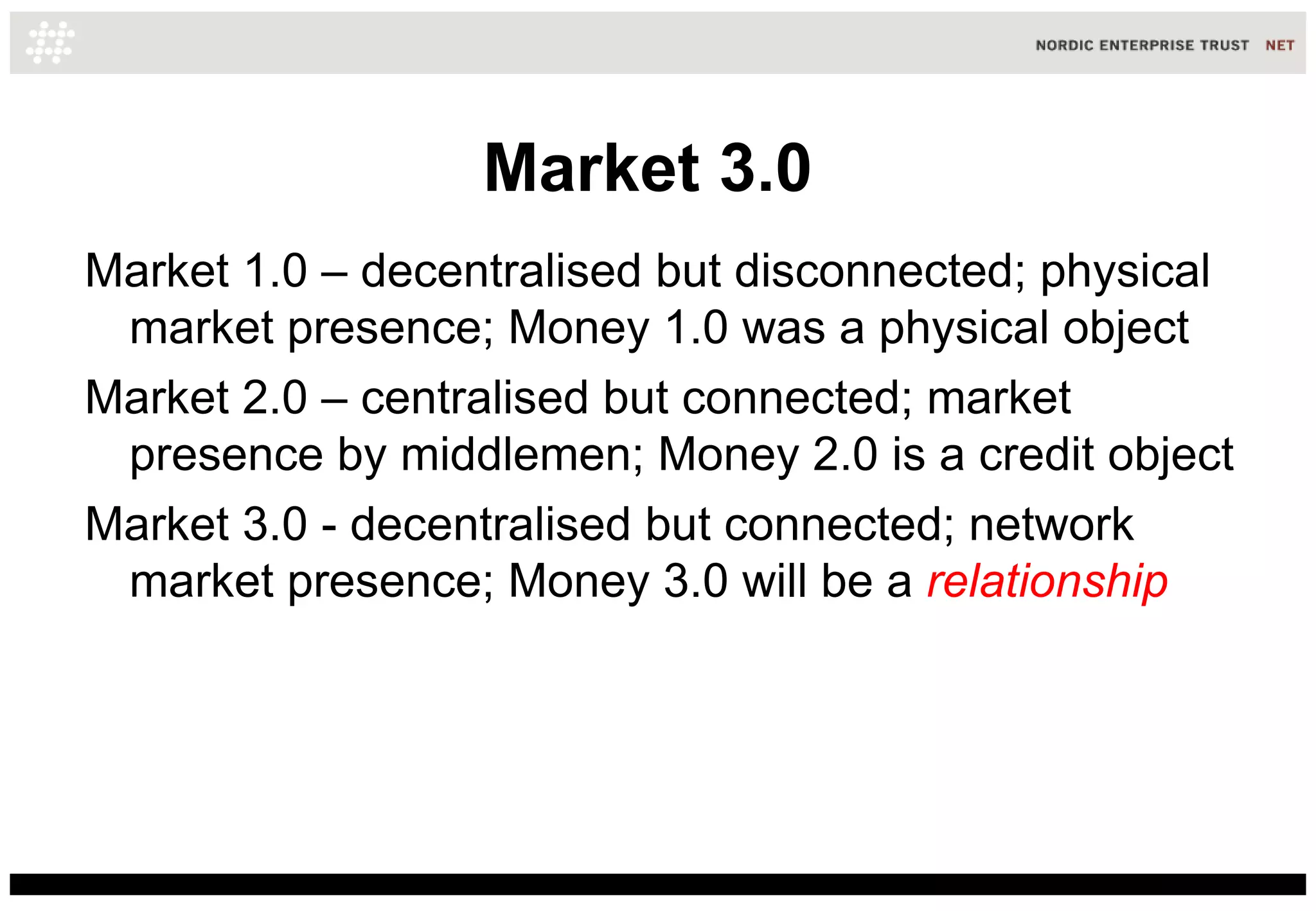
Market 1.0 – decentralised but disconnected; physical
 market presence; Money 1.0 was a physical object
Market 2.0 – centralised but connected; market
 presence by middlemen; Money 2.0 is a credit object
Market 3.0 - decentralised but connected; network
 market presence; Money 3.0 will be a relationship
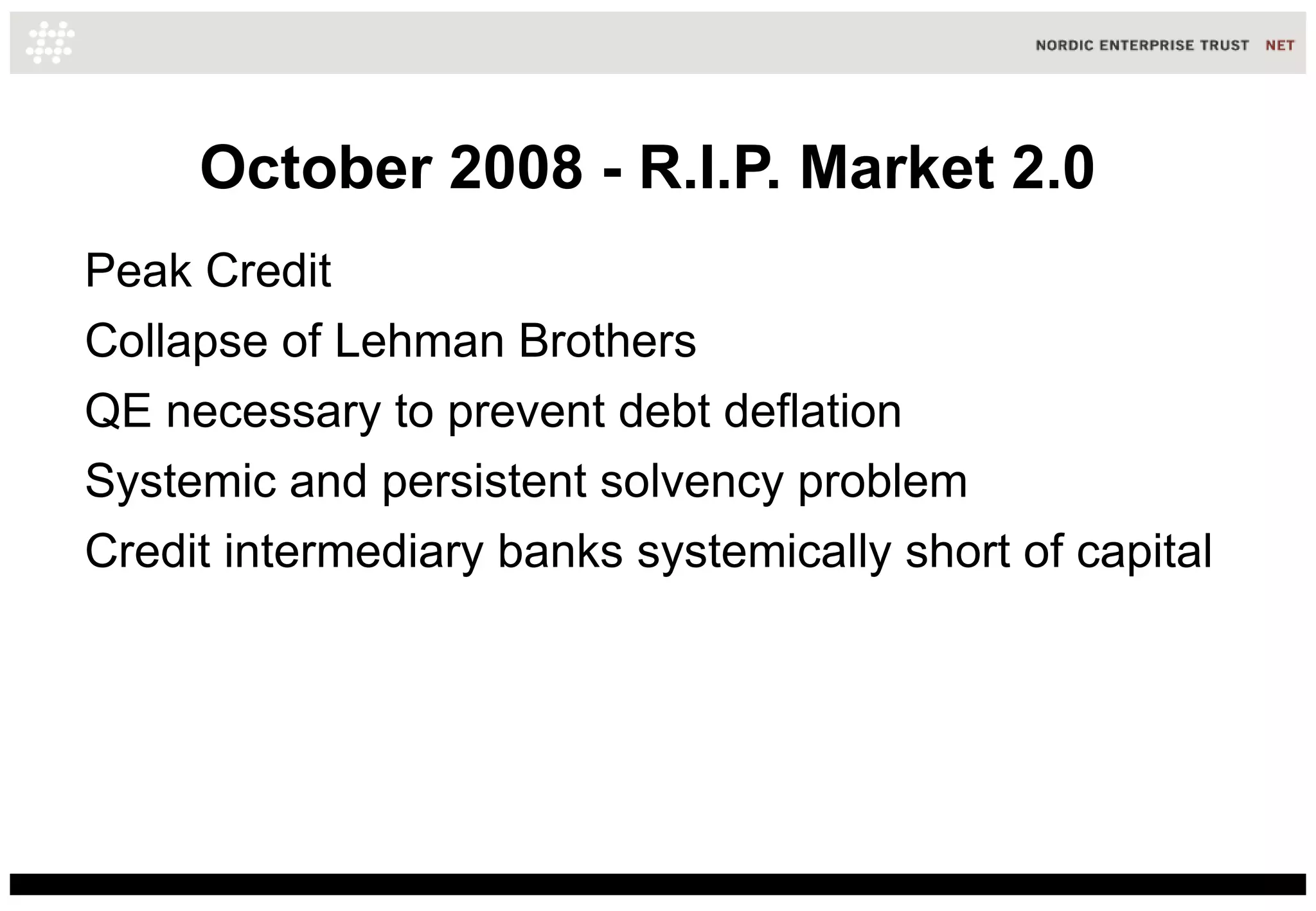
October 2008 - R.I.P. Market 2.0
Peak Credit
Collapse of Lehman Brothers
QE necessary to prevent debt deflation
Systemic and persistent solvency problem
Credit intermediary banks systemically short of capital
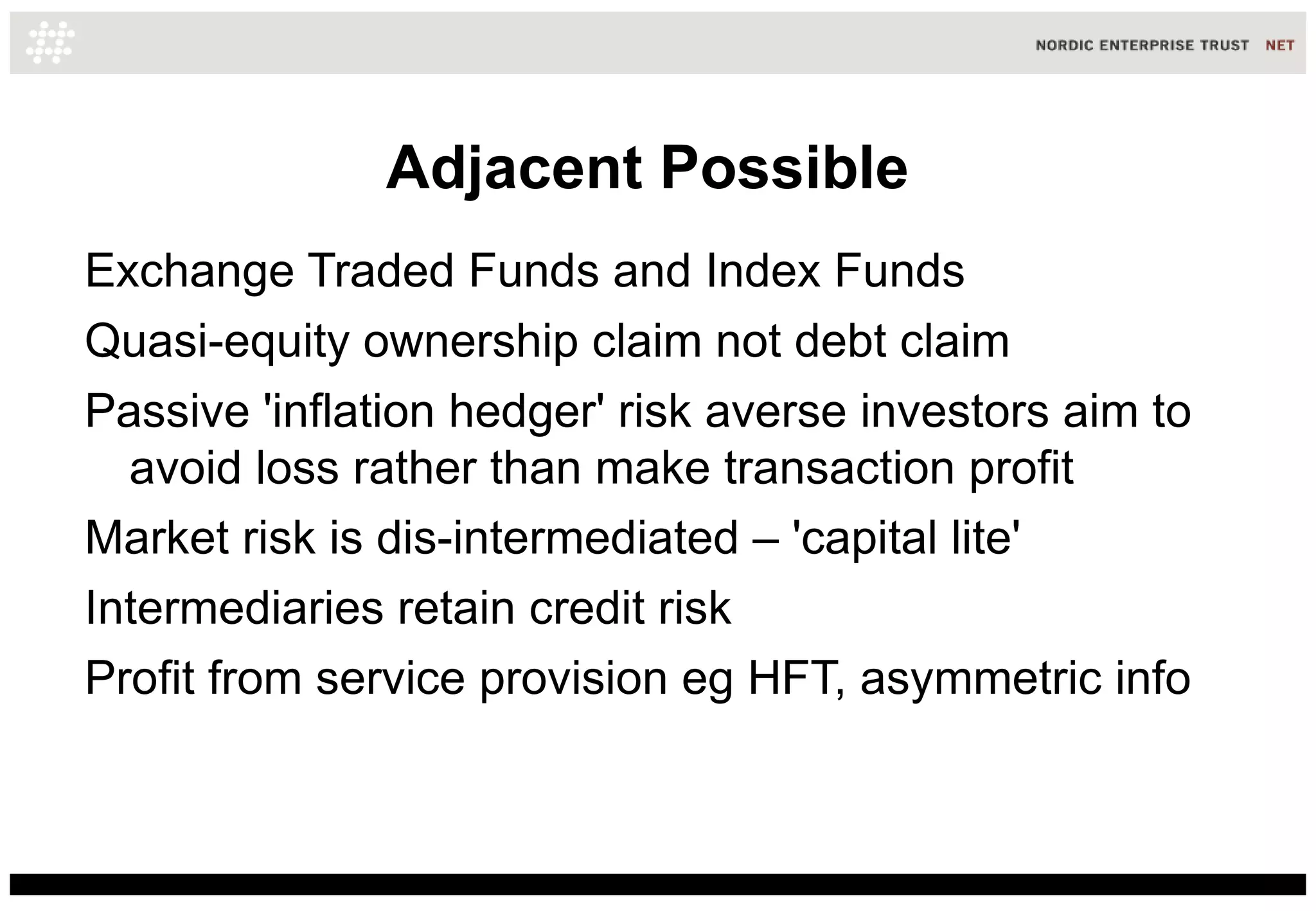
Adjacent Possible
Exchange Traded Funds and Index Funds
Quasi-equity ownership claim not debt claim
Passive 'inflation hedger' risk averse investors aim to
  avoid loss rather than make transaction profit
Market risk is dis-intermediated – 'capital lite'
Intermediaries retain credit risk
Profit from service provision eg HFT, asymmetric info
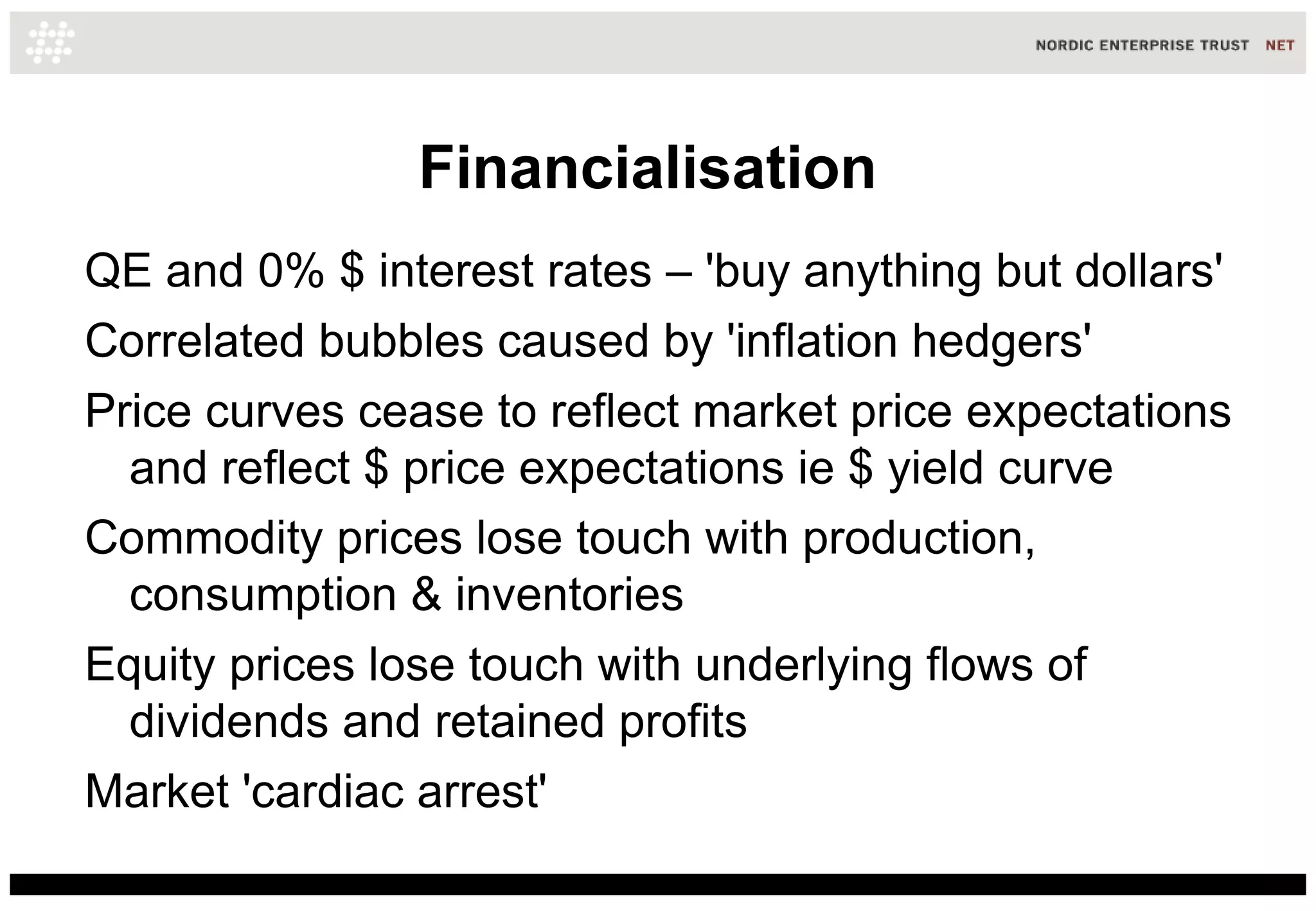
Financialisation
QE and 0% $ interest rates – 'buy anything but dollars'
Correlated bubbles caused by 'inflation hedgers'
Price curves cease to reflect market price expectations
  and reflect $ price expectations ie $ yield curve
Commodity prices lose touch with production,
  consumption & inventories
Equity prices lose touch with underlying flows of
  dividends and retained profits
Market 'cardiac arrest'
Correlated Commodity Bubbles
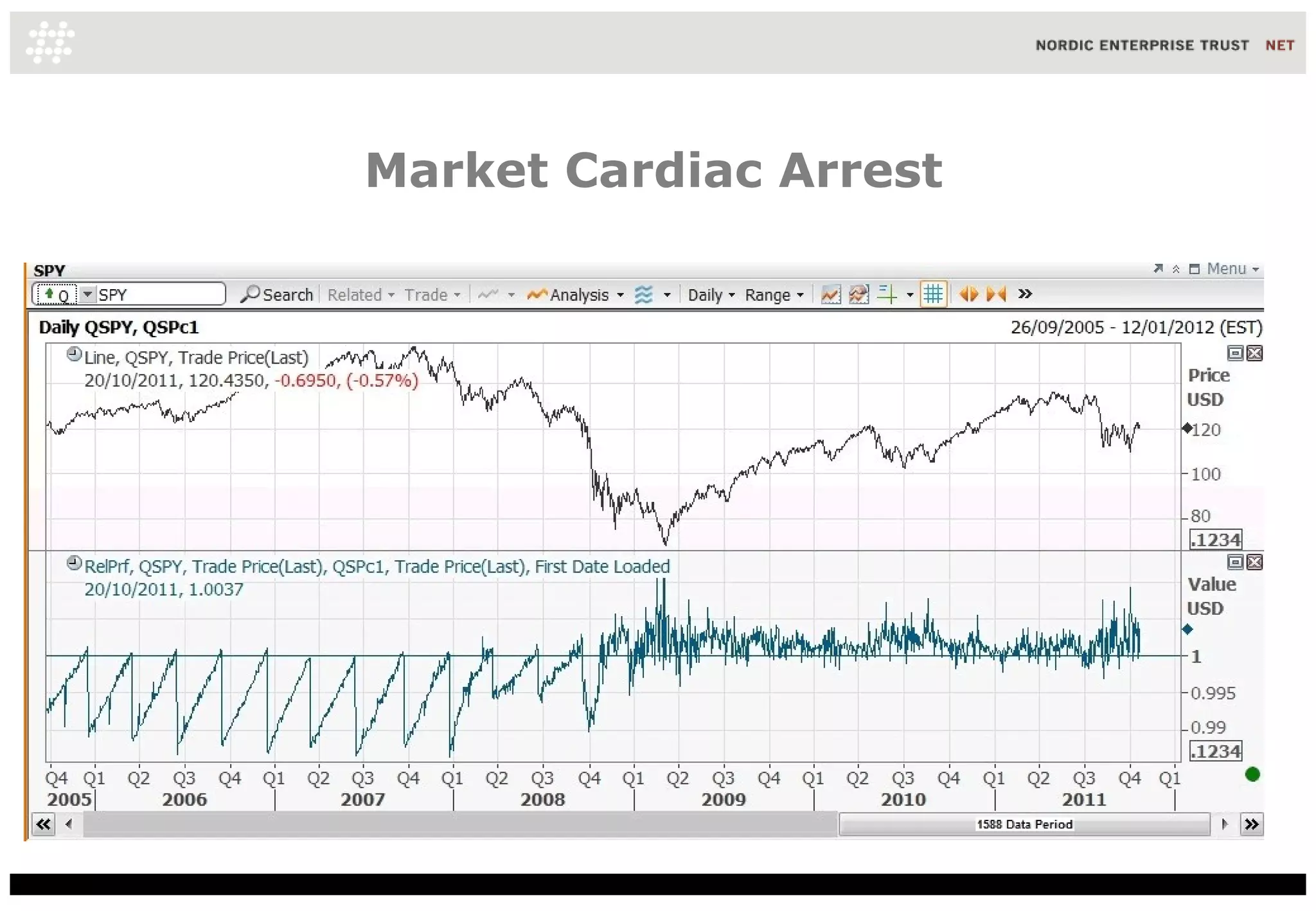
Market Cardiac Arrest
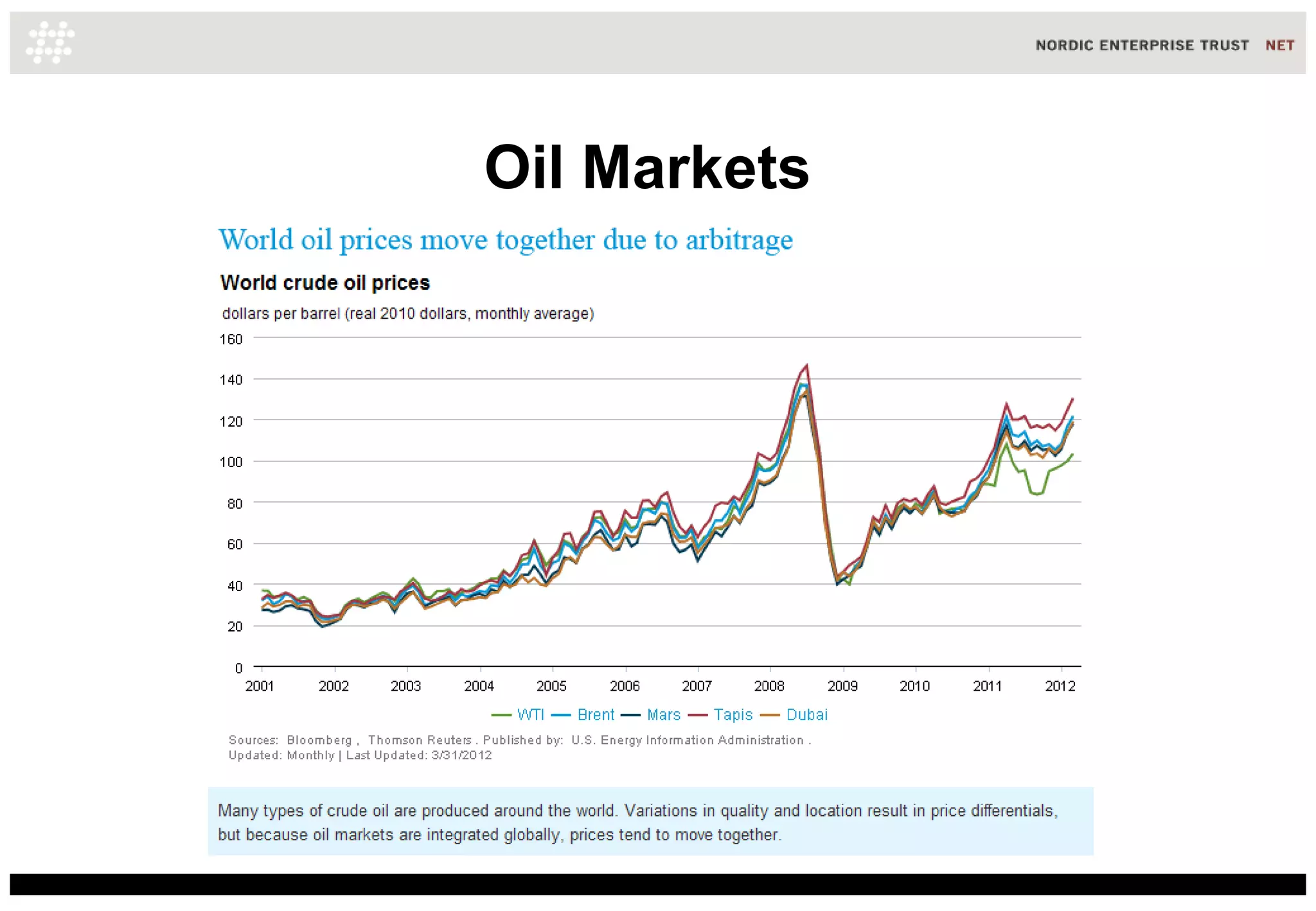
Oil Markets
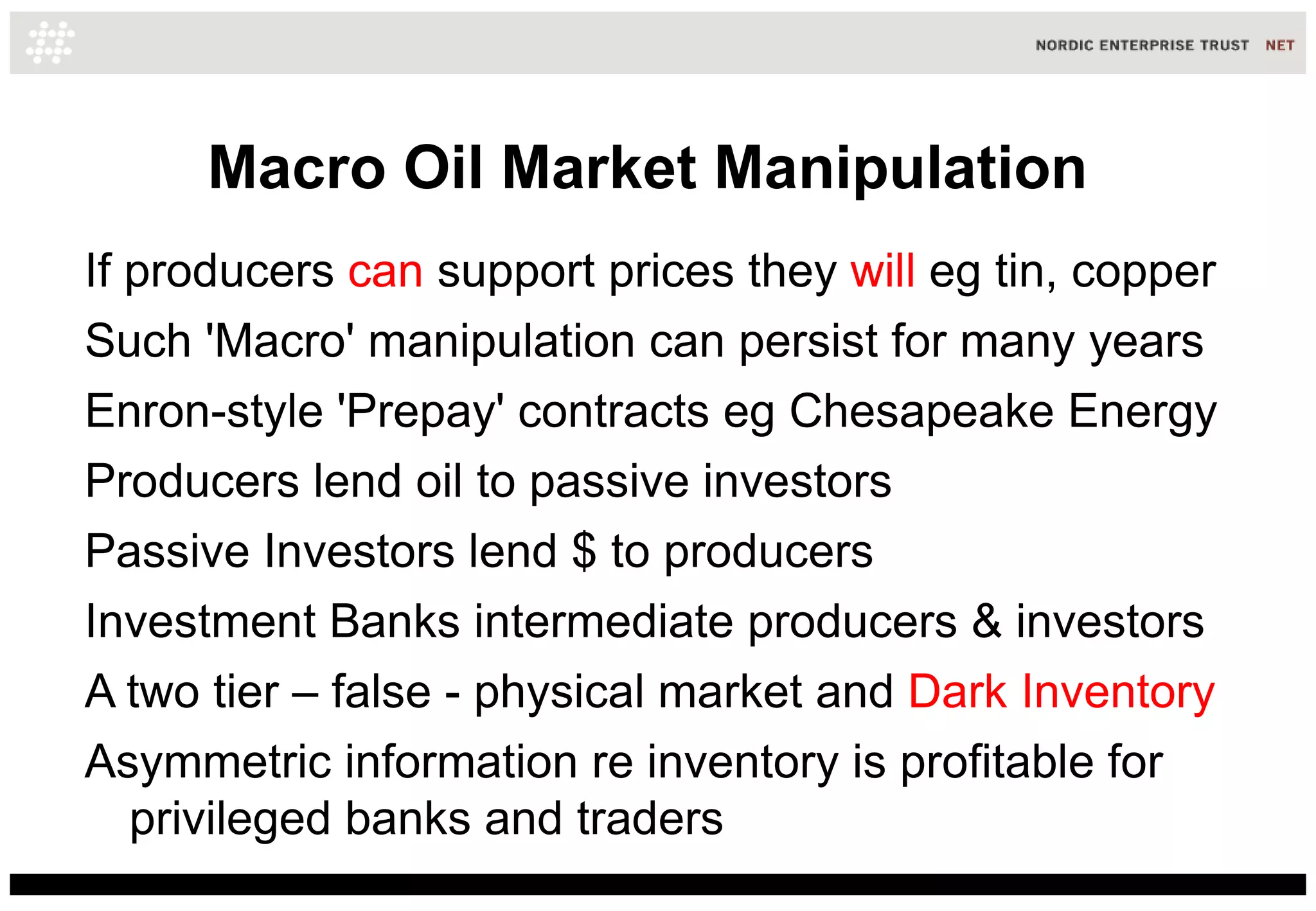
Macro Oil Market Manipulation
If producers can support prices they will eg tin, copper
Such 'Macro' manipulation can persist for many years
Enron-style 'Prepay' contracts eg Chesapeake Energy
Producers lend oil to passive investors
Passive Investors lend $ to producers
Investment Banks intermediate producers & investors
A two tier – false - physical market and Dark Inventory
Asymmetric information re inventory is profitable for
   privileged banks and traders
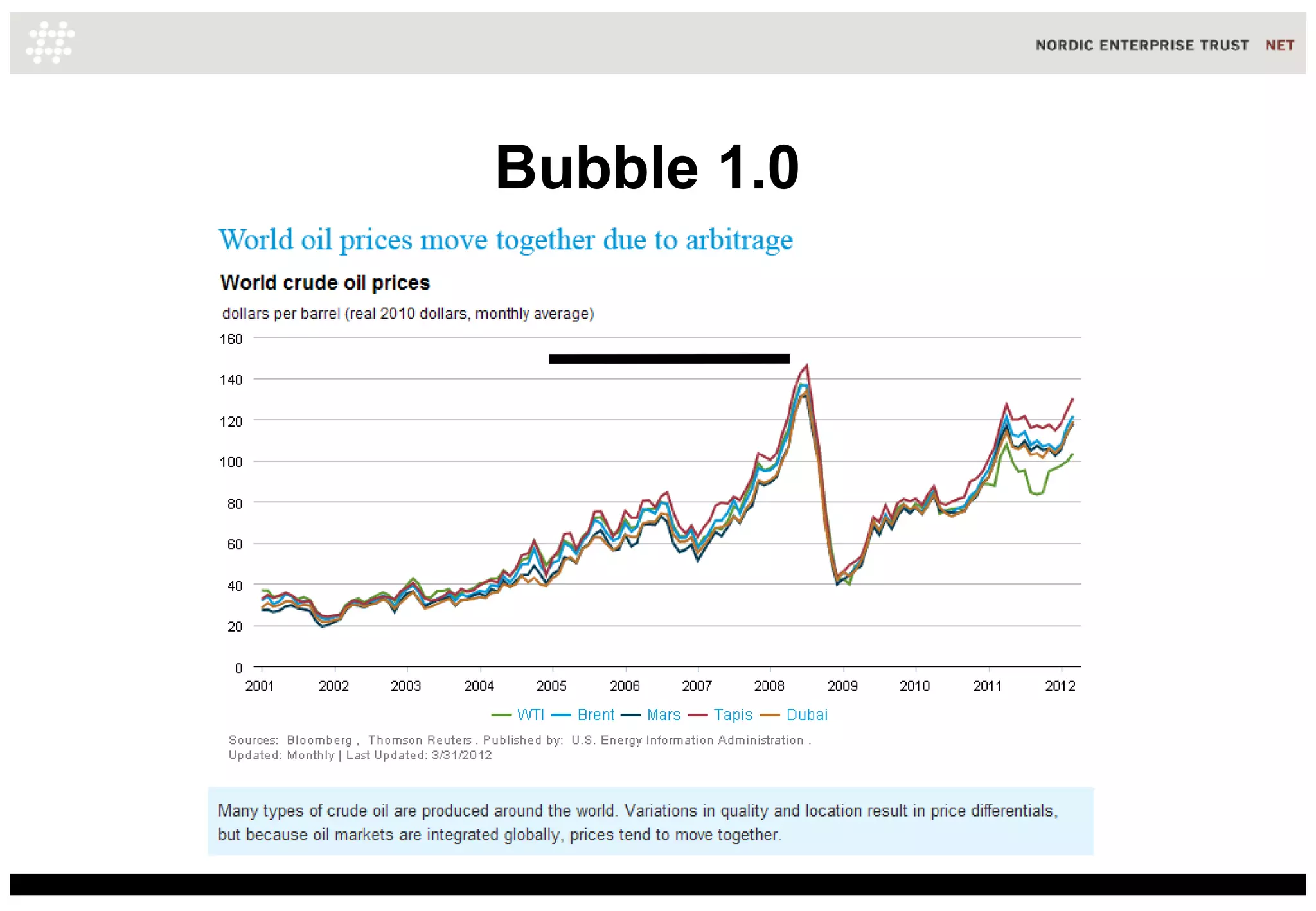
Bubble 1.0
2005 to July 2008 – Bubble 1.0
BP and Goldman Sachs joined at the head from 1995
GS creates Goldman Sachs Commodity Index fund
GS invents 'inflation hedging' meme
Prepay - GSCI lends $ to BP via GS
BP lends oil to GSCI via GS
Bubble 'spiked' in July 2008
July/December 2008 - Collapse
Price falls from $147/bbl to $35/bbl
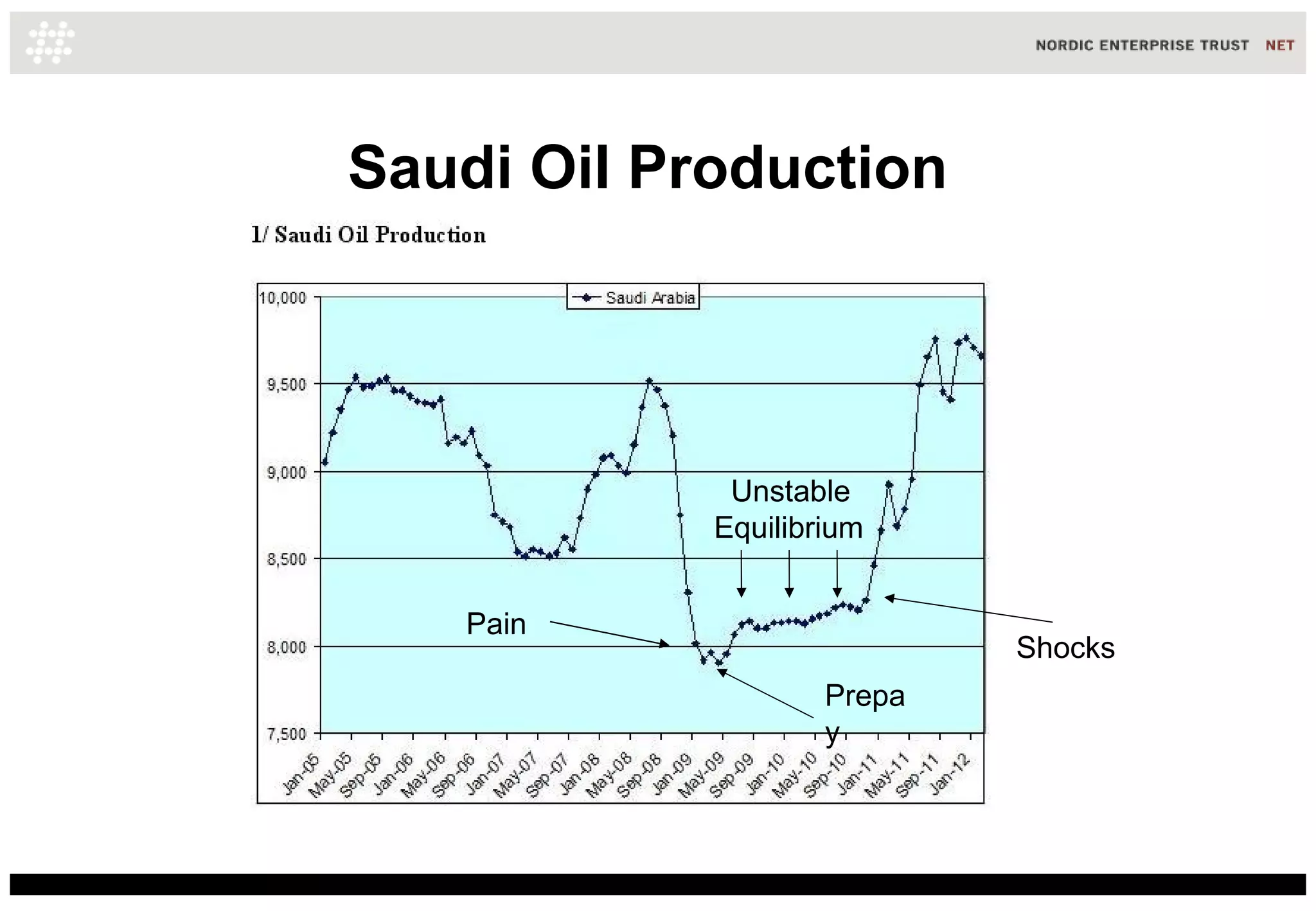
Saudis cut production by 1.5m bpd
Combination of price fall and production cut = Pain
October 2008 - $ billions of passive fund money flows
  into funds in response to ZIRP and QE
Saudis receive an offer they cannot refuse - Prepay
Saudi Oil Production


   Pain

               Prepa
               y
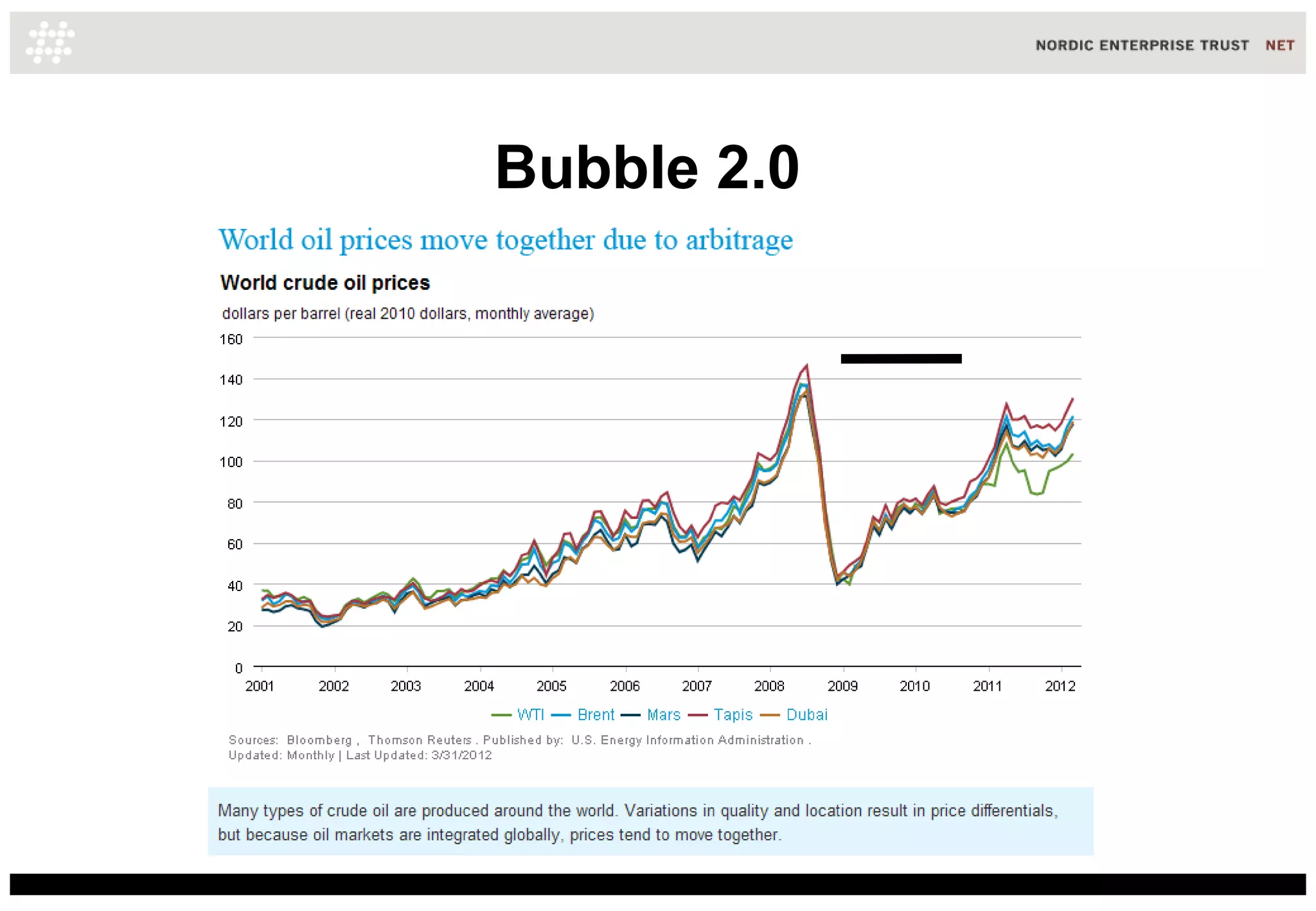
Bubble 2.0
Jan 2009 to March 2011 – Bubble 2.0
In or before January 2009 prepay programme begins
Market goes into 'super contango' and is re-inflated
Market price pegged for 18 months between $70 & $90
Unstable equilibrium
March 2011 - Libya supply shock & Japan demand shock
Saudi Oil Production


             Unstable
            Equilibrium


   Pain
                            Shocks
                    Prepa
                    y
End Game
March 2011 to Date – End Game
May 2011 - Libya/Japan shock subsides
September 2011 - passive investors pulling out
November 2011 - Iran risk premium commences
March 2012 and May 2012 Saudis deliver 20m bbl to the
   US – who are awash in oil (inventories @ 20 year high)
Prepays result in massive Saudi deliveries to US buyers
Market 1.5m to 3m bpd over-supplied
Iran risk premium subsiding
May 23rd Meeting in Baghdad
Muppets, Speculators & Shocks


                           Libya Shock
             What Shock?


                                         Iran Shock


03/04/10                                      19
Managed decline or Meltdown?
The market is going down as we speak
The risk is a market discontinuity
In 1985 the tin price collapsed from $8,000/tonne to
  $4,000/tonne overnight
WTI risk maybe $50/bbl drop
Brent risk maybe $60/bbl drop
This would wipe out speculators, some clearers and
  disrupt private 'too big to fail' clearing houses
What is the next Adjacent Possible?
ETF redeemable in gold recently launched
Fund units redeemable in payment for underlying asset
  reduce liquidity risk and credit risk
Stock – undated IOU returnable in payment for value
Pre-dates modern banking (from 1694)
Back to the Future
Next Adjacent Possible
'Peer to Asset' investment
Intermediaries become 'capital lite' service providers
Networked and resilient market with risk distributed to
   sellers and buyers collectively
Flight to Simplicity
Energy Doctrine
Stability – dis-intermediation reduces volatility and
  enables long term investment
Equity – fair balance between producers, consumers,
  service providers
High Carbon price – investment in renewables and
  energy savings funded out of shared surplus
Energy Standard – energy unit of account (not currency)
Energy Economics – investment decisions made on the
  basis of least energy cost rather than least dollar cost
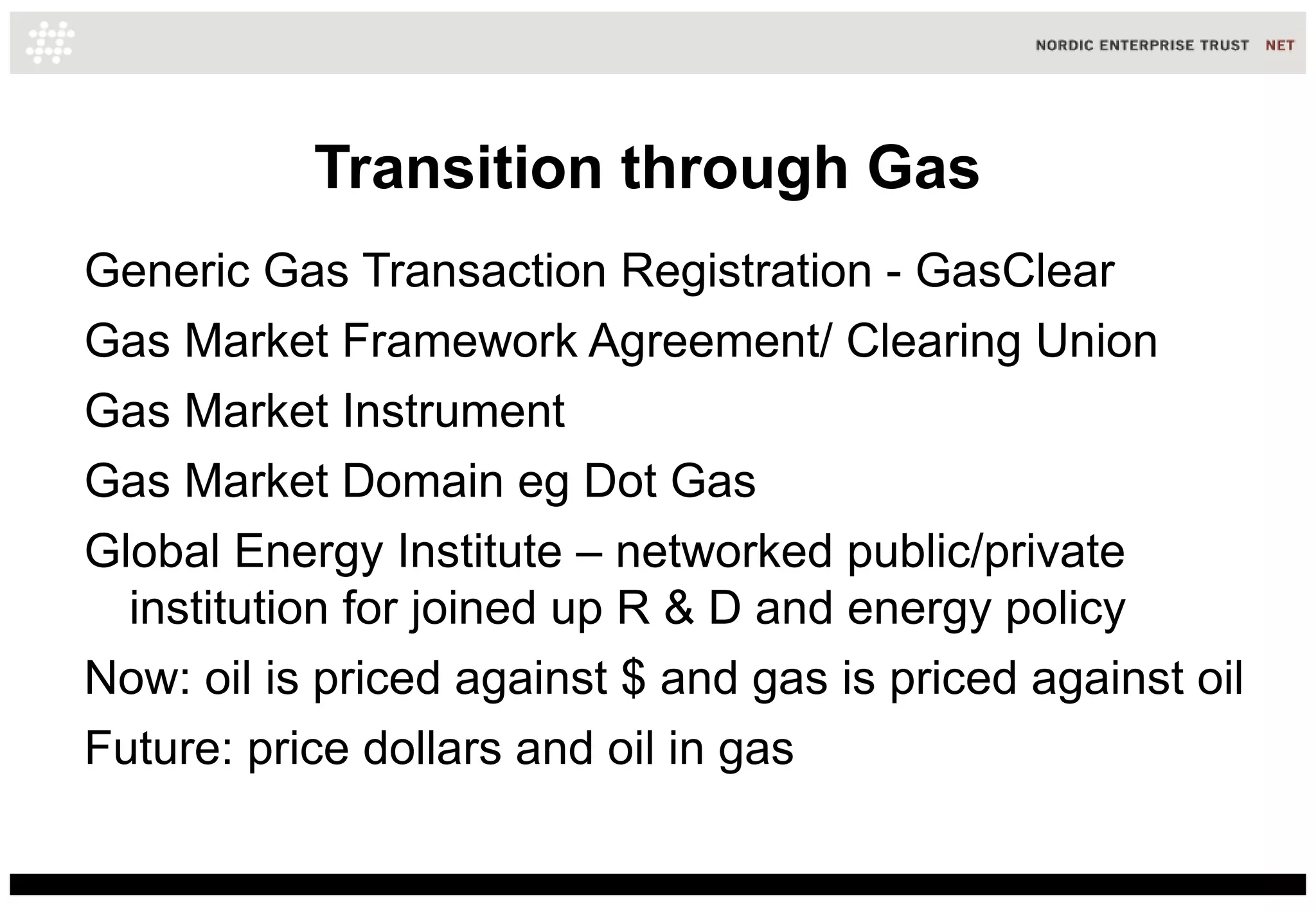
Transition through Gas
Generic Gas Transaction Registration - GasClear
Gas Market Framework Agreement/ Clearing Union
Gas Market Instrument
Gas Market Domain eg Dot Gas
Global Energy Institute – networked public/private
  institution for joined up R & D and energy policy
Now: oil is priced against $ and gas is priced against oil
Future: price dollars and oil in gas

Global Futures Forum

  • 1.
    Market 3.0 Transition through Gas Chris Cook 15 May 2012
  • 2.
    Market 3.0 Market 1.0– decentralised but disconnected; physical market presence; Money 1.0 was a physical object Market 2.0 – centralised but connected; market presence by middlemen; Money 2.0 is a credit object Market 3.0 - decentralised but connected; network market presence; Money 3.0 will be a relationship
  • 3.
    October 2008 -R.I.P. Market 2.0 Peak Credit Collapse of Lehman Brothers QE necessary to prevent debt deflation Systemic and persistent solvency problem Credit intermediary banks systemically short of capital
  • 4.
    Adjacent Possible Exchange TradedFunds and Index Funds Quasi-equity ownership claim not debt claim Passive 'inflation hedger' risk averse investors aim to avoid loss rather than make transaction profit Market risk is dis-intermediated – 'capital lite' Intermediaries retain credit risk Profit from service provision eg HFT, asymmetric info
  • 5.
    Financialisation QE and 0%$ interest rates – 'buy anything but dollars' Correlated bubbles caused by 'inflation hedgers' Price curves cease to reflect market price expectations and reflect $ price expectations ie $ yield curve Commodity prices lose touch with production, consumption & inventories Equity prices lose touch with underlying flows of dividends and retained profits Market 'cardiac arrest'
  • 6.
  • 7.
  • 8.
  • 9.
    Macro Oil MarketManipulation If producers can support prices they will eg tin, copper Such 'Macro' manipulation can persist for many years Enron-style 'Prepay' contracts eg Chesapeake Energy Producers lend oil to passive investors Passive Investors lend $ to producers Investment Banks intermediate producers & investors A two tier – false - physical market and Dark Inventory Asymmetric information re inventory is profitable for privileged banks and traders
  • 10.
  • 11.
    2005 to July2008 – Bubble 1.0 BP and Goldman Sachs joined at the head from 1995 GS creates Goldman Sachs Commodity Index fund GS invents 'inflation hedging' meme Prepay - GSCI lends $ to BP via GS BP lends oil to GSCI via GS Bubble 'spiked' in July 2008
  • 12.
    July/December 2008 -Collapse Price falls from $147/bbl to $35/bbl Saudis cut production by 1.5m bpd Combination of price fall and production cut = Pain October 2008 - $ billions of passive fund money flows into funds in response to ZIRP and QE Saudis receive an offer they cannot refuse - Prepay
  • 13.
  • 14.
  • 15.
    Jan 2009 toMarch 2011 – Bubble 2.0 In or before January 2009 prepay programme begins Market goes into 'super contango' and is re-inflated Market price pegged for 18 months between $70 & $90 Unstable equilibrium March 2011 - Libya supply shock & Japan demand shock
  • 16.
    Saudi Oil Production Unstable Equilibrium Pain Shocks Prepa y
  • 17.
  • 18.
    March 2011 toDate – End Game May 2011 - Libya/Japan shock subsides September 2011 - passive investors pulling out November 2011 - Iran risk premium commences March 2012 and May 2012 Saudis deliver 20m bbl to the US – who are awash in oil (inventories @ 20 year high) Prepays result in massive Saudi deliveries to US buyers Market 1.5m to 3m bpd over-supplied Iran risk premium subsiding May 23rd Meeting in Baghdad
  • 19.
    Muppets, Speculators &Shocks Libya Shock What Shock? Iran Shock 03/04/10 19
  • 20.
    Managed decline orMeltdown? The market is going down as we speak The risk is a market discontinuity In 1985 the tin price collapsed from $8,000/tonne to $4,000/tonne overnight WTI risk maybe $50/bbl drop Brent risk maybe $60/bbl drop This would wipe out speculators, some clearers and disrupt private 'too big to fail' clearing houses
  • 21.
    What is thenext Adjacent Possible? ETF redeemable in gold recently launched Fund units redeemable in payment for underlying asset reduce liquidity risk and credit risk Stock – undated IOU returnable in payment for value Pre-dates modern banking (from 1694) Back to the Future
  • 22.
    Next Adjacent Possible 'Peerto Asset' investment Intermediaries become 'capital lite' service providers Networked and resilient market with risk distributed to sellers and buyers collectively Flight to Simplicity
  • 23.
    Energy Doctrine Stability –dis-intermediation reduces volatility and enables long term investment Equity – fair balance between producers, consumers, service providers High Carbon price – investment in renewables and energy savings funded out of shared surplus Energy Standard – energy unit of account (not currency) Energy Economics – investment decisions made on the basis of least energy cost rather than least dollar cost
  • 24.
    Transition through Gas GenericGas Transaction Registration - GasClear Gas Market Framework Agreement/ Clearing Union Gas Market Instrument Gas Market Domain eg Dot Gas Global Energy Institute – networked public/private institution for joined up R & D and energy policy Now: oil is priced against $ and gas is priced against oil Future: price dollars and oil in gas