Meaning and Scope, Definitions, Rationale, Difference
between PPP and Privatization, Nature of collaboration,
Benefits, Types of p3, disadvantages, constraints and
benefits
 Define ppp
 Explain the meaning and scope of ppp. Also
explain the rationale of ppp.
 What are the benefits of ppp
 Difference between privatization and ppp
 What are the different types of ppp?
 Enumerate examples of P3 from Kerala and
India
 What is BOT? Explain in detail.
 Examine the disadvantages, constraints and
challenges of p3
 Though there is a great understanding of
what PPP is , there is no universally accepted
definition of what PPP is.
 In India, various government agencies have
given a number of definitions / descriptions
of the term p3 which indicate its nature and
scope.
 According to draft policy of pp partnership
brought by the government of Kerala, p3
refers to a long term contractual partnership
between public and private sector agencies
including co-operative institutions and other
non governmental organization specifically
targeted towards financing, designing,
implementing and operating infrastructure
facilities and services that are traditionally
provided by the govt. and/or its entities.
 “PPP is a mode of implementing government
programs and schemes in partnership with
private sector. The term “private” includes all
NGO’s such as corporate sector, voluntary
organization, self help groups, partnership
firms, individuals and community based
organizations. It subsumes all the objectives
of the services being provided earlier by the
government and is not intended to
compromise on them”------- the report of
PPP subgroup on social sector, govt of India
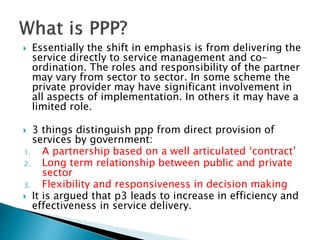
 Essentially the shift in emphasis is from delivering the
service directly to service management and co-
ordination. The roles and responsibility of the partner
may vary from sector to sector. In some scheme the
private provider may have significant involvement in
all aspects of implementation. In others it may have a
limited role.
 3 things distinguish ppp from direct provision of
services by government:
1. A partnership based on a well articulated ‘contract’
2. Long term relationship between public and private
sector
3. Flexibility and responsiveness in decision making
 It is argued that p3 leads to increase in efficiency and
effectiveness in service delivery.
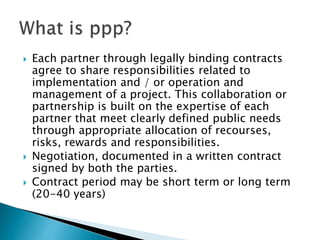
 Each partner through legally binding contracts
agree to share responsibilities related to
implementation and / or operation and
management of a project. This collaboration or
partnership is built on the expertise of each
partner that meet clearly defined public needs
through appropriate allocation of recourses,
risks, rewards and responsibilities.
 Negotiation, documented in a written contract
signed by both the parties.
 Contract period may be short term or long term
(20-40 years)
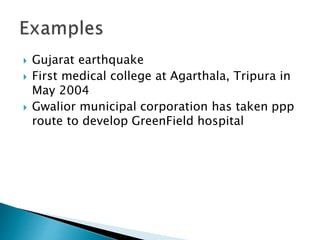
 Gujarat earthquake
 First medical college at Agarthala, Tripura in
May 2004
 Gwalior municipal corporation has taken ppp
route to develop GreenField hospital
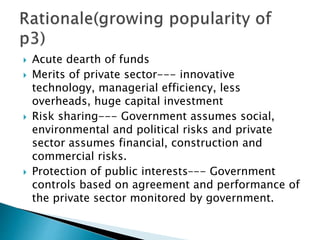
 Acute dearth of funds
 Merits of private sector--- innovative
technology, managerial efficiency, less
overheads, huge capital investment
 Risk sharing--- Government assumes social,
environmental and political risks and private
sector assumes financial, construction and
commercial risks.
 Protection of public interests–-- Government
controls based on agreement and performance of
the private sector monitored by government.
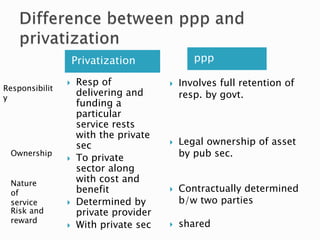
Privatization ppp
 Resp of
delivering and
funding a
particular
service rests
with the private
sec
 To private
sector along
with cost and
benefit
 Determined by
private provider
 With private sec
 Involves full retention of
resp. by govt.
 Legal ownership of asset
by pub sec.
 Contractually determined
b/w two parties
 shared
Responsibilit
y
Ownership
Nature
of
service
Risk and
reward
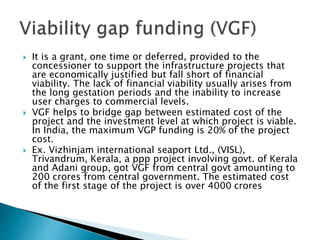
 It is a grant, one time or deferred, provided to the
concessioner to support the infrastructure projects that
are economically justified but fall short of financial
viability. The lack of financial viability usually arises from
the long gestation periods and the inability to increase
user charges to commercial levels.
 VGF helps to bridge gap between estimated cost of the
project and the investment level at which project is viable.
In India, the maximum VGP funding is 20% of the project
cost.
 Ex. Vizhinjam international seaport Ltd., (VISL),
Trivandrum, Kerala, a ppp project involving govt. of Kerala
and Adani group, got VGF from central govt amounting to
200 crores from central government. The estimated cost
of the first stage of the project is over 4000 crores
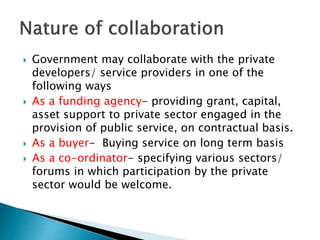
 Government may collaborate with the private
developers/ service providers in one of the
following ways
 As a funding agency- providing grant, capital,
asset support to private sector engaged in the
provision of public service, on contractual basis.
 As a buyer- Buying service on long term basis
 As a co-ordinator- specifying various sectors/
forums in which participation by the private
sector would be welcome.
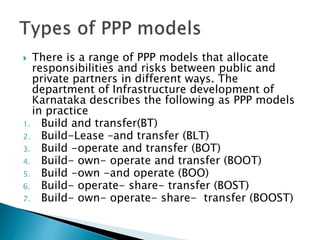
 There is a range of PPP models that allocate
responsibilities and risks between public and
private partners in different ways. The
department of Infrastructure development of
Karnataka describes the following as PPP models
in practice
1. Build and transfer(BT)
2. Build-Lease –and transfer (BLT)
3. Build -operate and transfer (BOT)
4. Build- own- operate and transfer (BOOT)
5. Build -own -and operate (BOO)
6. Build- operate- share- transfer (BOST)
7. Build- own- operate- share- transfer (BOOST)
 Build and transfer (BT) : A contractual agreement
whereby the concessionaire undertakes the financing
and construction of a given infrastructure or
development facility and after its completion turns it
to government agency or local government unit
concerned.
 Build- lease and- transfer (BLT)- A contractual
agreement whereby the concessionaire undertakes
the financing and construction of an infrastructure or
development facility and upon its completion turns it
to government agency or local government unit
concerned on a lease agreement for a fixed period
after which the ownership of the facility is
automatically transferred to government unit
concerned.
 Build, operate and transfer (BOT)- A contractual agreement
whereby the concessionaire undertake the construction,
including financing, of a given infrastructure facility and
the operation and maintenance thereof.
 Build-own-operate and transfer (BOOT)- A project based
on granting of a concession by a principal (Union or
government or a local authority) to the concessionaire,
who is responsible for the construction, financing,
operation and maintenance of a facility over the period of
the concession before finally transferring the facility at no
cost to the principal, a fully operational facility. During the
concession period, the promoter owns and operates the
facility and collects revenue in order to repay the financing
and investment costs, maintain and operate the facility
and make a margin of profit.
 Build- own –operate (BOO) A contractual agreement
whereby a concessionaire is authorized to finance,
construct, own, operate and maintain an infrastructure or
development facility from which the proponent is allowed
to recover its total investment, operating and maintenance
costs plus a reasonable return thereon by collecting tolls,
fees, rentals or other charges from facility users.
 Build –operate- share- transfer (BOST) A contractual
agreement whereby a concessionaire is authorized to
finance, construct, operate and maintain, share apart of
the revenue and transfer the infrastructure facility at the
end of the period. The proponent is allowed to recover its
total investment, operating and maintenance cost plus
reasonable return thereon by collecting tolls, fees, rentals
or other charges from facility users.
 Build-own-operate-share-transfer (BOOST):
A contractual agreement whereby a
concessionaire is authorized to finance,
construct, own operate and maintain, share a
part of the revenue and transfer the
infrastructure facility at the end of the period.
The proponent is allowed to recover its total
investment, operating and maintenance costs
plus a reasonable return thereon by
collecting tolls, fees, rentals or other charges
from facility users.
 BOT is a contractual arrangement whereby concessionaire
undertake the construction, financing, operation and
maintenance of the infrastructural facility. Operate over a
fixed term. Can recoup the investment cost through
rentals, tolls, fees extra as agreed upon in the legally
binding contract between the parties.
 Concessionaire transfers the facility at the end of the fixed
period to the government agency.
 Most popular models of PPP
 History could be traced back to 1834 when this model was
adopted for the development of Suez canal.
 It is used in the constructing of roads, bridges, railways,
airports, port water, sewer system etc.
 Concessioner act as the owner during the contract period.
The concession period may vary from 25 to 40 years
 Participants of BOT: (Pc2IO)
 Principal- The principal is usually a government body that
identifies the need for public facility and the need for a
private agency to finance, execute and the facility
 Concessionaire- is a person or business that has been
given the right to sell something on the property owned by
someone else. Thus concessionaire is the owner of the
facility during the concession period
 Investor- shareholders of the BOT project and the lenders
 Contractor- who is held responsible for the construction
of the project and for hiring subcontractors, suppliers and
consultants.
 Operator- is one who authorized by the concessionaire to
manage the operational stage of the facility.
 Cochin International airport (Cial)-first airport in india
developed under ppp model
 Trivandrum city road improvement project, Kochi
metro rail (1966 crores), Kannur airport (930
crores)through BOT
 Smart city at Kochi through BOO scheme, 1600 crores
 International container transshipment terminal (ICTT)
 Vizhinjam project-4360 crores, Adani group
 International container transshipment terminal (ICTT),
Vallarpadam, Kochi is a p3 project between Dubai
port world (DP world) and government of India
investing through Cochin port trust. 30 year BOT
agreement.
 Better identification of infrastructural projects and
projects in other preferred sectors and the
resultant economic and social benefits.
 Increase in investment, increase in the
development of infrastructure, leading to
acceleration of economic development.
 As a part of resources of the state is freed by the
ppp mode, more resources become available in
other priority areas and projects
 Cost effectiveness and better utilization national
resources as the selection of developers/service
providers depends on the competition or some
bench marking
 Time bound completion of projects since the
contracts generally have incentives and
penalty clauses vis-à-vis implementation of
capital projects/ programs.
 Possibility of enhancement of viability of the
project because of the involvement of
creditworthy sponsors and commercial
lenders
 Encouragement to productivity gains by
linking payment to performance
 The shift in focus from service input to output
may encourage innovation in service delivery and
enhances customer satisfaction.
 Encourages innovative decisions which generates
flexibility on account of decentralization.
 Assured maintenance during concession period,
the ppp concessionaire will be required to
maintain the projects in a proper predetermined
manner.
 Sharing project risks -the structure of ppp
project allocates the inherent risks to the agency
best suited to handle the same.
 PPP encounters several constraints and challenges.
1. Projects are very complicated from the viewpoint of technical, operational
and financial issues and need elaborate and expert detailing and evaluation.
2. There is lot of scope for corruption and nepotism
3. Efficient administrative system is required, fool proof and transparent
policies, regulation and monitoring mechanisms required.
4. Weakness in enabling policy and regulatory framework.
5. The market does not have adequate instruments and capacity to meet the
long term equity and debt financing needed by infrastructure projects
6. There is also lack of shelf of credible, bankable projects, which could be
offered for financing to the private sector.
7. Lack of capacity in public institutions and officials to manage PPP process.
8. How to incorporate the ideals of profit motive private sector and service
motive public sector is a question
9. Rational , fair and sustainable apportioning of risk is difficult.
10. Its is a challenge to manage partnership in a tightly framed concession
agreement over 20-30 years in a rapidly changing environment.
 PPP project life cycle
 PPP in India

Public private parnership.pptx

  • 1.
    Meaning and Scope,Definitions, Rationale, Difference between PPP and Privatization, Nature of collaboration, Benefits, Types of p3, disadvantages, constraints and benefits
  • 2.
     Define ppp Explain the meaning and scope of ppp. Also explain the rationale of ppp.  What are the benefits of ppp  Difference between privatization and ppp  What are the different types of ppp?  Enumerate examples of P3 from Kerala and India  What is BOT? Explain in detail.  Examine the disadvantages, constraints and challenges of p3
  • 3.
     Though thereis a great understanding of what PPP is , there is no universally accepted definition of what PPP is.  In India, various government agencies have given a number of definitions / descriptions of the term p3 which indicate its nature and scope.
  • 4.
     According todraft policy of pp partnership brought by the government of Kerala, p3 refers to a long term contractual partnership between public and private sector agencies including co-operative institutions and other non governmental organization specifically targeted towards financing, designing, implementing and operating infrastructure facilities and services that are traditionally provided by the govt. and/or its entities.
  • 5.
     “PPP isa mode of implementing government programs and schemes in partnership with private sector. The term “private” includes all NGO’s such as corporate sector, voluntary organization, self help groups, partnership firms, individuals and community based organizations. It subsumes all the objectives of the services being provided earlier by the government and is not intended to compromise on them”------- the report of PPP subgroup on social sector, govt of India
  • 6.
     Essentially theshift in emphasis is from delivering the service directly to service management and co- ordination. The roles and responsibility of the partner may vary from sector to sector. In some scheme the private provider may have significant involvement in all aspects of implementation. In others it may have a limited role.  3 things distinguish ppp from direct provision of services by government: 1. A partnership based on a well articulated ‘contract’ 2. Long term relationship between public and private sector 3. Flexibility and responsiveness in decision making  It is argued that p3 leads to increase in efficiency and effectiveness in service delivery.
  • 7.
     Each partnerthrough legally binding contracts agree to share responsibilities related to implementation and / or operation and management of a project. This collaboration or partnership is built on the expertise of each partner that meet clearly defined public needs through appropriate allocation of recourses, risks, rewards and responsibilities.  Negotiation, documented in a written contract signed by both the parties.  Contract period may be short term or long term (20-40 years)
  • 8.
     Gujarat earthquake First medical college at Agarthala, Tripura in May 2004  Gwalior municipal corporation has taken ppp route to develop GreenField hospital
  • 9.
     Acute dearthof funds  Merits of private sector--- innovative technology, managerial efficiency, less overheads, huge capital investment  Risk sharing--- Government assumes social, environmental and political risks and private sector assumes financial, construction and commercial risks.  Protection of public interests–-- Government controls based on agreement and performance of the private sector monitored by government.
  • 10.
    Privatization ppp  Respof delivering and funding a particular service rests with the private sec  To private sector along with cost and benefit  Determined by private provider  With private sec  Involves full retention of resp. by govt.  Legal ownership of asset by pub sec.  Contractually determined b/w two parties  shared Responsibilit y Ownership Nature of service Risk and reward
  • 11.
     It isa grant, one time or deferred, provided to the concessioner to support the infrastructure projects that are economically justified but fall short of financial viability. The lack of financial viability usually arises from the long gestation periods and the inability to increase user charges to commercial levels.  VGF helps to bridge gap between estimated cost of the project and the investment level at which project is viable. In India, the maximum VGP funding is 20% of the project cost.  Ex. Vizhinjam international seaport Ltd., (VISL), Trivandrum, Kerala, a ppp project involving govt. of Kerala and Adani group, got VGF from central govt amounting to 200 crores from central government. The estimated cost of the first stage of the project is over 4000 crores
  • 12.
     Government maycollaborate with the private developers/ service providers in one of the following ways  As a funding agency- providing grant, capital, asset support to private sector engaged in the provision of public service, on contractual basis.  As a buyer- Buying service on long term basis  As a co-ordinator- specifying various sectors/ forums in which participation by the private sector would be welcome.
  • 13.
     There isa range of PPP models that allocate responsibilities and risks between public and private partners in different ways. The department of Infrastructure development of Karnataka describes the following as PPP models in practice 1. Build and transfer(BT) 2. Build-Lease –and transfer (BLT) 3. Build -operate and transfer (BOT) 4. Build- own- operate and transfer (BOOT) 5. Build -own -and operate (BOO) 6. Build- operate- share- transfer (BOST) 7. Build- own- operate- share- transfer (BOOST)
  • 14.
     Build andtransfer (BT) : A contractual agreement whereby the concessionaire undertakes the financing and construction of a given infrastructure or development facility and after its completion turns it to government agency or local government unit concerned.  Build- lease and- transfer (BLT)- A contractual agreement whereby the concessionaire undertakes the financing and construction of an infrastructure or development facility and upon its completion turns it to government agency or local government unit concerned on a lease agreement for a fixed period after which the ownership of the facility is automatically transferred to government unit concerned.
  • 15.
     Build, operateand transfer (BOT)- A contractual agreement whereby the concessionaire undertake the construction, including financing, of a given infrastructure facility and the operation and maintenance thereof.  Build-own-operate and transfer (BOOT)- A project based on granting of a concession by a principal (Union or government or a local authority) to the concessionaire, who is responsible for the construction, financing, operation and maintenance of a facility over the period of the concession before finally transferring the facility at no cost to the principal, a fully operational facility. During the concession period, the promoter owns and operates the facility and collects revenue in order to repay the financing and investment costs, maintain and operate the facility and make a margin of profit.
  • 16.
     Build- own–operate (BOO) A contractual agreement whereby a concessionaire is authorized to finance, construct, own, operate and maintain an infrastructure or development facility from which the proponent is allowed to recover its total investment, operating and maintenance costs plus a reasonable return thereon by collecting tolls, fees, rentals or other charges from facility users.  Build –operate- share- transfer (BOST) A contractual agreement whereby a concessionaire is authorized to finance, construct, operate and maintain, share apart of the revenue and transfer the infrastructure facility at the end of the period. The proponent is allowed to recover its total investment, operating and maintenance cost plus reasonable return thereon by collecting tolls, fees, rentals or other charges from facility users.
  • 17.
     Build-own-operate-share-transfer (BOOST): Acontractual agreement whereby a concessionaire is authorized to finance, construct, own operate and maintain, share a part of the revenue and transfer the infrastructure facility at the end of the period. The proponent is allowed to recover its total investment, operating and maintenance costs plus a reasonable return thereon by collecting tolls, fees, rentals or other charges from facility users.
  • 18.
     BOT isa contractual arrangement whereby concessionaire undertake the construction, financing, operation and maintenance of the infrastructural facility. Operate over a fixed term. Can recoup the investment cost through rentals, tolls, fees extra as agreed upon in the legally binding contract between the parties.  Concessionaire transfers the facility at the end of the fixed period to the government agency.  Most popular models of PPP  History could be traced back to 1834 when this model was adopted for the development of Suez canal.  It is used in the constructing of roads, bridges, railways, airports, port water, sewer system etc.  Concessioner act as the owner during the contract period. The concession period may vary from 25 to 40 years
  • 19.
     Participants ofBOT: (Pc2IO)  Principal- The principal is usually a government body that identifies the need for public facility and the need for a private agency to finance, execute and the facility  Concessionaire- is a person or business that has been given the right to sell something on the property owned by someone else. Thus concessionaire is the owner of the facility during the concession period  Investor- shareholders of the BOT project and the lenders  Contractor- who is held responsible for the construction of the project and for hiring subcontractors, suppliers and consultants.  Operator- is one who authorized by the concessionaire to manage the operational stage of the facility.
  • 20.
     Cochin Internationalairport (Cial)-first airport in india developed under ppp model  Trivandrum city road improvement project, Kochi metro rail (1966 crores), Kannur airport (930 crores)through BOT  Smart city at Kochi through BOO scheme, 1600 crores  International container transshipment terminal (ICTT)  Vizhinjam project-4360 crores, Adani group  International container transshipment terminal (ICTT), Vallarpadam, Kochi is a p3 project between Dubai port world (DP world) and government of India investing through Cochin port trust. 30 year BOT agreement.
  • 21.
     Better identificationof infrastructural projects and projects in other preferred sectors and the resultant economic and social benefits.  Increase in investment, increase in the development of infrastructure, leading to acceleration of economic development.  As a part of resources of the state is freed by the ppp mode, more resources become available in other priority areas and projects  Cost effectiveness and better utilization national resources as the selection of developers/service providers depends on the competition or some bench marking
  • 22.
     Time boundcompletion of projects since the contracts generally have incentives and penalty clauses vis-à-vis implementation of capital projects/ programs.  Possibility of enhancement of viability of the project because of the involvement of creditworthy sponsors and commercial lenders  Encouragement to productivity gains by linking payment to performance
  • 23.
     The shiftin focus from service input to output may encourage innovation in service delivery and enhances customer satisfaction.  Encourages innovative decisions which generates flexibility on account of decentralization.  Assured maintenance during concession period, the ppp concessionaire will be required to maintain the projects in a proper predetermined manner.  Sharing project risks -the structure of ppp project allocates the inherent risks to the agency best suited to handle the same.
  • 24.
     PPP encountersseveral constraints and challenges. 1. Projects are very complicated from the viewpoint of technical, operational and financial issues and need elaborate and expert detailing and evaluation. 2. There is lot of scope for corruption and nepotism 3. Efficient administrative system is required, fool proof and transparent policies, regulation and monitoring mechanisms required. 4. Weakness in enabling policy and regulatory framework. 5. The market does not have adequate instruments and capacity to meet the long term equity and debt financing needed by infrastructure projects 6. There is also lack of shelf of credible, bankable projects, which could be offered for financing to the private sector. 7. Lack of capacity in public institutions and officials to manage PPP process. 8. How to incorporate the ideals of profit motive private sector and service motive public sector is a question 9. Rational , fair and sustainable apportioning of risk is difficult. 10. Its is a challenge to manage partnership in a tightly framed concession agreement over 20-30 years in a rapidly changing environment.
  • 25.
     PPP projectlife cycle  PPP in India