Jawaharlal Nehru Architecture & Fine Arts University
School of Planning and Architecture
B. Tech Planning IV year 8th semester
THESIS GUIDE: Dr. E. Sandhya
SUBMITTED BY: Vaka Tanmai Manisha
(19011BA040)
SHEET No.
ASSESSMENT ON ROLE OF PUBLIC PRIVATE PARTNERSHIP (PPP) Projects: A
Case Study On National Highways in Telangana
1
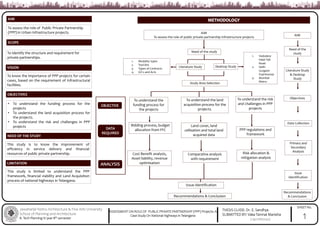
AIM
To assess the role of Public Private Partnership
(PPP) in Urban Infrastructure projects.
SCOPE
To identify the structure and requirement for
private partnerships.
VISION
To know the importance of PPP projects for certain
cases, based on the requirement of Infrastructural
facilities.
OBJECTIVES
• To understand the funding process for the
projects
• To understand the land acquisition process for
the projects.
• To understand the risk and challenges in PPP
projects
NEED OF THE STUDY
This study is to know the improvement of
efficiency in service delivery and financial
resources of public private partnership.
LIMITATION
To understand the risk
and challenges in PPP
projects
PPP regulations and
framework
Risk allocation &
mitigation analysis
Recommendations & Conclusion
AIM
To assess the role of public private partnership Infrastructure projects
Need of the study
Study Area Selection
To understand the
funding process for
the projects
To understand the land
acquisition process for the
projects.
Bidding process, budget
allocation from FFC
Land cover, land
utilisation and total land
acquired data
Cost Benefit analysis,
Asset liability, revenue
optimisation
Comparative analysis
with requirement
Literature Study Desktop Study
Issue Identification
1. Modality types
2. Tool kits
3. Types of Contracts
4. GO s and Acts
1. Vadodara
Halol Toll
Road
2. Delhi
Gurgaon
Expressway
3. Mumbai
Metro
AIM
Need of the
study
Literature Study
& Desktop
Study
Objectives
Data Collection
Primary and
Secondary
Analysis
Issue
Identification
Recommendations
& Conclusion
This study is limited to understand the PPP
framework, financial viability and Land Acquisition
process of national highways in Telangana.
Jawaharlal Nehru Architecture & Fine Arts University
School of Planning and Architecture
B. Tech Planning IV year 8th semester
THESIS GUIDE: Dr. E. Sandhya
SUBMITTED BY: Vaka Tanmai Manisha
(19011BA040)
SHEET No.
ASSESSMENT ON ROLE OF PUBLIC PRIVATE PARTNERSHIP (PPP) Projects: A
Case Study On National Highways in Telangana
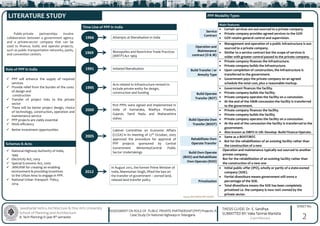
LITERATURE STUDY
Public-private partnerships involve
collaboration between a government agency
and a private-sector company that can be
used to finance, build, and operate projects,
such as public transportation networks, parks,
and convention centers.
 PPP will enhance the supply of required
services
 Provide relief from the burden of the costs
of design and
construction
 Transfer of project risks to the private
sector
 There will be better project design, choice
of technology, construction, operation and
maintenance service
 PPP projects are viably essential
 Work efficiency
 Better investment opportunities
1966 Attempts at liberalisation in India
1969 Monopolies and Restrictive Trade Practices
(MRTP) Act 1969
2005
Cabinet Committee on Economic Affairs
(CCEA) in its meeting of 27th October, 2005
approved the procedure for approval of
PPP projects sponsored by Central
Government Ministries/Central Public
Sector Undertakings
2000
first PPPs were signed and implemented in
India of Karnataka, Madhya Pradesh,
Gujarat, Tamil Nadu and Maharashtra
states.
2012
In August 2012, the former Prime Minister of
India, Manmohan Singh, lifted the ban on
the transfer of government – owned land,
relaxed land transfer policy
1995
Acts related to infrastructure revised to
include private entity for design,
construction and funding
1991 Initiated liberalisation
Time Line of PPP in India
Role of PPP in India
Schemes & Acts:
 National Highway Authority of India,
1995
 Electricity Act, 2003
 Special Economic Act, 2005
 JNNURM for creating an enabling
environment & providing incentives
to the Urban Area to engage in PPP.
 National Urban Transport Policy,
2014.
Main features
 Certain services are out-sourced to a private company.
 Private company provides agreed services to the GOV
 GOV retains general control and supervision.
 Management and operation of a public infrastructure is out-
sourced to a private company.
 Similar to a service contract but the scope of services is
wider with greater control passed to the private company.
 Private company finances the infrastructure.
 Private company builds the infrastructure.
 Upon completion of construction, the infrastructure is
transferred to the government.
 Government pays the private company on an agreed
schedule the total cost, plus a reasonable markup.
 Government finances the facility.
 Private company builds the facility.
 Private company operates the facility on a concession.
 At the end of the O&M concession the facility is transferred
to the government.
 Private company finances the facility.
 Private company builds the facility.
 Private company operates the facility on a concession.
 At the end of the concession the facility is transferred to the
government.
 Also known as DBFO in UK: Develop- Build Finance-Operate.
 Same as a BOOT/BOT.
 But for the rehabilitation of an existing facility rather than
the construction of a new
Operation and maintenance typically out sourced to another
private company.
But for the rehabilitation of an existing facility rather than
the construction of a new one
 Initial public offer (IPO), wholly or partly of a state-owned
company (SOE).
 Partial divestiture means government still owns a
percentage of the SOE.
 Total divestiture means the SOE has been completely
privatized i.e. the company is now 100% owned by the
private sector.
PPP Modality Types
Service
Contract
Operation and
Maintenance
contract (O & M)
Build Transfer / or
Annuity Type
Build Operate Own
Transfer (BOOT)
Rehabilitate Own
Operate Transfer
Build Own Operate
(BOO) and Rehabilitate
Own Operate (ROO)
Privatisation
Build Operate
Transfer (BOT)
Source: NITI AAYOG PPP TOOLKIT
2
Jawaharlal Nehru Architecture & Fine Arts University
School of Planning and Architecture
B. Tech Planning IV year 8th semester
THESIS GUIDE: Dr. E. Sandhya
SUBMITTED BY: Vaka Tanmai Manisha
(19011BA040)
SHEET No.
ASSESSMENT ON ROLE OF PUBLIC PRIVATE PARTNERSHIP (PPP) Projects: A
Case Study On National Highways in Telangana
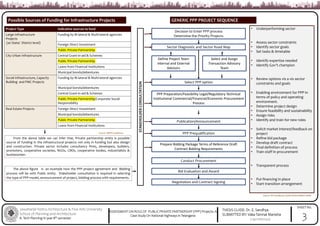
Decision to Enter PPP process
Determine the Priority Projects
Sector Diagnostic and Sector Road Map
Define Project Team
Internal and External
Advisors
Select and Assign
Transaction Advisory
Team
Select PPP option
PPP Preparation/Feasibility Legal/Regulatory Technical
Institutional Commercial/Financial/Economic Procurement
Process
Publication/Announcement
PPP Prequalification
Prepare Bidding Package Terms of Reference Draft
Contract Bidding Requirements
Conduct Procurement
Bid Evaluation and Award
Negotiation and Contract Signing
STAKEHOLDER
CONSULTATION
• Underperforming sector
• Assess sector constraints
• Identify sector goals
• Set tasks & timetable
• Identify expertise needed
• Identify Gov’t champion
• Review options vis a vis sector
constraints and goals
• Enabling environment for PPP in
terms of policy and operating
environment.
• Determine project design
• Ensure feasibility and sustainability
• Assign risks
• Identify and train for new roles
• Solicit market interest/feedback on
project
• Refine bid package
• Develop draft contract
• Final definition of process
• Train staff in procurement
• Transparent process
• Put financing in place
• Start transition arrangement
GENERIC PPP PROJECT SEQUENCE
Source: PPP Handbook, ASIAN DEVELOPMENT BANK
Project Type Indicative sources to fund
Large Infrastructure
Projects
(at State/ District level)
Funding by Bi-lateral & Multi-lateral agencies
Foreign Direct Investment
Public Private Partnership
City Urban Infrastructure Central Grant-in-aid & Schemes
Public Private Partnership
Loans from Financial Institutions
Municipal bonds/debentures
Social Infrastructure, Capacity
Building and PMC Projects
Funding by Bi‐lateral & Multi‐lateral agencies
Municipal bonds/debentures
Central Grant-in-aid & Schemes
Public Private Partnership/Corporate Social
Responsibility
Real Estate Projects Foreign Direct Investment
Municipal bonds/debentures
Public Private Partnership
Loans from Financial Institutions
Possible Sources of Funding for Infrastructure Projects
Source: URDPFI Guidelines
3
The above figure is an example how the PPP project agreement and Bidding
process will be with Public entity. Stakeholder consultation is required in selecting
the type of PPP model, announcement of project, bidding process with requirements.
From the above table we can infer that, Private partnership entity is possible
source of funding in the infrastructural projects not only in funding but also design
and construction. Private sector includes consultancy firms, developers, builders,
promoters, cooperative societies, NGOs, CBOs, cooperative bodies, industrialists &
businessmen.
Jawaharlal Nehru Architecture & Fine Arts University
School of Planning and Architecture
B. Tech Planning IV year 8th semester
THESIS GUIDE: Dr. E. Sandhya
SUBMITTED BY: Vaka Tanmai Manisha
(19011BA040)
SHEET No.
ASSESSMENT ON ROLE OF PUBLIC PRIVATE PARTNERSHIP (PPP) Projects: A
Case Study On National Highways in Telangana
Concessionaire’s
Special Purpose
Company
Govt. / Municipal Entity
Users /
Customers
Operator &
Maintenance Holder
Designer, Contractor
& Supplier
Shareholders
Lenders
Concession
Agreement
Payment for
Service
Operation & Maintenance
Agreement
Turnkey
Contract
Loan
Agreement
Shareholders
Agreement
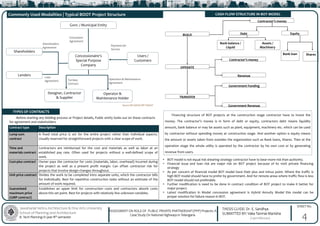
Commonly Used Modalities | Typical BOOT Project Structure
Source: NITI AAYOG PPP TOOLKIT
4
Contract type Description
Lump sum
contract
A fixed total price is set for the entire project rather than individual aspects.
Usually reserved for straightforward projects with a clear scope of work.
Time and
materials contract
Contractors are reimbursed for the cost and materials as well as labor at an
established pay rate. Often used for projects without a well-defined scope of
work.
Cost-plus contract Owner pays the contractor for costs (materials, labor, overhead) incurred during
the project as well as a present profit margin. Can offset contractor risk for
projects that involve design changes throughout.
Unit price contract Divides the work to be completed intro separate units, which the contractor bills
for individually. Best for repetitive construction tasks without an estimate of the
amount of work required.
Guaranteed
maximum price
(GMP contract)
Establishes an upper limit for construction costs and contractors absorb costs
above this set point. Best for projects with relatively few unknown variables.
TYPES OF CONTRACTS
Before starting any bidding process or Project details, Public entity looks out on these contracts
for agreement and stakeholders.
BUILD
OPERATE
TRANSFER
Equity
Bank balance /
Liquid
Debt
Contractor’s money
Assets /
Machinery
Bank loan Shares
Revenue
Contractor’s money
Government Funding
Government Revenue
CASH FLOW STRUCTURE IN BOT MODEL
• BOT model is not equal risk shearing strategy contractor have to bear more risk than authority.
• Financial issue and loan risk are major risk on BOT project because of its 100% private financing
strategy
• As per concern of financial model BOT model have their plus and minus point. Where the traffic is
high BOT model should have to prefer by government. And for remote areas where traffic flow is less
BOT model should not preferable.
• Further modification is need to be done in contract condition of BOT project to make it better for
major project.
• Latest modification in Model concession agreement is Hybrid Annuity Model this model can be
proper solution for failure reason in BOT.
Financing structure of BOT projects at the construction stage contractor have to invest the
money. The contractor’s money is in form of debt or equity, contractors debt means liquidity
amount, bank balance or may be assets such as plant, equipment, machinery etc. which can be used
by contractor without spending money at construction stage. And another option is equity means
the amount or assets taken from outsides the organization such as Bank loans, Shares. Then at the
operation stage the whole utility is operated by the contractor by his own cost or by generating
revenue from users.
Jawaharlal Nehru Architecture & Fine Arts University
School of Planning and Architecture
B. Tech Planning IV year 8th semester
THESIS GUIDE: Dr. E. Sandhya
SUBMITTED BY: Vaka Tanmai Manisha
(19011BA040)
SHEET No.
ASSESSMENT ON ROLE OF PUBLIC PRIVATE PARTNERSHIP (PPP) Projects: A
Case Study On National Highways in Telangana
Source: Department of Economic Affairs
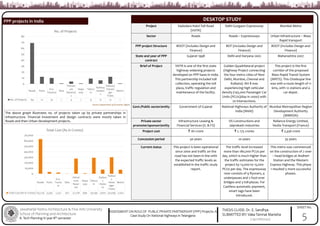
PPP projects in India
Roads Ports
Eco-
Tourism
Silos
Petrole
um
Reserve
s
Rope
way
Teleco
m
Railway
Station
s
Railway
Passen
ger
Trains
Metro
No. of Projects 69 12 10 1 4 1 9 6 12 1
0
10
20
30
40
50
60
70
80
No. of Projects
The above graph illustrates no. of projects taken up by private partnerships in
infrastructure. Financial investment and design contracts were mostly taken in
Roads and then Urban development projects.
Roads Ports
Eco-
Touris
m
Silos
Petrol
eum
Reser
ves
Rope
way
Teleco
m
Railwa
y
Statio
ns
Railwa
y
Passe
nger
Trains
Metro
Total Cost (Rs in Crores) 63,279 3,359 2,232 401 27,728 996 29,199 7,600 30,099 7,420
0
10,000
20,000
30,000
40,000
50,000
60,000
70,000
Total Cost (Rs in Crores)
DESKTOP STUDY
Project Vadodara Halol Toll Road
(VHTR)
Delhi Gurgaon Expressway Mumbai Metro
Sector Roads Roads – Expressways Urban infrastructure – Mass
Rapid transport
PPP project Structure BOOT (includes Design and
Finance)
BOT (includes Design and
Finance)
BOOT (includes Design and
Finance)
State and year of PPP
contract
Gujarat 1998 Delhi and Haryana 2002 Maharashtra 2007
Brief of Project VHTR is one of the first state
highway widening projects
developed on PPP basis in India.
This partnership included toll
collection, operating the toll
plaza, traffic regulation and
maintenance of the facility.
Golden Quadrilateral project
(Highway Project connecting
the four metro cities of New
Delhi, Mumbai, Chennai and
Kolkata). NH 8 was
experiencing high vehicular
density (145,000 Passenger Car
Units (PCUs)/day in 2000) with
20 intersections.
This project is the first
corridor of the proposed
Mass Rapid Transit System
(MRTS). This Ghatkopar line
was with a route length of 11
kms, with 12 stations and a
car depot.
Govt./Public sector/entity Government of Gujarat National Highways Authority of
India (NHAI)
Mumbai Metropolitan Region
Development Authority
(MMRDA)
Private sector
promoter/sponsor/entity
Infrastructure Leasing &
Financial Services (IL & FS)
DS Constructions and
Jaiprakash Industries
Reliance Energy Limited,
Veolia Transport (France)
Project cost ₹ 161 crore ₹ 1, 175 crores ₹ 2,356 crore
Concession period 30 years 20 years 35 years
Current status This project is been operational
since 2000 and traffic on the
road has not been in line with
the expected traffic levels as
established in the traffic study
report.
The traffic level increased
more than 180,000 PCUs per
day, which is much higher than
the traffic estimates for the
project by 13,000 to 15,000
PCUs per day. The expressway
now consists of 9 flyovers, 4
underpasses and 2 foot-over
bridges and 3 toll-plazas. For
Cashless automatic payment,
smart tags have been
introduced.
This metro was commenced
on the construction of 2 over
– head bridges at Andheri
Station and the Western
Express Highway. This phase
1 resulted 5 more successful
phases.
5
Jawaharlal Nehru Architecture & Fine Arts University
School of Planning and Architecture
B. Tech Planning IV year 8th semester
THESIS GUIDE: Dr. E. Sandhya
SUBMITTED BY: Vaka Tanmai Manisha
(19011BA040)
SHEET No.
ASSESSMENT ON ROLE OF PUBLIC PRIVATE PARTNERSHIP (PPP) Projects: A
Case Study On National Highways in Telangana
DESKTOP STUDY
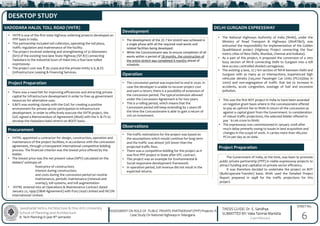
VADODARA HALOL TOLL ROAD (VHTR)
• VHTR is one of the first state highway widening projects developed on
PPP basis in India.
• This partnership included toll collection, operating the toll plaza,
traffic regulation and maintenance of the facility.
• The project involved widening and strengthening of 32 kilometers
(km) of the existing two-lane State Highway (SH 87) connecting
Vadodara to the industrial town of Halol into a four-lane tolled
expressway.
• The project cost was ₹ 161 crore and the private entity is IL & FS
(Infrastructure Leasing & Financing Services.
Project Preparation
• There was a need felt for improving efficiencies and attracting private
capital for infrastructure development in order to free up government
resources for alternative uses.
• IL&FS was working closely with the GoG for creating a positive
environment for private sector participation in infrastructure
development. In order to effectively execute the VHTR project, the
GoG signed a Memorandum of Agreement (MoA) with the IL & FS to
develop the Vadodara Halol stretch on BOOT basis.
Procurement
• VHTRL appointed a contractor for design, construction, operation and
maintenance of the project facilities, in accordance with the concession
agreement, through a transparent international competitive bidding
process. The financial criterion was the lowest price offered by the
bidder.
• The lowest price was the net present value (NPV) calculated on the
bidders’ estimate of:
fixed price of construction;
interest during construction;
and costs during the concession period on routine
maintenance, periodic maintenance (renewal and
overlay), toll systems, and toll augmentation
• VHTRL entered into an Operations & Maintenance Contract dated
January 22, 1999 (O&M Agreement) with Punj Lloyd Limited and IRCON
International Limited.
Development
• The development of the 31.7 km stretch was achieved in
a single phase with all the required road works and
related facilities being developed.
• While the Concessionaire was to ensure completion of all
works within a period of 18 months, the construction of
the entire stretch was completed 4 months ahead of
schedule.
Operation
• The concession period was expected to end in 2030. In
case the developer is unable to recover project cost
and earn a return, there is a possibility of extension of
the concession period. The typical extension allowed
under the Concession Agreement is for two years.
• This is a rolling period, which means that the
Concession period will keep extending by 2 years till
the time the Concessionaire is able to gain a return of
20% on investment.
Observations
• The traffic estimations for the project was based on
the assumptions which would continue for long term
and the traffic was almost 50% lower than the
projected traffic flow.
• There was a competitive bidding for this project as it
was first PPP project in State after EPC contract.
• This project was an example for Environmental &
Social responsive development framework.
• In operation period, toll revenue did not result in the
expected returns.
DELHI GURGAON EXPRESSWAY
• The National Highways Authority of India (NHAI), under the
Ministry of Road Transport & Highways (MoRT&H), was
entrusted the responsibility for implementation of the Golden
Quadrilateral project (Highway Project connecting the four
metro cities of New Delhi, Mumbai, Chennai and Kolkata).
• As a part of this project, it proposed the conversion of a very
busy section of NH-8 connecting Delhi to Gurgaon into a 6/8
lane access controlled divided carriageway.
• The existing 4 lane, 27.7 km section of NH-8 between Delhi and
Gurgaon with as many as 20 intersections, experienced high
vehicular density (145,000 Passenger Car Units (PCUs)/day in
2000) and non-segregation of traffic that led to increase in
accidents, acute congestion, wastage of fuel and excessive
pollution.
• This was the first BOT project in India to have been awarded
on negative grant basis where in the concessionaire offered
to pay an upfront fee to NHAI in return of the concession as
against a capital grant from the Government. In consideration
of robust traffic projections, the selected bidder offered to
pay ` 61.06 crore to NHAI.
• The expressway was commissioned in January 2008 after
much delay primarily owing to issues in land acquisition and
changes in the scope of work. It carries more than 180,000
PCUs per day as on date.
Project Preparation
The Government of India, at the time, was keen to promote
public private partnership (PPP) in viable expressway projects to
attract funding and capitalize on private sector efficiency.
It was therefore decided to undertake the project on BOT
(Build-operate-Transfer) basis. NHAI used the Detailed Project
Report prepared in 1998 for the traffic projections for this
project.
6
Jawaharlal Nehru Architecture & Fine Arts University
School of Planning and Architecture
B. Tech Planning IV year 8th semester
THESIS GUIDE: Dr. E. Sandhya
SUBMITTED BY: Vaka Tanmai Manisha
(19011BA040)
SHEET No.
ASSESSMENT ON ROLE OF PUBLIC PRIVATE PARTNERSHIP (PPP) Projects: A
Case Study On National Highways in Telangana
Procurement
• The project was initially envisaged to require a capital grant to
be paid by NHAI to the successful bidder towards the cost of
construction for enhancing the viability of the highway project.
• However, considering the robust traffic projections, bids were
received with negative grants. In April 2002, the consortium of
Jaiprakash Industries and DS Constructions was declared the
successful bidder.
• RBM Malaysia, which was the L2 bidder, had quoted ` 55 crore
as the negative grant. Other bidders were Gamuda Malaysia,
IJM Malaysia and Larsen & Toubro (L&T).
Development
• The construction of the expressway commenced in January
2003.
• The project development, however, soon ran into issues over
approvals, land acquisition and additions to the scope of work
which was largely due to the physical setting of the project
highway.
• NHAI and other agencies involved with this project put in a great
deal of effort to hasten the process. However, there were certain
small parcels of land which were difficult to acquire. In addition,
court cases, removal of trees, shifting of religious structures and
the massive number of utilities that had to be shifted contributed
to the delay.
• The provisional change of scope order was finalized and issued to
the concessionaire in July 2005 just days before the original
scheduled completion date.
Operation
• The project was commissioned on 25 January, 2008. The
expressway is fully operational and is handling a significant
traffic volume of more than 180,000 PCUs per day, growing at
9% year-on-year.
• The concession period is for 20 years and the projected end
date is 11 January 2023 when the expressway will be handed
over to the government.
Observations
• There was delay in Land acquisition process due to thickly
populated surrounding areas of the expressway which made delay
in project procurement to private entity.
• There was need of approval of more than 15 govt. agencies / civic
bodies for this project connectivity.
• Traffic forecast was outdated, resulting double of > 80, 000 PCUs
(Passenger Car Unit) and traffic risk.
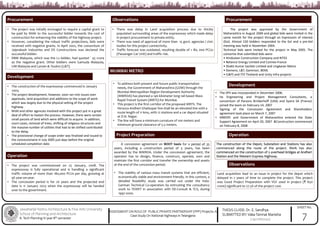
MUMBAI METRO
• To address both present and future public transportation
needs, the Government of Maharashtra (GOM) through the
Mumbai Metropolitan Region Development Authority
(MMRDA) has planned a 146 kilometer long rail based Mass
Rapid Transit System (MRTS) for Mumbai.
• This project is the first corridor of the proposed MRTS. The
Versova Andheri Ghatkopar line shall be an elevated line with a
route length of 11 kms, with 12 stations and a car depot situated
at D.N. Nagar.
• The line will have a minimum curvature of 100 meters and
minimum ground clearance of 5.5 meters.
Project Preparation
A concession agreement on BOOT basis for a period of 35
years, including a construction period of 5 years, has been
awarded by the MMRDA. Under the concession agreement, the
operator has to design, finance, construct, operate, own and
maintain the first corridor and transfer the ownership and assets
at the end of the concession period.
• The viability of various mass transit systems that are efficient,
economically viable and environment friendly. In this context, a
detailed feasibility study was carried out under the Indo-
German Technical Co-operation by entrusting the consultancy
work to TEWET in association with DE-Consult & TCS, during
1997-2000.
Procurement
The project was approved by the Government of
Maharashtra in August 2004 and global bids were invited in the
same month for the project through an Expression of Interest
(EoI). Almost 150 bidders responded to the EoI and a pre-bid
meeting was held in November 2004.
Technical bids were invited for the project in May 2005. The
consortia that submitted bids were:
• Hindustan Construction Company and RITES
• Reliance Energy Limited and Connex-France
• Shakti Kumar Sacheti Limited and Lingkaran Metro
• Siemens, L&T, Gammon, BEML
• IL&FS and ITD Thailand and Unity Infra projects
Development
Operation
Observations
• The SPV was incorporated in December 2006.
• he Engineering and Project Management Consultants, a
consortium of Parsons Brinkerhoff (USA) and Systra SA (France)
joined the team on February 14, 2007
• Signing of the Concession Agreement and Shareholders
agreement took place on March 7, 2007
• MMOPL and Government of Maharashtra entered the State
Support Agreement on April 20, 2007 &Construction commenced
on February 8, 2008
The construction of the Depot, Substation and Stations has also
commenced along the route of the project. Work has also
commenced on the construction of 2 overhead bridges at Andheri
Station and the Western Express Highway.
The construction of the Depot, Substation and Stations has also
commenced along the route of the project. Work has also
commenced on the construction of 2 overhead bridges at Andheri
Station and the Western Express Highway.
Land acquisition lead to an issue in project for the depot which
delayed in 2 years of time to complete the project. This project
was Good Project Preparation with VGF used in project (₹ 650
crore) significant to 27.5% of the project cost.
7
Jawaharlal Nehru Architecture & Fine Arts University
School of Planning and Architecture
B. Tech Planning IV year 8th semester
THESIS GUIDE: Dr. E. Sandhya
SUBMITTED BY: Vaka Tanmai Manisha
(19011BA040)
SHEET No.
ASSESSMENT ON ROLE OF PUBLIC PRIVATE PARTNERSHIP (PPP) Projects: A
Case Study On National Highways in Telangana
BHARATMALA PHASE - I
The Bharatmala Pariyojana envisages development of about 26,000 km length of Economic
Corridors, which along with Golden Quadrilateral (GQ) and North-South and East-West (NS-EW)
Corridors are expected to carry majority of the Freight Traffic on roads.
• According to sector head of NHAI, the EPC & Hybrid Annuity Modes account for 98% of total
awards to date. In terms of funding, the project initially envisaged 40% each from internal and extra-
budgetary resources, and the balance of 20% from gross budgetary support, including toll collections and
private sector investment.
near Border areas
Coastal roads including non – major ports
To develop
2021 – 2022
Actual
2022 – 2023
Budget
Estimates
2022 – 2023
Revised
Estimates
2023 – 2024
Budget Estimates
National Highways
Authority of India
57081 134015 1416060 162207
In ₹ crore
Particulars Details
Name of the Project Bharatmala Project
Launch yar 2015
Estimated cost ₹ 10.63 lakh crore
Length Phase I – 31, 800 KM ( 26, 000 km length of economic corridors along
with Golden Quadrilateral [GQ]and North – South & East – West [NS –
EW])
Phase II – 8, 100km
Modality type EPC (Engineering, Procurement and Construction) , Hybrid Annuity
Model (HAM) & BOT / BOOT (Build Operate Transfer) (for National
Highways)
Current status Only 23.4 % of 34,800 km has been completed till date i.e., 8,134 km.
8
KEY MAP:
SCALE
LEGEND:
Thesis Guide:
Dr. E. Sandhya
Submitted by:
V. Tanmai Manisha
( 19011BA040)
SHEET NO.:
School of planning &
Architecture,
Department of Urban & regional
Planning,
B.Tech (Planning)
VIIi semester
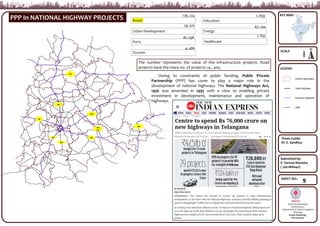
Owing to constraints of public funding, Public Private
Partnership (PPP) has come to play a major role in the
development of national highways. The National Highways Act,
1956 was amended in 1995 with a view to enabling private
investment in development, maintenance and operation of
highways.
Roads
Urban Development
Ports
Tourism
176, 724
81, 038
29, 475
4, 486
Education
Healthcare
Energy
1, 833
1, 849
67, 244
The number represents the value of the infrastructure projects. Road
projects have the more no. of projects i.e., 405.
PPP In NATIONAL HIGHWAY PROJECTS
District Boundary
State Highway
National Highway
ORR
9
65
163
44
765
65
44
30
63
161
AA
Jawaharlal Nehru Architecture & Fine Arts University
School of Planning and Architecture
B. Tech Planning IV year 8th semester
THESIS GUIDE: Dr. E. Sandhya
SUBMITTED BY: Vaka Tanmai Manisha
(19011BA040)
SHEET No.
ASSESSMENT ON ROLE OF PUBLIC PRIVATE PARTNERSHIP (PPP) Projects: A
Case Study On National Highways in Telangana
NATIONAL HIGHWAY COMMUTERS Survey Results
0
2
4
6
8
10
12
14
16
18
NH 150 NH 161 NH 163
(202)
NH 167 NH 30
(221)
NH
353B
NH
365B
NH 44
(7)
NH 563 NH 65
(9)
NH 765 NH
765D
Number
of
Users
National Highway
National Highway Commuters
NH Route
150 Kalaburgi - Yadagiri - Krishna road (to Raichur)
163
(202)
Hyderabad - Warangal - Bhoopalapatnam Road
Hyderabad - Molnabad - Chevella - Manneguda - Kodangal Road
161 Sangareddy - Nanded - Akola
167
Haggari - Raichur - Mahbubnagar - Jadcherla Road
Jadcherla - Kalwakurthy - Devarakonda - Miryalguda - Kodad
30 (221) Vijayawada Jagadalpur Road
353B Adilabad - Bela - Vansadi road
365B Suryapet (NH65) - Arvapally - Jangaon - Duddeda - Siddipet - Siricilla
44 (7) Nagpur - Hyderabad Bangalore Road
563 Jagityal - Karimnagar - Warangal - Khammam
65 (9) Pune - Hyderabad - Vijayawada road
765D Hyderabad (junction at ORR) - Narsapur - Medak - Yellareddy - Rudur
765 Hyderabad - Amangal - Kalwakurthi - Achampet - Srisallam Road
The above
mentioned 12
highways are majorly
used in Telangana for
trip purpose.
Primary Locations of
NH 44 and NH 65 to
travel Warangal,
Pune, Yadadri from
Hyderabad. Those
who drive primarily in
rural settings indicate
a higher level of
overall satisfaction
than those who drive
primarily in urban
settings
10
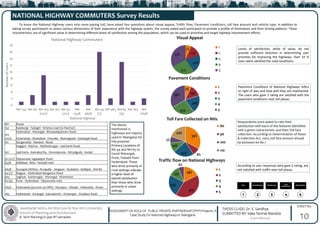
To know the National Highway users who were paying toll, have asked few questions about visual appeal, Traffic flow, Pavement conditions, toll fare amount and vehicle type. In addition to
asking survey participants to assess various dimensions of their experience with the highway system, the survey asked each participant to provide a profile of themselves and their driving patterns. These
characteristics are of significant value in determining different levels of satisfaction among the population, which can be used to prioritize and target highway improvement efforts.
7%
13%
20%
27%
33%
Visual Appeal
1
2
3
4
5
Levels of satisfaction, while of value, do not
provide sufficient direction in determining user
priorities for improving the highways. Over 33 %
users were satisfied the road conditions.
7%
13%
20%
27%
33%
Pavement Conditions
1
2
3
4
5
Pavement Conditions of National Highways refers
to right of way and how well they are maintained.
The users who gave 5 rating are satisfied with the
pavement conditions near toll plazas.
33%
8%
22%
10%
7%
20%
Toll Fare Collected on NHs
80
90
100
110
Respondents were asked to rate their
satisfaction with each of the features identified
with a given characteristic and then Toll fare
collection. According to Determination of Rates
& Collection Act, 2001; toll fare amount should
be between 60-80 /-
According to user responses who gave 2 rating, are
not satisfied with traffic near toll plazas.
18%
41%
23%
12%
6%
Traffic flow on National Highways
1
2
3
4
5
Jawaharlal Nehru Architecture & Fine Arts University
School of Planning and Architecture
B. Tech Planning IV year 8th semester
THESIS GUIDE: Dr. E. Sandhya
SUBMITTED BY: Vaka Tanmai Manisha
(19011BA040)
SHEET No.
ASSESSMENT ON ROLE OF PUBLIC PRIVATE PARTNERSHIP (PPP) Projects: A
Case Study On National Highways in Telangana
0
20
40
60
Bus Car Truck Van
Number
of
Vehicles
Vehicle type
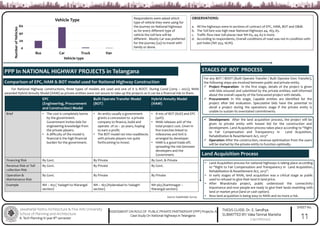
Vehicle Type Respondents were asked which
type of vehicle they were using for
the journey on National highways
as for every different type of
vehicle the toll fare will be
different. Mostly Car was preferred
for the journey (54) to travel with
family or alone.
11
OBSERVATIONS:
a. All the highways were in sections of contract of EPC, HAM, BOT and O&M.
b. The Toll fare was high near National Highways 44, 163, 65.
c. Traffic flow near toll plazas near NH 65, 44, 63 is more.
d. According to respondents, Overall conditions of road was not in condition with
pot holes (NH 353, 167N).
PPP In NATIONAL HIGHWAY PROJECTS in Telangana
EPC
(Engineering, Procurement
and Construction) Model
Built Operate Transfer Model
(BOT)
Hybrid Annuity Model
(HAM)
Brief • The cost is completely borne
by the government.
Government invites bids for
engineering knowledge from
the private players.
• A difficulty of the model is
financial is the high financial
burden for the government.
• An entity usually a government
grants a concession to a private
company to finance, build and
operate of 20 – 30 years, hoping
to earn a profit.
• The BOT model ran into roadblocks
with private players not quite
forthcoming to invest.
• A mix of BOT (60%) and EPC
(40%).
• NHAI releases 40% of the
total project cost. Given in
five tranches linked to
milestones and 60% is
arranged by developer.
• HAM is a good trade-off,
spreading the risk between
developers and the
Government.
Financing Risk By Govt. By Private By Govt. & Private
Revenue Risk or Toll
collection Risk
By Govt. By Private By Govt.
Operation &
Maintenance Risk
By Govt. By Private By Private
Example NH – 163 ( Yadagiri to Warangal
section)
NH – 163 (Hyderabad to Yadagiri
section)
NH 563 (Karimnagar –
Warangal section)
Comparison of EPC, HAM & BOT model used for National Highway Construction
For National Highway constructions, three types of models are used and one of it is BOOT. During Covid (2019 – 2022), NHAI
awarded Hybrid Annuity Model (HAM) as private entities were not assure to take up the projects as it can be a financial risk to them.
STAGES OF BOT PROCESS
For any BOT / BOOT (Built Operate Transfer / Built Operate Own Transfer),
the following steps are involved between public and private entity.
 Project Preparation: In the first stage, details of the project is given
with bids ensured and submitted by the private entities; well informed
about the overall capacity of the forecasted project with details.
 Procurement: In this stage, Capable entities are identified for the
project after bid evaluation. Speculative bids have the potential to
derail a project during the operations stage if the private entity is
unable to sustain its overstated commitments.
 Development: After the land acquisition process, the project will be
given to private entity with lowest bid for the construction and
development. Land Acquisition process takes place according to “Right
to Fair Compensation and Transparency in Land Acquisition,
Rehabilitation & Resettlement Act, 2013”
 Operation: After the construction, revenue optimisation from the users
will be started by the private entity to function optimally.
Land Acquisition Process
• Land Acquisition process for national highways is taking place according
to “Right to Fair Compensation and Transparency in Land Acquisition,
Rehabilitation & Resettlement Act, 2013”.
• In early stages of NHAI, land acquisition was a critical stage as public
used to refused to give their land in land price.
• After Bharatmala project, public understood the connectivity
importance and now people are ready to give their lands resettling with
land or market price (land or cash option).
• Now land acquisition is being easy to NHAI and no more a risk.
Source: Stakeholder Survey
Jawaharlal Nehru Architecture & Fine Arts University
School of Planning and Architecture
B. Tech Planning IV year 8th semester
THESIS GUIDE: Dr. E. Sandhya
SUBMITTED BY: Vaka Tanmai Manisha
(19011BA040)
SHEET No.
ASSESSMENT ON ROLE OF PUBLIC PRIVATE PARTNERSHIP (PPP) Projects: A
Case Study On National Highways in Telangana
Risk Allocation Framework
NH - 44 IN TELANGANA - 42.91 KM (Hyderabad to Banglore section)
Risk type Sensitivity Risk Period Primary risk bearer
A) Pre-Operative Risks
Delays in land acquisition Medium 0-3 years NHAI
Financing risks Medium 0-2 years Private sector
Approvals Low 0-5 years Private sector
B) Construction Phase Risks
Design Risk High 0-5 years Private sector
Construction Risk Medium 0-5 years Private sector
C) Operations Phase Risks
Operations & Maintenance
Risk High Throughout Private sector
Market Risk Medium Throughout Private sector
Financial Risks Medium Throughout Private sector
D) Handover risk events
Handover risk Low Private sector
Concessionaire event of
default Medium Throughout Private sector
NHAI’s event of default Low Throughout NHAI
E) Other Risks
Change in Law Low Throughout
Private Sector &
NHAI
Force Majeure Low Throughout NHAI
NH - 48 - DELHI - GURAGAON EXPRESSWAY 27.1KM
Risk type Sensitivity Risk Period Primary risk bearer
A) Pre-Operative Risks
Delays in land acquisition High 0-5 years NHAI
Financing risks Medium 0-5 years Private sector
Approvals Low 0-5 years Private sector
B) Construction Phase Risks
Design Risk High 0-5 years Private sector
Construction Risk High 0-5 years Private sector
C) Operations Phase Risks
Operations & Maintenance
Risk Medium Throughout Private sector
Market Risk Low Throughout Private sector
Financial Risks Medium Throughout Private sector
D) Handover risk events
Handover risk Medium
Last 2.5 to 3
years Private sector
Concessionaire event of
default Medium Throughout Private sector
NHAI’s event of default Low Throughout NHAI
E) Other Risks
Change in Law Low Throughout
Private Sector &
NHAI
Force Majeure Low Throughout NHAI
12
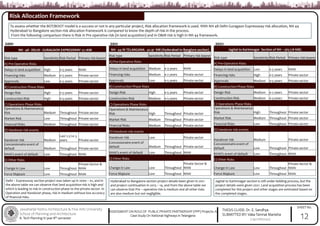
To assess whether the BOT/BOOT model is a success or not in any particular project, Risk allocation framework is used. With NH 48 Delhi Guragaon Expressway risk allocation, NH 44
Hyderabad to Bangalore section risk allocation framework is compared to know the depth of risk in the process.
From the following comparison there is Risk in Pre operative risk (in land acquisition) and in O&M risk is high in NH 44 framework.
Jagtial to Karimnagar Section of NH – 563 (18 KM)
Risk type Sensitivity Risk Period Primary risk bearer
A) Pre-Operative Risks
Delays in land acquisition Low 0-3 years NHAI
Financing risks High 0-5 years Private sector
Approvals Medium 0-5 years Private sector
B) Construction Phase Risks
Design Risk Medium 0-2 years Private sector
Construction Risk Medium 0-3 years Private sector
C) Operations Phase Risks
Operations & Maintenance
Risk High Throughout Private sector
Market Risk Medium Throughout Private sector
Financial Risks Low Throughout Private sector
D) Handover risk events
Handover risk Medium Private sector
Concessionaire event of
default Low Throughout Private sector
NHAI’s event of default Low Throughout NHAI
E) Other Risks
Change in Law Low Throughout
Private Sector &
NHAI
Force Majeure Low Throughout NHAI
2001 2011 2021
Delhi – Expressway section project was taken up in 2000 – 01, and in
the above table we can observe that land acquisition risk is high and
which is leading to risk in construction phase to the private sector. In
Operation and Handover phase, risk in medium without low accuracy
of financial risks.
Hyderabad to Bangalore section project details been given in 2011
and project continuation in 2013 – 14, and from the above table we
can observe that Pre – operative risk is medium and all other risks
are also medium but not negligible.
Jagtial to Karimnagar section is still under bidding process, but the
project details were given 2021. Land acquisition process has been
completed for this project and other stages are estimated based on
the completed stages.
Jawaharlal Nehru Architecture & Fine Arts University
School of Planning and Architecture
B. Tech Planning IV year 8th semester
THESIS GUIDE: Dr. E. Sandhya
SUBMITTED BY: Vaka Tanmai Manisha
(19011BA040)
SHEET No.
ASSESSMENT ON ROLE OF PUBLIC PRIVATE PARTNERSHIP (PPP) Projects: A
Case Study On National Highways in Telangana
RISK ASSESSMENT MATRIX
SWOT ANALYSIS
Pre - Operative Construction Phase Operation Phase Handover event Other Risk
2001 2011 2021
HIGH
MEDIUM
LOW
FACTORS STRENGTH WEAKNESS OPPORTUNITY THREAT
FUNDING PROCESS
Better investment opportunities for
Private entities
After covid, introducing Hybrid
Annuity Model, BOT / BOOT
preference for private entities is
being difficult as it was a safer option
-
Investment from Private entities is
delaying after covid pandemic as
there was a safer choice of HAM.
LAND ACQUISITION
PROCESS
In recent times, resettlement is becoming
little easy to government as public are
understanding the importance of
connectivity
-
Risk of land acquisition is being
decreased in recent times which is
resulting to uplift the project to complete
in estimated time
-
PPP REGULATION
-
There are many toolkits for PPP but
no common legal document for
regulations
- --
RISK ALLOCATION
FRAMEWORK
As pre-operative is medium which is
resulting which is winding-up the project
soon and moving to operation phase.
Financial and market risk are being
major problem for private entities
and resulting to increase in revenue
optimisation
-
Increase in financial risk may result to
overcome the project cost to the
private partner to complete in
concession period
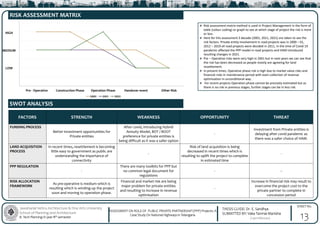
Risk assessment matrix method is used in Project Management in the form of
table (colour coding) or graph to see at which stage of project the risk is more
or less.
Here for this assessment 3 decade (2001, 2011, 2021) are taken to see the
risk factors. Private entity involvement in road projects was in 2000 – 01,
2012 – 2019 all road projects were decided in 2011, In the time of Covid 19
pandemic affected the PPP model in road projects and HAM introduced
resulting changes in 2021.
Pre – Operative risks were very high in 2001 but in next years we can see that
the risk has been decreased as people mostly are agreeing for land
resettlement.
In present times, Operative phase risk is high due to market value risks and
financial risks in maintenance period with even collection of revenue
optimisation in unconditional way.
For recent projects Operation phase cannot be precisely estimated but as
there is no risk in previous stages, further stages can be in less risk.
13
Jawaharlal Nehru Architecture & Fine Arts University
School of Planning and Architecture
B. Tech Planning IV year 8th semester
THESIS GUIDE: Dr. E. Sandhya
SUBMITTED BY: Vaka Tanmai Manisha
(19011BA040)
SHEET No.
ASSESSMENT ON ROLE OF PUBLIC PRIVATE PARTNERSHIP (PPP) Projects: A
Case Study On National Highways in Telangana
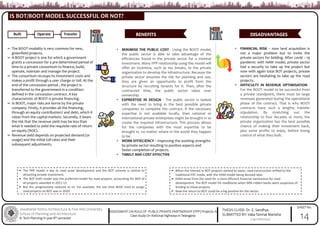
IS BOT/BOOT MODEL SUCCESSFUL OR NOT?
14
Built Operate Transfer BENEFITS DISADVANTAGES
The BOOT modality is very common for new,
greenfield projects.
A BOOT project is one for which a government
grants a concession for a pre-determined period of
time to a private consortium to finance, build,
operate, maintain and manage the project.
The consortium recoups its investment costs and
makes a profit through a user charge or toll. At the
end of the concession period , the project is
transferred to the government in a condition
defined in the concession contract. A key
characteristic of BOOT is private financing.
In BOOT, major risks are borne by the private
company. Firstly, it provides all the financing,
through an equity contribution7 and debt, which it
raises from the capital markets. Secondly, it bears
the risk that the revenue yield may be less than
what it needed to yield the requisite rate of return
on equity (ROE).
Revenue yield depends on projected demand (or
usage) and the initial toll rates and their
subsequent adjustments.
• MINIMISE THE PUBLIC COST - Using the BOOT model,
the public sector is able to take advantage of the
efficiencies found in the private sector for a minimal
investment. Many PPP relationship using this model will
offer an incentive, such as tax breaks, to the private
organization to develop the infrastructure. Because the
private sector assumes the risk for planning and use,
they are given an opportunity to profit from the
structure by recruiting tenants for it. Then, after the
contracted time, the public sector takes over
ownership.
• EXPRERTISE IN DESIGN - The public sector is tasked
with the need to bring in the best possible private
companies to complete the contract. If the necessary
expertise is not available locally, then national or
international private enterprises might be brought in to
create the required infrastructure. This process allows
for the companies with the most expertise to be
brought in, no matter where in the world they happen
to be.
• WORK EFFIECIENCY – Improving the working strengths
by private sector resulting to positive aspects and
faster completion of projects.
• TIMELY AND COST EFFECTIVE
• FINANCIAL RISK – now land acquisition is
not a major problem but to invite the
private sectors for bidding. After covid – 19
pandemic with HAM model, private sector
had a security to take up the project but
now with again total BOT projects, private
sectors are hesitating to take up the road
projects.
• DIFFICULTY IN REVENUE OPTIMISATION -
For the BOOT model to be successful from
a private standpoint, there must be large
revenues generated during the operational
phase of the contract. That is why BOOT
contracts have such a lengthy transfer
stipulation. By stretching out the
relationship to four decades or more, the
private organization has the best possible
chance of making their investment back,
plus some profits to enjoy, before losing
control of what they built.
The PPP model is key to road asset development and the BOT scheme is central to
attracting private investment.
The BOT (toll) model was the preferred model for road projects, accounting for 96% of
all projects awarded in 2011-12.
But this progressively reduced to nil. For example, the last time NHAI tried to assign
road projects on BOT was in 2020.
When the interest in BOT projects started to wane, road construction shifted to the
traditional EPC mode, with the HAM model being devised later.
HAM arose from the need for a more efficient financial mechanism for road
development. The BOT model hit roadblocks when NPA-ridden banks were suspicious of
lending to these projects.
Now the return to BOT could be a big positive for the sector.

19011BA040 tanmai.pptx

  • 1.
    Jawaharlal Nehru Architecture& Fine Arts University School of Planning and Architecture B. Tech Planning IV year 8th semester THESIS GUIDE: Dr. E. Sandhya SUBMITTED BY: Vaka Tanmai Manisha (19011BA040) SHEET No. ASSESSMENT ON ROLE OF PUBLIC PRIVATE PARTNERSHIP (PPP) Projects: A Case Study On National Highways in Telangana 1 AIM To assess the role of Public Private Partnership (PPP) in Urban Infrastructure projects. SCOPE To identify the structure and requirement for private partnerships. VISION To know the importance of PPP projects for certain cases, based on the requirement of Infrastructural facilities. OBJECTIVES • To understand the funding process for the projects • To understand the land acquisition process for the projects. • To understand the risk and challenges in PPP projects NEED OF THE STUDY This study is to know the improvement of efficiency in service delivery and financial resources of public private partnership. LIMITATION To understand the risk and challenges in PPP projects PPP regulations and framework Risk allocation & mitigation analysis Recommendations & Conclusion AIM To assess the role of public private partnership Infrastructure projects Need of the study Study Area Selection To understand the funding process for the projects To understand the land acquisition process for the projects. Bidding process, budget allocation from FFC Land cover, land utilisation and total land acquired data Cost Benefit analysis, Asset liability, revenue optimisation Comparative analysis with requirement Literature Study Desktop Study Issue Identification 1. Modality types 2. Tool kits 3. Types of Contracts 4. GO s and Acts 1. Vadodara Halol Toll Road 2. Delhi Gurgaon Expressway 3. Mumbai Metro AIM Need of the study Literature Study & Desktop Study Objectives Data Collection Primary and Secondary Analysis Issue Identification Recommendations & Conclusion This study is limited to understand the PPP framework, financial viability and Land Acquisition process of national highways in Telangana.
  • 2.
    Jawaharlal Nehru Architecture& Fine Arts University School of Planning and Architecture B. Tech Planning IV year 8th semester THESIS GUIDE: Dr. E. Sandhya SUBMITTED BY: Vaka Tanmai Manisha (19011BA040) SHEET No. ASSESSMENT ON ROLE OF PUBLIC PRIVATE PARTNERSHIP (PPP) Projects: A Case Study On National Highways in Telangana LITERATURE STUDY Public-private partnerships involve collaboration between a government agency and a private-sector company that can be used to finance, build, and operate projects, such as public transportation networks, parks, and convention centers.  PPP will enhance the supply of required services  Provide relief from the burden of the costs of design and construction  Transfer of project risks to the private sector  There will be better project design, choice of technology, construction, operation and maintenance service  PPP projects are viably essential  Work efficiency  Better investment opportunities 1966 Attempts at liberalisation in India 1969 Monopolies and Restrictive Trade Practices (MRTP) Act 1969 2005 Cabinet Committee on Economic Affairs (CCEA) in its meeting of 27th October, 2005 approved the procedure for approval of PPP projects sponsored by Central Government Ministries/Central Public Sector Undertakings 2000 first PPPs were signed and implemented in India of Karnataka, Madhya Pradesh, Gujarat, Tamil Nadu and Maharashtra states. 2012 In August 2012, the former Prime Minister of India, Manmohan Singh, lifted the ban on the transfer of government – owned land, relaxed land transfer policy 1995 Acts related to infrastructure revised to include private entity for design, construction and funding 1991 Initiated liberalisation Time Line of PPP in India Role of PPP in India Schemes & Acts:  National Highway Authority of India, 1995  Electricity Act, 2003  Special Economic Act, 2005  JNNURM for creating an enabling environment & providing incentives to the Urban Area to engage in PPP.  National Urban Transport Policy, 2014. Main features  Certain services are out-sourced to a private company.  Private company provides agreed services to the GOV  GOV retains general control and supervision.  Management and operation of a public infrastructure is out- sourced to a private company.  Similar to a service contract but the scope of services is wider with greater control passed to the private company.  Private company finances the infrastructure.  Private company builds the infrastructure.  Upon completion of construction, the infrastructure is transferred to the government.  Government pays the private company on an agreed schedule the total cost, plus a reasonable markup.  Government finances the facility.  Private company builds the facility.  Private company operates the facility on a concession.  At the end of the O&M concession the facility is transferred to the government.  Private company finances the facility.  Private company builds the facility.  Private company operates the facility on a concession.  At the end of the concession the facility is transferred to the government.  Also known as DBFO in UK: Develop- Build Finance-Operate.  Same as a BOOT/BOT.  But for the rehabilitation of an existing facility rather than the construction of a new Operation and maintenance typically out sourced to another private company. But for the rehabilitation of an existing facility rather than the construction of a new one  Initial public offer (IPO), wholly or partly of a state-owned company (SOE).  Partial divestiture means government still owns a percentage of the SOE.  Total divestiture means the SOE has been completely privatized i.e. the company is now 100% owned by the private sector. PPP Modality Types Service Contract Operation and Maintenance contract (O & M) Build Transfer / or Annuity Type Build Operate Own Transfer (BOOT) Rehabilitate Own Operate Transfer Build Own Operate (BOO) and Rehabilitate Own Operate (ROO) Privatisation Build Operate Transfer (BOT) Source: NITI AAYOG PPP TOOLKIT 2
  • 3.
    Jawaharlal Nehru Architecture& Fine Arts University School of Planning and Architecture B. Tech Planning IV year 8th semester THESIS GUIDE: Dr. E. Sandhya SUBMITTED BY: Vaka Tanmai Manisha (19011BA040) SHEET No. ASSESSMENT ON ROLE OF PUBLIC PRIVATE PARTNERSHIP (PPP) Projects: A Case Study On National Highways in Telangana Decision to Enter PPP process Determine the Priority Projects Sector Diagnostic and Sector Road Map Define Project Team Internal and External Advisors Select and Assign Transaction Advisory Team Select PPP option PPP Preparation/Feasibility Legal/Regulatory Technical Institutional Commercial/Financial/Economic Procurement Process Publication/Announcement PPP Prequalification Prepare Bidding Package Terms of Reference Draft Contract Bidding Requirements Conduct Procurement Bid Evaluation and Award Negotiation and Contract Signing STAKEHOLDER CONSULTATION • Underperforming sector • Assess sector constraints • Identify sector goals • Set tasks & timetable • Identify expertise needed • Identify Gov’t champion • Review options vis a vis sector constraints and goals • Enabling environment for PPP in terms of policy and operating environment. • Determine project design • Ensure feasibility and sustainability • Assign risks • Identify and train for new roles • Solicit market interest/feedback on project • Refine bid package • Develop draft contract • Final definition of process • Train staff in procurement • Transparent process • Put financing in place • Start transition arrangement GENERIC PPP PROJECT SEQUENCE Source: PPP Handbook, ASIAN DEVELOPMENT BANK Project Type Indicative sources to fund Large Infrastructure Projects (at State/ District level) Funding by Bi-lateral & Multi-lateral agencies Foreign Direct Investment Public Private Partnership City Urban Infrastructure Central Grant-in-aid & Schemes Public Private Partnership Loans from Financial Institutions Municipal bonds/debentures Social Infrastructure, Capacity Building and PMC Projects Funding by Bi‐lateral & Multi‐lateral agencies Municipal bonds/debentures Central Grant-in-aid & Schemes Public Private Partnership/Corporate Social Responsibility Real Estate Projects Foreign Direct Investment Municipal bonds/debentures Public Private Partnership Loans from Financial Institutions Possible Sources of Funding for Infrastructure Projects Source: URDPFI Guidelines 3 The above figure is an example how the PPP project agreement and Bidding process will be with Public entity. Stakeholder consultation is required in selecting the type of PPP model, announcement of project, bidding process with requirements. From the above table we can infer that, Private partnership entity is possible source of funding in the infrastructural projects not only in funding but also design and construction. Private sector includes consultancy firms, developers, builders, promoters, cooperative societies, NGOs, CBOs, cooperative bodies, industrialists & businessmen.
  • 4.
    Jawaharlal Nehru Architecture& Fine Arts University School of Planning and Architecture B. Tech Planning IV year 8th semester THESIS GUIDE: Dr. E. Sandhya SUBMITTED BY: Vaka Tanmai Manisha (19011BA040) SHEET No. ASSESSMENT ON ROLE OF PUBLIC PRIVATE PARTNERSHIP (PPP) Projects: A Case Study On National Highways in Telangana Concessionaire’s Special Purpose Company Govt. / Municipal Entity Users / Customers Operator & Maintenance Holder Designer, Contractor & Supplier Shareholders Lenders Concession Agreement Payment for Service Operation & Maintenance Agreement Turnkey Contract Loan Agreement Shareholders Agreement Commonly Used Modalities | Typical BOOT Project Structure Source: NITI AAYOG PPP TOOLKIT 4 Contract type Description Lump sum contract A fixed total price is set for the entire project rather than individual aspects. Usually reserved for straightforward projects with a clear scope of work. Time and materials contract Contractors are reimbursed for the cost and materials as well as labor at an established pay rate. Often used for projects without a well-defined scope of work. Cost-plus contract Owner pays the contractor for costs (materials, labor, overhead) incurred during the project as well as a present profit margin. Can offset contractor risk for projects that involve design changes throughout. Unit price contract Divides the work to be completed intro separate units, which the contractor bills for individually. Best for repetitive construction tasks without an estimate of the amount of work required. Guaranteed maximum price (GMP contract) Establishes an upper limit for construction costs and contractors absorb costs above this set point. Best for projects with relatively few unknown variables. TYPES OF CONTRACTS Before starting any bidding process or Project details, Public entity looks out on these contracts for agreement and stakeholders. BUILD OPERATE TRANSFER Equity Bank balance / Liquid Debt Contractor’s money Assets / Machinery Bank loan Shares Revenue Contractor’s money Government Funding Government Revenue CASH FLOW STRUCTURE IN BOT MODEL • BOT model is not equal risk shearing strategy contractor have to bear more risk than authority. • Financial issue and loan risk are major risk on BOT project because of its 100% private financing strategy • As per concern of financial model BOT model have their plus and minus point. Where the traffic is high BOT model should have to prefer by government. And for remote areas where traffic flow is less BOT model should not preferable. • Further modification is need to be done in contract condition of BOT project to make it better for major project. • Latest modification in Model concession agreement is Hybrid Annuity Model this model can be proper solution for failure reason in BOT. Financing structure of BOT projects at the construction stage contractor have to invest the money. The contractor’s money is in form of debt or equity, contractors debt means liquidity amount, bank balance or may be assets such as plant, equipment, machinery etc. which can be used by contractor without spending money at construction stage. And another option is equity means the amount or assets taken from outsides the organization such as Bank loans, Shares. Then at the operation stage the whole utility is operated by the contractor by his own cost or by generating revenue from users.
  • 5.
    Jawaharlal Nehru Architecture& Fine Arts University School of Planning and Architecture B. Tech Planning IV year 8th semester THESIS GUIDE: Dr. E. Sandhya SUBMITTED BY: Vaka Tanmai Manisha (19011BA040) SHEET No. ASSESSMENT ON ROLE OF PUBLIC PRIVATE PARTNERSHIP (PPP) Projects: A Case Study On National Highways in Telangana Source: Department of Economic Affairs PPP projects in India Roads Ports Eco- Tourism Silos Petrole um Reserve s Rope way Teleco m Railway Station s Railway Passen ger Trains Metro No. of Projects 69 12 10 1 4 1 9 6 12 1 0 10 20 30 40 50 60 70 80 No. of Projects The above graph illustrates no. of projects taken up by private partnerships in infrastructure. Financial investment and design contracts were mostly taken in Roads and then Urban development projects. Roads Ports Eco- Touris m Silos Petrol eum Reser ves Rope way Teleco m Railwa y Statio ns Railwa y Passe nger Trains Metro Total Cost (Rs in Crores) 63,279 3,359 2,232 401 27,728 996 29,199 7,600 30,099 7,420 0 10,000 20,000 30,000 40,000 50,000 60,000 70,000 Total Cost (Rs in Crores) DESKTOP STUDY Project Vadodara Halol Toll Road (VHTR) Delhi Gurgaon Expressway Mumbai Metro Sector Roads Roads – Expressways Urban infrastructure – Mass Rapid transport PPP project Structure BOOT (includes Design and Finance) BOT (includes Design and Finance) BOOT (includes Design and Finance) State and year of PPP contract Gujarat 1998 Delhi and Haryana 2002 Maharashtra 2007 Brief of Project VHTR is one of the first state highway widening projects developed on PPP basis in India. This partnership included toll collection, operating the toll plaza, traffic regulation and maintenance of the facility. Golden Quadrilateral project (Highway Project connecting the four metro cities of New Delhi, Mumbai, Chennai and Kolkata). NH 8 was experiencing high vehicular density (145,000 Passenger Car Units (PCUs)/day in 2000) with 20 intersections. This project is the first corridor of the proposed Mass Rapid Transit System (MRTS). This Ghatkopar line was with a route length of 11 kms, with 12 stations and a car depot. Govt./Public sector/entity Government of Gujarat National Highways Authority of India (NHAI) Mumbai Metropolitan Region Development Authority (MMRDA) Private sector promoter/sponsor/entity Infrastructure Leasing & Financial Services (IL & FS) DS Constructions and Jaiprakash Industries Reliance Energy Limited, Veolia Transport (France) Project cost ₹ 161 crore ₹ 1, 175 crores ₹ 2,356 crore Concession period 30 years 20 years 35 years Current status This project is been operational since 2000 and traffic on the road has not been in line with the expected traffic levels as established in the traffic study report. The traffic level increased more than 180,000 PCUs per day, which is much higher than the traffic estimates for the project by 13,000 to 15,000 PCUs per day. The expressway now consists of 9 flyovers, 4 underpasses and 2 foot-over bridges and 3 toll-plazas. For Cashless automatic payment, smart tags have been introduced. This metro was commenced on the construction of 2 over – head bridges at Andheri Station and the Western Express Highway. This phase 1 resulted 5 more successful phases. 5
  • 6.
    Jawaharlal Nehru Architecture& Fine Arts University School of Planning and Architecture B. Tech Planning IV year 8th semester THESIS GUIDE: Dr. E. Sandhya SUBMITTED BY: Vaka Tanmai Manisha (19011BA040) SHEET No. ASSESSMENT ON ROLE OF PUBLIC PRIVATE PARTNERSHIP (PPP) Projects: A Case Study On National Highways in Telangana DESKTOP STUDY VADODARA HALOL TOLL ROAD (VHTR) • VHTR is one of the first state highway widening projects developed on PPP basis in India. • This partnership included toll collection, operating the toll plaza, traffic regulation and maintenance of the facility. • The project involved widening and strengthening of 32 kilometers (km) of the existing two-lane State Highway (SH 87) connecting Vadodara to the industrial town of Halol into a four-lane tolled expressway. • The project cost was ₹ 161 crore and the private entity is IL & FS (Infrastructure Leasing & Financing Services. Project Preparation • There was a need felt for improving efficiencies and attracting private capital for infrastructure development in order to free up government resources for alternative uses. • IL&FS was working closely with the GoG for creating a positive environment for private sector participation in infrastructure development. In order to effectively execute the VHTR project, the GoG signed a Memorandum of Agreement (MoA) with the IL & FS to develop the Vadodara Halol stretch on BOOT basis. Procurement • VHTRL appointed a contractor for design, construction, operation and maintenance of the project facilities, in accordance with the concession agreement, through a transparent international competitive bidding process. The financial criterion was the lowest price offered by the bidder. • The lowest price was the net present value (NPV) calculated on the bidders’ estimate of: fixed price of construction; interest during construction; and costs during the concession period on routine maintenance, periodic maintenance (renewal and overlay), toll systems, and toll augmentation • VHTRL entered into an Operations & Maintenance Contract dated January 22, 1999 (O&M Agreement) with Punj Lloyd Limited and IRCON International Limited. Development • The development of the 31.7 km stretch was achieved in a single phase with all the required road works and related facilities being developed. • While the Concessionaire was to ensure completion of all works within a period of 18 months, the construction of the entire stretch was completed 4 months ahead of schedule. Operation • The concession period was expected to end in 2030. In case the developer is unable to recover project cost and earn a return, there is a possibility of extension of the concession period. The typical extension allowed under the Concession Agreement is for two years. • This is a rolling period, which means that the Concession period will keep extending by 2 years till the time the Concessionaire is able to gain a return of 20% on investment. Observations • The traffic estimations for the project was based on the assumptions which would continue for long term and the traffic was almost 50% lower than the projected traffic flow. • There was a competitive bidding for this project as it was first PPP project in State after EPC contract. • This project was an example for Environmental & Social responsive development framework. • In operation period, toll revenue did not result in the expected returns. DELHI GURGAON EXPRESSWAY • The National Highways Authority of India (NHAI), under the Ministry of Road Transport & Highways (MoRT&H), was entrusted the responsibility for implementation of the Golden Quadrilateral project (Highway Project connecting the four metro cities of New Delhi, Mumbai, Chennai and Kolkata). • As a part of this project, it proposed the conversion of a very busy section of NH-8 connecting Delhi to Gurgaon into a 6/8 lane access controlled divided carriageway. • The existing 4 lane, 27.7 km section of NH-8 between Delhi and Gurgaon with as many as 20 intersections, experienced high vehicular density (145,000 Passenger Car Units (PCUs)/day in 2000) and non-segregation of traffic that led to increase in accidents, acute congestion, wastage of fuel and excessive pollution. • This was the first BOT project in India to have been awarded on negative grant basis where in the concessionaire offered to pay an upfront fee to NHAI in return of the concession as against a capital grant from the Government. In consideration of robust traffic projections, the selected bidder offered to pay ` 61.06 crore to NHAI. • The expressway was commissioned in January 2008 after much delay primarily owing to issues in land acquisition and changes in the scope of work. It carries more than 180,000 PCUs per day as on date. Project Preparation The Government of India, at the time, was keen to promote public private partnership (PPP) in viable expressway projects to attract funding and capitalize on private sector efficiency. It was therefore decided to undertake the project on BOT (Build-operate-Transfer) basis. NHAI used the Detailed Project Report prepared in 1998 for the traffic projections for this project. 6
  • 7.
    Jawaharlal Nehru Architecture& Fine Arts University School of Planning and Architecture B. Tech Planning IV year 8th semester THESIS GUIDE: Dr. E. Sandhya SUBMITTED BY: Vaka Tanmai Manisha (19011BA040) SHEET No. ASSESSMENT ON ROLE OF PUBLIC PRIVATE PARTNERSHIP (PPP) Projects: A Case Study On National Highways in Telangana Procurement • The project was initially envisaged to require a capital grant to be paid by NHAI to the successful bidder towards the cost of construction for enhancing the viability of the highway project. • However, considering the robust traffic projections, bids were received with negative grants. In April 2002, the consortium of Jaiprakash Industries and DS Constructions was declared the successful bidder. • RBM Malaysia, which was the L2 bidder, had quoted ` 55 crore as the negative grant. Other bidders were Gamuda Malaysia, IJM Malaysia and Larsen & Toubro (L&T). Development • The construction of the expressway commenced in January 2003. • The project development, however, soon ran into issues over approvals, land acquisition and additions to the scope of work which was largely due to the physical setting of the project highway. • NHAI and other agencies involved with this project put in a great deal of effort to hasten the process. However, there were certain small parcels of land which were difficult to acquire. In addition, court cases, removal of trees, shifting of religious structures and the massive number of utilities that had to be shifted contributed to the delay. • The provisional change of scope order was finalized and issued to the concessionaire in July 2005 just days before the original scheduled completion date. Operation • The project was commissioned on 25 January, 2008. The expressway is fully operational and is handling a significant traffic volume of more than 180,000 PCUs per day, growing at 9% year-on-year. • The concession period is for 20 years and the projected end date is 11 January 2023 when the expressway will be handed over to the government. Observations • There was delay in Land acquisition process due to thickly populated surrounding areas of the expressway which made delay in project procurement to private entity. • There was need of approval of more than 15 govt. agencies / civic bodies for this project connectivity. • Traffic forecast was outdated, resulting double of > 80, 000 PCUs (Passenger Car Unit) and traffic risk. MUMBAI METRO • To address both present and future public transportation needs, the Government of Maharashtra (GOM) through the Mumbai Metropolitan Region Development Authority (MMRDA) has planned a 146 kilometer long rail based Mass Rapid Transit System (MRTS) for Mumbai. • This project is the first corridor of the proposed MRTS. The Versova Andheri Ghatkopar line shall be an elevated line with a route length of 11 kms, with 12 stations and a car depot situated at D.N. Nagar. • The line will have a minimum curvature of 100 meters and minimum ground clearance of 5.5 meters. Project Preparation A concession agreement on BOOT basis for a period of 35 years, including a construction period of 5 years, has been awarded by the MMRDA. Under the concession agreement, the operator has to design, finance, construct, operate, own and maintain the first corridor and transfer the ownership and assets at the end of the concession period. • The viability of various mass transit systems that are efficient, economically viable and environment friendly. In this context, a detailed feasibility study was carried out under the Indo- German Technical Co-operation by entrusting the consultancy work to TEWET in association with DE-Consult & TCS, during 1997-2000. Procurement The project was approved by the Government of Maharashtra in August 2004 and global bids were invited in the same month for the project through an Expression of Interest (EoI). Almost 150 bidders responded to the EoI and a pre-bid meeting was held in November 2004. Technical bids were invited for the project in May 2005. The consortia that submitted bids were: • Hindustan Construction Company and RITES • Reliance Energy Limited and Connex-France • Shakti Kumar Sacheti Limited and Lingkaran Metro • Siemens, L&T, Gammon, BEML • IL&FS and ITD Thailand and Unity Infra projects Development Operation Observations • The SPV was incorporated in December 2006. • he Engineering and Project Management Consultants, a consortium of Parsons Brinkerhoff (USA) and Systra SA (France) joined the team on February 14, 2007 • Signing of the Concession Agreement and Shareholders agreement took place on March 7, 2007 • MMOPL and Government of Maharashtra entered the State Support Agreement on April 20, 2007 &Construction commenced on February 8, 2008 The construction of the Depot, Substation and Stations has also commenced along the route of the project. Work has also commenced on the construction of 2 overhead bridges at Andheri Station and the Western Express Highway. The construction of the Depot, Substation and Stations has also commenced along the route of the project. Work has also commenced on the construction of 2 overhead bridges at Andheri Station and the Western Express Highway. Land acquisition lead to an issue in project for the depot which delayed in 2 years of time to complete the project. This project was Good Project Preparation with VGF used in project (₹ 650 crore) significant to 27.5% of the project cost. 7
  • 8.
    Jawaharlal Nehru Architecture& Fine Arts University School of Planning and Architecture B. Tech Planning IV year 8th semester THESIS GUIDE: Dr. E. Sandhya SUBMITTED BY: Vaka Tanmai Manisha (19011BA040) SHEET No. ASSESSMENT ON ROLE OF PUBLIC PRIVATE PARTNERSHIP (PPP) Projects: A Case Study On National Highways in Telangana BHARATMALA PHASE - I The Bharatmala Pariyojana envisages development of about 26,000 km length of Economic Corridors, which along with Golden Quadrilateral (GQ) and North-South and East-West (NS-EW) Corridors are expected to carry majority of the Freight Traffic on roads. • According to sector head of NHAI, the EPC & Hybrid Annuity Modes account for 98% of total awards to date. In terms of funding, the project initially envisaged 40% each from internal and extra- budgetary resources, and the balance of 20% from gross budgetary support, including toll collections and private sector investment. near Border areas Coastal roads including non – major ports To develop 2021 – 2022 Actual 2022 – 2023 Budget Estimates 2022 – 2023 Revised Estimates 2023 – 2024 Budget Estimates National Highways Authority of India 57081 134015 1416060 162207 In ₹ crore Particulars Details Name of the Project Bharatmala Project Launch yar 2015 Estimated cost ₹ 10.63 lakh crore Length Phase I – 31, 800 KM ( 26, 000 km length of economic corridors along with Golden Quadrilateral [GQ]and North – South & East – West [NS – EW]) Phase II – 8, 100km Modality type EPC (Engineering, Procurement and Construction) , Hybrid Annuity Model (HAM) & BOT / BOOT (Build Operate Transfer) (for National Highways) Current status Only 23.4 % of 34,800 km has been completed till date i.e., 8,134 km. 8
  • 9.
    KEY MAP: SCALE LEGEND: Thesis Guide: Dr.E. Sandhya Submitted by: V. Tanmai Manisha ( 19011BA040) SHEET NO.: School of planning & Architecture, Department of Urban & regional Planning, B.Tech (Planning) VIIi semester Owing to constraints of public funding, Public Private Partnership (PPP) has come to play a major role in the development of national highways. The National Highways Act, 1956 was amended in 1995 with a view to enabling private investment in development, maintenance and operation of highways. Roads Urban Development Ports Tourism 176, 724 81, 038 29, 475 4, 486 Education Healthcare Energy 1, 833 1, 849 67, 244 The number represents the value of the infrastructure projects. Road projects have the more no. of projects i.e., 405. PPP In NATIONAL HIGHWAY PROJECTS District Boundary State Highway National Highway ORR 9 65 163 44 765 65 44 30 63 161 AA
  • 10.
    Jawaharlal Nehru Architecture& Fine Arts University School of Planning and Architecture B. Tech Planning IV year 8th semester THESIS GUIDE: Dr. E. Sandhya SUBMITTED BY: Vaka Tanmai Manisha (19011BA040) SHEET No. ASSESSMENT ON ROLE OF PUBLIC PRIVATE PARTNERSHIP (PPP) Projects: A Case Study On National Highways in Telangana NATIONAL HIGHWAY COMMUTERS Survey Results 0 2 4 6 8 10 12 14 16 18 NH 150 NH 161 NH 163 (202) NH 167 NH 30 (221) NH 353B NH 365B NH 44 (7) NH 563 NH 65 (9) NH 765 NH 765D Number of Users National Highway National Highway Commuters NH Route 150 Kalaburgi - Yadagiri - Krishna road (to Raichur) 163 (202) Hyderabad - Warangal - Bhoopalapatnam Road Hyderabad - Molnabad - Chevella - Manneguda - Kodangal Road 161 Sangareddy - Nanded - Akola 167 Haggari - Raichur - Mahbubnagar - Jadcherla Road Jadcherla - Kalwakurthy - Devarakonda - Miryalguda - Kodad 30 (221) Vijayawada Jagadalpur Road 353B Adilabad - Bela - Vansadi road 365B Suryapet (NH65) - Arvapally - Jangaon - Duddeda - Siddipet - Siricilla 44 (7) Nagpur - Hyderabad Bangalore Road 563 Jagityal - Karimnagar - Warangal - Khammam 65 (9) Pune - Hyderabad - Vijayawada road 765D Hyderabad (junction at ORR) - Narsapur - Medak - Yellareddy - Rudur 765 Hyderabad - Amangal - Kalwakurthi - Achampet - Srisallam Road The above mentioned 12 highways are majorly used in Telangana for trip purpose. Primary Locations of NH 44 and NH 65 to travel Warangal, Pune, Yadadri from Hyderabad. Those who drive primarily in rural settings indicate a higher level of overall satisfaction than those who drive primarily in urban settings 10 To know the National Highway users who were paying toll, have asked few questions about visual appeal, Traffic flow, Pavement conditions, toll fare amount and vehicle type. In addition to asking survey participants to assess various dimensions of their experience with the highway system, the survey asked each participant to provide a profile of themselves and their driving patterns. These characteristics are of significant value in determining different levels of satisfaction among the population, which can be used to prioritize and target highway improvement efforts. 7% 13% 20% 27% 33% Visual Appeal 1 2 3 4 5 Levels of satisfaction, while of value, do not provide sufficient direction in determining user priorities for improving the highways. Over 33 % users were satisfied the road conditions. 7% 13% 20% 27% 33% Pavement Conditions 1 2 3 4 5 Pavement Conditions of National Highways refers to right of way and how well they are maintained. The users who gave 5 rating are satisfied with the pavement conditions near toll plazas. 33% 8% 22% 10% 7% 20% Toll Fare Collected on NHs 80 90 100 110 Respondents were asked to rate their satisfaction with each of the features identified with a given characteristic and then Toll fare collection. According to Determination of Rates & Collection Act, 2001; toll fare amount should be between 60-80 /- According to user responses who gave 2 rating, are not satisfied with traffic near toll plazas. 18% 41% 23% 12% 6% Traffic flow on National Highways 1 2 3 4 5
  • 11.
    Jawaharlal Nehru Architecture& Fine Arts University School of Planning and Architecture B. Tech Planning IV year 8th semester THESIS GUIDE: Dr. E. Sandhya SUBMITTED BY: Vaka Tanmai Manisha (19011BA040) SHEET No. ASSESSMENT ON ROLE OF PUBLIC PRIVATE PARTNERSHIP (PPP) Projects: A Case Study On National Highways in Telangana 0 20 40 60 Bus Car Truck Van Number of Vehicles Vehicle type Vehicle Type Respondents were asked which type of vehicle they were using for the journey on National highways as for every different type of vehicle the toll fare will be different. Mostly Car was preferred for the journey (54) to travel with family or alone. 11 OBSERVATIONS: a. All the highways were in sections of contract of EPC, HAM, BOT and O&M. b. The Toll fare was high near National Highways 44, 163, 65. c. Traffic flow near toll plazas near NH 65, 44, 63 is more. d. According to respondents, Overall conditions of road was not in condition with pot holes (NH 353, 167N). PPP In NATIONAL HIGHWAY PROJECTS in Telangana EPC (Engineering, Procurement and Construction) Model Built Operate Transfer Model (BOT) Hybrid Annuity Model (HAM) Brief • The cost is completely borne by the government. Government invites bids for engineering knowledge from the private players. • A difficulty of the model is financial is the high financial burden for the government. • An entity usually a government grants a concession to a private company to finance, build and operate of 20 – 30 years, hoping to earn a profit. • The BOT model ran into roadblocks with private players not quite forthcoming to invest. • A mix of BOT (60%) and EPC (40%). • NHAI releases 40% of the total project cost. Given in five tranches linked to milestones and 60% is arranged by developer. • HAM is a good trade-off, spreading the risk between developers and the Government. Financing Risk By Govt. By Private By Govt. & Private Revenue Risk or Toll collection Risk By Govt. By Private By Govt. Operation & Maintenance Risk By Govt. By Private By Private Example NH – 163 ( Yadagiri to Warangal section) NH – 163 (Hyderabad to Yadagiri section) NH 563 (Karimnagar – Warangal section) Comparison of EPC, HAM & BOT model used for National Highway Construction For National Highway constructions, three types of models are used and one of it is BOOT. During Covid (2019 – 2022), NHAI awarded Hybrid Annuity Model (HAM) as private entities were not assure to take up the projects as it can be a financial risk to them. STAGES OF BOT PROCESS For any BOT / BOOT (Built Operate Transfer / Built Operate Own Transfer), the following steps are involved between public and private entity.  Project Preparation: In the first stage, details of the project is given with bids ensured and submitted by the private entities; well informed about the overall capacity of the forecasted project with details.  Procurement: In this stage, Capable entities are identified for the project after bid evaluation. Speculative bids have the potential to derail a project during the operations stage if the private entity is unable to sustain its overstated commitments.  Development: After the land acquisition process, the project will be given to private entity with lowest bid for the construction and development. Land Acquisition process takes place according to “Right to Fair Compensation and Transparency in Land Acquisition, Rehabilitation & Resettlement Act, 2013”  Operation: After the construction, revenue optimisation from the users will be started by the private entity to function optimally. Land Acquisition Process • Land Acquisition process for national highways is taking place according to “Right to Fair Compensation and Transparency in Land Acquisition, Rehabilitation & Resettlement Act, 2013”. • In early stages of NHAI, land acquisition was a critical stage as public used to refused to give their land in land price. • After Bharatmala project, public understood the connectivity importance and now people are ready to give their lands resettling with land or market price (land or cash option). • Now land acquisition is being easy to NHAI and no more a risk. Source: Stakeholder Survey
  • 12.
    Jawaharlal Nehru Architecture& Fine Arts University School of Planning and Architecture B. Tech Planning IV year 8th semester THESIS GUIDE: Dr. E. Sandhya SUBMITTED BY: Vaka Tanmai Manisha (19011BA040) SHEET No. ASSESSMENT ON ROLE OF PUBLIC PRIVATE PARTNERSHIP (PPP) Projects: A Case Study On National Highways in Telangana Risk Allocation Framework NH - 44 IN TELANGANA - 42.91 KM (Hyderabad to Banglore section) Risk type Sensitivity Risk Period Primary risk bearer A) Pre-Operative Risks Delays in land acquisition Medium 0-3 years NHAI Financing risks Medium 0-2 years Private sector Approvals Low 0-5 years Private sector B) Construction Phase Risks Design Risk High 0-5 years Private sector Construction Risk Medium 0-5 years Private sector C) Operations Phase Risks Operations & Maintenance Risk High Throughout Private sector Market Risk Medium Throughout Private sector Financial Risks Medium Throughout Private sector D) Handover risk events Handover risk Low Private sector Concessionaire event of default Medium Throughout Private sector NHAI’s event of default Low Throughout NHAI E) Other Risks Change in Law Low Throughout Private Sector & NHAI Force Majeure Low Throughout NHAI NH - 48 - DELHI - GURAGAON EXPRESSWAY 27.1KM Risk type Sensitivity Risk Period Primary risk bearer A) Pre-Operative Risks Delays in land acquisition High 0-5 years NHAI Financing risks Medium 0-5 years Private sector Approvals Low 0-5 years Private sector B) Construction Phase Risks Design Risk High 0-5 years Private sector Construction Risk High 0-5 years Private sector C) Operations Phase Risks Operations & Maintenance Risk Medium Throughout Private sector Market Risk Low Throughout Private sector Financial Risks Medium Throughout Private sector D) Handover risk events Handover risk Medium Last 2.5 to 3 years Private sector Concessionaire event of default Medium Throughout Private sector NHAI’s event of default Low Throughout NHAI E) Other Risks Change in Law Low Throughout Private Sector & NHAI Force Majeure Low Throughout NHAI 12 To assess whether the BOT/BOOT model is a success or not in any particular project, Risk allocation framework is used. With NH 48 Delhi Guragaon Expressway risk allocation, NH 44 Hyderabad to Bangalore section risk allocation framework is compared to know the depth of risk in the process. From the following comparison there is Risk in Pre operative risk (in land acquisition) and in O&M risk is high in NH 44 framework. Jagtial to Karimnagar Section of NH – 563 (18 KM) Risk type Sensitivity Risk Period Primary risk bearer A) Pre-Operative Risks Delays in land acquisition Low 0-3 years NHAI Financing risks High 0-5 years Private sector Approvals Medium 0-5 years Private sector B) Construction Phase Risks Design Risk Medium 0-2 years Private sector Construction Risk Medium 0-3 years Private sector C) Operations Phase Risks Operations & Maintenance Risk High Throughout Private sector Market Risk Medium Throughout Private sector Financial Risks Low Throughout Private sector D) Handover risk events Handover risk Medium Private sector Concessionaire event of default Low Throughout Private sector NHAI’s event of default Low Throughout NHAI E) Other Risks Change in Law Low Throughout Private Sector & NHAI Force Majeure Low Throughout NHAI 2001 2011 2021 Delhi – Expressway section project was taken up in 2000 – 01, and in the above table we can observe that land acquisition risk is high and which is leading to risk in construction phase to the private sector. In Operation and Handover phase, risk in medium without low accuracy of financial risks. Hyderabad to Bangalore section project details been given in 2011 and project continuation in 2013 – 14, and from the above table we can observe that Pre – operative risk is medium and all other risks are also medium but not negligible. Jagtial to Karimnagar section is still under bidding process, but the project details were given 2021. Land acquisition process has been completed for this project and other stages are estimated based on the completed stages.
  • 13.
    Jawaharlal Nehru Architecture& Fine Arts University School of Planning and Architecture B. Tech Planning IV year 8th semester THESIS GUIDE: Dr. E. Sandhya SUBMITTED BY: Vaka Tanmai Manisha (19011BA040) SHEET No. ASSESSMENT ON ROLE OF PUBLIC PRIVATE PARTNERSHIP (PPP) Projects: A Case Study On National Highways in Telangana RISK ASSESSMENT MATRIX SWOT ANALYSIS Pre - Operative Construction Phase Operation Phase Handover event Other Risk 2001 2011 2021 HIGH MEDIUM LOW FACTORS STRENGTH WEAKNESS OPPORTUNITY THREAT FUNDING PROCESS Better investment opportunities for Private entities After covid, introducing Hybrid Annuity Model, BOT / BOOT preference for private entities is being difficult as it was a safer option - Investment from Private entities is delaying after covid pandemic as there was a safer choice of HAM. LAND ACQUISITION PROCESS In recent times, resettlement is becoming little easy to government as public are understanding the importance of connectivity - Risk of land acquisition is being decreased in recent times which is resulting to uplift the project to complete in estimated time - PPP REGULATION - There are many toolkits for PPP but no common legal document for regulations - -- RISK ALLOCATION FRAMEWORK As pre-operative is medium which is resulting which is winding-up the project soon and moving to operation phase. Financial and market risk are being major problem for private entities and resulting to increase in revenue optimisation - Increase in financial risk may result to overcome the project cost to the private partner to complete in concession period Risk assessment matrix method is used in Project Management in the form of table (colour coding) or graph to see at which stage of project the risk is more or less. Here for this assessment 3 decade (2001, 2011, 2021) are taken to see the risk factors. Private entity involvement in road projects was in 2000 – 01, 2012 – 2019 all road projects were decided in 2011, In the time of Covid 19 pandemic affected the PPP model in road projects and HAM introduced resulting changes in 2021. Pre – Operative risks were very high in 2001 but in next years we can see that the risk has been decreased as people mostly are agreeing for land resettlement. In present times, Operative phase risk is high due to market value risks and financial risks in maintenance period with even collection of revenue optimisation in unconditional way. For recent projects Operation phase cannot be precisely estimated but as there is no risk in previous stages, further stages can be in less risk. 13
  • 14.
    Jawaharlal Nehru Architecture& Fine Arts University School of Planning and Architecture B. Tech Planning IV year 8th semester THESIS GUIDE: Dr. E. Sandhya SUBMITTED BY: Vaka Tanmai Manisha (19011BA040) SHEET No. ASSESSMENT ON ROLE OF PUBLIC PRIVATE PARTNERSHIP (PPP) Projects: A Case Study On National Highways in Telangana IS BOT/BOOT MODEL SUCCESSFUL OR NOT? 14 Built Operate Transfer BENEFITS DISADVANTAGES The BOOT modality is very common for new, greenfield projects. A BOOT project is one for which a government grants a concession for a pre-determined period of time to a private consortium to finance, build, operate, maintain and manage the project. The consortium recoups its investment costs and makes a profit through a user charge or toll. At the end of the concession period , the project is transferred to the government in a condition defined in the concession contract. A key characteristic of BOOT is private financing. In BOOT, major risks are borne by the private company. Firstly, it provides all the financing, through an equity contribution7 and debt, which it raises from the capital markets. Secondly, it bears the risk that the revenue yield may be less than what it needed to yield the requisite rate of return on equity (ROE). Revenue yield depends on projected demand (or usage) and the initial toll rates and their subsequent adjustments. • MINIMISE THE PUBLIC COST - Using the BOOT model, the public sector is able to take advantage of the efficiencies found in the private sector for a minimal investment. Many PPP relationship using this model will offer an incentive, such as tax breaks, to the private organization to develop the infrastructure. Because the private sector assumes the risk for planning and use, they are given an opportunity to profit from the structure by recruiting tenants for it. Then, after the contracted time, the public sector takes over ownership. • EXPRERTISE IN DESIGN - The public sector is tasked with the need to bring in the best possible private companies to complete the contract. If the necessary expertise is not available locally, then national or international private enterprises might be brought in to create the required infrastructure. This process allows for the companies with the most expertise to be brought in, no matter where in the world they happen to be. • WORK EFFIECIENCY – Improving the working strengths by private sector resulting to positive aspects and faster completion of projects. • TIMELY AND COST EFFECTIVE • FINANCIAL RISK – now land acquisition is not a major problem but to invite the private sectors for bidding. After covid – 19 pandemic with HAM model, private sector had a security to take up the project but now with again total BOT projects, private sectors are hesitating to take up the road projects. • DIFFICULTY IN REVENUE OPTIMISATION - For the BOOT model to be successful from a private standpoint, there must be large revenues generated during the operational phase of the contract. That is why BOOT contracts have such a lengthy transfer stipulation. By stretching out the relationship to four decades or more, the private organization has the best possible chance of making their investment back, plus some profits to enjoy, before losing control of what they built. The PPP model is key to road asset development and the BOT scheme is central to attracting private investment. The BOT (toll) model was the preferred model for road projects, accounting for 96% of all projects awarded in 2011-12. But this progressively reduced to nil. For example, the last time NHAI tried to assign road projects on BOT was in 2020. When the interest in BOT projects started to wane, road construction shifted to the traditional EPC mode, with the HAM model being devised later. HAM arose from the need for a more efficient financial mechanism for road development. The BOT model hit roadblocks when NPA-ridden banks were suspicious of lending to these projects. Now the return to BOT could be a big positive for the sector.