Project Financing and Public
Private Partnership (PPP)
Presented by;
1. SYED AJMAL KAMAL
2. HAFIZ HASSAN QADRI
3. M. ASIM U.K
4. MUHAMMAD NAEEM
5. DANIYAL FAIQ
Presented to;
SIR OSAMA BASHIR SOMRO
Introduction –
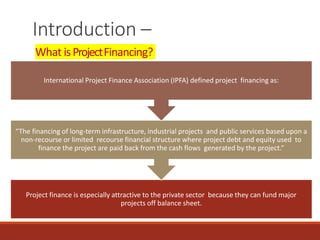
What isProjectFinancing?
Project finance is especially attractive to the private sector because they can fund major
projects off balance sheet.
“The financing of long-term infrastructure, industrial projects and public services based upon a
non-recourse or limited recourse financial structure where project debt and equity used to
finance the project are paid back from the cash flows generated by the project.”
International Project Finance Association (IPFA) defined project financing as:
/
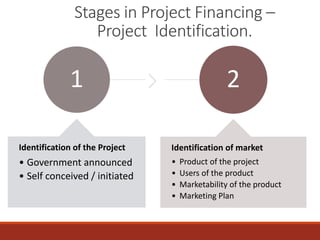
Stages in Project Financing –
Project Identification.
1
Identification of the Project
• Government announced
• Self conceived / initiated
2
Identification of market
• Product of the project
• Users of the product
• Marketability of the product
• Marketing Plan
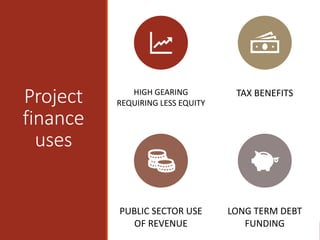
Project
finance
uses
HIGH GEARING
REQUIRING LESS EQUITY
TAX BENEFITS
PUBLIC SECTOR USE
OF REVENUE
LONG TERM DEBT
FUNDING
Introduction –
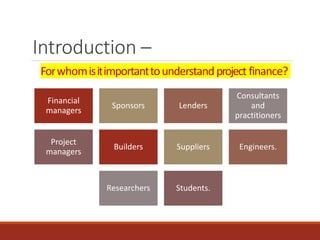
Forwhomisitimportanttounderstandproject finance?
Financial
managers
Sponsors Lenders
Consultants
and
practitioners
Project
managers
Builders Suppliers Engineers.
Researchers Students.
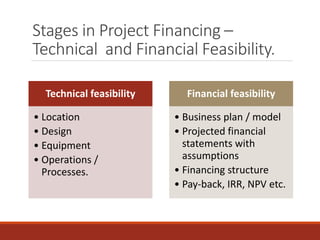
Stages in Project Financing –
Technical and Financial Feasibility.
Technical feasibility
• Location
• Design
• Equipment
• Operations /
Processes.
Financial feasibility
• Business plan / model
• Projected financial
statements with
assumptions
• Financing structure
• Pay-back, IRR, NPV etc.
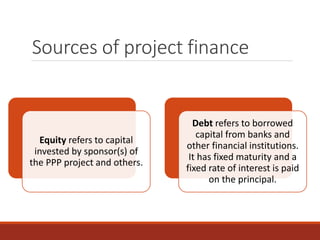
Sources of project finance
Equity refers to capital
invested by sponsor(s) of
the PPP project and others.
Debt refers to borrowed
capital from banks and
other financial institutions.
It has fixed maturity and a
fixed rate of interest is paid
on the principal.
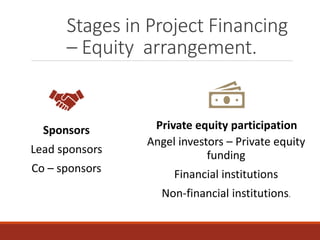
Stages in Project Financing
– Equity arrangement.
Sponsors
Lead sponsors
Co – sponsors
Private equity participation
Angel investors – Private equity
funding
Financial institutions
Non-financial institutions.
Stages in Project Financing –
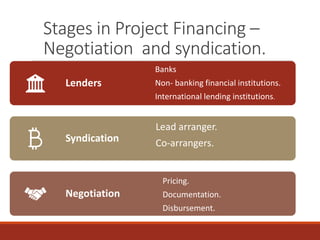
Negotiation and syndication.
Lenders
Banks
Non- banking financial institutions.
International lending institutions.
Syndication
Lead arranger.
Co-arrangers.
Negotiation
Pricing.
Documentation.
Disbursement.
Stages in Project Financing
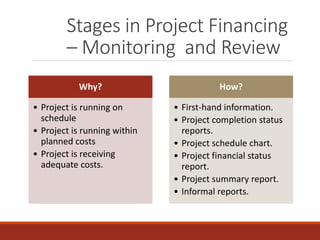
– Monitoring and Review
Why?
• Project is running on
schedule
• Project is running within
planned costs
• Project is receiving
adequate costs.
How?
• First-hand information.
• Project completion status
reports.
• Project schedule chart.
• Project financial status
report.
• Project summary report.
• Informal reports.
Stages in Project Financing –
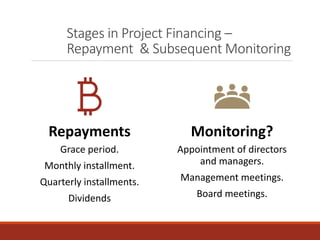
Repayment & Subsequent Monitoring
Repayments
Grace period.
Monthly installment.
Quarterly installments.
Dividends
Monitoring?
Appointment of directors
and managers.
Management meetings.
Board meetings.
Stages in Project Financing
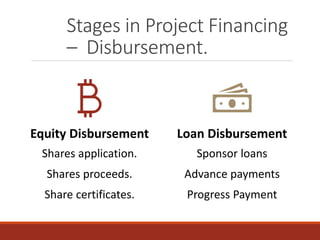
– Disbursement.
Equity Disbursement
Shares application.
Shares proceeds.
Share certificates.
Loan Disbursement
Sponsor loans
Advance payments
Progress Payment
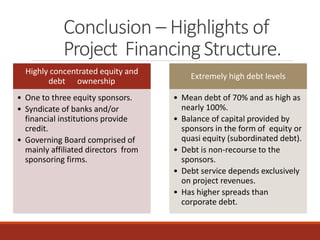
Conclusion – Highlights of
Project FinancingStructure.
Highly concentrated equity and
debt ownership
• One to three equity sponsors.
• Syndicate of banks and/or
financial institutions provide
credit.
• Governing Board comprised of
mainly affiliated directors from
sponsoring firms.
Extremely high debt levels
• Mean debt of 70% and as high as
nearly 100%.
• Balance of capital provided by
sponsors in the form of equity or
quasi equity (subordinated debt).
• Debt is non-recourse to the
sponsors.
• Debt service depends exclusively
on project revenues.
• Has higher spreads than
corporate debt.
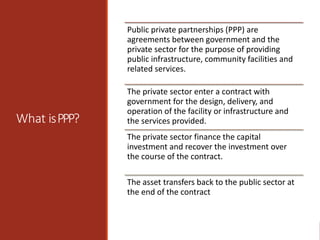
What isPPP?
Public private partnerships (PPP) are
agreements between government and the
private sector for the purpose of providing
public infrastructure, community facilities and
related services.
The private sector enter a contract with
government for the design, delivery, and
operation of the facility or infrastructure and
the services provided.
The private sector finance the capital
investment and recover the investment over
the course of the contract.
The asset transfers back to the public sector at
the end of the contract
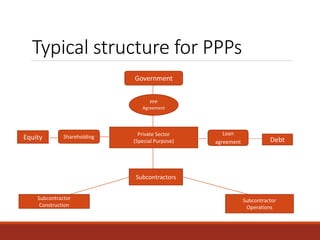
Typical structure for PPPs
Government
PPP
Agreement
Private Sector
(Special Purpose)
Loan
agreement Debt
Subcontractors
Subcontractor
Construction
Subcontractor
Operations
Shareholding
Equity
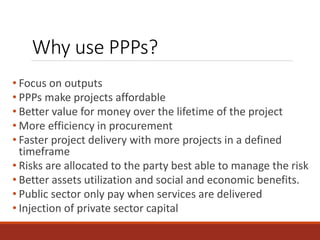
Why use PPPs?
• Focus on outputs
• PPPs make projects affordable
• Better value for money over the lifetime of the project
• More efficiency in procurement
• Faster project delivery with more projects in a defined
timeframe
• Risks are allocated to the party best able to manage the risk
• Better assets utilization and social and economic benefits.
• Public sector only pay when services are delivered
• Injection of private sector capital
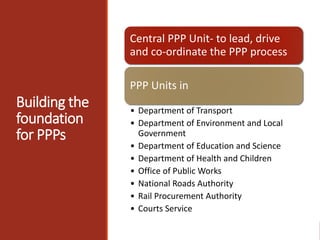
Building the
foundation
for PPPs
Central PPP Unit- to lead, drive
and co-ordinate the PPP process
PPP Units in
• Department of Transport
• Department of Environment and Local
Government
• Department of Education and Science
• Department of Health and Children
• Office of Public Works
• National Roads Authority
• Rail Procurement Authority
• Courts Service
NEED FOR PPP(PUBLIC PRIVATE
PARTNERSHIP)
The highways sector is witnessing significant
interest from both domestic as well as
foreign investors following the policy
initiatives taken by the Government of
Pakistan to promote Public Private
Partnership (PPP) on Design, Build, Finance,
Operate and Transfer (DBFOT) basis.
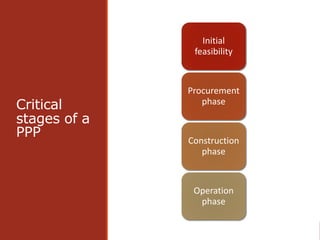
Critical
stages of a
PPP
Initial
feasibility
Procurement
phase
Construction
phase
Operation
phase
SOME OF PPP MODELS ARE
GIVEN BELOW:
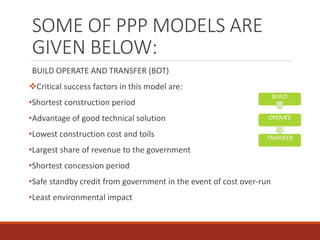
BUILD OPERATE AND TRANSFER (BOT)
Critical success factors in this model are:
•Shortest construction period
•Advantage of good technical solution
•Lowest construction cost and toils
•Largest share of revenue to the government
•Shortest concession period
•Safe standby credit from government in the event of cost over-run
•Least environmental impact
BUILD
OPERATE
TRANSFER
SOME OF PPP
MODELS ARE
GIVEN
BELOW:
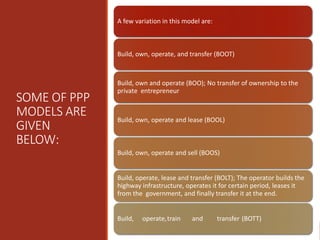
A few variation in this model are:
Build, own, operate, and transfer (BOOT)
Build, own and operate (BOO); No transfer of ownership to the
private entrepreneur
Build, own, operate and lease (BOOL)
Build, own, operate and sell (BOOS)
Build, operate, lease and transfer (BOLT); The operator builds the
highway infrastructure, operates it for certain period, leases it
from the government, and finally transfer it at the end.
Build, operate,train and transfer (BOTT)
/
SOME OF PPP MODELS ARE GIVEN
BELOW:
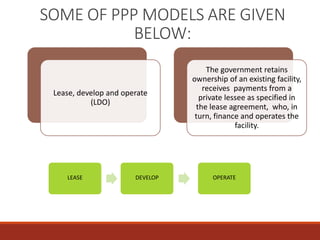
LEASE DEVELOP OPERATE
Lease, develop and operate
(LDO)
The government retains
ownership of an existing facility,
receives payments from a
private lessee as specified in
the lease agreement, who, in
turn, finance and operates the
facility.
SOME OF PPP MODELS ARE
GIVEN BELOW:
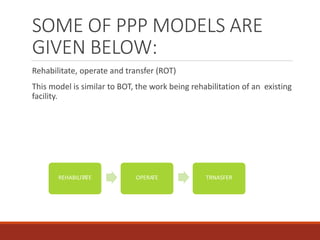
Rehabilitate, operate and transfer (ROT)
This model is similar to BOT, the work being rehabilitation of an existing
facility.
REHABILITATE OPERATE TRNASFER
FACTORS AFFECTING PPP
Risk allocation
As an underlying principle, risks have been allocated to the
parties that are best suited to manage them. Project risks
have, therefore, been assigned to the private sector to the
extent it can manage them.
The commercial and technical risks relating to construction,
operation and maintenance are being allocated to the
Concessionaire, as it is best suited to manage them. The
traffic risk, however, is significantly mitigated as the
Project Highway is a natural monopoly where existing
traffic volumes can be measured with reasonable accuracy.
On the other hand, all direct and indirect political risks are
being assigned to the Authority.
FACTORS
AFFECTING
PPP
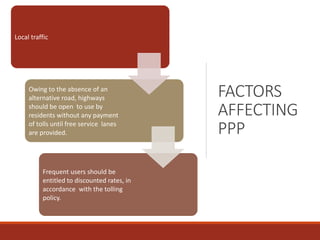
Local traffic
Owing to the absence of an
alternative road, highways
should be open to use by
residents without any payment
of tolls until free service lanes
are provided.
Frequent users should be
entitled to discounted rates, in
accordance with the tolling
policy.
FACTORS
AFFECTING
PPP
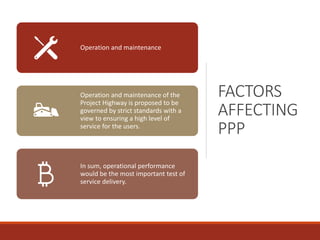
Operation and maintenance
Operation and maintenance of the
Project Highway is proposed to be
governed by strict standards with a
view to ensuring a high level of
service for the users.
In sum, operational performance
would be the most important test of
service delivery.
What makes
a successful
PPP?
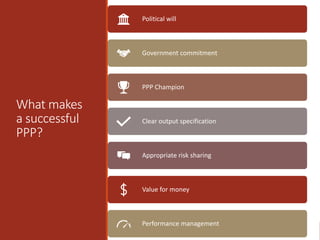
Political will
Government commitment
PPP Champion
Clear output specification
Appropriate risk sharing
Value for money
Performance management
PPPU and
Pakistan
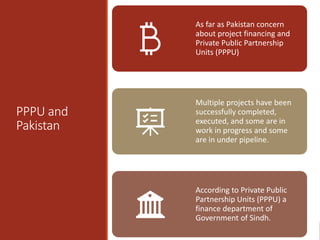
As far as Pakistan concern
about project financing and
Private Public Partnership
Units (PPPU)
Multiple projects have been
successfully completed,
executed, and some are in
work in progress and some
are in under pipeline.
According to Private Public
Partnership Units (PPPU) a
finance department of
Government of Sindh.
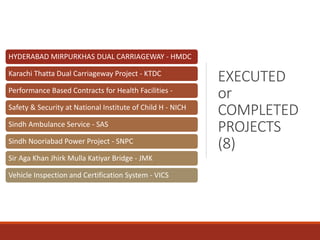
EXECUTED
or
COMPLETED
PROJECTS
(8)
HYDERABAD MIRPURKHAS DUAL CARRIAGEWAY - HMDC
Karachi Thatta Dual Carriageway Project - KTDC
Performance Based Contracts for Health Facilities -
Safety & Security at National Institute of Child H - NICH
Sindh Ambulance Service - SAS
Sindh Nooriabad Power Project - SNPC
Sir Aga Khan Jhirk Mulla Katiyar Bridge - JMK
Vehicle Inspection and Certification System - VICS
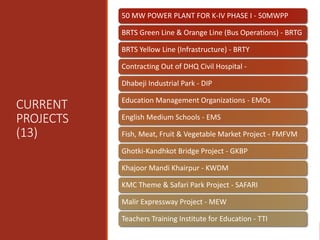
CURRENT
PROJECTS
(13)
50 MW POWER PLANT FOR K-IV PHASE I - 50MWPP
BRTS Green Line & Orange Line (Bus Operations) - BRTG
BRTS Yellow Line (Infrastructure) - BRTY
Contracting Out of DHQ Civil Hospital -
Dhabeji Industrial Park - DIP
Education Management Organizations - EMOs
English Medium Schools - EMS
Fish, Meat, Fruit & Vegetable Market Project - FMFVM
Ghotki-Kandhkot Bridge Project - GKBP
Khajoor Mandi Khairpur - KWDM
KMC Theme & Safari Park Project - SAFARI
Malir Expressway Project - MEW
Teachers Training Institute for Education - TTI
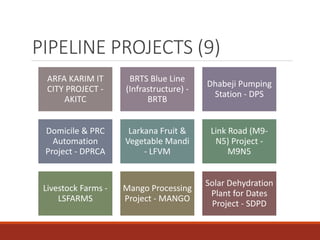
PIPELINE PROJECTS (9)
ARFA KARIM IT
CITY PROJECT -
AKITC
BRTS Blue Line
(Infrastructure) -
BRTB
Dhabeji Pumping
Station - DPS
Domicile & PRC
Automation
Project - DPRCA
Larkana Fruit &
Vegetable Mandi
- LFVM
Link Road (M9-
N5) Project -
M9N5
Livestock Farms -
LSFARMS
Mango Processing
Project - MANGO
Solar Dehydration
Plant for Dates
Project - SDPD
/
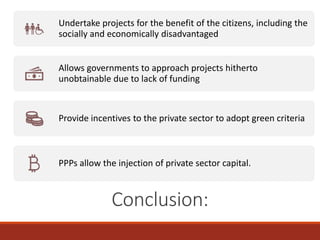
Conclusion:
Undertake projects for the benefit of the citizens, including the
socially and economically disadvantaged
Allows governments to approach projects hitherto
unobtainable due to lack of funding
Provide incentives to the private sector to adopt green criteria
PPPs allow the injection of private sector capital.
Thank
You!

projectfinancingandpublicprivatepartnershipppp-191120191032.pdf

  • 1.
    Project Financing andPublic Private Partnership (PPP) Presented by; 1. SYED AJMAL KAMAL 2. HAFIZ HASSAN QADRI 3. M. ASIM U.K 4. MUHAMMAD NAEEM 5. DANIYAL FAIQ Presented to; SIR OSAMA BASHIR SOMRO
  • 2.
    Introduction – What isProjectFinancing? Projectfinance is especially attractive to the private sector because they can fund major projects off balance sheet. “The financing of long-term infrastructure, industrial projects and public services based upon a non-recourse or limited recourse financial structure where project debt and equity used to finance the project are paid back from the cash flows generated by the project.” International Project Finance Association (IPFA) defined project financing as:
  • 3.
    / Stages in ProjectFinancing – Project Identification. 1 Identification of the Project • Government announced • Self conceived / initiated 2 Identification of market • Product of the project • Users of the product • Marketability of the product • Marketing Plan
  • 4.
    Project finance uses HIGH GEARING REQUIRING LESSEQUITY TAX BENEFITS PUBLIC SECTOR USE OF REVENUE LONG TERM DEBT FUNDING
  • 5.
    Introduction – Forwhomisitimportanttounderstandproject finance? Financial managers SponsorsLenders Consultants and practitioners Project managers Builders Suppliers Engineers. Researchers Students.
  • 6.
    Stages in ProjectFinancing – Technical and Financial Feasibility. Technical feasibility • Location • Design • Equipment • Operations / Processes. Financial feasibility • Business plan / model • Projected financial statements with assumptions • Financing structure • Pay-back, IRR, NPV etc.
  • 7.
    Sources of projectfinance Equity refers to capital invested by sponsor(s) of the PPP project and others. Debt refers to borrowed capital from banks and other financial institutions. It has fixed maturity and a fixed rate of interest is paid on the principal.
  • 8.
    Stages in ProjectFinancing – Equity arrangement. Sponsors Lead sponsors Co – sponsors Private equity participation Angel investors – Private equity funding Financial institutions Non-financial institutions.
  • 9.
    Stages in ProjectFinancing – Negotiation and syndication. Lenders Banks Non- banking financial institutions. International lending institutions. Syndication Lead arranger. Co-arrangers. Negotiation Pricing. Documentation. Disbursement.
  • 10.
    Stages in ProjectFinancing – Monitoring and Review Why? • Project is running on schedule • Project is running within planned costs • Project is receiving adequate costs. How? • First-hand information. • Project completion status reports. • Project schedule chart. • Project financial status report. • Project summary report. • Informal reports.
  • 11.
    Stages in ProjectFinancing – Repayment & Subsequent Monitoring Repayments Grace period. Monthly installment. Quarterly installments. Dividends Monitoring? Appointment of directors and managers. Management meetings. Board meetings.
  • 12.
    Stages in ProjectFinancing – Disbursement. Equity Disbursement Shares application. Shares proceeds. Share certificates. Loan Disbursement Sponsor loans Advance payments Progress Payment
  • 13.
    Conclusion – Highlightsof Project FinancingStructure. Highly concentrated equity and debt ownership • One to three equity sponsors. • Syndicate of banks and/or financial institutions provide credit. • Governing Board comprised of mainly affiliated directors from sponsoring firms. Extremely high debt levels • Mean debt of 70% and as high as nearly 100%. • Balance of capital provided by sponsors in the form of equity or quasi equity (subordinated debt). • Debt is non-recourse to the sponsors. • Debt service depends exclusively on project revenues. • Has higher spreads than corporate debt.
  • 14.
    What isPPP? Public privatepartnerships (PPP) are agreements between government and the private sector for the purpose of providing public infrastructure, community facilities and related services. The private sector enter a contract with government for the design, delivery, and operation of the facility or infrastructure and the services provided. The private sector finance the capital investment and recover the investment over the course of the contract. The asset transfers back to the public sector at the end of the contract
  • 15.
    Typical structure forPPPs Government PPP Agreement Private Sector (Special Purpose) Loan agreement Debt Subcontractors Subcontractor Construction Subcontractor Operations Shareholding Equity
  • 16.
    Why use PPPs? •Focus on outputs • PPPs make projects affordable • Better value for money over the lifetime of the project • More efficiency in procurement • Faster project delivery with more projects in a defined timeframe • Risks are allocated to the party best able to manage the risk • Better assets utilization and social and economic benefits. • Public sector only pay when services are delivered • Injection of private sector capital
  • 17.
    Building the foundation for PPPs CentralPPP Unit- to lead, drive and co-ordinate the PPP process PPP Units in • Department of Transport • Department of Environment and Local Government • Department of Education and Science • Department of Health and Children • Office of Public Works • National Roads Authority • Rail Procurement Authority • Courts Service
  • 18.
    NEED FOR PPP(PUBLICPRIVATE PARTNERSHIP) The highways sector is witnessing significant interest from both domestic as well as foreign investors following the policy initiatives taken by the Government of Pakistan to promote Public Private Partnership (PPP) on Design, Build, Finance, Operate and Transfer (DBFOT) basis.
  • 19.
  • 20.
    SOME OF PPPMODELS ARE GIVEN BELOW: BUILD OPERATE AND TRANSFER (BOT) Critical success factors in this model are: •Shortest construction period •Advantage of good technical solution •Lowest construction cost and toils •Largest share of revenue to the government •Shortest concession period •Safe standby credit from government in the event of cost over-run •Least environmental impact BUILD OPERATE TRANSFER
  • 21.
    SOME OF PPP MODELSARE GIVEN BELOW: A few variation in this model are: Build, own, operate, and transfer (BOOT) Build, own and operate (BOO); No transfer of ownership to the private entrepreneur Build, own, operate and lease (BOOL) Build, own, operate and sell (BOOS) Build, operate, lease and transfer (BOLT); The operator builds the highway infrastructure, operates it for certain period, leases it from the government, and finally transfer it at the end. Build, operate,train and transfer (BOTT)
  • 22.
    / SOME OF PPPMODELS ARE GIVEN BELOW: LEASE DEVELOP OPERATE Lease, develop and operate (LDO) The government retains ownership of an existing facility, receives payments from a private lessee as specified in the lease agreement, who, in turn, finance and operates the facility.
  • 23.
    SOME OF PPPMODELS ARE GIVEN BELOW: Rehabilitate, operate and transfer (ROT) This model is similar to BOT, the work being rehabilitation of an existing facility. REHABILITATE OPERATE TRNASFER
  • 24.
    FACTORS AFFECTING PPP Riskallocation As an underlying principle, risks have been allocated to the parties that are best suited to manage them. Project risks have, therefore, been assigned to the private sector to the extent it can manage them. The commercial and technical risks relating to construction, operation and maintenance are being allocated to the Concessionaire, as it is best suited to manage them. The traffic risk, however, is significantly mitigated as the Project Highway is a natural monopoly where existing traffic volumes can be measured with reasonable accuracy. On the other hand, all direct and indirect political risks are being assigned to the Authority.
  • 25.
    FACTORS AFFECTING PPP Local traffic Owing tothe absence of an alternative road, highways should be open to use by residents without any payment of tolls until free service lanes are provided. Frequent users should be entitled to discounted rates, in accordance with the tolling policy.
  • 26.
    FACTORS AFFECTING PPP Operation and maintenance Operationand maintenance of the Project Highway is proposed to be governed by strict standards with a view to ensuring a high level of service for the users. In sum, operational performance would be the most important test of service delivery.
  • 27.
    What makes a successful PPP? Politicalwill Government commitment PPP Champion Clear output specification Appropriate risk sharing Value for money Performance management
  • 28.
    PPPU and Pakistan As faras Pakistan concern about project financing and Private Public Partnership Units (PPPU) Multiple projects have been successfully completed, executed, and some are in work in progress and some are in under pipeline. According to Private Public Partnership Units (PPPU) a finance department of Government of Sindh.
  • 29.
    EXECUTED or COMPLETED PROJECTS (8) HYDERABAD MIRPURKHAS DUALCARRIAGEWAY - HMDC Karachi Thatta Dual Carriageway Project - KTDC Performance Based Contracts for Health Facilities - Safety & Security at National Institute of Child H - NICH Sindh Ambulance Service - SAS Sindh Nooriabad Power Project - SNPC Sir Aga Khan Jhirk Mulla Katiyar Bridge - JMK Vehicle Inspection and Certification System - VICS
  • 30.
    CURRENT PROJECTS (13) 50 MW POWERPLANT FOR K-IV PHASE I - 50MWPP BRTS Green Line & Orange Line (Bus Operations) - BRTG BRTS Yellow Line (Infrastructure) - BRTY Contracting Out of DHQ Civil Hospital - Dhabeji Industrial Park - DIP Education Management Organizations - EMOs English Medium Schools - EMS Fish, Meat, Fruit & Vegetable Market Project - FMFVM Ghotki-Kandhkot Bridge Project - GKBP Khajoor Mandi Khairpur - KWDM KMC Theme & Safari Park Project - SAFARI Malir Expressway Project - MEW Teachers Training Institute for Education - TTI
  • 31.
    PIPELINE PROJECTS (9) ARFAKARIM IT CITY PROJECT - AKITC BRTS Blue Line (Infrastructure) - BRTB Dhabeji Pumping Station - DPS Domicile & PRC Automation Project - DPRCA Larkana Fruit & Vegetable Mandi - LFVM Link Road (M9- N5) Project - M9N5 Livestock Farms - LSFARMS Mango Processing Project - MANGO Solar Dehydration Plant for Dates Project - SDPD
  • 32.
    / Conclusion: Undertake projects forthe benefit of the citizens, including the socially and economically disadvantaged Allows governments to approach projects hitherto unobtainable due to lack of funding Provide incentives to the private sector to adopt green criteria PPPs allow the injection of private sector capital.
  • 33.